Finished viewing? Save it for later —
Download CBSE Class 12 Question Paper 2025 Solution Yoga (PDF · 7 pages)About CBSE Class 12 Question Paper 2025 Solution Yoga
CBSE Class 12 Question Paper 2025 Solution Yoga is available here for free download. Published by CBSE for Class 12, this solution can be viewed online or downloaded as a PDF (7 pages). Candidates preparing for Class 12 can use CBSE Class 12 Question Paper 2025 Solution Yoga to understand the exam pattern, the type of questions asked, and the overall difficulty level.
Frequently Asked Questions
How can I download CBSE Class 12 Question Paper 2025 Solution Yoga?
Open this page and click the Download button to save CBSE Class 12 Question Paper 2025 Solution Yoga as a PDF. It is completely free on AglaSem Docs.
Is CBSE Class 12 Question Paper 2025 Solution Yoga free to download?
Yes. CBSE Class 12 Question Paper 2025 Solution Yoga can be viewed online and downloaded as a PDF free of cost on AglaSem Docs.
How many pages does CBSE Class 12 Question Paper 2025 Solution Yoga have?
CBSE Class 12 Question Paper 2025 Solution Yoga contains 7 pages, which you can read online or download together as a single PDF.
Where can I find more Class 12 study material?
You can find more Class 12 question papers, sample papers, syllabus, and answer keys on AglaSem Docs.
CBSE Class 12 Question Paper 2025 Solution Yoga – Text
Read the full text of this solution below — useful to quickly search, copy and reference the content online without downloading the PDF.
📄 View text version (7 pages)
Page 1
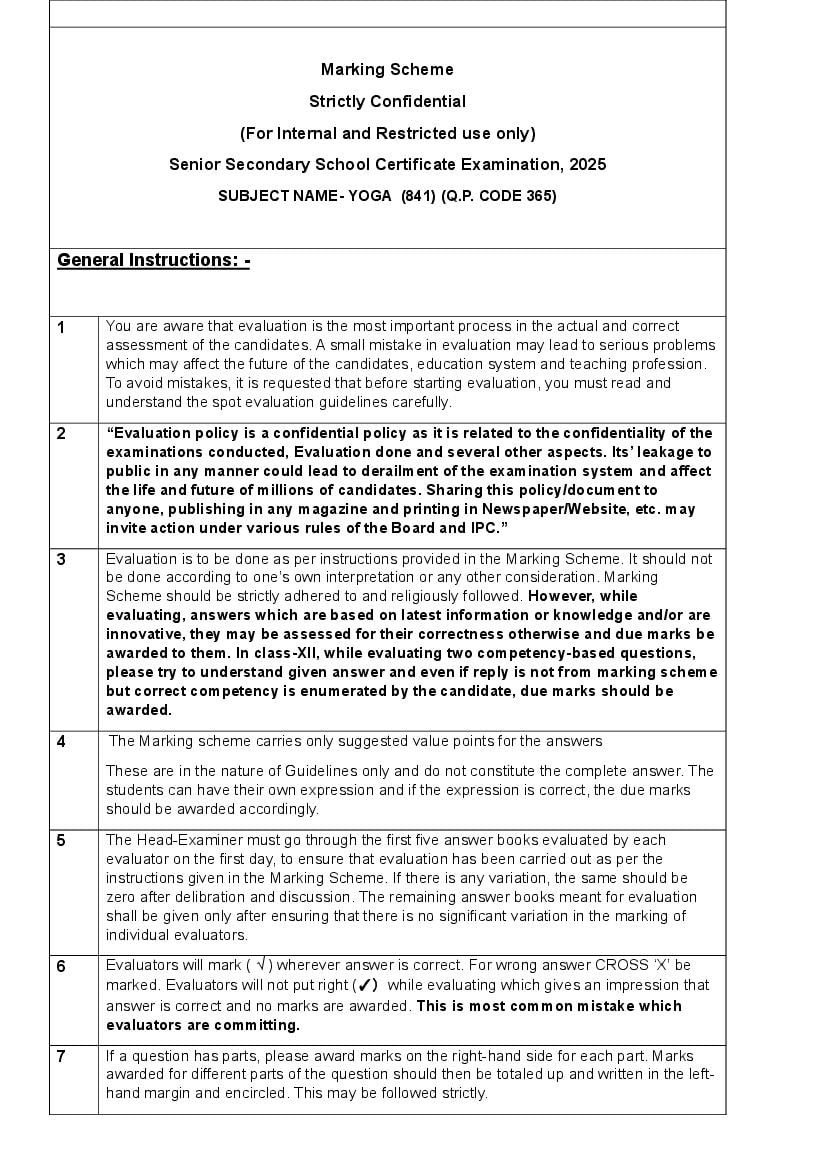
Strictly Confidential
(For Internal and Restricted use only)
Senior Secondary School Certificate Examination, 2025
SUBJECT NAME- YOGA (841) (Q.P. CODE 365)
General Instructions: -
1 You are aware that evaluation is the most important process in the actual and correct
assessment of the candidates. A small mistake in evaluation may lead to serious problems
which may affect the future of the candidates, education system and teaching profession.
To avoid mistakes, it is requested that before starting evaluation, you must read and
understand the spot evaluation guidelines carefully.
2 “Evaluation policy is a confidential policy as it is related to the confidentiality of the
examinations conducted, Evaluation done and several other aspects. Its’ leakage to
public in any manner could lead to derailment of the examination system and affect
the life and future of millions of candidates. Sharing this policy/document to
anyone, publishing in any magazine and printing in Newspaper/Website, etc. may
invite action under various rules of the Board and IPC.”
3 Evaluation is to be done as per instructions provided in the Marking Scheme. It should not
be done according to one’s own interpretation or any other consideration. Marking
Scheme should be strictly adhered to and religiously followed. However, while
evaluating, answers which are based on latest information or knowledge and/or are
innovative, they may be assessed for their correctness otherwise and due marks be
awarded to them. In class-XII, while evaluating two competency-based questions,
please try to understand given answer and even if reply is not from marking scheme
but correct competency is enumerated by the candidate, due marks should be
awarded.
4 The Marking scheme carries only suggested value points for the answers
These are in the nature of Guidelines only and do not constitute the complete answer. The
students can have their own expression and if the expression is correct, the due marks
should be awarded accordingly.
5 The Head-Examiner must go through the first five answer books evaluated by each
evaluator on the first day, to ensure that evaluation has been carried out as per the
instructions given in the Marking Scheme. If there is any variation, the same should be
zero after delibration and discussion. The remaining answer books meant for evaluation
shall be given only after ensuring that there is no significant variation in the marking of
individual evaluators.
6 Evaluators will mark ( √ ) wherever answer is correct. For wrong answer CROSS ‘X’ be
marked. Evaluators will not put right (✓) while evaluating which gives an impression that
answer is correct and no marks are awarded. This is most common mistake which
evaluators are committing.
7 If a question has parts, please award marks on the right-hand side for each part. Marks
awarded for different parts of the question should then be totaled up and written in the left-
hand margin and encircled. This may be followed strictly.
Page 2
encircled. This may also be followed strictly.
9 If a student has attempted an extra question, answer of the question deserving more
marks should be retained and the other answer scored out with a note “Extra Question”.
10 No marks to be deducted for the cumulative effect of an error. It should be penalized only
once.
11 A full scale of marks 50 (example 0 to 80/70/60/50/40/30 marks as given in Question
Paper) has to be used. Please do not hesitate to award full marks if the answer deserves
it.
12 Every examiner has to necessarily do evaluation work for full working hours i.e., 8 hours
every day and evaluate 20 answer books per day in main subjects and 25 answer books
per day in other subjects (Details are given in Spot Guidelines) This is in view of the
reduced syllabus and number of questions in question paper.
13 Ensure that you do not make the following common types of errors committed by the
Examiner in the past: -
● Leaving answer or part thereof unassessed in an answer book.
● Giving more marks for an answer than assigned to it.
● Wrong totaling of marks awarded on an answer.
● Wrong transfer of marks from the inside pages of the answer book to the title page.
● Wrong question wise totaling on the title page.
● Wrong totaling of marks of the two columns on the title page.
● Wrong grand total.
● Marks in words and figures not tallying/not same.
● Wrong transfer of marks from the answer book to online award list.
● Answers marked as correct, but marks not awarded. (Ensure that the right tick mark is
correctly and clearly indicated. It should merely be a line. Same is with the X for
incorrect answer.)
● Half or a part of answer marked correct and the rest as wrong, but no marks awarded.
14 While evaluating the answer books if the answer is found to be totally incorrect, it should
be marked as cross (X) and awarded zero (0) Marks.
15 Any unassessed portion, non-carrying over of marks to the title page, or totalling error
detected by the candidate shall damage the prestige of all the personnel engaged in the
evaluation work as also of the Board. Hence, in order to uphold the prestige of all
concerned, it is again reiterated that the instructions be followed meticulously and
judiciously.
16 The Examiners should acquaint themselves with the guidelines given in the “Guidelines
for Spot Evaluation” before starting the actual evaluation.
17 Every Examiner shall also ensure that all the answers are evaluated, marks carried over to
the title page, correctly totaled and written in figures and words.
18 The candidates are entitled to obtain photocopy of the Answer Book on request on
payment of the prescribed processing fee. All Examiners/Additional Head Examiners/Head
Examiners are once again reminded that they must ensure that evaluation is carried out
strictly as per value points for each answer as given in the Marking Scheme.
Page 3
Senior Secondary School Certificate Examination, 2025
SUBJECT NAME -YOGA (841)
(Q.P. CODE 365)
SECTION- A
(OBJECTIVE TYPE QUESTIONS)
1. Answer any 4 questions out of given 6 questions on Employability Skills: (4×1=4)
(i) (C)10 August, 2018 1
(ii) (A) Entrepreneur 1
(iii) (D) Extrinsic Motivation 1
(iv) (C) Specific 1
(v) (D) Please allow me to reach office at 11 AM on Tuesday, 11 June 2019, as I have an
appointment with a dentist. 1
(vi) (B) Select all rows and columns to be sorted, click on Data, select Sort, click on Sort
Key 1 and select total from the drop-down. 1
2. Answer any 5 questions out of given 6 questions: (5×1=5)
(i) (C) Dhauti 1
(ii) (D) Vrikshasana 1
(iii) (B) Bronchial Asthma 1
(iv) (A) Vijnanamaya kosha/ (B) Aanandmaya Kosha 1
(v) All options are correct 1
(vi) (B) Cognitive Development 1
3. Answer any 5 questions out of given 6 questions: (5×1=5)
(i) (C) Basti 1
(ii) (B) 45 minutes; 15 to 20 minutes 1
(iii) (B) Hath Yoga 1
(iv) (A) Motivates and focusses energy 1
(v) (D) Pratyahara 1
(vi) (D) Calm mind and remove distraction 1
4. Answer any 5 questions out of given 6 questions: (5×1=5)
(i) (A) Provide energy and heat 1
(ii) All options are correct 1
(iii) (B) Spiritual Health 1
(iv) (A) Tapas 1
(v) (D) Behavior and Communication 1
(vi) (C) Tamasic diet 1
5. Answer any 5 questions out of given 6 questions: (5×1=5)
(i) (D) Makarasana 1
(ii) (B) Arjun and Shri Krishna 1
(iii) (C) Anger outburst and social withdrawal 1
(iv) (B) Cittavriti Nirodha 1
(v) (C) Automated External defibrillator 1
(vi) (D) Push straight down 5 cm @ 100 compressions per minute 1
Page 4
SUBJECTIVE TYPE QUESTIONS
Answer any 3 out of the given 5 questions in 20 – 30 words each (2 x 3 = 6 marks).
6. Following are the steps to apply filters to a table. 2
I. Click on ‘Auto filter’
II. Click on the filter for class column
III. Drop down will show the list of all values
IV. By default all values are checked
V. If you want to check data of XII A then uncheck class XII B
VI. Click on ‘OK’
VII. Data of XII A will be displayed
7. Following are the stages of active listening: 2
I. Receiving
II. Understanding
III. Remembering
IV. Evaluating
V. Responding
8. Startup is often financed by the founders, until the business gets of the
grounds. (any 4 points): (1/2x4=2)
I. Can be started with minimum investment.
II. Seek financial investments differently. They rely on capital that comes is a angel
investors or venture capital firms. A lot of Indian startups, too, have received
funding from global investors.
III. Comes up with innovative ideas. But need continual supports of expert mentors
and investors. Start up a flagship initiative of the Government of India, is
intended to build an ecosystem for the growth of startup business.
IV. New startups in India can avail regulatory and tax benefits, capital gain
exemption as well as government funding.
9. (any 4) (1/2x4=2)
I. Set clear goals
II. Prepare an action plan
III. Use the right resources and tools
IV. Communicate with mentors and peers
V. Make a colander
VI. Work hard
10. Few ways to reduce the amount of waste generation. (any 4) (1/2x4=2)
I. Reusing scrap material
II. Ensuring quality control
III. Waste exchange
IV. Managing e-waste
V. Use of ecofriendly material
Answer any 4 out of the given 6 questions in 20 – 30 words each. (2 x 4 = 8 marks)
11. Career opportunities in Yoga 2
Yoga Instructor, Corporate Yoga Entrepreneur, Yoga Therapist, Yoga Teacher,
Resource Officer, Naturopathy doctor ....
Page 5
Spiritual Meditation Mantra Meditation
1. This meditation for those who 1. Mantras are words that are chanted loudly
regularly participate in prayers. It’s during meditation.
based on communicating with 2. This loud sound helps to focus on the object /
God. God.
2. One must be calm and quiet begin 3. In yoga on mantra chanting delivers a deep
to focus on a question or problem. vibration that makes it easy for the mind to
3. This meditation is not only relaxing concentrate on that particular sound.
but rewarding as well.
13. Effect of stress on Respiratory and Cardiovascular system: - (any 4) (1/2x4=2)
i. Stress hormones affect the respiratory and cardiovascular systems.
ii. During stress, breathing becomes faster in an effort to quickly distribute oxygen-rich blood to our
body.
iii. If someone suffering from a breathing problem like asthma, stress can make it even harder to
breathe.
iv. Due to stress, the heart pumps faster.
v. Stress hormones can cause the blood vessels to constrict and divert more oxygen to your muscles
so that one has more strength to take action.
vi. It also raises blood pressure. So does the risk of having a stroke or heart attack.
14. Asanas to manage Arthritis: (1/2x4=2)
Tadasana, Urdhwa hastottanasa, Pawanmuktasana etc.
Pranayamas to manage Arthritis (any 2)
Nadishodan, Suryabhedana, Ujjayi, Bhramari
15. Order of CPR Intervention 2
i. Put the Ramesh on his back on a firm surface.
ii. Start performing chest compressions. Press straight down on the chest about 2 inches
(approximately 5 cm). Push hard at a rate of 100 to 120 compressions a minute if the teacher
is untrained.
iii. Open the airways, put palm on the forehead and gently tilt the head back.
iv. Performed 30 chest compressions followed by 2 rescue breath, if the teacher is trained.
v. Continue CPR until the Ramesh moves or emergency medical help arrives.
16. Causes of Low Back Pain: (any 2) 2
i. As the age advances, bone strength and muscle elasticity, decreases. The discs begin
to lose fluid and flexibility which decreases the movement of the vertebrae.
ii. lifting heavy weight or over stretching the muscles or ligaments in the back.
iii. Nerve roots become compressed or irritated, results back pain.
Page 6
v. Osteoporosis, viral infections, congenital abnormalities obesity, poor posture, lack of
physical activity.
Answer any 3 out of the given 5 questions in 80-100 words each (4 x 3 = 12 marks)
17 Before doing pranayama, one must follow the essentials steps which are stated below: 4
I. External environment: - Any place that is well- ventilated and free from noise, insects
and flies should be preferred to practice pranayama.
II. Right season to begin the practice of Pranayama: - One should start to practice
Pranayama in spring season i.e., March-April and autumn season i.e., Sept- Oct.
One who is already in practice should continue its practice.
III. Right time: - Morning is the best suited time to practice Pranayama.
IV. Seat or Asana: - The seat should be soft, thick and comfortable.
V. Asana: - Asanas such as Padamasana, Siddhasana, Vajrasana and Sukhasana are
considered the most suitable postures for the practice of pranayama
Effects of Mitahara : (Yogic Diet) 4
18.
I. Cleanses body and helps to get rid of harmful toxins.
II. Obtain a body without ailments and diseases.
III. Keeps genuinely fit, intellectually graceful.
IV. It adjusts the body, mind and soul, bringing energy in life of a person.
V. It’s the ideal way to lose fat.
VI. Helps to strengthen body’s immunity.
VII. Yogic diet is easy to digest, results in proper bowl movement and clean skin.
19 Concept of mental health well-being according to Patanjali yoga (2+2=4)
Mental health is defined as state of psychological and emotional well-being in which an
individual is able to use learning abilities, function constructively and fruit fully in the society
and can meet us in the ordinary demands of everyday life.
Effects on Cittavikshepa :
I. Pain (Dukha)
II. Depression (Daurmanasya)
III. Trembling of the body (Angamejayatva)
IV. Irregular breathing (Shvaspar Shvas) are the major symptoms of mental
distraction (Citta Vikshepa)
20 The role of yoga in the management of hypertension is well documented. Aim of treatment
of hypertension should be to lower the blood pressure and to prevent further
complications. In general, the practices prescribed for the hypertension cases are:(1+3=4)
I. Prayer- For calmness
II. Kriyas: Jalneti, Sutraneti Surya-namaskara and selected practices of Yoga.
III. Sukshma Vyayama (Surya-namaskara may be avoided in severe cases)
IV. Asanas: Tadasana, Katichakrasana, Konasana, Uttanapadasana, Ardhhalasana,
Pavanamuktasana, Vajrasana, Ushtrasana, Bhujangasana, Dhanurasana,
Gomukhasana, Vakrasana, Uttanamandukasana, Shavasana.
V. Pranayama: - Nadishuddi, Ujjayi and Bhramari.
Page 7
VII. Diet: - Sattvic diet should be followed.
Q.21 Yoga is considered as an effective tool for development of personality of children. Yoga acts
on all five koshas (sheaths) surrounding the self. 4
1. Asanas are the tools which mainly influence Annamaya kosha by bringing flexibility,
relaxation, toning, strength, balance and general fitness.
2. Various researches have revealed that at the Pranamaya kosha or the subtle energy
level, pranayama restores harmony to the flow of prana (vital force) by removing blocks and
imbalances.
3. Manomaya kosha works at two levels, the level of mind and the level of emotion. At the
Mental level, dharna, dhyana and smadhi facilitate channelization of thoughts and then
focus on a single thought leading to the state of super consciousness. At the Emotional
level, Bhakti Yoga is good for culturing emotion. It gives emotion the right direction for
growth. By devotional practices, negative, harsh and violent emotions can be replaced with
the positive, soft and gentle emotions. Thus, Dhyan and Bhakti Yoga facilitate the mental
and emotional development of the children. Dhyana and Jnana Yoga are helpful to reach
the level of higher buddhi.
4.Good intellect, intuition, wisdom, higher knowledge and psychic abilities shine out from
the innermost sheath (Vijnaymaya kosha/Anandmaya kosha). Love, compassion, joy,
accomplishment and mutually fulfilling relationships get evolved from the crude level to a
more refined level.
5. With the practice of Ashtanga Yog child can develop overall personality (physical, mental,
emotional, social and spiritual).
Document Details
| Board / Org | CBSE |
| Exam | Class 12 |
| Type | Solution |
| Pages | 7 |
| Updated | 24 Sep 2026 |