TIFR GS 2012 Question Paper Chemistry X
Finished viewing? Save it for later —
Download TIFR GS 2012 Question Paper Chemistry X (PDF · 19 pages)About TIFR GS 2012 Question Paper Chemistry X
TIFR GS 2012 Question Paper Chemistry X is available here for free download. Published by Default for TIFR GS, this question paper can be viewed online or downloaded as a PDF (19 pages). Candidates preparing for TIFR GS can use TIFR GS 2012 Question Paper Chemistry X to understand the exam pattern, the type of questions asked, and the overall difficulty level.
Frequently Asked Questions
How can I download TIFR GS 2012 Question Paper Chemistry X?
Open this page and click the Download button to save TIFR GS 2012 Question Paper Chemistry X as a PDF. It is completely free on AglaSem Docs.
Is TIFR GS 2012 Question Paper Chemistry X free to download?
Yes. TIFR GS 2012 Question Paper Chemistry X can be viewed online and downloaded as a PDF free of cost on AglaSem Docs.
How many pages does TIFR GS 2012 Question Paper Chemistry X have?
TIFR GS 2012 Question Paper Chemistry X contains 19 pages, which you can read online or download together as a single PDF.
Where can I find more TIFR GS study material?
You can find more TIFR GS question papers, sample papers, syllabus, and answer keys on AglaSem Docs.
TIFR GS 2012 Question Paper Chemistry X – Text
Read the full text of this question paper below — useful to quickly search, copy and reference the content online without downloading the PDF.
📄 View text version (19 pages)
Page 1
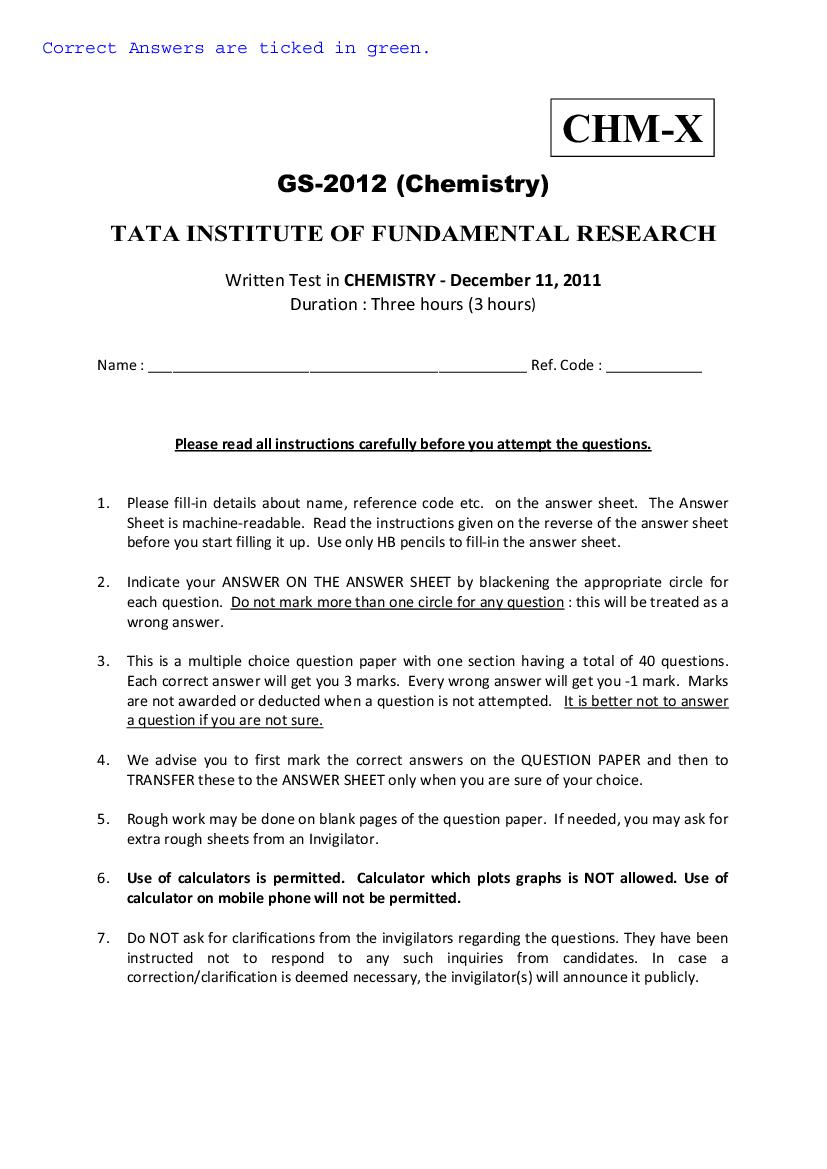
CHM-X
GS-2012 (Chemistry)
TATA INSTITUTE OF FUNDAMENTAL RESEARCH
Written Test in CHEMISTRY - December 11, 2011
Duration : Three hours (3 hours)
Name : _______________________________________________ Ref. Code : ____________
Please read all instructions carefully before you attempt the questions.
1. Please fill-in details about name, reference code etc. on the answer sheet. The Answer
Sheet is machine-readable. Read the instructions given on the reverse of the answer sheet
before you start filling it up. Use only HB pencils to fill-in the answer sheet.
2. Indicate your ANSWER ON THE ANSWER SHEET by blackening the appropriate circle for
each question. Do not mark more than one circle for any question : this will be treated as a
wrong answer.
3. This is a multiple choice question paper with one section having a total of 40 questions.
Each correct answer will get you 3 marks. Every wrong answer will get you -1 mark. Marks
are not awarded or deducted when a question is not attempted. It is better not to answer
a question if you are not sure.
4. We advise you to first mark the correct answers on the QUESTION PAPER and then to
TRANSFER these to the ANSWER SHEET only when you are sure of your choice.
5. Rough work may be done on blank pages of the question paper. If needed, you may ask for
extra rough sheets from an Invigilator.
6. Use of calculators is permitted. Calculator which plots graphs is NOT allowed. Use of
calculator on mobile phone will not be permitted.
7. Do NOT ask for clarifications from the invigilators regarding the questions. They have been
instructed not to respond to any such inquiries from candidates. In case a
correction/clarification is deemed necessary, the invigilator(s) will announce it publicly.
Page 2
Avogadro number = 6.02×10²³ mol-1 e = 1.6×10⁻¹⁹ C
RT/F = 0.0257 V at 25°C h = 6.626×10⁻³⁴ J⋅s
Faraday = 96500 C/eq. wt. c = 3×10⁸ m s−1
Boltzmann constant k = 1.38×10⁻²³ J K−1 R = 8.314 J K-1 mol-1
Z2
En = − a.u. for hydrogen like atom
2n 2
Mass of an electron = 9.109×10⁻³¹ kg
8kT
Average velocity =
π ⋅m
1. A quantum mechanical state Q is a superposition of two normalized energy
eigenstates A and B in an amplitude ratio 2:1. If the two states are degenerate with
a common eigenvalue E, what is the energy of the state Q?
A) 0,
B) 3E
C) 5E
D) E
2. For the above, if the states were non-degenerate and with energy eigenvalues E
and −E respectively, then what would be the expectation value of the energy?
A) 3E
B) 5E
C) E
D) None of the above
3. Suppose we inscribe a circle inside an equilateral triangle, and then inscribe a
square inside this circle. What is the ratio of the side of the square to the side of
the triangle?
A) 1: ¥3
B) 2:5
C) 1: ¥6
D) 1:2
Page 1 of 16
Page 3
constant Keq = [P]/[S] is 2 x 10³. The forward rate constant was found to be 5 x
104 sec-1 and 4 x 10⁻⁶ sec-1 in the presence and in the absence of the catalyst
respectively. What is the expected rate constant for the reverse reaction in the
absence of the catalyst?
A) 5 x 10⁸ sec-1
B) 2 x 10⁻⁹ sec-1
C) 0.8 x 10⁻¹⁰ sec-1
D) 5 x 10⁻⁹ sec-1
5. The molar extinction coefficient (at 550 nm) of compounds A and B are 1x10⁴ M-1
cm-1 and 1 x 10⁵ M-1 cm-1 respectively. Solutions of A and B are made at
concentrations of 1 x 10⁻⁴ M and 2 x 10⁻⁵ M respectively. In a spectrophotometer
set at 550 nm, the percentage of light transmitted by solutions A and B (in two
separate experiments) will be:
A) the same
B) B will transmit 10 times less light compared to A
C) B will transmit 5 times less light compared to A
D) B will transmit 2 times less light compared to A.
6. What are the configurations (R or S) of the chiral centers in the following
molecules:
H OH NH2
HOOC NH2
SH
H OH
1 2 3
A) Compound 1 = R; Compound 2 = R; Compound 3 = 1S, 2S
B) Compound 1 = R; Compound 2 = S; Compound 3= 1R, 2S
C) Compound 1 = S; Compound 2 = S; Compound 3 = 1S, 2R
D) Compound 1 = R; Compound 2 = S; Compound 3 = 1S, 2R
Page 2 of 16
Page 4
1. PdCl2
2. Pd(PPh3)4
3. Pd(OAc)2
4. ArPdBr where Ar is Aryl
A) 2, 4, 2, 2
B) 2, 0, 2, 1
C) 2, 0, 2, 2
D) 0, 0, 0, 2
8. Methanesulfonyl chloride is used commonly to form methanesulfonates upon
reaction with alcohols. Methanesulfonates are good leaving groups in nucleophilic
substitution reaction. In the following reaction calculate the volumes of
methanesulfonyl chloride and triethylamine required in ȝL. The amount of starting
material and the number of equivalents of each reagent is given.
O S O O S O
HO OH O O
N N
O
N Ethyl Acetate
+ S Cl +
O
solid liquid liquid
Amount (mg) 100
equivalents 1 2 3
Density (g/mL) 1.48 0.73
μL D E
A) D = 126, E = 167
B) D = 0.085, E = 0.229
C) D = 85, E = 229
D) D = 1.1, E = 1.65
Page 3 of 16
Page 5
first reported by Late Sir CV Raman in 1928. The intensity of the individual
vibrational resonances observed in a Raman spectrum is proportional to
A) Number of molecules
B) Polarizibility of the bond
C) Wavelength of radiation used
D) All of the above
10. The Wittig reaction is a reaction with an aldehyde or ketone with a phosphonium
ylide. Predict the product of the following reaction:
O
PPh3 + H
A)
B)
C)
D)
Page 4 of 16
Page 6
2 H2O Æ O2 + 4H+ + 4e-
The redox potential of the same reaction at pH = 7 would be:
A) -0.41 V
B) -1 V
C) -0.82 V
D) -1.64 V
12. Amino acid side-chains in proteins have hydrogen bonds for structural and
catalytic reasons. One such combination of H-bonding partners is Histidine
associated with a partnering residue such as Tyrosine (X-H…N-His, where X is the
partnering amino acid). If the pKa of Histidine is 6.1, estimate the pKa of the
partnering residue (X-H) such that protonation of His at pH 6.5 is a favourable
process.
A) pKa >10
B) pKa <1
C) pKa < 6
D) pKa > 6.5
13. The total energy expended to charge (total charge = +q) a sphere of radius ‘r’ in a
dielectric medium (İ) is given by (in SI units):
A) q2/4πİr
B) q2/16πİr
C) q2/ 4πİr2
D) q2/8πİr
Page 5 of 16
Page 7
concentration is 1mM, and concentrations at later times are as shown:
Time (min) [A] (mM)
____________________
1 0.83
2 0.72
4 0.56
8 0.38
16 0.24
What is the order of the reaction?
A) zero
B) first-order
C) second-order
D) pseudo-first order
15. ΔG0 values for the hydrolysis of glucose-1-phosphate and glucose-6-phosphate are
−21 kJ/mol and –14 kJ/mol, respectively. What is the equilibrium constant for the
following equilibrium at 250C?
Glucose-1-phosphate ֎ Glucose-6-phosphate
A) 0.06
B) 16.9
C) 4798
D) 284
16. In a double stranded DNA, if the sequence 5’AGATCC3’ appears on one strand of
DNA, what sequence in the complementary strand?
A) 5’AGATCC3’
B) 5’CCTAGA3’
C) 5’GGATCT3’
D) 5’TCTAGG3’
Page 6 of 16
Page 8
hydrolysis of one mole of a fragment with this sequence gives 2 mol alanine, 3
mol glycine, and 1 mol serine. Partial hydrolysis yields Ala-Gly-Ala, Gly-Ala-
Gly, Gly-Ser-Gly, and Ser-Gly-Ala peptides. What is the amino acid repeat?
A) Gly-Gly-Ser-Ala-Gly-Ala
B) Gly-Gly-Gly-Ala-Ala-Ser
C) Ser-Ala-Ala-Gly-Gly-Gly
D) Gly-Ser-Gly-Ala-Gly-Ala
18. Which of the following compounds would give the 1H NMR spectrum shown
below
A) CH3CH(CH3)CH2X
B) CH3C(CH3)2CH2CH2X
C) CH3CH2(CH3)CH2X
D) CH3CH2CH(CH3)X
Page 7 of 16
Page 9
between pH 6.5 and 8.5?
O O
O O
R N R C O N R C I
RS S N
O O
R1 R2 R3 R4
A) R1, R2 and R3
B) R2, R3 and R4
C) R4, R2 and R1
D) R1, R3 and R4
20. In a spherical polar coordinate system, a point A at (x, y, z) in the Cartesian
coordinate system can be described by (r, θ, φ) where r, θ, and φ have their usual
meaning. Expression for the volume of an infinitesimally small cube confined by
dx, dy, and dz in terms of the spherical coordinate system is given by
A) drdθdφ
B) rsinθdrdθdφ
C) r2sin2θdrdθdφ
D) r2sinθdrdθdφ
21. Rotational energy of a diatomic molecule is given by Erot = J(J + 1)hBe, where Erot
is in Joules. If the rotational constant for H2 molecule is given as
Be = 1.8324 x 10¹² Hz, the rotational period of the H2 molecule in J = 10 level will
be
A) 1.33 × 10⁻¹⁹ sec
B) 5.0 × 10⁻¹⁵ sec
C) 5.46 × 10⁻¹³ sec
D) 7.39 × 10⁻⁷ sec
Page 8 of 16
Page 10
COO -
H2
A) HO C CH
+NH3
COO -
H2
-O C CH
B)
NH 2
COO -
H2
HO C CH
C)
NH 2
COO -
H2
-O C CH
D)
+NH3
23. Quartz crystal watches lose or gain about a second a week. What is the accuracy
of these watches in ppm?
A) 1
B) 1000
C) 0.605
D) 1.653
24. The reaction of sodium ethoxide with ethyliodide to form diethyl ether is termed
A) electrophilic substitution
B) nucleophilic substitution
C) electrophilic addition
D) radical substitution
Page 9 of 16
Page 11
spin octahedral complexes?
A) Fe3+
B) Co3+
C) Co2+
D) Cr2+
26. In a certain axis of quantization, the z-component of the spin angular momentum,
Sz, has the following matrix representation.
ª1 0 0 º
S z = ! ««0 0 0 »»
«¬0 0 − 1»¼
What would be the trace of the matrix of Sx2 (square of the x-component) in the
same representation?
A) 0ƫ2
B) 1ƫ2
C) 2ƫ2
D) None of the above
Page 10 of 16
Page 12
crystal in the following manner. The separation of the layers in the crystal is 404
pm. Find the angle α along which the first-order reflection will occur.
α
A) 79°
B) 45°
C) 11°
D) None of the above
28. How many molecules of cetanol (of cross-sectional area 2.58 x 10⁻¹⁹ m2) can be
adsorbed on the surface of a spherical drop of dodecane of radius 17.8 nm?
A) 3.90 x 10³
B) 1.54 x 10⁴
C) 1.54 x 10²
D) 6.5 x 10⁻⁵
29. The velocity of Li+ ion in water is 2 x 10⁻² cm/sec when 100 V is applied between
two electrodes separated by 2 cm. The mobility of Li+ ion in water is,
A) 4 x 10⁻⁴ cm2 s-1 V-1
B) 1 x 10⁻⁴ s-1 V-1
C) 4 V cm2 s-1
D) 2.5 x 10⁵ V s cm-2
Page 11 of 16
Page 13
of the following statements can explain this difference in their melting points?
i. Metallic bonding in lithium is stronger than metallic bonding in sodium.
ii. The delocalised electrons are more strongly attracted to the metal cation of
lithium.
iii. The lithium cations have a greater charge density than sodium cation.
iv. Li+ cations are smaller than Na+ cations.
A) Only (i) and (ii)
B) Only (ii) and (iii)
C) Only (iv)
D) (i), (ii), (iii), and (iv)
31. What is the final product after the following reaction has gone to completion?
Benzene (liquid) + Chlorine (gas) Sunlight ?
A) Benzene
B) Benzenehexachloride
C) Chlorobenzene
D) Dichlorobenzene
32. The transition probability for spontaneous emission from state m to state n is given
by an expression
2
§ 64 π 4ν mn
3
· §¨ ∧ ·
¸
A m → n = ¨¨ ¸¸ ⋅ m d n
¹ ¨© ¸
3
© 3 hc ¹
Where, νmn is the frequency of transition, and the term in the parenthesis is the
transition dipole. Assuming that the magnitude of the transition dipole is same for
all types of transitions, arrange the average lifetimes for the electronic, vibrational,
and rotational transitions in the proper order.
A) electronic < vibrational < rotational
B) vibrational < rotational < electronic
C) rotational < vibrational < electronic
D) electronic < rotational ≈ vibrational
Page 12 of 16
Page 14
+0.2669V. What can you say about the standard entropy of this reaction? Assume
that the standard ΔH˚ and ΔS˚ are independent of temperature.
A) ΔS˚ = 0
B) ΔS˚ = +ve
C) ΔS˚ = −ve
D) Not enough information is given.
34. Which of the following most closely resembles the 13C NMR spectrum of ethanol?
Assume a scalar coupling of 150 Hz among the 1H and the 13C nuclei within a
functional group, a scalar coupling of 50 Hz between the 13C nuclei, a static
magnetic field of 11.7 T, and a temperature of 300 K.
A)
13
C ppm
B)
13
C ppm
C)
13
C ppm
D)
13
C ppm
Page 13 of 16
Page 15
What is the maximum value of b?
A) −2
B) 0
C) 1
D) 2
36. The corrosion of iron in contact with an acidic aqueous solution undergoes the
following reaction
Fe(s) + 2H+(aq) ⇔ Fe2+(aq) + H2(g) (1)
in the anaerobic condition, and the following reaction
2Fe(s) + O2(aq) + 4H+(aq) ⇔ Fe2+(aq) + 2H2O(l) (2)
in the aerobic condition. During the corrosion, Fe(II) ions are formed in both
conditions. If the water is polluted with Cr(IV), the following reaction may take
place.
7H+(aq) + 3Fe2+(aq) + HCrO4−(aq) ⇔ 3Fe3+(aq) + Cr3+ (aq) + 4H2O(l) (3)
Reaction (3) be broken down to the following redox half-reactions:
3Fe3+ + 3e− ⇔ 3Fe2+(aq) E0 = +0.77 V (4)
7H+(aq) + HCrO4−(aq) + 3e− ⇔ Cr3+ (aq) + 4H2O(l) E0 = +1.38 V (3)
The standard potentials of these reactions are with respect to the normal hydrogen
electrode. What would be the approximate value of the equilibrium constant of
reaction 3 at 298 K?
A) 1011
B) 1031
C) 10-31
D) 10−11
Page 14 of 16
Page 16
equal size. In the left compartment there is nitrogen at 1.0 atm and 25 °C; in the
right compartment there is hydrogen at the same temperature and pressure. What
will happen when the partition is removed?
A) The entropy increases, and the free energy decreases.
B) The entropy decreases, and the free energy decreases.
C) The entropy increases, and the free energy increases.
D) The entropy decreases, and the free energy increases.
38. Each of the following flasks contains 25 ml of 1M HCl solution in water. To them
a certain amount of solid sodium bicarbonate is added and, as shown the picture,
then the mouths of the flasks are quickly closed by rubber balloons of identical
size. The masses of NaHCO3 added to the flask 1 through the flask 5 are 0.70 g,
1.00 g, 2.10 g, 4.20 g and 6.30 g, respectively. After waiting for a sufficiently
long time, predict the relative size of the 5 balloons.
Flask 1 Flask 2 Flask 3 Flask 4 Flask 5
1 M HCl 25 ml 25 ml 25 ml 25 ml 25 ml
NaHCO3 0.70 g 1.00 g 2.10 g 4.20 g 6.30 g
A) The size of Balloon 1 = Balloon 2 = Balloon 3 = Balloon 4 = Balloon 5.
B) The size of Balloon 1 < Balloon 2 < Balloon 3 < Balloon 4 < Balloon 5.
C) The size of Balloon 1 < Balloon 2 < Balloon 3 = Balloon 4 = Balloon 5.
D) The size of Balloon 1 < Balloon 2 < Balloon 3 < Balloon 4 = Balloon 5.
39. The degeneracy of the energy level 12h2/8ma2 of a particle in a three dimensional
cube of length “a” is
A) 1
B) 3
C) 6
D) 12
Page 15 of 16
Page 17
are immiscible. The partition coefficient of A between the two solvents is 10.
10 mL of a 2 x 10⁻⁵M solution of A in solvent Y is mixed vigorously with 100 mL
of solvent X and the two phases are allowed to separate out. The concentration of
A in phase Y after the separation would be:
A) 2 x 10⁻⁹ M
B) 1.98 x 10⁻⁷ M
C) 2 x 10⁻⁶ M
D) 1.8 x 10⁻⁷M
The following question does NOT carry any marks and is given to collect
information only:
41. How much time did you take to complete this chemistry exam?
A) Less than 1 hour.
B) Between 1 to 2 hours.
C) Between 2 to 3 hours.
D) Insufficient time was given.
Page 16 of 16
Page 18
CHM-X
ANSWER SHEET
Please see reverse for instructions on filling of answer sheet.
Question Paper Set : X Y
Name Reference Code :
Ref Code 1 { { { { {
Address 2 { { { { {
3 { { { { {
4 { { { { {
5 { { { { {
Phone 6 { { { { {
Email 7 { { { { {
8 { { { { {
Would you like to be considered for Biology also : 9 { { { { {
YES { NO { 0 { { { { {
SECTION A SECTION A
(A) (B) (C) (D) (A) (B) (C) (D)
1 { { { { 21 { { { {
2 { { { { 22 { { { {
3 { { { { 23 { { { {
4 { { { { 24 { { { {
5 { { { { 25 { { { {
6 { { { { 26 { { { {
7 { { { { 27 { { { {
8 { { { { 28 { { { {
9 { { { { 29 { { { {
10 { { { { 30 { { { {
11 { { { { 31 { { { {
12 { { { { 32 { { { {
13 { { { { 33 { { { {
14 { { { { 34 { { { {
15 { { { { 35 { { { {
16 { { { { 36 { { { {
17 { { { { 37 { { { {
18 { { { { 38 { { { {
19 { { { { 39 { { { {
20 { { { { 40 { { { {
41 { { { {
____________________
Signature of the Student
Page 19
The Answer Sheet is machine-readable. Apart from filling in the details asked for on the
answer sheet, please make sure that the Reference Code is filled by blackening the
appropriate circles in the box provided on the right-top corner. Only use HB pencils to fill-in
the answer sheet.
e.g. if your reference code is 15207:
Also, the multiple choice questions are to be answered by blackening the appropriate circles
as described below
e.g. if your answer to question 1 is (b)
and your answer to question 2 is (d)
then ..........
Document Details
| Board / Org | Default |
| Exam | TIFR GS |
| Type | Question Paper |
| Pages | 19 |
| Updated | 22 Jul 2026 |