MAHA SET 2015 Question Paper 2 Political Science
Finished viewing? Save it for later —
Download MAHA SET 2015 Question Paper 2 Political Science (PDF · 32 pages)About MAHA SET 2015 Question Paper 2 Political Science
MAHA SET 2015 Question Paper 2 Political Science is available here for free download. Published by Maharashtra Exams for Maharashtra State Eligibility Test, this question paper can be viewed online or downloaded as a PDF (32 pages). Candidates preparing for Maharashtra State Eligibility Test can use MAHA SET 2015 Question Paper 2 Political Science to understand the exam pattern, the type of questions asked, and the overall difficulty level.
Frequently Asked Questions
How can I download MAHA SET 2015 Question Paper 2 Political Science?
Open this page and click the Download button to save MAHA SET 2015 Question Paper 2 Political Science as a PDF. It is completely free on AglaSem Docs.
Is MAHA SET 2015 Question Paper 2 Political Science free to download?
Yes. MAHA SET 2015 Question Paper 2 Political Science can be viewed online and downloaded as a PDF free of cost on AglaSem Docs.
How many pages does MAHA SET 2015 Question Paper 2 Political Science have?
MAHA SET 2015 Question Paper 2 Political Science contains 32 pages, which you can read online or download together as a single PDF.
Where can I find more Maharashtra State Eligibility Test study material?
You can find more Maharashtra State Eligibility Test question papers, sample papers, syllabus, and answer keys on AglaSem Docs.
MAHA SET 2015 Question Paper 2 Political Science – Text
Read the full text of this question paper below — useful to quickly search, copy and reference the content online without downloading the PDF.
📄 View text version (32 pages)
Page 1
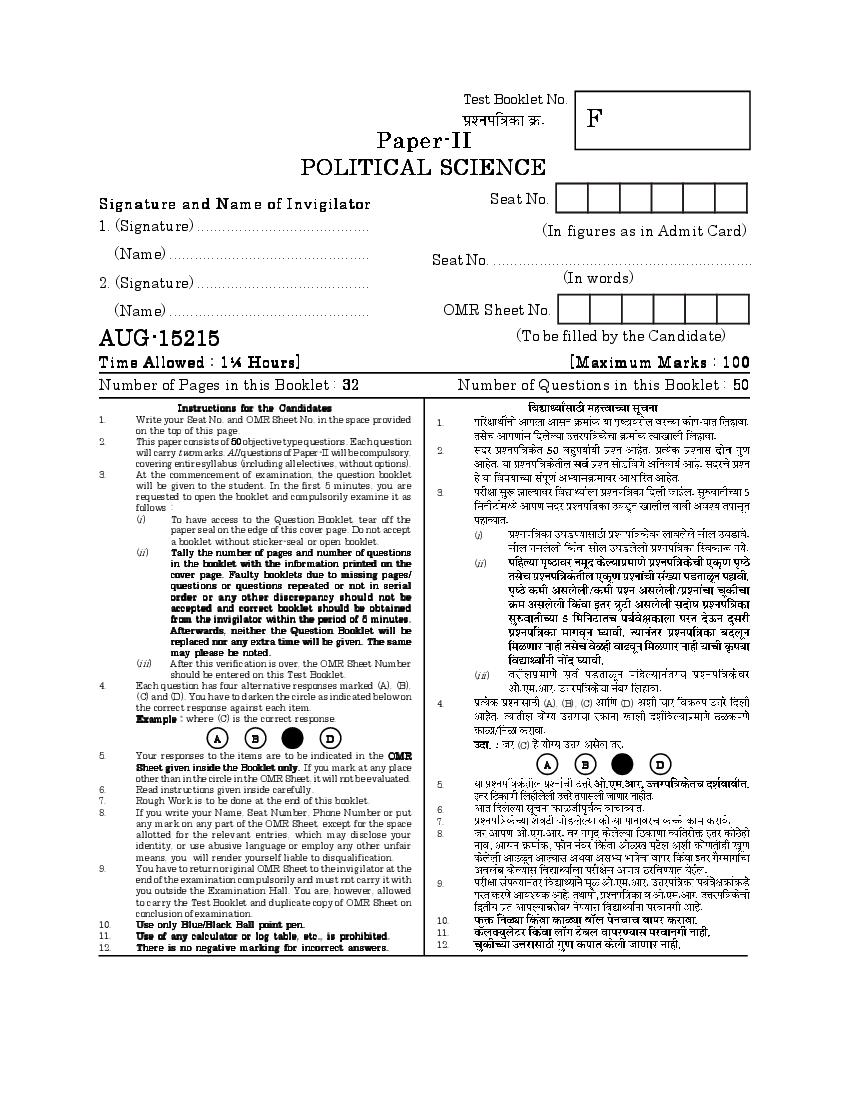
F
POLITICAL SCIENCE
Signature and Name of Invigilator Seat No.
1. (Signature) ......................................... (In figures as in Admit Card)
(Name) ................................................ Seat No. ..............................................................
2. (Signature) ......................................... (In words)
(Name) ................................................ OMR Sheet No.
AUG-15215 (To be filled by the Candidate)
Time Allowed : 1¼ Hours] [Maximum Marks : 100
Number of Pages in this Booklet : 32 Number of Questions in this Booklet : 50
Instructions for the Candidates
1. Write your Seat No. and OMR Sheet No. in the space provided 1.
on the top of this page.
2. This paper consists of 50 objective type questions. Each question
will carry two marks. All questions of Paper-II will be compulsory, 2.
covering entire syllabus (including all electives, without options).
3. At the commencement of examination, the question booklet
will be given to the student. In the first 5 minutes, you are
requested to open the booklet and compulsorily examine it as 3.
follows :
(i) To have access to the Question Booklet, tear off the
paper seal on the edge of this cover page. Do not accept
(i)
a booklet without sticker-seal or open booklet.
(ii) Tally the number of pages and number of questions
in the booklet with the information printed on the (ii)
cover page. Faulty booklets due to missing pages/
questions or questions repeated or not in serial
o rder or any other discre pancy should not be
accepted and correct booklet should be obtained
from the invigilator within the period of 5 minutes.
Afterwards, neither the Question Booklet will be
replaced nor any extra time will be given. The same
may please be noted.
(iii) After this verification is over, the OMR Sheet Number
should be entered on this Test Booklet. (iii)
4. Each question has four alternative responses marked (A), (B),
(C) and (D). You have to darken the circle as indicated below on
the correct response against each item. 4. (A), (B), (C) (D)
Example : where (C) is the correct response.
A B D
(C)
5. Your responses to the items are to be indicated in the OMR
Sheet given inside the Booklet only. If you mark at any place A B D
other than in the circle in the OMR Sheet, it will not be evaluated.
5.
6. Read instructions given inside carefully.
7. Rough Work is to be done at the end of this booklet.
8. If you write your Name, Seat Number, Phone Number or put 6.
any mark on any part of the OMR Sheet, except for the space 7.
allotted for the relevant entries, which may disclose your 8.
identity, or use abusive language or employ any other unfair
means, you will render yourself liable to disqualification.
9. You have to return original OMR Sheet to the invigilator at the
end of the examination compulsorily and must not carry it with 9.
you outside the Examination Hall. You are, however, allowed
to carry the Test Booklet and duplicate copy of OMR Sheet on
conclusion of examination.
10. Use only Blue/Black Ball point pen. 10.
11. Use of any calculator or log table, etc., is prohibited. 11.
12. There is no negative marking for incorrect answers. 12.
Page 2
Page 3
Paper II
II
Time Allowed : 75 Minutes] [Maximum Marks : 100
Note : This paper contains Fifty (50) multiple choice questions. Each question
carries Two (2) marks. Attempt All questions.
(50) (2)
1. Which phrase did Kautilya use to 1.
describe human life in the absence
of the state ?
(A)
(A) State of Nature
(B)
(B) Law of the fishes
(C)
(C) Perpetual peace
(D)
(D) State of innocence
2.
2. Which of the following pairs is
incorrectly matched ?
(A) M.K. Gandhi — Swaraj (A)
(B) M.N. Roy — Radical (B)
Humanism
(C) Aurobindo Ghosh— Spiritual (C)
Unity
(D) B.R. Ambedkar— Hindutva (D)
3 [P.T.O.
Page 4
Papal Supremacy ?
(A) Alighieri Dante (A)
(B) William of Ockham (B)
(C)
(C) Marsiglio of Padua
(D)
(D) Giles of Rome
4. Which of the following statements 4.
are correct ?
(a) Positivism was the (a)
philosophical basis of
behaviourism
(b)
(b) Behaviourists emphasised the
separation of facts and values
(c) Post-behaviourists considered (c)
relevance to be more important
than rigour
(d)
(d) Behaviourism triumphed over
post-behaviourism
(A) (a), (b) (c)
(A) (a), (b) and (c)
(B) (a), (b) and (d) (B) (a), (b) (d)
(C) (b), (c) and (d) (C) (b), (c) (d)
(D) (a), (c) and (d) (D) (a), (c) (d)
4
Page 5
consonance with :
(A) Liberal individualism (A)
(B) Civic republicanism (B)
(C) Totalitarianism
(C)
(D) Theocracy
(D)
6. Give the correct answer by using the
6.
codes given below :
(1) Plato is the father of political
(1)
philosophy
(2) Aristotle is not the father of
(2)
political science
(3)
(3) Machiavelli is the father of
political realism
(4)
(4) Antonio Gramsci is not the
father of passive revolution
Codes :
(A) (1) and (2) are correct (A) (1) (2)
(B) (2) and (3) are correct (B) (2) (3)
(C) (2) and (4) are correct (C) (2) (4)
(D) (3) is correct (D) (3)
5 [P.T.O.
Page 6
correctly matched ?
(A) G.W.F. Hegel—Civil Society (A)
(B) T.H. Green—Social Contract
(B)
(C) Karl Marx—General Will
(C)
(D) Machiavelli—Political Idealism
(D)
8. According to Marx what is the
8.
correct sequence of the modes of
production ?
(A)
(A) Slavery, Feudalism and
Capitalism
(B)
(B) Feudalism, Slavery and
Capitalism
(C) Capitalism, Slavery and (C)
Feudalism
(D) Slavery, Capitalism and (D)
Feudalism
6
Page 7
not correctly matched ?
(A) J.S. Mill—The subjection of
(A)
women
(B)
(B) Machiavelli—The Prince
(C)
(C) Aristotle—Utilitarianism
(D)
(D) Hobbes—The Leviathan
10. Which one of the following pairs is 10.
not correctly matched ?
(A) Mao Zedong—Cultural
Revolution
(A)
(B) Antonio Gramsci—Cultural
hegemony
(B)
(C) V.I. Lenin—Bolshevik
Revolution (C)
(D) Karl Marx—Cultural
(D)
Revolution
7 [P.T.O.
Page 8
11.
(A) In Switzerland the members of
(A)
the executive are the members
of Legislature
(B) In USA the members of the (B)
executive are not the members
of Legislature
(C)
(C) In UK the members of
executive are the members of
Legislature
(D) In India the members of the
(D)
executive are the members of
the Legislature
8
Page 9
12. I
using the codes given below :
II
List-I List-II
I II
(1) USA (a) Council of States
(1) (a)
& National Council
(2) Switzerland (b) House of Lords &
(2) (b)
House of Commons
(3) France (c) Senate & House of
(3) (c)
Representatives
(4) UK (d) National Assembly
(4) (d)
& Senate
Codes :
(A) (1—c) (2—a) (3—d) (4—b) (A) (1—c) (2—a) (3—d) (4—b)
(B) (1—d) (2—c) (3—b) (4—a) (B) (1—d) (2—c) (3—b) (4—a)
(C) (1—b) (2—d) (3—a) (4—c) (C) (1—b) (2—d) (3—a) (4—c)
(D) (1—d) (2—b) (3—c) (4—a) (D) (1—d) (2—b) (3—c) (4—a)
9 [P.T.O.
Page 10
correctly matched ?
(A)
(A) France — Biparty System
(B)
(B) USA — Biparty System
(C)
(C) India — Multiparty System
(D) China — One Party System (D)
14. Which among the following pairs is
14.
not correctly matched ?
(A)
(A) Consti- — Supremacy
tutionalism of Constitution
(B) Federalism — Division of
(B)
Powers
(C)
(C) Parliamentary —Supremacy of
System Executive
(D) Presidential — Separation of
(D)
System Powers
10
Page 11
political system ?
(A) USA (A)
(B) India (B)
(C) UK (C)
(D) Switzerland (D)
16. What is the tenure of Swiss 16.
Executive ?
(A) 5 Years (A)
(B) 4 Years (B)
(C) 6 Years (C)
(D) 7 Years (D)
11 [P.T.O.
Page 12
statements is incorrect ?
(A)
(A) Constitutionalism implies
(B)
limited Government
(B) War is the important threat to
Constitutionalism
(C)
(C) American Constitution
guarantee rights to the citizens
(D)
(D) British Constitution is the first
Enacted Constitution
18. Who described bureaucracy as a 18.
“continental nuisance” ?
(A) Thomas Carlyle (A)
(B) R.K. Merton (B)
(C) Max Weber (C)
(D)
(D) M. Crozier
12
Page 13
fundamental change in the
predominant myth of a social
order” ?
(A)
(A) Huntington
(B)
(B) G.S. Peter
(C)
(C) H. Arendt
(D) Neumann (D)
20. Arrange in the order that AFK 20.
Organski examined the role of
government through the four stages
of his “Stages of Political
Development”. (1)
(1) Industrialization
(2)
(2) Primitive national unification
(3)
(3) Abundance
(4)
(4) National welfare
Codes :
(A) (2), (1), (4), (3) (A) (2), (1), (4), (3)
(B) (1), (2), (3), (4)
(B) (1), (2), (3), (4)
(C) (3), (4), (1), (2)
(C) (3), (4), (1), (2)
(D) (4), (3), (2), (1)
(D) (4), (3), (2), (1)
13 [P.T.O.
Page 14
and “Delhi Chalo” ?
(A) Aurobindo Ghosh (A)
(B) Jawaharlal Nehru (B)
(C) Mahatma Gandhi (C)
(D) Subhash Chandra Bose (D)
22. The preamble enshrines certain 22.
ideals that were first spelt out in :
(A) The speech by Jawaharlal
Nehru on the banks of Ravi
(A)
when he called for Purna
Swaraj
(B) The Nehru Report
(C) A resolution adopted at the (B)
Karachi Session of the Indian
(C)
National Congress
(D) The objectives Resolution
adopted by the Constituent (D)
Assembly
14
Page 15
the correct answer from the codes
given below :
I II
List-I List-II
(a) (1)
(a) Article 43A (1) Legal aid to the poor
(b) Article 43 (2) Prohibition of
(b) (2)
consumption of alcoholic
drinks
(c) Article 47 (3) Prohibition of Cottage (c) (3)
Industries (d) (4)
(d) Article 39A (4) Workers Participation
in Management
Codes :
(a) (b) (c) (d)
(a) (b) (c) ( d)
(A) (1) (3) (4) (2)
(A) (1) (3) (4) (2)
(B) (2) (1) (4) (3)
(B) (2) (1) (4) (3)
(C) (4) (3) (2) (1)
(C) (4) (3) (2) (1)
(D) (3) (2) (1) (4)
(D) (3) (2) (1) (4)
15 [P.T.O.
Page 16
the Constitution can be amended by
Parliament by a simple majority ?
(A) Creation of new states in the (A)
union
(B)
(B) Fundamental Rights
(C) Directive Principles of States (C)
Policy
(D) Provisions related to (D)
Panchayati Raj (Article 243)
25.
25. Which one of the following
statements related to President of
India is incorrect ?
(A)
(A) President shall have the power
to summon or prorogue the
session of parliament
(B)
(B) President shall have the right
to send message to either House
of Parliament
(C) President shall have power to
(C)
send message not only
legislative matters but also
“otherwise”
(D) President shall have the power
to send message only on (D)
Legislative matters
16
Page 17
about NITI Aayog :
(A) The power to allocate funds is
not vested with Finance (A)
Ministry
(B) The number of full time
(B)
members could be fewer than
Planning Commission
(C) Chief Ministers of Union (C)
Territories are not part of NITI
Aayog
(D) Only four Cabinet Ministers (D)
will serve as ex-officio
members
27.
27. Select the correct answer by using
the codes given below :
(a) (1)
(a) Regional Party (1) Akali Dal/TDP
(b) National Party (2) BJP/DMK (b) (2)
(c) Bahujan Party (3) BSP/Bahujan
Mahasangh (c) (3)
(d) (4)
(d) Ideology Based (4) CPM/CPI
Political Party
(A) (1) and (2) are correct (A) (1) (2)
(B) (2) and (3) are correct (B) (2) (3)
(C) (3) and (4) are incorrect (C) (3) (4)
(D) (1), (3) (4)
(D) (1), (3) and (4) are correct
17 [P.T.O.
Page 18
which one of the states given
below ?
(A)
(A) Nagaland, Tripura and Assam
(B)
(B) Mizoram, J & K and Nagaland
(C)
(C) Meghalaya, Tripura and J & K
(D) J & K, Nagaland and Jharkhand (D)
29. Match List-I with List-II and choose 29.
the correct answer from the codes
given below :
List-I List-II I II
(Constitutional (Effects)
Amendment)
(a) (1)
(a) 58th (1) Lowering of voting age
from 21 to 18
(b) (2)
(b) 61st (2) Right to education
(c) 77th (3) Publication of the
(c) (3)
Constitution in Hindi
(d) 86th (4) Reservation in (d) (4)
promotions to SCs and
STs
Codes : (a) (b) (c) (d)
(a) (b) (c) ( d)
(A) (2) (3) (1) (4)
(A) (2) (3) (1) (4)
(B) (3) (1) (4) (2)
(B) (3) (1) (4) (2)
(C) (1) (4) (3) (2)
(C) (1) (4) (3) (2)
(D) (4) (2) (1) (3)
(D) (4) (2) (1) (3)
18
Page 19
labelled as Assertion (A) and the
(A) (R)
other labelled as Reason (R) :
Assertion (A) : Leftist Government
of West Bengal suggested to initiate (A)
an amendment to include the word
‘Federal’ in the description of
‘Republic of India’
Reason (R) : They suggested to
replace the ‘Union’ by the expression (R)
‘Federation’ in all places to protect
states autonomy.
In this context of the above which
one of the following is correct ?
(A) Both (A) and (R) are true but
(R) is not the correct (A) (A) (R) (R)
explanation of (A)
(A)
(B) Both (A) and (R) are true and
(B) (A) (R) (R)
(R) is the correct explanation of
(A) (A)
(C) (A) is false and (R) is true (C) (A) (R)
(D) (A) is true but (R) is false
(D) (A) (R)
19 [P.T.O.
Page 20
the correct answer by using the
codes given below the list :
List-I List-II I II
(a) Purpose (1) Education (a) (1)
(b) Process (2) Tribal Welfare (b) (2)
(c) Clientele (3) Law (c) (3)
(d) Area (4) North-East (d) (4)
Codes :
(a) (b) (c) ( d) (a) (b) (c) (d)
(A) (3) (1) (2) (4)
(A) (3) (1) (2) (4)
(B) (1) (3) (2) (4)
(B) (1) (3) (2) (4)
(C) (2) (3) (4) (1)
(C) (2) (3) (4) (1)
(D) (2) (1) (4) (3)
(D) (2) (1) (4) (3)
20
Page 21
the code below about ‘Adhocracy”.
(i) The term coined by Warren
Bennis (i)
(ii) It is popularised by Alwin (ii)
Toffler
(iii)
(iii) It is the opposite of
bureaucracy (iv)
(iv) It refers to a small project team
which work across the
departmental boundaries of an
organisation :
Codes :
(A) (i ) ( iii ) ( ii )
(A) (i) and (iii) are correct, (ii) and
(iv)
(iv) are incorrect
(B) (i) and (ii) are correct, (iii) and (B) (i ) ( ii ) (iii )
(iv) are incorrect (iv)
(C) ( i ), ( ii ), ( iii ) and ( iv ) are
(C) (i) (ii), (iii) (iv)
correct
(D) (i) and (ii) are incorrect, (iii) and (D) ( i ) ( ii ) ( iii )
(iv) are correct (iv)
21 [P.T.O.
Page 22
institution related to planning in
India. Choose the correct code :
(i) Planning and Development
(i)
Department
(ii)
(ii) Advisory Planning Board
(iii)
(iii) Planning Commission
(iv)
(iv) NITI Aayog
Codes :
(A) (ii), (i), (iii) (iv)
(A) (ii), (i), (iii) and (iv)
(B) (i), (ii), (iii) (iv)
(B) (i), (ii), (iii) and (iv)
(C) (iii), (ii), (i) (iv)
(C) (iii), (ii), (i) and (iv)
(D) (iv), (iii), (ii) and (i) (D) (iv), (iii), (ii) ( i)
22
Page 23
34.
Estimate Committee from the
codes :
(i) It is a standing committee (i)
(ii) All members belonging to Lok (ii)
Sabha
(iii)
(iii) Members are elected on the
basis of proportional
representation (iv)
(iv) Suggest alternative policies to
bring efficiency and economy in
administration
(A) (i), (ii), (iii) (iv)
Codes :
(A) (i), (ii), (iii) are correct, (iv) is
incorrect
(B) (i), (ii), (iv) (iii)
(B) (i), (ii), (iv) are correct, (iii) is
incorrect
(C) (i), (ii), (iii), (iv)
(C) (i), (ii), (iii), (iv) are correct
(D) (i), (ii) (iii) (iv)
(D) (i), (ii) are correct, (iii) and (iv)
are incorrect
23 [P.T.O.
Page 24
decentralisation :
(A)
(A) Decentralisation may be
political or administrative
(B)
(B) Administrative decentralisation
may be vertical and territorial
or horizontal and functional
(C) Creation of Panchayati Raj (C)
Institution within the states is
an example of decentralisation
(D)
(D) Planning Commission
symbolizes the trend towards
decentralisation
24
Page 25
36.
Asoka Mehta Committee on
Panchayati Raj :
(A)
(A) Main thesis of the Committee
was functional necessity for
decentralisation of
administration
(B)
(B) Recommended the creation of a
two-tiered system
(C)
(C) Compulsory powers of taxation
to Panchayati Raj Institution
(D) Recommended the creation of a (D)
three-tiered system
25 [P.T.O.
Page 26
Maintenance Act come into
force ?
(A) 1978
(A) 1978
(B) 1968
(B) 1968
(C) 1962
(C) 1962
(D) 1979
(D) 1979
38. Arrange chronologically the various 38.
stages of Budget in the Parliament
by selecting the correct code :
(1)
(1) General Discussion
(2)
(2) Presentation in the Parliament
(3)
(3) Consideration and Passing
(4)
(4) Voting on Demand for Grant
:
Codes :
(A) (2), (1), (3), (4)
(A) (2), (1), (3), (4)
(B) (1), (2), (3), (4)
(B) (1), (2), (3), (4)
(C) (2), (3), (4), (1) (C) (2), (3), (4), (1)
(D) (2), (1), (4), (3) (D) (2), (1), (4), (3)
26
Page 27
Ombudsman by using codes below :
(i) Officer of state appointed to
(i)
provide an extra check on the
right of citizens against
governmental action (ii)
(ii) It is a Scandinavian origin (iii)
system
(iv)
(iii) It is an institution for
decentralisation
(A) (i) (ii) , (iii)
(iv) It is against Federal system
(iv)
Codes :
(B) (i ), ( ii ) ( iii )
(A) (i) and (ii) are correct, (iii) and
(iv) are incorrect (iv)
(B) (i), (ii) and (iii) are correct, (iv) (C) ( i ), ( ii ), ( iii ) ( iv )
is incorrect
(C) (i), (ii), (iii) and (iv) are correct
(D) ( i ), (ii ), ( iii ) ( iv )
(D) (i), (ii), (iii) and (iv) are incorrect
27 [P.T.O.
Page 28
provides :
(A) Transperancy (A)
(B) Accountability
(B)
(C) Decentralisation
(C)
(D) Anti-corruption
(D)
41. Which of the following is not a tenet
41.
of Realism ?
(A) The centrality of security and
(A)
survival
(B) The importance of the virtues
of strength and cunning (B)
(C) Values of Intelligence, nerve (C)
and risk taking
(D) State is a major actor along with (D)
others non-state actors
42. What did the Westphalian system 42.
denote ?
(A)
(A) The duty of nation-states to
adhere to the Church
(B)
(B) International alliances would
(C)
take precedence
(D)
(C) Rise of the modern nation-state
(D) King had the divine right to rule
28
Page 29
43.
at the Treaty of Versailles ?
(A) Castlereagh (A)
(B) Metternich (B)
(C) Talleyrand (C)
(D) Woodrow Wilson (D)
44. What was the name of the massive 44.
economic rebuilding plan for
Western Europe which was to
rebuilt was torn economies after
Second World War ?
(A)
(A) NATO
(B) Marshall Plan (B)
(C) Containment (C)
(D) IMF Loans (D)
45. Which among the following are 45.
tangible elements of power ?
(1) Physical Geography and
(1)
Geopolitics
(2) Natural Resources and raw (2)
materials (3)
(3) Technology (4)
(4) National character and morale
Codes :
(A) (1), (2) (3)
(A) (1), (2) and (3) are correct
(B) (1), (2) and (4) are correct (B) (1), (2) (4)
(C) (2), (3) and (4) are correct (C) (2), (3) (4)
(D) (1), (3) and (4) are correct (D) (1), (3) (4)
29 [P.T.O.
Page 30
result of the Korean war in 1950 was
an example of :
(A) Splendid Isolation (A)
(B)
(B) Peaceful coexistence
(C)
(C) Collective Security
(D)
(D) Balance of Power
47.
47. Choose the correct chronological
order on the basis of the codes given
below : (1)
(1) Tokyo Round (2)
(2) Kennedy Round (3)
(3) Doha Round
(4)
(4) Uruguay Round
Codes :
(A) (2), (1), (4), (3)
(A) (2), (1), (4), (3)
(B) (1), (2), (3), (4)
(B) (1), (2), (3), (4)
(C) (4), (3), (2), (1)
(C) (4), (3), (2), (1)
(D) (3), (4), (1), (2) (D) (3), (4), (1), (2)
30
Page 31
48.
codes given below :
Assertion (A) : India’s LEAP (Look
East and Act Policy) began before (A) LEAP
1991.
Reason (R) : The Cholas were a
naval power that traded in the Indo- (R)
Pacific region
Codes :
(A) Both (A) and (R) are correct and
(R) is the right explanation of
(A) (A) (R)
(A)
(R) (A)
(B) Both (A) and (R) are correct but
(B) (A) (R)
(R) is not the correct
(R) (A)
explanation of (A)
(C) (A) is true, but (R) is false (C) (A) (R)
(D) (A) is false, but (R) is true (D) (A) (R)
49. Where did the first summit of the 49.
Non-Aligned Movement (NAM) take
place in 1961 ? (A)
(A) Cairo
(B)
(B) Belgrade
(C)
(C) Bandung
(D) New Delhi (D)
50. Which one of the following countries 50. BIMSTEC
is not a member of BIMSTEC ?
(A) Bangladesh (A)
(B) Australia (B)
(C) Myanmar (C)
(D) Thailand (D)
31 [P.T.O.
Page 32
32
Document Details
| Board / Org | Maharashtra Exams |
| Exam | Maharashtra State Eligibility Test |
| Type | Question Paper |
| Pages | 32 |
| Updated | 30 Apr 2026 |