CBSE Class 12 Textile Chemical Processing Question Paper 2019
Finished viewing? Save it for later —
Download CBSE Class 12 Textile Chemical Processing Question Paper 2019 (PDF · 5 pages)About CBSE Class 12 Textile Chemical Processing Question Paper 2019
CBSE Class 12 Textile Chemical Processing Question Paper 2019 is available here for free download. Published by CBSE for Class 12, this question paper can be viewed online or downloaded as a PDF (5 pages). Candidates preparing for Class 12 can use CBSE Class 12 Textile Chemical Processing Question Paper 2019 to understand the exam pattern, the type of questions asked, and the overall difficulty level.
Frequently Asked Questions
How can I download CBSE Class 12 Textile Chemical Processing Question Paper 2019?
Open this page and click the Download button to save CBSE Class 12 Textile Chemical Processing Question Paper 2019 as a PDF. It is completely free on AglaSem Docs.
Is CBSE Class 12 Textile Chemical Processing Question Paper 2019 free to download?
Yes. CBSE Class 12 Textile Chemical Processing Question Paper 2019 can be viewed online and downloaded as a PDF free of cost on AglaSem Docs.
How many pages does CBSE Class 12 Textile Chemical Processing Question Paper 2019 have?
CBSE Class 12 Textile Chemical Processing Question Paper 2019 contains 5 pages, which you can read online or download together as a single PDF.
Where can I find more Class 12 study material?
You can find more Class 12 question papers, sample papers, syllabus, and answer keys on AglaSem Docs.
CBSE Class 12 Textile Chemical Processing Question Paper 2019 – Text
Read the full text of this question paper below — useful to quickly search, copy and reference the content online without downloading the PDF.
📄 View text version (5 pages)
Page 1
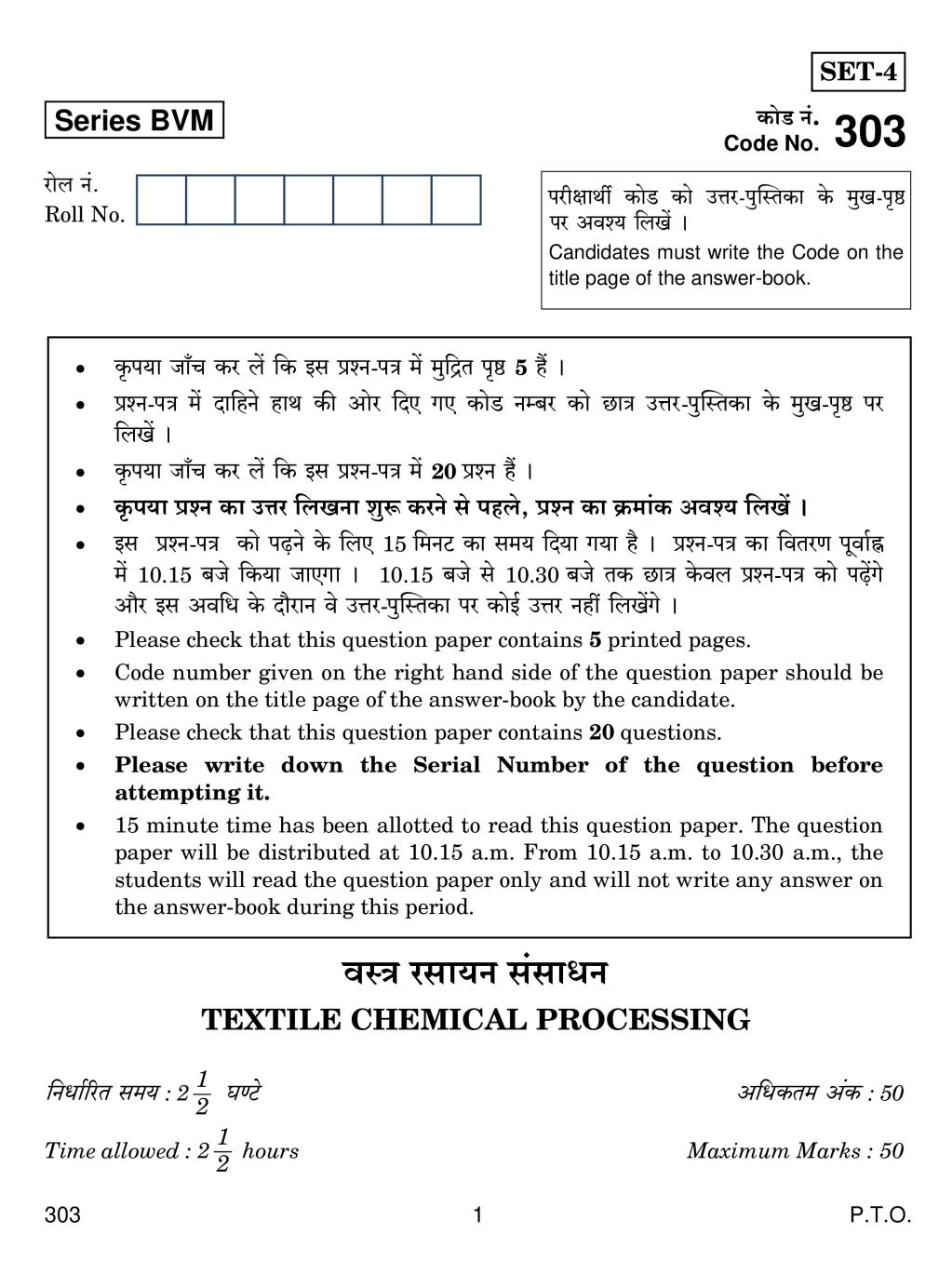
Series BVM H$moS> Z§.
Code No. 303
amob Z§. narjmWu H$moS >H$mo CÎma-nwpñVH$m Ho$ _wI-n¥ð
Roll No. >na Adí` {bIo§ &
Candidates must write the Code on the
title page of the answer-book.
H¥$n`m Om±M H$a b| {H$ Bg àíZ-nÌ _o§ _w{ÐV n¥ð> 5 h¢ &
àíZ-nÌ _| Xm{hZo hmW H$s Amoa {XE JE H$moS >Zå~a H$mo N>mÌ CÎma -nwpñVH$m Ho$ _wI-n¥ð> na
{bI| &
H¥$n`m Om±M H$a b| {H$ Bg àíZ-nÌ _| 20 àíZ h¢ &
H¥$n`m àíZ H$m CÎma {bIZm ewê$ H$aZo go nhbo, àíZ H$m H«$_m§H$ Adí` {bI| &
Bg àíZ-nÌ H$mo n‹T>Zo Ho$ {bE 15 {_ZQ >H$m g_` {X`m J`m h¡ & àíZ-nÌ H$m {dVaU nydm©•
_| 10.15 ~Oo {H$`m OmEJm & 10.15 ~Oo go 10.30 ~Oo VH$ N>mÌ Ho$db àíZ-nÌ H$mo n‹T>|Jo
Am¡a Bg Ad{Y Ho$ Xm¡amZ do CÎma-nwpñVH$m na H$moB© CÎma Zht {bI|Jo &
Please check that this question paper contains 5 printed pages.
Code number given on the right hand side of the question paper should be
written on the title page of the answer-book by the candidate.
Please check that this question paper contains 20 questions.
Please write down the Serial Number of the question before
attempting it.
15 minute time has been allotted to read this question paper. The question
paper will be distributed at 10.15 a.m. From 10.15 a.m. to 10.30 a.m., the
students will read the question paper only and will not write any answer on
the answer-book during this period.
dñÌ agm`Z g§gmYZ
TEXTILE CHEMICAL PROCESSING
{ZYm©[aV g_` : 2 12 KÊQ>o A{YH$V_ A§H$ : 50
1
Time allowed : 2 hours Maximum Marks : 50
2
303 1 P.T.O.
Page 2
(i) Bg àíZ-nÌ _| 20 àíZ em{_b h¢ &
(ii) àíZ-nÌ Xmo IÊS>m| _| {d^m{OV h¡ &
IÊS> H$
~hþ{dH$ënr` àíZ /[aº ñWmZ ^[aE /grYo àíZ : Hw$b 12 àíZ em{_b h¢ Omo
1 – 1 A§H$ Ho$ h¢ & BZ_| go {H$Ýht 10 àíZm| Ho$ CÎma Xr{OE &
A{V bKw CÎmar` àíZ : BZ_| Hw$b 7 àíZ em{_b h¢, àË`oH$ 2 A§H$ Ho$ h¢ & BZ_| go
{H$Ýht 5 àíZm| Ho$ CÎma Xr{OE &
bKw CÎmar` àíZ : BZ_| Hw$b 7 àíZ em{_b h¢, àË`oH$ 3 A§H$ Ho$ h¢ & BZ_| go
{H$Ýht 5 àíZm| Ho$ CÎma Xr{OE &
IÊS> I
XrK© CÎmar` /{Z~ÝYmË_H$ àíZ : BZ_| Hw$b 5 àíZ em{_b h¢, àË`oH$ 5 A§H$ Ho$ h¢ & BZ_|
go {H$Ýht 3 àíZm| Ho$ CÎma Xr{OE &
(iii) Ohm± gå^d hmo, AnZo CÎmam| H$mo {M{ÌV H$s{OE &
General Instructions :
(i) This question paper contains 20 questions.
(ii) Question paper is divided into two sections.
SECTION A
Multiple choice questions / Fill in the blanks/Direct questions :
contains total 12 questions of 1 mark each. Answer any 10 questions.
Very short answer type questions : contains total 7 questions of
2 marks each. Answer any 5 questions.
Short answer type questions : contains total 7 questions of 3 marks
each. Answer any 5 questions.
SECTION B
Long answer / Essay type questions : contains total 5 questions of 5 marks
each. Answer any 3 questions.
(iii) Illustrate your answers wherever possible.
303 2
Page 3
SECTION A
1. {ZåZ{b{IV ‘| go {H$Ýht Xg H$m {_bmZ H$s{OE : 1×10=10
(i) D$Z H$s Aew{Õ (a) JwAma Jm|X
(ii) aoe‘ H$s Aew{Õ (b) H¡$[a¶a (Carrier)
(iii) C^ao aoeo hQ>mZo Ho$ {bE (c) ’$m°ñ’$moag (Phosphorus)
(iv) a§JmB© H$m ¶§Ì (d) Eo{gS> (Acid) a§J
(v) Eo{H«${bH$ (Acrylic) `mZ© Ho$ {bE a§J (e) ‘mo‘ H$m Kmob (B_ëeZ)
(vi) aoe‘ Ho$ {bE a§J (f) qgqOJ (Singeing)
(vii) a§JmB© Ho$ {bE ghm¶H$ (g) go[a{gZ (Sericin)
(viii) N>nmB© H$s e¡br (h) ~o{gH$ a§J
(ix) {WH$qZJ (Thickening) nXmW© (i) J«rg (Grease)
(x) [aS>çyqgJ (Reducing) ãbrM (j) {OJa (Jigger)
(xi) A{½Z gwajm àXmZ H$aZm (k) {S>ñMmO© (Discharge)
(xii) Za‘ H$aZo dmbr n[agÁOm (l) gmo{S>¶‘ hmBS´>mogë’$mBQ>
Match any ten of the following :
(i) Impurity in wool (a) Guar gum
(ii) Impurity in silk (b) Carrier
(iii) For removal of protruding fibres (c) Phosphorus
(iv) Dyeing machine (d) Acid dyes
(v) Dye for acrylic yarn (e) Wax emulsion
(vi) Dye for silk (f) Singeing
(vii) Auxiliary for dyeing (g) Sericin
(viii) Style of printing (h) Basic dyes
(ix) Thickening agent (i) Grease
(x) Reducing bleach (j) Jigger
(xi) Flame proofing (k) Discharge
(xii) Softening finish (l) Sodium Hydrosulphite
303 3 P.T.O.
Page 4
Very Short Answer Type Questions (Any five)
2. {S>gmBqµOJ (Desizing) H$m ³¶m Cn`moJ h¡ ? 2
What is the use of Desizing ?
3. gë’$a (Sulphur) a§Jm| na {Q>ßnUr {b{IE & 2
Write a note on Sulphur dyes.
4. EµOmoBH$ (Azoic) a§Jm| Ho$ Cn¶moJ Ho$ ‘w»¶ MaU ~VmBE & 2
State the main steps of Azoic dye application.
5. H¡$[a¶a (carrier) H$m H$m¶© CXmhaU g{hV g_PmBE & 2
Explain the role of carrier with an example.
6. ãbm°M (Blotch) N>nmB© Ho$ H$n‹S>o H$m {ddaU Xr{OE & 2
Describe a blotch printed fabric.
7. nmM©‘|Q>mBµOoeZ (Parchmentization) g‘PmBE & 2
Explain Parchmentization.
8. dñÌm| na Z¡qnJ (napping) n[agÁOm H¡$go Xr OmVr h¡ ? 2
How is napping finish imparted to fabrics ?
bKw CÎmar¶ àíZ (H$moB© nm±M) 3×5=15
Short Answer Type Questions (Any five)
{ZåZ{b{IV H$s VwbZm H$s{OE :
Compare the following :
9. J¡g (Gas) d ßboQ> (Plate) qgqOJ (Singeing) 3
Gas and Plate Singeing
10. S>m`ao³Q> (Direct) d Eo{gS> (Acid) a§J 3
Direct and Acid Dyes
11. AdamoYH$ d S>m`ao³Q> (Direct) N>nmB© 3
Resist and Direct Printing
303 4
Page 5
Block and Flock Printing
13. hñV d Am°Q>mo‘¡{Q>H$ âb¡Q> ~oS> ñH«$sZ (Automatic Flat Bed Screen) N>nmB© 3
Hand and Automatic Flat Bed Screen Printing
14. AñWmB© d ñWmB© n[agÁOm 3
Temporary and Durable Finishes
15. dm°Q>aày’$ (Waterproof) d dm°Q>a [anob|Q> (Water Repellent) n[agÁOm 3
Waterproof and Water Repellent Finish
IÊS> I
SECTION B
XrK© CÎmar¶ àíZ (H$moB© VrZ) 5×3=15
Long Answer Type Questions (Any three)
16. ‘agamBµOoeZ (Mercerization) H$mo {dñVma go g‘PmBE & 5
Explain Mercerization in detail.
17. ãbrqMJ (Bleaching) ³¶m| Am¡a H¡$go H$s OmVr h¡ ? 5
Why and how is bleaching carried out ?
18. D$Zr dñÌm| H$s Aew{Õ¶m± d CÝh| hQ>mZo Ho$ VarHo$ ~VmBE & 5
State the impurities present in wool and the processes used for their
removal.
19. nmo{bEñQ>a H$n‹S>m| (Polyester) na {S>ñng© (disperse) a§J H$aZo H$s Xmo {d{Y¶m| H$m dU©Z
H$s{OE & 5
Describe two methods of applying disperse dyes on polyester fabrics.
20. aoe‘r H$n‹S>m| na Eo{gS> (Acid) a§J M‹T>mZo H$s {d{Y H$m dU©Z H$s{OE & 5
Explain the method of applying acid dyes on silk fabrics.
303 5 P.T.O.
Document Details
| Board / Org | CBSE |
| Exam | Class 12 |
| Type | Question Paper |
| Pages | 5 |
| Updated | 30 Apr 2026 |