MAHA SET 2018 Question Paper 3 Home Science
Finished viewing? Save it for later —
Download MAHA SET 2018 Question Paper 3 Home Science (PDF · 36 pages)About MAHA SET 2018 Question Paper 3 Home Science
MAHA SET 2018 Question Paper 3 Home Science is available here for free download. Published by Maharashtra Exams for Maharashtra State Eligibility Test, this question paper can be viewed online or downloaded as a PDF (36 pages). Candidates preparing for Maharashtra State Eligibility Test can use MAHA SET 2018 Question Paper 3 Home Science to understand the exam pattern, the type of questions asked, and the overall difficulty level.
Frequently Asked Questions
How can I download MAHA SET 2018 Question Paper 3 Home Science?
Open this page and click the Download button to save MAHA SET 2018 Question Paper 3 Home Science as a PDF. It is completely free on AglaSem Docs.
Is MAHA SET 2018 Question Paper 3 Home Science free to download?
Yes. MAHA SET 2018 Question Paper 3 Home Science can be viewed online and downloaded as a PDF free of cost on AglaSem Docs.
How many pages does MAHA SET 2018 Question Paper 3 Home Science have?
MAHA SET 2018 Question Paper 3 Home Science contains 36 pages, which you can read online or download together as a single PDF.
Where can I find more Maharashtra State Eligibility Test study material?
You can find more Maharashtra State Eligibility Test question papers, sample papers, syllabus, and answer keys on AglaSem Docs.
MAHA SET 2018 Question Paper 3 Home Science – Text
Read the full text of this question paper below — useful to quickly search, copy and reference the content online without downloading the PDF.
📄 View text version (36 pages)
Page 1
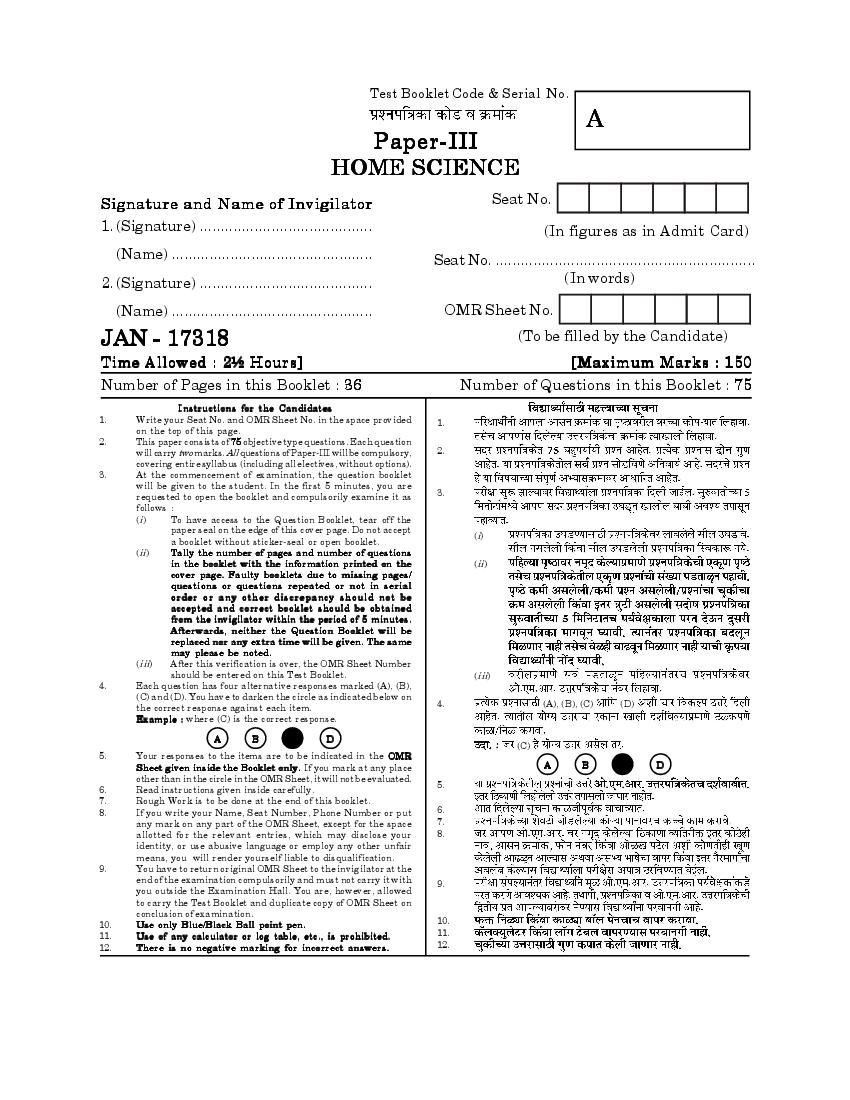
A
Paper-III
HOME SCIENCE
Signature and Name of Invigilator Seat No.
1. (Signature) ......................................... (In figures as in Admit Card)
(Name) ................................................ Seat No. ..............................................................
2. (Signature) ......................................... (In words)
(Name) ................................................ OMR Sheet No.
JAN - 17318 (To be filled by the Candidate)
Time Allowed : 2½ Hours] [Maximum Marks : 150
Number of Pages in this Booklet : 36 Number of Questions in this Booklet : 75
Instructions for the Candidates
1. Write your Seat No. and OMR Sheet No. in the space provided 1.
on the top of this page.
2. This paper consists of 75 objective type questions. Each question
will carry two marks. All questions of Paper-III will be compulsory, 2.
covering entire syllabus (including all electives, without options).
3. At the commencement of examination, the question booklet
will be given to the student. In the first 5 minutes, you are
requested to open the booklet and compulsorily examine it as 3.
follows :
(i) To have access to the Question Booklet, tear off the
paper seal on the edge of this cover page. Do not accept
(i)
a booklet without sticker-seal or open booklet.
(ii) Tally the number of pages and number of questions
in the booklet with the information printed on the (ii)
cover page. Faulty booklets due to missing pages/
questions or questions repeated or not in serial
o rder or any other discre pancy should not be
accepted and correct booklet should be obtained
from the invigilator within the period of 5 minutes.
Afterwards, neither the Question Booklet will be
replaced nor any extra time will be given. The same
may please be noted.
(iii) After this verification is over, the OMR Sheet Number
should be entered on this Test Booklet. (iii)
4. Each question has four alternative responses marked (A), (B),
(C) and (D). You have to darken the circle as indicated below on
the correct response against each item. 4. (A), (B), (C) (D)
Example : where (C) is the correct response.
A B D
(C)
5. Your responses to the items are to be indicated in the OMR
Sheet given inside the Booklet only. If you mark at any place A B D
other than in the circle in the OMR Sheet, it will not be evaluated.
5.
6. Read instructions given inside carefully.
7. Rough Work is to be done at the end of this booklet.
8. If you write your Name, Seat Number, Phone Number or put 6.
any mark on any part of the OMR Sheet, except for the space 7.
allotted for the relevant entries, which may disclose your 8.
identity, or use abusive language or employ any other unfair
means, you will render yourself liable to disqualification.
9. You have to return original OMR Sheet to the invigilator at the
end of the examination compulsorily and must not carry it with 9.
you outside the Examination Hall. You are, however, allowed
to carry the Test Booklet and duplicate copy of OMR Sheet on
conclusion of examination.
10. Use only Blue/Black Ball point pen. 10.
11. Use of any calculator or log table, etc., is prohibited. 11.
12. There is no negative marking for incorrect answers. 12.
Page 2
Page 3
Paper III
III
Time Allowed : 2½ Hours] [Maximum Marks : 150
Note : This paper contains Seventy Five (75) multiple choice questions, each
question carrying Two (2) marks. Attempt All questions.
(75) (2)
1. Which Vitamin is converted to 1.
its active form (calcitriol) in the
kidneys ?
(A)
(A) Vitamin A
(B)
(B) Vitamin D
(C) Vitamin E (C)
(D) Vitamin K (D)
2. Products that contain live 2.
microorganisms in sufficient
numbers to alter intestinal
microflora and promote intestinal
microbial balance are known as
...................... . (A)
(A) Antibiotics (B)
(B) Probiotics
(C)
(C) Prebiotics
(D) Enzymes (D)
3 [P.T.O.
Page 4
following nutrient composition :
10 g of fat, 5 g of protein, 10 g of
water and 20 g of carbohydrates.
How many calories does it provide ? (A)
(A) 250 kcal
(B)
(B) 200 kcal
(C)
(C) 150 kcal
(D) 190 kcal (D)
4. The type of alcohol in beverages 4.
such as wine and beer is :
(A)
(A) Ethyl alcohol (Ethanol)
(B)
(B) Isopropyl alcohol (Isopropanol)
(C) Methyl alcohol (Methanol)
(C)
(D) Propyl alcohol (Propanol)
(D)
4
Page 5
slower turnover of customers is :
(A) Self service (A)
(B) Waiter service (B)
(C) Buffet service (C)
(D) Cafetaria service
(D)
6. Hormone which regulates water 6.
balance :
(A) Antidiuretic hormone (A)
(B) Insulin
(B)
(C) Prolactin
(C)
(D) Thyroxine
(D)
7. Infant and young child feeding is
7.
promoted by :
(A) World Bank (A)
(B) UNICEF (B)
(C) FAO (C)
(D) CDC (D)
5 [P.T.O.
Page 6
in :
(A) Alcoholics (A)
(B) Cirrhosis (B)
(C) Jaundice (C)
(D) Peptic ulcer (D)
9. Sugar alcohols are : 9.
(A) Low calorie sweeteners (A)
(B) Non-calorie sweeteners (B)
(C) Preservatives (C)
(D) Stabilisers (D)
10. Head circumference measurements 10.
are used in nutritional assessment
for :
(A)
(A) Children under 5 years
(B)
(B) Children under 2 years
(C) Infants (C)
(D) Adolescents (D)
6
Page 7
supplementation is given along with
this vaccination :
(A)
(A) BCG
(B)
(B) Rubella
(C)
(C) Measles
(D) Chickenpox (D)
12. To study the prevalence of a 12.
micronutrient deficiency, what study
design would you choose ?
(A) Longitudinal (A)
(B) Cohort (B)
(C) Experiment (C)
(D) Cross-sectional survey (D)
13. HDPE storage containers stand 13.
for :
(A) High Density Polyethylene (A)
(B) High Density Polyethanoate (B)
(C) High Density Polyethane (C)
(D) High Density Polyethanol (D)
7 [P.T.O.
Page 8
goitrogen ?
(A)
(A) Spinach
(B)
(B) Lentils
(C)
(C) Fish
(D) Radish (D)
15. Alkaline ash diet includes : 15.
(A) Fruits, vegetables and milk
(A)
(B) Meat, egg, fish and poultry
(B)
(C) Egg, milk, pulses (C)
(D) Meat, milk, cereals (D)
16. Screening candidates electronically, 16.
having online skill assessment, video
conferencing are :
(A) Methods of Interview (A)
(B) Method of Recruiting (B)
(C) Job title (C)
(D) Advertising (D)
8
Page 9
on :
(A) Physical, Environment and
(A)
Motivation
(B) Physical Health and Skills (B)
(C) Psychological, Sociological and
(C)
Skills
(D)
(D) Physical, Psychological and
Social relational
18. The concepts of wages are : 18.
(A) Minimum Wages, Fair Wages,
Living Wages (A)
(B) Maximum wages, Tips, No
wages (B)
(C) Wages for sustenance, Spending (C)
wages
(D) Investment of wages, Gifting of (D)
wages , Bonus
9 [P.T.O.
Page 10
emphasises :
(A) Increase in efficiency (A)
(B) Prefection in job (B)
(C) Allround development of worker (C)
(D) Increase in work
(D)
20. The training benefits the 20.
organisation by :
(A) Improving profitability and (A)
developing positive attitude
(B) Improving physical status and
(B)
motivation
(C)
(C) Ice breakers, Leadership and
skills
(D)
(D) Job rotation, specification and
behaviour
10
Page 11
providing protection services for
street children ?
(A)
(A) Protection from Sexual and/or
substance abuse
(B) Protection from exposure to
(B)
environmental hazards
(C) Protection from anxiety related
to college admission and career (C)
choice
(D) Protection from threat of
disease (D)
22. Which type of change in society are 22.
articles published by times of India
related to “protection and pride of
girl child” targeting ?
(A)
(A) Cognitive change
(B)
(B) Behaviour change
(C)
(C) Action change
(D) Value change (D)
11 [P.T.O.
Page 12
23.
breast feeding through an intensive
campaign of one week. At the end
of three days you talk to important
stakeholders to know if your work
is going in the right direction. In this
case you are doing :
(A) Formal program evaluation
(B) Mid course program (A)
evaluation
(B)
(C) Message effectiveness
(C)
evaluation
(D) Summative program (D)
evaluation
12
Page 13
effective in reaching out to para
professionals who work in
community settings ? (A)
(A) Pre-service training with
regular short term follow-up
(B)
training on the job
(B) Pre-service training with
orientation at induction
(C)
(C) On the job training with strict
everyday supervision
(D) Pre-service orientation with
(D)
prescribed module for everyday
activities
13 [P.T.O.
Page 14
require that we have institutions to
ensure rights of young children ?
(A)
(A) Early childhood care and
education policy
(B)
(B) Domestic violence and child
abuse bill
(C)
(C) Right to food security for all
(D) Child care and child right policy (D)
26. We say that a child has achieved the 26.
skill of conservation when she knows
that :
(A)
(A) Change in appearance of an
object does not affect number/
weight/volume
(B)
(B) Change in appearance leads to
change in volume (C)
(C) Appearance is related to volume
and weight
(D)
(D) Aspects of weight volume and
appearance are independent
14
Page 15
play individually next to each other
in a sand pit. This represents :
(A) Cooperative Play (A)
(B) Parallel Play (B)
(C) Solitary Play
(C)
(D) Cultural Play
(D)
28. Chitra’s mother from a slum
28.
community had taken up to drinking
during her pregnancy. So Chitra
faces the risk of :
(A) Emotional disturbance in
(A)
during childhood
(B) Insecure attachment (B)
(C) Being born with the physical
(C)
and cognitive abnormalities of
fetal alcohol syndrome
(D) Addiction to a range of drugs
(D)
throughout life
15 [P.T.O.
Page 16
appropriate relationship between
learning and maturation in
children ?
(A)
(A) Learning occurs among children
irrespective of maturational
influence
(B)
(B) Maturational readiness is
important for learning
(C) Maturation and learning are
independent (C)
(D) Learning is influenced by
environment (D)
30. Jagriti and Kirti have a 13-month- 30.
old baby girl. As per Erikson’s theory
their sensitive and loving care of
their daughter contributes to :
(A)
(A) The child’s sense of basic trust
(B)
(B) The child’s secure attachment
(C)
(C) The child’s sense of control
(D) Desire fulfillment (D)
16
Page 17
of girl friends with whom she feels
freer and more open with her friends
than with her family. Champa’s
parents should :
(A) Be concerned, because of (A)
deteriorating parent-adolescent
relationships
(B)
(B) Should help Champa find as
many good friends and follow up
with them
(C) Seek family counseling
(C)
(D) Not worry, since adolescence is
(D)
typically a time of growing peer
influence and diminishing
parental influence
17 [P.T.O.
Page 18
that helps her in playing musical
instruments. This is an example of :
(A) Excellent locomotor skill (A)
(B) Hereditary motor skill (B)
(C) Bodily motor skill (C)
(D) Fine motor skill (D)
33. Child who believes that “what is 33.
right is lawful and that what is
wrong in unlawful”, is at what stage
of moral development, as per
Kolberg’s theory ?
(A) Punishment and Obedience
Orientation (A)
(B) Social System Morality (B)
(C) Interpersonal Norms
(C)
(D) Good boy/girl orientation
(D)
18
Page 19
wants to know about children social
relationships in and out of class.
Which technique of child study will
help her ?
(A)
(A) Sociometry and Sociogram
(B)
(B) Psychometry
(C)
(C) Social and resource mapping
(D) Social kaleidoscope (D)
35. Lack of nutrition and stimulation in 35.
early years has a major impact on
the child’s :
(A) Brain architecture (A)
(B) Future admission to school (B)
(C) Attachment with peers (C)
(D) Ability to resist diseases (D)
36. ‘Raglan’ is a type of : 36.
(A) Placket (A)
(B) Pocket (B)
(C) Sleeve (C)
(D) Collar (D)
19 [P.T.O.
Page 20
from dyed fabric to create white
design on coloured background is
known as :
(A) Discharge printing (A)
(B) Resist printing (B)
(C) Duplex printing (C)
(D) Ikat printing (D)
38. Which of the following is the 38.
traditional embroidery from
Punjab ?
(A)
(A) Kantha
(B)
(B) Kasuti
(C) Phulkari (C)
(D) Kashida (D)
39. The weave used for Turkish towels 39.
is :
(A) Cut pile (A)
(B) Uncut pile (B)
(C) Jacquard (C)
(D) Lappet (D)
20
Page 21
fiber ?
(A) Acrylic (A)
(B) Spandex (B)
(C) Olefin (C)
(D) Casein (D)
41. ‘Jigger’ is used for .................. . 41.
(A) Piece dyeing (A)
(B) Beam dyeing (B)
(C) Stock dyeing (C)
(D) Solution dyeing (D)
42. Which of the following is not a 42.
chemical spinning process ?
(A) Wet spinning
(A)
(B) Dry spinning
(B)
(C) Melt spinning
(C)
(D) Ring spinning
(D)
21 [P.T.O.
Page 22
with complex woven zari motifs in
border and pallu is :
(A) Narayanpeth (A)
(B) Paithani (B)
(C) Panetar (C)
(D) Shahpuri (D)
44. The ability of a textile material to 44.
regain its shape and volume after
being compressed or twisted is
known as :
(A) Elasticity (A)
(B) Resiliency (B)
(C) Pliability (C)
(D) Cohesiveness (D)
22
Page 23
held together by :
(A) Fibrion (A)
(B) Sericin (B)
(C) Pectin (C)
(D) Lycine (D)
46. A seam that encloses a previously
46.
stitched seam is ................. .
(A) Lapped seam
(A)
(B) Fused seam
(B)
(C) Rolled seam
(C)
(D) French seam
(D)
23 [P.T.O.
Page 24
before being bleached, dyed or
finished are known as :
(A) Unfinished goods (A)
(B) Raw goods (B)
(C) Grey goods (C)
(D) Unbleached goods (D)
48. ...................... blue is made from coal- 48.
tar dyes.
(A) Indigo (A)
(B) Ultra marine (B)
(C) Prussian (C)
(D) Aniline (D)
49. ........................ starch is procurred 49.
from the roots of a plant.
(A) Tapioca (A)
(B) Rice (B)
(C) Wheat (C)
(D) Potato (D)
24
Page 25
to consumer about qualities
inherent in the merchandise.
(A)
(A) Trademark
(B)
(B) Label
(C)
(C) Standard
(D) Brand (D)
51. Decisions related to routine, 51.
repetitive action are called ........... .
(A) Technical decisions (A)
(B) Habitual decisions (B)
(C) Grup decisions (C)
(D) Intellectual decisions (D)
25 [P.T.O.
Page 26
is ..................... .
(A) Motivated, Guiding, Moderating
(A)
(B) Enthusiastic self control, sad
(B)
(C) Intelligence, lmagination, work
(C)
efficiency
(D) Planning, set goals and (D)
frustrated
53. Values that can be verbalized and 53.
held at a conscious level are termed
as :
(A) Implicit values
(A)
(B) Explicit values
(B)
(C) Instrumental values
(C)
(D) Instrinsic values
(D)
26
Page 27
individuals communicating with
each other on social media is from
................ to ................. feet.
(A) 1.5, 4 (A)
(B) 2, 1.5 (B)
(C) 1, 2 (C)
(D) 4, 12 (D)
55. What are some of the benefits of time 55.
management ?
(A) Rustout, burnout (A)
(B) Reality, Stagnation (B)
(C) Control stress, Balance your life (C)
(D)
(D) Freedom, relaxation
27 [P.T.O.
Page 28
purpose of packaging ?
(A)
(A) Classifying goods
(B)
(B) Providing indviduality
(C) Providing protection in
(C)
transportation
(D)
(D) Identifying goods
57. FPO stands for : 57.
(A) Food product order (A)
(B)
(B) Fruit product order
(C)
(C) Fruit produces order
(D)
(D) Fruit product option
28
Page 29
unknown form are called .............. .
(A) Abstract
(A)
(B) Geometric
(B)
(C) Stylized
(C)
(D) Naturalistic
(D)
59. Energizing in the control step 59. :
means :
(A)
(A) Taking an overall view of the
job (B)
(B) Putting the plan into action
(C)
(C) Preparing the plan
(D)
(D) Finding an alternative
29 [P.T.O.
Page 30
the left hard will cover :
(A) Minimal working area (A)
(B) Normal working area (B)
(C) No working area (C)
(D) Maximum working area (D)
61. ................... is one objective of Home 61.
Science extension.
(A) To control the human
(A)
behaviour
(B)
(B) To bring about desirable change
in human behaviour
(C)
(C) To create problems
(D) To control the rural people (D)
30
Page 31
Administration :
(A)
(A) Staffing
(B)
(B) Extension work
(C)
(C) Identification of problem
(D) Teaching (D)
63. What is the full name of I.R.D.P ? 63.
(A) Integrated Rural District
Programme
(A)
(B) Integrated Rural Development
Project
(B)
(C) Integrated Rural Development
Programme (C)
(D) Integrated Regional Develop-
(D)
ment Project
31 [P.T.O.
Page 32
published in :
(A) Extension bulletin (A)
(B) Folder (B)
(C) Newspaper (C)
(D) Sports magazine (D)
65. ..................... is act of overseeing, 65.
inspection and control.
(A) Management (A)
(B) Controlling (B)
(C) Planning (C)
(D) Supervision (D)
66. The approach towards vocational 66.
selection should be :
(A) Knowledge
(A)
(B) Medium
(B)
(C) Communication
(C)
(D) Honest
(D)
32
Page 33
extension :
(A) Honest (A)
(B) Communication (B)
(C) Co-operation (C)
(D) Social (D)
68. .................... is a physical barriers to 68.
communication.
(A) Mental stress (A)
(B) Fear
(B)
(C) Tension
(C)
(D) Environmental stress
(D)
69. Communication is a primary tool for
69.
effective :
(A) Speaking
(A)
(B) Behaviour change
(B)
(C) Impact
(C)
(D) Express knowledge
(D)
33 [P.T.O.
Page 34
subject matter into symbols is called
as ............... .
(A)
(A) Encoding
(B)
(B) Decoding
(C) Channel (C)
(D) Physical barrier (D)
71. The folk or traditional arts of India 71.
have from ancient times been used
for ................. purposes.
(A)
(A) Impact
(B)
(B) Education
(C) Informal education (C)
(D) Socio-political (D)
72. Which is the following teaching 72.
method good for home science
teaching ?
(A)
(A) Lecture
(B)
(B) Seminar
(C) Lecture-Demonstration (C)
(D) Discussion (D)
34
Page 35
(A) Chalk board (A)
(B) Poster (B)
(C) Photograph (C)
(D) Filmstrip (D)
74. Who is related to Panchayat Raj ? 74.
(A) B.R. Mehta (A)
(B) Mahatma Gandhi (B)
(C) M.S. Mehta (C)
(D) R.N. Tagore (D)
75. Puppetry becomes a valuable 75.
................... only if the message to be
communicated is developed in
dramatic terms.
(A)
(A) Art
(B)
(B) Visual aids
(C) Audio aids (C)
(D) Media (D)
35 [P.T.O.
Page 36
36
Document Details
| Board / Org | Maharashtra Exams |
| Exam | Maharashtra State Eligibility Test |
| Type | Question Paper |
| Pages | 36 |
| Updated | 30 Apr 2026 |