CBSE Class 12 Chemistry Question Paper 2019 Set 4
Finished viewing? Save it for later —
Download CBSE Class 12 Chemistry Question Paper 2019 Set 4 (PDF · 15 pages)About CBSE Class 12 Chemistry Question Paper 2019 Set 4
CBSE Class 12 Chemistry Question Paper 2019 Set 4 is available here for free download. Published by CBSE for Class 12, this question paper can be viewed online or downloaded as a PDF (15 pages). Candidates preparing for Class 12 can use CBSE Class 12 Chemistry Question Paper 2019 Set 4 to understand the exam pattern, the type of questions asked, and the overall difficulty level.
Frequently Asked Questions
How can I download CBSE Class 12 Chemistry Question Paper 2019 Set 4?
Open this page and click the Download button to save CBSE Class 12 Chemistry Question Paper 2019 Set 4 as a PDF. It is completely free on AglaSem Docs.
Is CBSE Class 12 Chemistry Question Paper 2019 Set 4 free to download?
Yes. CBSE Class 12 Chemistry Question Paper 2019 Set 4 can be viewed online and downloaded as a PDF free of cost on AglaSem Docs.
How many pages does CBSE Class 12 Chemistry Question Paper 2019 Set 4 have?
CBSE Class 12 Chemistry Question Paper 2019 Set 4 contains 15 pages, which you can read online or download together as a single PDF.
Where can I find more Class 12 study material?
You can find more Class 12 question papers, sample papers, syllabus, and answer keys on AglaSem Docs.
CBSE Class 12 Chemistry Question Paper 2019 Set 4 – Text
Read the full text of this question paper below — useful to quickly search, copy and reference the content online without downloading the PDF.
📄 View text version (15 pages)
Page 1
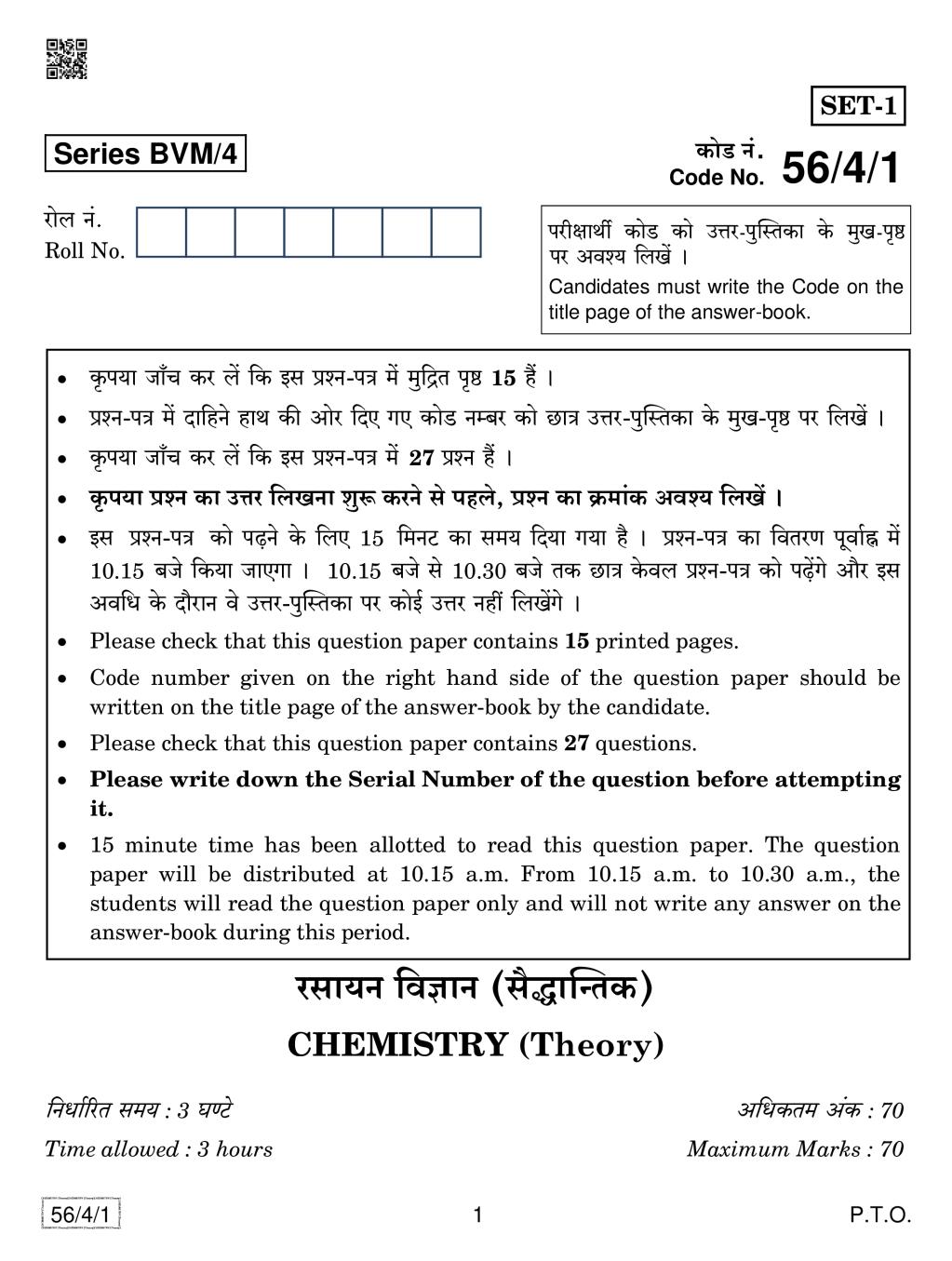
Series BVM/4 H$moS> Z§.
Code No. 56/4/1
amob Z§. narjmWu H$moS >H$mo CÎma-nwpñVH$m Ho$ _wI-n¥ð
Roll No. >na Adí` {bIo§ &
Candidates must write the Code on the
title page of the answer-book.
H¥$n`m Om±M H$a b| {H$ Bg àíZ-nÌ _o§ _w{ÐV n¥ð> 15 h¢ &
àíZ-nÌ _| Xm{hZo hmW H$s Amoa {XE JE H$moS >Zå~a H$mo N>mÌ CÎma-nwpñVH$m Ho$ _wI-n¥ð> na {bI| &
H¥$n`m Om±M H$a b| {H$ Bg àíZ-nÌ _| >27 àíZ h¢ &
H¥$n`m àíZ H$m CÎma {bIZm ewê$ H$aZo go nhbo, àíZ H$m H«$_m§H$ Adí` {bI| &
Bg àíZ-nÌ H$mo n‹T>Zo Ho$ {bE 15 {_ZQ >H$m g_` {X`m J`m h¡ & àíZ-nÌ H$m {dVaU nydm©• _|
10.15 ~Oo {H$`m OmEJm & 10.15 ~Oo go 10.30 ~Oo VH$ N>mÌ Ho$db àíZ-nÌ H$mo n‹T>|Jo Am¡a Bg
Ad{Y Ho$ Xm¡amZ do CÎma-nwpñVH$m na H$moB© CÎma Zht {bI|Jo &
Please check that this question paper contains 15 printed pages.
Code number given on the right hand side of the question paper should be
written on the title page of the answer-book by the candidate.
Please check that this question paper contains 27 questions.
Please write down the Serial Number of the question before attempting
it.
15 minute time has been allotted to read this question paper. The question
paper will be distributed at 10.15 a.m. From 10.15 a.m. to 10.30 a.m., the
students will read the question paper only and will not write any answer on the
answer-book during this period.
agm`Z {dkmZ (g¡ÕmpÝVH$)
CHEMISTRY (Theory)
{ZYm©[aV g_` : 3 KÊQ>o A{YH$V_ A§H$ : 70
Time allowed : 3 hours Maximum Marks : 70
56/4/1 1 P.T.O.
Page 2
(i) g^r àíZ A{Zdm`© h¢ &
(ii) IÊS> A : àíZ g§»`m 1 go 5 VH$ A{V bKw-CÎmar` àíZ h¢ Am¡a àË`oH$ àíZ Ho$ {bE 1 A§H$
h¡ &
(iii) IÊS> ~ : àíZ g§»`m 6 go 12 VH$ bKw-CÎmar` àíZ h¢ Am¡a àË`oH$ àíZ Ho$ {bE 2 A§H$ h¡§ &
(iv) IÊS> g : àíZ g§»`m 13 go 24 VH$ ^r bKw-CÎmar` àíZ h¢ Am¡a àË`oH$ àíZ Ho$ {bE 3 A§H$
h¢ &
(v) IÊS> X : àíZ g§»`m 25 go 27 VH$ XrK©-CÎmar` àíZ h¢ Am¡a àË`oH$ àíZ Ho$ {bE 5 A§H$ h¢ &
(vi) àíZ nÌ _| g_J« {dH$ën Zht {X`m J`m h¡ & {\$a ^r EH$ A§H$ dmbo Xmo àíZm| _|, Xmo A§H$m| dmbo
Xmo àíZmo§ _|, VrZ A§H$m| dmbo Mma àíZm| _| VWm nm±M A§H$m| dmbo VrZm| àíZm| _| {dH$ën {X`m J`m
h¡ & Eogo g^r àíZm| _| go AmnH$mo EH$ hr {dH$ën H$m CÎma XoZm h¡ &
(vii) `{X Amdí`H$Vm hmo, Vmo Amn bKwJUH$s` gma{U`m± _m±J gH$Vo h¢ & H¡$ëHw$boQ>am| Ho$ à`moJ H$s
AZw_{V Zht h¡ &
General Instructions :
(i) All questions are compulsory.
(ii) Section A : Questions number 1 to 5 are very short answer questions and carry
1 mark each.
(iii) Section B : Questions number 6 to 12 are short answer questions and carry
2 marks each.
(iv) Section C : Questions number 13 to 24 are also short answer questions and
carry 3 marks each.
(v) Section D : Questions number 25 to 27 are long answer questions and carry
5 marks each.
(vi) There is no overall choice. However, an internal choice has been provided in
two questions of one mark, two questions of two marks, four questions of three
marks and all the three questions of five marks weightage. You have to attempt
only one of the choices in such questions.
(vii) Use of log tables, if necessary. Use of calculators is not allowed.
IÊS> A
SECTION A
1. {ZåZ{b{IV {H«$ñQ>b _| Xmof {b{IE : 1
X+ Y– X+ Y–
Y– Y– X+
X+ X+ Y–
Y– X+ Y– X+
56/4/1 2
Page 3
X+ Y– X+ Y–
Y– Y– X+
X+ X+ Y–
Y– X+ Y– X+
2. O~ Cnghg§`moOZ `m¡{JH$ CrCl3 . 6H2O _| AgNO3 {_bm`m J`m Vmo à{V EH$ _mob
`m¡{JH$ Ho$ {bE Xmo _mob AgCl Ho$ Adjo{nV hþE & Cnghg§`moOZ `m¡{JH$ H$m g§aMZmË_H$
gyÌ Š`m h¡ ? 1
g§Hw$b Am¡a {Û bdU _| Š`m A§Va h¡ ? 1
When a coordination compound CrCl3 . 6H2O is mixed with AgNO3, two
moles of AgCl are precipitated per mole of the compound. What is the
structural formula of the coordination compound ?
OR
What is the difference between a complex and a double salt ?
3. EH$ CXmhaU g{hV ghMmar H$mobm°BS> H$mo n[a^m{fV H$s{OE & 1
Define associated colloid with an example.
4. n-ã`y{Q>b ~«mo_mBS> H$s VwbZm _| t-ã`y{Q>b ~«mo_mBS> SN1 A{^{H«$`m Ho$ à{V A{YH$
A{^{H«$`merb Š`m| h¡ ? 1
Why is t-butyl bromide more reactive towards SN1 reaction as compared
to n-butyl bromide ?
5. hm°\$_mZ ~«mo_m_mBS> {ZåZrH$aU A{^{H«$`m go gå~Õ A{^{H«$`m {b{IE & 1
àmonoZo_rZ Am¡a N,N-S>mB_o{Wb_oWoZo_rZ _| H$m~©Z na_mUwAm| H$s g§»`m g_mZ hmoVo hþE ^r
N,N-S>mB_o{Wb_oWoZo_rZ H$s VwbZm _| àmonoZo_rZ H$m ŠdWZm§H$ CƒVa hmoVm h¡ & Š`m| ? 1
Write the reaction involved in the Hoffmann bromamide degradation
reaction.
OR
Propanamine and N,N-dimethylmethanamine contain the same number
of carbon atoms, even though Propanamine has higher boiling point than
N,N-dimethylmethanamine. Why ?
56/4/1 3 P.T.O.
Page 4
SECTION B
6. {ZåZ{b{IV Ho$ {bE H$maU Xr{OE : 2
(a) Obr` ñnrerµO H$moîU Ob H$s VwbZm _| R>ÊS>o Ob _| A{YH$ Amam_ go ahVr h¢ &
(b) A{YH$ D±$MmB© na ahZo dmbo bmoJ EoZm°pŠg`m go nr{‹S>V hmo OmVo h¢, \$bñdê$n do
ñnîQ>V`m gmoM Zht nmVo h¢ &
EogrQ>moZ Ed§ Šbmoamo\$m°_© {db`Z go {H$g àH$ma H$m pñWaŠdmWr {_lU ~ZoJm ? {db`Z _|
{dH${gV A§VamAUwH$ ~bm| Ho$ gm_Ï`© Ho$ AmYma na nwpîQ> H$s{OE & 2
Give reasons for the following :
(a) Aquatic species are more comfortable in cold water than warm
water.
(b) At higher altitudes people suffer from anoxia resulting in inability
to think.
OR
What type of azeotropic mixture will be formed by a solution of acetone
and chloroform ? Justify on the basis of strength of intermolecular
interactions that develop in the solution.
7. à~b {dÚwV²-AnKQ>çm| Ho$ VZwH$aU Ho$ gmW _moba MmbH$Vm _| {dMaU H$s ì`m»`m AmboI
XoVo hþE H$s{OE & 2
Explain with a graph, the variation of molar conductivity of a strong
electrolyte with dilution.
8. O~ {H$gr ZmBQ´>oQ> Am`Z `wº$ Obr` {db`Z _| VZw \o$ag gë\o$Q> {db`Z {_bmZo Ho$ níMmV²
gmdYmZrnyd©H$ naIZbr H$s Xrdma Ho$ ghmao gm§Ð gëâ`y[aH$ Aåb {_bm`m OmVm h¡, Vmo
{db`Z VWm gëâ`y[aH$ Aåb A§Vamn¥îR> na EH$ ^yar db` ~Z OmVr h¡ & ^yar db` H$m
~ZZm {H$g G$Um`Z H$s CnpñW{V gw{ZpíMV H$aVm h¡ & ^yar db` H$m g§KQ>Z Š`m h¡ ? 2
Amn HCl go Cl2 H$m {daMZ Am¡a Cl2 go HCl H$m {daMZ H¡$go H$a gH$Vo h¢ ? Ho$db
A{^{H«$`mE± {b{IE & 2
When dilute ferrous sulphate solution is added to an aqueous solution
containing nitrate ion followed by careful addition of concentrated
sulphuric acid along the sides of test tube, a brown ring is formed at the
interface between the solution and sulphuric acid layers. Which anion is
confirmed by the appearance of brown ring ? What is the composition of
the brown ring ?
OR
How can you prepare Cl2 from HCl and HCl from Cl2 ? Write reactions
only.
56/4/1 4
Page 5
H$s{OE : 12=2
Cr Mn Fe Co
Eo 2 – 0·91 – 1·18 – 0·44 – 0·28
M /M
o
E 3 – 0·41 + 1·57 + 0·77 + 1·97
M / M2
(a) Obr` _mÜ`_ _| H$m¡Z à~bVa AnMm`H$ h¡, Cr2+ AWdm Fe2+ Am¡a Š`m| ?
(b) +2 Am°ŠgrH$aU AdñWm _| H$m¡Z-gm g~go A{YH$ ñWm`r Am`Z h¡ Am¡a Š`m| ?
Use the data to answer the following and also justify giving reason :
Cr Mn Fe Co
Eo 2 – 0·91 – 1·18 – 0·44 – 0·28
M /M
o
E 3 – 0·41 + 1·57 + 0·77 + 1·97
M / M2
(a) Which is a stronger reducing agent in aqueous medium,
Cr2+ or Fe2+ and why ?
(b) Which is the most stable ion in +2 oxidation and why ?
10. g_rH$aU g{hV n[a^m{fV H$s{OE : 12=2
(a) amB_a-Q>r_Z A{^{H«$`m
(b) {d{b`_gZ g§íbofU
Define with equation :
(a) Riemer-Tiemann Reaction
(b) Williamson’s Synthesis
11. {ZåZ{b{IV ~hþbH$m| Ho$ EH$bH$m| H$s g§aMZmE± Xr{OE : 12=2
(a) ZmBbm°Z-6,6
(b) ã`yZm-S
Give the structures of monomers of the following polymers :
(a) Nylon-6,6
(b) Buna-S
56/4/1 5 P.T.O.
Page 6
(a) Q>oâbm°Z
(b) PHBV
Classify the following as addition and condensation polymers giving
reason :
(a) Teflon
(b) PHBV
IÊS> g
SECTION C
13. H«$mo{_`_ bcc g§aMZm _| {H«$ñQ>brH¥$V hmoVm h¡ & `{X BgHo$ H$moa H$s b§~mB© 300 pm h¡, Vmo
BgH$m KZËd n[aH${bV H$s{OE & H«$mo{_`_ H$m na_mpÊdH$ Ðì`_mZ 52 u h¡ &
[NA = 6.022 1023 mol1] 3
Chromium crystallises in bcc structure. If its edge length is 300 pm, find
its density. Atomic mass of chromium is 52 u. [NA = 6.022 1023 mol1]
14. 300 K na 30 g à{V brQ>a gm§ÐVm dmbo ½byH$mog Ho$ {db`Z H$m namgaU Xm~ 4·98 bar
h¡ & `{X Bgr Vmn na ½byH$mog {db`Z H$m namgaU Xm~ 1·52 bar h¡, Vmo CgH$s gm§ÐVm
Š`m hmoJr ? 3
At 300 K, 30 g of glucose present in a litre of its solution has an osmotic
pressure of 4·98 bar. If the osmotic pressure of a glucose solution is
1·52 bar at the same temperature, what would be its concentration ?
15. {ZåZ{b{IV A{^{H«$`m H$m rG Am¡a log Kc n[aH${bV H$s{OE : 3
Cd+2(aq) + Zn(s) Zn2+(aq) + Cd(s)
{X`m h¡ : Eo 2 = – 0·403 V
Cd / Cd
o
E = – 0·763 V
Zn 2 / Zn
CrO3 dmbo Aåbr` {db`Z go H«$mo{_`_ YmVw H$m {ZåZ{b{IV g_rH$aU Ho$ AZwgma
{dÚwV²-bonZ {H$`m OmVm h¡ :
CrO3(aq) + 6H+ + 6e Cr(s) + 3H2O
n[aH${bV H$s{OE {H$ 24,000 Hy$bm°_ go H«$mo{_`_ Ho$ {H$VZo J«m_ {dÚwV²-bo{nV hmo|Jo VWm
12·5 A H$s {dÚwV² Ymam à`wº$ H$aZo na 1·5 g H«$mo{_`_ {dÚwV²-bo{nV H$aZo _| {H$VZm g_`
bJoJm ? [Cr H$m na_mUw ^ma = 52 g mol1, 1 F = 96500 C mol1] 3
56/4/1 6
Page 7
Cd+2(aq) + Zn(s) Zn2+(aq) + Cd(s)
Given : Eo 2 = – 0·403 V
Cd / Cd
Eo 2 = – 0·763 V
Zn / Zn
OR
Chromium metal is electroplated using an acidic solution containing
CrO3 according to the following equation :
CrO3(aq) + 6H+ + 6e Cr(s) + 3H2O
Calculate how many grams of chromium will be electroplated by
24,000 coulombs. How long will it take to electroplate 1·5 g chromium
using 12·5 A current ?
[Atomic mass of Cr = 52 g mol1, 1 F = 96500 C mol1]
16. {ZåZ{b{IV Ho$ {bE H$maU Xr{OE : 13=3
(a) M_©emoYZ Ho$ níMmV² M_© H$R>moa hmo OmVm h¡ &
(b) eara Ho$ {H$gr ^mJ Ho$ H$Q> OmZo na aº$òmd H$s AdñWm _| KCl H$s Anojm
FeCl3 H$mo dar`Vm Xr OmVr h¡ &
(c) {H$gr R>mog na J¡g Ho$ A{YemofU Ho$ {bE Cƒ Xm~ na \«$m°`ÝS>{bH$ g_Vmnr Xm~ go
ñdV§Ì hmo OmVr h¡ &
Give reasons for the following :
(a) Leather gets hardened after tanning.
(b) FeCl3 is preferred over KCl in case of a cut leading to bleeding.
(c) Freundlich isotherm becomes independent of pressure at high
pressure for a gas absorbed on a solid.
17. {ZåZ{b{IV H$s Š`m ^y{_H$m h¡ : 13=3
(a) \o$Z ßbdZ {d{Y _| AdZ_H$ H$s
(b) _m°ÝS> àH«$_ _| H$m~©Z _moZm°ŠgmBS> H$s
(c) ~m°ŠgmBQ>> go Eobw{_Zm Ho$ {ZjmbZ _| gmÝÐ gmo{S>`_ hmBS´>m°ŠgmBS> H$s
~m°ŠgmBQ> A`ñH$ go Eobw{_{Z`_ Ho$ {ZîH$f©U _§o hmoZo dmbr amgm`{ZH$ A{^{H«$`mE± {b{IE & 3
56/4/1 7 P.T.O.
Page 8
(a) Depressants in froth floatation ?
(b) Carbon monoxide in Mond’s process ?
(c) Concentrated sodium hydroxide in leaching of alumina from
bauxite ?
OR
Write chemical reactions taking place in the extraction of Aluminium
from Bauxite ore.
18. H«$mo_mBQ> A`ñH$ go gmo{S>`_ S>mBH«$mo_oQ> H$s {daMZ {d{Y H$s ì`m»`m H$s{OE & S>mBH«$mo_oQ
Am`Z Ûmam \o$ag bdUm| Ho$ Am°ŠgrH$aU H$mo {Zê${nV H$aZo Ho$ {bE g_rH$aU Xr{OE & 13=3
{ZåZ{b{IV A{^{H«$`mAm| H$mo nyU© H$s{OE : 13=3
(a) MnO2 + KOH + O2
–
(b) I– + MnO 4 + H+
2–
(c) Cr2O7 + Sn2+ + H+
Explain the method of preparation of sodium dichromate from chromite
ore. Give the equation representing oxidation of ferrous salts by
dichromate ion.
OR
Complete the following reactions :
(a) MnO2 + KOH + O2
–
(b) I– + MnO 4 + H+
2–
(c) Cr2O7 + Sn2+ + H+
19. {ZåZ{b{IV g§Hw$bm| H$s g§H$aU AdñWm Am¡a Mw§~H$s` JwU {b{IE : 3
(i) [Fe(H2O)6]2+
(ii) [Ni(CN)4]2
[na_mUw H«$_m§H$ : Fe = 26, Ni = 28]
Write the hybridization and magnetic character of the following
complexes :
(i) [Fe(H2O)6]2+
(ii) [Ni(CN)4]2
[Atomic number : Fe = 26, Ni = 28]
56/4/1 8
Page 9
(a) Am°Wm©o AWdm n¡am pñW{V na –NO2 g_yh H$s CnpñW{V h¡bmoEoarZm| H$s Zm{^H$amJr
à{VñWmnZ A{^{H«$`mAm| Ho$ à{V {H«$`merbVm ~‹T>m XoVr h¡ &
(b) Am°Wm©o AWdm _oQ>m g_md`d H$s VwbZm _| p-S>mBŠbmoamo~oݵOrZ H$m JbZm§H$ CƒVa
hmoVm h¡ &
(c) EoëH$mohm°bm| go EpëH$b ŠbmoamBS> {daMZ Ho$ {bE Wm`mo{Zb ŠbmoamBS> {d{Y H$mo
dar`Vm Xr OmVr h¡ &
(a) 1-Šbmoamoã`yQ>oZ go 1-Am`moS>moã`yQ>oZ Ho$ {daMZ H$m g_rH$aU {b{IE &
(b) 2-~«mo_monoÝQ>oZ, 2-~«mo_mo-2-_o{Wbã`yQ>oZ Am¡a 1-~«mo_monoÝQ>oZ _| go H$m¡Z-gm `m¡{JH$
{dbmonZ A{^{H«$`m Ho$ à{V A{YH$ {H«$`merb h¡ Am¡a Š`m| ?
(c) IUPAC Zm_ {b{IE : 13=3
Give reasons for the following :
(a) The presence of –NO2 group at ortho or para position increases
the reactivity of haloarenes towards nucleophilic substitution
reactions.
(b) p-dicholorobenzene has higher melting point than that of ortho or
meta isomer.
(c) Thionyl chloride method is preferred for preparing alkyl chloride
from alcohols.
OR
(a) Write equation for preparation of 1-iodobutane from
1-chlorobutane.
(b) Out of 2-bromopentane, 2-bromo-2-methylbutane and
1-bromopentane, which compound is most reactive towards
elimination reaction and why ?
(c) Give IUPAC name of
56/4/1 9 P.T.O.
Page 10
(b) {ZåZ{b{IV A{^{H«$`m H$s H$m`©{d{Y {b{IE : 1+2=3
H
CH3CH2OH CH2 = CH2 + H2O
443 K
(a) How will you synthesise the following alcohol from appropriate
alkene :
(b) Write the mechanism of the following reaction :
H
CH3CH2OH CH2 = CH2 + H2O
443 K
22. (a) {ZåZ{b{IV `m¡{JH$ `wJbm| _| {d^oX Ho$ {bE EH$-EH$ amgm`{ZH$ narjU Xr{OE :
(i) CH3NH2 Am¡a (CH3)2NH
(ii) Eo{ZbrZ Am¡a EWoZo_rZ
(b) Eo{ZbrZ \«$sS>ob-H«$mâQ>²g A{^{H«$`m Š`m| Zht XoVr h¡ ? 3
(a) Give one chemical test to distinguish between the compounds of
the following pairs :
(i) CH3NH2 and (CH3)2NH
(ii) Aniline and Ethanamine
(b) Why aniline does not undergo Friedel-Crafts reaction ?
56/4/1 10
Page 11
g_Pm`m Om gH$Vm h¡ &
(b) Eo{_bog Am¡a Eo{_bmonopŠQ>Z H$s g§KQ>ZmË_H$ g§aMZm Ho$ nXm| _| VwbZm H$s{OE &
(c) Eo_rZmo Aåb C^`Y_u àH¥${V Š`m| Xem©Vo h¢ ? 13=3
(a) Give any one property of glucose that cannot be explained by the
open chain structure.
(b) Compare amylase with amylopectin in terms of constituting
structure.
(c) Why do amino acids show amphoteric behaviour ?
24. {ZåZ{b{IV H$mo C{MV CXmhaU g{hV n[a^m{fV H$s{OE : 13=3
(a) ny{VamoYr (EpÝQ>gopßQ>H$)
(b) AñdmnH$ (Zm°Z-ZmaH$mo{Q>H$) nr‹S>mhmar
(c) YZm`Zr An_mO©H$
Define the following with suitable example of each :
(a) Antiseptics
(b) Non-narcotic analgesics
(c) Cationic detergents
IÊS> X
SECTION D
25. (a) A{^{H«$`m R P na {dMma H$s{OE {Og_| R H$s gmÝÐVm _| g_` Ho$ gmW
n[adV©Z {ZåZ{b{IV AmboI Ûmam Xem©`m J`m h¡ :
(i) A{^{H«$`m H$s H$mo{Q> H$s àmJw{º$ H$s{OE &
(ii) dH«$ H$s T>mb (àdUVm) Š`m B§{JV H$aVr h¡ ?
56/4/1 11 P.T.O.
Page 12
OmVm h¡ & Ea H$s JUZm `h _mZVo hþE H$s{OE {H$ BgH$m _mZ Vmn Ho$ gmW
n[ad{V©V Zht hmoVm h¡ & 1+2+2=5
[R = 8·314 JK–1 mol–1]
(a) {H$gr amgm`{ZH$ A{^{H«$`m Ho$ {bE ln k Am¡a 1/T Ho$ ~rM EH$ J«m\$ It{ME &
A§V:I§S> Š`m {Zê${nV H$aVm h¡ ? T>mb Ed§ Ea Ho$ _Ü` g§~§Y Š`m h¡ ?
(b) EH$ àW_ H$mo{Q> H$s A{^{H«$`m _| 20% {d`moOZ hmoZo _| 30 {_ZQ> bJVo h¢ & t1/2
H$s JUZm H$s{OE & [log 2 = 0·3010] 2+3=5
(a) Consider the reaction R P for which the change in concentration
of R with time is shown by the following graph :
(i) Predict the order of reaction.
(ii) What does the slope of the curve indicate ?
(b) The rate of reaction quadruples when temperature changes from
293 K to 313 K. Calculate Ea assuming that it does not change
with time. [R = 8·314 JK–1 mol–1]
OR
(a) Draw the plot of ln k vs 1/T for a chemical reaction. What does the
intercept represent ? What is the relation between slope and Ea ?
(b) A first order reaction takes 30 minutes for 20% decomposition.
Calculate t . [log 2 = 0.3010]
1/2
56/4/1 12
Page 13
(i) HClO3
(ii) H2S2O8
(b) {ZåZ{b{IV Ho$ {bE H$maU Xr{OE :
(i) gë\$a 1000 K Ho$ D$na AZwMwå~H$Ëd Xem©Vm h¡ &
(ii) `Ú{n âbwAmoarZ H$s BboŠQ´>m°Z bpãY EÝW¡ënr ŠbmoarZ H$s VwbZm _| H$_
G$UmË_H$ h¡, bo{H$Z âbwAmoarZ, ŠbmoarZ H$s Anojm à~b Am°ŠgrH$maH$
h¡ &
(iii) R>mog AdñWm _| PCl5 H$m ApñVËd Am`{ZH$ `m¡{JH$ H$s ^m±{V hmoVm h¡ & 2+3=5
(a) {ZåZ{b{IV A{^{H«$`mAm| H$mo nyU© H$s{OE :
(i) PbS(s) + O3
(ii) XeF6 + NaF
(b) H$maU XoVo hþE {ZåZ{b{IV H$mo B§{JV JwUY_© Ho$ ~‹T>Vo H«$_ _| ì`dpñWV H$s{OE :
(i) dJ© 15 Ho$ hmBS´>mBS> – ŠdWZm§H$
(ii) dJ© 17 Ho$ hmBS´>mBS> – Aåbr` gm_Ï`©
(iii) dJ© 16 Ho$ hmBS´>mBS> – AnMm`H$ JwU 2+3=5
(a) Draw the structure of the following :
(i) HClO3
(ii) H2S2O8
(b) Give reasons for the following :
(i) Above 1000 K sulphur shows paramagnetism.
(ii) Although electron gain enthalpy of fluorine is less negative
than that of chlorine, yet flourine is a better oxidising agent
than chlorine.
(iii) In solid state PCl5 exists as an ionic compound.
OR
(a) Complete the following reactions :
(i) PbS(s) + O3
(ii) XeF6 + NaF
56/4/1 13 P.T.O.
Page 14
giving reason :
(i) Hydrides of group 15 – boiling points
(ii) Hydrides of group 17 – acidic strength
(iii) Hydrides of group 16 – reducing character
27. (a) {ZåZ{b{IV ê$nmÝVaU {Zînm{XV H$s{OE :
(i) p-ZmBQ´>moQ>m°byB©Z go 2-~«mo_mo~oݵOmoBH$ Aåb
(ii) àmonoZmoBH$ Aåb go Eogr{Q>H$ Aåb
(b) C5H10 AUwgyÌ dmbm H$moB© EoëH$sZ AmoµOmoZr-AnKQ>Z Ûmam B Am¡a C, Xmo `m¡{JH$m|
H$m {_lU XoVm h¡ & `m¡{JH$ B YZmË_H$ \o$qbJ narjU XoVm h¡ VWm Am`moS>rZ Am¡a
NaOH {db`Z go ^r A{^{H«$`m H$aVm h¡ & `m¡{JH$ C \o$qbJ narjU Zht XoVm
naÝVw Am`moS>mo\$m°_© ~ZmVm h¡ & `m¡{JH$ A, B Am¡a C H$mo nhMm{ZE & 2+3=5
(a) {ZåZ{b{IV ê$nmÝVaU {Zînm{XV H$s{OE :
(i) ~oݵOmoBH$ Aåb go Eo{ZbrZ
(ii) ~«mo_mo_oWoZ go EWoZm°b
(b) {ZåZ{b{IV _| _w»` CËnmX/CËnmXm| H$s g§aMZm {b{IE :
2+3=5
56/4/1 14
Page 15
(i) P-nitrotoluene to 2-bromobenzoic acid
(ii) Propanoic acid to acetic acid
(b) An alkene with molecular formula C5H10 on ozonolysis gives a
mixture of two compounds, B and C. Compound B gives positive
Fehling test and also reacts with iodine and NaOH solution.
Compound C does not give Fehling solution test but forms
iodoform. Identify the compounds A, B and C.
OR
(a) Carry out the following conversions :
(i) Benzoic acid to aniline
(ii) Bromomethane to ethanol
(b) Write the structure of major product(s) in the following :
56/4/1 15 P.T.O.
Document Details
| Board / Org | CBSE |
| Exam | Class 12 |
| Type | Question Paper |
| Pages | 15 |
| Updated | 09 Jun 2026 |