CBSE Class 12 Biology Question Paper 2020 Set 57-B
Finished viewing? Save it for later —
Download CBSE Class 12 Biology Question Paper 2020 Set 57-B (PDF · 15 pages)About CBSE Class 12 Biology Question Paper 2020 Set 57-B
CBSE Class 12 Biology Question Paper 2020 Set 57-B is available here for free download. Published by CBSE for Class 12, this question paper can be viewed online or downloaded as a PDF (15 pages). Candidates preparing for Class 12 can use CBSE Class 12 Biology Question Paper 2020 Set 57-B to understand the exam pattern, the type of questions asked, and the overall difficulty level.
Frequently Asked Questions
How can I download CBSE Class 12 Biology Question Paper 2020 Set 57-B?
Open this page and click the Download button to save CBSE Class 12 Biology Question Paper 2020 Set 57-B as a PDF. It is completely free on AglaSem Docs.
Is CBSE Class 12 Biology Question Paper 2020 Set 57-B free to download?
Yes. CBSE Class 12 Biology Question Paper 2020 Set 57-B can be viewed online and downloaded as a PDF free of cost on AglaSem Docs.
How many pages does CBSE Class 12 Biology Question Paper 2020 Set 57-B have?
CBSE Class 12 Biology Question Paper 2020 Set 57-B contains 15 pages, which you can read online or download together as a single PDF.
Where can I find more Class 12 study material?
You can find more Class 12 question papers, sample papers, syllabus, and answer keys on AglaSem Docs.
CBSE Class 12 Biology Question Paper 2020 Set 57-B – Text
Read the full text of this question paper below — useful to quickly search, copy and reference the content online without downloading the PDF.
📄 View text version (15 pages)
Page 1
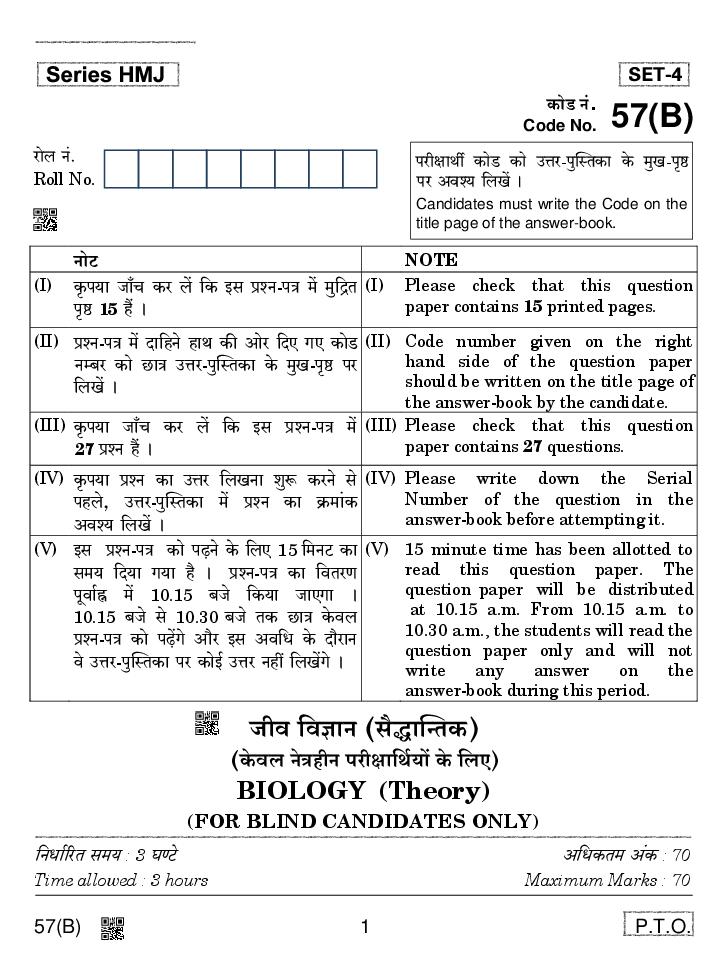
Code No. 57(B)
amob Z§. narjmWu H$moS >H$mo CÎma-nwpñVH$m Ho$ _wI-n¥ð
Roll No. >na Adí` {bIo§ &
Candidates must write the Code on the
title page of the answer-book.
ZmoQ> NOTE
(I) H¥$n`m Om±M H$a b| {H$ Bg àíZ-nÌ _o§ _w{ÐV (I) Please check that this question
n¥ð> 15 h¢ & paper contains 15 printed pages.
(II) àíZ-nÌ _| Xm{hZo hmW H$s Amoa {XE JE H$moS (II) Code number given on the right
>Zå~a H$mo N>mÌ CÎma-nwpñVH$m Ho$ _wI-n¥ð> na hand side of the question paper
{bI| & should be written on the title page of
the answer-book by the candidate.
(III) H¥$n`m Om±M H$a b| {H$ Bg àíZ-nÌ _| (III) Please check that this question
>27 àíZ h¢ & paper contains 27 questions.
(IV) H¥$n`m àíZ H$m CÎma {bIZm ewê$ H$aZo go (IV) Please write down the Serial
nhbo, CÎma-nwpñVH$m _| àíZ H$m H«$_m§H$ Number of the question in the
Adí` {bI| & answer-book before attempting it.
(V) Bg àíZ-nÌ H$mo n‹T>Zo Ho$ {bE 15 {_ZQ >H$m (V) 15 minute time has been allotted to
g_` {X`m J`m h¡ & àíZ-nÌ H$m {dVaU read this question paper. The
nydm©• _| 10.15 ~Oo {H$`m OmEJm & question paper will be distributed
10.15 ~Oo go 10.30 ~Oo VH$ N>mÌ Ho$db at 10.15 a.m. From 10.15 a.m. to
10.30 a.m., the students will read the
àíZ-nÌ H$mo n‹T>|Jo Am¡a Bg Ad{Y Ho$ Xm¡amZ question paper only and will not
do CÎma-nwpñVH$m na H$moB© CÎma Zht {bI|Jo & write any answer on the
answer-book during this period.
Ord {dkmZ (g¡ÕmpÝVH$)
(Ho$db ZoÌhrZ narjm{W©`m| Ho$ {bE)
BIOLOGY (Theory)
(FOR BLIND CANDIDATES ONLY)
{ZYm©[aV g_` : 3 KÊQ>o A{YH$V_ A§H$ : 70
Time allowed : 3 hours Maximum Marks : 70
57(B) 1 P.T.O.
Page 2
{ZåZ{b{IV {ZX}em| H$mo ~hþV gmdYmZr go n{‹T>E Am¡a CZH$m g™Vr go nmbZ H$s{OE :
(i) àíZ-nÌ nm±M IÊS>m| _§| {d^m{OV {H$`m J`m h¡ H$, I, J, K Am¡a L> &
(ii) Bg àíZ-nÌ _| 27 àíZ h¢ & g^r àíZ A{Zdm`© h¢ &
(iii) IÊS> H$ _| àíZ g§»`m 1 go 5 VH$ ~hþ{dH$ënr` àíZ h¢, àË`oH$ àíZ 1 A§H$
H$m h¡ &
(iv) IÊS> I _| àíZ g§»`m 6 go 12 VH$ bKw-CÎmar` àH$ma-I Ho$ àíZ h¢, àË`oH$
àíZ 2 A§H$m| H$m h¡ &
(v) IÊS> J _| àíZ g§»`m 13 go 21 VH$ bKw-CÎmar` àH$ma-II Ho$ àíZ h¢, àË`oH$
àíZ 3 A§H$m| H$m h¡ &
(vi) IÊS> K _| àíZ g§»`m 22 go 24 VH$ bKw-CÎmar` àH$ma-III Ho$ àíZ h¢, àË`oH$
àíZ 3 A§H$m| H$m h¡ &
(vii) IÊS> L> _| àíZ g§»`m 25 go 27 VH$ XrK©-CÎmar` àíZ h¢, àË`oH$ àíZ 5 A§H$m|
H$m h¡ &
(viii) CÎma g§{já VWm q~Xþdma hmoZo Mm{hE &
(ix) Bg àíZ-nÌ _| g_J« na H$moB© {dH$ën Zht h¡ & VWm{n EH$-EH$ A§H$ dmbo Xmo
àíZm| _|, Xmo-Xmo A§H$m| dmbo EH$ àíZ _§o, VrZ-VrZ A§H$m| dmbo Xmo àíZm| _§o Am¡a
nm±M-nm±M A§H$m| dmbo VrZm| àíZm| _§o Am§V[aH$ {dH$ën {XE JE h¢ & Eogo àíZm| _|
Ho$db EH$ hr {dH$ën H$m CÎma Xr{OE &
(x) BgHo$ A{V[aº$, Amdí`H$VmZwgma, àË`oH$ IÊS> Am¡a àíZ Ho$ gmW `Wmo{MV {ZX}e
{XE JE h¢ &
IÊS H$ $
1. H$mo{Z{S>¶m Ûmam Ab¢{JH$ àOZZ H$aZo dmbm Ord h¡ 1
(A) hmBS´>m
(B) ñn§O
(C) n¡{Zgr{b¶‘
(D) A‘r~m
57(B) 2
Page 3
Read the following instructions very carefully and strictly follow them :
(i) Question paper comprises five sections – A, B, C, D and E.
(ii) There are 27 questions in the question paper. All questions are
compulsory.
(iii) Section A – Questions no. 1 to 5 are multiple choice questions,
carrying 1 mark each.
(iv) Section B – Questions no. 6 to 12 are short-answer questions
type-I, carrying 2 marks each.
(v) Section C – Questions no. 13 to 21 are short-answer questions
type-II, carrying 3 marks each.
(vi) Section D – Questions no. 22 to 24 are short-answer questions
type-III, carrying 3 marks each.
(vii) Section E – Questions no. 25 to 27 are long-answer questions,
carrying 5 marks each.
(viii) Answers should be brief and to the point.
(ix) There is no overall choice in the question paper. However, an
internal choice has been provided in two questions of 1 mark,
one question of 2 marks, two questions of 3 marks and all
three questions of 5 marks. Only one of the choices in such
questions have to be attempted.
(x) In addition to this, separate instructions are given with each
section and question, wherever necessary.
SECTION A
1. The organism that reproduces asexually through conidia is 1
(A) Hydra
(B) Sponge
(C) Penicillium
(D) Amoeba
57(B) 3 P.T.O.
Page 4
Cn¶moJ H$s ghm¶Vm go ¶h {ZîH$f© {ZH$mbm {H$ ‘‘S>r.EZ.E. à{VH¥${V¶Z AY©g§ajr
h¡’’ Ho$ Zm‘ h¢ 1
(A) dmQ>gZ Ed§ {H«$H$
(B) ‘ogoëgZ Ed§ ñQ>mb
(C) Amono[aZ Ed§ hmëS>oZ
(D) hf} Ed§ Mog
AWdm
‘mZd é{Ya dJm] H$m {Z¶§ÌU H$aZo dmbr OrZ ‘I’ Ho$ VrZ Ebrb hmoVo h¢ &
‘mZd é{Ya Ho$ g§^m{dV OrZràê$n (OrZmoQ>mBn) VWm Ñí`àê$n (’$sZmoQ>mBn) hmo
gH$Vo h¢ 1
(A) 7 OrZràê$n VWm 7 Ñí`àê$n
(B) 7 OrZràê$n VWm 4 Ñí`àê$n
(C) 6 OrZràê$n VWm 4 Ñí`àê$n
(D) 4 OrZràê$n VWm 4 Ñí`àê$n
3. n{j¶m| ‘| qbJ {ZYm©aU Ho$ {bE CÎmaXm`r qbJ H«$mo‘mogmo‘ h¢ 1
(A) XO àH$ma
(B) XX àH$ma
(C) ZW àH$ma
(D) ZZ àH$ma
4. ES>rg ‘ÀN>a {Og ‘mZd amoJ Ho$ g§dmhH$ H$m H$m¶© H$aVm h¡, dh amoJ h¡ 1
(A) ‘bo[a¶m
(B) S>|Jy
(C) {S>µâWr[a¶m
(D) ݶy‘mo{Z¶m
57(B) 4
Page 5
density gradient that helped them to reach the conclusion that
the DNA replication is semi-conservative are 1
(A) Watson and Crick
(B) Meselson and Stahl
(C) Oparin and Haldane
(D) Hershey and Chase
OR
The possible number of genotypes and phenotypes of human
blood groups, where gene ‘I’ with three alleles control the blood
group is 1
(A) 7 genotypes and 7 phenotypes
(B) 7 genotypes and 4 phenotypes
(C) 6 genotypes and 4 phenotypes
(D) 4 genotypes and 4 phenotypes
3. The sex chromosomes responsible for sex determination in
birds are 1
(A) XO type
(B) XX type
(C) ZW type
(D) ZZ type
4. The human disease where Aedes mosquito serves as a vector is 1
(A) Malaria
(B) Dengue
(C) Diphtheria
(D) Pneumonia
57(B) 5 P.T.O.
Page 6
Ord Ho$ ghO ßbmpµÁ_S> go Omo‹S>Zo go hþAm, dh Ord h¡ 1
(A) gmë‘moZobm Q>mB’$s‘y[a¶‘
(B) EJ«mo~¡³Q>r[a¶‘ Q>çy‘rµ’o${gE§g
(C) E§Q>A‘r~m {hñQ>mo{b{Q>H$m
(D) ñQ´>oßQ>moH$moH$g ݶy‘moZr
AWdm
nwZ¶m}JO S>r.EZ.E. VH$ZrH$ ‘| dm§{N>V n[aUm‘ àmßV H$aZo Ho$ {bE Cn¶moJr OrZ
H$mo h‘oem Bggo Omo‹S>m OmVm h¡ & 1
(A) nanmofr
(B) naOrdr
(C) do³Q>a (g§dmhH$)
(D) àmoQ>rZ
IÊS I
6. ‘‘Ab¢{JH$ OZZ H$aZo dmbo àm{U ³bmoZ ~ZmVo h¢ &’’ EH$ CXmhaU H$s ghm¶Vm go
H$WZ H$m Am¡{M˶ {gÕ H$s{OE & 2
AWdm
‘mBMo{b¶m Ho$ ñÌrHo$ga H$mo ~hþA§S>nr VWm {d¶w³Vm§S>nr ³¶m| H$hm OmVm h¡ ? 2
7. ‘narjmW© g§H$aU’ ³¶m h¡ ? BgH$m ‘hÎd {b{IE & 2
8. CZ Xmo {d{eîQ> A{^bjUm| H$s gyMr ~ZmBE {OZ na Cnm{O©V à{Vajm (E³dm¶S>©
Bå¶yZ) AZw{H«$¶m AmYm[aV h¡ & àmW{‘H$ VWm {ÛVr¶H$ à{Vajm AZw{H«$¶mAm| ‘|
{d^oX H$s{OE & 2
9. Ebrgm (ELISA) H$m {dñV¥V Zm‘ {b{IE & Cg amoJH$maH$ VWm amoJ H$m Zm‘
{b{IE {OgHo$ Z¡Xm{ZH$ narjU hoVw Ebrgm H$m Cn¶moJ {H$¶m OmVm h¡ & 2
10. ‘‘ñVZYmar A§Q>mH©${Q>H$m ‘| VWm ghmam ‘éñWb XmoZm| ‘| hr OrdZ`mnZ H$a gH$Vo
h¢ &’’ g‘PmBE dh Eogm H$aZo ‘| {H$g àH$ma gj‘ h¢ & 2
57(B) 6
Page 7
of a gene encoding antibiotic resistance with the native
plasmid of 1
(A) Salmonella typhimurium
(B) Agrobacterium tumefaciens
(C) Entamoeba histolytica
(D) Streptococcus pneumoniae
OR
In DNA recombinant technique, for desired results, the gene of
interest is always linked to 1
(A) host
(B) parasite
(C) vector
(D) protein
SECTION B
6. ‘‘Asexually reproducing animals produce clones.’’ Justify the
statement with the help of an example. 2
OR
Why, in Michelia, is the gynoecium said to be multicarpellary
and apocarpous ? 2
7. What is a ‘test cross’ ? Write its importance. 2
8. List the two specific features on which the acquired immune
response is based. Differentiate between primary and
secondary immune responses. 2
9. Expand ELISA. Name the pathogen and the disease for which
ELISA is used as a diagnostic test. 2
10. ‘‘Mammals can live in Antarctica as well as in the Sahara
Desert.’’ Explain how they manage to do this. 2
57(B) 7 P.T.O.
Page 8
h¢ &’’ ³¶m Amn Bg H$WZ go gh‘V h¢ ? EH$ g‘w{MV CXmhaU H$s ghm¶Vm go
AnZo CÎma H$s nw{îQ> H$s{OE & 2
12. ‘‘{dXoer Om{V¶m| H$m AmH«$‘U O¡d-{d{dYVm H$s j{V H$m EH$ à‘wI H$maU h¡ &’’
EH$ g‘w{MV CXmhaU H$s ghm¶Vm go H$WZ H$s ì¶m»¶m H$s{OE & 2
IÊS J
13. EH$ Amd¥V~rOr Ho$ ~rOmÊS> ‘| EH$ Jwé~rOmUw H$hm± Am¡a {H$g àH$ma {dH${gV
hmoVm h¡ ? EH$~rOmUwO {dH$mg ³¶m h¡ ? {b{IE & 3
14. nm¡Ym| ‘| {Za§Va ñdnamJU Ho$ ’$bñdê$n A§V…àOZZ AdZ‘Z hmoVm h¡ & ñdnamJU
H$mo hVmoËgm{hV H$aZo Ho$ {bE nm¡Ym| Ûmam {dH${gV {H$Ýht VrZ ~{h…àOZZ ¶w{³V¶m|
H$s ì¶m»¶m H$s{OE & 3
AWdm
_mZd {ñ̶m| Ho$ OZZm§Jm| ‘| {ZåZ{b{IV g§aMZmE± {d{eîQ> ê$n go H$hm± AdpñWV
hmoVr h¢ ? à˶oH$ H$m àH$m¶© ^r {b{IE & 3
(a) Pëbar (q’$~«r)
(b) Vw§{~H$m (Eånwbm)
(c) àmW{‘H$ nwQ>H$
15. {J«{\$W Ûmam AnZo à¶moJ ‘| Cn¶moJ {H$E JE OrdmUw H$m d¡km{ZH$ Zm‘ {b{IE &
CgHo$ Ûmam BñVo‘mb {H$E JE OrdmUw Ho$ {d{^Þ à^oXm| Ho$ Zm‘, VWm CZHo$
{d{eîQ> A{^bjU {b{IE & 3
16. {d{^Þ ‘mZdmoX²^dr {H«$¶mAm| H$s gyMr ~ZmH$a g‘PmBE {H$ CZHo$ Ûmam {dH$mg
{H$g àH$ma g§^d hþAm & 3
17. S>m{d©Z Zo ‘AZwHy$br {d{H$aU’ H$s ³¶m ì¶m»¶m H$s ? EH$ CXmhaU H$s ghm¶Vm go
AnZo CÎma H$s nw{îQ> H$s{OE & 3
18. ¶wdH$m| ‘| S´>J VWm EoëH$mohm°b Ho$ Hw$à¶moJ Ho$ {H$Ýht N>… gm‘mݶ gMoVH$
(MoVmdZr) g§Ho$Vm| H$s gyMr ~ZmBE & 3
57(B) 8
Page 9
either directly or indirectly.’’ Do you agree with this
statement ? Support your answer with the help of a suitable
example. 2
12. ‘‘Alien species invasion is one of the major causes of
biodiversity loss.’’ Explain the statement with the help of a
suitable example. 2
SECTION C
13. Where and how does a megaspore develop in an ovule of an
angiosperm ? State what is a monosporic development. 3
14. Continued self-pollination in plants results in inbreeding
depression. Explain any three outbreeding devices developed
by plants to discourage self-pollination. 3
OR
Where are the following located in the specific regions of a
human female’s reproductive organs ? State the function of
each one of them. 3
(a) Fimbriae
(b) Ampulla
(c) Primary follicle
15. Write the scientific name of the bacterium used by Griffith in
his experiment. Name the different strains of bacteria used,
and their characteristic features. 3
16. List the different anthropogenic actions, and explain how have
they led to evolution. 3
17. How did Darwin explain ‘adaptive radiation’ ? Support your
answer with the help of an example. 3
18. List any six common warning signs of drug and alcohol abuse
among the youth. 3
57(B) 9 P.T.O.
Page 10
{bE nmbVy n{j¶m| H$m ì`mdgm{`H$ à~§YZ {H$`m OmVm h¡ & CZHo$ ’$m‘© à~§YZ Ho$
{H$Ýht Mma ‘hÎdnyU© KQ>H$m| H$mo {b{IE & 3
AWdm
(a) ‘mZd eara ‘| Hw$N> àgm‘mݶ H$mo{eH$mE± H¢$gaOZr H¡$go hmo OmVr h¢ ?
(b) ‘oQ>mñQ>o{gg ³¶m h¡ ? 3
20. (a) àmH¥${VH$ ê$n go {‘bZo dmbo {H$Ýht Xmo ³bmoqZJ g§dmhH$m| (do³Q>am|) Ho$ Zm‘
{b{IE &
(b) EH$ ³bmoqZJ g§dmhH$ ‘| à{VH¥${V H$m ‘yb ‘Ori’ VWm ‘³bmoqZJ ñWbm|’ H$s
^y{‘H$m {b{IE & 3
21. (a) nr.gr.Ama. VH$ZrH$ ‘| Cn¶moJ {H$E OmZo dmbo S>r.EZ.E. nm°{b‘aoµO H$m
Zm‘ {b{IE & BgHo$ òmoV Ord H$m d¡km{ZH$ Zm‘ {b{IE & S>r.EZ.E.
nm°{b‘aoµO go ¶h S>r.EZ.E. {H$g àH$ma {^Þ h¡ ?
(b) nr.gr.Ama. VH$ZrH$ H$s Cn¶mo{JVm H$m CëboI H$s{OE & 3
IÊS> K
22. µ’$gbm| H$s nr‹S>H$ à{VamoYr {H$ñ‘| {dH${gV H$aHo$ nr‹S>H$Zm{e¶m| na h‘mar {Z^©aVm
H$‘ H$aZo ‘| O¡d-àm¡Úmo{JH$s Zo EH$ A{V ‘hÎdnyU© ^y{‘H$m {Z^mB© h¡ & Bg àH$ma
µ’$gb CËnmX ‘| d¥{Õ hmoZo go {H$gmZm| H$s ghm¶Vm hþB© h¡ & Bg VH$ZrH$ Ûmam
{dH${gV H$nmg H$s {H$ñ‘ BgH$m EH$ CXmhaU h¡ & ZrMo {XE JE àíZm| Ho$ CÎma
Xr{OE &
(a) Bg àH$ma {dH${gV H$nmg H$s JmobH$ eb^ H¥${‘ à{VamoYr {H$ñ‘ H$m Zm‘
{b{IE &
(b) O~ JmobH$ eb^ H¥${‘ Bg nm¡Yo H$m ImVm h¡, Vmo
(i) Bg nm¡Yo Ho$ àmH²${df Am±Ì ‘| {H$g àH$ma g{H«$¶ hmo OmVo h¢ ?
(ii) Bggo H¥${‘ H$s Am±Ì na ³¶m à^md n‹S>Vm h¡ {H$ nr‹S>H$ H$s ‘¥Ë¶w hmo
OmVr h¡ ? 3
57(B) 10
Page 11
their eggs managed for commercial purpose. Write any four
important components of their farm management. 3
OR
(a) How do normal cells in a human body become cancerous ?
(b) What is metastasis ? 3
20. (a) Name any two naturally occurring cloning vectors.
(b) State the role of ‘Ori’ and ‘Cloning sites’ in a cloning
vector. 3
21. (a) Name the DNA polymerase used in PCR technique.
Write the scientific name of its source organism. How is
this DNA different from the DNA polymerase ?
(b) Mention the application of PCR technique. 3
SECTION D
22. Biotechnology has played a very important role in reducing
reliance on pesticides by developing pest-resistant crop
varieties. Thus it has helped in increasing crop yields which
has helped the farmers. One such example is of cotton plant
being developed. Answer the questions that follow :
(a) Name the bollworm resistant variety of cotton plant that
was developed.
(b) When the bollworm ingests this plant,
(i) how do prototoxins from the plant get activated in
the gut ?
(ii) how does the gut get affected causing death of the
pest ? 3
57(B) 11 P.T.O.
Page 12
EH$b ì¶{îQ> Ho$ ê$n ‘| Zht nmE OmVo, daZ² do AnZr Om{V H$s g‘{îQ> Ho$ ê$n ‘|
ahVo h¢ &
(a) {d{^Þ àOm{V¶m| Ho$ Ordm| ‘| g‘yh ‘| ahZo H$s àd¥{Îm ³¶m| hmoVr h¡ Omo
g‘{îQ> H$s aMZm H$aVo h¢ ?
(b) g‘{îQ> KZËd H$mo {ZåZ{b{IV H$maH$ H¡$go à^m{dV H$aVo h¢ ?
(i) CËàdmgZ
(ii) AmàdmgZ 3
24. ‘Yw‘³Ir nmbZ àmMrZ H$mb go Mbm Am ahm EH$ Hw$Q>ra CÚmoJ h¡, Omo AnojmH¥$V
AmgmZ h¡, H$‘ bmJV dmbm h¡ VWm BgHo$ {bE {deofkVm H$s Amdí¶H$Vm ^r
Zht hmoVr & BgHo$ CËnmX go {H$gmZm| H$mo {Z¶{‘V Am¶ àmßV H$aZo ‘| ghm¶Vm
{‘b gH$Vr h¡ &
(a) ‘Yw‘³Ir nmbZ CÚmoJ go àmßV hmoZo dmbo Xmo gm‘mݶ bmoH${චCËnmXm| Ho$
Zm‘ {b{IE &
(b) AnZo Xoe ‘| ‘Yw‘³Ir nmbZ ‘| Cn¶moJ H$s OmZo dmbr ‘Yw‘³Ir H$s
gd©gm‘mݶ Om{V H$m d¡km{ZH$ Zm‘ {b{IE &
(c) ‘Yw‘³Ir nmbZ àUm{b¶m| Ho$ {bE M¶Z {H$E OmZo dmbo {H$gr Cn¶w³V
joÌ H$m CëboI H$s{OE & 3
IÊS> L>
25. EH$ Amd¥V~rOr nm¡Yo Ho$ nwîn ‘| gwg§JV namJU Ho$ níMmV² hmoZo dmbr n[aKQ>ZmAm|
H$m dU©Z ¶w½‘O (µOmBJmoQ>) ~ZZo H$s AdñWm VH$ H$s{OE & 5
AWdm
EH$ ñÌr (‘mXm ‘mZd) ‘| àmapå^H$ ^«yUmdñWm go ¶m¡dZmaå^ VH$ ‘A§S>OZZ’
(D$OoZo{gg) àH«$‘ H$m dU©Z H$s{OE & 5
57(B) 12
Page 13
microbes, tend to live as a single individual, but they have a
population of their own species.
(a) Why do different species of organisms tend to live in
groups that constitute population ?
(b) How do the following affect the population density ? 3
(i) Emigration
(ii) Immigration
24. Beekeeping practice is an age-old cottage industry which is
relatively easy, inexpensive and does not require
specialisation. It can help in generating regular income for the
farmers from its produce.
(a) Name two popular products obtained from the
beekeeping industry.
(b) Write the scientific name of the most common species of
bees used in beekeeping in our country.
(c) Mention any suitable area to be selected for beekeeping
practices. 3
SECTION E
25. Describe the events that follow after compatible pollination
up to zygote formation only, in an angiosperm flower. 5
OR
Describe the process of ‘Oogenesis’ in a human female, from
early embryonic life till adult reproductive life. 5
57(B) 13 P.T.O.
Page 14
g’o$X ’y$bm| dmbo nm¡Yo Ho$ gmW g§H$aU H$m F2 nr‹T>r VH$ H«$m°g ~ZmBE VWm
{ZåZ{b{IV _| ào{jV d§emJ{V n¡Q>Z© H$m dU©Z H$s{OE :
(i) F1 nr‹T>r
(ii) F2 nr‹T>r
(b) Bg àH$ma H$s d§emJ{V ‘|S>b Ûmam d{U©V EH$g§H$a H«$m°g Ho$ n¡Q>Z© go {H$g
àH$ma {^Þ h¡ ? 5
AWdm
(a) ñVZYm[a¶m| H$m 2·2 ‘rQ>a bå~m {ÛHw§$S>br S>r.EZ.E. BgH$s H$mo{eH$m Ho$
gyú‘ Ho$ÝÐH$ ‘| {H$g àH$ma g‘m{hV (n¡³S>) hmoVm h¡ ? ì¶m»¶m H$s{OE &
(b) Ho$db EH$ g§aMZmË‘H$ VWm EH$ àH$m¶m©Ë‘H$ A§Va XoVo hþE ¶yH«$mo‘o{Q>Z VWm
hoQ>oamoH«$mo‘o{Q>Z ‘| {d^oX H$s{OE & 5
27. (a) g§aMZm VWm g§KQ>Z Ho$ g§X^© ‘| g^r nm[apñW{VH$ g‘wXm¶m| Ho$ ‘hÎdnyU©
A{^bjUm| H$mo {b{IE & Ma‘ g‘wXm¶ ³¶m h¡ ?
(b) nm[apñW{VH$ AZwH«$‘U ³¶m h¡ ? àmW{‘H$ VWm {ÛVr¶H$ AZwH«$‘U ‘| A§Va
ñnîQ> H$s{OE & 5
AWdm
(a) {dídì`mnr CîUVm Ho$ {bE gdm©{YH$ à^mdH$mar Xmo ‘J«rZhmCg J¡gm|’ Ho$
Zm‘ {b{IE &
(b) ¶{X ‘J«rZhmCg à^md’ Zht hmoVm, Vmo n¥Ïdr na ³¶m à^md n‹S>Vm ? ¶h H¡$go
hmoVm h¡ ?
(c) n¥Ïdr na d¡pídH$ ({dídì¶mnr) CîUVm Ho$ g§KmV H$s ì¶m»¶m H$s{OE & 5
57(B) 14
Page 15
and true-bred white-flowered plant in Antirrhinum sp.
up to F2 generation. Describe the pattern of inheritances
observed in the following :
(i) F1 generation
(ii) F2 generation
(b) How is this pattern of inheritance different from the one
described by Mendel in a monohybrid cross ? 5
OR
(a) How is 2·2 metres length of double helix mammalian
DNA packed in a small nucleus of its cell ? Explain.
(b) Differentiate between euchromatin and heterochromatin
giving one structural and one functional difference only. 5
27. (a) Write the important characteristics of all the ecological
communities with respect to structure and composition.
What is a climax community ?
(b) What is an ecological succession ? Differentiate between
primary and secondary succession. 5
OR
(a) Name the two ‘greenhouse gases’ responsible for the
maximum contribution towards global warming.
(b) What would have happened on Earth without the
‘greenhouse effect’ ? How is it caused ?
(c) Explain the impact of global warming on Earth. 5
57(B) 15 P.T.O.
Document Details
| Board / Org | CBSE |
| Exam | Class 12 |
| Type | Question Paper |
| Pages | 15 |
| Updated | 22 Jul 2026 |