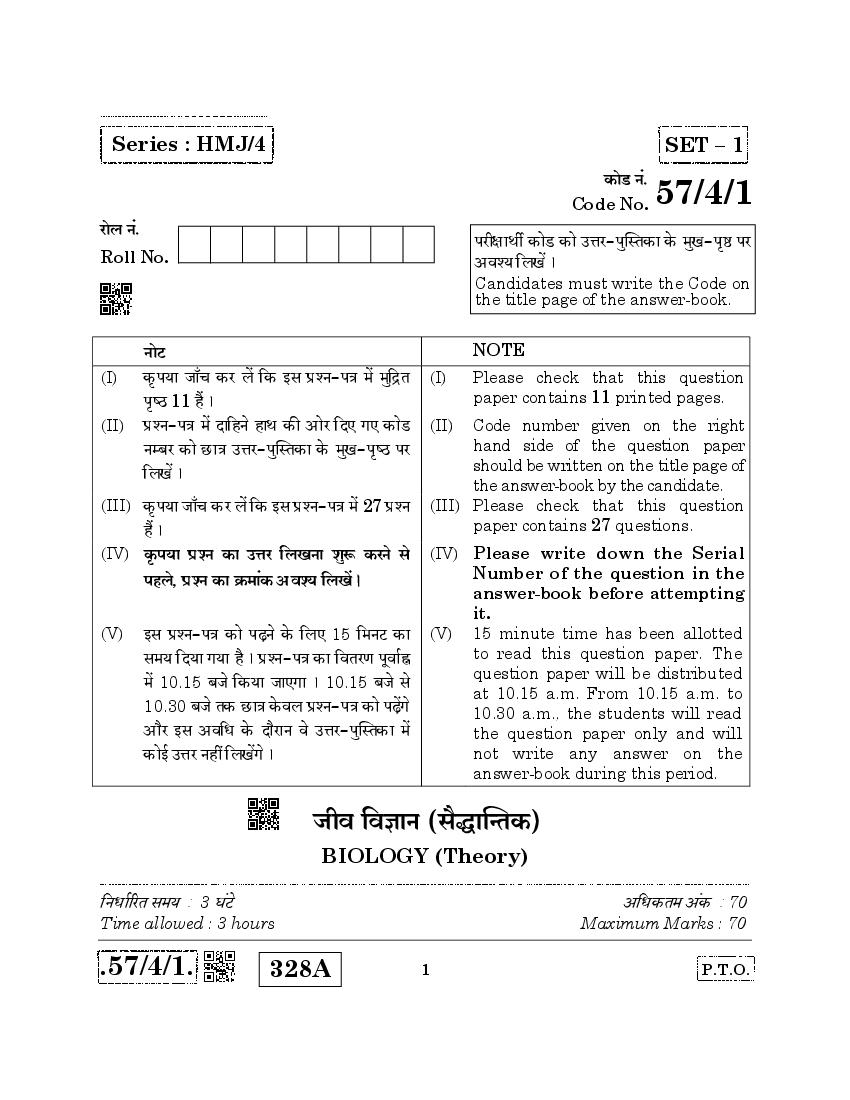
CBSE Class 12 Biology Question Paper 2020 Set 57-4-1
Finished viewing? Save it for later —
Download CBSE Class 12 Biology Question Paper 2020 Set 57-4-1 (PDF · 12 pages)About CBSE Class 12 Biology Question Paper 2020 Set 57-4-1
CBSE Class 12 Biology Question Paper 2020 Set 57-4-1 is available here for free download. Published by CBSE for Class 12, this question paper can be viewed online or downloaded as a PDF (12 pages). Candidates preparing for Class 12 can use CBSE Class 12 Biology Question Paper 2020 Set 57-4-1 to understand the exam pattern, the type of questions asked, and the overall difficulty level.
Frequently Asked Questions
How can I download CBSE Class 12 Biology Question Paper 2020 Set 57-4-1?
Open this page and click the Download button to save CBSE Class 12 Biology Question Paper 2020 Set 57-4-1 as a PDF. It is completely free on AglaSem Docs.
Is CBSE Class 12 Biology Question Paper 2020 Set 57-4-1 free to download?
Yes. CBSE Class 12 Biology Question Paper 2020 Set 57-4-1 can be viewed online and downloaded as a PDF free of cost on AglaSem Docs.
How many pages does CBSE Class 12 Biology Question Paper 2020 Set 57-4-1 have?
CBSE Class 12 Biology Question Paper 2020 Set 57-4-1 contains 12 pages, which you can read online or download together as a single PDF.
Where can I find more Class 12 study material?
You can find more Class 12 question papers, sample papers, syllabus, and answer keys on AglaSem Docs.
CBSE Class 12 Biology Question Paper 2020 Set 57-4-1 – Text
Read the full text of this question paper below — useful to quickly search, copy and reference the content online without downloading the PDF.
📄 View text version (12 pages)
Page 1
.
Code No. 57/4/1
.
- -
Roll No.
Candidates must write the Code on
the title page of the answer-book.
NOTE
(I) - (I) Please check that this question
11 paper contains 11 printed pages.
(II) - (II) Code number given on the right
- - hand side of the question paper
should be written on the title page of
the answer-book by the candidate.
(III) - 27 (III) Please check that this question
paper contains 27 questions.
(IV) (IV) Please write down the Serial
, Number of the question in the
answer-book before attempting
it.
(V) - 15 (V) 15 minute time has been allotted
- to read this question paper. The
question paper will be distributed
10.15 10.15
at 10.15 a.m. From 10.15 a.m. to
10.30 - 10.30 a.m., the students will read
- the question paper only and will
not write any answer on the
answer-book during this period.
()
BIOLOGY (Theory)
: 3 : 70
Time allowed : 3 hours Maximum Marks : 70
.57/4/1. 328A 1 P.T.O.
Page 2
(i) - – , , ,
(ii) - 27
(iii) - 1 5 , 1
(iv) - 6 12 -I , 2
(v) - 13 21 -II 3
(vi) - 22 24 -III 3
(vii) - 25 27 5
(viii)
(ix) - , - , -
, - -
(x) -,
(xi) , ,
–
1. () ?
(a) (b) (c) (d) 1
2.
(a) (b) (c) (d) 1
3. ()
(a) 21 (b) - (c) X- (d) Y- 1
.57/4/1. 2
Page 3
Read the following instructions very carefully and strictly follow them :
(i) Question paper comprises five sections – A, B, C, D and E.
(ii) There are 27 questions in the question paper. All questions are
compulsory.
(iii) Section A question number 1 to 5 are multiple choice questions,
carrying one mark each.
(iv) Section B question number 6 to 12 are short answer questions type-I,
carrying two marks each.
(v) Section C question number 13 to 21 are short answer questions type-II,
carrying three marks each.
(vi) Section D question number 22 to 24 are short answer questions type-III,
carrying three marks each.
(vii) Section E question number 25 to 27 are long answer questions, carrying
five marks each.
(viii) Answer should be brief and to the point also the above word limit be
adhered to as far as possible.
(ix) There is no overall choice in the question paper. However, an internal
choice has been provided in two questions of 1 mark, one question of 2
marks, two questions of 3 marks and three questions of 5 marks
questions. Only one of the choices in such questions have to be
attempted.
(x) The diagram drawn should be neat proportionate and properly
labelled, wherever necessary.
(xi) In addition to this, separate instructions are given with each section
and question, wherever necessary.
SECTION – A
1. Which one of the following is not found in a female gametophyte of an
angiosperm ?
(a) Germ pore (b) Synergids
(c) Filiform apparatus (d) Central cell 1
2. The autosomal disorder/disease in humans is
(a) Colour blindness (b) Thalassemia
(c) Haemophilia (d) Turner’s Syndrome 1
3. Choose the chromosome, in a human, that possesses least number of
genes.
(a) 21st Chromosome (b) Autosome
(c) X-Chromosome (d) Y-Chromosome 1
.57/4/1. 3 P.T.O.
Page 4
, ()
(a) (b) (c) (d) 1
( )
(a) (b) (c) (d) 1
5. () ,
(a) (b)
(c) (d) 1
,
(i) (ii)
(iii) (iv)
(a) (i) (ii) (b) (i) (iii) (c) (ii) (iii) (d) (iii) (iv) 1
–
6. 2
7. ( ) ‘AB’
‘O’ ‘A’ ‘B’
2
8.
2
- -
? 2
9. -I (EcoR-I) 2
10. ?
? 2
.57/4/1. 4
Page 5
no common ancestor on either side of the pedigree for 4-6 generation is
known as
(a) out-breeding (b) out-crossing
(c) cross-breeding (d) in-breeding 1
OR
Bacteria present in rumen of a cattle digest cellulose to produce
(a) Polysaccharides (b) Sucrose
(c) Ethanol (d) Methane 1
5. It is observed that, the species diversity decreases as we
(a) move away from equator to poles
(b) move towards equator from poles
(c) move along the equator
(d) move from deserts to rain-forests. 1
OR
CNG is preferred as a fuel over diesel for public transport because
(i) it is cost effective. (ii) it burns almost completely.
(iii) it can be recycled. (iv) it burns only partially.
Choose the correct combination.
(a) (i) + (ii) (b) (i) + (iii)
(c) (ii) + (iii) (d) (iii) + (iv) 1
SECTION – B
6. Mention the advantages of emasculation and bagging in artificial
hybridization in plants bearing unsexual, and bisexual flowers. 2
7. Two children one with blood group ‘AB’ and other with blood group ‘O’ are
born to parents, where the father has blood group ‘A’ and the mother has
blood group ‘B’. Work out a cross to show how is it possible ? 2
8. Name the types of acquired immune responses, and the special types of
lymphocytes involved in providing them. 2
OR
Name two organisms belonging to two different kingdoms, that are
commonly used as biofertilizers, and how ? 2
9. Write the basis of naming the restriction endonuclease EcoR-I. 2
10. What are transgenic animals ? How was the first transgenic cow found to
be more useful than the normal cow, for humans ? 2
.57/4/1. 5 P.T.O.
Page 6
(a) (b) (c) (d) 2
12. (a)
?
(b) 2
–
13. 3
14. (a)
(b) ()
3
15. ()
3
()
3
16. ‘ , ’
- 3
17. (), () ()
3
18. (a) -
(b) r- ? 3
19. ‘Z’ ‘Y’
A, B, D, E ‘+’/‘–’ ‘C’ ‘F’
-‘Z’ -‘Y’
A B
– – C
D E
+ O F 3
20.
? 3
(a) ()
(b) - 3
.57/4/1. 6
Page 7
conditions ?
(a) Fungi (b) Zooplankton
(c) Bear (d) Snails 2
12. (a) How many primary producers do you think would be needed to
support six tertiary consumers in a grassland ecosystem ?
(b) Draw a grassland pyramid to substantiate your answer. 2
SECTION – C
13 Explain the role of pituitary and ovarian hormones in the menstrual cycle
of humans females. 3
14. (a) List the four major causes of increasing population in our country
that you would like to speak on to your fellow students.
(b) Write any two steps that you would stress upon to control the
population explosion. 3
15. Explain the discovery made by Hershey and Chase using radioactive
sulphur and phosphorus in their experiment. 3
OR
Describe the experiment where Mathew Meselson and Franklin Stahl
used heavy isotope of Nitrogen. 3
16. Analogous organs are a result of convergent evolution whereas
homologous organs are a result of divergent evolution. Justify with the
help of suitable example for each. 3
17. Compare the symptoms of ascariasis, amoebiasis and elephantitis. 3
18. (a) Write the difference between the pro insulin and mature insulin.
(b) How did American company Eli Lilly produce human insulin using
rDNA technique ? 3
19. Study the table showing the population interaction between species ‘Z’
and ‘Y’ respectively. Assign the appropriate ‘+’/‘–’ signs for ‘A’, ‘B’, ‘D’, ‘E’
and respective interactions for ‘C’ and ‘F’.
Species ‘Z’ Species ‘Y’ Name of Interaction
A B Mutualism
– – C
D E Parasitism
+ O F 3
20. How would you differentiate between gross primary productivity from net
primary productivity, and secondary productivity of an ecosystem. 3
OR
(a) Explain the concept of endemism.
(b) Name four regions in and around our country that are considered
hot-spots. 3
.57/4/1. 7 P.T.O.
Page 8
3
–
22. - :
P2 + 2Pq + q2 = 1
(a) ‘P’ ‘q’ () ?
(b) -
(c) ‘1’ ? 3
23. :
(a) ‘A’
(b) ‘A’ ()
(c) 3
24. pBR 322
(a) pBR 322 ?
(b) ‘rop’
(c) ‘ampR’ ‘tetR’ 3
.57/4/1. 8
Page 9
Award”. Write her contribution towards the conservation of forests. 3
SECTION – D
22. Hardy-Weinberg Principle is stated in the following algebraic equation :
P2 + 2Pq + q2 = 1.
(a) State what do ‘P’ and ‘q’ denote in the equation.
(b) State Hardy-Weinberg principle as indicated in the equation.
(c) What would you interpret if the value of ‘1’ in the equation gets deviated ? 3
23. Study the picture of biogas plant given below and answer the questions
that follow :
(a) Name the components gaining entry from A into the chamber.
(b) Mention the group of bacteria and the condition in which they act on
the component that entered from A in the digester.
(c) Name the components that get collected in gas holder. 3
24. Observe the diagram shown below of pBR 322. Answer the questions that follow :
(a) What is pBR322 ?
(b) Write the role of ‘rop’.
(c) State the significance of ‘ampR’ and ‘tetR’. 3
.57/4/1. 9 P.T.O.
Page 10
25. 2-
5
?
5
26. ( ) () , t-
m- 5
() F-2
() 9 : 3 : 3 : 1 :
(a)
(b) :
(i)
(ii) 5
27. (a) ?
(b) ()
() ?
(i) ()
(ii) ()
(iii) ()
(c) ()
5
(a) ‘ ’ ?
(b) ‘ ’
(c) ()
5
_______________
.57/4/1. 10
Page 11
25. Trace the development of a 2-celled pollen grain of an angiosperm within
an anther. Draw a labelled diagram to substantiate your answer. 5
OR
Where does fertilisation occur in the oviduct of a human female ? Explain
the embryonic development from fertilised ovum upto its implantation. 5
26. Explain the relationship of ribosomes, t-RNA and m-RNA during the
process of translation in Prokaryotes. 5
OR
A cross was carried out between two pea plants homozygous dominant for
yellow and round seeds with homozygous recessive for the same trait. The
F2 progeny of such a cross showed phenotypic ratio of 9 : 3 : 3 : 1.
(a) State the different laws of Mendel that could be derived from such a
cross.
(b) Write the possible genotypes for the progeny for such a cross having
(i) yellow and wrinkled seeds
(ii) green and round seeds. 5
27. (a) How do normal cells become cancerous ?
(b) Cancer can be treated successfully only if detected at an early stage.
How do the following help in detecting cancer ?
(i) Biopsy (ii) Histopathology (iii) MRI
(c) Name any two methods that can possibly cure cancer. 5
OR
(a) State what is hidden hunger.
(b) Name the crop breeding phenomenon and state its objective that has
helped in overcoming hidden hunger.
(c) IARI has helped in improving some vegetable crops in this respect.
Explain with the help of two examples. 5
_______________
.57/4/1. 11 P.T.O.
Page 12
Document Details
| Board / Org | CBSE |
| Exam | Class 12 |
| Type | Question Paper |
| Pages | 12 |
| Updated | 22 Jul 2026 |