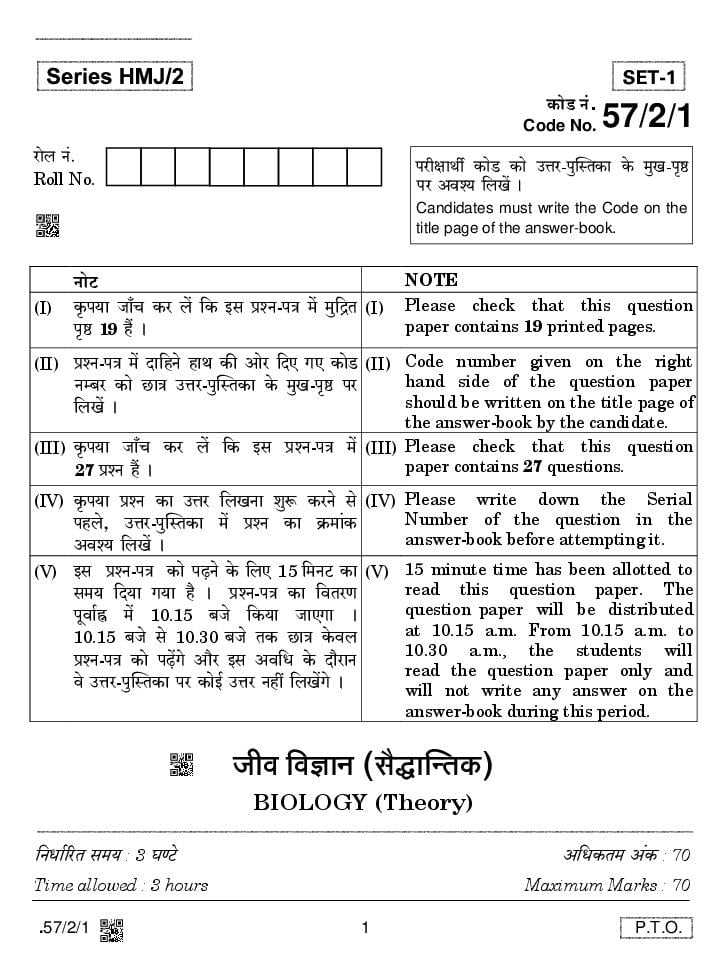
CBSE Class 12 Biology Question Paper 2020 Set 57-2-1
Finished viewing? Save it for later —
Download CBSE Class 12 Biology Question Paper 2020 Set 57-2-1 (PDF · 19 pages)About CBSE Class 12 Biology Question Paper 2020 Set 57-2-1
CBSE Class 12 Biology Question Paper 2020 Set 57-2-1 is available here for free download. Published by CBSE for Class 12, this question paper can be viewed online or downloaded as a PDF (19 pages). Candidates preparing for Class 12 can use CBSE Class 12 Biology Question Paper 2020 Set 57-2-1 to understand the exam pattern, the type of questions asked, and the overall difficulty level.
Frequently Asked Questions
How can I download CBSE Class 12 Biology Question Paper 2020 Set 57-2-1?
Open this page and click the Download button to save CBSE Class 12 Biology Question Paper 2020 Set 57-2-1 as a PDF. It is completely free on AglaSem Docs.
Is CBSE Class 12 Biology Question Paper 2020 Set 57-2-1 free to download?
Yes. CBSE Class 12 Biology Question Paper 2020 Set 57-2-1 can be viewed online and downloaded as a PDF free of cost on AglaSem Docs.
How many pages does CBSE Class 12 Biology Question Paper 2020 Set 57-2-1 have?
CBSE Class 12 Biology Question Paper 2020 Set 57-2-1 contains 19 pages, which you can read online or download together as a single PDF.
Where can I find more Class 12 study material?
You can find more Class 12 question papers, sample papers, syllabus, and answer keys on AglaSem Docs.
CBSE Class 12 Biology Question Paper 2020 Set 57-2-1 – Text
Read the full text of this question paper below — useful to quickly search, copy and reference the content online without downloading the PDF.
📄 View text version (19 pages)
Page 1
Code No. 57/2/1
amob Z§. narjmWu H$moS >H$mo CÎma-nwpñVH$m Ho$ _wI-n¥ð
Roll No. >na Adí` {bIo§ &
Candidates must write the Code on the
title page of the answer-book.
ZmoQ> NOTE
(I) H¥$n`m Om±M H$a b| {H$ Bg àíZ-nÌ _o§ _w{ÐV (I) Please check that this question
n¥ð> 19 h¢ & paper contains 19 printed pages.
(II) àíZ-nÌ _| Xm{hZo hmW H$s Amoa {XE JE H$moS (II) Code number given on the right
>Zå~a H$mo N>mÌ CÎma-nwpñVH$m Ho$ _wI-n¥ð> na hand side of the question paper
{bI| & should be written on the title page of
the answer-book by the candidate.
(III) H¥$n`m Om±M H$a b| {H$ Bg àíZ-nÌ _| (III) Please check that this question
>27 àíZ h¢ & paper contains 27 questions.
(IV) H¥$n`m àíZ H$m CÎma {bIZm ewê$ H$aZo go (IV) Please write down the Serial
nhbo, CÎma-nwpñVH$m _| àíZ H$m H«$_m§H$ Number of the question in the
Adí` {bI| & answer-book before attempting it.
(V) Bg àíZ-nÌ H$mo n‹T>Zo Ho$ {bE 15 {_ZQ >H$m (V) 15 minute time has been allotted to
g_` {X`m J`m h¡ & àíZ-nÌ H$m {dVaU read this question paper. The
nydm©• _| 10.15 ~Oo {H$`m OmEJm & question paper will be distributed
10.15 ~Oo go 10.30 ~Oo VH$ N>mÌ Ho$db at 10.15 a.m. From 10.15 a.m. to
10.30 a.m., the students will
àíZ-nÌ H$mo n‹T>|Jo Am¡a Bg Ad{Y Ho$ Xm¡amZ read the question paper only and
do CÎma-nwpñVH$m na H$moB© CÎma Zht {bI|Jo & will not write any answer on the
answer-book during this period.
Ord {dkmZ (g¡ÕmpÝVH$)
BIOLOGY (Theory)
{ZYm©[aV g_` : 3 KÊQ>o A{YH$V_ A§H$ : 70
Time allowed : 3 hours Maximum Marks : 70
.57/2/1 1 P.T.O.
Page 2
{ZåZ{b{IV {ZX}em| H$mo ~hþV gmdYmZr go n{‹T>E Am¡a CZH$m g™Vr go nmbZ H$s{OE :
(i) àíZ-nÌ nm±M IÊS>m| _§| {d^m{OV {H$`m J`m h¡ H$, I, J, K Am¡a L> &
(ii) Bg àíZ-nÌ _| 27 àíZ h¢ & g^r àíZ A{Zdm`© h¢ &
(iii) IÊS> H$ _| àíZ g§»`m 1 go 5 VH$ ~hþ{dH$ënr` àíZ h¢, àË`oH$ àíZ 1 A§H$ H$m h¡ &
(iv) IÊS> I _| àíZ g§»`m 6 go 12 VH$ bKw-CÎmar` àH$ma-I Ho$ àíZ h¢, àË`oH$ àíZ 2 A§H$m|
H$m h¡ &
(v) IÊS> J _| àíZ g§»`m 13 go 21 VH$ bKw-CÎmar` àH$ma-II Ho$ àíZ h¢, àË`oH$ àíZ
3 A§H$m| H$m h¡ &
(vi) IÊS> K _| àíZ g§»`m 22 go 24 VH$ bKw-CÎmar` àH$ma-III Ho$ àíZ h¢, àË`oH$ àíZ
3 A§H$m| H$m h¡ &
(vii) IÊS> L> _| àíZ g§»`m 25 go 27 VH$ XrK©-CÎmar` àíZ h¢, àË`oH$ àíZ 5 A§H$m| H$m h¡ &
(viii) CÎma g§{já VWm q~Xþdma hmoZo Mm{hE &
(ix) Bg àíZ-nÌ _| g_J« na H$moB© {dH$ën Zht h¡ & VWm{n EH$-EH$ A§H$ dmbo Xmo àíZm| _|,
Xmo-Xmo A§H$m| dmbo EH$ àíZ _§o, VrZ-VrZ A§H$m| dmbo Xmo àíZm| _§o Am¡a nm±M-nm±M A§H$m|
dmbo VrZm| àíZm| _§o Am§V[aH$ {dH$ën {XE JE h¢ & Eogo àíZm| _| Ho$db EH$ hr {dH$ën H$m
CÎma Xr{OE &
(x) Ohm± Amdí`H$ hmo, dhm± gmµ\$-gwWam, AmZwnm{VH$ VWm g_w{MV Zm_m§{H$V {MÌ ~ZmBE &
(xi) BgHo$ A{V[aº$, Amdí`H$VmZwgma, àË`oH$ IÊS> Am¡a àíZ Ho$ gmW `Wmo{MV {ZX}e {XE JE
h¢ &
IÊS> H$
ZmoQ> : {ZåZ{b{IV àíZm| _| àË`oH$ àíZ _| {XE JE {dH$ënm| go ghr {dH$ën MwZH$a {b{IE &
1. AZwÝ_rë` namJUr nwîn ñdnamJUr hmoVo h¢ Š`m|{H$ 1
(A) do C^`qbJr ({ÛqbJr) nwîn hmoVo h¢ Omo H$^r ^r AZmd¥V Zht hmoVo &
(B) do C^`qbJr ({ÛqbJr) VWm AZmd¥V nwîn hmoVo h¢ &
(C) do EH$qbJr hmoVo h¢ &
(D) namJH$moe Ho$ ñ\w$Q>Z go nhbo hr d{V©H$mJ« n[anŠd hmo OmVm h¡ &
AWdm
Bg_| Mb ~rOmUwAm| Ûmam Ab¢{JH$ àOZZ hmoVm h¡ 1
(A) no{Zgr{b`_
(B) hmBS´>m
(C) ñn§O
(D) Šb¡{_S>mo_moZmg
.57/2/1 2
Page 3
Read the following instructions very carefully and strictly follow them :
(i) Question paper comprises five sections – A, B, C, D and E.
(ii) There are 27 questions in the question paper. All questions are compulsory.
(iii) Section A – Questions no. 1 to 5 are multiple choice questions, carrying
1 mark each.
(iv) Section B – Questions no. 6 to 12 are short-answer questions type-I,
carrying 2 marks each.
(v) Section C – Questions no. 13 to 21 are short-answer questions type-II,
carrying 3 marks each.
(vi) Section D – Questions no. 22 to 24 are short-answer questions type-III,
carrying 3 marks each.
(vii) Section E – Questions no. 25 to 27 are long-answer questions, carrying
5 marks each.
(viii) Answers should be brief and to the point.
(ix) There is no overall choice in the question paper. However, an internal
choice has been provided in two questions of 1 mark, one question of
2 marks, two questions of 3 marks and three questions of 5 marks. Only
one of the choices in such questions have to be attempted.
(x) The diagrams drawn should be neat, proportionate and properly labelled,
wherever necessary.
(xi) In addition to this, separate instructions are given with each section and
question, wherever necessary.
SECTION A
Note : Choose the correct option from the choices given in each of the following
questions.
1. Cleistogamous flowers are self-pollinated because 1
(A) they are bisexual flowers which do not open at all.
(B) they are bisexual and open flowers.
(C) they are unisexual.
(D) their stigma matures before the anthers dehisce.
OR
Asexual reproduction by zoospores is observed in 1
(A) Penicillium
(B) Hydra
(C) Sponge
(D) Chlamydomonas
.57/2/1 3 P.T.O.
Page 4
(A) ñdV: OZZ {gÕmÝV
(B) OrdZ nhbo go {dÚ_mZ OrdZ go hr CËnÞ hmoVm h¡
(C) AOrdmËOZZ
(D) {~J ~¢J {gÕmÝV
3. _mZdm| _| Q>mB\$m°BS> H$s nw{ï> hoVw {ZXmZmË_H$ narjU h¡ 1
(A) E{bgm
(B) {dS>mb
(C) E_.Ama.AmB©.
(D) Cë~doYZ
4. O¡d-g{H«$` AUw {OgH$m Cn`moJ A§J à{VamonU Ho$ Xm¡amZ à{Vajm -{ZamoYH$ (Bå`yZmogàog|Q> )
Ho$ ê$n _| {H$`m OmVm h¡ 1
(A) Q>oQ´>mgmBŠbrZ
(B) gmBŠbmoñnmo[aZ-E
(C) ñQ>¡{Q>Z
(D) ñQ´>¡ßQ>mo_mBgrZ
AWdm
‘Zrbr H«$m§{V’ H$m Cn`moJ Bg g§X^© _| {H$`m OmVm h¡ 1
(A) Ob g§ajU hoVw ~m±Y ~ZmZm
(B) ~‹S>r _mÌm _| _Ëñ` CËnmXZ
(C) dm{hV _b H$m CnMma
(D) e¡dmb àñ\w$Q>Z (AëJb ãby_) H$m {Z`§ÌU
5. {ZåZ{b{IV _| go H$m¡Z-gm nmaOrdr à`moJm| H$m CËnmX Zht h¡ ? 1
(A) nr‹S>H$-n«{VamoYr µ\$gb H$s {H$ñ_
(B) ImÚmZm| _| Cƒ nm¡f{UH$ _mZ
(C) Ama.-S>r.EZ.E. VH$ZrH$ Ûmam B§gwbrZ H$m CËnmXZ
(D) Obm^md-à{VamoYr µ\$gb|
.57/2/1 4
Page 5
Pasteur is 1
(A) Spontaneous generation theory
(B) Life comes only from pre-existing life
(C) Abiogenesis of life
(D) Big bang theory
3. The diagnostic test that confirms typhoid in humans is 1
(A) ELISA
(B) Widal
(C) MRI
(D) Amniocentesis
4. The bioactive molecule used as an immunosuppressive agent during
organ transplant is 1
(A) Tetracyclin
(B) Cyclosporin-A
(C) Statin
(D) Streptomycin
OR
‘Blue revolution’ refers to 1
(A) construction of water dams for conservation of water
(B) production of fish in large quantities
(C) sewage treatment
(D) controlling algal bloom
5. Which one of the following is not the product of transgenic experiments ? 1
(A) Pest-resistant crop variety
(B) High nutritional value in grains
(C) Production of insulin by rDNA technique
(D) Drought-resistant crops
.57/2/1 5 P.T.O.
Page 6
6. _mZd _| (a) AY©gyÌmUw (AY©gyÌr H$mo{eH$m), VWm (b) `w½_H$m| _| gyÌJwUVm VWm JwUgyÌm| H$s
g§»`m {b{IE & 2
7. AgwJw{UVm (EoÝ`yßbmoBS>r) Š`m h¡ ? _mZd _| (a) EH$ A{b§JgyÌ H$s A{YH$Vm, VWm
(b) _mXmAm| ({ñÌ`m|) _| EH$ qbJ JwUgyÌ H$s hm{Z Ho$ H$maU JwUgyÌr` (H«$mo_mogmo_r`)
{dH$ma H$m Zm_ {b{IE & 2
8. {ZåZ{b{IV àHy$Q>m| (H$moS>m°Zm|) _| EH$ àH$m`m©Ë_H$ A§Va {b{IE : 2
(a) AUG VWm UAA
(b) {d{eï> VWm Anõm{gV
9. (a) ZrMo Xr JB© gyMr _| go {H$Ýht Xmo {eewYmZr àm{U`m| H$mo nhMmZ H$a {b{IE :
(i) bo_a
(ii) Yã~oXma H$ñH$g
(iii) C‹S>Z-\¡$boÝOa
(iv) ~m¡~H¡$Q>
(v) Vñ_m{Z`mB© ^o{‹S>`m
(vi) >N>Ny>±Xa
(b) ‘‘AmñQ´>o{b`m Ho$ {eewYmZr àm{U AZwHy$br {d{H$aU àX{e©V H$aVo h¢ &’’ H$WZ H$s
Ý`m`g§JVVm {gÕ H$s{OE & 2
10. ZdOmV {eew H$mo _m± Ûmam àXmZ H$s OmZo dmbr à{Vajm Ho$ àH$ma H$m Zm_ {b{IE & `h
H¡$go hmoVr h¡ ? 2
11. Xmo àmW{_H$ bgrH$m^ A§Jm| Ho$ Zm_ {b{IE & Q>r-bgrH$mUwAm| H$m _hÎd {b{IE & 2
12. XþX©_ A~w©X gwX_ A~w©X go {H$g àH$ma {^Þ h¢ ? Hw$N> amo{J`m| H$m CnMma -B§Q>a\o$am°Zm| go Š`m|
{H$`m OmVm h¡ ? 2
AWdm
Cg hm°_m}Z H$m Zm_ {b{IE Omo _ëQ>rnb Am¡ì`yboeZ E¡på~«`mo Q´>m§g \$a (MOET) VH$ZrH$
Ûmam Jm` H$mo {X`m OmVm h¡ & Bg hm°_m}Z H$m àH$m`© {b{IE & 2
.57/2/1 6
Page 7
6. Write the ploidy and number of chromosomes in human (a) meiocytes,
and (b) gametes. 2
7. What is aneuploidy ? Name a chromosomal disorder in humans caused
due to (a) gain of an autosome, and (b) loss of a sex chromosome in
females. 2
8. State a functional difference between the following codons : 2
(b) AUG and UAA
(b) Specific and Degenerate
9. (a) Identify any two marsupials from the list given below :
(i) Lemur
(ii) Spotted cuscus
(iii) Flying phalanger
(iv) Bobcat
(v) Tasmanian wolf
(vi) Mole
(b) ‘‘Australian marsupials exhibit adaptive radiation.’’ Justify the
statement. 2
10. Name the type of immunity the mother provides the newborn baby. How
does it happen ? 2
11. Name the two primary lymphoid organs. State the importance of
T-lymphocytes. 2
12. How are malignant tumours different from benign tumours ? Why are
some patients treated with -interferons ? 2
OR
Name the hormone with which a cow is administered using MOET
technology. State the function of this hormone. 2
.57/2/1 7 P.T.O.
Page 8
13. EH$ nwînr nmXn Ho$ ñÌrHo$ga H$m namJU hmoZo Ho$ níMmV² H$s AdñWm H$s AZwàñW-H$mQ> H$m
AmaoI ~ZmBE & {ZåZ{b{IV H$mo Zm_m§{H$V H$s{OE : 3
(a) namJ H$Um| H$m A§Hw$aU Xem©Vo hþE d{V©H$mJ«
(b) d{V©H$m
(c) ~rOmÊS>Ûma VH$ nhþ±MVr hþB© namJ Z{bH$m
(d) ^«yU H$mof
(e) A§S> CnH$aU Ho$ KQ>H$
14. {XE JE {MÌ H$m AÜ``Z H$s{OE :
A EH$ ^«yUmdñWm h¡ Omo B _| ê$nmÝV[aV hmo OmVm h¡ VWm _mZd {ñÌ`m| Ho$ J^m©e` A§V:ñVa
_| A§Vam}{nV hmo OmVm h¡ &
(a) A, B VWm BgHo$ C Ed§ D ^mJm| H$mo nhMmZ H$a {b{IE &
(b) _mZdm| _| ^«yUr` n[adY©Z Ho$ Xm¡amZ H$mbmÝVa _| C VWm D H$m Š`m hmoVm h¡ ? 3
AWdm
.57/2/1 8
Page 9
13. Draw a longitudinal section of the pistil from a flowering plant, where
pollination has occurred. Label the following : 3
(a) Stigma showing germinating pollen grains
(b) Style
(c) Pollen tube reaching the micropyle of the ovule
(d) Embryo sac
(e) Components of the egg apparatus
14. Study the given diagram :
A is an embryonic stage that gets transformed into B, which in turn gets
implanted in the endometrium in human females.
(a) Identify A, B and its parts C and D.
(b) State the fate of C and D in the course of embryonic development
in humans. 3
OR
.57/2/1 9 P.T.O.
Page 10
H$a {b{IE &
(b) E H$m àH$m`© ^r {b{IE & 3
15. EH$ gm_mÝ` Xån{V H$mo nhbr g§VmZ CËnÞ hmoVr h¡, Omo hr_mo\$s{b`m go J«ñV h¡ & BgH$s
g§^mì`Vm H$mo Xem©Zo Ho$ {bE EH$ H«$m°g ~ZmBE & Bg Xån{V go n¡Xm hmoZo dmbr gm_mÝ` VWm
hr_mo\$s{b`mJ«ñV g§V{V H$s qbJmZwgma g§^mì`Vm H$m CëboI H$s{OE & 3
16. {H$gr nm[aV§Ì _| _yb AÝdofH$ àOm{V Ho$ EH$ Z½Z MÅ>mZ na AmH«$_U go àma§^ H$a
Ma_mdñWm g_wXm` VH$ Ho$ AZwH«$_U Ho$ {d{^Þ MaUm| H$m dU©Z H$s{OE & Bg àH$ma Ho$
AZwH«$_U H$m Zm_ {b{IE & 3
17. ZJam| Ho$ An{eï> Ob Ed§ Am¡Úmo{JH$ ~{h:òmd H$mo àmH¥${VH$ Ob òmoVm| _§o {Z_w©º$ H$aZo go
Obr` OrdZ na {dZmeH$mar (KmVH$) à^md n‹S> ahm h¡ & Bg ~{h:òmd H$mo àmH¥${VH$ Ob
òmoVm| _| {dg{O©V H$aZo go nhbo BgHo$ dm§{N>V O¡{dH$ CnMma H$s ì`m»`m H$s{OE & 3
18. gyú_-àdY©Z VH$ZrH$ Ho$ H$moB© Xmo bm^m| H$m C„oI H$s{OE & à`moJembm _| Bg {H«$`m H$mo
{H$g àH$ma {H$`m OmVm h¡ ? Bg VH$ZrH$ Ûmam ì`mdgm{`H$ ñVa na CJmE OmZo dmbo {H$Ýht
Xmo _hÎdnyU© ImÚ-nmXnm| Ho$ Zm_ {b{IE & 3
.57/2/1 10
Page 11
and E.
(b) State the function of E. 3
15. A normal couple has their first child, who is haemophilic. Work out a
cross to show how it is possible. State the possibility of the normal and
the haemophilic children, along with their sexes, that can be born to
them. 3
16. Starting from the pioneer species, trace the sequence that follows in an
ecological succession on a bare rock, until climax community is reached in
an ecosystem. Name this type of succession. 3
17. The release of municipal wastewater and industrial waste into our
natural water bodies is causing disastrous effect to the aquatic life.
Explain the biological treatment that should be given to it before
releasing into the natural water bodies. 3
18. Mention any two advantages of micropropagation technique. Write how
its process is carried out in the laboratory. Name any two important food
plants grown commercially by this method. 3
.57/2/1 11 P.T.O.
Page 12
OmVm h¡, naÝVw `h ñd`§ Aà^m{dV ahVm h¡ & g_PmBE {H$ `h {H$g àH$ma g§^d h¡ & 3
20. (a) EH$ nm[aV§Ì _| naOrdm| _§o {H$g àH$ma H$m AZwHy$bZ hþAm {H$ dh AnZo nanmofr Ho$
gmW gh-ApñVËd ~ZmE aI gH|$ & g_PmBE &
(b) naOrdr {d{eï> nanmofr na hr Am{lV hmoVo h¢ VWm gh-{dH${gV hmoVo h¢ & `{X
nanmofr naOrdr Ho$ à{V à{VamoYr AWdm AñdrH$ma H$aZo H$m VarH$m {dH${gV H$aVm
h¡, Vmo naOrdr {H$g àH$ma AZw{H«$`m H$aoJm ? 3
AWdm
(a) {H$gr nm[aV§Ì _| nmE OmZo dmbo AmXe© {na¡{_S> H$m Zm_ {b{IE & BgH$mo Vrgao
nmofU ñVa VH$ ~ZmBE VWm CZHo$ Zm_ {b{IE &
(b) {H$gr nm[aV§Ì H$mo gy`© go 1,000,000 J gm¡a D$Om© àmá hmoVr h¡ & H«$_e: àW_ Ed§
Vrgao nmofr ñVa na CnbãY D$Om© H$s _mÌm {b{IE & 3
21. d¡pídH$ ñVa na H$m~©Z H$m pñWarH$aU Ord_§S>b _| àH$me-g§íbofU Ho$ Ûmam hmoVm h¡ &
(a) {H$Ýht Eogo Xmo VarH$m| H$s ì`m»`m H$s{OE {OZHo$ Ûmam àmH¥${VH$ àH«$_m| Ûmam
dm`w_§S>b _| H$m~©Z H$s nwZamny{V© (dmngr) hmoVr h¡ &
(b) _mZd Ho$ Eogo H$moB© Xmo H$m`©H$bmnm| H$s gyMr ~ZmBE {OZgo àH¥${V _| H$m~©Z MH«$
à^m{dV hwAm hmo & 3
.57/2/1 12
Page 13
killed, but itself remains unaffected. Explain how it is possible. 3
20. (a) Write how parasites have evolved with adaptation to co-exist with
their hosts in an ecosystem.
(b) Parasites are host specific and tend to co-evolve. How would the
parasite respond if the host evolves a certain mechanism to resist
or reject the parasite ? 3
OR
(a) Name an ideal pyramid existing in an ecosystem. Construct it up
to its three trophic levels along with their names.
(b) The sun provides 1,000,000 J of sunlight (solar energy) to an
ecosystem. Write the amount of energy that is available to the first
and third trophic levels, respectively. 3
21. Global carbon is fixed in the biosphere through photosynthesis.
(a) Explain any two ways by which carbon is returned to the
atmosphere through natural processes.
(b) List any two human activities that have influenced the carbon
cycle in nature. 3
.57/2/1 13 P.T.O.
Page 14
22.
D$na {XE JE ì`dñWmnH$ {Zê$nU H$m AÜ``Z H$s{OE VWm {ZåZ{b{IV àíZm| Ho$ CÎma
Xr{OE :
(a) Bg_| A H$mo nhMmZ H$a {b{IE &
(b) Bg_| D H$mo nhMmZ H$a {b{IE &
(c) `{X {XE JE g_` t na g_{ï> KZËd H$m _mZ Cn`w©º$ AmaoImZwgma N h¡, Vmo
g_w{MV g§Ho$Vm| H$m Cn`moJ H$aVo hþE t + 1 g_` na g_{ï> KZËd H$mo g_rH$aU Ho$
ê$n _| {b{IE & 3
23. (a) ZrMo Xr JB© nm°br_aoO ûm¥§Ibm A{^{H«$`m Ho$ MH«$ _| MaU A VWm B H$mo nhMmZ H$a
{b{IE & >
(b) MaU B _| Cn`moJ {H$E OmZo dmbo E§µOmB_ H$m {d{eï> A{^bjU {b{IE & 3
.57/2/1 14
Page 15
22.
Study the schematic representation given above and answer the following
questions :
(a) Identify A in it.
(b) Identify D in it.
(c) When the population density at time t is N as shown above, write
the population density at time t + 1 in the form of an equation
using appropriate symbols. 3
23. (a) Identify steps A and B in a cycle of Polymerase Chain Reaction
given below.
(b) State the specific characteristic feature of the enzyme in carrying
step B. 3
.57/2/1 15 P.T.O.
Page 16
VWm {ZåZ{b{IV àíZm| Ho$ CÎma Xr{OE :
BboŠQ´>moS>
~ÝX âbmñH$
d¡Š`y_ nån H$mo
J¡g|
Ob ~mha
g§K{ZÌ
Ob A§Xa
Ob {~ÝXþ
H$m~©{ZH$ `m¡{JH$m|
C~bVm Ob dmbm Ob
nme _| Ðd Ob
(a) Eg.Eb. {_ba Zo AnZo à`moJ g§`moOZ _§o CZ n[apñW{V`m| H$mo H¡$go CËnÞ {H$`m Omo
n¥Ïdr na OrdZ H$s CËn{Îm go nyd© _m¡OyX Wt ?
(b) CgHo$ à`moJ Ho$ A§V _§o ~ZZo dmbo H$m~©{ZH$ `m¡{JH$ H$m Zm_ {b{IE {Ogo CgZo àmá
(EH${ÌV) {H$`m &
(c) {dH$mg Ho$ Cg àH$ma H$m Zm_moëboI H$s{OE {OgH$m g_W©Z CgHo$ à`moJ Ûmam
hþAm & 3
.57/2/1 16
Page 17
below and answer the questions that follow :
Electrodes
Closed flask
To vacuum
pump
Gases
Water out
Condenser
Water in
Water droplets
Water containing
Boiling water organic compounds
Liquid water in trap
(a) How did S.L. Miller create the conditions which existed before the
origin of any life on Earth ?
(b) Name the organic compound formed and collected at the end of his
experiment.
(c) Mention the kind of evolution his experiment supports. 3
.57/2/1 17 P.T.O.
Page 18
25. (a) _mZd H$s ewH«$OZH$ Z{bH$m Ho$ AmaoIr` H$mQ> H$m {MÌ ~ZmBE & BgHo$ {H$Ýht N>:
^mJm| H$mo Zm_m§{H$V H$s{OE &
(b) ewH«$OZZ àH«$_ _| em{_b nr`yf J«§{W hm°_m}Zm| Ho$ Zm_ {b{IE VWm BZHo$ àH$m`m] H$m
C„oI H$s{OE & 5
AWdm
(a) AmB©.`y.S>r. H$mo EH$ à^mdr J^©{ZamoYH$ `w{º$ H$hm OmVm h¡ & gm_mÝ` ê$n go
gdm©{YH$ Cn`moJ H$s OmZo dmbr {H$Ýht Xmo AmB©.`y.S>r. `w{º$`m| Ho$ Zm_ {b{IE VWm
CZHo$ H$m`© H$aZo Ho$ VarH$m| H$mo {b{IE &
(b) {H$gr {ddm{hV X§n{V H$mo ~§Ü`H$aU H$s gbmh H$~ Xr OmVr h¡ ? Bgo H«$_e: EH$
nwéf VWm ñÌr _| {H$g àH$ma g§nÞ H$aVo h¢ ? 5
26. b¡ŠQ>mog `wº$ g§dY©Z _mÜ`_ _| g§d{Y©V B©.H$mobmB© _§o b¡H$ àMmboH$ (Amonoam°Z) OrZ H$s
A{^ì`{º$ H$s ì`m»`m H$s{OE & 5
AWdm
H$mo{eH$mAm| Ho$ àH$ma VWm àH«$_ H$m Zm_ {b{IE {OgHo$ Ûmam {df_m§Jr Ho$ÝÐH$s`
Ama.EZ.E. (hnRNA) ~ZVm h¡ & {H«$`merb hmoZo Ho$ {bE `h {OZ àH«$_m| go JwµOaVm h¡
CgH$s {H«$`m{d{Y H$m dU©Z H$s{OE & 5
27. {díd _| ha OJh àH¥${V _| nm[apñW{VH$ g§VwbZ ~ZmE aIZo Ho$ {bE O¡d{d{dYVm g§ajU Ho$
à{V AË`{YH$ qMVm h¡ & VrZ H$maU XoVo hþE BgH$s ì`m»`m H$s{OE & Eogo {d{^Þ Cnm`m| H$mo
{b{IE Omo h_mao Xoe _| ~mKm| H$s g_{ï> ~‹T>mZo _| ghm`H$ {gÕ hþE h¢ & 5
AWdm
EH$sH¥$V O¡d IoVr Š`m h¡ ? gmoZrnV, h[a`mUm Ho$ a_oe MÝÐ S>mJa Zm_H$ {H$gmZ Zo Bg
VarHo$ H$m à^mdembr T>§J go {H$g àH$ma Cn`moJ {H$`m {H$ dh eyÝ` An{eï> à~§YZ _|
g\$b ahm ? 5
.57/2/1 18
Page 19
25. (a) Draw the sectional view of a seminiferous tubule of human. Label
its any six parts.
(b) Name the pituitary hormones involved in the process of
spermatogenesis. State their functions. 5
OR
(a) IUDs are said to be effective contraceptives. Name any two
commonly used IUDs and write the mode of their actions.
(b) When is sterilisation advised to married couples ? How is it carried
out in a human male and a female, respectively ? 5
26. Explain the expression of lac operon genes in E. coli growing in lactose
containing culture medium. 5
OR
Name the types of cells and the process by which hnRNA is formed.
Describe the processing mechanism it undergoes before it becomes
functional. 5
27. There is a great concern all over the world to conserve biodiversity for
maintaining ecological balance in nature. Explain giving three reasons.
Write different ways that have helped in increasing tiger population in
our country. 5
OR
What is integrated organic farming ? How did Ramesh Chandra Dagar, a
farmer from Sonepat, Haryana effectively use this procedure and succeed
with zero waste ? 5
.57/2/1 19 P.T.O.
Document Details
| Board / Org | CBSE |
| Exam | Class 12 |
| Type | Question Paper |
| Pages | 19 |
| Updated | 22 Jul 2026 |