CBSE Class 12 Biology Question Paper 2020 Set 57-1-1
Finished viewing? Save it for later —
Download CBSE Class 12 Biology Question Paper 2020 Set 57-1-1 (PDF · 15 pages)About CBSE Class 12 Biology Question Paper 2020 Set 57-1-1
CBSE Class 12 Biology Question Paper 2020 Set 57-1-1 is available here for free download. Published by CBSE for Class 12, this question paper can be viewed online or downloaded as a PDF (15 pages). Candidates preparing for Class 12 can use CBSE Class 12 Biology Question Paper 2020 Set 57-1-1 to understand the exam pattern, the type of questions asked, and the overall difficulty level.
Frequently Asked Questions
How can I download CBSE Class 12 Biology Question Paper 2020 Set 57-1-1?
Open this page and click the Download button to save CBSE Class 12 Biology Question Paper 2020 Set 57-1-1 as a PDF. It is completely free on AglaSem Docs.
Is CBSE Class 12 Biology Question Paper 2020 Set 57-1-1 free to download?
Yes. CBSE Class 12 Biology Question Paper 2020 Set 57-1-1 can be viewed online and downloaded as a PDF free of cost on AglaSem Docs.
How many pages does CBSE Class 12 Biology Question Paper 2020 Set 57-1-1 have?
CBSE Class 12 Biology Question Paper 2020 Set 57-1-1 contains 15 pages, which you can read online or download together as a single PDF.
Where can I find more Class 12 study material?
You can find more Class 12 question papers, sample papers, syllabus, and answer keys on AglaSem Docs.
CBSE Class 12 Biology Question Paper 2020 Set 57-1-1 – Text
Read the full text of this question paper below — useful to quickly search, copy and reference the content online without downloading the PDF.
📄 View text version (15 pages)
Page 1
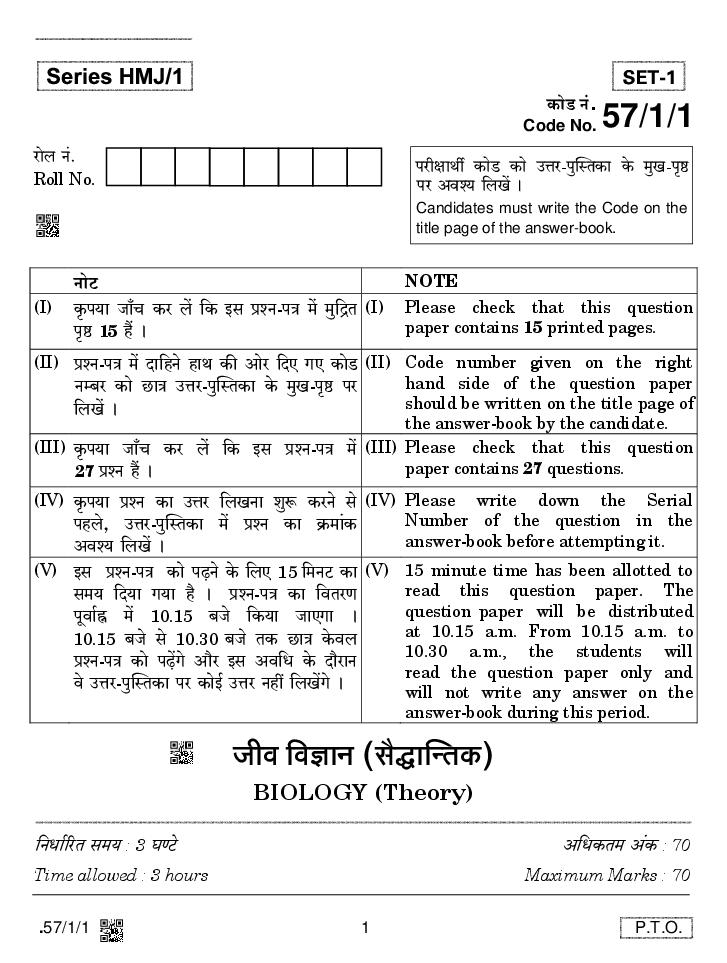
Code No. 57/1/1
amob Z§. narjmWu H$moS >H$mo CÎma-nwpñVH$m Ho$ _wI-n¥ð
Roll No. >na Adí` {bIo§ &
Candidates must write the Code on the
title page of the answer-book.
ZmoQ> NOTE
(I) H¥$n`m Om±M H$a b| {H$ Bg àíZ-nÌ _o§ _w{ÐV (I) Please check that this question
n¥ð> 15 h¢ & paper contains 15 printed pages.
(II) àíZ-nÌ _| Xm{hZo hmW H$s Amoa {XE JE H$moS (II) Code number given on the right
>Zå~a H$mo N>mÌ CÎma-nwpñVH$m Ho$ _wI-n¥ð> na hand side of the question paper
{bI| & should be written on the title page of
the answer-book by the candidate.
(III) H¥$n`m Om±M H$a b| {H$ Bg àíZ-nÌ _| (III) Please check that this question
>27 àíZ h¢ & paper contains 27 questions.
(IV) H¥$n`m àíZ H$m CÎma {bIZm ewê$ H$aZo go (IV) Please write down the Serial
nhbo, CÎma-nwpñVH$m _| àíZ H$m H«$_m§H$ Number of the question in the
Adí` {bI| & answer-book before attempting it.
(V) Bg àíZ-nÌ H$mo n‹T>Zo Ho$ {bE 15 {_ZQ >H$m (V) 15 minute time has been allotted to
g_` {X`m J`m h¡ & àíZ-nÌ H$m {dVaU read this question paper. The
nydm©• _| 10.15 ~Oo {H$`m OmEJm & question paper will be distributed
10.15 ~Oo go 10.30 ~Oo VH$ N>mÌ Ho$db at 10.15 a.m. From 10.15 a.m. to
10.30 a.m., the students will
àíZ-nÌ H$mo n‹T>|Jo Am¡a Bg Ad{Y Ho$ Xm¡amZ read the question paper only and
do CÎma-nwpñVH$m na H$moB© CÎma Zht {bI|Jo & will not write any answer on the
answer-book during this period.
Ord {dkmZ (g¡ÕmpÝVH$)
BIOLOGY (Theory)
{ZYm©[aV g_` : 3 KÊQ>o A{YH$V_ A§H$ : 70
Time allowed : 3 hours Maximum Marks : 70
.57/1/1 1 P.T.O.
Page 2
{ZåZ{b{IV {ZX}em| H$mo ~hþV gmdYmZr go n{‹T>E Am¡a CZH$m g™Vr go nmbZ H$s{OE :
(i) àíZ-nÌ nm±M IÊS>m| _§| {d^m{OV {H$`m J`m h¡ H$, I, J, K Am¡a L> &
(ii) Bg àíZ-nÌ _| 27 àíZ h¢ & g^r àíZ A{Zdm`© h¢ &
(iii) IÊS> H$ _| àíZ g§»`m 1 go 5 VH$ ~hþ{dH$ënr` àíZ h¢, àË`oH$ àíZ 1 A§H$ H$m h¡ &
(iv) IÊS> I _| àíZ g§»`m 6 go 12 VH$ bKw-CÎmar` àH$ma-I Ho$ àíZ h¢, àË`oH$ àíZ 2 A§H$m|
H$m h¡ &
(v) IÊS> J _| àíZ g§»`m 13 go 21 VH$ bKw-CÎmar` àH$ma-II Ho$ àíZ h¢, àË`oH$ àíZ
3 A§H$m| H$m h¡ &
(vi) IÊS> K _| àíZ g§»`m 22 go 24 VH$ bKw-CÎmar` àH$ma-III Ho$ àíZ h¢, àË`oH$ àíZ
3 A§H$m| H$m h¡ &
(vii) IÊS> L> _| àíZ g§»`m 25 go 27 VH$ XrK©-CÎmar` àíZ h¢, àË`oH$ àíZ 5 A§H$m| H$m h¡ &
(viii) CÎma g§{já VWm q~Xþdma hmoZo Mm{hE &
(ix) Bg àíZ-nÌ _| g_J« na H$moB© {dH$ën Zht h¡ & VWm{n EH$-EH$ A§H$ dmbo Xmo àíZm| _|,
Xmo-Xmo A§H$m| dmbo EH$ àíZ _§o, VrZ-VrZ A§H$m| dmbo Xmo àíZm| _§o Am¡a nm±M-nm±M A§H$m|
dmbo VrZm| àíZm| _§o Am§V[aH$ {dH$ën {XE JE h¢ & Eogo àíZm| _| Ho$db EH$ hr {dH$ën H$m
CÎma Xr{OE &
(x) Ohm± Amdí`H$ hmo, dhm± gmµ\$-gwWam, AmZwnm{VH$ VWm g_w{MV Zm_m§{H$V {MÌ ~ZmBE &
(xi) BgHo$ A{V[aº$, Amdí`H$VmZwgma, àË`oH$ IÊS> Am¡a àíZ Ho$ gmW `Wmo{MV {ZX}e {XE JE
h¢ &
IÊS> H$
1. _ogëgZ d ñQ>mb Zo AnZo à`moJm| _| CsCl2 KZËd J«o{S>E|Q> _| AnHo$ÝÐrH$aU H$m Cn`moJ BÝh|
n¥WH²$ H$aZo Ho$ {bE {H$`m : 1
(A) Ama.EZ.E. go S>r.EZ.E. H$mo
(B) àmoQ>rZ go S>r.EZ.E. H$mo
(C) 15N- S>r.EZ.E. go gm_mÝ` S>r.EZ.E. AUwAm| H$mo
(D) A§VaU Ama.EZ.E. go S>r.EZ.E. H$mo
.57/1/1 2
Page 3
Read the following instructions very carefully and strictly follow them :
(i) Question paper comprises five sections – A, B, C, D and E.
(ii) There are 27 questions in the question paper. All questions are compulsory.
(iii) Section A – Questions no. 1 to 5 are multiple choice questions, carrying
1 mark each.
(iv) Section B – Questions no. 6 to 12 are short-answer questions type-I,
carrying 2 marks each.
(v) Section C – Questions no. 13 to 21 are short-answer questions type-II,
carrying 3 marks each.
(vi) Section D – Questions no. 22 to 24 are short-answer questions type-III,
carrying 3 marks each.
(vii) Section E – Questions no. 25 to 27 are long-answer questions, carrying
5 marks each.
(viii) Answers should be brief and to the point.
(ix) There is no overall choice in the question paper. However, an internal
choice has been provided in two questions of 1 mark, one question of
2 marks, two questions of 3 marks and three questions of 5 marks. Only
one of the choices in such questions have to be attempted.
(x) The diagrams drawn should be neat, proportionate and properly labelled,
wherever necessary.
(xi) In addition to this, separate instructions are given with each section and
question, wherever necessary.
SECTION A
1. Meselson and Stahl carried out centrifugation in CsCl2 density gradient
to separate : 1
(A) DNA from RNA
(B) DNA from protein
(C) The normal DNA from 15N-DNA
(D) DNA from tRNA
.57/1/1 3 P.T.O.
Page 4
(A) nwîn {ÛqbJr (C^`qbJr) h¡ &
(B) S>§R>b V§Vw H$s Anojm d{V©H$m b§~r hmoVr h¡ &
(C) nwîn AZwÝ_rë` h¡ &
(D) nwîn _| ñÌrHo$ga VWm nw§Ho$ga Ho$ n[anŠd hmoZo Ho$ g_` _| A§Va hmoVm h¡ &
AWdm
Bg Ord _| Mb ~rOmUw Ab¢{JH$ OZZ H$s OZZ BH$mB© h¡ 1
(A) Šb¡{_S>mo_moZmg
(B) ñnmBamoJmBam
(C) `rñQ>
(D) amBµOmong
3. {ZåZ{b{IV Ûmam gyú_àdY©Z {H$`m Om gH$Vm h¡ : 1
(A) ñdnamJU
(B) Ab¢{JH$ OZZ
(C) D$VH$ g§dY©Z
(D) H$m{`H$ àdY©Z
AWdm
agmoB`m| _| gm_mÝ`V… Cn`moJ {H$E OmZo dmbo gyú_Ord h¢ 1
(A) b¡ŠQ>mo~¡{gbg VWm `rñQ>
(B) n¡Zrgr{b`_ VWm `rñQ>
(C) _mBH«$moñnmoam VWm B©. H$mobmB©
(D) amBµOmong VWm b¡ŠQ>mo~¡{gbg
4. gyú_Ordm| H$mo h_mao eara _| à{dîQ> hmoZo go amoH$Zo dmbm à_wI AdamoYH$ h¡ 1
(A) à{Vajr
(B) d¥hV²^jH$mUw (_¡H«$mo\$mO)
(C) EH$H|$ÐH$mUw (_moZmogmBQ²>g)
(D) ËdMm
5. {ZåZ{b{IV dmhH$ H$m Cn`moJ H$aHo$ gyÌH¥${_ {d{eîQ> OrZm| H$mo nanmofr V§~mHy$ Ho$ nm¡Yo _|
à{dîQ> H$am`m J`m 1
(A) pBR 322
(B) ßb¡pµÁ_S>>
(C) OrdmUw^moOr
(D) EJ«mo~¡ŠQ>r[a`_
.57/1/1 4
Page 5
(A) the flower is bisexual.
(B) the style is longer than the filament.
(C) the flower is cleistogamous.
(D) the time of pistil and anther maturity is different.
OR
Zoospores are the reproductive units to carry asexual reproduction in 1
(A) Chlamydomonas
(B) Spirogyra
(C) Yeast
(D) Rhizopus
3. Micropropagation can be achieved by 1
(A) Self-pollination
(B) Asexual reproduction
(C) Tissue culture
(D) Vegetative propagation
OR
The microbes commonly used in kitchens are 1
(A) Lactobacillus and Yeast
(B) Penicillium and Yeast
(C) Microspora and E. coli
(D) Rhizopus and Lactobacillus
4. The main barrier that prevents the entry of micro-organisms into our
body is 1
(A) Antibodies
(B) Macrophages
(C) Monocytes
(D) Skin
5. Nematode specific genes were introduced into the tobacco host plant using
a vector 1
(A) pBR 322
(B) Plasmid
(C) Bacteriophage
(D) Agrobacterium
.57/1/1 5 P.T.O.
Page 6
6. {H$gr S>r.EZ.E. IÊS> H$s EH$ aÁOwH$ H$mo ZrMo {X`m J`m h¡ :
TACGTACGTACGTACG
3 5
(a) BgH$s nyaH$ aÁOwH$ Amao{IV H$s{OE ({b{IE) &
(b) ~ZZo dmbo Cn`w©º$ S>r.EZ.E. AUw go AZwboIZ Ûmam ~ZZo dmbr g§^m{dV
Ama.EZ.E. aÁOwH$ H$mo {b{IE & 2
7. n{j`m| VWm {VV{b`m| Ho$ n§I CÝh| C‹S>Zo _| ghm`H$ hmoVo h¢ & Eogo A§J {H$g àH$ma Ho$
{dH$mg H$m n[aUm_ h¢ ? ì`m»`m H$s{OE & 2
8. AŠga Eogm XoIm J`m h¡ {H$ CZ ì`{ŠV`m| _| Igam (_r{µOëg) H$m g§H«$_U hmoZo H$s
g§^mdZm ~hþV H$_ hmoVr h¡ Omo AnZo àma§{^H$ ~më`H$mb _| Bg amoJ go nr{‹S>V hmo MwHo$ h¢ &
H$WZ H$m Am¡{MË` {gÕ H$s{OE & 2
9. {ñÌ`m| _| Ho$db gJ^©Vm H$s Ad{Y _| òm{dV hmoZo dmbo VrZ hm°_m}Zm| H$s gyMr ~ZmBE &
gJ^©Vm Ho$ Xm¡amZ EñQ´>moOZ VWm àmoOoñQ>amoZ Ho$ ñVa _| Š`m n[adV©Z hmoVo h¢ ? 2
10. EH$ e¡j{UH$ ^«_U Ho$ Xm¡amZ EH$ {dÚmWu H$mo AMmZH$ ídmg boZo _| naoemZr hmoVr h¡ VWm
dh ~hþV A{YH$ N>tH$Zo bJVm h¡ & Bg àH$ma H$s AZw{H«$`m H$m Zm_ {b{IE VWm g_PmBE
{H$ `h {H$g H$maU hmoVm h¡ & 2
11. g_w{MV CXmhaU H$s ghm`Vm go g_PmBE {H$ newAm| _| ZB© Zñb {dH${gV H$aZo Ho$ {bE
~{h…g§H$aU H¡$go g§nÞ {H$`m OmVm h¡ & 2
12. ~¡Š`ybmodmBag H$s Cg OrZg H$m Zm_ {b{IE Omo EH$ amoJOZH$ hmoZo Ho$ ~mdOyX
O¡d-{Z`§ÌH$ H$maH$ H$m H$m`© H$aVm h¡ & Eogo VrZ H$maU Omo Bgo A{V CÎm_ O¡d-{Z`§ÌH$
~ZmVo h¢, H$m CëboI H$aVo hþE Am¡{MË` {gÕ H$s{OE & 2
AWdm
‘‘dm{hV _b Ho$ O¡{dH$ CnMma _| gyú_Ord EH$ _hÎdnyU© ^y{_H$m {Z^mVo h¢ &’’ Am¡{MË`
{gÕ H$s{OE & 2
.57/1/1 6
Page 7
6. Given below is one of the strands of a DNA segment :
TACGTACGTACGTACG
3 5
(a) Write its complementary strand.
(b) Write a possible RNA strand that can be transcribed from the
above DNA molecule formed. 2
7. Wings of birds and wings of butterflies contribute to locomotion. Explain
the type of evolution such organs are a result of. 2
8. It is often observed that the chances of a person suffering from measles in
his or her lifetime are low if he or she has suffered from the disease in
their early childhood. Justify the statement. 2
9. List the three hormones produced in women only during pregnancy.
What happens to the levels of estrogen and progesterone during
pregnancy ? 2
10. A student on a field trip suddenly felt breathlessness and started to
sneeze very badly. Name this response and explain what it is due to. 2
11. With the help of a suitable example, explain how cross-breeding is carried
out in developing a new breed in animals. 2
12. Name the genus of baculovirus that acts as a biological control agent in
spite of being a pathogen. Justify by giving three reasons that make it an
excellent candidate for the job. 2
OR
‘‘Micro-organisms play an important role for the biological treatment of
sewage.’’ Justify. 2
.57/1/1 7 P.T.O.
Page 8
13. EH$ Amd¥V~rOr Ho$ n[anŠd namJH$moe H$s AZwàñW H$mQ> H$m ì`dpñWV AmaoI ~ZmBE &
BgH$s ~møËdMm, _Ü`naV, Q>onrQ>_, A§VñWr{g`_ (E§S>moWr{g`_), ~rOmUwOZ D$VH$ VWm
g§`moOr H$mo Zm_m§{H$V H$s{OE & 3
14. dm`w nam{JV VWm H$sQ> nam{JV nwînm| _| {d^oX H$s{OE & 3
15. Am_Vm¡a na `h XoIm J`m h¡ {H$ nwéfm| H$mo hr_mo\$s{b`m amoJ H$s g§^mdZm A{YH$ hmoVr h¡
O~{H$ {ñÌ`m| _| Bg amoJ go J«ñV hmoZo H$s g§^mdZm {dab hmoVr h¡ & H$maU XoVo hþE ì`m»`m
H$s{OE & 3
AWdm
~¢JZr \y$b dmbo _Q>a Ho$ nm¡Ym| H$s F1 g§V{V H$m VWm ídmZ (ñZonS´>oJZ) nm¡Yo H$s bmb nwîn
dmbr F1 g§V{V H$m F2 g§V{V CËnÞ H$aZo Ho$ {bE ñdnamJU H$am`m J`m & BZ nm¡Ym| H$s
F2 g§V{V Ho$ Ñí`àê$n (\$sZmoQ>mBn), OrZàê$n (OrZmoQ>mBn) VWm d§emJ{V Ho$ n¡Q>Z© H$s
VwbZm H$s{OE & 3
16. O~ XÿY _| g_w{MV Ama§^H$/{Zdoe Ðì` {_bm`m OmVm h¡, Vmo XÿY _| hmoZo dmbo n[adV©Zm| H$s
ì`m»`m H$s{OE & ~ZZo dmbm A§{V_ CËnmX _mZd ñdmñÏ` Ho$ {bE {H$g àH$ma Cn`moJr
{gÕ hmoVm h¡ ? 3
17. {dXoer Om{V`m| H$m AmH«$_U O¡d-{d{dYVm Ho$ {bE ˜Vam ahm h¡ & C{MV CXmhaU H$s
ghm`Vm go Am¡{MË` {gÕ H$s{OE & Bg àH$ma H$s j{V Ho$ {bE CÎmaXm`r {H$Ýht VrZ AÝ`
H$maUm| H$s gyMr ~ZmBE & 3
18. ZrMo Xr JB© Vm{bH$m H$m AÜ``Z H$s{OE VWm a, b, c, d, e VWm f H$s nhMmZ H$s{OE : 3
µ\$gb {H$ñ_ amoJ Ho$ à{VamoYH$
a nygm gXm~hma b
c d ídoV {H$Q²>Q>
e {h_{Jar f
AWdm
nmXn àOZZ Š`m h¡ ? nma§n[aH$ nmXn àOZZ Ho$ Xmo MaUm| H$s ì`m»`m H$s{OE & 3
.57/1/1 8
Page 9
13. Draw a schematic transverse section of a mature anther of an
angiosperm. Label its epidermis, middle layers, tapetum, endothecium,
sporogenous tissue and the connective. 3
14. Differentiate between wind pollinated and insect pollinated flowers. 3
15. Generally it is observed that human males suffer from hemophilia more
than human females, who rarely suffer from it. Explain giving reasons. 3
OR
F1 progeny of pea plant bearing violet flowers and snapdragon plant
bearing red flowers were selfed to produce their respective F2 progeny.
Compare the phenotypes, the genotypes and the pattern of inheritance of
their respective F2 progeny. 3
16. Explain the changes that milk undergoes when suitable starter/inoculum
is added to it. How does the end product formed prove to be beneficial for
human health ? 3
17. Alien species invasion has been a threat to biodiversity. Justify with the
help of a suitable example. List any other three causes responsible for
such a loss. 3
18. Study the table given below and identify a, b, c, d, e and f : 3
Crops Variety Resistance to disease
a Pusa sadabahar b
c d White rust
e Himgiri f
OR
What is plant breeding ? Explain the two steps involved in classical plant
breeding. 3
.57/1/1 9 P.T.O.
Page 10
H$s ì`m»`m H$s{OE & 3
20. {H$Ýht Xmo àmH¥${VH$ ŠbmoqZJ g§dmhH$m| Ho$ Zm_ {b{IE & dh H$maU ~VmBE Omo CÝh| ŠbmoqZJ
g§dmhH$m| Ho$ ê$n _| H$m`© H$aZo hoVw gj_ ~ZmVo h¢ & Eogo Xmo bjU {b{IE {OZHo$ {bE
ê$nm§V[aV (H¥${Ì_) g§dmhH$m| H$mo V¡`ma {H$`m OmVm h¡ & 3
21. àË`oH$ Ho$ EH$-EH$ g_w{MV CXmhaU H$s ghm`Vm go gh^mo{OVm VWm ghmonH$m[aVm
A§V:{H«$`mAm| _| A§Va H$s ì`m»`m H$s{OE & 3
IÊS> K
22. _mZd eara _| B§gw{bZ A½Ý`me` Ûmam àmH²$hm°_m}Z/àmH²$B§gw{bZ Ho$ ê$n _| òm{dV {H$`m OmVm
h¡ & àmH²$B§gw{bZ H$s nm°{bnoßQ>mBS> g§aMZm H$m ì`dpñWV AmaoI ZrMo Xem©`m J`m h¡ & eara
_| Bg àmH²$B§gw{bZ H$mo {H«$`merb hmoZo go nhbo g§gm{YV hmoZo H$s Amdí`H$Vm hmoVr h¡ &
ZrMo {XE JE àíZm| Ho$ CÎma Xr{OE :
(a) {H«$`merb (àH$m`m©Ë_H$) hmoZo Ho$ {bE BgHo$ g§gm{YV hmoZo H$s Ad{Y _|
àmH²$B§gw{bZ _| hmoZo dmbo n[adV©Z {b{IE &
(b) Cg VH$ZrH$ H$m Zm_ {b{IE {OgHo$ Cn`moJ Ûmam Ebr {bbr Zm_H$ A_o[aH$s H§$nZr
Zo _mZd B§gw{bZ H$m dm{UpÁ`H$ ñVa na CËnmXZ {H$`m &
(c) {H«$`merb (àH$m`m©Ë_H$) B§gw{bZ Ho$ Xmo nm°{bnoßQ>mBS²>g amgm`{ZH$ ê$n go H¡$go Ow‹S>o
hmoVo h¢ ? 3
.57/1/1 10
Page 11
using the enzyme EcoRI. 3
20. Name any two natural cloning vectors. Give reasons that make them act
as cloning vectors. Write the two characteristics the engineered vectors
are made to possess. 3
21. Explain the difference between commensalism and mutualism types of
interactions, with the help of a suitable example of each. 3
SECTION D
22. Insulin in the human body is secreted by pancreas as
prohormone/proinsulin. The schematic polypetide structure of proinsulin
is given below. This proinsulin needs to undergo processing before it
becomes functional in the body. Answer the questions that follow :
(a) State the change the proinsulin undegoes at the time of its
processing to become functional.
(b) Name the technique the American company Eli Lilly used for the
commercial production of human insulin.
(c) How are the two polypeptides of a functional insulin chemically
held together ? 3
.57/1/1 11 P.T.O.
Page 12
AmZwd§{eH$/H«$mo_mogmo_r` AmYma H$s g§H$ënZm H$m {dH$mg hþAm & qbJ-{ZYm©aU H$s
{H«$`m{d{Y Ho$ AÜ``Z Ho$ {bE _Yw_ŠIr (_Ywn) EH$ é{MH$a (AÀN>m) CXmhaU h¡ & Za
VWm _mXm _Yw_pŠI`m| (_Ywn) _| g§H$aU Ho$ ZrMo {XE JE ì`dpñWV H«$m°g Ho$ {Zê$nU H$m
AÜ``Z H$s{OE VWm CgHo$ ZrMo {XE JE àíZm| Ho$ CÎma Xr{OE :
(a) H$mo{eH$m {d^mOZ ‘A’ VWm ‘B’ H$s H«$_mZwgma nhMmZ H$s{OE Omo Za Ed§ _mXm
_Yw_pŠI`m| (_Ywn) go g§~Õ `w½_H$m| Ho$ ~ZZo Ho$ g_` hmoVo h¢ &
(b) àH«$_ ‘C’ H$m Zm_ {b{IE {OgHo$ Ûmam Za _Ywn (S´>moZ) H$m {dH$mg hmoVm h¡ & 3
24. ZrMo {XE JE _mZd g_{îQ> Ho$ Am`w {na¡{_S> ‘A’, ‘B’ Ed§ ‘C’ H$m AÜ``Z H$s{OE VWm
CgHo$ ZrMo {XE JE àíZm| Ho$ CÎma Xr{OE :
OÝ_moÎma
OZZj_
OÝ_nyd©
‘A’ ‘B’ ‘C’
(a) {na¡{_S> ‘B’ VWm ‘C’ H$s nhMmZ H$s{OE &
(b) {Og AmYma na Cn`w©ŠV {na¡{_S>m| H$m AmaoIU {H$`m J`m, Cgo {b{IE & 3
.57/1/1 12
Page 13
development of the concept of genetic/chromosomal basis of
sex-determination mechanism. Honey bee is an interesting example to
study the mechanism of sex-determination. Study the schematic cross
between the male and the female honey bees given below and answer the
questions that follow :
(a) Identify the cell divisions ‘A’ and ‘B’ that lead to gamete formation
in female and male honey bees respectively.
(b) Name the process ‘C’ that leads to the development of male honey
bee (drone). 3
24. Study the age pyramids ‘A’, ‘B’ and ‘C’ of the human population given
below and answer the questions that follow :
Post-reproductive
Reproductive
Pre-reproductive
‘A’ ‘B’ ‘C’
(a) Identify pyramids ‘B’ and ‘C’.
(b) Write the basis on which the above pyramids are plotted. 3
.57/1/1 13 P.T.O.
Page 14
25. (a) AmOH$b ‘AmB©.dr.E\$.’ EH$ ~hþV bmoH${à` VH$ZrH$ h¡, Omo g§VmZhrZ X§n{V H$s
g§VmZmoËn{Îm _| ghm`H$ h¡ & Bg VH$ZrH$ Ho$ {d{^Þ MaUm| H$m dU©Z H$s{OE &
(b) Š`m Amn `w½_H$ A§V…qS>~dm{hZr (\¡$bmonr) ñWmZmÝVaU (Or.AmB©.E\$.Q>r.) H$mo EH$
àH$ma H$m ‘AmB©.dr.E\$.’ _mZ gH$Vo h¢ ? AnZo CÎma H$s nw{îQ> hoVw EH$ H$maU
Xr{OE & 5
AWdm
(a) _mZd A§S>me` H$s n[aÀN>oXr H$mQ> H$m Ñí`{MÌ ~ZmBE VWm Bg_| àmW{_H$ nwQ>H$,
V¥Vr`H$ nwQ>H$, J«m\$s nwQ>H$ (J«¡{\$`Z \$m°{b{H$b) VWm nrV qnS> (H$m°n©g ë`y{Q>`_)
H$mo Zm_m§{H$V H$s{OE &
(b) JmoZ¡S>moQ´>m°{nÝg Ho$ Zm_ {b{IE Am¡a A§S>OZZ VWm A§S>moËgJ© _| BZH$s ^y{_H$m H$s
ì`m»`m H$s{OE & 5
26. hf} VWm Mog Ûmam {H$E JE à`moJ H$m dU©Z H$s{OE & àmßV n[aUm_m| Ho$ AmYma na CZHo$
Ûmam {H$E JE {ZîH$f© ^r {b{IE & 5
AWdm
(a) B§½b¢S> _| gZ² 1850 go gZ² 1920 H$s Ad{Y _| _Ü` ídoV n§Im| dmbo Ed§ Jhao n§Im|
dmbo eb^m| Ho$ g§J«h Ho$ àojUm| H$m dU©Z H$s{OE & BZ àojUm| go Š`m n[aUm_ /g§Ho$V
{ZH$bVo h¢ ?
(b) _mZdm| Ûmam {d{^Þ CÔoí`m| Ho$ {bE emH$ZmeH$m|, nr‹S>H$ZmeH$m| VWm à{VO¡{dH$m| Ho$
Cn`moJ H$s VwbZm D$na Ho$ àíZ _| eb^m| Ho$ àojU go {H$g àH$ma H$s Om gH$Vr
h¡ ? Bg àH$ma H$s n[aKQ>Zm H$mo Š`m H$hVo h¢ ? 5
27. EH$ ñWbr` nm[apñW{VH$ V§Ì _| µ\$m°°ñµ\$moag MH«$ Ho$ _m°S>b H$m dU©Z H$s{OE & 5
AWdm
Obr` ImÚ ûm§¥Ibm _| hmoZo dmbo ‘S>r.S>r.Q>r.’ Ho$ O¡d-AmdY©Z H$m dU©Z H$s{OE & ImÚ
ûm§¥Ibm Ho$ A§{V_ nmofU ñVa Ho$ Ordm| na Bg àH«$_ Ho$ à{VHy$b (G UmË_H$) à^mdm| H$m
CëboI H$s{OE & 5
.57/1/1 14
Page 15
25. (a) IVF is a very popular method these days that is helping childless
couples to bear a child. Describe the different steps that are carried
out in this technique.
(b) Would you consider Gamete Intrafallopian Transfer (GIFT) as an
IVF ? Give a reason in support of your answer. 5
OR
(a) Draw a sectional view of a human ovary and label primary follicle,
tertiary follicle, Graafian follicle and corpus luteum in it.
(b) Name the gonadotropins and explain their role in oogenesis and
the release of ova. 5
26. Describe the experiment carried out by Hershey and Chase. Write the
conclusion they arrived at. 5
OR
(a) Describe the observations made on collection of white winged
moths and dark winged moths in England between the years 1850
and 1920. What did these observations lead to ?
(b) How is the use of herbicides, pesticides and antibiotics by humans
for various purposes, comparable with the observations made on
moths in the above question ? What is this type of phenomenon
called ? 5
27. Describe the model of phosphorus cycle in the terrestrial ecosystem. 5
OR
Describe the DDT biomagnification occurring in an aquatic food chain.
State the negative effects the process has on the organisms at the last
trophic level of the food chain. 5
.57/1/1 15 P.T.O.
Document Details
| Board / Org | CBSE |
| Exam | Class 12 |
| Type | Question Paper |
| Pages | 15 |
| Updated | 22 Jul 2026 |