MAHA SET 2015 Question Paper 2 English
Finished viewing? Save it for later —
Download MAHA SET 2015 Question Paper 2 English (PDF · 12 pages)About MAHA SET 2015 Question Paper 2 English
MAHA SET 2015 Question Paper 2 English is available here for free download. Published by Maharashtra Exams for MAHA SET, this question paper can be viewed online or downloaded as a PDF (12 pages). Candidates preparing for MAHA SET can use MAHA SET 2015 Question Paper 2 English to understand the exam pattern, the type of questions asked, and the overall difficulty level.
Frequently Asked Questions
How can I download MAHA SET 2015 Question Paper 2 English?
Open this page and click the Download button to save MAHA SET 2015 Question Paper 2 English as a PDF. It is completely free on AglaSem Docs.
Is MAHA SET 2015 Question Paper 2 English free to download?
Yes. MAHA SET 2015 Question Paper 2 English can be viewed online and downloaded as a PDF free of cost on AglaSem Docs.
How many pages does MAHA SET 2015 Question Paper 2 English have?
MAHA SET 2015 Question Paper 2 English contains 12 pages, which you can read online or download together as a single PDF.
Where can I find more MAHA SET study material?
You can find more MAHA SET question papers, sample papers, syllabus, and answer keys on AglaSem Docs.
MAHA SET 2015 Question Paper 2 English – Text
Read the full text of this question paper below — useful to quickly search, copy and reference the content online without downloading the PDF.
📄 View text version (12 pages)
Page 1
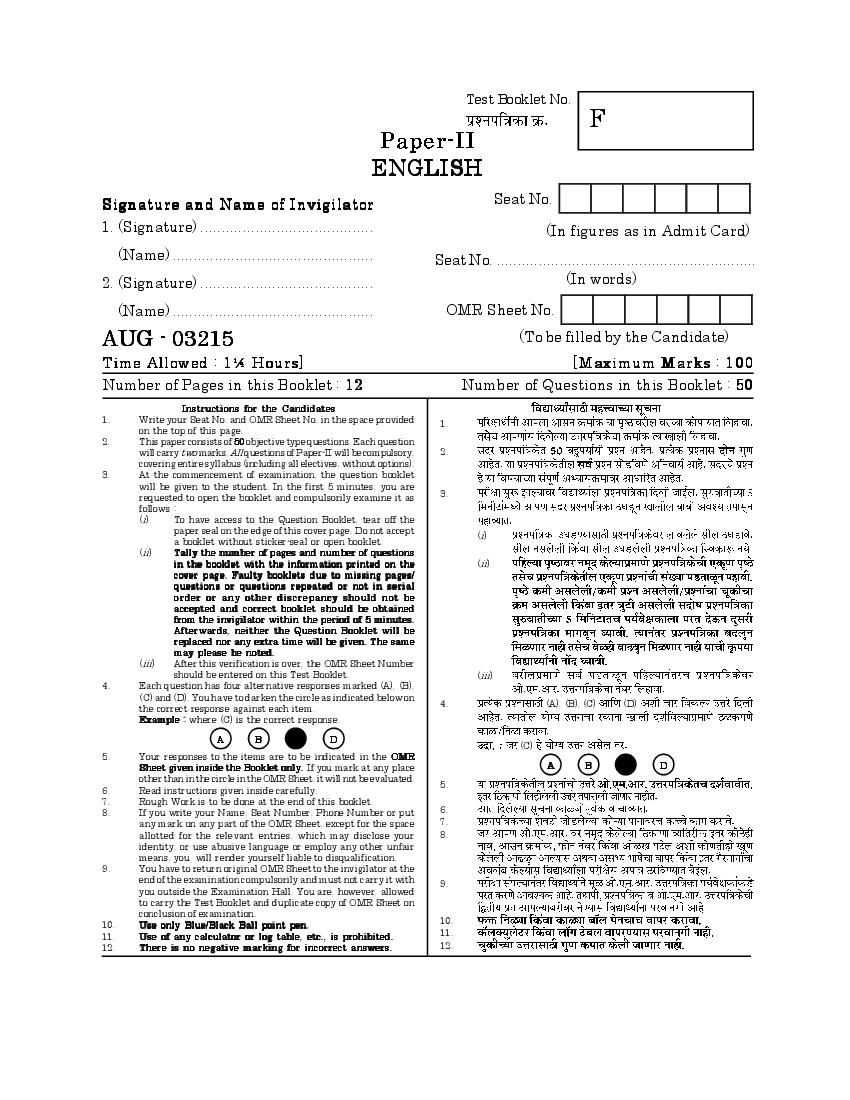
F
ENGLISH
Signature and Name of Invigilator Seat No.
1. (Signature) ......................................... (In figures as in Admit Card)
(Name) ................................................ Seat No. ..............................................................
2. (Signature) ......................................... (In words)
(Name) ................................................ OMR Sheet No.
AUG - 03215 (To be filled by the Candidate)
Time Allowed : 1¼ Hours] [Maximum Marks : 100
Number of Pages in this Booklet : 12 Number of Questions in this Booklet : 50
Instructions for the Candidates
1. Write your Seat No. and OMR Sheet No. in the space provided 1.
on the top of this page.
2. This paper consists of 50 objective type questions. Each question
will carry two marks. All questions of Paper-II will be compulsory, 2.
covering entire syllabus (including all electives, without options).
3. At the commencement of examination, the question booklet
will be given to the student. In the first 5 minutes, you are
requested to open the booklet and compulsorily examine it as 3.
follows :
(i) To have access to the Question Booklet, tear off the
paper seal on the edge of this cover page. Do not accept (i)
a booklet without sticker-seal or open booklet.
(ii) Tally the number of pages and number of questions
in the booklet with the information printed on the (ii)
cover page. Faulty booklets due to missing pages/
questions or questions repeated or not in serial
o rder or any other discre pancy should not be
accepted and correct booklet should be obtained
from the invigilator within the period of 5 minutes.
Afterwards, neither the Question Booklet will be
replaced nor any extra time will be given. The same
may please be noted.
(iii) After this verification is over, the OMR Sheet Number
should be entered on this Test Booklet. (iii)
4. Each question has four alternative responses marked (A), (B),
(C) and (D). You have to darken the circle as indicated below on
the correct response against each item. 4. (A), (B), (C) (D)
Example : where (C) is the correct response.
A B D
(C)
5. Your responses to the items are to be indicated in the OMR
Sheet given inside the Booklet only. If you mark at any place A B D
other than in the circle in the OMR Sheet, it will not be evaluated.
5.
6. Read instructions given inside carefully.
7. Rough Work is to be done at the end of this booklet.
8. If you write your Name, Seat Number, Phone Number or put 6.
any mark on any part of the OMR Sheet, except for the space 7.
allotted for the relevant entries, which may disclose your 8.
identity, or use abusive language or employ any other unfair
means, you will render yourself liable to disqualification.
9. You have to return original OMR Sheet to the invigilator at the
end of the examination compulsorily and must not carry it with 9.
you outside the Examination Hall. You are, however, allowed
to carry the Test Booklet and duplicate copy of OMR Sheet on
conclusion of examination.
10. Use only Blue/Black Ball point pen. 10.
11. Use of any calculator or log table, etc., is prohibited. 11.
12. There is no negative marking for incorrect answers. 12.
Page 2
Page 3
Paper II
Time Allowed : 75 Minutes] [Maximum Marks : 100
Note : This Paper contains Fifty (50) multiple choice questions. Each question
carries Two (2) marks. Attempt All questions.
1. Blake’s famous poem ‘The Tyger’ is 4. The concept of Negative Capability
remarkable for its portrayal of the is attributed to ..........
feeling of :
(A) Coleridge
(A) depression
(B) Keats
(B) amazement
(C) Shelley
(C) skepticism
(D) Wordsworth
(D) anger and betrayal
5. Structuralist criticism is influenced
2. Heathcliff is a character in .......
by the ideas of :
(A) Emma
(A) Sigmund Freud
(B) Jane Eyre
(B) Ferdinand de Saussure
(C) Vanity Fair
(C) Karl Marx
(D) Wuthering Heights
(D) T.S. Eliot
3. Who wrote ‘Essays in Criticism’ ?
6. T.S. Eliot was born in :
(A) Arnold
(A) England
(B) Tennyson
(B) United States
(C) Pope
(C) New Zealand
(D) Hazlitt
(D) Canada
3 [P.T.O.
Page 4
Eighteenth Century writer ?
(A) a novel
(A) Ann Finch
(B) an essay
(B) Elizabeth Thomas
(C) a play
(C) Elizabeth Tollett
(D) a poem (D) Carol Ann Duffy
8. Which of the following pairs is not 10. The tragic flow of Hamlet is :
properly matched ? (A) indecision
(A) Hanif Kureishi : Buddha of (B) ambition
Suburbia (C) vanity
(D) jealousy
(B) Michael Ondaatje : The English
11. Yeats’ ‘Easter, 1916’ is a poetic
Patient
commentary on :
(C) Vikram Seth : A Suitable
(A) Pagan culture
Boy
(B) Greek civilization
(D) Carol Ann Duffy : Dancing at (C) Irish freedom struggle
Lughnasa (D) Roman civilization
4
Page 5
(A) France by ............
(B) Wales (A) Shaw
(C) Scotland (B) Terrence Rattigan
(D) Ireland (C) T.S. Eliot
13. D.H. Lawrence’s The Rainbow (D) J.B. Priestley
grapples with the dynamics of :
16. Who among the following was a
(A) man-woman relationship
‘‘Transcendentalist’’ ?
(B) state oppression
(A) Emerson
(C) the relationship between man
(B) Hawthorne
and God
(C) Dreiser
(D) the aspirations of human soul
(D) Fitzgerald
14. The Country Wife is a play written
by .............. 17. Milton’s ‘‘On His Blindness’ is :
(A) George Etherege (A) an epic
(B) Thomas Otway (B) a mock-epic
(C) William Congreve (C) a sonnet
(D) William Wycherley (D) an elegy
5 [P.T.O.
Page 6
is taken from ................. in his ‘An Epistle from Mr. Pope, to
Dr. Arbuthnot’ in real life was ..........
(A) Julius Caesar
(A) Sir Robert Walpole
(B) Hamlet
(B) King William-III
(C) Macbeth
(C) King George II
(D) Othello
(D) John Lord Hervey
19. Alexander Pope had been attacked
22. According to Aristotle, the soul of a
in verse by ...........
tragedy is :
(A) Queen Caroline
(A) music
(B) Lady Mary Wortley Montagu
(B) character
(C) Queen Anne
(C) chorus
(D) Elizabeth Montagu
(D) plot
20. Encyclopaedia Britannica was a
23. Who is the author of The Colour
product of ...........
Purple ?
(A) British Enlightenment
(A) Alice Walker
(B) Spanish Enlightenment
(B) Margaret Laurence
(C) Scottish Enlightenment
(C) Margaret Atwood
(D) French Enlightenment (D) Fay Weldon
6
Page 7
(A) love song poem ?
(B) narrative poem
(A) Alaster
(C) nuptial poem
(B) Adonais
(D) mourning song
(C) Queen Mab
25. Jane Austen’s first novel was ...............
(D) The Cenci
(A) Sense and Sensibility
28. The oft-quoted line, ‘‘Happiness was
(B) Emma
but the occasional episode in a
(C) Mansfield Park
general drama of pain’’ appears
(D) Pride and Prejudice
in ..........
26. The book Seven Types of Ambiguity
(A) Dicken’s A Tale of Two Cities
is authored by :
(A) John Crowe Ransom (B) Hardy’s The Mayor of
Casterbridge
(B) William Empson
(C) Cleanth Brooks (C) D.H. Lawrence’s The Rainbow
(D) Allen Tale (D) Joyce’s Dublimers
7 [P.T.O.
Page 8
32. For the deconstructionists, meaning
coined by ............
results from .............
(A) T.S. Eliot
(A) The interplay of words used and
(B) John Ruskin
(C) G.M. Hopkins not used
(D) Matthew Arnold
(B) The interplay of words
30. ‘Ethnology’ is a systematic and
used
organized record of .............
(A) animal behaviour (C) The interplay of words not used
(B) human cultures (D) The free play of words used
(C) plant conditions
33. Dr. Jekyll and Mr. Hyde is a fine
(D) universal ethics
example of a .................
31. Structuralism is an intellectual
movement which began in ................ (A) Regional novel
(A) Italy
(B) Campus novel
(B) England
(C) Religious novel
(C) Rome
(D) France (D) Terror-Mystery novel
8
Page 9
by ............ books.
(A) Thomas Malory (A) 5
(B) 8
(B) Thomas Edison
(C) 7
(C) Thomas More
(D) 11
(D) Thomas King
38. Who wrote ‘‘To err is human, to
35. Bacon’s New Atlantis is ..........
forgive divine’’ ?
(A) a prose romance
(A) Bacon
(B) a satire (B) Lamb
(C) a utopia (C) Addison
(D) a ballad (D) Pope
36. Gaveston is a character in ................ 39. Northrop Frye is associated with :
(A) Myth Criticism
(A) Dr. Faustus
(B) Gender Discourse
(B) Edward II
(C) New Criticism
(C) Richard II
(D) Structuralism
(D) King John
9 [P.T.O.
Page 10
Canadian dramatist ?
by :
(A) Beverly Simons
(A) Jane Austen
(B) Carol Bolt
(B) George Eliot
(C) Sharon Pollock
(C) Charles Dickens
(D) Samuel Selvon
(D) D.H. Lawrence
41. The essay ‘‘Commonwealth
Literature Does Not Exist’’ is written 44. Which of the following statements
by : is not true about W.M.
(A) Salman Rushdie Thackeray ?
(B) C.D. Narasimhaiah
(A) Thackeray was born in 1811
(C) A.C. Ward
(B) Thackeray’s finest art is shown
(D) Bruce King
in his pictures of rogues
42. Burgess is a character in the
(C) Thackeray was no cynic,
following play :
though he has often been
(A) Major Barbara
termed one
(B) Candida
(D) Jonathan Wild has been written
(C) Arms and the Man
by W.M. Thackeray
(D) Pygmalion
10
Page 11
wirtten by : an example of :
(A) G.K. Chesterton (A) synecdoche
(B) E.V. Lucas (B) transferred epithet
(C) A.G. Gardiner (C) onomatopoeia
(D) Matthew Arnold (D) oxymoron
46. The term ‘rhetoric’ was originally
49. ‘If winter comes, can spring be far
concerned with the skills of :
behind ?’ is an example of :
(A) Effective acting
(A) a polarity question
(B) Public speaking
(B) an alternative question
(C) Production of artistic objects
(C) a rhetorical question
(D) Writing literature
(D) an echo question
47. ‘Around his tomb let Art and Genius
50. ‘O Hamlet ! thou has cleft my heart
weep’. The dominant metrical
in twain’ is an example of :
pattern in this line is :
(A) antithesis
(A) iambic
(B) euphemism
(B) dactylic
(C) hyperbole
(C) trochaic
(D) personification
(D) anapaestic
11 [P.T.O.
Page 12
12
Document Details
| Board / Org | Maharashtra Exams |
| Exam | MAHA SET |
| Type | Question Paper |
| Pages | 12 |
| Updated | 30 Apr 2026 |