Karnataka Diploma CET 2017 Question Paper Aeronautical Engineering
Finished viewing? Save it for later —
Download Karnataka Diploma CET 2017 Question Paper Aeronautical Engineering (PDF · 32 pages)About Karnataka Diploma CET 2017 Question Paper Aeronautical Engineering
Karnataka Diploma CET 2017 Question Paper Aeronautical Engineering is available here for free download. Published by KEA for Karnataka Diploma Common Entrance Test, this question paper can be viewed online or downloaded as a PDF (32 pages). Candidates preparing for Karnataka Diploma Common Entrance Test can use Karnataka Diploma CET 2017 Question Paper Aeronautical Engineering to understand the exam pattern, the type of questions asked, and the overall difficulty level.
Frequently Asked Questions
How can I download Karnataka Diploma CET 2017 Question Paper Aeronautical Engineering?
Open this page and click the Download button to save Karnataka Diploma CET 2017 Question Paper Aeronautical Engineering as a PDF. It is completely free on AglaSem Docs.
Is Karnataka Diploma CET 2017 Question Paper Aeronautical Engineering free to download?
Yes. Karnataka Diploma CET 2017 Question Paper Aeronautical Engineering can be viewed online and downloaded as a PDF free of cost on AglaSem Docs.
How many pages does Karnataka Diploma CET 2017 Question Paper Aeronautical Engineering have?
Karnataka Diploma CET 2017 Question Paper Aeronautical Engineering contains 32 pages, which you can read online or download together as a single PDF.
Where can I find more Karnataka Diploma Common Entrance Test study material?
You can find more Karnataka Diploma Common Entrance Test question papers, sample papers, syllabus, and answer keys on AglaSem Docs.
Karnataka Diploma CET 2017 Question Paper Aeronautical Engineering – Text
Read the full text of this question paper below — useful to quickly search, copy and reference the content online without downloading the PDF.
📄 View text version (32 pages)
Page 1
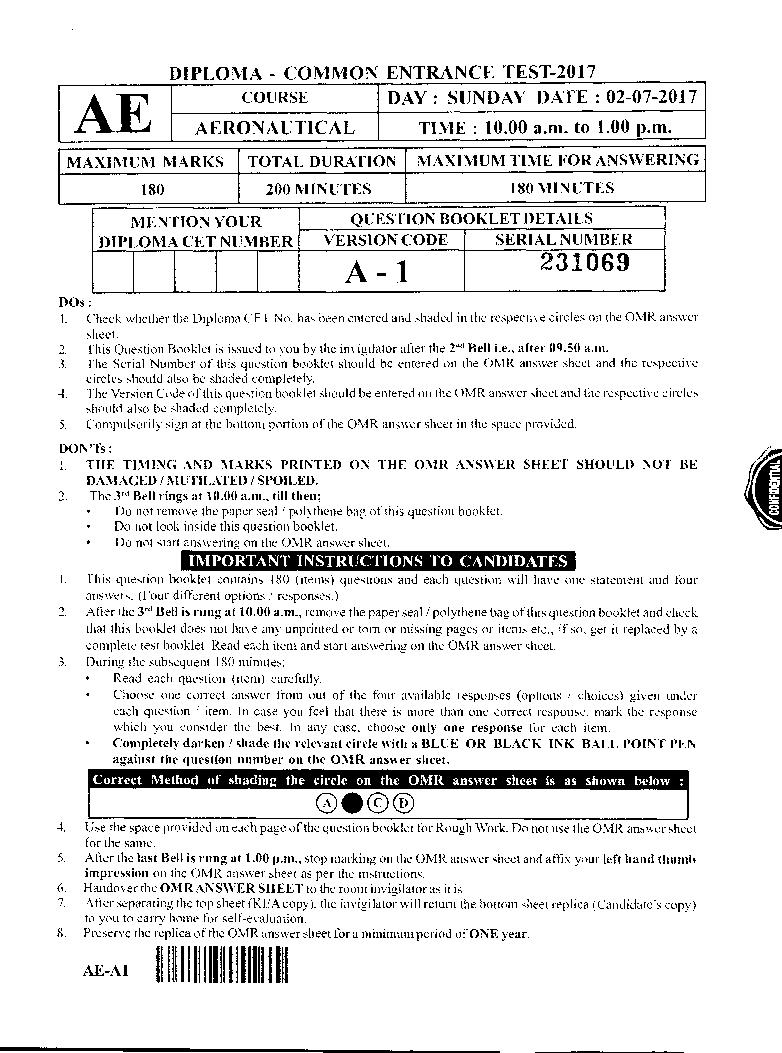
COURSE DAY : SUNDAY DATE : 02-07-2017
AE AERONAUTICAL TIME : 10.00 a.m. to 1.00p .m.
MAXIMUM MARKS TOTAL DURATION MAXIMUM TIME FOR ANSWERING
180 200 MINUTES 180 MINUTES
MENTION YOUR QUESTION BOOKLET DETAILS
DIPLOMA CET NUMBER VERSION CODE SERIAL NUMBER
A- 1 231069
DOs :
1. Check whether the Diploma CET No. has been entered and shaded in the respective circles on the OMR answer
sheet.
2. This Question Booklet is issued to you by the invigilator after the 2"" Bell i.e., after 09.50 a.m.
3. The Serial Number of this question booklet should be entered on the OMR answer sheet and the respective
circles should also be shaded completely.
4. The Version Code of this question booklet should be entered on the OMR answer sheet and the respective circles
should also he shaded completely.
5. Compulsorily sign at the bottom portion of the OMR answer sheet in the space provided.
DON'Ts :
1. THE TIMING AND MARKS PRINTED ON THE OMR ANSWER SHEET SHOULD NOT BE
DAMAGED / MUTILATED / SPOILED.
The 3" Bell rings at 10.00 a.m., till then;
Do not remove the paper seal / polythene bag of this question booklet.
Do not look inside this question booklet.
Do not start answering on the OMR answer sheet.
IMPORTANT INSTRUCTIONS TO CANDIDATES
1. This question booklet contains 180 (items) questions and each question will have one statement and four
answers. (Four different options .1 responses.)
2. After the 3' Bell is rung at 10.00 a.m., remove the paper seal / polythene bag of this question booklet and check
that this booklet does not have any unprinted or torn or missing pages or items etc., if so, get it replaced by a
complete test booklet. Read each item and start answering on the OMR answer sheet.
3. During the subsequent 180 minutes:
• Read each question (item) carefully.
• Choose one correct answer from out of the four available responses (options choices) given under
each question item. In case you feel that there is more than one correct response, mark the response
which you consider the best. In any case, choose only one response for each item.
Completely darken / shade the relevant circle with a BLUE OR BLACK INK BALL POINT PEN
against the question number on the OMR answer sheet.
Correct Method of shading the circle on the OMR answer sheet is as shown below :
4. Use the space provided on each page of the question booklet for Rough Work. Do not use the OMR answer sheet
for the same.
5. After the last Bell is rung at 1.00 p.m., stop marking on the OMR answer sheet and affix your left hand thumb
impression on the OMR answer sheet as per the instructions.
6. Handover the OMR ANSWER SHEET to the room invigilator as it is.
7. After separating the top sheet (KEA copy), the invigilator will return the bottom sheet replica (Candidate's copy)
to you to carry 1 ome for self-evaluation.
8. Preserve the replica of the OMR answer sheet for a minimum period of ONE year.
AE-A1 I iii
Page 2
APPLIED SCIENCE
1. The S.I. unit of Coefficient of Viscosity is
(A) Poise (B) NSin-2
(C) NS-I m2 (D) NS-1 m-2
The prefix used for 10' is
(A) Mega (B) Tera
(C) Giga (D) Hecta
3. The physical quantity which has the dimensional formula [ML'T 2 is
(A) Force (B) Surface tension
(C) Viscosity (D) Work
4. The least count of slide callipers is given by
(A) I MSD + I VSD (B) 1 MSD x 1 VSD
(D) I MSD
(C) 1 MSD — 1 VSD
I VSD
5. The product of force and time is
(A) Momentum (B) Moment
(C) Impulse (D) Acceleration
6. The change in position of a particle in a particular direction is referred to as
(A) Speed (B) Displacement
(C) Velocity (D) Acceleration
A-1 2 AE
Page 3
al (2n —1)
(A) S = u -- (B) Sn = u (2n —1)
(C) Si, = u + (2n +1) (D) Si, = u — (2n + 1)
8. A bullet of mass 0.01 kg is fired with a velocity of 960 ms-1 from a rifle of mass 3 kg, the
velocity of recoil of rifle is
(A) —320 ms (B) —0.32 ms-1
(C) — 3.1 ms-1 (D) ms-1
9. One of the following is not a scalar quantity :
(A) Mass (B) Density
(C) Force (D) Speed
10. If a body fixed about a point rotates in clockwise direction, the moment of force is measured
as
(A) Positive (B) Negative
(C) Zero (D) Equal
11. The resultant magnitude of two forces P and Q acting in same line and in same direction is
(A) P — Q (B) P +Q
(C) Q—P (D)
Q
AE 3 A-1
Page 4
(A) 100 N (B) 10 N
(C) 48 N (D) 14 N
13. The value of resultant magnitude of two forces acting at a point is maximum, when the
angle between the two forces is
(A) 0° (B) 90°
(C) 180° (D) 45°
14. Rise of liquid in a capillary tube is due to
(A) Energy (B) Viscosity
(C) Surface tension (D) Pressure
15. The ratio of volume stress to volume strain is called
(A) Bulk modulus (B) Young's modulus
(C) Rigidity modulus (D) Poisson's ratio
16. The reciprocal of bulk modulus of elasticity is called
(A) Compressibility (B) Rigidity
(C) Plasticity (D) Modulus of elasticity
17. The force of cohesion is maximum in
(A) Solids (B) Gases
(C) Liquids (D) Plasma
A-1 4 AE
Page 5
(A) 8 x10² Nm-1 (B) 80 Nin -I
(C) 8x10⁻² Nm-1 (D) 8 x10³ Nm-
19. Pressure at the bottom of a container having base area of 10 m2 tilled with water to a height
of 10 in is
(A) 9.8 x 10⁴ Pa (B) 980 x 104 Pa
(C) 9.8 x 10⁻⁴ Pa (D) 980 x 10-4 Pa
20. 100 °C when expressed in absolute scale is
(A) 100 K (B) 0 K
(C) 273 K (D) 373 K
21. Gas law which gives the relation between pressure and volume changes is
(A) Boyle's law (B) Charles' law
(C) Gay-Lussac's law (D) Hooke's law
11. Amount of heat required to raise the temperature of one gram of water through 1 °C is
(A) Heat capacity (B) Conductivity
(C) Calorie (D) Joule
23. An example of longitudinal wave is
(A) Sound waves (B) Waves on the surface of water
(C) Light waves (D) Electromagnetic waves
AE 5 A-I
Page 6
(A) v x T (B)
(C) v x VT (D) ' T 22
25. The distance between a node and the next antinode in a stationary wave is equal to
(A) one wavelength (B) half wavelength
(C) twice wavelength (D) one fourth wavelength
26. Damage caused by marching military columns to the suspension bridge is due to
(A) Echo (B) Resonance
(C) Beats (D) Interference
27. During forced vibrations, if the forced frequency is F1 and natural frequency is F? the body
resonates if
(A) F1 > F, (B) F, >
(C) Fi = 2.5 F, (D) Fi = FT,
28. The fundamental frequency of transverse vibrations of the stretched string is inversely
proportional to
(A) tension (B) length of string
(C) square root of tension (D) square root of length of string
29. Minimum length of a hall to produce an echo is
(A) 50 in (B) 34 m
(C) (D) 17m
A-1 6 AE
Page 7
(A) Polarisation (B) Photoelectric effect
(C) Interference (D) Compton effect
31. The spectrum of black body radiation is successfully explained by
(A) Newton's corpuscular theory of light
(B) lIuygen's wave theory of light
(C) Maxwell's electromagnetic theory of light
(D) Planck's quantum theory of light
32. For constructive interference of light, the path difference should be
/nX X
(A) (B) (2n +1) —
(C) (2n +1)— (D) (2n +1) --
)`
3 4
33. Two very close objects are just resolved if the central maximum of one object is on
(A) central maximum of another
(B) first minimum of another
(C) beyond second minimum of another
(D) between central maximum and first minimum of another
34. The light is incident at polarising angle Op and the angle of refraction is r, then
(A) + r = 0° (B) 011+ r = 90°
(C.) 8p+ r = 180° (D) 0 2+ r = 360°
AF 7 A-1
Page 8
(A) Kinetic energy (B) Potential energy
(C) Work function (D) Energy function
36. When the size of the scattering particle is small, the intensity of scattered light is inversely
proportional to
(A) fourth power of wavelength (B) square of wavelength
(C) square root of wavelength (D) cube of wavelength
37. Time for which an atom stays in metastable state is of the order of
(A) Seconds (B) Milli-seconds
(C) Micro-seconds (D) Nano-seconds
38. If an element emits f3-ray then its atomic number
(A) increases by one (B) decreases by one
(C) remains same (D) decreases by two
39. If the concentration of H + ions is more than 10-7 gmion per litre, the solution is
(A) Base (B) Acid
(C) Neutral (D) Both Acid and Base
40. A galvanic cell is one in which
(A) chemical energy produce electric energy
(B) electric energy produce chemical energy
(C) chemical energy will not produce electric energy
(D) electric energy will not produce chemical energy
A-1 8 AE
Page 9
APPLIED MATHEMATICS
1
/ 3
41. The value of x if 2 x 3 = 0 is
3 4 3
(A) 0 (B) 3
(C) 3 (D) 18
42. The value of x, if 4x + y = 7, 3y + 4: = 5 and 3z+ 5x = 2 is
(A) 0 (B) I
(C) 3 (D) -1
2 -1
43. If A , then A-1 is
3 -4
-4 -3 -4 1
(A) - (B) -1
5 1 2 5 -3 2
-4 -3 -1 -4 1
(C) -- (D)
11 1 - 11 -3 2
2 -1 is
44. The characteristic equation of the matrix A =
5 -h
(A) A2 + 8A - 71= 0 (B) A2 + 4A -171= 0
(C) A2 + 4A + 71= 0 (D) A2 + 4A - 71= 0
AE 9 A-1
Page 10
45. If +A- , then A is
1 ) 3
- .,1, _2
)- 3
(A) (B)
_ -)
0_ _) 0
0 3
(C) (D)
0 -)
24
( 7A
46. The middle term of the expansion of -- is
24,-, 10 12 (B) 24c13212
(A) io 2 x
(c) 24 C13 (D) 24 C1,212 x1 2
47. The term independent of x in( x2 — — is
13x
(A) 9 C6 (4)6 (B) C (3) n
r3
9 ( 9
(C) C( 3 (D) C6 -
\,4,/
48. If 3i — 2j + k, i — 3j + 5k, 2i j 4k are the sides of a triangle, then the triangle is
(A) Right angled triangle (B) Equilateral triangle
(C) Isosceles triangle (D) Isosceles right angled triangle
49. If a = (2, —1, 4) and b = (2, —3, 4), then projection of a on b is
23 23
(A)
(B) J29
-)3
(C), (D)
J21
A-1 10 AE
Page 11
j65 ) -\/65
(A) (B
3 AF3
A/65
(C) (D) J65
9
tan245+cot230
51. If x sir 45 — then the value of x is
sin245 + cos245
(A) 4 (B) 2
(C) 6 (D) 8
4 lt ilt 3 )7 ) lt
52. The value of —sec- —cosec- — + tan- -- 2 sin- -- is
3 3 6 4 4 3
11
(A) (B) 53
12 12
7
(C) (D)
12 12
53. The value of
i lm A
+0
sin (90-0) sec \ 2 ) tan (180-0) .
+ + is
cos (360-0) cosec (7t+0) tan (-0)
(A) 1 (B) —1
(C) 3 (D)
54. The value of cosec 43 cot 43 cot 47 cos 47
(B) 0
(D) 2
AE 11 A-1
Page 12
55. The value of
1- tan 69° tan 66°
(A) 1 (B) -1
(C) 0 (D) cr-)
56. If tan = x then sin A + tan A is
er)
41 4.v
(A) (B) 1 ±.1.2
4.v 4x
(C) (D)
1+_v4 1—A74
57. The value of sin 70° - sin 50° - sin 10° is
(A) 1 (B) 0
I
(C) --I (D) -
58. sin -i .v is also equal to
(
(A) cosec (B) cosec x
1
(C) cosec-1 .v (D)
sin -v
59. Centroid divides the median in the ratio
(A) 2 : 1 (B) 1 :2
(C) 1 : 1 (D) 1 :4
60. The co-ordinates of a point which divides the line join of the points (a + b, a - b) and
(a - h, a + b) in the ratio 2 : 3 is
5a + 5b 5a-5b a + h a- b
(A) (B)
5 5 5 5
5a + b 5a —b 5a —b a +5b
(C) . (D)
5 5 5
A-1 12 AE
Page 13
(A) 5x — 3y = 15 (B) 5x + 3y = 15
(C) 5x 3y = 1 (D) 15x + 15y = 1
62. The angle between the lines whose slopes are Arj and respectively is
-‘3
71
(A)
6
(C)
63. The equation of the straight line passing through (2, 3) and x intercept is twice its y intercept
is
(A) .v + 2y = 8 (B) — 2y = 8
(C) x + y = 4 (D) 2x + 2y = 8
64. The equation to the line passing through the point (-6, 7) and parallel to the line joining
(3, 4) and (6, —8) is
(A) 4x+y+31 =0 (B) + 4y — 1 =0
(C) x — 4y + 1 =0 (D) 4x+y+ 17 =0
65. lim (sec 0 — tan 0) is equal to
o
(A) 0 (B) 1
(C) (D) 71
—4
66. lim is equal to
v -* 4 3_03_
(A) 3 (B) 9
(C) 6 (D) 0
AE 13 A-1
Page 14
67. If y = (1 + logx)' , then is
dx
5
(A) 5(logx)4 (B) — (l+logx)4
(C) 5(1+ log x)4 (D) 5x4 logx
dy
68. If x = cos- t and y = sin t. then -- is
dx
(A) —1 (B) 1
(C) / (D)
2V1—t 2 — t2
dy
69. It y = x log y, then ---- is
dx
log log y'
(A) - —
.v — y x— y
logy` log y'
(C)
x—y x
x +1
70. If y = , then dy is
x+2 dx
1 7x +3
(A)
(x +2)2 (x+ 2)2
—3
(C)
(x + 2)2 (x+2) 2
71. The equation of tangent to the curve y2 = 4x at (I, 2) is
(A) .v + y — 3 = 0 (B) x—y+ I = 0
(C) 2a- -y= 0 (D) 2x + y — 4 = 0
A-1 14 AE
Page 15
(A) 15 (B) —4
(C) —2 (D) 31
73. The value of flog 2x dx is
(A) x log 2x + x + C (B) x log 2x — x + C
(C) 1 +C (D) 1-- + C
74. The value of fsec4 x • tan x dx
4
SCC x
(A) +C (B) 4 sec-4x + C
4
tan4x
(C) 3 sec2x + C (D) +C
4
75. The value of f x log x dx is
x2
(A) --logx +C (B) log,x + +C
2
2
. X
(C) log x --+ C (D) —
2 log x +—+C
4 4
g/4
76. Jtan 2 x dx is equal to
(A) — -1 (B) I 4
4
(C) (D)1
16 16
AE 15 A-1
Page 16
(C) c.
78. The volume generated by revolving the line y = x + 1 about the x-axis between the ordinates
x = 0 and x — 2
267t 7t
(A) units (B) 10 units
3
(C) units (D) 4 units
3
1/3
2y
79. The degree and order of the differential equation d , 1+ are
(A) 2 and 1 (B) 1 and 2
(C) 3 and 2 (D) 2 and 3
dy
80. The solution of differential equation + y tan x = sec x is
clx
(A) y see x = tan x + C
(B) y sin x sec x + C
(C) log(sec = tan x + C
(D) y sec x = —cot x + C
A-1 16 AE
Page 17
AERONAUTICAL ENGINEERING
81. Radio waves transmission takes place through which layer of atmosphere ?
(A) Troposphere (B) Stratosphere
(C) Mesosphere (D) Thermosphere
82. The phenomena like rainfall, fog or hailstorm occurs in which layer of the atmosphere.
(A) Troposphere only (B) Stratosphere only
(C) Troposphere and stratosphere (D) Mesosphere
83. With respect to air speed terminologies, which of the following statement is incorrect :
(1) True air speed accounts for standard sea level density for any altitude.
(2) True air speed accounts for relative density for a particular altitude.
(3) Equivalent air speed accounts for standard sea level density for any altitude.
(A) (1) only (B) (2) only
(C) (2) and (3) (D) (1) and (2) only
84. Person studying in living room experiences which type of pressure ?
(A) Static pressure
(B) Dynamic pressure
(C) Static and total pressure, and also they are equal
(D) Total pressure
85. The difference in pressure distribution over top surface and bottom surface of cylinder is
created by
(A) only rotating cylinder
(B) relative air flow and by rotating cylinder
(C) relative air flow without rotating cylinder
(D) relative air flow only
AE 17 A-1
Page 18
(A) pressure distribution only
(B) shear stress distribution only
(C) both pressure distribution and shear stress distribution
(D) camber length only
87. The syMmetric airfoil produce lift only
(A) at- zero degree angle of attack
(B) at zero degree as well as at higher angle of attack
(C) when angle of attack is given
(D) none of these
88. The function of flap is to
(A) get additional lift
(B) get additional drag
(C) get additional lift but drag increases slightly depending on flap inclination
(D) none of these
89. Slats are deployed mainly to
(A) keep flow attached to surface of body
(B) to delay the stall
(C) both keep flow attached to surface of body and to delay the stall
(D) none of these
90. Increasing wing span area leads to
(A) increase in lift
(B) increase in drag
(C) both increase in lift and increase in drag
(D) decrease in lift and increase in drag
91. Mach number (M) range of supersonic flow is
(A) M < 1 (B) M > 1
(C) M = 1 (D) M > 5
A-1 18 AE
Page 19
(A) To keep shockwave attached to body
(B) To keep shockwave oblique to body
(C) To keep shockwave normal to body
(D) Both to keep shockwave attached to body and to keep shockwave oblique to body
93. For selection of aircraft material standardisation is a factor.
(A) Engineering (B) Economic
(C) Mechanical property (D) Aesthetic
94. Steel containing carbon percentage from 0.10 to 0.30% is termed as
(A) Low Carbon Steel (B) Medium Carbon Steel
(C) High Carbon Steel (D) Cast Iron
95. Corrosion is accelerated by temperature.
(A) warm (B) cold
(C) very cold (D) all
96. Composites are engineered materials made from reinforcement and
(A) alloy (B) wood
(C) matrix (D) chemical
97. Aluminium alloys are and ductile.
(A) malleable (B) hard
(C) brittle (D) heavy
98. The lapse rate in temperature is
(A) 3 °C/1000 ft (B) 5 °C/1000 ft
(C) 1.98 °C/1000 ft (D) 0.5 °C/1000 11
99. Static pressure is used by these cockpit instruments.
(A) Altimeter (B) Air Speed Indicator
(C) Rate of climb indicator (D) All the three
AE 19 A-1
Page 20
(A) High speed jet fighter planes
(B) Transport/Civil passenger planes
(C) Helicopter
(D) Both Transport/Civil passenger planes and Helicopter
101. The basic six instruments of an aircraft cockpit arc
(A) ASI, GH, VSI, Altimeter, Direction indicator, TSI
(B) ASI, VHI, ALTI, DI, TSI, ROCI
(C) ASI, MACH METER. VSI, TSI, DI, GH
(D) ASI, DI, ROCH, TSI, GH, ALTI
102. Basic T instruments of an aircraft are
(A) ASI, GH, ALTI, VSI, MACH meter, D1, RMI, TSI
(B) AS!, GH, ALTI, DI
(C) ASI, GH, ALTI, VSI, TS1
(D) None of these
103. Elastic pressure sensing elements are those
(A) which become elastic under pressure.
(B) which change their shape or dimension when pressure is applied.
(C) which become liquid when high pressure is applied.
(D) which change their dimension when high temperature is applied.
104. The normal gyroscope has
(A) three axes of movement
(B) two axes of freedom
(C) only one axes of freedom
(D) both three axes of movement and only one axes of freedom
105. The gyro horizon or GH indicates the following altitudes of an aircraft:
(A) Pitch & Bank (B) Pitch & Slip
(C) Pitch & direction (D) None of these
A-1 20 AE
Page 21
(A) two gyroscope (B) two gimbal ring
(C) only one gimbal ring (D) no gimbal ring
107. Mach meter does not indicate the speed of sound or speed of aircraft. It displays the ratio
of
(A) local speed of sound to aircraft speed
(B) local air speed to speed of aircraft at an altitude
(C) aircraft speed to local speed of sound
(D) none of these
108. In airframe construction Longeron is a member.
(A) Vertical (B) Longitudinal
(C) Circular (D) Slant
109. There are major structural stresses acting on an aircraft.
(A) 5 (B) 7
(C) 3 (D) 4
110. When structure follows equation M = 2f— 3, it is
(A) statically unstable structure (B) statically indeterminate structure
(C) statically determinate structure (D) none of these
111. supports the aircraft when it is parked, on tarmac.
(A) Jack (B) Wing
(C) Landing gear (D) Tail section
112. Generally configuration use rectangular plane form.
(A) High wing (B) Medium wing
(C) Low wing (D) Diehedral
113. Nacells are aerodynamically designed enclosures to house
(A) wings (B) landing gear
(C) engines (D) propellers
Space For Rough Work.
AE 21 A-1
Page 22
(A) decreasing (B) augmenting
(C) reducing (D) none of these
115. Main gearbox is a major component of transmission system of
(A) Aircraft (B) Helicopter
(C) Spacecraft (D) Hovercraft
116. The roll movement of an aircraft is also movement
(A) around longitudinal axis (B) around lateral axis
(C) around vertical axis (D) none of these
117. Rudder is a control surface.
(A) tertiary (B) secondary
(C) primary (D) auxiliary
118. A on the primary control surface enables pilot to move more easily and hold
control surface in position.
(A) Trim Tab (B) Flap
(C) Balance Tab (D) Spring Tab
119. Fuel system based upon its function is classified in groups.
(A) 3 (B) 4
(C) 2 (D) 6
120. The purpose of tank baffles is to stop of fuel during rapid changes of speed and
direction.
(A) surge (B) pressure
(C) leakage (D) bulge
121. Bell crank, levers, gears and screw jack form part of media.
(A) Hydraulic (B) Pneumatic
(C) Mechanical (D) Fly by wire
A-1 22 AE
Page 23
(A) entering the oil cooler (B) entering the engine
(C) in the oil tank (D) after passing oil cooler
123. forms part of aircraft environment control.
(A) Ice protection system (B) Landing gear
(C) Cabin pressurisation (D) Fuel system
124. Anti-icing system the formation of ice on the protected surfaces.
(A) aids (B) removes
(C) prevents (D) facilitates
125. In four stroke engine crankshaft completes how many revolutions for each thermodynamic
cycle ?
(A) One (B) Two
(C) Three (D) Four
126. Work output is produced in a four stroke engine during following stroke :
(A) Intake (B) Compression
(C) Expansion (D) Exhaust
127. Otto cycle consist of
(A) one isentropic process, one constant volume process
(B) two isentropic process, two constant volume process
(C) three isentropic process, one constant volume process
(D) four constant volume processes
128. Fins are provided in a piston engine to the temperature of engine.
(A) increase (B) decrease
(C) does not have any effect (D) none of these
129. Gas turbine engine works on following cycle:
(A) Otto cycle (B) Diesel cycle
(C) Brayton cycle (D) ATKINSON cycle
AE 23 A-1
Page 24
(A) Diffuser (B) Compressor
(C) Combustion chamber (D) Turbine
131. A typical subsonic air inlet of Jet engine consist of duct whose diameter from
front to hack.
(A) decreases (B) increases
(C) remains constant (D) either decreases or remains constant
132. In axial flow compressor the flow of air is to the rotor shaft.
(A) radially outward (B) radially inward
(C) parallel (D) tangential
133. The parts of the gas turbine engine are arranged in the order.
(A) Diffuser —> Compressor —> Combustion Chamber —> Nozzle —> Turbine
(B) Compressor —> Diffuser —> Combustion Chamber —> Turbine —> Nozzle
(C) Diffuser —> Compressor Combustion Chamber —> Turbine —> Nozzle
(D) Diffuser —> Turbine —> Combustion Chamber —> Compressor —> Nozzle
134. Which one of the following is not a function of compressor?
(A) To compress the air. (B) To supply Bleed air.
(C) To supply heated air for anti-icing. (D) To expand the air.
135. Brayton cycle consists of
(A) two reversible isobaric processes and two reversible adiabatic processes
(B) one reversible isobaric process and one reversible adiabatic process
(C) four reversible isobaric processes
(D) four reversible adiabatic processes
136. By pass ratio of a turbofan engine is defined as the ratio of
cold thrust hot thrust
(A) (B)
hot thrust cold thrust
total thrust total thrust
(C) (D)
hot thrust cold thrust
A-1 24 AE
Page 25
(A) constant temperature (B) constant volume
(C) constant pressure (D) constant entropy
138. The working of jet propulsion is based on
(A) Impulse principle (B) Centrifugal principle
(C) Reaction principle (D) Centripetal principle
139. The maximum temperature of the combustor of gas turbine engine is limited because
(A) it is difficult to burn the fuel.
(B) the air fuel ratio is too lean.
(C) combustion chamber walls cannot sustain high temperature.
(D) turbine blades cannot accept very high temperatures.
140. Commutators are used to
(A) collect current from rotating armature conductors.
(B) distribute load from stator to rotor.
(C) reduce arcing of rotor current.
(D) to supply constant field current.
141. In a carbon pile regulator, the resistance of the carbon pile
(A) reduces with increase of pressure.
(B) increases with increase of pressure.
(C) increase very gradually with pressure.
(D) does not get affected by pressure change at all.
142. In an aircraft navigation lights, when an aircraft is approaching you
(A) the green light is on right, the red light is on left.
(B) the green is left, the red is on right.
(C) the position of green and red depends on type of aircraft.
(D) none of these
AE 25 A-1
Page 26
(A) for pilot to see ice formation on leading edge of wings.
(B) to see if control surfaces are moving properly.
(C) to see if there is any damage to leading edge of wings.
(D) all of these
144. In aircraft electrical system 400 C/s frequency is used because
(A) it is most economical to use for high rating.
(B) it reduces the number of terns of winding and hence the total weight of systems..
(C) it is very commonly used in all the countries.
(D) it can give very high rated loads.
145: The conditions to he Dant for paralleling of alternat ors are
(A) they should be from same company, should have same construction, frequency.
loads.
(B) they should be of similar rating, same phase, frequency and speed.
(C) they should be of smaller size, same frequency, same number of poles, voltage.
(D) none of these
146. The damage caused to landing gear is by following reason:
(A) If particular aircraft weight exceeds.
(B) If vertical descent velocity exceeds.
(C) If vertical descent velocity precedes.
(D) Both if particular aircraft weight exceeds and if vertical descent velocity exceeds.
147. The importance of inspection scheduling is
(A) co-ordination in flying and serving task.
(B) greater serviceability, safety and efficiency
(C) both co-ordination in flying and serving task and greater serviceability, safety and
efficiency.
(D) none of these
A-1 26 AE
Page 27
for the following reason :
(A) air conditioning system is heavier due to presence of compressor
(B) warm inside air condenses while impinging on colder areas of structure
(C) thermal acoustic linings presence
(D) warm inside air condenses while impinging on colder areas of structure and thermal
acoustic linings presence
149. The process of protecting aircraft from inadvertent movement and against adverse weather
conditions is known as
(A) Towing (B) Taxiing
(C) Mooring (D) None of these
150. The correct statement among the following with respect to fire extinguisher is
(A) seal on the neck will weaken causing compressed gas to escape
(B) fire extinguishers are cheaper
(C) fire extinguishers do expire.
(D) all of these
151. The resultant performance of aircraft due to ice accumulation is
(A) increase in drag
(B) decrease in lift
(C) both increase in drag and decrease in lift
(D) none of these
152. The fires due to electric equipment is Categorized as
(A) Class-A (B) Class-B
(C) Class-C (D) Class-D
153. The following problems caused for aircraft due to static charges picked up is
(A) noise disturbance in radio communication
(B) disturbance in electronic systems
(C) both noise disturbance in radio communication and disturbance in electronic systems
(D) none of these
AE 27 A-1
Page 28
(A) 2 — 4 GHz (13) 4 6 GHz
(C) 8 — 10 GHz (D) 1 — 2 GHz
155. Very low frequency (VLF) is from
(A) 30 — 300 Hz (B) 3 to 30 kHz
(C) 30 — 300 kHz (D) 3000 —3 GHz
156. The range of HF is
(A) very high / long compared to VHF/UHF
(B) almost range as VHF/UHF
(C) low compared to VHF/UHF
(D) both almost range as VHF/UHF and low compared to VHF/UHF
157. The LOS range is normally (in communication)
(A) 40 — 50 kms (B) 10 — 20 kms
(C) 100 — 200 kms (D) 300 — 400 kms
158. The paths of propagation for Em waves are
(A) ground waves, sky waves. space waves
(B) underground, above ground and sky waves
(C) space waves, sky waves, underground waves
(D) both ground waves, sky waves, space waves and underground, above ground and
sky waves
159. Skip distance in space wave communication is
(A) silence zone
(B) maxi radiation zone
(C) where signals are very clear
(D) both maxi radiation zone and where signals are very clear
A-1 28 AE
Page 29
(A) dependent on ground support equipment
(B) not dependent on any ground support equipment
(C) most accurate system at any distance, time
(D) not used any more because of its limitations
161. ILS is a system which is used
(A) when visibility is very poor (B) for long distance
(C) for only small aircrafts (D) none of these
162. The accuracy of INS
(A) degrades with distance and time
(B) improves with distance because of stabilization
(C) does not depend on time or distance
(D) none of these
163. Aircraft Act 1934 empowers to make rules and implement as per Geneva
convention.
(A) manufactures (B) operators
(C) central government (D) owners of aircraft
164. CAR section 2 series a airworthiness is issued by airworthiness Dte under provisions of
rule of 1937.
(A) 60 (B) 83
(C) 133 A (D) 143 A
165. The written information on defect with complete details shall be forwarded by scheduled
operator within
(A) 3 days (B) 30 days
(C) 24 hours (D) 3 hours
166. Sudden and total failure is called as
(A) Quick time failure (B) Catastrophic failure
(C) Breakdown failure (D) Common failure
AE 29 A-1
Page 30
(A) Rich and total fuel (B) Emergency and Breakdown
(C) Real term f-► ilure (D) Real time failure
168. BITE stands for
(A) Built in time equipment
(B) Built in tailored equipment
(C) Built in test equipment
(D) Both built in time equipment and built in test equipment
169. TQM stands for
(A) Total Quantity Measured (B) Total Quality Maintenance
(C) Total Quotient Managed (D) Total Quality Management
170. Degradation failure is
(A) graded and potential (B) graded and timed
(C) graded and partial (D) graded and total
171. DUT stands kir
(A) Detained Und Test (B) Device Under Test
(C) Deviation Under Test (D) Devices Unplanned Testing
172. Ability of an item to perform a required function under the given operational and
environmental conditions for a stated period is called
(A) Resilience (B) Reliability
(C) Life cycle (D) Total performance
173. SQC means
(A) Standing Quality Contract
(B) Standing Quality Control
(C) Statistical Quality Control
(D) Both Statistical Quality Control and Standing Quality Control
A-1 30 AE
Page 31
(A) Mean test before failure
(B) Mean time before failure
(C) Maintenance time before failure
(D) Mean test before failure and Maintenance time before failure
175. Unscheduled maintenance is required in the case of
(A) Breakdown
(B) VIP equipment servicing
(C) When maintenance is not done for 3 months
(D) both Breakdown and VIP equipment servicing
176. International regulatory arrangement is established by under aegis of U.N.
(A) EASA (B) DGCA
(C) ICAO (D) JAA
177. ATF contamination is divided in categories.
(A) 3 (B) 5
(C) (D) 6
178. To test contamination of fuel with water, we use
(A) Hydrometer (B) Water finding paste
(C) Die penetrant (D) Radiography
179. Aircraft tyres provide necessary for braking and stopping of aircraft on landing.
(A) Surface (B) Traction
(C) Groove (D) Force
180. Hydroplanning is a condition experienced on
(A) long runways (B) high altitude runways
(C) wet runways (D) short runways
AE 31 A-1
Page 32
Document Details
| Board / Org | KEA |
| Exam | Karnataka Diploma Common Entrance Test |
| Type | Question Paper |
| Pages | 32 |
| Language | english |
| Updated | 30 Apr 2026 |