CBSE Class 12 Question Paper 2024 Solution Accountancy
Finished viewing? Save it for later —
Download CBSE Class 12 Question Paper 2024 Solution Accountancy (PDF · 22 pages)About CBSE Class 12 Question Paper 2024 Solution Accountancy
CBSE Class 12 Question Paper 2024 Solution Accountancy is available here for free download. Published by CBSE for Class 12, this solution can be viewed online or downloaded as a PDF (22 pages). Candidates preparing for Class 12 can use CBSE Class 12 Question Paper 2024 Solution Accountancy to understand the exam pattern, the type of questions asked, and the overall difficulty level.
Frequently Asked Questions
How can I download CBSE Class 12 Question Paper 2024 Solution Accountancy?
Open this page and click the Download button to save CBSE Class 12 Question Paper 2024 Solution Accountancy as a PDF. It is completely free on AglaSem Docs.
Is CBSE Class 12 Question Paper 2024 Solution Accountancy free to download?
Yes. CBSE Class 12 Question Paper 2024 Solution Accountancy can be viewed online and downloaded as a PDF free of cost on AglaSem Docs.
How many pages does CBSE Class 12 Question Paper 2024 Solution Accountancy have?
CBSE Class 12 Question Paper 2024 Solution Accountancy contains 22 pages, which you can read online or download together as a single PDF.
Where can I find more Class 12 study material?
You can find more Class 12 question papers, sample papers, syllabus, and answer keys on AglaSem Docs.
CBSE Class 12 Question Paper 2024 Solution Accountancy – Text
Read the full text of this solution below — useful to quickly search, copy and reference the content online without downloading the PDF.
📄 View text version (22 pages)
Page 1
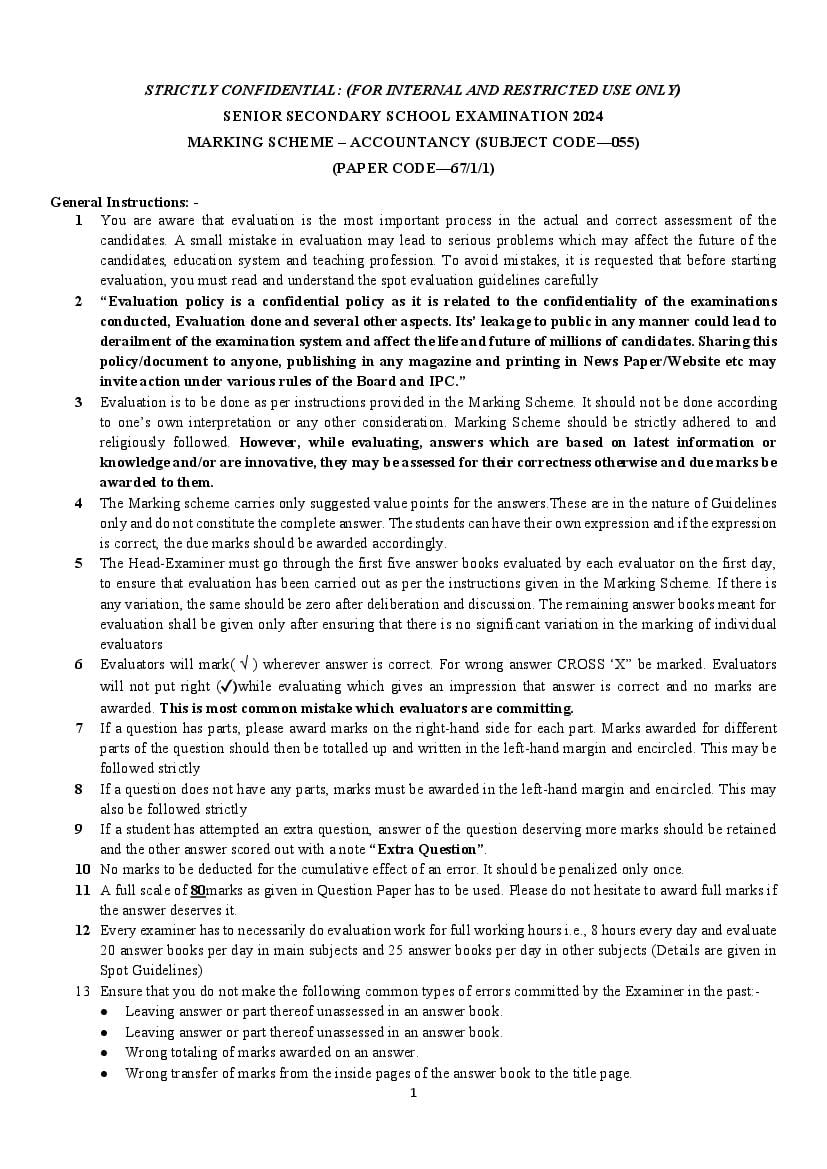
SENIOR SECONDARY SCHOOL EXAMINATION 2024
MARKING SCHEME – ACCOUNTANCY (SUBJECT CODE—055)
(PAPER CODE—67/1/1)
General Instructions: -
1 You are aware that evaluation is the most important process in the actual and correct assessment of the
candidates. A small mistake in evaluation may lead to serious problems which may affect the future of the
candidates, education system and teaching profession. To avoid mistakes, it is requested that before starting
evaluation, you must read and understand the spot evaluation guidelines carefully
2 “Evaluation policy is a confidential policy as it is related to the confidentiality of the examinations
conducted, Evaluation done and several other aspects. Its’ leakage to public in any manner could lead to
derailment of the examination system and affect the life and future of millions of candidates. Sharing this
policy/document to anyone, publishing in any magazine and printing in News Paper/Website etc may
invite action under various rules of the Board and IPC.”
3 Evaluation is to be done as per instructions provided in the Marking Scheme. It should not be done according
to one’s own interpretation or any other consideration. Marking Scheme should be strictly adhered to and
religiously followed. However, while evaluating, answers which are based on latest information or
knowledge and/or are innovative, they may be assessed for their correctness otherwise and due marks be
awarded to them.
4 The Marking scheme carries only suggested value points for the answers.These are in the nature of Guidelines
only and do not constitute the complete answer. The students can have their own expression and if the expression
is correct, the due marks should be awarded accordingly.
5 The Head-Examiner must go through the first five answer books evaluated by each evaluator on the first day,
to ensure that evaluation has been carried out as per the instructions given in the Marking Scheme. If there is
any variation, the same should be zero after deliberation and discussion. The remaining answer books meant for
evaluation shall be given only after ensuring that there is no significant variation in the marking of individual
evaluators
6 Evaluators will mark( √ ) wherever answer is correct. For wrong answer CROSS ‘X” be marked. Evaluators
will not put right (✓)while evaluating which gives an impression that answer is correct and no marks are
awarded. This is most common mistake which evaluators are committing.
7 If a question has parts, please award marks on the right-hand side for each part. Marks awarded for different
parts of the question should then be totalled up and written in the left-hand margin and encircled. This may be
followed strictly
8 If a question does not have any parts, marks must be awarded in the left-hand margin and encircled. This may
also be followed strictly
9 If a student has attempted an extra question, answer of the question deserving more marks should be retained
and the other answer scored out with a note “Extra Question”.
10 No marks to be deducted for the cumulative effect of an error. It should be penalized only once.
11 A full scale of 80marks as given in Question Paper has to be used. Please do not hesitate to award full marks if
the answer deserves it.
12 Every examiner has to necessarily do evaluation work for full working hours i.e., 8 hours every day and evaluate
20 answer books per day in main subjects and 25 answer books per day in other subjects (Details are given in
Spot Guidelines)
13 Ensure that you do not make the following common types of errors committed by the Examiner in the past:-
● Leaving answer or part thereof unassessed in an answer book.
● Leaving answer or part thereof unassessed in an answer book.
● Wrong totaling of marks awarded on an answer.
● Wrong transfer of marks from the inside pages of the answer book to the title page.
1
Page 2
● Wrong totaling of marks of the two columns on the title page.
● Wrong grand total.
● Marks in words and figures not tallying/not same.
● Wrong transfer of marks from the answer book to online award list.
● Answers marked as correct, but marks not awarded. (Ensure that the right tick mark is correctly and clearly
indicated. It should merely be a line. Same is with the X for incorrect answer.)
● Half or a part of answer marked correct and the rest as wrong, but no marks awarded.
14 While evaluating the answer books if the answer is found to be totally incorrect, it should be marked as cross
(X) and awarded zero (0) marks
15 Any un assessed portion, non-carrying over of marks to the title page, or totaling error detected by the candidate
shall damage the prestige of all the personnel engaged in the evaluation work as also of the Board. Hence, in
order to uphold the prestige of all concerned, it is again reiterated that the instructions be followed meticulously
and judiciously.
16 The Examiners should acquaint themselves with the guidelines given in the “Guidelines for spot Evaluation”
before starting the actual evaluation.
17 Every Examiner shall also ensure that all the answers are evaluated, marks carried over to the title page, correctly
totaled and written in figures and words.
18 The candidates are entitled to obtain photocopy of the Answer Book on request on payment of the prescribed
processing fee. All Examiners/Additional Head Examiners/Head Examiners are once again reminded that they
must ensure that evaluation is carried out strictly as per value points for each answer as given in the Marking
Scheme.
2
Page 3
Senior Secondary School Examination, 2024
ACCOUNTANCY [ Paper Code — 67/1/1]
Q. No. Marks
EXPECTED ANSWER / VALUE POINTS
PART A
(Accounting for Partnership Firms and Companies)
1. Q. Atul, Beena and Sita were partners in a firm….
Ans. (B) 4:7:5:4 1 mark
OR
OR
Q. Rushil and Abheer were partners in a firm….
1 mark
Ans. (C) 2:2:3
2. Q. Abhay, Boris and Chetan were partners in a firm….
Ans. (A) ₹17,500 1 mark
3. Q. Aavya, Mitansh and Praveen were partners in a firm.
Ans. (D) ₹15,000 1 mark
4. Q. Piyush, Rajesh and Avinash were partners in a firm…
Ans. (D) Old partners in sacrificing ratio 1 mark
5. Q. Alex, Benn and Cole were partners in a firm…
Ans. (A) ₹75,000 1 mark
6. Q. Assertion(A): Each partner is a principal….
Ans. (B) Both Assertion (A) and Reason (R) are correct and Reason (R) is the correct explanation of
Assertion (A). 1 mark
Read the following………………………..
7. Q. The amount of interest on capital…
Ans. (D) ₹30,000 1 mark
8. Q. Babita’s share in profit….
1 mark
3
Page 4
9. Q. Alfa Ltd. invited applications for….
Ans. (D) ₹26,00,000 1 mark
10. Q. Reserve capital is that part…
Ans. (C) Uncalled 1 mark
11. Q. Xeno Ltd. issued 25,000 equity shares….
Ans. (C) ₹13,500 1 mark
12. Q. Assertion (A): Irredeemable debentures are also known as…
Ans. (A) Both Assertion (A) and Reason (R) are correct and reason (R) is the correct explanation of
Assertion (A). 1 mark
13. Q.(a) Money received in advance from shareholders…
Ans. (B) Credited to calls in advance account 1 mark
OR
OR
(b) An offer of securities or invitation….
Ans (C) Private placement of shares 1 mark
14. Q. (a) A share of ₹100 on which ₹80 is received….
Ans. (D) ₹20 1 mark
OR
OR
(b) Shiv Ltd. forfeited 500 shares of 10 each….
Ans. (A) ₹3,000 1 mark
4
Page 5
Ans.
Date Particulars Dr. Amount Cr. Amount
(₹) (₹)
1 mark
(C) Furhan’s Capital A/c Dr. 27,000
To Dan’s Capital A/c 27,000
OR OR
(b) Sia, Tom and Vidhi were partners in a firm….
Ans.
Date Particulars Dr. Amount Cr. Amount
(₹) (₹)
(A) Sia’s Capital A/c Dr. 30,000
Tom’s Capital A/c Dr. 20,000
Vidhi’s Capital A/c Dr. 10,000
To Profit & Loss A/c 60,000 1 mark
16. Q. (a) Anju, Divya and Bobby were partners in a firm….
Ans. (C) 3:1 1 mark
OR
OR
Q. (b) Mita, Veena and Atul were partners in a firm….
Ans. (B) 8:7 1 mark
17. Q. Aamir, Bashir and Chirag were partners in a firm…
Ans.
Gain = New share – Old Share
(½ )
Aamir’s Gain= 1/ 3 - 3/8 = -1/24 (sacrifice)
Bashir’s Gain = 2/3 - 3/8 = 7/24 (gain) (½ )
5
Page 6
JOURNAL
(2)
Date Particulars L.F. Dr. Amount Cr. Amount
(₹) (₹)
Bashir’s Capital A/c Dr. 1,57,500 =3
To Aamir’s Capital A/c 22,500 marks
To Chirag’s Capital A/c 1,35,000
(Goodwill treated on Chirag’s
retirement without opening
Goodwill account)
18. Q. Pearl and Ruby were partners in a firm….
Ans.
Calculation of Normal Adjusted Profit
Year Profit (₹) Adjustment (₹) Adjusted Profit (₹)
2019-20 35,000 - 35,000
2020-21 25,000 - 25,000
2021-22 32,000 - 32,000
2022-23 33,000 (5,000) 28,000
TOTAL 1,20,000
Average Profit= (Total Adjusted Profit)/ No. of years
= 1,20,000/4 = ₹30,000 (1)
Normal Profit= Capital Employed x Normal Rate of Return
100
= 2,50,000 x 10 = ₹25,000 (½)
100
Super Profit = Average Profit – Normal Profit
= 30,000 - 25,000 = ₹5,000 (½)
Goodwill= Super Profit x No. of years’ purchase (1 )
= 5,000 x 3 = ₹15,000
=3
marks
19. Q. (a) Sunrise Ltd. acquired assets of ₹3,60,000…..
Ans.
6
Page 7
JOURNAL
Date Particulars L.F Dr. Amount Cr. Amount
(₹) (₹)
Sundry Assets A/c Dr. 3,60,000
Goodwill A/c Dr. 2,20,000
To Creditors A/c 1,00,000 (1 ½ )
To Moonlight Ltd. 4,80,000
(Assets acquired and liabilities taken over
from Moonlight Ltd)
_______________________________
Moonlight Ltd. Dr. 4,80,000
Discount on Issue of (1 )
Debentures A/c Dr. 20,000
To 9% Debentures A/c 5,00,000
(Purchase consideration settled by issuing
5,000 9% debentures at 4% discount)
_______________________________
Working Note: (1/2 )
No. of debentures = (Purchase Consideration) / Issue Price =3
= 4,80,000/ 96 marks
= 5,000
OR
OR
(b) Q. Grapple Ltd. took over assets of ₹25,00,000…..
Ans. In the books of Grapple Ltd.
JOURNAL
Date Particulars L.F. Dr. Amount Cr. Amount
(₹) (₹)
Sundry Assets A/c Dr. 25,00,000
To Liabilities A/c 5,00,000
To Allore Ltd. 18,00,000 (1 ½ )
To Capital Reserve A/c 2,00,000
(Assets acquired and liabilities taken
over from Allore Ltd.)
___________________________
Allore Ltd. Dr. 18,00,000
To 11% Debentures A/c (1 )
15,00,000
To Securities Premium A/c 3,00,000
7
Page 8
issuing 15,000 11% debentures at
20% premium)
___________________________
Working Note: (½)
No. of debentures = (Purchase Consideration) / Issue Price
=3
= 18,00,000/ 120
marks
= 15,000
20. Q. (a) Mohan, Suhaan and Adit were partners in a firm….
Ans Solution:
In the Books of Mohan, Suhaan and Adit
JOURNAL
Date Particulars L.F. Dr. Cr.
Amount Amount
(₹) (₹)
Adit’s Current A/c Dr. 1,000
To Suhaan’s Current A/c 1,000 (1)
(Adjustment entry for Interest on Capital credited at
a higher rate)
Working Notes:
Statement of Adjustment
Particulars Mohan Suhaan Adit
₹ ₹ ₹ (2)
Interest on capital to be debited (6,000) (3,000) (3,000)
Profit to be credited now (₹12,000 in 3:2:1) 6,000 4,000 2,000
=3
Adjustment - 1,000 (1,000)
marks
Cr. Dr.
(NOTE: Full credit be given if working notes are prepared in any other form)
OR
OR
(b) Q. Manoj and Nitin were partners in a firm….
8
Page 9
JOURNAL
Date Particulars L.F. Dr. Cr.
Amount Amount
(₹) (₹)
Manoj’s Capital A/c Dr. 2,000 (1)
To Nitin’s Capital A/c 2,000
(Adjustment entry for omission of Interest on
Capital and Interest on Drawings)
Working Notes:
Calculation of Opening Capital
Particulars Manoj Nitin
₹ ₹
Closing Capital 90,000 80,000
Add: Drawings 40,000 20,000 (½ )
Less: Profit (₹30,000 in 2:1) (20,000) (10,000)
Opening Capital 1,10,000 90,000
Statement of Adjustment
Particulars Manoj Nitin
₹ ₹
Amount to be credited
Interest on Capital 11,000 9,000
Less: Interest on Drawings (3,000) (2,000)
8,000 7,000
(1½ )
Amount to be debited now (₹15,000 in 2:1) (10,000) (5,000)
Adjustment (2,000) 2,000
Dr Cr
=3
(NOTE: Full credit be given if working notes are prepared in any other form) marks
21. Q. Shivalik Ltd. was registered with an authorised capital….
Ans. Shivalik Ltd.
BALANCE SHEET (extract)
As at ……
Particulars Note Amount
No. (₹)
I Equity and Liabilities
1. Shareholders’ Funds
(a) Share Capital 1 4,68,000 (1)
9
Page 10
Particulars Amount
₹
1. Share Capital
Authorised Capital
1,00,000 equity shares of ₹10 each 10,00,000 (1)
Issued Capital
50,000 equity shares of ₹10 each 5,00,000 (1 )
Subscribed Capital
Subscribed & fully paid-up
46,000 equity shares of ₹10 each 4,60,000
(1)
Add: Share Forfeiture A/c 8,000
4,68,000
=4
marks
22. Q. Archana, Vandana and Arti were partners in a firm….
Ans.
Dr Realisation A/c Cr
Particulars Amount Particulars Amount
₹ ₹
To Investments A/c 80,000 By Creditors A/c (½) 60,000
To Plant A/c 1,00,000
To Stock (½) 40,000 By Bank A/c (½)
To Debtors A/c 50,000 Debtors 40,000
Stock 50,000
To Bank (½) 60,000 Plant 60,000 1,50,000
To Arti’s Capital A/c (½) 20,000
By Vandana’s capital A/c (½) 18,000
By Archana’s capital A/c (½) 54,000
By Loss transferred to Partners’
Capital A/c: (½)
Archana 34,000
Vandana 20,400
Arti 13,600 68,000 =4
3,50,000 3,50,000 marks
23. Q. Azhar, Sumit and Robit were partners in a firm….
10
Page 11
Dr. Robit’s Capital A/c Cr.
Particulars Amount Particulars Amount
₹ ₹
To Robit’s Executor’s A/c / Legal 41,650 By Bal b/d 20,000 (½)
Representatives A/c (½) By General Reserve A/c 12,000 (1)
By Interest on Capital A/c 500 (1)
By Azhar’s Capital A/c 6,300 (1)
By Sumit’s Capital A/c 2,100 (1)
By P&L Suspense A/c 750 (1)
41,650 41,650
=6
marks
Working Notes:
(i) Goodwill = 3 x 56,000 = 42,000
4
Robit’s Share in firm’s Goodwill = 42,000 x 1/5 = 8,400
Gaining ratio between Azhar and Sumit = 3:1
(ii) Robit’s Share in the Profit upto the date of death = 15,000 x 1/5 x 3/12
= 750
NOTE: No marks to be awarded for the working note .
11
Page 12
Ans. (a) Books of Zubian Ltd.
JOURNAL
Date Particulars L.F Dr. Amount Cr. Amount
(₹) (₹)
2022 (i)
Apr 1 Bank A/c Dr. 10,60,000
To Debenture Application & 10,60,000
Allotment A/c (1)
(Application money received on 10,000, 7%
Debentures)
_______________________________
Apr 1 (ii)
Debenture Application &
Allotment A/c Dr. 10,60,000
Loss on issue of Issue of
Debentures A/c Dr. 40,000
To 7% Debentures A/c 10,00,000 (2)
To Securities Premium A/c 60,000
To Premium on Redemption of 40,000
Debentures A/c
(Debentures issued at 6% premium,
redeemable at 4% premium on redemption)
________________________________
(iii)
2023
Securities Premium A/c Dr.
Mar 31 40,000
To Loss on Issue of Debentures A/c
40,000 (1)
(Loss on issue of debentures written off)
________________________________
(b)
Dr Loss on Issue of Debentures A/c Cr
Date Particulars Amount Date Particulars Amount
₹ ₹
1.4.22 To Premium on 40,000 31.3.23 By Securities 40,000
Redemption of Premium A/c
Debentures A/c (2)
40,000 40,000
=6
marks
12
Page 13
Ans. In the Books of Qumtan Ltd.
JOURNAL
Date Particulars L.F Dr. Cr. Amount
Amount (₹)
(₹)
(i)
Bank A/c Dr. 12,80,000
To Equity Share Application and 12,80,000
Allotment A/c
(Application and allotment money received on
1,60,000 shares)
________________________________
(ii)
Equity Share Application and
Allotment A/c Dr. 12,80,000
To Equity Share Capital A/c 5,00,000
To Securities Premium A/c 3,00,000
To Bank A/c 4,80,000
(Application money transferred to Share Capital
and Securities Premium; excess amount returned)
________________________________
1x6
(v)
Equity Share First & Final Call A/c Dr.
8,00,000
To Equity Share Capital A/c
5,00,000
To Securities Premium A/c
3,00,000
(Share First & Final Call money due)
________________________________
(vi)
Bank A/c Dr.
7,98,400
Calls- in- Arrears A/c Dr.
1,600
To Equity Share First & Final Call A/c
8,00,000
(Share first and final call money received except
on 200 shares)
Alternatively
Bank A/c Dr. 7,98,400
To Equity Share First & Final Call A/c 7,98,400
(Share first and final call money received except
on 200 shares)
________________________________________
(vii)
Equity Share Capital A/c Dr. 2,000
Securities Premium A/c Dr. 600
To Calls- in- Arrears A/c 1,600
To Share Forfeiture A/c 1,000
13
Page 14
first and final call)
Alternatively
Equity Share Capital A/c Dr. 2,000
Securities Premium A/c Dr. 600
To Equity Share First and Final Call A/c 1,600
To Share Forfeiture A/c 1,000
(200 equity shares forfeited for non-payment of
first and final call)
_____________________________________
(viii)
1,000
Bank A/c Dr.
1,000
Share Forfeiture A/c Dr.
2,000
To Equity Share Capital A/c
(200 forfeited shares reissued) =6
_____________________________________
marks
OR
OR
(b) Printkit Limited invited applications…..
Ans
In the books of Printkit Limited
JOURNAL
Date Particulars L.F Dr. Amount Cr. Amount
(₹) (₹)
(i)
Bank A/c Dr. 4,50,000
(½)
To Equity Share Application A/c 4,50,000
(Application money received on 1,50,000shares)
___________________________________
(ii)
Equity Share Application A/c Dr. 4,50,000
To Equity Share Capital A/c 2,40,000
To Equity Share Allotment A/c 1,40,000
To Calls-in- Advance A/c 40,000 (1½)
To Bank A/c 30,000
(Application money transferred to Share Capital
and excess amount adjusted to Share Allotment
A/c and calls-in-advance; application money on
10,000 shares refunded)
________________________________
(iii)
Equity Share Allotment A/c Dr. 1,60,000
To Equity Share Capital A/c 1,60,000 (1)
(Allotment money due on 80,000 shares)
14
Page 15
(iv)
Bank A/c Dr. 20,000
To Equity Share Allotment A/c 20,000
(1)
(Allotment money received after adjusting
excess application money)
___________________________________
(v)
Equity Share First & Final Call A/c Dr. 4,00,000
To Equity Share Capital A/c 4,00,000 (1)
(Share First & Final Call money due)
___________________________________
(vi)
Bank A/c Dr. 3,60,000
Calls- in- Advance A/c Dr. 40,000
(1)
To Equity Share First & Final Call A/c 4,00,000
(Share first and final call money received after
adjusting calls- in- advance)
___________________________________
=6
marks
26. Q. (a) Shubhi and Revanshi were partners in a firm….
Ans.
Dr. REVALUATION A/c Cr.
Particulars Amount Particulars Amount
₹ ₹
To Fixed Assets A/c ½ 27,000 By Stock A/c ½ 7,000
By Loss transferred to
Partners Capital A/c: ½ (1½ )
Shubhi- 12,000 20,000
Revanshi- 8,000
27,000 27,000
15
Page 16
Particulars Shubhi Revanshi Pari Particulars Shubhi Revanshi Pari
₹ ₹ ₹ ₹ ₹ ₹
To Revaluation 12,000 8,000 By Bal b/d 60,000 32,000
(4½ )
A/c ½ ½
To Cash A/c ½ 6,000 By General 18,000 12,000
To Bal c/d 1 Reserve A/c
90,000 60,000 50,000 ½
By Cash A/c 50,000
½
By Premium
for Goodwill 30,000 20,000
A/c ½ =6
By Cash A/c marks
4,000
½
1,08,000 68,000 50,000 1,08,000 68,000 50,000
OR
OR
(b)Rishi, Shashi and Trishi were partners in a firm….
Dr. REVALUATION A/c Cr.
Particulars Amount Particulars Amount
₹ ₹
To Fixed Assets A/c ½ 24,000 By Stock A/c ½ 6,000
(1 ½ )
By Loss transferred to
Partners Capital A/c: ½
Rishi- 9,000
Shashi- 3,000 18,000
Trishi- 6,000
24,000 24,000
Dr. PARTNERS’ CAPITAL A/c Cr.
Particulars Rishi Shashi Trishi Particulars Rishi Shashi Trishi
₹ ₹ ₹ ₹ ₹ ₹
To Revaluation 9,000 3,000 6,000 By Bal b/d ½ 36,000 30,000 20,000
A/c ½ By General (4 ½ )
To Stock A/c ½ 26,000 Reserve A/c ½ 15,000 5,000 10,000
To Shashi’s 1,800 1,200 By Rishi’s Capital
Capital A/c ½ A/c ½
1,800
To Shashi’s Loan By Trishi’s Capital
9,000
A/c ½ A/c ½
40,200 22,800 1,200
To Bal c/d ½
51,000 38,000 30,000 51,000 38,000 30,000
=6
marks
16
Page 17
OPTION - I
(Analysis of Financial statements)
27. Q. The quick ratio of a company is …..
1 mark
Ans. (B) Sold goods on credit
28. Q. Identify which of the following transactions….
Ans. (D) Amount received from debtors 1 mark
29. Q. (a) Analysis of Financial Statements is useful…
Ans. (B) Trade Payables 1 mark
OR
OR
(b)______________________ratios are calculated to determine…..
1 mark
Ans. (C) Solvency
30. Q. (a) The transaction ‘Acquisition of machinery……
Ans. (D) No flow of cash 1 mark
OR
OR
(b)The transaction ‘ Capital Gains tax….
Ans. (B) Investing Activities 1 mark
31. Q. Classify the following items under major heads….
Ans.
Item Major Heads Sub heads
½ mark
(a) Long Term Loans Non –Current Liabilities Long Term Borrowings each
from Bank
(b) Loose Tools Current Assets Inventories
=3
(c) Outstanding Current Liabilities Other Current Liabilities marks
Expenses
17
Page 18
Ans.
(a) Quick Ratio= Quick Assets ½
Current Liabilities
Quick assets = Current Assets – Inventory
= 4,00,000 – 1,00,000
= ₹3,00,000 ½
Quick Ratio = 3,00,000 = 1.5:1 ½
2,00,000 (1 ½ )
(b) Inventory Turnover Ratio = Cost of Revenue from Operations ½
Average Inventory
Cost of Revenue from Operation = Revenue from Operations – Gross Profit
= 10,00,000 – 2,00,000
= ₹ 8,00,000 ½
Inventory Turnover Ratio = 8,00,000 = 8 times ½ (1 ½ )
1,00,000
=3
marks
33. Q. (a) From the given Balance Sheet of Geox Ltd., ………
Ans. Geox Ltd
Common size Balance Sheet
As at March 31, 2022 and March 31, 2023
Particulars Absolute Amounts Percentage of Total Assets
31.3.2022 31.3.2023 31.3.2022 31.3.2023
(₹) (₹) (%) (%)
I - Equity and Liabilities:
1. Shareholders’ Funds
(a) Share Capital 2,50,000 4,00,000 50 50 (½)
2. Non- Current Liabilities
(a) Long Term Borrowings 1,50,000 2,00,000 30 25 (½)
3. Current Liabilities
(a) Trade Payables 1,00,000 2,00,000 20 25 (½)
TOTAL 5,00,000 8,00,000 100 100
(½)
II – Assets:
1. Non – Current Assets
(a) Fixed Assets/Property, Plant
and Equipment and Intangible
Assets
3,50,000 4,00,000 70 50 (½)
2. Current Assets
18
Page 19
(b) Trade Receivables 80,000 2,00,000 16 25
(½)
(½)
TOTAL 5,00,000 8,00,000 100 100
=4
marks
OR OR
(b)Q. From the following information, prepare a Comparative Statement of Profit and Loss…
Ans. Comparative Statement of Profit & Loss
For the year ended March 31, 2023
Particulars 2021- 22 2022-23 Absolute Percentage
(₹) (₹) Increase or Increase or
Decrease (₹) Decrease(%)
I Revenue from Operations 8,00,000 10,00,000 2,00,000 25 (½)
II Less: Expenses
(½)
Employee Benefit Expenses 1,00,000 2,50,000 1,50,000 150
(½)
Other Expenses 4,00,000 5,50,000 1,50,000 37.5
III Profit before Tax 3,00,000 2,00,000 (1,00,000) (33.3) ( 1)
IV Less: Tax @ 50% 1,50,000 1,00,000 (50,000) (33.3) (½)
V Profit after Tax 1,50,000 1,00,000 (50,000) (33.3) (1)
=4
marks
19
Page 20
Ans.
Cash Flows from Operating Activities
Particulars Details Amount
₹ ₹
Net Profit before Tax and Extraordinary items 8,50,000
Adjustments for Non- Cash and Non- operating items
Add: Depreciation
1,40,000 (½ )
Loss on Sale of Machinery
30,000 (½ )
Less: Gain on Sale of Investments
(20,000) (½ )
Dividend Received on Investments (½ )
(6,000)
Operating profit before Working Capital changes 9,94,000
Add: Increase in Current Liabilities
Less: Increase in Current Assets 1,61,000 (½ )
Decrease in Current Liabilities (6,00,000) (½ )
Cash generated from operations (64,000) (½ )
Less: Income Tax paid 4,91,000
(1,18,000) (½ )
Net cash inflows from Operating Activities
3,73,000 (1)
Calculation of Net Profit before Tax and Extraordinary items
Surplus = 6,28,000
(1)
+ Provision for Tax = 1,50,000
+ Proposed Dividend = 72,000 =6
8,50,000 marks
PART B
OPTION – II
(Computerised Accounting)
27. Q. Data, ___________, ______________, Hardware…..
Ans. (B) People and Procedures 1 mark
28. Q. (a) Name the Accounting information sub-system…..
Ans. (C) Cash and Bank sub-system 1 mark
OR
OR
(b)When the accumulated data from……
Ans. ( C) Batch processing 1 mark
29. Q. How many categories of data…
20
Page 21
30. Q. (a) From the following, identify…
1 mark
Ans. (A) Block code
OR
OR
(b)Correct ##### appears….
1 mark
Ans. (A) When column is not wide enough
31. Q. Explain the terms ‘ Doughnut’ and ‘Exploded Doughnut’ as types of charts.
Ans. (a) Doughnut Chart:
1½ x2
It displays data in rings where each ring represents a data series. It is like pie-chart.
It shows the relationship of parts to a whole, but it can contain more than one. These charts are not
easy to read.
(b) Exploded Doughnut:
=3
Much like exploded pie chart, exploded doughnut display the contribution of each value to a total
marks
while emphasising individual values but they can contain more than one data series.
32. Q. Explain ‘Transparency and Control’ and ‘Accuracy and Speed’ as features of Computerised
Accounting System.
Ans.
(a) Transparency and Control:
CAS provides sufficient time to plan, increase data accessibility and enhances user satisfaction. With
computerised accounting, the organisation will have greater transparency for day-to- day business (1 ½)
operations and access to vital information. This will make feedback and decision making timely,
hence, better control over the processes can be established.
(b) Accuracy and Speed:
CAS provides user definable templates (data entry screen or forms) for fast, accurate data entry of the
transactions. It not only makes data entry fast but also provides checks to check its accuracy from (1 ½)
time to time.at the same time, the facility of generating desired documents and reports is also there.
=
3 marks
33. Q. (a) State any four advantages of Computerised Accounting System.
Ans. Advantages of CAS (any four):
(i) Timely generation of reports and information in desired format
(ii) Efficient record keeping
1 x4
(iii) Ensures effective control over the system
(iv) Economy in the processing of accounting data
(v) Confidentiality of data is maintained =4
(vi) Transparency in recording of data helps in avoiding frauds marks
21
Page 22
(viii) Accuracy in data makes the reports reliable
OR
OR
(b)Explain ‘Password security’ and ‘Data audit’ as security features of computerised accounting
system.
Ans. Password Security:
Password security is a mechanism, which enables a user to access a system including data. The
system facilitates defining the user rights according to organisation policy. Consequently, a person in
(2)
the organisation may be given access to a particular set of data while he may be denied access to
another set of data.
Password is the key (Code) to allow the access to the system
Data Audit:
(2)
This feature enables one to know as to who and what changes have been made in the original data,
thereby helping and fixing the responsibility of the person who has manipulated the data and also
answers data integrity. Basically, this feature is similar to Audit Trail. =4
marks
34. Q. Explain the two syntax forms of ‘Lookup’ function.
Ans. The ‘LOOKUP’ function has two syntax forms:
(i) Vector
This ‘LOOKUP’ form looks in a one row or one column range for a value and then returns a value
from the same position in a second one row or one column range. The syntax is LOOKUP ( lookup-
value, lookup-vector, result-vector)
• LOOKUP-Value is a value that LOOKUP searches for in the first vector. It can be a
number, text, a logical number, name, etc.
• LOOKUP- Vector is a range that contains only one row or one column. The value in
LOOKUP- Vector can be text, numbers or logical values.
• Result- Vector is range that contains only one row or column. It must be the same size
as LOOKUP- Vector. 3 x 2
(ii) Array
It looks in the first row or column of an array for the specified value, and then returns a value from
the same position in the last row or column of the array. The syntax is
• LOOKUP (lookup- value-array)
• LOOKUP- Value cannot find the lookup-value, it uses largest value in the array
that is less than or equal to lookup-value.
• If lookup-value is smaller than the smallest value in the first row or column, it
returns the #N/A error values.
• Array is the range of cells that contains text, numbers or logical values that we
want to compare with lookup-values. =6
marks
22
Document Details
| Board / Org | CBSE |
| Exam | Class 12 |
| Type | Solution |
| Pages | 22 |
| Updated | 30 Apr 2026 |