Finished viewing? Save it for later —
Download CBSE Class 12 Question Paper 2024 Solution Applied Math (PDF · 22 pages)About CBSE Class 12 Question Paper 2024 Solution Applied Math
CBSE Class 12 Question Paper 2024 Solution Applied Math is available here for free download. Published by CBSE for Class 12, this solution can be viewed online or downloaded as a PDF (22 pages). Candidates preparing for Class 12 can use CBSE Class 12 Question Paper 2024 Solution Applied Math to understand the exam pattern, the type of questions asked, and the overall difficulty level.
Frequently Asked Questions
How can I download CBSE Class 12 Question Paper 2024 Solution Applied Math?
Open this page and click the Download button to save CBSE Class 12 Question Paper 2024 Solution Applied Math as a PDF. It is completely free on AglaSem Docs.
Is CBSE Class 12 Question Paper 2024 Solution Applied Math free to download?
Yes. CBSE Class 12 Question Paper 2024 Solution Applied Math can be viewed online and downloaded as a PDF free of cost on AglaSem Docs.
How many pages does CBSE Class 12 Question Paper 2024 Solution Applied Math have?
CBSE Class 12 Question Paper 2024 Solution Applied Math contains 22 pages, which you can read online or download together as a single PDF.
Where can I find more Class 12 study material?
You can find more Class 12 question papers, sample papers, syllabus, and answer keys on AglaSem Docs.
CBSE Class 12 Question Paper 2024 Solution Applied Math – Text
Read the full text of this solution below — useful to quickly search, copy and reference the content online without downloading the PDF.
📄 View text version (22 pages)
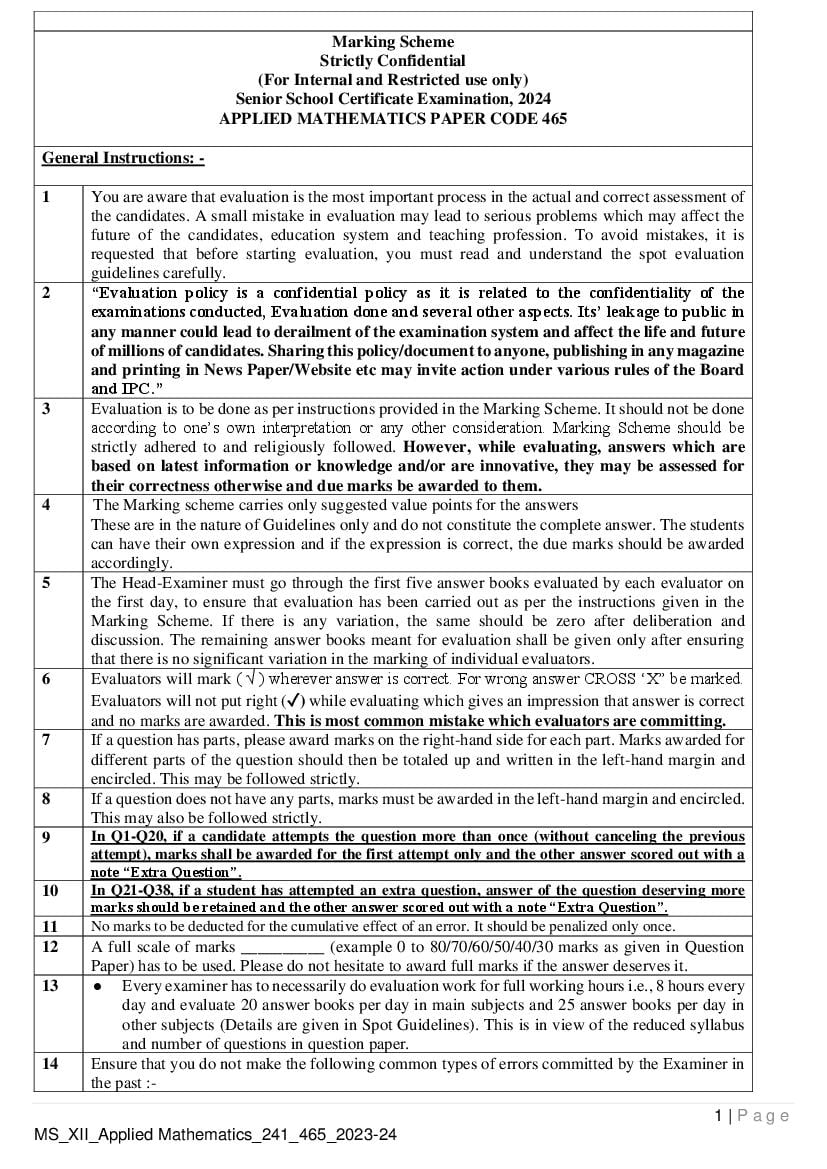
Page 1
Strictly Confidential
(For Internal and Restricted use only)
Senior School Certificate Examination, 2024
APPLIED MATHEMATICS PAPER CODE 465
General Instructions: -
1 You are aware that evaluation is the most important process in the actual and correct assessment of
the candidates. A small mistake in evaluation may lead to serious problems which may affect the
future of the candidates, education system and teaching profession. To avoid mistakes, it is
requested that before starting evaluation, you must read and understand the spot evaluation
guidelines carefully.
2 “Evaluation policy is a confidential policy as it is related to the confidentiality of the
examinations conducted, Evaluation done and several other aspects. Its’ leakage to public in
any manner could lead to derailment of the examination system and affect the life and future
of millions of candidates. Sharing this policy/document to anyone, publishing in any magazine
and printing in News Paper/Website etc may invite action under various rules of the Board
and IPC.”
3 Evaluation is to be done as per instructions provided in the Marking Scheme. It should not be done
according to one’s own interpretation or any other consideration. Marking Scheme should be
strictly adhered to and religiously followed. However, while evaluating, answers which are
based on latest information or knowledge and/or are innovative, they may be assessed for
their correctness otherwise and due marks be awarded to them.
4 The Marking scheme carries only suggested value points for the answers
These are in the nature of Guidelines only and do not constitute the complete answer. The students
can have their own expression and if the expression is correct, the due marks should be awarded
accordingly.
5 The Head-Examiner must go through the first five answer books evaluated by each evaluator on
the first day, to ensure that evaluation has been carried out as per the instructions given in the
Marking Scheme. If there is any variation, the same should be zero after deliberation and
discussion. The remaining answer books meant for evaluation shall be given only after ensuring
that there is no significant variation in the marking of individual evaluators.
6 Evaluators will mark ( √ ) wherever answer is correct. For wrong answer CROSS ‘X” be marked.
Evaluators will not put right (✓) while evaluating which gives an impression that answer is correct
and no marks are awarded. This is most common mistake which evaluators are committing.
7 If a question has parts, please award marks on the right-hand side for each part. Marks awarded for
different parts of the question should then be totaled up and written in the left-hand margin and
encircled. This may be followed strictly.
8 If a question does not have any parts, marks must be awarded in the left-hand margin and encircled.
This may also be followed strictly.
9 In Q1-Q20, if a candidate attempts the question more than once (without canceling the previous
attempt), marks shall be awarded for the first attempt only and the other answer scored out with a
note “Extra Question”.
10 In Q21-Q38, if a student has attempted an extra question, answer of the question deserving more
marks should be retained and the other answer scored out with a note “Extra Question”.
11 No marks to be deducted for the cumulative effect of an error. It should be penalized only once.
12 A full scale of marks __________ (example 0 to 80/70/60/50/40/30 marks as given in Question
Paper) has to be used. Please do not hesitate to award full marks if the answer deserves it.
13 ● Every examiner has to necessarily do evaluation work for full working hours i.e., 8 hours every
day and evaluate 20 answer books per day in main subjects and 25 answer books per day in
other subjects (Details are given in Spot Guidelines). This is in view of the reduced syllabus
and number of questions in question paper.
14 Ensure that you do not make the following common types of errors committed by the Examiner in
the past :-
1|Page
Page 2
● Giving more marks for an answer than assigned to it.
● Wrong totaling of marks awarded on an answer.
● Wrong transfer of marks from the inside pages of the answer book to the title page.
● Wrong question wise totaling on the title page.
● Wrong totaling of marks of the two columns on the title page.
● Wrong grand total.
● Marks in words and figures not tallying/not same.
● Wrong transfer of marks from the answer book to online award list.
● Answers marked as correct, but marks not awarded. (Ensure that the right tick mark is correctly
and clearly indicated. It should merely be a line. Same is with the X for incorrect answer.)
Half or a part of answer marked correct and the rest as wrong, but no marks awarded.
15 While evaluating the answer books if the answer is found to be totally incorrect, it should be marked
as cross (X) and awarded zero (0) Marks.
16 Any un assessed portion, non-carrying over of marks to the title page, or totaling error detected by
the candidate shall damage the prestige of all the personnel engaged in the evaluation work as also
of the Board. Hence, in order to uphold the prestige of all concerned, it is again reiterated that the
instructions be followed meticulously and judiciously.
17 The Examiners should acquaint themselves with the guidelines given in the “Guidelines for spot
Evaluation” before starting the actual evaluation.
18 Every Examiner shall also ensure that all the answers are evaluated, marks carried over to the title
page, correctly totaled and written in figures and words.
19 The candidates are entitled to obtain photocopy of the Answer Book on request on payment of the
prescribed processing fee. All Examiners/Additional Head Examiners/Head Examiners are once
again reminded that they must ensure that evaluation is carried out strictly as per value points for
each answer as given in the Marking Scheme.
2|Page
Page 3
APPLIED MATHEMATICS (Subject Code–241)
(PAPER CODE: 465)
Section A
Q. No. EXPECTED OUTCOMES/VALUE POINTS Marks
SECTION A
Questions no. 1 to 18 are multiple choice questions (MCQs) and questions number 19
and 20 are Assertion-Reason based questions of 1 mark each.
1.
Sol. (C) 491 seconds (1)
2.
𝐱 𝐲
Sol. (D) 𝐳 < 𝐳 (1)
3.
Sol. (D) 2B (1)
4.
Sol. (A) 0 (1)
3|Page
Page 4
Sol. (D) −𝟖𝐞−𝟐𝐱 (1)
6.
Sol. 𝟏 𝟏 (1)
(D) increasing in (𝟐 , 𝟏) and decreasing in (𝟎, 𝟐)
7.
Sol. (A) 1,1 (1)
8.
Sol. (A) 1 (1)
9.
Sol. Since correct answer is not in the options given
So, it is suggested that 1 mark may be given to all who attempted this question (1)
4|Page
Page 5
Sol. (C) 𝐤 + 𝟏 (1)
11.
Sol. (B) is accepted (1)
12.
Sol. (C) 𝒏𝟏 + 𝒏𝟐 − 𝟐 (1)
13.
Sol. (B) 40, 42, 44 (1)
14.
Sol. (B) ₹ 800 (1)
5|Page
Page 6
Sol. (B) ₹ 6,000 (1)
16.
Sol. (C) ₹ 2480.57 (1)
17.
Sol. (C) half-plane that neither contains the origin nor the points on the line 𝟐𝐱 + 𝟑𝐲 = 𝟔 (1)
18.
Sol. (D) infinite (1)
6|Page
Page 7
Sol. (D) Assertion (A) is false, but Reason (R) is true (1)
20.
Sol. (B) Both Assertion (A) and Reason (R) are true, but Reason (R) is the not the correct (1)
explanation of the Assertion (A).
SECTION B
This section comprises very short answer (VSA) type questions of 2 marks each.
21(a).
Sol. 𝟏 𝟎 𝟏 𝟎 𝟏
Given 𝑨 = [ ], 𝐀𝟐 = [ ] (𝟐)
– 𝟏 𝟕 – 𝟖 𝟒𝟗
𝐀𝟐 – 𝟖𝐀 + 𝐤𝐈 = 𝟎 gives
𝟏
𝟏 𝟎 𝟏 𝟎 𝟏 𝟎 𝟎 𝟎 (𝟐)
[ ] – 𝟖[ ] + 𝐤[ ]= [ ]
– 𝟖 𝟒𝟗 – 𝟏 𝟕 𝟎 𝟏 𝟎 𝟎
𝟏– 𝟖 + 𝐤 𝟎– 𝟎 + 𝟎 𝟎 𝟎 𝟏
[ ]=[ ] (𝟐)
– 𝟖 + 𝟖 + 𝟎 𝟒𝟗 – 𝟓𝟔 + 𝐤 𝟎 𝟎
𝐤=𝟕 𝟏
(𝟐)
7|Page
Page 8
21(b).
Sol. Here, 𝐱 – 𝐲 = – 𝟏, 𝟐𝐱 – 𝐲 = 𝟎, 𝟐𝐱 + 𝐳 = 𝟓, 𝟑𝐳 + 𝐰 = 𝟏𝟑 (1)
Solving these equations, we get
𝐱 = 𝟏, 𝐲 = 𝟐, 𝐳 = 𝟑, 𝐰 = 𝟒 (1)
22.
Sol. 𝟐 𝟑 𝟏
(𝟐)
Here, 𝐃 = | | = −𝟒𝟑 ≠ 𝟎
𝟏𝟏 −𝟓
𝟏
𝟓 𝟑 (𝟐)
𝐃𝟏 = | | = −𝟒𝟑
𝟔 −𝟓
𝟐 𝟓 𝟏
𝐃𝟐 = | | = −𝟒𝟑 (𝟐)
𝟏𝟏 𝟔
𝟏
𝐃𝟏 −𝟒𝟑 𝐃𝟐 −𝟒𝟑 (𝟐)
So, 𝐱 𝟏 = = = 𝟏, 𝐱 𝟐 = = =𝟏
𝐃 −𝟒𝟑 𝐃 −𝟒𝟑
23.
8|Page
Page 9
𝟏
(𝟏 𝟐)
for
correct
graph
𝟏
Since feasible region is empty, there is no solution to the problem. (𝟐)
24.
Sol. 𝟎.𝟎𝟔 (1)
Here, 𝐑 = 𝟔𝟎𝟎, 𝐢 = = 𝟎. 𝟎𝟏𝟓
𝟒
𝐑 𝟔𝟎𝟎
So, 𝐏𝐕 = 𝐢 = 𝟎.𝟎𝟏𝟓 = ₹ 𝟒𝟎, 𝟎𝟎𝟎 (𝟏)
25 (a).
Sol. 𝟓𝟎𝟎𝟎𝟎 𝟏/𝟑 (𝟏)
CAGR = [(𝟐𝟎𝟎𝟎𝟎) − 𝟏] × 𝟏𝟎𝟎
= [(𝟐. 𝟓)𝟏/𝟑 − 𝟏] × 𝟏𝟎𝟎 = (𝟏. 𝟑𝟓𝟓 − 𝟏) × 𝟏𝟎𝟎
= 𝟎. 𝟑𝟓𝟓 × 𝟏𝟎𝟎 = 𝟑𝟓. 𝟓% (1)
OR
25 (b).
Sol. 𝟏𝟓𝟎𝟎𝟎−𝟏𝟐𝟎𝟎𝟎 𝟏
Nominal rate of return = × 𝟏𝟎𝟎 (𝟐)
𝟏𝟐𝟎𝟎𝟎
𝟑𝟎𝟎𝟎 𝟏
= 𝟏𝟐𝟎𝟎𝟎 × 𝟏𝟎𝟎 = 𝟐𝟓% (𝟐)
9|Page
Page 10
= 𝟐𝟓% − 𝟔% = 𝟏𝟗% (𝟏)
SECTION C
This section comprises short answer (SA) type questions of 3 marks each.
26.
Sol. Juice contained in the container after final replacement
𝟓 𝟓 𝟗 𝟓 (2)
= 𝟓𝟎 (𝟏 − 𝟓𝟎) = 𝟓𝟎 (𝟏𝟎)
= 𝟓𝟎 × 𝟎. 𝟓𝟗𝟎𝟒𝟗 = 𝟐𝟗. 𝟓 litres (1)
27(a).
Sol. Required Area
𝟐 𝟏
𝟐 𝐱𝟑 𝟖 (1𝟐)
= ∫𝟎 𝐱 𝟐 𝐝𝐱 = | 𝟑 | = 𝟑
𝟎
𝟏
(1𝟐)
for
correct
graph
OR
10 | P a g e
Page 11
Sol.
𝟏 𝐝𝐱
𝐈 = ∫𝟎 𝐞𝐱(𝟏+𝐞𝐱)
𝟏
𝐞 𝐝𝐭 (𝟐)
= ∫𝟏 𝐭 𝟐 (𝟏+𝐭) (Put 𝐞𝐱 = 𝐭 ⟹ 𝐞𝐱 𝐝𝐱 = 𝐝𝐭)
𝐞 𝟏 𝟏 𝟏
= ∫𝟏 (− 𝐭 + 𝐭 𝟐 + 𝟏+𝐭) 𝐝𝐭 (1)
𝟏 𝐞
= [− 𝐥𝐨𝐠(𝐭) − 𝐭 + 𝐥𝐨𝐠(𝟏 + 𝐭)]
𝟏
𝟏+𝐭 𝟏 𝐞 (1)
= [𝐥𝐨𝐠 ( 𝐭 ) − 𝐭 ]
𝟏
𝟏+𝐞 𝟏
= [log ( ) – 𝐞] − [log 2 – 𝟏]
𝐞
𝟏+𝐞 𝟏 𝟏
= 𝐥𝐨𝐠 ( 𝟐𝐞 ) – 𝐞 + 𝟏 (𝟐)
28.
Sol. Here, the equation of the circle is
(𝐱 − 𝐚)𝟐 + (𝐲 − 𝐚)𝟐 = 𝐚𝟐 … (1)
i.e., 𝐱 𝟐 + 𝐲 𝟐 − 𝟐𝐚𝐱 − 𝟐𝐚𝐲 + 𝐚𝟐 = 𝟎 (1)
𝐝𝐲 𝐝𝐲
⟹ 𝟐𝐱 + 𝟐𝐲 𝐝𝐱 − 𝟐𝐚 − 𝟐𝐚 𝐝𝐱 = 𝟎
𝐝𝐲
𝐱+𝐲
𝐝𝐱
⟹𝐚= 𝐝𝐲 (𝟏)
𝟏+
𝐝𝐱
From (1), we have
𝐝𝐲 𝟐 𝐝𝐲 𝟐 𝐝𝐲 𝟐
𝐱+𝐲 𝐱+𝐲 𝐱+𝐲
𝐝𝐱 𝐝𝐱 𝐝𝐱
(𝐱 – 𝐝𝐲 ) + (𝐲 – 𝐝𝐲 ) =( 𝐝𝐲 ) (𝟏)
𝟏+ 𝟏+ 𝟏+
𝐝𝐱 𝐝𝐱 𝐝𝐱
𝐝𝐲 𝟐 𝐝𝐲
or (𝐝𝐱) (𝐱 𝟐 − 𝟐𝐱𝐲) − 𝟐𝐱𝐲 𝐝𝐱 + 𝐲 𝟐 − 𝟐𝐱𝐲 = 𝟎
29.
11 | P a g e
Page 12
Here, 𝐙 = (𝟐)
𝟏𝟎
𝐏(𝟗𝟎 < 𝐗 < 𝟏𝟏𝟎) = 𝐏(𝐗 < 𝟏𝟏𝟎) − 𝐏(𝐗 < 𝟗𝟎)
⟹ 𝐏(𝟗𝟎 < 𝐗 < 𝟏𝟏𝟎) = 𝐏(−𝟏 < 𝐙 < 𝟏) = 𝐏(𝐙 < 𝟏) − 𝐏(𝐙 < −𝟏) (𝟐)
= 𝟎. 𝟖𝟒𝟏𝟑 − 𝟎. 𝟏𝟓𝟖𝟕
𝟏
= 𝟎. 𝟔𝟖𝟐𝟔 (𝟐)
30.
Sol. Here, 𝛍𝟎 = 𝟓𝟎, 𝐱̅ = 𝟓𝟓, 𝐧 = 𝟐𝟎 and 𝐒 = 𝟏𝟎 𝟏
(𝟐)
𝐇𝟎 : 𝛍 = 𝟓𝟎 (The advertisement campaign was not successful)
𝐇𝛂 : 𝛍 > 𝟓𝟎 (The advertisement campaign was successful)
The test statistic 𝒕 is given by
𝐱̅−𝛍 𝟓𝟓−𝟓𝟎 𝟐√𝟓 𝟏
𝐭= 𝐒 = 𝟏𝟎 = = √𝟓 = 𝟐. 𝟐𝟒 (𝟏 𝟐)
𝟐
√𝐧 √𝟐𝟎
Degree of freedom = 𝟐𝟎 − 𝟏 = 𝟏𝟗
𝟏
Here, 𝐭 > 𝐭 𝟏𝟗 (𝟎. 𝟎𝟓) as 𝟐. 𝟐𝟒 > 𝟏. 𝟕𝟐𝟗 (𝟐)
⟹ null hypothesis is rejected
i.e., Advertising campaign was successful 𝟏
(𝟐)
31(a).
Sol. 𝟒𝟓𝟐𝟎𝟎−𝟎 𝟒𝟓𝟐𝟎𝟎
(i) Annual amount of depreciation = =₹
𝟑 𝟑
𝟒𝟓𝟐𝟎𝟎
𝟑
Rate of depreciation = 𝟒𝟓𝟐𝟎𝟎 × 𝟏𝟎𝟎 = 𝟑𝟑. 𝟑% (𝟏)
12 | P a g e
Page 13
(ii) 𝐯(𝐭) = 𝐦𝐭 + 𝐂 = − 𝐭 + 𝟒𝟓𝟐𝟎𝟎
𝟑
𝟏 𝟒𝟓𝟐𝟎𝟎 𝟑 (1)
(iii) 𝐯 (𝟏 𝟐) = − × 𝟐 + 𝟒𝟓𝟐𝟎𝟎 = ₹ 𝟐𝟐𝟔𝟎𝟎
𝟑
OR
31(b).
Sol. 𝐫 𝟐 𝟏𝟎 𝟐 (1)
(i) 𝐫𝐞 = (𝟏 + 𝟐𝟎𝟎) − 𝟏 = (𝟏 + 𝟐𝟎𝟎) − 𝟏
𝟏
𝟐 (𝟐)
= (𝟏. 𝟎𝟓) − 𝟏 = 𝟏. 𝟏𝟎𝟐𝟓 − 𝟏 = 𝟏𝟎. 𝟐𝟓%
𝐫 𝟒 𝟏𝟎 𝟒
(ii) 𝐫𝐞 = (𝟏 + 𝟒𝟎𝟎) − 𝟏 = (𝟏 + 𝟒𝟎𝟎) − 𝟏 (1)
𝟏
= (𝟏. 𝟎𝟐𝟓)𝟒 − 𝟏 = 𝟏. 𝟏𝟎𝟑𝟖 − 𝟏 = 𝟏𝟎. 𝟑𝟖% (𝟐)
SECTION D
This section comprises of Long Answer (LA) type questions of 5 marks each.
32.
Sol. Let the cistern be emptied in 𝒏 hours after 5 a.m.
𝟏
Clearly pipes A and B fill the cistern for 𝒏 and 𝒏 − 𝟏 hours respectively, while pipe C (𝟏 𝟐)
empties the tank for 𝒏 − 𝟐 hours
𝒏 𝒏−𝟏 𝒏−𝟐
∴ + − =𝟎 𝟏
(1𝟐)
𝟑 𝟒 𝟏
𝟐𝟏
Solving, we get 𝒏 = 𝟓 (1)
i.e., 4 hours 12 minutes past 5 am i.e., at 9:12 am (1)
13 | P a g e
Page 14
Sol.
3 45
f(x) = − 4 x 4 − 8x 3 − 2 x 2 + 105
f ′ (x) = −3x 3 − 24x 2 − 45x and f ′′ (x) = −9x 2 − 48x − 45 (𝟏)
f ′ (x) = 0 ⟹ x = 0 or x 2 + 8x + 15 = 0
i.e., x = 0, −3, −5 (1)
At x = 0, f ′′ (0) < 0 ⟹ 0 is a point of local maxima (1)
At x = −3, f ′′ (−3) > 0 ⟹ −3 is a point of local minima (1)
At x = −5, f ′′ (−5) < 0 ⟹ −5 is a point of local maxima (1)
OR
33(b).
Sol.
f(x) = 20 − 9x + 6x 2 − x 3
𝟏
f ′ (x) = −9 + 12x − 3x 2 = −3(x 2 − 4x + 3) (𝟐)
(1)
= −3(x − 1)(x − 3)
𝟏
f ′ (x) = 0 ⟹ x = 1,3 (𝟐)
𝟏
Now intervals are (−∞, 1), (1,3) and (3, ∞) (𝟐)
Intervals Sign of 𝑓′(𝑥)
𝟏
(−∞, 1) −ve (1𝟐)
(1,3) +ve
(3, ∞) −ve
𝟏
(𝟐)
⟹ f(x) is strictly increasing in (1,3) or [1,3]
𝟏
(𝟐)
And f(x) is strictly decreasing in (−∞, 1) ∪ (3, ∞) or (−∞, 1] ∪ [3, ∞)
14 | P a g e
Page 15
Sol. (i) 𝟎. 𝟏 + 𝐤 + 𝟐𝐤 + 𝟐𝐤 + 𝐤 = 𝟏 (1)
𝟎. 𝟏 + 𝟔𝐤 = 𝟏
𝟑 (1)
𝐤 = 𝟐𝟎
𝟏
(ii) 𝐏(𝐗 ≥ 𝟐) = 𝐏(𝟐) + 𝐏(𝟑) + 𝐏(𝟒) (𝟐)
= 𝟐𝐤 + 𝟐𝐤 + 𝐤
𝟑
= 𝟓𝐤 = 𝟒
(1)
(iii) 𝐏(𝐗 ≤ 𝟐) = 𝐏(𝟎) + 𝐏(𝟏) + 𝐏(𝟐) 𝟏
(𝟐)
= 𝟎. 𝟏 + 𝐤 + 𝟐𝐤
𝟏 𝟗 𝟏𝟏
= 𝟏𝟎 + 𝟐𝟎 = 𝟐𝟎 (1)
OR
34(b).
Sol. Here, mean expectation = 𝛌 = 𝟐 (1)
𝛌𝐤 𝐞−𝛌
𝐏(𝐗 = 𝐤) = 𝐤!
𝐏(𝐗 ≤ 𝟑) = 𝐏(𝟎) + 𝐏(𝟏) + 𝐏(𝟐) + 𝐏(𝟑) (1)
𝟒
= 𝐞−𝟐 (𝟏 + 𝟐 + 𝟐 + 𝟑) (2)
𝟏𝟗
= 𝟎. 𝟏𝟑𝟓𝟑𝟒 × 𝟑 = 𝟎. 𝟖𝟓𝟕𝟏 𝐨𝐫 𝟎. 𝟖𝟔 (1)
15 | P a g e
Page 16
Sol. 𝐧 = 𝟐 × 𝟏𝟐 = 𝟐𝟒, 𝟏
(𝟐)
𝟐𝟎 𝟏
𝐢 = 𝟏𝟐𝟎𝟎 = 𝟔𝟎 𝟏
(𝟐)
𝐏𝐢
EMI = 𝟏–(𝟏 + 𝐢)–𝐧
𝐏×
𝟏 (1)
𝟔𝟎
𝟐𝟓𝟒𝟒𝟖 = 𝟏
𝟏–(𝟏 + )−𝟐𝟒
𝟔𝟎
𝟏 –𝟐𝟒 (1)
𝐏 = 𝟐𝟓𝟒𝟒𝟖 × 𝟔𝟎 [𝟏 − (𝟏 + 𝟔𝟎) ]
𝟏
(𝟐)
𝐏 = 𝟐𝟓𝟒𝟒𝟖 × 𝟔𝟎(𝟏 − 𝟎. 𝟔𝟕𝟐𝟓𝟑)
= ₹ 𝟓, 𝟎𝟎, 𝟎𝟎𝟎 approx. (1)
𝟏
Hence the actual price of the car is ₹ 7,50,000 approx. (𝟐)
SECTION E
This section comprises of 3 case-study based questions of 4 marks each.
16 | P a g e
Page 17
Sol.
(i) Let number of children be 𝑥 and the amount donated to each child be ₹ 𝑦
𝟏
∴ (x − 8)(y + 10) = xy and (x + 16)(y − 10) = xy (𝟐)
𝟏
i.e., 5x − 4y = 40 and 5x − 8y = −80 (𝟐)
5 – 4 x 40
(ii) A=[ ] , X = [y] , B = [ ]
5 – 8 – 80 (1)
17 | P a g e
Page 18
(𝟐)
(iii) (a) |A| = −40 + 20 = −20 ≠ 0
– 8 4
adj (A) = [ ] (1)
– 5 5
1 – 8 4 1 8 – 4
⟹ 𝐴−1 = − 20 [ ] = 20 [ ] 𝟏
(𝟐)
– 5 5 5 – 5
OR
x
(iii) (b) X = [y] = A−1 B
1 8 – 4 40 𝟏
= 20 [ ] [ ] (𝟐)
5 – 5 – 80
1 640 32 (1)
= 20 [ ]=[ ]
600 30
𝟏
⟹ x = 32, y = 30 (𝟐)
37.
18 | P a g e
Page 19
(i) x ≥ 0, y ≥ 0 (1)
(ii) (a) 2x − y ≤ 0,
(1)
2x + y ≤ 200 (1)
OR
(ii) (b) 2x + y ≤ 200, (1)
(1)
2x − y ≥ 0
(iii) Corner points of R1 are A(0,50), B(20,40), C(50,100) and 𝐷(0,200)
𝟏
(𝟐)
𝐙𝐀 = 𝟏𝟎𝟎; 𝐙𝐁 = 𝟏𝟖𝟎; 𝐙𝐂 = 𝟒𝟓𝟎; 𝐙𝐃 = 𝟒𝟎𝟎
𝟏
So, 𝑍 is maximum at 𝐶 and maximum value of Z = 450 (𝟐)
19 | P a g e
Page 20
20 | P a g e
Page 21
(i)
Year (𝑥𝑖 ) Index xi − A x2 xy
x=
Number (y) 0.5
1996 6.5 −5 25 −32.5 (𝟏) for
1997 5.3 −3 9 −15.9 correct
table
1998 4.3 −1 1 −4.3
1999 6.1 1 1 6.1
2000 5.6 3 9 16.8
2001 7.8 5 25 39
n=6 ∑ y = 35.6 ∑x = 0 ∑ x 2 = 70 ∑ xy = 9.2
∑y 35.6 ∑ xy 9.2 𝟏
a= n = , b = ∑ x2 = 70 = 0.13 (𝟐)
6
∴ Equation of straight-line trend is given by
𝟏
y = a + bx = 5.9 + 0.13x (𝟐)
(ii) (a) Trend Values
(𝟏)
1996 5 · 9 + (– 5) 0 · 13 = 5 · 25
mark
1997 5 · 9 + (– 3) 0 · 13 = 5 · 51 for
1998 5 · 9 + (– 1) 0 · 13 = 5 · 77 correct
trend
1999 5 · 9 + (1) 0 · 13 = 6.03
values
2000 5 · 9 + (3) 0 · 13 = 6.29
2001 5 · 9 + (5) 0 · 13 = 6.55
Expected sales trend for 2002
2002−1998.5 𝟏
= 5.9 + 0.13 ( ) (𝟐)
0.5
𝟏
= ₹ 6.81 lakhs (𝟐)
OR
(ii) (b)
21 | P a g e
Page 22
(𝟏) for
2004 114 −3 9 −342
correct
2005 130 −2 4 −260
table
2006 126 −1 1 −126
2007 144 0 0 0
2008 138 1 1 138
2009 156 2 4 312
2010 164 3 9 492
n=7 ∑ y = 972 ∑x = 0 ∑ x 2 = 28 ∑ xy = 214
∑ y 972 ∑ xy 214 𝟏
a= = = 138.86, b = = = 7.64 (𝟐)
n 7 ∑ x2 28
So, required equation of straight- line trend is
𝟏
(𝟐)
y = a + bx = 138.86 + 7.64x
22 | P a g e
Document Details
| Board / Org | CBSE |
| Exam | Class 12 |
| Type | Solution |
| Pages | 22 |
| Updated | 30 Apr 2026 |