CBSE Class 10 Question Bank 2021 Science
Finished viewing? Save it for later —
Download CBSE Class 10 Question Bank 2021 Science (PDF · 16 pages)About CBSE Class 10 Question Bank 2021 Science
CBSE Class 10 Question Bank 2021 Science is available here for free download. Published by CBSE for Class 10, this question bank can be viewed online or downloaded as a PDF (16 pages). Candidates preparing for Class 10 can use CBSE Class 10 Question Bank 2021 Science to understand the exam pattern, the type of questions asked, and the overall difficulty level.
Frequently Asked Questions
How can I download CBSE Class 10 Question Bank 2021 Science?
Open this page and click the Download button to save CBSE Class 10 Question Bank 2021 Science as a PDF. It is completely free on AglaSem Docs.
Is CBSE Class 10 Question Bank 2021 Science free to download?
Yes. CBSE Class 10 Question Bank 2021 Science can be viewed online and downloaded as a PDF free of cost on AglaSem Docs.
How many pages does CBSE Class 10 Question Bank 2021 Science have?
CBSE Class 10 Question Bank 2021 Science contains 16 pages, which you can read online or download together as a single PDF.
Where can I find more Class 10 study material?
You can find more Class 10 question papers, sample papers, syllabus, and answer keys on AglaSem Docs.
CBSE Class 10 Question Bank 2021 Science – Text
Read the full text of this question bank below — useful to quickly search, copy and reference the content online without downloading the PDF.
📄 View text version (16 pages)
Page 1
Sample Case Studies
1. Read the following and answer any four questions from 1.1 to 1.5:
Marble’s popularity began in ancient Rome and Greece, where white and off-white marble were
used to construct a variety of structures, from hand-held sculptures to massive pillars and
buildings.
1.1 The substance not likely to contain CaCO3 is
a) Dolomite
b) A marble statue
c) Calcined gypsum
d) Sea shells.
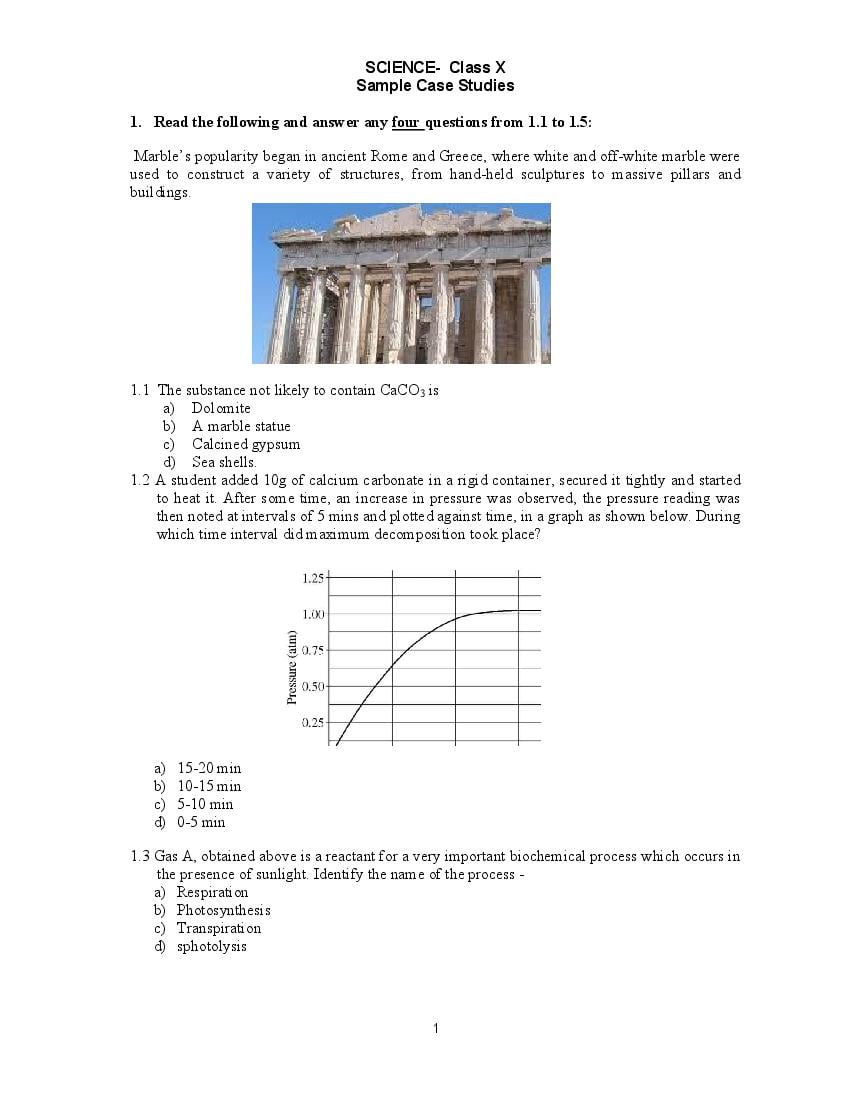
1.2 A student added 10g of calcium carbonate in a rigid container, secured it tightly and started
to heat it. After some time, an increase in pressure was observed, the pressure reading was
then noted at intervals of 5 mins and plotted against time, in a graph as shown below. During
which time interval did maximum decomposition took place?
a) 15-20 min
b) 10-15 min
c) 5-10 min
d) 0-5 min
1.3 Gas A, obtained above is a reactant for a very important biochemical process which occurs in
the presence of sunlight. Identify the name of the process -
a) Respiration
b) Photosynthesis
c) Transpiration
d) sphotolysis
1
Page 2
rain water. Identify the main reason.
reason
a) decomposition of calcium carbonate to calcium oxide
b) polluted water is basic in nature hence it reacts with calcium carbonate
c) polluted water is acidic in nature he
hence it reacts with calciumcarbonate
d) calcium carbonate dissolves in water to give calcium hydroxide.
1.5 Calcium oxide can be reduced to calcium, by heating with sodium metal. Which compound
would act as an oxidizing agent in the above process?
a) Sodium
b) sodium oxide
c) calcium
d) calcium oxide
Answer 1.1 white precipitate is obtained
Key 1.2 0-5 min
1.3 photosynthesis
1.4 polluted water is acidic in nature hence it reacts with calcium carbonate
1.5 calcium oxide
2. Read the following and answer any four questions from 2.1 to 2.5:
The reaction between MnO2 with HCl is depicted in the following diagram. It was observed that
a gas with bleaching abilities was released .
2.1 The chemical reaction between MnO2 and HCl is an example of:
a) displacement reaction
b) combination reaction
c) redox reaction
d) decomposition
ecomposition reaction.
2.2 Chlorine gas reacts with _______ to form bleaching powder.
a) dry Ca(OH)2
b) dil. solution of Ca(OH)2
c) conc. solution of Ca(OH)2
d) dry CaO
2
Page 3
MnO2 is getting reduced whereas HCl is getting oxidized
a) MnO2 is getting oxidized whereas HCl is getting reduced.
b) MnO2 and HCl both are getting reduced.
c) MnO2 and HCl both are getting oxidized.
2.4 In the above discussed reaction, what is the nature of MnO2 ?
a) Acidic oxide
b) Basic oxide
c) Neutral oxide
d) Amphoteric oxide
2.5 What will happen if we take dry HCl gas instead of aqueous solution of HCl?
a) Reaction will occur faster.
b) Reaction will not occur.
c) Reaction rate will be slow
d) Reaction rate will remain the same.
2.1(c) redox reaction
Answer 2.2(a) dry Ca(OH)2
Key 2.3(a)MnO2 is getting reduced whereas HCl is getting oxidized
2.4(b) Basic oxide
2.5(b) Reaction will not occur
*******
3. Read the following and answer any four questions from 3.1 to 3.5:
Chemistry in Automobiles:
Foran internalcombustion enginetomoveavehicledowntheroad,itmustconvertthe energy stored
in the fuel into mechanical energy to drive the wheels. In your car,the distributor and battery
provide this starting energy by creating an electrical "spark",which helps in combustion of
fuels like gasoline. Below is the reactiondepictingcomplete combustionof
gasolineinfullsupplyof air:
3.1 Which of the following are the products obtained from the reaction mentioned in the above
case?
Product ‘X’Product ‘Y’
a) CO2 H2O2
b) H2O CO
c) CH3OH H2 O
d) CO2 H2 O
3.2 Identify the types of chemical reaction occurring during the combustion of fuel:
a) Oxidation & Endothermic reaction
b) Decomposition & Exothermic reaction
c) Oxidation & Exothermic reaction
d) Combination & Endothermic reaction
3
Page 4
.3 On the basis of evolution/absorption of energy, which of the following processes are similar
to combustion of fuel?
a) Photosynthesis in plants
b) Respiration in the human body
c) Decomposition of vegetable matter
d) Decomposition of ferrous sulphate.
(a) (ii) & (iii)
(b) (i) & (ii)
(c) (iii) & (iv)
(d) (ii) & (i)
3.4 ‘A student while walking on the road observed that a cloud of black smoke belched out from
the exhaust stack of moving trucks on the road.’ Choose the correct reason for the production
of black smoke:
a) Limited supply of air leads to incomplete combustion of fuel.
b) Rich supply of air leads to complete combustion of fuel.
c) Rich supply of air leads to a combination reaction.
d) Limited supply of air leads to complete combustion of fuel.
3.5
.5 ‘Although nitrogen is the most abundant gas in the atmosphere, it does not take part in
combustion’. Identify the correct reason for this statement.
a) Nitrogen is a reactive gas
b) Nitrogen is an inert gas
c) Nitrogen is an explosive gas
d) Only hydrocarbons can take part in combustion
3.1-(d)
Answer Key 3.2-(c)
3.3-(a)
3.4-(a)
3.5-(b)
4. Read the following and answer any four questions from 4.1 to 4.5:
Frothing in Yamuna:
The primary reason behind the formation of the toxic foam is high phosphate content in the
wastewater because of detergents used in dyeing industries, dhobi ghats ghats and households.
Yamuna's pollution level is so bad that parts of it have been labelled 'dead' as there is no oxygen
in it for aquatic life to survive.
4
Page 5
detergents dissolved in it.
a) 10-11
b) 5-7
c) 2-5
d) 7
4.2 Which of the following statements is correct for the water with detergents dissolved in it?
a) low concentration of hydroxide ion (OH- )and high concentration of hydronium ion
(H3O+)
b) high concentration of hydroxide ion (OH- )and low concentration of hydronium ion
(H3O+)
c) high concentration of hydroxide ion (OH-) as well as hydronium ion (H3O+)
d) equal concentration of both hydroxide ion (OH-) and hydronium ion (H3O+).
4.3 The table provides the pH value of four solutions P, Q, R and S
Solution pH value
P 2
Q 9
R 5
S 11
Which of the following correctly represents the solutions in increasing order of their
hydronium ion concentration?
a) P>Q>R>S
b) P>S>Q>R
c) S<Q<R<P
d) S<P<Q<R
4.4 High content of phosphate ion in river Yamuna may lead to:
a) decreased level of dissolved oxygen and increased growth of algae
b) decreased level of dissolved oxygen and no effect of growth of algae
c) increased level of dissolved oxygen and increased growth of algae
d) decreased level of dissolved oxygen and decreased growth of algae
4.5 If a sample of water containing detergents is provided to you, which of the following
methods will you adopt to neutralize it?
a) Treating the water with baking soda
b) Treating the water with vinegar
c) Treating the water with caustic soda
d) Treating the water with washing soda
Answer Key 4.1 (a)
4.2 (b)
4.3 (c)
4.4 (a)
4.5 (b)
5
Page 6
of information provided and studied concepts.
A biogas plant is where biogas is produced by fermenting biomass.
5.1 In which of the parts would you find anaerobic bacteria ?
a) A
b) B
c) C
d) D
5.2 Which one of the following is NOT correct for biogas -
a) its carbon neutral
b) its non-renewable
c) it depends on micro-organisms
organisms
d) yields rich manure
5.3 Which of the following best indicates the steps of anaerobic digestion?
a) Waste watezr feed → biogas storage → generator → biogas
b) Waste water feed → digester → biogas → biogas storage → generator
c) Generator → waste water feed → digester → biogas → biogas storage
d) Waste water feed → biogas → digester → biogas storage → generator
5.4 Biogas is a better fuel than animal dung cake because
a) Biogas is a renewable source of energy
b) Animal dung cake has higher calorific value
c) Biogas has high heating capacity
d) Biogas burns without smoke.
i. (a) only
ii. (b) only
iii. (c) and (d)
iv. (a) and (b)
5.5 Biogas is formed in the
a) presence of air only
b) presence of water only
c) presence of air and absence of water
d) presence of water and absence of air.
6
Page 7
5.2 b) its non-renewable
5.3 (b) Waste water feed → digester → biogas → biogas storage → generator
5.4 (c) (iii) and (iv)
5.5 (d) presence of water and absence of air
*****
6. Read the following and answer the questions any four from (i) to (v)
Food chains are very important for the survival of most species.
6.1 If 10,000 J solar energy falls on green plants in a terrestrial ecosystem, what percentage of
solar energy will be converted into food energy?
a) 10,000 J
b) 100 J
c) 1000 J
d) It will depend on the type of the terrestrial plant.
6.2 If Ravi is consuming curd/yogurt for lunch , which trophic level in a food chain he should be
considered as occupying ?
a) First trophic level
b) Second trophic level
c) Third trophic level
d) Fourth trophic level
6.3 The decomposers are not included in the food chain.The correct reason for the same is
because decomposers:
a) Act at every trophic level of the food chain
b) Do not breakdown organic compounds
c) Convert organic material to inorganic forms
d) Release enzymes outside their body to convert organic material to inorganic forms
6.4 Matter and energy are two fundamental inputs of an ecosystem. Movement of
a) Energy is bidirectional and matter is repeatedly circulating.
b) Energy is repeatedly circulation and matter is unidirectional.
c) Energy is unidirectional and matter is repeatedly circulating.
d) Energy is multidirectional and matter is bidirectional.
7
Page 8
a) Decrease in energy at higher trophic levels
b) Less availability of food
c) Polluted air
d) Water
Answer Key 6.1 b) 100 J
6.2 c) Third Trophic level
6.3 a) Act at every trophic level of the food chain
6.4 c) Energy is unidirectional and matter is repeatedly circulating
6.5 a) Decrease in energy at higher trophic level
7. Read the following and answer the questions any four from (i) to (v)
Observe the food web and answer the questions given below -
7.1 The mussel can be described as
a) Producer
b) Primary consumer
c) Secondary consumer
d) decomposer
7.2 Which trophic level is incorrectly defined?
a) Carnivores – secondary or tertiary consumers
b) Decomposers – microbial heterotrophs
c) Herbivores – primary consumers
d) Omnivores – molds, yeast and mushrooms
7.3 The given figure best represents:
a) Grassland food chain
b) Parasitic food chain
c) Forest food chain
d) Aquatic food chain
8
Page 9
.4 Why do all food chains start with plants?
a) Because plants are easily grown
b) Because plants are nutritious
c) Because plants can produce its own energy
d) Because plants do not requi
require energy
7.5
.5 In the food web, what two organisms are competing for food?
a) A and B c) A and C
b) D and F d) B and D
Answer Key 7.1 c)Secondary consumer
7.2 d) Omnivores – molds, yeast and mushrooms
7.3 a) Grassland food chain
7.4 c) Because plants can produce its own energy
7.5 d) B and D
8. Observe the following diagram and answer the questions any four from (i) to (v)
8.1 Choose the waste management strategy that is matched with correct example.
a) Refuse Choose products that use less packaging
b) Reduce Give unwanted toys and books to hospitals or schools
c) Reuse Not using single use plastic
d) Repurpose Making flower pot from used plastic bottle
9
Page 10
packaging because
a) recycled papers may release color /dyes on food items
b) recycled papers are not absorbent
c) recycled papers can cause infection due to release of methane
d) recycled papers are costly
8.3 According to the ‘Solid Waste Management Rule 2016’, the waste should be segregated into
three categories. Observe the table below and select the row that has correct information
Wet waste Dry waste Hazardous waste
a) Cooked food, vegetable Used bulbs, fluorescent Plastic carry bags, bottles,
peels lamps newspaper, cardboard
b) Coffee and tea powder, Plastic carry bags, bottles, Expired medicines, razors,
garden waste newspaper, cardboard paint cans
c) Leftover food, vegetable Coffee and tea powder, Insect repellents, cleaning
peels garden waste solutions
d) Uncooked food, tea Old crockery, frying pans Coffee and tea powder, garden
leaves waste
8.4 Effective segregation of wastes at the point of generation is very important. Select the
appropriate statements giving the importance of waste segregation.
i) less waste goes to the landfills
ii) better for public health and the environment
iii) help in reducing the waste
iv) resulting in deterioration of a waste picker’s health
a) both i) and ii)
b) both i) and iii)
c) both ii) and iii)
d) both i) and iv)
8.5 When recycling a plastic water bottle, what should you do with the cap?
a) The cap goes into a garbage can and the bottle goes in a recycling bin
b) Screw the cap back on the bottle, then put the bottle and cap in a recycling bin
c) Screw the cap back on the bottle, then put the bottle and cap in the garbage can
d) Recycle the cap separately.
Answer Key 8.1 – d
8.2 -c
8.3 -b
8.4 -a
8.5 -.a
9. Read the following and answer any FOUR questions from 9.1 to 9.5 that follow on the basis of
information provided and studied concepts.
In Kunjpura village, located in Karnal district, Haryana, AdityaAggarwal and his older brother
AmitAggarwal run Tee Cee Industries, a steel plant set up by their ancestors in 1984. Along with this,
they also run a gaushala that houses 1,200 cows that can no longer produce milk.
10
Page 11
because
they spent a whopping Rs 5 lakh every month on electricity.
The brothers struck upon an idea. Why not run the factory with the biogas produced from cow dung
from the shelter and other gaushalas, along with bio and agri-waste
agri waste like sewage, farm waste, etcThis
etc
led Aditya and Amit to start AmritFertilisers, a biogas project, in 2014, without any government
support.
9.1
.1 Biogas is a mixture of the following gases.
(a) Ethane,Carbon monoxide, Nitrogen and Butane
(b) Methane,Hydrogen,Carbon dioxide and Nitrogen
(c) Butane,Carbon
Carbon monoxide,Propane and Hydrogen
(d) Carbon monoxide,Sulphur dioxide and Hydrogen
9.2
.2 Raw material used in bio gas plant is
(a) Animal dung
(b) crop residue
(c) Food waste
(d) All of the above
9.3
.3 The correct labelling in a biogas plant is given in
(a) A- Manure B- slurry C-Gas tank D-Digester
(b)A- Slurry B-Digester
Digester C-Manure D- Gas tank
(c) A-Gas tank B-Manure
Manure C-Digester D- Slurry
(d) A- Digester B-Gas
Gas tank C-Slurry D-Manure.
9.4
.4 Biogas is a better fuel than animal dung cake because
(i) Biogas has lower calorific value.
(ii) Animal dung cake has higher calorific value.
(iii) Biogas has high heating capacity.
(iv) Biogas burns without smoke.
(a) (i) only
(b) (ii) only
(c) (iii) and (iv)
(d) (i) and (ii)
11
Page 12
(a) presence of air only.
(b) presence of water only.
(c) absence of air only.
(d) presence of water and absence of air.
Answer Key 9.1 : (b)
9.2: (d)
9.3: (b)
9.4: (c)
9.5: (d)
10. Read the following and answer the questions any four from (i) to (v)
Food chains are very important for the survival of most species. When only one element is removed from
the food chain it can result in extinction of a species in some cases. The foundation of the food chain
consists of primary producers.
Primary producers, or autotrophs, can use either solar energy or chemical energy to create complex
organic compounds, whereas species at higher trophic levels cannot and so must consume producers or
other life that itself consumes producers. Because the sun's light is necessary for photosynthesis, most life
could not exist if the sun disappeared. Even so, it has recently been discovered that there are some forms
of life, chemotrophs, that appear to gain all their metabolic energy from chemosythesis driven by
hydrothermal vents, thus showing that some life may not require solar energy to thrive.
10.1 If 10,000 J solar energy falls on green plants in a terrestrial ecosystem, what percentage of solar
energy will be converted into food energy?
a) 10,000 J
b) 100 J
c) 1000 J
d) It will depend on the type of the terrestrial plant.
10.2 Mr. X is eating curd/yogurt. For this food intake in a food chain he should be considered as
occupying
a) First trophic level
b) Second trophic level
c) Third trophic level
d) Fourth trophic level
12
Page 13
The correct reason for the same is because decomposers:
a) Act at every trophic level of the food chain
b) Do not breakdown organic compounds
c) Convert organic material to inorganic forms
d) Release enzymes outside their body to convert organic material to inorganic forms
10.4 Matter and energy are two fundamental inputs of an ecosystem. Movement of
a) Energy is bidirectional and matter is repeatedly circulating.
b) Energy is repeatedly circulation and matter is unidirectional.
c) Energy is unidirectional and matter is repeatedly circulating.
d) Energy is multidirectional and matter is bidirectional.
10.5 Which of the following limits the number of trophic levels in a food chain?
a) Decrease in energy at higher trophic levels
b) Less availability of food
c) Polluted air
d) Water
Answer Key 10.1 b) 100 J
10.2 c) Third Trophic level
10.3 a) Act at every trophic level of the food chain
10.4 c) Energy is unidirectional and matter is repeatedly circulating
10.5 a) Decrease in energy at higher trophic level
11. Read the following and answer the questions any four from (i) to (v)
Biosphere is a global ecosystem composed of living organisms and abiotic factors from which they derive
energy and nutrients. And ecosystem is defined as structural and functional unit of the biosphere
comprising of living and non-living environment that interact by means of food chains and chemical
cycles resulting in energy flow, biotic diversity and material cycling to form a stable, self-supporting
system
11.1 Which trophic level is incorrectly defined?
a) Carnivores – secondary or tertiary consumers
b) Decomposers – microbial heterotrophs
c) Herbivores – primary consumers
d) Omnivores – molds, yeast and mushrooms
11.2 The diagram below shows a food web from the sea shore
13
Page 14
a) Producer
b) Primary consumer
c) Secondary consumer
d) Decomposer
11.3 The given figure best represents:
a) Grassland food chain
b) Parasitic food chain
c) Forest food chain
d) Aquatic food chain
11.4 Consider the following statements concerning food chains:
(i) Removal of 80% tigers from an area resulted in greatly increased growth of vegetation
(ii) Removal of most of the carnivores resulted in an increased population of herbivores.
(iii) The length of the food chains is generally limited to 3 – 4 trophic levels due to energy loss
(iv) The length of the food chains may vary from 2 to 8 trophic levels
Which two of the above statements are correct?
a) (i), (iv)
b) (i), (ii)
c) (ii), (iii)
d) (iii), (iv)
11.5 Which of the following group of organisms are not included in ecological food chain?
a) Carnivores
b) Saprophytes
c) Herbivores
d) Predators
Answer 11.1 d) Omnivores – molds, yeast and mushrooms
Key 11.2 c)Secondary consumer
11.3 a) Grassland food chain
11.4 c) (ii), (iii)
11.5 b) Saprophytes
14
Page 15
waste is getting doubled day by day. Moreover, the increase in waste is affecting the lives of many
people.
Waste management is the managing of waste by disposal and recycling of it. Moreover, waste
management needs proper techniques keeping in mind the environmental situations. For instance,
there are various methods and techniques by which the waste is disposed of. You must have come
across 5 R’s to save the environment: refuse, reduce, reuse, repurpose and recycle.
12.1 Choose the waste management strategy that is matched with correct example.
a) Refuse Choose products that use less packaging
b) Reduce Give unwanted toys and books to
hospitals or schools
c) Reuse Not using single use plastic
d) Repurpose Making flower pot from used plastic bottle
12.2 Recycling of paper is a good practice but recycled paper should not be used as food packaging
because
a) recycled papers take lots of space
b) recycled papers can’t cover food properly
c) recycled papers can cause infection
d) recycled papers are costly
12.3 According to the ‘Solid Waste Management Rule 2016’, the waste should be segregated into three
categories. Observe the table below and select the row that has correct information
Wet waste Dry waste Hazardous waste
a) Cooked food, Used bulbs, Plastic carry bags,
vegetable peels fluorescent lamps bottles, newspaper,
cardboard
b) Coffee and tea Plastic carry bags, Expired medicines,
powder, garden bottles, newspaper, razors, paint cans
waste cardboard
c) Leftover food, Coffee and tea Insect repellents,
vegetable peels powder, garden waste cleaning solutions
d) Uncooked food, Old crockery, frying Coffee and tea powder,
tea leaves pans garden waste
12.4 Effective segregation of wastes at the point of generation is very important. Select the appropriate
statements giving the importance of waste segregation.
i) less waste goes to the landfills
ii) better for public health and the environment
iii) help in reducing the waste
iv) resulting in deterioration of a waste picker’s health
a) both i) and ii)
b) both i) and iii)
c) both ii) and iii)
d) both i) and iv)
15
Page 16
the reason of low success rate of waste management process.
a) only
ly 15% of urban India’s waste is processed
b) less than 60% of waste is collected from households
c) more than 60% of waste is collected from households
d) both a and b
Answer Key 12.1 (d)
12.2 (c)
12.3 (b)
12.4 (a)
12.5 (d)
16
Document Details
| Board / Org | CBSE |
| Exam | Class 10 |
| Type | Question Bank |
| Pages | 16 |
| Updated | 22 Jul 2026 |