CBSE Class 12 Question Paper 2024 Solution Biotechnogoly
Finished viewing? Save it for later —
Download CBSE Class 12 Question Paper 2024 Solution Biotechnogoly (PDF · 12 pages)About CBSE Class 12 Question Paper 2024 Solution Biotechnogoly
CBSE Class 12 Question Paper 2024 Solution Biotechnogoly is available here for free download. Published by CBSE for Class 12, this solution can be viewed online or downloaded as a PDF (12 pages). Candidates preparing for Class 12 can use CBSE Class 12 Question Paper 2024 Solution Biotechnogoly to understand the exam pattern, the type of questions asked, and the overall difficulty level.
Frequently Asked Questions
How can I download CBSE Class 12 Question Paper 2024 Solution Biotechnogoly?
Open this page and click the Download button to save CBSE Class 12 Question Paper 2024 Solution Biotechnogoly as a PDF. It is completely free on AglaSem Docs.
Is CBSE Class 12 Question Paper 2024 Solution Biotechnogoly free to download?
Yes. CBSE Class 12 Question Paper 2024 Solution Biotechnogoly can be viewed online and downloaded as a PDF free of cost on AglaSem Docs.
How many pages does CBSE Class 12 Question Paper 2024 Solution Biotechnogoly have?
CBSE Class 12 Question Paper 2024 Solution Biotechnogoly contains 12 pages, which you can read online or download together as a single PDF.
Where can I find more Class 12 study material?
You can find more Class 12 question papers, sample papers, syllabus, and answer keys on AglaSem Docs.
CBSE Class 12 Question Paper 2024 Solution Biotechnogoly – Text
Read the full text of this solution below — useful to quickly search, copy and reference the content online without downloading the PDF.
📄 View text version (12 pages)
Page 1
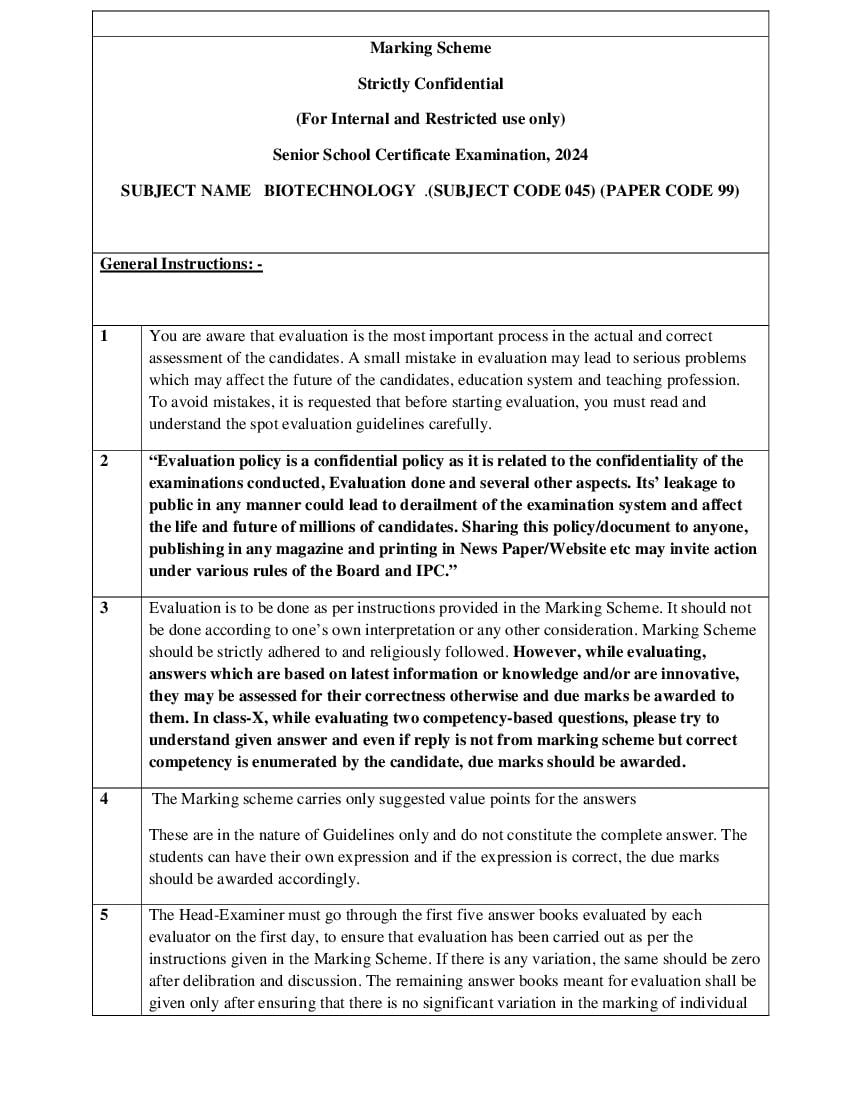
Strictly Confidential
(For Internal and Restricted use only)
Senior School Certificate Examination, 2024
SUBJECT NAME BIOTECHNOLOGY .(SUBJECT CODE 045) (PAPER CODE 99)
General Instructions: -
1 You are aware that evaluation is the most important process in the actual and correct
assessment of the candidates. A small mistake in evaluation may lead to serious problems
which may affect the future of the candidates, education system and teaching profession.
To avoid mistakes, it is requested that before starting evaluation, you must read and
understand the spot evaluation guidelines carefully.
2 “Evaluation policy is a confidential policy as it is related to the confidentiality of the
examinations conducted, Evaluation done and several other aspects. Its’ leakage to
public in any manner could lead to derailment of the examination system and affect
the life and future of millions of candidates. Sharing this policy/document to anyone,
publishing in any magazine and printing in News Paper/Website etc may invite action
under various rules of the Board and IPC.”
3 Evaluation is to be done as per instructions provided in the Marking Scheme. It should not
be done according to one’s own interpretation or any other consideration. Marking Scheme
should be strictly adhered to and religiously followed. However, while evaluating,
answers which are based on latest information or knowledge and/or are innovative,
they may be assessed for their correctness otherwise and due marks be awarded to
them. In class-X, while evaluating two competency-based questions, please try to
understand given answer and even if reply is not from marking scheme but correct
competency is enumerated by the candidate, due marks should be awarded.
4 The Marking scheme carries only suggested value points for the answers
These are in the nature of Guidelines only and do not constitute the complete answer. The
students can have their own expression and if the expression is correct, the due marks
should be awarded accordingly.
5 The Head-Examiner must go through the first five answer books evaluated by each
evaluator on the first day, to ensure that evaluation has been carried out as per the
instructions given in the Marking Scheme. If there is any variation, the same should be zero
after delibration and discussion. The remaining answer books meant for evaluation shall be
given only after ensuring that there is no significant variation in the marking of individual
Page 2
6 Evaluators will mark( √ ) wherever answer is correct. For wrong answer CROSS ‘X” be
✓)while evaluating which gives an impression that
marked. Evaluators will not put right (✓
answer is correct and no marks are awarded. This is most common mistake which
evaluators are committing.
7 If a question has parts, please award marks on the right-hand side for each part. Marks
awarded for different parts of the question should then be totaled up and written in the left-
hand margin and encircled. This may be followed strictly.
8 If a question does not have any parts, marks must be awarded in the left-hand margin and
encircled. This may also be followed strictly.
9 If a student has attempted an extra question, answer of the question deserving more marks
should be retained and the other answer scored out with a note “Extra Question”.
10 No marks to be deducted for the cumulative effect of an error. It should be penalized only
once.
11 A full scale of marks __________(example 0 to 80/70/60/50/40/30 marks as given in
Question Paper) has to be used. Please do not hesitate to award full marks if the answer
deserves it.
12 Every examiner has to necessarily do evaluation work for full working hours i.e., 8 hours
every day and evaluate 20 answer books per day in main subjects and 25 answer books per
day in other subjects (Details are given in Spot Guidelines).This is in view of the reduced
syllabus and number of questions in question paper.
13 Ensure that you do not make the following common types of errors committed by the
Examiner in the past:-
● Leaving answer or part thereof unassessed in an answer book.
● Giving more marks for an answer than assigned to it.
● Wrong totaling of marks awarded on an answer.
● Wrong transfer of marks from the inside pages of the answer book to the title page.
● Wrong question wise totaling on the title page.
● Wrong totaling of marks of the two columns on the title page.
● Wrong grand total.
● Marks in words and figures not tallying/not same.
● Wrong transfer of marks from the answer book to online award list.
● Answers marked as correct, but marks not awarded. (Ensure that the right tick mark is
correctly and clearly indicated. It should merely be a line. Same is with the X for
incorrect answer.)
● Half or a part of answer marked correct and the rest as wrong, but no marks awarded.
14 While evaluating the answer books if the answer is found to be totally incorrect, it should
be marked as cross (X) and awarded zero (0)Marks.
15 Any un assessed portion, non-carrying over of marks to the title page, or totaling error
Page 3
evaluation work as also of the Board. Hence, in order to uphold the prestige of all
concerned, it is again reiterated that the instructions be followed meticulously and
judiciously.
16 The Examiners should acquaint themselves with the guidelines given in the “Guidelines
for spot Evaluation” before starting the actual evaluation.
17 Every Examiner shall also ensure that all the answers are evaluated, marks carried over to
the title page, correctly totaled and written in figures and words.
18 The candidates are entitled to obtain photocopy of the Answer Book on request on payment
of the prescribed processing fee. All Examiners/Additional Head Examiners/Head
Examiners are once again reminded that they must ensure that evaluation is carried out
strictly as per value points for each answer as given in the Marking Scheme.
Page 4
SUBJECT : BIOTECHNOLOGY THEORY (045)
AISSCE 2024
SET 4 QP. CODE 99
SESSION: 2023-24
GENERAL INSTRUCTIONS :
a. The Marking Scheme carries suggested value points for the answers.
b. These are guidelines which constitute the complete answer.
c. The students can have their own expression and if the expression is correct the marks can
be awarded accordingly.
Page 5
BIOTECHNOLOGY (045)
SET-4 ( Series &RQPS)
Q.P. CODE 99
(2023-24)
SECTION – A
Sl. Value Points Marks
No.
1 (C) Bacillus amyloliquefaciens 1
2 (B) Adenosine deaminase 1
3 (B) Non-coding / (A) Coding (As per the prescribed text book, pg63,both options(A)and(B) are 1
correct)
4 (A) Torpedo 1
5 (C) Blood serum 1
6 (D) M13 1
7 (D) Antibiotics 1
8 (B) Gene pollution 1
9 (A) 2001 1
10 (B) Pluripotent 1
11 (B) Penicillium chrysogenum 1
12 (C) Callus 1
13 (A) Both Assertion (A) and Reason (R) are true and Reason (R) is the correct explanation of 1
the Assertion (A) .
14 (D) Assertion (A) is false, but Reason (R) is true. 1
15 (B) Both Assertion (A) and Reason (R) are true, but the Reason (R) is not the correct 1
explanation of the Assertion (A).
16 (C) Assertion (A) is true, but Reason (R) is false. 1
Page 6
17 Fig 2, Pg 6 / Fig 6, Pg 14 (Any One Fig.)
2
Page 7
To search for new diagnostic methods
1+1= 2
To search for new therapeutic modality or uses (Any two)
19 Two dimensional Gel Electrophoresis Technique / Mass Spectrometry Technique
1+1=2
Principle of Two dimensional Gel Electrophoresis Technique:
Separation of proteins is on the basis of charge and size. First proteins get separated on the
basis of isoelectric pH (pI) by IEF technique and then on the basis of molecular size by SDS
PAGE technique .
Principle of Mass Spectrometry Technique:
It determines the molecular weight of a chemical compound or protein by separating the
molecular ions according to m/z ratio.
(Any one technique with principle)
-To overexpress a gene that encodes for the first enzyme in the biosynthetic pathway
20 -To use Agrobacterium rhizogenes to induce excessive secondary roots (hairy roots) in plants
1+1= 2
that normally produce useful secondary metabolites in this region.
21 (a) Drawbacks : Small size / Scale up is challenging / may not represent in vivo phenotype
1+1= 2
or genotype (Any two for 1 mark each)
OR
(b) (i) The oncologist is trying to determine whether the tumour is cancerous or not.
1+1= 2
(ii)Cell comprising tissues and organs like liver of an animal grow only to a certain size
after which they cease to grow / Infant animal grow only to adulthood and not any further.
SECTION C
(a) The principle involved in FISH technique is hybridization of DNA of metaphase
22
chromosomes affixed to a microscopic slide with a fluorescent DNA probe.
1
The principle of Microarray is that complementary sequences will bind to each other by
base pairing or hybridisation. Fluorescently labelled single stranded probe binds with
1
single stranded DNA molecule spotted on the microarray plate.
Applications of FISH are :
Diagnosis of genetic diseases
Locating specific DNA sequences
Page 8
½
To study translocation of genes on chromosomes. (Any 1 point)
Applications of Microarray are :
To monitor the whole genome on a single chip for interactions among thousands of genes
simultaneously. ½
To compare the amounts of many different mRNA in two cell populations in tissue specific
genes to study the regulatory gene defects, cellular response to environment, cell cycle
variations. (Any 1 point)
OR
(b)
Expression Proteomics Functional Proteomics
1 Study of qualitative and Identification and analysis of protein
½ x 6 =3
quantitative networks involved in a living cell/
expression of proteins in different nuclear pore complex/ study of protein
environment or disease. functions and interactions/ molecular
mechanisms and biological roles.
2 Used to identify disease specific To analyse the properties of molecular
proteins networks involved in a living cell.
3 To provide understanding of the Identification of novel proteins which
basis of tumour development. are important for translocating
important molecules from cytoplasm of
a cell to nucleus and vice versa.
.
23
S. No. Protein Pharmaceutical Therapeutic Use Animal Cell
Line
½ x 6 =3
(A) Erythropoietin Anaemia CHO cell line
(B) Herceptin Breast cancer CHO cell line
therapy
(C) Interleukin 2 Cancer therapy CHO cell line
(D) Tissue plasminogen Stroke CHO cell line
activator
Any Three
Page 9
24 Denaturation : The DNA duplex gets separated at temperature above 80°C to form two
single stranded DNA templates.
½ x 6= 3
Step 2 –
Annealing : Two primers bind to the 3’ end of DNA templates at temperature between 50 -
60°C
Step 3 –
Extension : Each primer is extended by Taq DNA polymerase in 5’ 3’ direction using
dNTPs and the DNA strand as template at 70°C
25 A – Trypsin
B – Paper Electrophoresis 1x3=3
C – Sequencing
26 Viable plate count method [colony forming units(CFU) ]– counting the number of live cells
Turbidity measurement – Absorbance at a particular wavelength is proportional to cell
½ x 6 =3
concentration
Coulter counter – Direct counting of cells in suspension as they pass through electrical field
in a single file.
Dry weight – to measure constant weight of fixed volume of culture after drying.
Wet weight- to measure weight of fixed volume of culture. ATP measurement- to measure
ATP in the beginning end at the end of the culture.
[Any Three ways with explanation]
27 Inactive, harmless precursors of proteolytic enzymes are called zymogens. 1
Sl. Chymotrypsinogen Chymotrypsin
No. 1+1 = 2
1 It is inactive precursor of chymotrypsin It is fully active
enzyme. enzyme.
2 The substrate-binding pocket is blocked/ The substrate-binding
not exposed. pocket is not blocked
and is exposed.
3 Serine 195 is not acidic. Serine 195 is acidic.
4 Charge relay doesn’t operate Charge relay operates
Any two points
Page 10
Lac Z gene -- produces β galactosidase enzyme ½ x 6 =3
GFP gene – Produces Green Fluorescent Protein
Tetracycline resistance gene -----provides tetracycline resistance
Leu 2 gene -- codes for an enzyme needed for synthesis of amino acid leucine
Any three
SECTION D
29 (a) Protein A is extracellular 1
(b) Solvent extraction / Chromatography 1
(c) Fig 10, Pg. 100
2
OR
(c) Lesser number of steps for downstream processing are advisable for :
- Less cost 1+1 = 2
- High yield
Page 11
(b) Inositol 1
(c) Auxins and Cytokinins 2
OR
(b) - Autoclaving: Sterilisation is performed at 15 pounds per square inch pressure for 20 1+1 = 2
minutes in an autoclave
- Membrane filter sterilisation- Culture medium is forced through a membrane of very
fine pore size.
SECTION E
31 (a) (i) Elevation of glutathione (a reducing compound) in cells that detoxifies xenobiotics.
1+1=2
Protects cellular components from oxygen intermediates and free radicals.
(ii) Jaundice / Infected skin lesions / genito urinary tract infections / Intestinal infections. 1+1=2
(iii) Curd is used as a probiotic as it is a source of beneficial bacteria which can colonise
1
the intestinal tract.
OR
(b) (i) Recombinant vaccine based on selected epitope: Synthetic gene for an epitope of a
virus is assembled and introduced into host cells which are grown on large scale . The 3
epitope protein is isolated, purified and used as recombinant or subunit vaccine.
(ii) Thermal stability / pH stability / Solvent tolerance / Solubility / Catalytic potency/ 1+1= 2
Biological adaptation to environmental stresses such as high salinity, drought , cold, etc.
Any two
32 (a) (i) ddNTPs lack 3′Hydroxyl group so the phosphodiester bond between 3’ hydroxyl group
of the previous nucleotide cannot be formed with the 5’ phosphate group of the incoming
2
nucleotide and hence the growing DNA chain cannot be further extended and the chain
gets terminated.
(ii) The sequencing technique is carried out in four test tubes, each carrying single stranded
DNA template, deoxy nucleotide tri phosphates, primer and DNA polymerase. A small 3
amount of four dideoxy nucleotide triphosphates i.e. ddATP, ddTTP, ddGTP and ddCTP are
added separately into the four test tubes and the reaction is allowed to proceed. Prematurely
terminated strands in a given tube are separated on special gels by electrophoresis wherein
the bands can be resolved even if they differ by one nucleotide . The shorter fragments move
faster towards the anode. The radioactive primers help in easy visualisation using
autoradiography. The gel is read from bottom to top to arrive at 5′ to 3′ original DNA
sequence.
Page 12
(b) (i) - The fastest moving shortest DNA fragment is obtained at 5’ position (towards 2
anode).
- Since DNA synthesis occurs in 5’ to 3’ direction, the gel is read from 5’ end (anode)
(ii) Single tube DNA sequencing uses fluorescent colours rather than radioactive isotopes 1+1=2
so is safer.
It is better as it is automated /faster /uses a single lane gel for electrophoresis/ result is
directly displayed on a computer screen and data can be stored in a computer.
(iii) M13-based vector 1
33 (a) (i) Entrez allows us to access literature in the form of abstracts , sequences and
½ x 6= 3
structures. Entrez provides comprehensive information on a given biological question.
Taxonomy browser provides information on taxonomic classification of various
species.
Locus link provides information on official gene names, descriptive information
about genes and on homologous genes
(ii) UniProtKB gives information about annotated protein sequences.
PDB (Protein Database) contains information about three dimensional structure of 1+1 =2
proteins.
OR
(b) (i)In BLAST:
1x3=3
- A given sequence is compared with the database sequences using matrices which
give scores. They either reward a match or penalise a mismatch.
- Top scoring matches are ranked based on whether the match was due to ancestral
relationship or just a random chance.
- True matches are examined through ENTREZ
(ii) GeneMark for bacterial genomes and GENSCAN for eukaryotic genomes.
1+1= 2
Document Details
| Board / Org | CBSE |
| Exam | Class 12 |
| Type | Solution |
| Pages | 12 |
| Updated | 30 Apr 2026 |