CBSE Class 12 Accountancy Question Paper 2019 Set 1 Solutions
Finished viewing? Save it for later —
Download CBSE Class 12 Accountancy Question Paper 2019 Set 1 Solutions (PDF · 58 pages)About CBSE Class 12 Accountancy Question Paper 2019 Set 1 Solutions
CBSE Class 12 Accountancy Question Paper 2019 Set 1 Solutions is available here for free download. Published by CBSE for Class 12, this solution can be viewed online or downloaded as a PDF (58 pages). Candidates preparing for Class 12 can use CBSE Class 12 Accountancy Question Paper 2019 Set 1 Solutions to understand the exam pattern, the type of questions asked, and the overall difficulty level.
Frequently Asked Questions
How can I download CBSE Class 12 Accountancy Question Paper 2019 Set 1 Solutions?
Open this page and click the Download button to save CBSE Class 12 Accountancy Question Paper 2019 Set 1 Solutions as a PDF. It is completely free on AglaSem Docs.
Is CBSE Class 12 Accountancy Question Paper 2019 Set 1 Solutions free to download?
Yes. CBSE Class 12 Accountancy Question Paper 2019 Set 1 Solutions can be viewed online and downloaded as a PDF free of cost on AglaSem Docs.
How many pages does CBSE Class 12 Accountancy Question Paper 2019 Set 1 Solutions have?
CBSE Class 12 Accountancy Question Paper 2019 Set 1 Solutions contains 58 pages, which you can read online or download together as a single PDF.
Where can I find more Class 12 study material?
You can find more Class 12 question papers, sample papers, syllabus, and answer keys on AglaSem Docs.
CBSE Class 12 Accountancy Question Paper 2019 Set 1 Solutions – Text
Read the full text of this solution below — useful to quickly search, copy and reference the content online without downloading the PDF.
📄 View text version (58 pages)
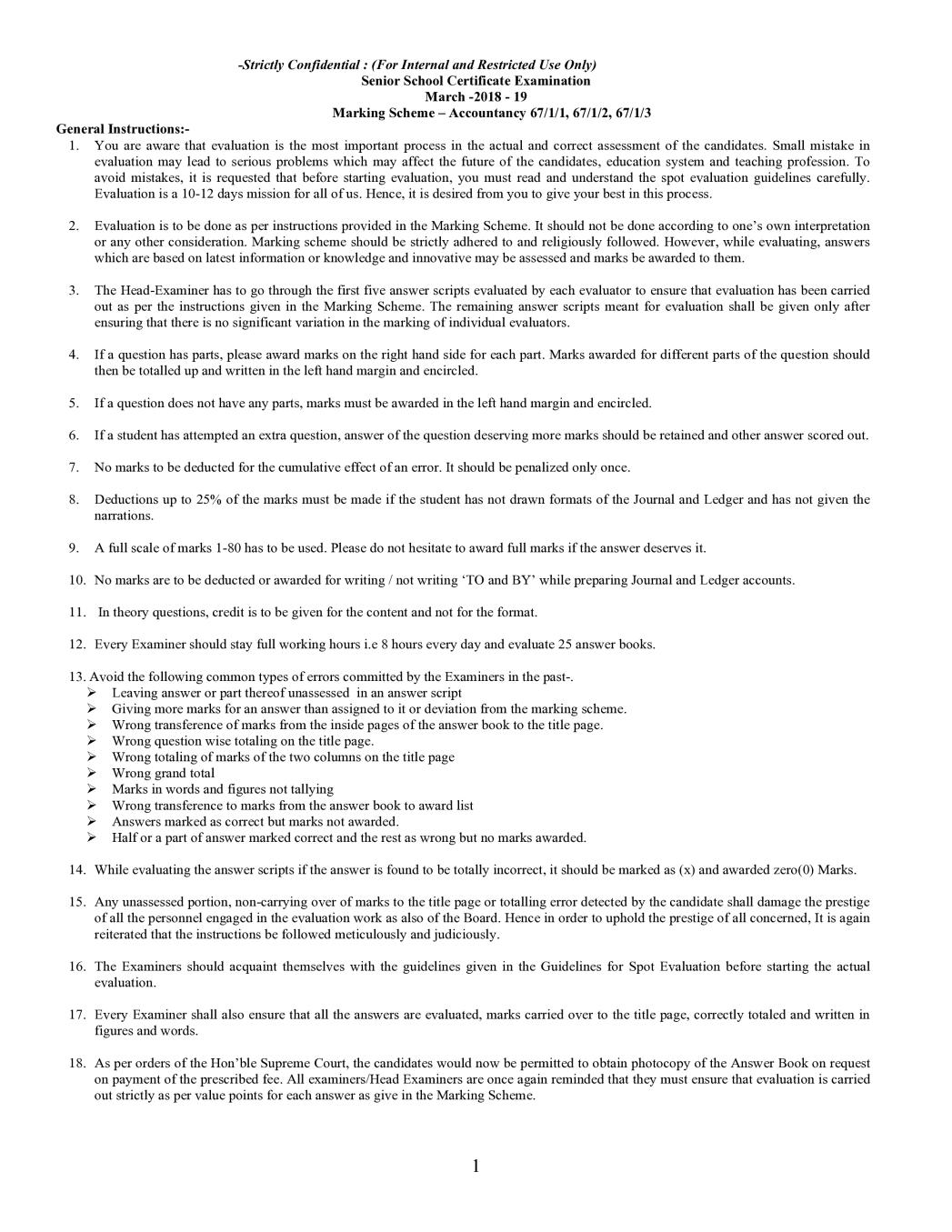
Page 1
Senior School Certificate Examination
March -2018 - 19
Marking Scheme – Accountancy 67/1/1, 67/1/2, 67/1/3
General Instructions:-
1. You are aware that evaluation is the most important process in the actual and correct assessment of the candidates. Small mistake in
evaluation may lead to serious problems which may affect the future of the candidates, education system and teaching profession. To
avoid mistakes, it is requested that before starting evaluation, you must read and understand the spot evaluation guidelines carefully.
Evaluation is a 10-12 days mission for all of us. Hence, it is desired from you to give your best in this process.
2. Evaluation is to be done as per instructions provided in the Marking Scheme. It should not be done according to one’s own interpretation
or any other consideration. Marking scheme should be strictly adhered to and religiously followed. However, while evaluating, answers
which are based on latest information or knowledge and innovative may be assessed and marks be awarded to them.
3. The Head-Examiner has to go through the first five answer scripts evaluated by each evaluator to ensure that evaluation has been carried
out as per the instructions given in the Marking Scheme. The remaining answer scripts meant for evaluation shall be given only after
ensuring that there is no significant variation in the marking of individual evaluators.
4. If a question has parts, please award marks on the right hand side for each part. Marks awarded for different parts of the question should
then be totalled up and written in the left hand margin and encircled.
5. If a question does not have any parts, marks must be awarded in the left hand margin and encircled.
6. If a student has attempted an extra question, answer of the question deserving more marks should be retained and other answer scored out.
7. No marks to be deducted for the cumulative effect of an error. It should be penalized only once.
8. Deductions up to 25% of the marks must be made if the student has not drawn formats of the Journal and Ledger and has not given the
narrations.
9. A full scale of marks 1-80 has to be used. Please do not hesitate to award full marks if the answer deserves it.
10. No marks are to be deducted or awarded for writing / not writing ‘TO and BY’ while preparing Journal and Ledger accounts.
11. In theory questions, credit is to be given for the content and not for the format.
12. Every Examiner should stay full working hours i.e 8 hours every day and evaluate 25 answer books.
13. Avoid the following common types of errors committed by the Examiners in the past-.
Ø Leaving answer or part thereof unassessed in an answer script
Ø Giving more marks for an answer than assigned to it or deviation from the marking scheme.
Ø Wrong transference of marks from the inside pages of the answer book to the title page.
Ø Wrong question wise totaling on the title page.
Ø Wrong totaling of marks of the two columns on the title page
Ø Wrong grand total
Ø Marks in words and figures not tallying
Ø Wrong transference to marks from the answer book to award list
Ø Answers marked as correct but marks not awarded.
Ø Half or a part of answer marked correct and the rest as wrong but no marks awarded.
14. While evaluating the answer scripts if the answer is found to be totally incorrect, it should be marked as (x) and awarded zero(0) Marks.
15. Any unassessed portion, non-carrying over of marks to the title page or totalling error detected by the candidate shall damage the prestige
of all the personnel engaged in the evaluation work as also of the Board. Hence in order to uphold the prestige of all concerned, It is again
reiterated that the instructions be followed meticulously and judiciously.
16. The Examiners should acquaint themselves with the guidelines given in the Guidelines for Spot Evaluation before starting the actual
evaluation.
17. Every Examiner shall also ensure that all the answers are evaluated, marks carried over to the title page, correctly totaled and written in
figures and words.
18. As per orders of the Hon’ble Supreme Court, the candidates would now be permitted to obtain photocopy of the Answer Book on request
on payment of the prescribed fee. All examiners/Head Examiners are once again reminded that they must ensure that evaluation is carried
out strictly as per value points for each answer as give in the Marking Scheme.
1
Page 2
Marking Scheme 2018-19
67 67 67 Accountancy (055) MARKS
/1 /1 /1 Delhi- 67/1/1
/1 /2 /3 Expected Answers/ Value Points
1 2 5 Q. Atul and Neera are in partnership….Calculate the new profit sharing
ratio.
½
Ans. Mitali’s share in profit= 1/10 +
½
Atul’s new share= 3/5-1/10=5/10 …1/2 mark =
Neera’s new share= 2/5
Mitali’s share=1/10 1 mark
New ratio= 5:4:1………………….1/2 mark
2 4 4 Q. What is meant by ‘Issued Capital’?
Ans. Issued Capital is that part of the Authorised Capital which is offered to the 1 mark
public for subscription.
OR OR
Q. What is meant by ‘Employees Stock Option Plan’?
Ans. Employees Stock Option Plan means option granted by the company to its 1 mark
employees and directors to subscribe to the shares of the company at a price that is
lower than the market price.
3 - - Q. Differentiate between Dissolution of Partnership and Dissolution of a Firm
on the basis of ‘Court’s intervention’.
Ans.
Dissolution of Partnership Dissolution of a Firm
Court’s The court does not intervene because The firm can be 1 mark
intervention partnership is dissolved by mutual dissolved by court’s
agreement order.
.
4 1 3 Q. What is meant by ‘Gaining Ratio’ on retirement of a partner?
Ans. Gaining ratio is the ratio in which the remaining partners acquire the retiring 1 mark
partner’s share.
OR OR
Q. P, Q and R were partners …. rate at which interest will be paid to R
Ans. 6% p.a. 1 mark
2
Page 3
Ans. Journal
Date Particulars Dr. (₹) Cr. (₹)
Chhavi’s Capital/ Current Account Dr. 900 - 1 mark
To Interest on drawings A/c - 900
(Being Interest on drawings charged)
.
6 5 1 Q. How are Specific donations treated while preparing final accounts of a
‘Not-For-Profit Organisation?
Ans. Specific donations are taken on the liabilities side of the Balance Sheet of a
Not-For-Profit Organisation 1 mark
or
Specific donations are capitalized while preparing the final accounts of a Not-For-
Profit Organisation.
OR OR
Q. State the basis of accounting of preparing ‘Income and Expenditure 1 mark
Account’ of a Not-For-Profit Organisations.
Ans. Accrual basis.
7 - - Q. The capital of the firm of Anuj and Benu … Calculate the goodwill of the
firm.
Ans. Actual profits = ₹3,60,000 – ₹1,20,000 = ₹2,40,000
Normal profits= 15% x ₹10,00,000 = ₹1,50,000…………………..1 mark
Super profits = Actual profits – Normal profits 1+1+1
= ₹2,40,000 – ₹1,50,000
= ₹90,000……………………………………………1 mark =
Goodwill= Super profits x Number of years purchase 3 marks
= ₹90,000 x 2
= ₹1,80,000……………………………………………...1 mark
8 - - Q. How the following items…. Aisko Club:
Ans. Balance Sheet of Aisko Club as on 31st March 2018
Liabilities Amount Assets Amount ½ mark for
(₹) (₹) each item
Tournament Fund 1,50,000 Tournament Fund Investments 1,50,000 =
Add Income from Tournament Accrued Interest on Tournament ½x6
Fund Investments 18,000 Fund Investments 6,000 =
Add Accrued Interest 6,000
Less Tournament expenses 3 marks
(12,000) 1,62,000
3
Page 4
Investments as ₹24,000 instead of ₹18,000 and ₹6,000 separately and added it
to the Tournament Fund, full credit should be given.
9 7 7 Q. Garvit Ltd. invited applications… Ltd.
Ans. Journal of Garvit Ltd.
Date Particulars Dr. (₹) Cr. (₹)
Bank A/c Dr. 3,38,400 -
To Debenture Application and Allotment A/c - 3,38,400 1 mark
(Being application money received on 3,600
debentures) +
Debenture Application and Allotment A/c Dr. 3,38,400 -
Discount/Loss on issue of Debentures A/c Dr. 18,000 - 2 marks
To 11% Debentures 3,00,000
To Bank A/c 56,400
(Being application money adjusted) =
3 marks
OR
OR
st
Q. On 1 April 2015, P Ltd. issued ….. Loss on issue of 12%Debentures
Account.
Ans. Dr. Loss on issue of 12% Debentures Account Cr.
Date Particulars Amount Date Particulars Amount
(₹) (₹)
2015 2016
April 1 To Premium on 42,000 Mar 31 By Statement of 14,000
Redemption of P/L
Debentures A/c Mar 31 By Balance c/d 28,000
42,000 42,000
2016 2017 1x3
April 1 To balance b/d 28,000 Mar 31 By Statement of =
P/L 14,000 3 marks
Mar 31 By Balance c/d 14,000
28,000 28,000
2017 2018
April 1 To balance b/d 14,000 Mar 31 By Statement of 14,000
P/L
14,000 14,000
10 - - Q. Unilink Ltd. had outstanding…. year ended 31st March 2018.
Ans. Journal of Unilink Ltd.
Date Particulars Dr. (₹) Cr. (₹)
2017* Debenture Redemption Investments A/c Dr. 90,000
Apr.30 To Bank A/c 90,000
(Being Debenture Redemption Investments ½ mark
purchased)
4
Page 5
Mar.31 To Debenture Redemption Investments A/c 90,000 1 mark
(Being Debenture Redemption Investments
sold)
“ 9% Debentures A/c Dr. 6,00,000
Premium on redemption of Debentures A/c Dr. 48,000
To Debenture holders A/c 6,48,000 1 mark
(Being Debentures due for redemption)
“ Debenture holders A/c Dr. 6,48,000
To Bank A/c 6,48,000 ½ mark
(Being Debentures redeemed)
Debenture Redemption Reserve A/c Dr. 1,50,000
To General Reserve A/c 1,50,000
(Being Debenture Redemption Reserve
transferred to general reserve) -
* Any date from April 1 to April 30 can be given for purchase of Debenture
Redemption Investments
=
Note: No marks to be deducted if the student has not transferred Debenture 3marks
Redemption Reserve to General Reserve
11 - - Q. Ankit, Bobby and Kartik……………… is settled at ₹12,500.
Ans. Journal
Date Particulars Dr. (₹) Cr. (₹)
(i) Ankit’s Capital A/c Dr. 32,000
Bank/ Cash A/c Dr. 52,000
To Realisation A/c 84,000
(Being stock taken over by Ankit, remaining sold at a
profit)
or
Ankit’s Capital A/c Dr. 32,000
To Realisation A/c 32,000
(Being stock taken over by Ankit)
Bank/ Cash A/c Dr. 52,000
To Realisation A/c 52,000
(Being stock sold at a profit) 1x4
=
(ii) Realisation A/c Dr. 69,000 4 marks
To Bank/ Cash A/c 69,000
(Being payment made to creditors)
(iii) Realisation A/c Dr. 22,000
To Bank/ Cash A/c 22,000
5
Page 6
(iv) Kartik’s loan A/c Dr. 12,000
Realisation A/c Dr. 500
To Bank/ Cash A/c 12,500
(Being Kartik’s loan settled)
or
Kartik’s loan A/c Dr. 12,000
To Bank/ Cash A/c 12,000
(Being Kartik’s loan settled)
Realisation A/c Dr. 500
To Bank / CashA/c 500
(Being Kartik’s loan settled at a loss)
.
12 - - Q. Radhika, Bani and Chitra …above changes.
Ans. JOURNAL
Date Particulars Dr. (₹) Cr. (₹)
Radhika’s Capital A/c Dr. 8,000
Bani’s Capital A/c Dr. 12,000
Chitra’s Capital A/c Dr. 4,000 1 mark
To Profit and Loss A/c 24,000
(Being undistributed loss transferred to Partners’
Capital Accounts)
General Reserve Dr. 1,44,000
To Radhika’s Capital A/c 48,000
To Bani’s Capital A/c 72,000 1 mark
To Chitra’s Capital A/c 24,000
(Being General Reserve distributed to Partners’
Capital Accounts)
Radhika’s Capital A/c Dr. 30,000
To Bani’s Capital A/c 30,000 1 mark
(Being adjustment entry made for goodwill)
Land A/c Dr. 1,80,000
To Revaluation A/c 1,80,000 ½ mark
(Being Land revalued)
Revaluation A/c Dr. 1,80,000
To Radhika’s Capital A/c 60,000
To Bani’s Capital A/c 90,000 ½ mark
To Chitra’s Capital A/c 30,000
(Being gain on Revaluation transferred to Partners’
Capital Accounts)
=
4 marks
6
Page 7
Ans. Dr. Income and Expenditure A/c for the year ended March 31, 2018 Cr.
Particulars Amount Particulars Amount
(₹) (₹) ½ mark for
To Stationery consumed 22,400 By Subscriptions 2,00,000 each item
To loss on sale of old furniture 2,400 By Interest on investments =
To electricity expenses 10,600 800 ½x8
To expenses on lectures 30,000 Add interest accrued 160 960 =
To surplus 1,52,960 By Government Grant 17,400 4 marks
2,18,360 2,18,360
Balance Sheet of Sears Club as on 31st March 2018
Liabilities Amount Assets Amount 1 mark
(₹) (₹) each for
Subscriptions received in Outstanding Subscriptions 1,01,000 liabilities
advance 7,200 Stock of Stationery 4,000 and asset
Donations for building 40,000 Cash 50,000 side
Capital Fund 62,000 Investments 8,000 1+1
Add Surplus 1,52,960 2,14,960 Interest accrued on =
investments 160
Sports Equipment 59,000 2 marks
Books 40,000
2,62,160 2,62,160
Interest on 12% Investments
In case, a candidate has credited Income and Expenditure Account byRs.800 on
account of Interest on 12% Investments, it may be marked correct.
Working Notes:
Balance Sheet of Sears Club as on 31st March 2017
Liabilities Amount Assets Amount
(₹) (₹)
Subscriptions received in Outstanding
advance 25,000 Subscriptions 60,000
Capital Fund 62,000 Stock of Stationery 3,000
Cash 20,000
Furniture 4,000 =
87,000 87,000 4+2
=
Note: In case the candidate has not prepared the Opening Balance Sheet, no 6 marks
marks are to be deducted.
14 15 13 Q. Girija, Yatin and Zubin …. Zubin’s Executors Account till he is finally
paid.
7
Page 8
Date Particulars Amount Date Particulars Amount
(₹) (₹)
2015 2015
Aug 1 To Bank A/c 10,300 Aug 1 By Zubin’s Capital A/c 90,300 2 marks
2016 2016
March 31 To Balance c/d 83,200 Mar 31 By Interest accrued 3,200
93,500 93,500
2017 2016
Mar 31 To Bank A/c 48,000 Apr 1 By Balance b/d 83,200
2 marks
2017
“ To Balance c/d 40,000 Mar 31 By Interest 4,800
88,000 88,000
2018 2017
Mar 31 To Bank A/c 42,400 Apr 1 By Balance b/d 40,000
2018 2 marks
Mar 31 By Interest 2,400
42,400 42,400 =
6 marks
OR
Ans. Dr. Zubin’s Executors Account Cr. OR
Date Particulars Amount Date Particulars Amount
(₹) (₹)
2015 2015
Aug 1 To Bank A/c 10,300 Aug 1 By Zubin’s Capital A/c 90,300
2016 2 marks
March 31 To Bank A/c 3,200 2016
“ To Balance c/d 80,000 Mar 31 By Interest 3,200
93,500 93,500
2017 2016
Mar 31 To Bank A/c 44,800 Apr 1 By Balance b/d 80,000
2017
“ To Balance c/d 40,000 Mar 31 By Interest 4,800 2 marks
88,800 88,800
2018 2017
Mar 31 To Bank A/c 42,400 Apr 1 By Balance b/d 40,000
2018 2 marks
Mar 31 By Interest 2,400 =
42,400 42,400 6 marks
OR
Ans. Dr. Zubin’s Executors Account Cr.
Date Particulars Amount Date Particulars Amount OR
(₹) (₹)
2015 2015
Aug 1 To Bank A/c 10,300 Aug 1 By Zubin’s Capital A/c 90,300 2 marks
2016 2016
March 31 To Balance c/d 83,200 Mar 31 By Interest accrued 3,200
93,500 93,500
2017 2016
Mar 31 To Bank A/c 48,192 Apr 1 By Balance b/d 83,200
8
Page 9
“ To Balance c/d 40,000 Mar 31 By Interest 4,992
88,192 88,192
2018 2017
Mar 31 To Bank A/c 42,400 Apr 1 By Balance b/d 40,000 2 marks
2018
Mar 31 By Interest 2,400
=
42,400 42,400
6 marks
15 13 14 Q. Sonu and Rajat started a partnership firm … books of Sonu and Rajat.
Ans. Journal
Date Particulars Dr. (₹) Cr. (₹)
Profit and Loss A/c Dr. 4,89,950
To Profit and Loss Appropriation A/c 4,89,950
(Being profit transferred from Profit and Loss A/c ½ mark
to Profit and Loss Appropriation A/c)
Partner’s Salary A/c Dr. 2,40,000
To Sonu’s Capital A/c 2,40,000
(Being salary credited to Sonu’s Capital A/c) ½ mark
Profit and Loss Appropriation A/c Dr. 2,40,000
To Partner’s Salary A/c 2,40,000
(Being salary transferred to Profit and Loss
Appropriation A/c) ½ mark
Partner’s Commission A/c Dr. 1,00,000
To Rajat’s Capital A/c 1,00,000
(Being commission credited to Rajat’s Capital A/c)
½ mark
Profit and Loss Appropriation A/c Dr. 1,00,000
To Partner’s Commission A/c 1,00,000
(Being salary transferred to Profit and Loss
Appropriation A/c)
½ mark
Interest on Capital A/c Dr. 1,12,000
To Sonu’s Capital A/c 64,000
To Rajat’s Capital A/c 48,000
(Being interest on capital credited to Partners’
Capital A/c) ½
mark
Profit and Loss Appropriation A/c Dr. 1,12,000
To Interest on Capital A/c 1,12,000
(Being Interest on Capital transferred to Profit and
Loss Appropriation A/c)
½ mark
Sonu’s Capital A/c Dr. 400
Rajat’s Capital A/c Dr. 1,650
To Interest on Drawings A/c 2,050
(Being Interest on drawings charged) 1 mark
9
Page 10
To Profit and Loss Appropriation A/c 2,050
(Being Interest on drawings transferred to Profit
and Loss Appropriation A/c) ½ mark
Profit and Loss Appropriation A/c Dr. 40,000
To Sonu’s Capital A/c 24,000
To Rajat’s Capital A/c 16,000
(Being Profit credited to Partners’ Capital 1 mark
accounts)
Note: If a combined entries has been passed for Partner’s commission, =
Partner’s salary, Interest on Capital and Interest on Drawings, no mark is to 6 marks
be deducted.
OR
Q. Jay, Vijay and Karan…. For the year ended 31st March 2018
Ans. OR
Dr. Profit and Loss Appropriation A/c for the year ended 31st March 2018
Cr.
Particulars Amount Particulars Amount
(₹) (₹)
To salary By Net Profit 15,00,000
Jay’s Capital A/c 1,80,000 By Jay’s Capital A/c
Vijay’s Capital A/c 1,80,000 3,60,000 (2,00,000 – 1,75,000)/
Deficiency in guaranteed 25,000
To Profit transferred to: fees
Jay’s Capital A/c 4.66,000 ½ mark
- guarantee to Karan 3,05,800 for each
(1,60,200) correct
item
Vijay’s Capital A/c 4,66,000 3,59,200 =
- guarantee to Karan(1,06,800) ½x6
=
Karan’s Capital A/c 2,33,000 5,00,000 3 marks
Add guarantee 2,67,000
15,25,000 15,25,000
+
Dr. Partners’ Capital Accounts Cr.
Particulars Jay Vijay Karan Particulars Jay Vijay Karan
(₹) (₹) (₹) (₹) (₹) (₹)
25,000 - - By salary
1 mark for
To P/L 1,80,000 1,80,000 --
Appr. A/c By P/L
each
To 4,60,800 5,39,200 5,00,000 Appropriation 3,05,800 3,59,200 5,00,000 correct
balance A/c- Profit Capital A/c
c/d =
4,85,800 5,39,200 5,00,000 4,85,800 5,39,200 5,00,000 1x3
. =
In case, the candidate has prepared the Partners Capital accounts considering the 3 marks
guarantee in any other way and the closing balances in their Capital Accounts are =
10
Page 11
=
6 marks
16 17 16 Q. DF Ltd. was registered … the necessary Journal entries in the books of DF
Ltd.
Ans. Journal of DF Ltd.
Date Particulars Dr. (₹) Cr. (₹)
Bank A/c Dr. 2,10,000
To Equity Share Application A/c 2,10,000 3marks
(Being application money received on 70,000 shares)
Equity Share Application A/c Dr. 2,10,000
To Equity Share Capital A/c 1,00,000
To Securities premium reserve A/c 50,000
To Equity Share Allotment A/c 15,000 2 marks
To Bank A/c 45,000
(Being application money transferred to share capital,
securities premium reserve, share allotment and the
balance refunded)
Equity Share Allotment A/c Dr. 1,50,000
To Equity Share Capital A/c 1,00,000
To Securities Premium Reserve A/c 50,000 3 marks
(Being Allotment money due on 50,000 shares)
Bank A/c Dr.
To Equity Share Allotment A/c
(Being allotment money received)
OR
-
Bank A/c Dr.
Calls in arrears A/c Dr.
To Equity Share Allotment A/c
(Being allotment money received)
Equity Share First call A/c Dr. 1,50,000
To Equity Share Capital A/c 1,50,000
-
(Being First call money due on 50,000 shares)
Bank A/c Dr. 1,20,000
To Equity Share First call A/c 1,20,000
(Being first call money received)
OR -
Bank A/c Dr. 1,20,000
Calls in arrears A/c Dr. 30,000 =
To Equity Share First call A/c 1,50,000 8 marks
(Being first call money received
OR
OR
11
Page 12
Ans. Journal of EF Ltd.
Date Particulars Dr. (₹) Cr. (₹)
Bank A/c Dr. 24,00,000
To Equity Share Application A/c 24,00,000 ½ mark
(Being application money received on 1,20,000 shares)
Equity Share Application A/c Dr. 24,00,000
To Equity Share Capital A/c 12,00,000
To Securities premium reserve A/c 4,00,000
To Equity Share Allotment A/c 4,00,000
1 mark
To Bank A/c 4,00,000
(Being application money transferred to share capital,
securities premium reserve, share allotment and the
balance refunded)
Equity Share Allotment A/c Dr. 12,00,000
To Equity Share Capital A/c 8,00,000 ½ mark
To Securities Premium Reserve A/c 4,00,000
(Being Allotment money due on 80,000 shares)
Bank A/c Dr. 7,60,000
Calls in arrears A/c Dr. 40,000
To Equity Share Allotment A/c 8,00,000
1 mark
(Being allotment money received)
Equity Share First call A/c Dr. 12,00,000
To Equity Share Capital A/c 12,00,000 ½ mark
(Being First call money due on 80,000 shares)
Bank A/c Dr. 12,10,000
Calls in arrears A/c (First call) Dr. 30,000 1 ½ marks
To Equity Share First call A/c 12,00,000
To Calls in Arrears A/c (Allotment) 40,000
(Being first call money received)
Equity Share Capital A/c Dr. 80,000
To Share Forfeiture A/c 50,000 1 mark
To Calls in Arrears A/c 30,000
(Being Sahaj’s shares forfeited for non payment of first
call)
Bank A/c Dr. 1,20,000
To Equity Share Capital A/c 1,00,000 1 mark
To Securities Premium Reserve A/c 20,000
(Being Sahaj’s shares reissued for ₹60 per share)
Share Forfeiture A/c Dr. 50,000
To Capital Reserve A/c 50,000 1 mark
(Being balance in Share forfeiture account transferred
to capital reserve)
=
Note: In case a candidate has attempted one or both the alternatives and
8 marks
struck off one or both of them, both the answers may be evaluated and the
answer in which the candidate has secured more marks may be retained.
12
Page 13
Ans.
Dr. Revaluation A/c Cr.
Particulars Amount Particulars Amount
(₹) (₹)
½ mark for
To Provision for doubtful debts 7,000 By Plant and Machinery 20,000
each amount
To Furniture 3,000 =
To Profit transferred to: ½x4
Akul’s Capital A/c 4,000 =
Bakul’s Capital A/c 4,000 2 marks
Chandan’s Capital A/c 2,000 10,000
20,000 20,000
In case, the student has calculated ‘Provision for doubtful debts’ correctly,
full credit is to be given.
Dr. Partners Capital Accounts Cr. 1 mark for
Particulars Akul Bakul Chandan Particulars Akul Bakul Chandan each
(₹) (₹) (₹) (₹) (₹) (₹) capital
To Bakul By balance b/d 1,60,000 1,20,000 92,000 A/c
Capital A/c 80,000 - 40,000 By General +
To Bakul loan Reserve 8,000 8,000 4,000 1 mark for
A/c - 2,52,000 - By Revaluation capital
To balance c/d 92,000 58,000 A/c 4,000 4,000 2,000
adjustment
By Akul Capital
A/c - 80,000 - =
By Chandan 3+1
Capital A/c - 40,000 - =
1,72,000 2,52,000 98,000 1,72,000 2,52,000 98,000
To Bank A/c - - 8,000 By balance b/d 92,000 - 58,000 4 marks
To balance c/d 1,00,000 - 50,000 By Bank A/c 8,000 - -
1,00,000 - 58,000 1,00,000 - 58,000
Note: If the candidate has not extended the Capital Accounts but done the
Capital Adjustment correctly, full credit be given.
1 mark for
Balance Sheet of the reconstituted firm as on 31st March 2018 correct assets
Liabilities Amount Assets Amount side
(₹) (₹) +
1 mark for
Sundry Creditors 45,000 Cash at bank 42,000
correct
Employees Provident Fund 13,000 Debtors 60,000
liability side
Bakul’s Loan 2,52,000 Less Provision for =
Capitals doubtful debts 9,000 51,000 2 marks
Akul 1,00,000 Stock 80,000 =
Chandan 50,000 1,50,000 Furniture 87,000 2+4+2
Plant and Machinery 2,00,000 =
4,60,000 4,60,000 8 marks
OR OR
Q. Sanjana and Alok are partners ….. Nidhi’s admission.
Ans.
Dr. Revaluation A/c Cr.
13
Page 14
(₹) (₹)
½x4
To Furniture 30,000 By Investments 40,000
=
2 marks
To Profit transferred to: By Stock 30,000
Sanjana’s Capital A/c 24,000
Alok’s Capital A/c 16,000 40,000
70,000 70,000
Dr. Partners Capital Accounts Cr. 1 mark for
Particulars Sanjana Alok Nidhi Particulars Sanjana Alok Nidhi
each
(₹) (₹) (₹) (₹) (₹) (₹)
capital
To Cash A/c 30,000 20,000 - By Balance b/d 5,00,000 4,00,000 -
A/c
To By Cash A/c - - 3,00,000
Investments By Premium for - =
A/c - 3,00,000 - goodwill A/c 60,000 40,000 1x3
To Cash A/c 50,000 - - By Workmen’s - =
To Balance Compensation 36,000 24,000 - 3 marks
c/d 5,40,000 3,60,000 3,00,000 Reserve A/c -
By Revaluation A/c 24,000 16,000
By Cash - 2,00,000
6,20,000 6,80,000 3,00,000 6,20,000 6,80,000 3,00,000
Balance Sheet of the reconstituted firm as on 31st March 2018
½x6
Liabilities Amount Assets Amount
=
(₹) (₹) 3 marks
Creditors 60,000 Cash at bank 6,66,000
Capitals: Debtors 1,46,000 =
Sanjana 5,40,000 Less Provision for 2+3+3
Alok 3,60,000 doubtful debts 2,000 1,44,000
Nidhi 3,00,000 12,00,000 Stock 1,80,000 =
Furniture 2,70,000 8 marks
12,60,000 12,60,000
PART B
OPTION 1
Analysis of Financial Statements
18 - - Q. Mevo Finance Ltd ……Investing Activities.
Ans. Cash Flows from Investing activities
Particulars Amount (₹) Amount (₹)
Sale of Machinery 69,000
Purchase of machinery (9,00,000) 1 mark
Net Cash used in Investing (8,31,000)
Activities
19 - - Q. State the meaning of ‘Cash Equivalents’.
Ans. Cash Equivalents mean short term highly liquid investments that are readily 1 mark
convertible into known amounts of cash and which are subject to an insignificant
risk of changes in value.
14
Page 15
Ans. Objectives of ‘Financial Statements Analysis’: (Any four)
½ mark for
(i) Assessing the earning capacity or profitability heading
(ii) Assessing the managerial efficiency +
(iii) Assessing the short term and the long-term solvency of the enterprise ½ mark
(iv) Inter- firm comparison. for its
(v) Forecasting and preparing budgets. explanation
(vi) Ascertaining the relative importance of different components of the financial =
position of the firm. 1x4
=
(If the candidate has not given the headings but has given the correct 4 marks
explanation, full credit may be given)
OR OR
Q. State under which major headings and sub-headings ……..developed by
the company.
Ans.
Item Head Sub-Head
(i) Prepaid Insurance Current Assets Other Current Assets
(ii) Investment in Non Current Assets Non Current
Debentures Investments
(iii) Calls-in-arrears Shareholders’ Share Capital/ ½x8
Funds Subscribed Capital =
4 marks
(iv) Unpaid dividend Current Liabilities Other Current Liabilities
(v) Capital Reserve Shareholders’ Reserves and Surplus
Funds
(vi) Loose Tools Current Assets Inventories
(vii) Capital work-in- Non Current Assets Fixed Assets
progress
(viii) Patents being Non Current Assets Fixed Assets- Intangible
developed by Assets under
the company development
.
21 22 21 (a) Calculate Revenue from operations ……. 25% on cost.
Ans. Current ratio =2:1 and Current assets = ₹8,00,000
Current ratio = Current Assets/ Current Liabilities=2:1
Therefore, Current Liabilities =₹4,00,000
Quick ratio = Quick Assets/ Current Liabilities=1.5:1
Therefore, Quick Assets =₹6,00,000
15
Page 16
=₹8,00,000 - ₹6,00,000 marks
=₹2,00,000
Inventory Turnover Ratio=6 times
Cost of Revenue from operations/ Average Inventory = 6 times
Cost of Revenue from operations/ ₹2,00,000 = 6 +
Cost of Revenue from operations =₹12,00,000
Gross Profit is 25% on cost =25% of ₹12,00,000
=₹3,00,000
So, Revenue from operations = ₹12,00,000 +₹3,00,000
= ₹15,00,000
(b) The Operating ratio of a company is 60%. State whether ‘Purchase of
goods costing ₹20,000’ will increase, decrease or not change the operating 1 mark
ratio. =
Ans. ‘Purchase of goods costing ₹20,000’ will not change the operating ratio. 4 marks
OR
OR
Q. Calculate ‘Total Assets to Debt……
Ans.
Total Assets= Total Liabilities= Equity Share Capital + Long Term borrowings +
Surplus +General reserve + Current Liabilities + Long term Provisions
=₹4,00,000 + ₹1,80,000 + ₹1,00,000 + ₹70,000 + ₹30,000 + ₹1,20,000
=₹9,00,000
3
marks
Debt= Long Term borrowings+ Long term Provisions
= ₹1,80,000 + ₹1,20,000
= ₹3,00,000
Total assets to debt Ratio= Total assets/ debt +
=₹9,00,000/₹3,00,000
=3:1
(b) The Debt Equity ratio….. Debt Equity Ratio.
1 mark
Ans. Issue of bonus Shares will not change the ratio. =
4 marks
22 - - Q. From the following information extracted from the Statement of Profit and
Loss for….
16
Page 17
for the years ended 31st March 2017 and 31st March 2018
Particulars 2016-17 2017-18 Absolute Percentage
(₹) (₹) Increase/ Increase/
Decrease Decrease
(₹) (%)
Revenue from operations 5,00,000 6,00,000 1,00,000 20
Add Other income 1,00,000 1,20,000 20,000 20 1 mark
Total Revenue 6,00,000 7,20,000 1,20,000 20
Less Employee benefit expenses 1,80,000 2,88,000 1,08,000 60 1 mark
Profit before Tax 4,20,000 4,32,000 12,000 2.86
Less Tax 2,10,000 2,16,000 6,000 2.86 1 mark
Profit after Tax 2,10,000 2,16,000 6,000 2.86 1 mark
=
. 4 marks
23 23 23 Q. Following are the Balance Sheets of Kiero Ltd…. debentures were issued
on 1st September 2017.
Ans. Cash Flow Statement of Kiero Ltd. for the year ended 31st March 2018
Particulars Amount (₹) Amount (₹)
CASH FLOWS FROM OPERATING ACTIVITIES
Net Profit before Tax 4,58,000
Add depreciation on Plant and Machinery 5,000
Interest on 12% Debentures 50,000
Operating profit before Working Capital changes 5,13,000 2 marks
Less Increase in Trade Receivables (2,90,000)
Cash generated from operations 2,23,000
Less tax paid (46,000)
Cash Inflows from Operating activities 1,77,000
CASH FLOWS FROM INVESTING ACTIVITIES
Purchase of Plant and Machinery (3,50,000) 1 mark
Purchase of Goodwill (98,000)
Cash used in Investing activities (4,48,000)
CASH FLOWS FROM FINANCING ACTIVITIES
Issue of Shares 2,10,000
Issue of 12% Debentures 2,00,000 1 ½ marks
Bank overdraft raised 73,000
Interest paid on 12% Debentures (50,000)
Cash Inflows from Financing activities 4,33,000
17
Page 18
Add Opening balance of Cash and Cash equivalents 70,000
Current Investments 63,000 1,33,000
Cash and Cash equivalents ½ mark
Closing balance of Cash and Cash equivalents 1,40,000
Current Investments 1,55,000 2,95,000
Cash and Cash equivalents
Working Notes:
Calculation of Net Profit before Tax:
Net profit 2,60,000
Add Amount transferred to reserve 80,000 1 mark
Add Provision for Tax 1,18,000
4,58,000 =
6 marks
PART B
OPTION II
Computerised Accounting
18 - - Q. What is meant by ‘Data base design’?
1 mark
Ans. It means description of the structure of different parts of the overall database.
19 - - Q. What is meant by a ‘Summary Query’?
Ans. Summary Query is used to extract aggregate of data items for a group of 1 mark
records rather than a detailed set of records.
20 - - Q. Why is it necessary….data security.
Ans. To maintain the secrecy of accounting data it is necessary to have
security features in accounting software.
Tools which provide data security are: (Any two)
(i) Password security:
Password is widely accepted security control to access the data. Only the
authorised person can access the data. Any user who does not know the
password cannot retrieve information from the system. It ensures data
integrity. It uses a binary encoding format of storage and offers access to 2 +2
the data base. marks
(ii) Data Audit:
Audit feature of accounting software provides the user with
administrator right in order to keep track of unauthorised access to the
data base. It audit for the correctness of entries. Once entries are audited
18
Page 19
name of the auditor user and date and time of alteration. =
4 marks
(iii) Data vault:
Software provides additional security for the imputed data and this
feature is referred as data vault. Data vault ensures that original
information is presented and is not tempered. Data vault password
cannot be broken. Some software uses data encryption method. 4 marks
21 22 21 Q. Explain “Null Values and Complex attributes”.
Ans. Null Values: Absence of data item is represented by a special value
called Null Value. There are three situations which may require the use
of null value.
- When a particular attribute does not apply to an entity. 2 marks
- Value of an attribute is unknown, although it exist;
- Unknown because it does not exist. +
Complex Attributes: The composite and multi value attributes may be 2 marks
nested (or grouped) to constitute complex ones. The parenthesis [ ] are
used for showing grouping of components of composite attributes. The =
braces { } are used for showing the multi value attributes. 4 marks
OR OR
Q. Explain closing entries and adjusting entries.
Ans. Closing entry: The closing entries for completing the profit and
loss account are:
(i) Debit profit and loss account.
Credit the various expenses account appearing in the Trail Balance.
(a) Debit account showing incomes or gains Credit the profit and loss
account. 2 marks
This will close the profit and loss account. Entries required to make the
trading account and profit and loss account are known as closing entries
because their effect is to close the books of account for the year
concerned.
+
Adjusting Entry: The Adjusting entry is recorded to relate the figures
to the trading period. Suppose, premises have been sublet on March 31,
and three months’ rent, has been received in advance amounting to Rs.
9000. While preparing accounts up to 31st March, one should take into 2 marks
account only one month’s rent for preparing the profit and loss account
(accounting period concept); the rest two month’s rent, already received
is for the next year and will be credited to profit and loss account next
year. The adjusting entry will be:
Rent Account Dr
To Advance Rent Account =
Rent Received in advance Account is a ‘Liability’ and is shown in the 4 marks
balance sheet.
19
Page 20
Ans. Transparency and control
CAS provides sufficient time to plan, increases data accessibility and
enhances user satisfaction. With computerised accounting, the 2 marks
organisation will have greater transparency for day to day business
operations and access to the vital information.
+
Scalability
CAS enables in changing the volume of data processing in tune with the 2 marks
change in the size of the business. The software can be used for any size =
the business and type of the organisation. 4 marks
OR OR
Q. Explain ‘Payroll Accounting Subsystem’ and ‘ Costing
Subsystem’.
Ans. Payroll Accounting Sub-system
It deals with payment of wages and salary to employees. A typical was
report details information about basic pay, dearness. Allowance, and 2 marks
other allowances and deductions from salary and wages on account of
provident fund, taxes, loans, advances and other charges. The system
generates reports about wage bill, overtime payment and payment on
account of leave encashment, etc. +
Costing Sub-system
It deals with the ascertainment of cost of goods produced. It has linkages
with other accounting Sub-systems for obtaining the necessary 2 marks
information about cost of material, labour, and other expenses. This
system generates information about changes in the cost that takes place =
during the period under review. 4 marks
23 23 23 Q. Name and explain the function which returns the future value of
an investment which has constant payment and interest.
Ans. PMT
The PMT function calculates the periodic payment for an annuity
assuming equal payments and a constant rate of interest. The syntax of
PMT function is as follows:
=PMT (rate, nper, pv, [fv], [type]) where
Rate is the interest rate per period,
Nper is the number of periods,
Pv is the present value or the amount the future payments are worth 6 marks
presently,
future value or cash balance that after the last payment is made (a future
value of zero when we omit this optional argument)
Type is the value 0 for payments made at the end of the period or the
value 1 for payments made at the beginning of the period.
The PMT function is often used to calculate the payment for mortgage loans that
have a fixed rate of interest.
20
Page 21
67 67 67 Marking Scheme 2018-19
/1 /1 /1 Accountancy (055)
MARKS
/1 /2 /3 Delhi- 67/1/2
Expected Answers/ Value Points
4 1 3 Q. What is meant by ‘Gaining Ratio’ on retirement of a partner?
Ans. Gaining ratio is the ratio in which the remaining partners acquire the retiring 1 mark
partner’s share.
OR OR
Q. P, Q and R were partners …. rate at which interest will be paid to R
Ans. 6% p.a. 1 mark
1 2 5 Q. Atul and Neera are in partnership….Calculate the new profit sharing ratio.
Ans. Mitali’s share in profit= 1/10 ½
+
Atul’s new share= 3/5-1/10=5/10 …1/2 mark ½
Neera’s new share= 2/5 =
Mitali’s share=1/10
1 mark
New ratio= 5:4:1………………….1/2 mark
5 3 2 Q. Chhavi and Neha are partners in a firm ….. interest on drawings.
Ans. Journal
Date Particulars Dr. (₹) Cr. (₹)
Chhavi’s Capital/ Current Account Dr. 900 - 1 mark
To Interest on drawings A/c - 900
(Being Interest on drawings charged)
.
2 4 4 Q. What is meant by ‘Issued Capital’?
Ans. Issued Capital is that part of the Authorised Capital which is offered to the public 1 mark
for subscription.
OR OR
Q. What is meant by ‘Employees Stock Option Plan’?
Ans. Employees Stock Option Plan means option granted by the company to its 1 mark
employees and directors to subscribe to the shares of the company at a price that is
lower than the market price.
21
Page 22
For-Profit Organisation?
Ans. Specific donations are taken on the liabilities side of the Balance Sheet of a Not-
For-Profit Organisation 1 mark
or
Specific donations are capitalized while preparing the final accounts of a Not-For-
Profit Organisation.
OR OR
Q. State the basis of accounting of preparing ‘Income and Expenditure Account’
of a Not-For-Profit Organisations. 1 mark
Ans. Accrual basis.
- 6 - Q. State any two situations ….compulsorily dissolved
Ans. A firm is compulsorily dissolved in the following cases: (Any two) ½x2
(i) When all the partners or all but one partner become insolvent. =
(ii) When the business of the firm becomes illegal 1 mark
(iii) When some event has taken place which makes the business of the firm unlawful
for the partners to carry on the business.
9 7 7 Q. Garvit Ltd. invited applications… Ltd.
Ans. Journal of Garvit Ltd.
Date Particulars Dr. (₹) Cr. (₹)
Bank A/c Dr. 3,38,400 -
To Debenture Application and Allotment A/c - 3,38,400 1 mark
(Being application money received on 3,600
debentures) +
Debenture Application and Allotment A/c Dr. 3,38,400 -
Discount/Loss on issue of Debentures A/c Dr. 18,000 - 2 marks
To 11% Debentures 3,00,000
To Bank A/c 56,400
(Being application money adjusted) =
3 marks
OR
OR
st
Q. On 1 April 2015, P Ltd. issued ….. Loss on issue of 12%Debentures Account.
Ans. Dr. Loss on issue of 12% Debentures Account Cr.
Date Particulars Amount Date Particulars Amount
(₹) (₹)
2015 2016
April 1 To Premium on 42,000 Mar 31 By Statement 14,000
Redemption of of P/L
Debentures A/c Mar 31 By Balance c/d 28,000
42,000 42,000
22
Page 23
April 1 To balance b/d 28,000 Mar 31 By Statement =
of P/L 14,000 3 marks
Mar 31 By Balance c/d 14,000
28,000 28,000
2017 2018
April 1 To balance b/d 14,000 Mar 31 By Statement 14,000
of P/L
14,000 14,000
- 8 - Q. A firm earned average profit….average profits.
Ans.
Actual profits = ₹3,00,000
Net Tangible Assets = Assets – Liabilities
= ₹17,00,000 – ₹2,00,000 3 marks
= ₹15,00,000…………………………………………..…..1 mark
Capitalised value of the firm= (Average Profits x 100)/ Normal rate of return
= (₹3,00,000 x 100)/15
= ₹20,00,000…………………………………….1 mark
Goodwill= Capitalised value of the firm – Net Tangible Assets
= ₹20,00,000 - ₹15,00,000
= ₹5,00,000……………………………….…………………………1 mark
- 9 - Q. Present the following ….organisation.
Ans.
Dr. Income and Expenditure A/c for the year ended March 31, 2018 Cr.
Particulars Amount Particulars Amount
(₹) (₹) 1 mark
To Match Expenses 1,000
Balance Sheet as on 31st March 2018
Liabilities Amount Assets………………….. Amount
(₹) (₹)
Match Fund 5,00,000 ½x4
Add Donations 1,24,000 =
Add Sale of Match Tickets 2 marks
3,75,000 =
Less Match expenses (9,99,000) -- 3 marks
.
- 10 - Q. Krishna Ltd. had outstanding…for the year ended 31st March 2018.
Ans. Journal of Ltd.
Date Particulars Dr. (₹) Cr. (₹)
2017 Surplus i.e. balance in Statement of P/L Dr. 1,00,000
Mar 31 To Debenture Redemption Reserve A/c 1,00,000 ½ mark
(Being necessary amount transferred to Debenture
23
Page 24
2017* Debenture Redemption Investments A/c Dr. 1,50,000
Apr.30 To Bank A/c 1,50,000 ½ mark
(Being Debenture Redemption Investments purchased)
2018 Bank A/c Dr. 1,50,000
Mar.31 To Debenture Redemption Investments A/c 1,50,000
½ mark
(Being Debenture Redemption Investments sold)
“ 9% Debentures A/c Dr. 10,00,000
Premium on redemption of Debentures A/c Dr. 1,00,000
To Debenture holders A/c 11,00,000 1 mark
(Being Debentures due for redemption)
“ Debenture holders A/c Dr. 11,00,000 ½ mark
To Bank A/c 11,00,000
(Being Debentures redeemed)
Debenture Redemption Reserve A/c Dr. 2,50,000
To General Reserve A/c 2,50,000
-
(Being Debenture Redemption Reserve transferred to
general reserve)
. * Any date from April 1 to April 30 can be given for purchase of Debenture
Redemption Investments
Note: =
1. No marks to be deducted if the student has not transferred Debenture 3marks
Redemption Reserve to General Reserve.
2. No marks to be deducted for writing or not writing the date for creation of
Debenture Redemption Reserve.
- 11 - Q. Gaurav, Saurabh and Vaibhav….books of the firm.
Ans. Journal
Date Particulars Dr. (₹) Cr. (₹)
(i) (a) Gaurav’s Capital A/c Dr. 3,00,000
To Realisation A/c
(Being machinery taken over by Gaurav) 3,00,000
(b) No entry
(ii) Cash/ Bank A/c Dr. 3,92,000
To Realisation A/c 3,92,000
(Being Land and Building sold)
(iii) Realisation A/c Dr. 76,000 1x4
To Cash/ Bank A/c 76,000 =
(Being payment made to creditors) 4 marks
Vaibhav’s Capital A/c Dr. 17,000
To Realisation A/c 17,000
(Being assets taken over by Vaibhav)
24
Page 25
To Bank A/c
(Being bank loan paid along with interest) 3,21,000
.
- 12 - Q. P, Q and R were partners …… on reconstitution of the firm.
Ans. JOURNAL
Date Particulars Dr. (₹) Cr. (₹)
Profit and Loss A/c Dr. 9,000
To P’s Capital A/c 2,250
To Q’s Capital A/c 2,250 1
To R’s Capital A/c 4,500 mark
(Being Profit and Loss Account credited to Partners’
Capital Accounts)
Workmen’s Compensation Reserve A/c Dr. 64,000
To Workmen’s Compensation Claim A/c 30,000
To P’s Capital A/c 8,500 1½
To Q’s Capital A/c 8,500 marks
To R’s Capital A/c 17,000
(Being Workmen’s Compensation Reserve adjusted for
claim and the balance distributed among the partners)
P’s Capital A/c Dr. 60,000
Q’s Capital A/c Dr. 60,000 1½
To R’s Capital A/c 1,20,000 marks
(Being adjustment entry made for goodwill)
. =
4 marks
15 13 14 Q. Sonu and Rajat started a partnership firm … books of Sonu and Rajat.
Ans. Journal
Date Particulars Dr. (₹) Cr. (₹)
Profit and Loss A/c Dr. 4,89,950
To Profit and Loss Appropriation A/c 4,89,950 ½ mark
(Being profit transferred from Profit and Loss A/c to
Profit and Loss Appropriation A/c)
Partner’s Salary A/c Dr. 2,40,000
To Sonu’s Capital A/c 2,40,000 ½ mark
(Being salary credited to Sonu’s Capital A/c)
Profit and Loss Appropriation A/c Dr. 2,40,000
To Partner’s Salary A/c 2,40,000 ½ mark
(Being salary transferred to Profit and Loss
Appropriation A/c)
25
Page 26
To Rajat’s Capital A/c 1,00,000 ½ mark
(Being commission credited to Rajat’s Capital A/c)
Profit and Loss Appropriation A/c Dr. 1,00,000
To Partner’s Commission A/c 1,00,000 ½ mark
(Being salary transferred to Profit and Loss
Appropriation A/c)
Interest on Capital A/c Dr. 1,12,000
To Sonu’s Capital A/c 64,000 ½
To Rajat’s Capital A/c 48,000 mark
(Being interest on capital credited to Partners’ Capital A/c)
Profit and Loss Appropriation A/c Dr. 1,12,000
To Interest on Capital A/c 1,12,000
(Being Interest on Capital transferred to Profit and Loss ½ mark
Appropriation A/c)
Sonu’s Capital A/c Dr. 400
Rajat’s Capital A/c Dr. 1,650
To Interest on Drawings A/c 2,050 1 mark
(Being Interest on drawings charged)
Interest on Drawings A/c Dr. 2,050
To Profit and Loss Appropriation A/c 2,050
(Being Interest on drawings transferred to Profit and ½ mark
Loss Appropriation A/c)
Profit and Loss Appropriation A/c Dr. 40,000
To Sonu’s Capital A/c 24,000
To Rajat’s Capital A/c 16,000 1 mark
(Being Profit credited to Partners’ Capital accounts)
Note: If a combined entries has been passed for Partner’s commission, Partner’s
salary, Interest on Capital and Interest on Drawings, no mark is to be deducted. =
6 marks
OR
Q. Jay, Vijay and Karan…. For the year ended 31st March 2018
Ans.
Dr. Profit and Loss Appropriation A/c for the year ended 31st March 2018 Cr. OR
Particulars Amount Particulars Amount
(₹) (₹)
To salary By Net Profit 15,00,000
Jay’s Capital A/c 1,80,000 By Jay’s Capital A/c ½ mark
Vijay’s Capital A/c 1,80,000 3,60,000 (2,00,000 – 1,75,000)/ for each
Deficiency in guaranteed fees 25,000 correct
To Profit transferred to:
item
Jay’s Capital A/c 4.66,000
- guarantee to Karan 3,05,800
=
(1,60,200) ½x6
=
3 marks
26
Page 27
- guarantee to Karan(1,06,800)
+
Karan’s Capital A/c 2,33,000 5,00,000
Add guarantee 2,67,000
15,25,000 15,25,000
1 mark for
each correct
Dr. Partners’ Capital Accounts Cr.
Particulars Jay Vijay Karan Particulars Jay Vijay Karan
Capital A/c
(₹) (₹) (₹) (₹) (₹) (₹) =
To P/L 25,000 - - By salary 1,80,000 1,80,000 --
1x3
Appr. A/c By P/L =
To balance 4,60,800 5,39,200 5,00,000 Appropriation 3,05,800 3,59,200 5,00,000 3 marks
c/d A/c- Profit =
4,85,800 5,39,200 5,00,000 4,85,800 5,39,200 5,00,000 6 marks
.
In case, the candidate has prepared the Partners Capital accounts considering the
guarantee in any other way and the closing balances in their Capital Accounts are same
as indicated above, full credit be given.
13 14 15 Q. From the following Receipts and Payments A/c ..…..
Ans. Dr. Income and Expenditure A/c for the year ended March 31, 2018 Cr.
Particulars Amount Particulars Amount
(₹) (₹) ½ mark for
To Stationery consumed 22,400 By Subscriptions 2,00,000 each item
To loss on sale of old furniture 2,400 By Interest on investments =
To electricity expenses 10,600 800 ½x8
To expenses on lectures 30,000 Add interest accrued 160 960 =
To surplus 1,52,960 By Government Grant 17,400 4 marks
2,18,360 2,18,360
Balance Sheet of Sears Club as on 31st March 2018
Liabilities Amount Assets Amount
(₹) (₹)
1 mark
Subscriptions received in Outstanding Subscriptions 1,01,000
each for
advance 7,200 Stock of Stationery 4,000
liabilities
Donations for building 40,000 Cash 50,000
and asset
Capital Fund 62,000 Investments 8,000
side
Add Surplus 1,52,960 2,14,960 Interest accrued on
1+1
investments 160
=
Sports Equipment 59,000
Books 40,000
2 marks
2,62,160 2,62,160
Interest on 12% Investments
In case, a candidate has credited Income and Expenditure Account byRs.800 on
account of Interest on 12% Investments, it may be marked correct.
27
Page 28
Balance Sheet of Sears Club as on 31st March 2017
Liabilities Amount Assets Amount
(₹) (₹)
Subscriptions received in advance 25,000 Outstanding Subscriptions 60,000 =
Capital Fund 62,000 Stock of Stationery 3,000 4+2
Cash 20,000 =
Furniture 4,000 6 marks
87,000 87,000
Note: In case the candidate has not prepared the Opening Balance Sheet, no
marks are to be deducted.
14 15 13 Q. Girija, Yatin and Zubin …. Zubin’s Executors Account till he is finally paid.
Ans. Dr. Zubin’s Executors Account Cr.
Date Particulars Amount Date Particulars Amount
(₹) (₹)
2015 2015
Aug 1 To Bank A/c 10,300 Aug 1 By Zubin’s Capital A/c 90,300 2 marks
2016 2016
March 31 To Balance c/d 83,200 Mar 31 By Interest accrued 3,200
93,500 93,500
2017 2016
Mar 31 To Bank A/c 48,000 Apr 1 By Balance b/d 83,200
2017 2 marks
“ To Balance c/d 40,000 Mar 31 By Interest 4,800
88,000 88,000
2018 2017
Mar 31 To Bank A/c 42,400 Apr 1 By Balance b/d 40,000
2018
Mar 31 By Interest 2,400 2 marks
42,400 42,400
=
OR 6 marks
OR
Ans. Dr. Zubin’s Executors Account Cr.
Date Particulars Amount Date Particulars Amount
(₹) (₹)
2015 2015
Aug 1 To Bank A/c 10,300 Aug 1 By Zubin’s Capital A/c 90,300 2 marks
2016
March 31 To Bank A/c 3,200 2016
Mar 31 By Interest 3,200
“ To Balance c/d 80,000
93,500 93,500
2017 2016
Mar 31 To Bank A/c 44,800 Apr 1 By Balance b/d 80,000 2 marks
2017
28
Page 29
88,800 88,800
2018 2017
Mar 31 To Bank A/c 42,400 Apr 1 By Balance b/d 40,000
2018 2 marks
Mar 31 By Interest 2,400
42,400 42,400
OR
Ans. Dr. Zubin’s Executors Account Cr. OR
Date Particulars Amount Date Particulars Amount
(₹) (₹)
2015 2015
Aug 1 To Bank A/c 10,300 Aug 1 By Zubin’s Capital A/c 90,300
2016 2016 2 marks
March 31 To Balance c/d 83,200 Mar 31 By Interest accrued 3,200
93,500 93,500
2017 2016
Mar 31 To Bank A/c 48,192 Apr 1 By Balance b/d 83,200 2 marks
2017
“ To Balance c/d 40,000 Mar 31 By Interest 4,992
88,192 88,192
2018 2017
Mar 31 To Bank A/c 42,400 Apr 1 By Balance b/d 40,000
2018 2 marks
Mar 31 By Interest 2,400
42,400 42,400 =
6 marks
17 16 17 Q. Akul, Bakul and Chandan ….. of the reconstituted firm.
Ans.
Dr. Revaluation A/c Cr.
Particulars Amount Particulars Amount
(₹) (₹) ½ mark for
To Provision for doubtful debts 7,000 By Plant and Machinery 20,000 each amount
To Furniture 3,000 =
½x4
To Profit transferred to:
=
Akul’s Capital A/c 4,000 2 marks
Bakul’s Capital A/c 4,000
Chandan’s Capital A/c 2,000 10,000
20,000 20,000
Dr. Partners Capital Accounts Cr. 1 mark for
Particulars Akul Bakul Chandan Particulars Akul Bakul Chandan
each
(₹) (₹) (₹) (₹) (₹) (₹)
capital
To Bakul Capital By balance b/d 1,60,000 1,20,000 92,000
A/c
A/c 80,000 - 40,000 By General Reserve 8,000 8,000 4,000
By Revaluation A/c 4,000 4,000 2,000 +
To Bakul loan A/c - 2,52,000 - By Akul Capital A/c - 80,000 - 1 mark for
By Chandan Capital capital
To balance c/d 92,000 58,000 A/c - 40,000 - adjustment
1,72,000 2,52,000 98,000 1,72,000 2,52,000 98,000 =
To Bank A/c - - 8,000 By balance b/d 92,000 - 58,000 3+1
29
Page 30
1,00,000 - 58,000 1,00,000 - 58,000
4 marks
Note: If the candidate has not extended the Capital Accounts but done the Capital
Adjustment correctly, full credit be given.
1 mark for
Balance Sheet of the reconstituted firm as on 31st March 2018 correct assets
Liabilities Amount Assets Amount side
(₹) (₹) +
1 mark for
Sundry Creditors 45,000 Cash at bank 42,000
correct
Employees Provident Fund 13,000 Debtors 60,000 liability side
Bakul’s Loan 2,52,000 Less Provision for =
Capitals doubtful debts 9,000 51,000 2 marks
Akul 1,00,000 Stock 80,000 =
Chandan 50,000 1,50,000 Furniture 87,000 2+4+2
Plant and Machinery 2,00,000 =
4,60,000 4,60,000 8 marks
OR OR
Q. Sanjana and Alok are partners ….. Nidhi’s admission.
Ans.
Dr. Revaluation A/c Cr.
Particulars Amount Particulars Amount
(₹) (₹)
½x4
To Furniture 30,000 By Investments 40,000 =
To Profit transferred to: By Stock 30,000 2 marks
Sanjana’s Capital A/c 24,000
Alok’s Capital A/c 16,000 40,000
70,000 70,000
Dr. Partners Capital Accounts Cr.
Particulars Sanjana Alok Nidhi Particulars Sanjana Alok Nidhi
(₹) (₹) (₹) (₹) (₹) (₹)
1 mark for
To Cash A/c 30,000 20,000 - By Balance b/d 5,00,000 4,00,000 -
To By Cash A/c - - 3,00,000 each
Investments - 3,00,000 - By Premium for - capital
A/c goodwill A/c 60,000 40,000 A/c
To Cash A/c 50,000 - - By Workmen’s - =
To Balance 5,40,000 3,60,000 3,00,000 Compensation Reserve 36,000 24,000 - 1x3
c/d A/c - =
By Revaluation A/c 24,000 16,000 3 marks
By Cash - 2,00,000
6,20,000 6,80,000 3,00,000 6,20,000 6,80,000 3,00,000
Balance Sheet of the reconstituted firm as on 31st March 2018
Liabilities Amount Assets Amount
½x6
(₹) (₹) =
Creditors 60,000 Cash at bank 6,66,000 3 marks
Capitals: Debtors 1,46,000
Sanjana 5,40,000 Less Provision for =
Alok 3,60,000 doubtful debts 2,000 1,44,000 2+3+3
Nidhi 3,00,000 12,00,000 Stock 1,80,000
30
Page 31
12,60,000 12,60,000 8 marks
16 17 16 Q. DF Ltd. was registered … the necessary Journal entries in the books of DF
Ltd.
Ans. Journal of DF Ltd.
Date Particulars Dr. (₹) Cr. (₹)
Bank A/c Dr. 2,10,000
To Equity Share Application A/c 2,10,000 3 marks
(Being application money received on 70,000 shares)
Equity Share Application A/c Dr. 2,10,000
To Equity Share Capital A/c 1,00,000
To Securities premium reserve A/c 50,000
To Equity Share Allotment A/c 15,000 2 marks
To Bank A/c 45,000
(Being application money transferred to share capital,
securities premium reserve, share allotment and the balance
refunded)
Equity Share Allotment A/c Dr. 1,50,000
To Equity Share Capital A/c 1,00,000
To Securities Premium Reserve A/c 50,000 3 marks
(Being Allotment money due on 50,000 shares)
Bank A/c Dr.
To Equity Share Allotment A/c
(Being allotment money received)
OR
Bank A/c Dr. -
Calls in arrears A/c Dr.
To Equity Share Allotment A/c
(Being allotment money received)
Equity Share First call A/c Dr. 1,50,000
To Equity Share Capital A/c 1,50,000
-
(Being First call money due on 50,000 shares)
Bank A/c Dr. 1,20,000
To Equity Share First call A/c 1,20,000
(Being first call money received)
OR -
Bank A/c Dr. 1,20,000
Calls in arrears A/c Dr. 30,000
To Equity Share First call A/c 1,50,000 =
(Being first call money received 8 marks
OR
OR
31
Page 32
Ans. Journal of EF Ltd.
Date Particulars Dr. (₹) Cr. (₹)
Bank A/c Dr. 24,00,000
To Equity Share Application A/c 24,00,000 ½ mark
(Being application money received on 1,20,000 shares)
Equity Share Application A/c Dr. 24,00,000
To Equity Share Capital A/c 12,00,000
1 mark
To Securities premium reserve A/c 4,00,000
To Equity Share Allotment A/c 4,00,000
To Bank A/c 4,00,000
(Being application money transferred to share capital,
securities premium reserve, share allotment and the balance
refunded)
Equity Share Allotment A/c Dr. 12,00,000
To Equity Share Capital A/c 8,00,000
To Securities Premium Reserve A/c 4,00,000 ½ mark
(Being Allotment money due on 80,000 shares)
Bank A/c Dr. 7,60,000
Calls in arrears A/c Dr. 40,000
To Equity Share Allotment A/c 8,00,000
(Being allotment money received) 1 mark
Equity Share First call A/c Dr. 12,00,000
To Equity Share Capital A/c 12,00,000
(Being First call money due on 80,000 shares) ½ mark
Bank A/c Dr. 12,10,000
Calls in arrears A/c (First call) Dr. 30,000
To Equity Share First call A/c 12,00,000 1 ½ marks
To Calls in Arrears A/c (Allotment) 40,000
(Being first call money received)
Equity Share Capital A/c Dr. 80,000
To Share Forfeiture A/c 50,000
To Calls in Arrears A/c 30,000 1 mark
(Being Sahaj’s shares forfeited for non payment of first call)
Bank A/c Dr. 1,20,000
To Equity Share Capital A/c 1,00,000
To Securities Premium Reserve A/c 20,000
(Being Sahaj’s shares reissued for ₹60 per share) 1 mark
Share Forfeiture A/c Dr. 50,000
To Capital Reserve A/c 50,000 1 mark
(Being balance in Share forfeiture account transferred to
capital reserve)
=
Note: In case a candidate has attempted one or both the alternatives and struck 8 marks
off one or both of them, both the answers may be evaluated and the answer in
which the candidate has secured more marks may be retained.
32
Page 33
OPTION 1
Analysis of Financial Statements
- 18 - Q. What is meant by ‘Cash Flows’?
Ans. Cash Flows imply movement of cash in and out due to some non cash items. 1 mark
- 19 - Q. K Ltd., a manufacturing company…investing activities.
Ans.
Cash Flows from Financing Activities
Particulars Details (₹) Amount (₹)
Loan raised 6,00,000 ½ mark
Net Cash Inflows from Financing 6,00,000
Activities
+
Cash Flows from Investing activities
Particulars Details (₹) Amount (₹)
Loan Advanced (1,00,000) ½ mark
Machinery purchased (5,00,000) =
Net Cash used in Investing Activities (6,00,000) 1 mark
.
- 20 - Q. Prepare a Comparative….
Ans. Comparative Statement of Profit and Loss
for the years ended 31st March 2017 and 31st March 2018
Particulars 2016-17 2017-18 Absolute Percentage
(₹) (₹) Increase/ Increase/
Decrease Decrease
(₹) (%)
Revenue from operations 10,00,000 12,00,000 2,00,000 20
Add Other income 2,50,000 3,00,000 50,000 20 1 mark
Total Revenue 12,50,000 15,00,000 2,50,000 20
Less Employee benefit expenses 3,75,000 6,00,000 2,25,000 60 1 mark
Profit before Tax 8,75,000 9,00,000 25,000 2.86
Less Tax 3,50,000 3,60,000 10,000 2.86 1 mark
Profit after Tax 5,25,000 5,40,000 15,000 2.86 1 mark
=
. 4 marks
33
Page 34
Ans. Objectives of ‘Financial Statements Analysis’: (Any four)
(i) Assessing the earning capacity or profitability ½ mark for
(ii) Assessing the managerial efficiency heading
(iii) Assessing the short term and the long-term solvency of the enterprise +
(iv) Inter- firm comparison. ½ mark
(v) Forecasting and preparing budgets. for its
(vi) Ascertaining the relative importance of different components of the financial explanation
position of the firm. =
1x4
(If the candidate has not given the headings but has given the correct explanation, =
full credit may be given) 4 marks
OR
Q. State under which major headings and sub-headings ……..developed by the OR
company.
Ans.
Item Head Sub-Head
(i) Prepaid Insurance Current Assets Other Current Assets
(ii) Investment in Debentures Non Current Assets Non Current Investments
(iii) Calls-in-arrears Shareholders’ Funds Share Capital/
Subscribed Capital
½x8
(iv)
Unpaid dividend Current Liabilities Other Current Liabilities =
(v)Capital Reserve Shareholders’ Funds Reserves and Surplus 4 marks
(vi)
Loose Tools Current Assets Inventories
(vii)
Capital work-in-progress Non Current Assets Fixed Assets
(viii)
Patents being Non Current Assets Fixed Assets- Intangible
developed by Assets under development
the company
21 22 21 (a) Calculate Revenue from operations ……. 25% on cost.
Ans. Current ratio =2:1 and Current assets = ₹8,00,000
Current ratio = Current Assets/ Current Liabilities=2:1
Therefore, Current Liabilities =₹4,00,000………………………………. 1 mark
Quick ratio = Quick Assets/ Current Liabilities=1.5:1
Therefore, Quick Assets =₹6,00,000
Inventory= Current Assets - Quick Assets 3
=₹8,00,000 - ₹6,00,000 marks
=₹2,00,000…………………………………………………….. 1 mark
Inventory Turnover Ratio=6 times
Cost of Revenue from operations/ Average Inventory = 6 times
Cost of Revenue from operations/ ₹2,00,000 = 6 +
Cost of Revenue from operations =₹12,00,000
Gross Profit is 25% on cost =25% of ₹12,00,000
34
Page 35
So, Revenue from operations = ₹12,00,000 +₹3,00,000
= ₹15,00,000………………………………1 mark
(b) The Operating ratio of a company is 60%. State whether ‘Purchase of goods
costing ₹20,000’ will increase, decrease or not change the operating ratio. 1 mark
Ans. ‘Purchase of goods costing ₹20,000’ will not change the operating ratio.
=
OR 4 marks
Q. Calculate ‘Total Assets to Debt …… OR
Ans.
Total Assets= Total Liabilities= Equity Share Capital + Long Term borrowings +
Surplus +General reserve + Current Liabilities + Long term Provisions
=₹4,00,000 + ₹1,80,000 + ₹1,00,000 + ₹70,000 + ₹30,000 + ₹1,20,000
=₹9,00,000……………………………………………………………1 mark
Debt= Long Term borrowings+ Long term Provisions
= ₹1,80,000 + ₹1,20,000 3
= ₹3,00,000………………………………………………………1 mark marks
Total assets to debt Ratio= Total assets/ debt
=₹9,00,000/₹3,00,000
=3:1…………………………………………1 mark
+
(b) The Debt Equity ratio ….. Debt Equity Ratio.
1 mark
Ans. Issue of bonus Shares will not change the ratio.
=
4 marks
23 23 23 Q. Following are the Balance Sheets of Kiero Ltd…. debentures were issued on 1st
September 2017.
Ans. Cash Flow Statement of Kiero Ltd. for the year ended 31st March 2018
Particulars Amount (₹) Amount (₹)
CASH FLOWS FROM OPERATING ACTIVITIES
Net Profit before Tax 4,58,000
Add depreciation on Plant and Machinery 5,000
Interest on 12% Debentures 50,000
Operating profit before Working Capital changes 5,13,000
Less Increase in Trade Receivables (2,90,000) 2 marks
Cash generated from operations 2,23,000
Less tax paid (46,000)
Cash Inflows from Operating activities 1,77,000
CASH FLOWS FROM INVESTING ACTIVITIES
Purchase of Plant and Machinery (3,50,000)
Purchase of Goodwill (98,000) 1 mark
Cash used in Investing activities (4,48,000)
35
Page 36
Issue of Shares 2,10,000
Issue of 12% Debentures 2,00,000
Bank overdraft raised 73,000 1 ½ marks
Interest paid on 12% Debentures (50,000)
Cash Inflows from Financing activities 4,33,000
Net increase in Cash and Cash equivalents 1,62,000
Add Opening balance of Cash and Cash equivalents
Current Investments 70,000 ½ mark
Cash and Cash equivalents 63,000 1,33,000
Closing balance of Cash and Cash equivalents
Current Investments 1,40,000
Cash and Cash equivalents 1,55,000 2,95,000
Working Notes:
Calculation of Net Profit before Tax:
1 mark
Net profit 2,60,000
Add Amount transferred to reserve 80,000
Add Provision for Tax 1,18,000
4,58,000 =
6 marks
PART B
OPTION 2
Computerised Accounting
- 18 - Q. What is a Spread Sheet? 1 mark
Ans. A spreadsheet without any formula is a collection of data which are arranged in
rows and columns like a calendar, time table or simple list etc.
- 19 - Q. Give the meaning of ‘Database design’. 1 mark
Ans. It means description of the structure of different parts of the overall database.
- 20 - Q. Explain ‘Payroll accounting system’ and ‘ Management Information System’.
Ans. Payroll Accounting Sub-System
It deals with payment of wages and salary to employees. A typical wage report details
information about basic pay, dearness allowance, and other allowance and deductions
from salary and wages on account of provident fund, taxes, loans, advances and other 2 marks
charges. The system generates reports about wage bill overtime payment and payment
on account of leave encashment, etc.
Management Information System
Management information system (MIS) deals with generation and processing of
reports that are vital for management decision-making. The information system should 2 marks
be so flexible as to provide customised reports to support various managerial functions
36
Page 37
including operational, functional and strategic nature. 4 marks
22 21 22 Q. Explain ‘Transparency control’ and ‘Scalability’ as….
Ans. Transparency and control
CAS provides sufficient time to plan, increases data accessibility and
enhances user satisfaction. With computerised accounting, the organisation 2 marks
will have greater transparency for day to day business operations and access
to the vital information.
Scalability
CAS enables in changing the volume of data processing in tune with the 2 marks
change in the size of the business. The software can be used for any size the =
business and type of the organisation. 4 marks
OR OR
Q. Explain ‘Payroll Accounting Subsystem’ and ‘ Costing Subsystem’.
Ans.
Payroll Accounting Sub-system
It deals with payment of wages and salary to employees. A typical was report
details information about basic pay, dearness. Allowance, and other
allowances and deductions from salary and wages on account of provident 2 marks
fund, taxes, loans, advances and other charges. The system generates reports
about wage bill, overtime payment and payment on account of leave
encashment, etc.
Costing Sub-system
It deals with the ascertainment of cost of goods produced. It has linkages 2 marks
with other accounting Sub-systems for obtaining the necessary information
about cost of material, labour, and other expenses. This system generates =
information about changes in the cost that takes place during the period 4 marks
under review.
21 22 21 Q. Explain “Null Values and Complex attributes”.
Ans. Null Values: Absence of data item is represented by a special value
called Null Value. There are three situations which may require the use of
null value.
- When a particular attribute does not apply to an entity. 2 marks
- Value of an attribute is unknown, although it exist;
- Unknown because it does not exist.
Complex Attributes: The composite and multi value attributes may be nested
(or grouped) to constitute complex ones. The parenthesis [ ] are used for 2 marks
showing grouping of components of composite attributes. The braces { } are =
used for showing the multi value attributes. 4 marks
OR
37
Page 38
Q. Explain closing entries and adjusting entries.
Ans. Closing entry: The closing entries for completing the profit and loss
account are:
(i) Debit profit and loss account.
Credit the various expenses account appearing in the Trail Balance.
(a) Debit account showing incomes or gains Credit the profit and loss
account.
This will close the profit and loss account. Entries required to make the 2 marks
trading account and profit and loss account are known as closing entries
because their effect is to close the books of account for the year concerned.
Adjusting Entry: The Adjusting entry is recorded to relate the figures to
the trading period. Suppose, premises have been sublet on March 31, and
three months’ rent, has been received in advance amounting to Rs. 9000. 2 marks
While preparing accounts up to 31st March, one should take into account
only one month’s rent for preparing the profit and loss account (accounting
period concept); the rest two month’s rent, already received is for the next
year and will be credited to profit and loss account next year. The adjusting
entry will be: =
Rent Account Dr 4 marks
To Advance Rent Account
Rent Received in advance Account is a ‘Liability’ and is shown in the
balance sheet.
23 23 23 Q. Name and explain the function which returns the future value of an
investment which has constant payment and interest.
Ans. PMT
The PMT function calculates the periodic payment for an annuity assuming
equal payments and a constant rate of interest. The syntax of PMT function
is as follows:
=PMT (rate, nper, pv, [fv], [type]) where
Rate is the interest rate per period,
Nper is the number of periods,
Pv is the present value or the amount the future payments are worth 6 marks
presently,
future value or cash balance that after the last payment is made (a future
value of zero when we omit this optional argument)
Type is the value 0 for payments made at the end of the period or the value 1
for payments made at the beginning of the period.
The PMT function is often used to calculate the payment for mortgage loans that have
a fixed rate of interest.
38
Page 39
67 67 67 Marking Scheme 2018-19
/1 /1 /1 Accountancy (055)
/1 /2 /3 Delhi- 67/1/3 MARKS
Expected Answers/ Value Points
6 5 1 Q. How are Specific donations treated while preparing final accounts of a
‘Not-For-Profit Organisation?
Ans. Specific donations are taken on the liabilities side of the Balance Sheet of a
Not-For-Profit Organisation 1 mark
or
Specific donations are capitalized while preparing the final accounts of a Not-For-
Profit Organisation.
OR OR
Q. State the basis of accounting of preparing ‘Income and Expenditure 1 mark
Account’ of a Not-For-Profit Organisations.
Ans. Accrual basis.
5 3 2 Q. Chhavi and Neha are partners in a firm ….. interest on drawings.
Ans. Journal
Date Particulars Dr. (₹) Cr. (₹)
Chhavi’s Capital/ Current Account Dr. 900 - 1 mark
To Interest on drawings A/c - 900
(Being Interest on drawings charged)
.
4 1 3 Q. What is meant by ‘Gaining Ratio’ on retirement of a partner?
Ans. Gaining ratio is the ratio in which the remaining partners acquire the retiring 1 mark
partner’s share.
OR OR
Q. P, Q and R were partners …. rate at which interest will be paid to R
Ans. 6% p.a. 1 mark
2 4 4 Q. What is meant by ‘Issued Capital’?
Ans. Issued Capital is that part of the Authorised Capital which is offered to the 1 mark
public for subscription.
OR OR
39
Page 40
Ans. Employees Stock Option Plan means option granted by the company to its 1 mark
employees and directors to subscribe to the shares of the company at a price that
is lower than the market price.
1 2 5 Q. Atul and Neera are in partnership….Calculate the new profit sharing
ratio.
Ans. Mitali’s share in profit= 1/10
½
Atul’s new share= 3/5-1/10=5/10 …1/2 mark +
Neera’s new share= 2/5 ½
Mitali’s share=1/10 =
New ratio= 5:4:1………………….1/2 mark 1 mark
- - 6 Q. State any two contingencies ….. partnership firm.
Ans. Contingencies that may result into dissolution of a partnership firm: ½x2
(Any two) =
(i) If the firm is constituted for a fixed term, on the expiry of that term 1 mark
(ii) If constituted to carry out one or more ventures, on the completion of the
venture.
(iii) On the death of a partner
(iv) On the adjudication of a partner as an insolvent.
9 7 7 Q. Garvit Ltd. invited applications… Ltd.
Ans. Journal of Garvit Ltd.
Date Particulars Dr. (₹) Cr. (₹)
Bank A/c Dr. 3,38,400 -
To Debenture Application and Allotment A/c - 3,38,400 1 mark
(Being application money received on 3,600
debentures) +
Debenture Application and Allotment A/c Dr. 3,38,400 -
Discount/Loss on issue of Debentures A/c Dr. 18,000 -
To 11% Debentures 3,00,000 2 marks
To Bank A/c 56,400
(Being application money adjusted)
=
3 marks
OR
OR
40
Page 41
Account.
Ans. Dr. Loss on issue of 12% Debentures Account Cr.
Date Particulars Amount Date Particulars Amount
(₹) (₹)
2015 2016
April 1 To Premium on 42,000 Mar 31 By Statement of 14,000
Redemption of P/L
Debentures A/c Mar 31 By Balance c/d 28,000
42,000 42,000
2016 2017 1x3
April 1 To balance b/d 28,000 Mar 31 By Statement of
=
P/L 14,000
Mar 31 By Balance c/d 14,000 3 marks
28,000 28,000
2017 2018
April 1 To balance b/d 14,000 Mar 31 By Statement of 14,000
P/L
14,000 14,000
- - 8 Q. L, M and N were partners in a firm…
Ans.
Average profits = ₹1,80,000
Goodwill= Average profits x Number of years purchase
= 1,80,000 x 3 1 ½ marks
= ₹5,40,000
S’s share of Goodwill =5,40,000/5=₹1,08,000
Journal
Date Particulars Dr. (₹) Cr. (₹)
S’s Current/ Capital A/c Dr. 1,08,000
To L’s Capital A/c 54,000 1½
To M’s Capital A/c 32,400 marks
To N’s Capital A/c 21,600
(Being adjustment entry made for goodwill) =
3 marks
.
- - 9 Q. From the following information…
Ans. Dr. Stock of Sports Materials A/c Cr.
Particulars Amount Particulars Amount
(₹) (₹)
To Balance b/d 21,000 By Income and 1,10,500
To Purchases A/c 1,13,500 Expenditure A/c 1 ½ marks
(Stationery purchased)
By Balance c/d 24,000
1,34,500 1,34,500
41
Page 42
Particulars Amount Particulars Amount
(₹) (₹)
To Cash 1,10,000 By Balance b/d 23,500 =
To Balance c/d 27,000 By Purchases 1,13,500 3 marks
1,37,000 1,37,000
OR
OR
Alternate Solution
Calculation of Sports Materials to be debited to Income and Expenditure A/c:
₹ ½x6
Amount paid to creditors 1,10,000
Add Closing balance of creditors 27,000 =
Less Opening balance of creditors (23,500) 3 marks
Purchases of Sports Materials 1,13,500
Add Opening Stock of Sports Materials 21,000
Less Closing Stock of Sports Materials (24,000)
Sports Materials to be debited to Income and Expenditure A/c 1,10,500
- -‐
10 Q. Krishna Ltd. had outstanding …… for the year ended 31st March 2018.
Ans. Journal of Ltd.
Date Particulars Dr. (₹) Cr. (₹)
2017 Surplus i.e. balance in Statement of P/L Dr. 17,50,000
Mar 31 To Debenture Redemption Reserve A/c 17,50,000 1 mark
(Being Debenture Redemption Reserve created)
2017* Debenture Redemption Investments A/c Dr. 10,50,000
Apr30 To Bank A/c 10,50,000
½ mark
(Being Debenture Redemption Investments
purchased)
2018 Bank A/c Dr. 10,50,000
Mar31 To Debenture Redemption Investments A/c 10,50,000 ½ mark
(Being Debenture Redemption Investments sold)
42
Page 43
Premium on redemption of Debentures A/c Dr. 3,50,000 ½ mark
To Debenture holders A/c 73,50,000
(Being Debentures due for redemption)
“ Debenture holders A/c Dr. 73,50,000
To Bank A/c 73,50,000
(Being Debentures redeemed)
½ mark
Debenture Redemption Reserve A/c Dr. 17,50,000
To General Reserve A/c 17,50,000 -
(Being Debenture Redemption Reserve transferred
to general reserve)
.
* Any date from April 1 to April 30 can be given for purchase of Debenture
Redemption Investments
=
Note: 3marks
1. No marks to be deducted if the student has not transferred Debenture
Redemption Reserve to General Reserve
2. No marks to be deducted for writing or not writing the date for
creation of Debenture Redemption Reserve
- - 11 Q. Ravi, Shankar and Madhur………...
Ans. Journal
Date Particulars Dr. (₹) Cr. (₹)
(i) Bank/ Cash A/c Dr. 1,63,000
To Realisation A/c
(Being amount received from debtors) 1,63,000
(ii) Realisation A/c Dr. 3,500
To Cash/ Bank A/c 3,500
(Being payment made to creditors)
(iii) Realisation A/c Dr. 2,000
To Cash/ Bank A/c 2,000 1x4
(Being discounted bill dishonoured) =
4 marks
(iv) Realisation A/c Dr. 6,000
To Ravi’s Capital A/c 4,200
To Shankar’s Capital A/c 1,200
To Madhur’s Capital A/c 600
(Being profit on Realisation transferred to partners
capital accounts))
.
- - 12 Q. Aman, Bobby and Chandani were partners …… on reconstitution of the
firm.
43
Page 44
Date Particulars Dr. (₹) Cr. (₹)
Aman’s Capital A/c Dr. 2,500
Bobby’s Capital A/c Dr. 2,000 1 mark
Chandani’s Capital A/c Dr. 500
To Revaluation A/c 5,000
(Being loss on revaluation debited to Partners’ Capital
Accounts)
Chandani’s Capital A/c Dr. 28,000
To Aman’s Capital A/c 20,000 2 marks
To Bobby’s Capital A/c 8,000
(Being adjustment entry made for goodwill)
General Reserve A/c Dr. 20,000
To Aman’s Capital A/c 10,000
To Bobby’s Capital A/c 8,000 1 mark
To Chandani’s Capital A/c 2,000 =
(Being General Reserve distributed among the
partners)
4 marks
.
14 15 13 Q. Girija, Yatin and Zubin …. Zubin’s Executors Account till he is finally
paid.
Ans. Dr. Zubin’s Executors Account Cr.
Date Particulars Amount Date Particulars Amount
(₹) (₹)
2015 2015
Aug 1 To Bank A/c 10,300 Aug 1 By Zubin’s Capital A/c 90,300
2016 2016 2 marks
March 31 To Balance c/d 83,200 Mar 31 By Interest accrued 3,200
93,500 93,500
2017 2016
Mar 31 To Bank A/c 48,000 Apr 1 By Balance b/d 83,200
2017
“ To Balance c/d 40,000 Mar 31 By Interest 4,800 2 marks
88,000 88,000
2018 2017
Mar 31 To Bank A/c 42,400 Apr 1 By Balance b/d 40,000
2018 2 marks
Mar 31 By Interest 2,400
42,400 42,400 =
6 marks
OR
Ans. Dr. Zubin’s Executors Account Cr. OR
Date Particulars Amount Date Particulars Amount
(₹) (₹)
2015 2015
Aug 1 To Bank A/c 10,300 Aug 1 By Zubin’s Capital A/c 90,300
2016 2 marks
March 31 To Bank A/c 3,200 2016
44
Page 45
“ To Balance c/d 80,000
93,500 93,500
2017 2016
Mar 31 To Bank A/c 44,800 Apr 1 By Balance b/d 80,000
2017 2 marks
“ To Balance c/d 40,000 Mar 31 By Interest 4,800
88,800 88,800
2018 2017
Mar 31 To Bank A/c 42,400 Apr 1 By Balance b/d 40,000
2018
Mar 31 By Interest 2,400 2 marks
42,400 42,400 =
6 marks
OR OR
Ans. Dr. Zubin’s Executors Account Cr.
Date Particulars Amount Date Particulars Amount
(₹) (₹)
2015 2015
Aug 1 To Bank A/c 10,300 Aug 1 By Zubin’s Capital A/c 90,300
2016 2016 2 marks
March 31 To Balance c/d 83,200 Mar 31 By Interest accrued 3,200
93,500 93,500
2017 2016
Mar 31 To Bank A/c 48,192 Apr 1 By Balance b/d 83,200
2017 2 marks
“ To Balance c/d 40,000 Mar 31 By Interest 4,992
88,192 88,192
2018 2017
Mar 31 To Bank A/c 42,400 Apr 1 By Balance b/d 40,000
2018
Mar 31 By Interest 2,400 2 marks
42,400 42,400 =
6 marks
15 13 14 Q. Sonu and Rajat started a partnership firm … books of Sonu and Rajat.
Ans. Journal
Date Particulars Dr. (₹) Cr. (₹)
Profit and Loss A/c Dr. 4,89,950
To Profit and Loss Appropriation A/c 4,89,950
(Being profit transferred from Profit and Loss A/c ½ mark
to Profit and Loss Appropriation A/c)
Partner’s Salary A/c Dr. 2,40,000
To Sonu’s Capital A/c 2,40,000
(Being salary credited to Sonu’s Capital A/c) ½ mark
Profit and Loss Appropriation A/c Dr. 2,40,000
45
Page 46
(Being salary transferred to Profit and Loss
Appropriation A/c)
Partner’s Commission A/c Dr. 1,00,000
To Rajat’s Capital A/c 1,00,000 ½ mark
(Being commission credited to Rajat’s Capital
A/c)
Profit and Loss Appropriation A/c Dr. 1,00,000
To Partner’s Commission A/c 1,00,000 ½ mark
(Being salary transferred to Profit and Loss
Appropriation A/c)
Interest on Capital A/c Dr. 1,12,000
To Sonu’s Capital A/c 64,000 ½
To Rajat’s Capital A/c 48,000 mark
(Being interest on capital credited to Partners’
Capital A/c)
Profit and Loss Appropriation A/c Dr. 1,12,000
To Interest on Capital A/c 1,12,000 ½ mark
(Being Interest on Capital transferred to Profit and
Loss Appropriation A/c)
Sonu’s Capital A/c Dr. 400
Rajat’s Capital A/c Dr. 1,650 1 mark
To Interest on Drawings A/c 2,050
(Being Interest on drawings charged)
Interest on Drawings A/c Dr. 2,050
To Profit and Loss Appropriation A/c 2,050 ½ mark
(Being Interest on drawings transferred to Profit
and Loss Appropriation A/c)
Profit and Loss Appropriation A/c Dr. 40,000
To Sonu’s Capital A/c 24,000
To Rajat’s Capital A/c 16,000 1 mark
(Being Profit credited to Partners’ Capital
accounts) =
6 marks
Note: If a combined entries has been passed for Partner’s commission,
Partner’s salary, Interest on Capital and Interest on Drawings, no mark is to
be deducted.
OR OR
Q. Jay, Vijay and Karan…. For the year ended 31st March 2018
Ans.
46
Page 47
Particulars Amount Particulars Amount
(₹) (₹)
To salary By Net Profit 15,00,000
Jay’s Capital A/c 1,80,000 By Jay’s Capital A/c ½ mark
Vijay’s Capital A/c 1,80,000 3,60,000 (2,00,000 – 1,75,000)/ for each
Deficiency in 25,000 correct
To Profit transferred to: guaranteed fees
item
Jay’s Capital A/c 4.66,000
- guarantee to Karan (1,60,200) 3,05,800 =
½x6
Vijay’s Capital A/c 4,66,000 =
- guarantee to Karan(1,06,800) 3,59,200 3 marks
Karan’s Capital A/c 2,33,000
Add guarantee 2,67,000 5,00,000 +
15,25,000 15,25,000
Dr. Partners’ Capital Accounts Cr. 1 mark for
Particulars Jay Vijay Karan Particulars Jay Vijay Karan each
(₹) (₹) (₹) (₹) (₹) (₹)
correct
To P/L 25,000 - - By salary 1,80,000 1,80,000 -- Capital A/c
Appr. A/c By P/L
=
To 4,60,800 5,39,200 5,00,000 Appropriation 3,05,800 3,59,200 5,00,000
balance A/c- Profit
1x3
c/d =
4,85,800 5,39,200 5,00,000 4,85,800 5,39,200 5,00,000 3 marks
. =
In case, the candidate has prepared the Partners Capital accounts considering the 3+3
guarantee in any other way and the closing balances in their Capital Accounts are =
same as indicated above, full credit be given. 6 marks
13 14 15 Q. From the following Receipts and Payments A/c ..…..
Ans. Dr. Income and Expenditure A/c for the year ended March 31, 2018 Cr.
Particulars Amount Particulars Amount
(₹) (₹) ½ mark for
To Stationery consumed 22,400 By Subscriptions 2,00,000 each item
To loss on sale of old furniture 2,400 By Interest on investments =
To electricity expenses 10,600 800 ½x8
To expenses on lectures 30,000 Add interest accrued 160 960 =
To surplus 1,52,960 By Government Grant 17,400 4 marks
2,18,360 2,18,360
Balance Sheet of Sears Club as on 31st March 2018
Liabilities Amount Assets Amount
(₹) (₹) 1 mark
Subscriptions received in Outstanding Subscriptions 1,01,000 each for
advance 7,200 Stock of Stationery 4,000 liabilities
Donations for building 40,000 Cash 50,000 and asset
Capital Fund 62,000 Investments 8,000 side
47
Page 48
investments 160 =
Sports Equipment 59,000 2 marks
Books 40,000
2,62,160 2,62,160
Interest on 12% Investments
In case, a candidate has credited Income and Expenditure Account byRs.800 on
account of Interest on 12% Investments, it may be marked correct.
Working Notes:
Balance Sheet of Sears Club as on 31st March 2017
Liabilities Amount Assets Amount
(₹) (₹)
Subscriptions received in 25,000 Outstanding 60,000 =
advance 62,000 Subscriptions 3,000 4+2
Capital Fund Stock of Stationery 20,000 =
Cash 4,000 6 marks
Furniture
87,000 87,000
Note: In case the candidate has not prepared the Opening Balance Sheet, no
marks are to be deducted.
16 17 16 Q. DF Ltd. was registered … the necessary Journal entries in the books of
DF Ltd.
Ans. Journal of DF Ltd.
Date Particulars Dr. (₹) Cr. (₹)
Bank A/c Dr. 2,10,000
To Equity Share Application A/c 2,10,000 3 marks
(Being application money received on 70,000 shares)
Equity Share Application A/c Dr. 2,10,000
To Equity Share Capital A/c 1,00,000
To Securities premium reserve A/c 50,000
To Equity Share Allotment A/c 15,000 2 marks
To Bank A/c 45,000
(Being application money transferred to share capital,
securities premium reserve, share allotment and the
balance refunded)
Equity Share Allotment A/c Dr. 1,50,000
To Equity Share Capital A/c 1,00,000
To Securities Premium Reserve A/c 50,000 3 marks
(Being Allotment money due on 50,000 shares)
Bank A/c Dr.
To Equity Share Allotment A/c
(Being allotment money received)
OR
-
48
Page 49
Calls in arrears A/c Dr.
To Equity Share Allotment A/c
(Being allotment money received)
Equity Share First call A/c Dr. 1,50,000
To Equity Share Capital A/c 1,50,000
(Being First call money due on 50,000 shares)
-
Bank A/c Dr. 1,20,000
To Equity Share First call A/c 1,20,000
(Being first call money received)
OR
Bank A/c Dr. 1,20,000 -
Calls in arrears A/c Dr. 30,000
To Equity Share First call A/c 1,50,000
(Being first call money received =
8 marks
OR
OR
Q. EF Ltd. …. calls in arrears account wherever required.
Ans. Journal of EF Ltd.
Date Particulars Dr. (₹) Cr. (₹)
Bank A/c Dr. 24,00,000
To Equity Share Application A/c 24,00,000
(Being application money received on 1,20,000 shares)
½ mark
Equity Share Application A/c Dr. 24,00,000
To Equity Share Capital A/c 12,00,000
To Securities premium reserve A/c 4,00,000
To Equity Share Allotment A/c 4,00,000 1 mark
To Bank A/c 4,00,000
(Being application money transferred to share capital,
securities premium reserve, share allotment and the
balance refunded)
Equity Share Allotment A/c Dr. 12,00,000
To Equity Share Capital A/c 8,00,000
To Securities Premium Reserve A/c 4,00,000
½ mark
(Being Allotment money due on 80,000 shares)
Bank A/c Dr. 7,60,000
Calls in arrears A/c Dr. 40,000
To Equity Share Allotment A/c 8,00,000 1 mark
(Being allotment money received)
Equity Share First call A/c Dr. 12,00,000
To Equity Share Capital A/c 12,00,000 ½ mark
(Being First call money due on 80,000 shares)
Bank A/c Dr. 12,10,000
49
Page 50
To Equity Share First call A/c 12,00,000 1 ½ marks
To Calls in Arrears A/c (Allotment) 40,000
(Being first call money received)
Equity Share Capital A/c Dr. 80,000
To Share Forfeiture A/c 50,000
To Calls in Arrears A/c 30,000
1 mark
(Being Sahaj’s shares forfeited for non payment of first
call)
Bank A/c Dr. 1,20,000
To Equity Share Capital A/c 1,00,000
To Securities Premium Reserve A/c 20,000 1 mark
(Being Sahaj’s shares reissued for ₹60 per share)
Share Forfeiture A/c Dr. 50,000
To Capital Reserve A/c 50,000
(Being balance in Share forfeiture account transferred 1 mark
to capital reserve)
Note: In case a candidate has attempted one or both the alternatives and =
struck off one or both of them, both the answers may be evaluated and the 8 marks
answer in which the candidate has secured more marks may be retained.
17 16 17 Q. Akul, Bakul and Chandan ….. of the reconstituted firm.
Ans. Dr. Revaluation A/c Cr.
Particulars Amount Particulars Amount
(₹) (₹)
To Provision for doubtful debts 7,000 By Plant and Machinery 20,000 ½ mark for
To Furniture 3,000 each amount
To Profit transferred to: =
½x4
Akul’s Capital A/c 4,000
=
Bakul’s Capital A/c 4,000
2 marks
Chandan’s Capital A/c 2,000 10,000
20,000 20,000
Dr. Partners Capital Accounts Cr.
Particulars Akul Bakul Chandan Particulars Akul Bakul Chandan
(₹) (₹) (₹) (₹) (₹) (₹) 1 mark for
To Bakul By balance b/d 1,60,000 1,20,000 92,000 each
Capital A/c 80,000 - 40,000 By General capital
To Bakul loan Reserve 8,000 8,000 4,000 A/c
A/c - 2,52,000 - By Revaluation +
To balance c/d 92,000 58,000 A/c 4,000 4,000 2,000 1 mark for
By Akul Capital capital
A/c - 80,000 - adjustment
By Chandan =
Capital A/c - 40,000 -
3+1
1,72,000 2,52,000 98,000 1,72,000 2,52,000 98,000
=
To Bank A/c - - 8,000 By balance b/d 92,000 - 58,000
To balance c/d 1,00,000 - 50,000 By Bank A/c 8,000 - - 4 marks
1,00,000 - 58,000 1,00,000 - 58,000
Note: If the candidate has not extended the Capital Accounts but done the
Capital Adjustment correctly, full credit be given.
50
Page 51
st correct assets
Balance Sheet of the reconstituted firm as on 31 March 2018 side
Liabilities Amount Assets Amount +
(₹) (₹) 1 mark for
Sundry Creditors 45,000 Cash at bank 42,000 correct
Employees Provident Fund 13,000 Debtors 60,000 liability side
Bakul’s Loan 2,52,000 Less Provision for =
2 marks
Capitals doubtful debts 9,000 51,000
=
Akul 1,00,000 Stock 80,000
2+4+2
Chandan 50,000 1,50,000 Furniture 87,000 =
Plant and Machinery 2,00,000 8 marks
4,60,000 4,60,000
OR
OR
Q. Sanjana and Alok are partners ….. Nidhi’s admission.
Ans.
Dr. Revaluation A/c Cr.
Particulars Amount Particulars Amount
(₹) (₹) ½ mark for
To Furniture 30,000 By Investments 40,000 each amount
To Profit transferred to: By Stock 30,000 =
Sanjana’s Capital A/c 24,000 ½x4
Alok’s Capital A/c 16,000 40,000 =
2 marks
70,000 70,000
Dr. Partners Capital Accounts Cr.
Particulars Sanjana Alok Nidhi Particulars Sanjana Alok Nidhi
(₹) (₹) (₹) (₹) (₹) (₹) 1 mark for
To Cash A/c 30,000 20,000 - By Balance b/d 5,00,000 4,00,000 - each
To By Cash A/c - - 3,00,000 capital
Investments - 3,00,000 - By Premium for - A/c
A/c goodwill A/c 60,000 40,000
=
To Cash A/c 50,000 - - By Workmen’s -
To Balance 5,40,000 3,60,000 3,00,000 Compensation 36,000 24,000 -
1x3
c/d Reserve A/c - =
By Revaluation A/c 24,000 16,000 3 marks
By Cash - 2,00,000
6,20,000 6,80,000 3,00,000 6,20,000 6,80,000 3,00,000
Balance Sheet of the reconstituted firm as on 31st March 2018
Liabilities Amount Assets Amount
(₹) (₹) ½ mark for
Creditors 60,000 Cash at bank 6,66,000 each correct
Capitals: Debtors 1,46,000 amount
Sanjana 5,40,000 Less Provision for =
½x6
Alok 3,60,000 doubtful debts 2,000 1,44,000
=
Nidhi 3,00,000 12,00,000 Stock 1,80,000 3 marks
Furniture 2,70,000
12,60,000 12,60,000 =
51
Page 52
=
8 marks
PART B
OPTION 1
Analysis of Financial Statements
- - 18 Q. How will commission received’ …………..?
1 mark
Ans. It will be treated as Cash flows from operating activities
- - 19 Q. How is ‘dividend paid’ treated…?
1 mark
Ans. Dividend paid is treated as a financing activity.
- - 20 Q. Prepare a Comparative….
Ans. Comparative Statement of Profit and Loss
for the years ended 31st March 2017 and 31st March 2018
Particulars 2016-17 2017-18 Absolute Percentage
(₹) (₹) Increase/ Increase/
Decrease Decrease
(₹) (%)
Revenue from operations 10,00,000 15,00,000 5,00,000 50
Add Other income 5,00,000 9,00,000 4,00,000 80 1 mark
Total Revenue 15,00,000 24,00,000 9,00,000 60
Less Employee benefit 4,50,000 9,60,000 5,10,000 113.33 1 mark
expenses
Profit before Tax 10,50,000 14,40,000 3,90,000 37.14
Less Tax 4,20,000 5,76,000 1,56,000 37.14 1 mark
Profit after Tax 6,30,000 8,64,000 2,34,000 37.14 1 mark
. =
4 marks
21 22 21 (a) Calculate Revenue from operations ……. 25% on cost.
Ans. Current ratio =2:1 and Current assets = ₹8,00,000
Current ratio = Current Assets/ Current Liabilities=2:1
Therefore, Current Liabilities =₹4,00,000
Quick ratio = Quick Assets/ Current Liabilities=1.5:1
Therefore, Quick Assets =₹6,00,000
52
Page 53
=₹8,00,000 - ₹6,00,000 marks
=₹2,00,000
Inventory Turnover Ratio=6 times
Cost of Revenue from operations/ Average Inventory = 6 times
Cost of Revenue from operations/ ₹2,00,000 = 6 +
Cost of Revenue from operations =₹12,00,000
Gross Profit is 25% on cost =25% of ₹12,00,000
=₹3,00,000
So, Revenue from operations = ₹12,00,000 +₹3,00,000
= ₹15,00,000
(b) The Operating ratio of a company is 60%. State whether ‘Purchase of
goods costing ₹20,000’ will increase, decrease or not change the operating 1 mark
ratio. =
4 marks
Ans. ‘Purchase of goods costing ₹20,000’ will not change the operating ratio.
OR
OR
Q. Calculate ‘Total Assets to Debt……
Ans.
Total Assets= Total Liabilities= Equity Share Capital + Long Term borrowings +
Surplus +General reserve + Current Liabilities + Long term Provisions
=₹4,00,000 + ₹1,80,000 + ₹1,00,000 + ₹70,000 + ₹30,000 + ₹1,20,000
3
=₹9,00,000
marks
Debt= Long Term borrowings+ Long term Provisions
= ₹1,80,000 + ₹1,20,000
= ₹3,00,000
+
Total assets to debt Ratio= Total assets/ debt
=₹9,00,000/₹3,00,000
=3:1
(b) The Debt Equity ratio….. Debt Equity Ratio. 1 mark
=
Ans. Issue of bonus Shares will not change the ratio. 4 marks
20 21 22 Q. Explain briefly any four objectives of ‘Analysis of Financial Statements’.
Ans. Objectives of ‘Financial Statements Analysis’: (Any four)
(i) Assessing the earning capacity or profitability ½ mark for
(ii) Assessing the managerial efficiency heading
53
Page 54
(iv) Inter- firm comparison. ½ mark
(v) Forecasting and preparing budgets. for its
(vi) Ascertaining the relative importance of different components of the financial explanation
position of the firm. =
1x4
(If the candidate has not given the headings but has given the correct =
explanation, full credit may be given) 4 marks
OR OR
Q. State under which major headings and sub-headings ……..developed by
the company.
Ans.
Item Head Sub-Head
(i) Prepaid Insurance Current Assets Other Current Assets
(ii) Investment in Non Current Assets Non Current
Debentures Investments
(iii) Calls-in-arrears Shareholders’ Share Capital/ ½x8
Funds Subscribed Capital =
4 marks
(iv) Unpaid dividend Current Liabilities Other Current Liabilities
(v) Capital Reserve Shareholders’ Reserves and Surplus
Funds
(vi) Loose Tools Current Assets Inventories
(vii) Capital work-in- Non Current Assets Fixed Assets
progress
(viii) Patents being Non Current Assets Fixed Assets- Intangible
developed by Assets under
the company development
.
23 23 23 Q. Following are the Balance Sheets of Kiero Ltd…. debentures were issued
on 1st September 2017.
Ans. Cash Flow Statement of Kiero Ltd. for the year ended 31st March 2018
Particulars Amount Amount
(₹) (₹)
CASH FLOWS FROM OPERATING
ACTIVITIES 4,58,000
Net Profit before Tax 5,000
Add depreciation on Plant and Machinery 50,000
Interest on 12% Debentures 5,13,000 2 marks
Operating profit before Working Capital changes (2,90,000)
Less Increase in Trade Receivables 2,23,000
Cash generated from operations (46,000)
Less tax paid 1,77,000
Cash Inflows from Operating activities
CASH FLOWS FROM INVESTING ACTIVITIES (3,50,000) 1 mark
Purchase of Plant and Machinery (98,000)
Purchase of Goodwill (4,48,000)
54
Page 55
CASH FLOWS FROM FINANCING ACTIVITIES 2,10,000
Issue of Shares 2,00,000 1 ½ marks
Issue of 12% Debentures 73,000
Bank overdraft raised (50,000)
Interest paid on 12% Debentures 4,33,000
Cash Inflows from Financing activities 1,62,000
Net increase in Cash and Cash equivalents ½ mark
Add Opening balance of Cash and Cash equivalents 70,000
Current Investments 63,000 1,33,000
Cash and Cash equivalents
Closing balance of Cash and Cash equivalents 1,40,000
Current Investments 1,55,000 2,95,000
Cash and Cash equivalents
Working Notes:
Calculation of Net Profit before Tax:
Net profit 2,60,000 1 mark
Add Amount transferred to reserve 80,000
Add Provision for Tax 1,18,000 =
4,58,000 6 marks
PART C
OPTION 2
Computerised Accounting
- - 18 Q. What is meant by ‘Mixed Reference’?
Ans. A mixed reference is a reference that is fixed only on part of the reference 1 mark
either the row or column. It is useful when the formula or function is copied to
another location.
- - 19 Q. List any two attributes of information to be stored in Payroll data base.
Ans. Attributes of information to be stored in Payroll data base: (Any two)
(i) Name ½x2
(ii) ID =
(iii) Designation
(iv) Location 1 mark
(v) Basic Pay
- - 20 Q. Differentiate between ‘Generic Softwares’ and ‘Specific Softwares’ on any
four bases.
Ans.
Basis Generic Softwares Specific Softwares
Nature of business Small, conventional Large, medium business
business
Cost of installation and Low Relatively high
maintenance 1x4
55
Page 56
secrecy (software and 4 marks
Data)
Number of user and their Limited As per specifications
interface
Linkage to other Restricted Yes
information system
Adaptability High Relatively high
Training requirements Low Medium
.
21 22 21 Q. Explain “Null Values and Complex attributes”.
Ans. Null Values: Absence of data item is represented by a special
value called Null Value. There are three situations which may require
the use of null value.
- When a particular attribute does not apply to an entity. 2 marks
- Value of an attribute is unknown, although it exist;
- Unknown because it does not exist.
Complex Attributes: The composite and multi value attributes may be
nested (or grouped) to constitute complex ones. The parenthesis [ ] are 2 marks
used for showing grouping of components of composite attributes. The =
braces { } are used for showing the multi value attributes. 4 marks
2x2=4 marks
OR OR
Q. Explain closing entries and adjusting entries.
Ans. Closing entry: The closing entries for completing the profit and
loss account are:
(i) Debit profit and loss account.
Credit the various expenses account appearing in the Trail Balance.
(a) Debit account showing incomes or gains Credit the profit and loss
account. 2 marks
This will close the profit and loss account. Entries required to make the
trading account and profit and loss account are known as closing entries
because their effect is to close the books of account for the year
concerned.
Adjusting Entry: The Adjusting entry is recorded to relate the figures
to the trading period. Suppose, premises have been sublet on March 31,
and three months’ rent, has been received in advance amounting to Rs.
9000. While preparing accounts up to 31st March, one should take into 2 marks
account only one month’s rent for preparing the profit and loss account
(accounting period concept); the rest two month’s rent, already received
is for the next year and will be credited to profit and loss account next
year. The adjusting entry will be:
Rent Account Dr
To Advance Rent Account
Rent Received in advance Account is a ‘Liability’ and is shown in the
balance sheet. =
56
Page 57
22 21 22 Q. Explain ‘Transparency control’ and ‘Scalability’ as….
Ans. Transparency and control
CAS provides sufficient time to plan, increases data accessibility and
enhances user satisfaction. With computerised accounting, the 2 marks
organisation will have greater transparency for day to day business
operations and access to the vital information.
Scalability
CAS enables in changing the volume of data processing in tune with the 2 marks
change in the size of the business. The software can be used for any size =
the business and type of the organisation. 4 marks
OR
OR
Q. Explain ‘Payroll Accounting Subsystem’ and ‘ Costing
Subsystem’.
Ans.
Payroll Accounting Sub-system
It deals with payment of wages and salary to employees. A typical was
report details information about basic pay, dearness. Allowance, and
other allowances and deductions from salary and wages on account of
provident fund, taxes, loans, advances and other charges. The system 2 marks
generates reports about wage bill, overtime payment and payment on
account of leave encashment, etc.
Costing Sub-system
It deals with the ascertainment of cost of goods produced. It has
linkages with other accounting Sub-systems for obtaining the necessary 2 marks
information about cost of material, labour, and other expenses. This
system generates information about changes in the cost that takes place =
during the period under review. 4 marks
23 23 23 Q. Name and explain the function which returns the future value of
an investment which has constant payment and interest.
Ans. PMT
The PMT function calculates the periodic payment for an annuity
assuming equal payments and a constant rate of interest. The syntax of
PMT function is as follows:
=PMT (rate, nper, pv, [fv], [type]) where
Rate is the interest rate per period,
Nper is the number of periods,
Pv is the present value or the amount the future payments are worth 6 marks
presently, future value or cash balance that after the last payment is
made (a future value of zero when we omit this optional argument)
Type is the value 0 for payments made at the end of the period or the
value 1 for payments made at the beginning of the period.
The PMT function is often used to calculate the payment for mortgage loans that
have a fixed rate of interest.
57
Page 58
Document Details
| Board / Org | CBSE |
| Exam | Class 12 |
| Type | Solution |
| Pages | 58 |
| Updated | 09 Jun 2026 |