Finished viewing? Save it for later —
Download CBSE Class 12 Question Paper 2024 Solution Economics (PDF · 14 pages)About CBSE Class 12 Question Paper 2024 Solution Economics
CBSE Class 12 Question Paper 2024 Solution Economics is available here for free download. Published by CBSE for Class 12, this solution can be viewed online or downloaded as a PDF (14 pages). Candidates preparing for Class 12 can use CBSE Class 12 Question Paper 2024 Solution Economics to understand the exam pattern, the type of questions asked, and the overall difficulty level.
Frequently Asked Questions
How can I download CBSE Class 12 Question Paper 2024 Solution Economics?
Open this page and click the Download button to save CBSE Class 12 Question Paper 2024 Solution Economics as a PDF. It is completely free on AglaSem Docs.
Is CBSE Class 12 Question Paper 2024 Solution Economics free to download?
Yes. CBSE Class 12 Question Paper 2024 Solution Economics can be viewed online and downloaded as a PDF free of cost on AglaSem Docs.
How many pages does CBSE Class 12 Question Paper 2024 Solution Economics have?
CBSE Class 12 Question Paper 2024 Solution Economics contains 14 pages, which you can read online or download together as a single PDF.
Where can I find more Class 12 study material?
You can find more Class 12 question papers, sample papers, syllabus, and answer keys on AglaSem Docs.
CBSE Class 12 Question Paper 2024 Solution Economics – Text
Read the full text of this solution below — useful to quickly search, copy and reference the content online without downloading the PDF.
📄 View text version (14 pages)
Page 1
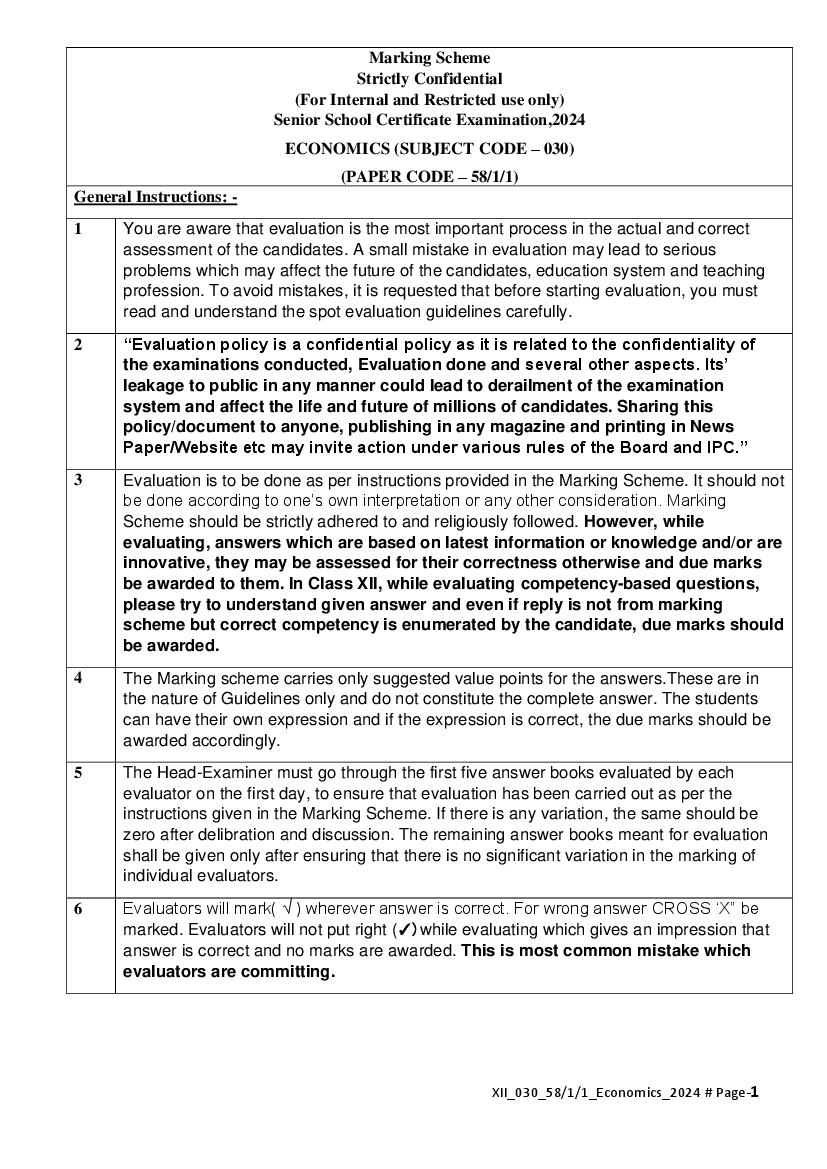
Strictly Confidential
(For Internal and Restricted use only)
Senior School Certificate Examination,2024
ECONOMICS (SUBJECT CODE – 030)
(PAPER CODE – 58/1/1)
General Instructions: -
1 You are aware that evaluation is the most important process in the actual and correct
assessment of the candidates. A small mistake in evaluation may lead to serious
problems which may affect the future of the candidates, education system and teaching
profession. To avoid mistakes, it is requested that before starting evaluation, you must
read and understand the spot evaluation guidelines carefully.
2 “Evaluation policy is a confidential policy as it is related to the confidentiality of
the examinations conducted, Evaluation done and several other aspects. Its’
leakage to public in any manner could lead to derailment of the examination
system and affect the life and future of millions of candidates. Sharing this
policy/document to anyone, publishing in any magazine and printing in News
Paper/Website etc may invite action under various rules of the Board and IPC.”
3 Evaluation is to be done as per instructions provided in the Marking Scheme. It should not
be done according to one’s own interpretation or any other consideration. Marking
Scheme should be strictly adhered to and religiously followed. However, while
evaluating, answers which are based on latest information or knowledge and/or are
innovative, they may be assessed for their correctness otherwise and due marks
be awarded to them. In Class XII, while evaluating competency-based questions,
please try to understand given answer and even if reply is not from marking
scheme but correct competency is enumerated by the candidate, due marks should
be awarded.
4 The Marking scheme carries only suggested value points for the answers.These are in
the nature of Guidelines only and do not constitute the complete answer. The students
can have their own expression and if the expression is correct, the due marks should be
awarded accordingly.
5 The Head-Examiner must go through the first five answer books evaluated by each
evaluator on the first day, to ensure that evaluation has been carried out as per the
instructions given in the Marking Scheme. If there is any variation, the same should be
zero after delibration and discussion. The remaining answer books meant for evaluation
shall be given only after ensuring that there is no significant variation in the marking of
individual evaluators.
6 Evaluators will mark( √ ) wherever answer is correct. For wrong answer CROSS ‘X” be
marked. Evaluators will not put right (✓)while evaluating which gives an impression that
answer is correct and no marks are awarded. This is most common mistake which
evaluators are committing.
XII_030_58/1/1_Economics_2024 # Page-1
Page 2
awarded for different parts of the question should then be totaled up and written in the
left-hand margin and encircled. This may be followed strictly.
8 If a question does not have any parts, marks must be awarded in the left-hand margin
and encircled. This may also be followed strictly.
9 If a student has attempted an extra question, answer of the question deserving more
marks should be retained and the other answer scored out with a note “Extra Question”.
10 No marks to be deducted for the cumulative effect of an error. It should be penalized only
once.
11 A full scale of marks 80 has to be used. Please do not hesitate to award full marks if the
answer deserves it.
12 Every examiner has to necessarily do evaluation work for full working hours i.e., 8 hours
every day and evaluate 20 answer books per day in main subjects and 25 answer books
per day in other subjects (Details are given in Spot Guidelines).
13 Ensure that you do not make the following common types of errors committed by the
Examiner in the past:- Giving more marks for an answer than assigned to it.
● Wrong totaling of marks awarded on an answer.
● Wrong transfer of marks from the inside pages of the answer book to the title page.
● Wrong question wise totaling on the title page.
● Leaving answer or part thereof unassessed in an answer book.
● Wrong totaling of marks of the two columns on the title page.
● Wrong grand total.
● Marks in words and figures not tallying/not same.
● Wrong transfer of marks from the answer book to online award list.
● Answers marked as correct, but marks not awarded. (Ensure that the right tick mark is
correctly and clearly indicated. It should merely be a line. Same is with the X for
incorrect answer.)
● Half or a part of answer marked correct and the rest as wrong, but no marks awarded.
14 While evaluating the answer books if the answer is found to be totally incorrect, it should
be marked as cross (X) and awarded zero (0)Marks.
15 Any un assessed portion, non-carrying over of marks to the title page, or totaling error
detected by the candidate shall damage the prestige of all the personnel engaged in the
evaluation work as also of the Board. Hence, in order to uphold the prestige of all
concerned, it is again reiterated that the instructions be followed meticulously and
judiciously.
16 The Examiners should acquaint themselves with the guidelines given in the “Guidelines
for spot Evaluation” before starting the actual evaluation.
17 Every Examiner shall also ensure that all the answers are evaluated, marks carried over
to the title page, correctly totaled and written in figures and words.
18 The candidates are entitled to obtain photocopy of the Answer Book on request on
payment of the prescribed processing fee. All Examiners/Additional Head
Examiners/Head Examiners are once again reminded that they must ensure that
evaluation is carried out strictly as per value points for each answer as given in the
Marking Scheme.
XII_030_58/1/1_Economics_2024 # Page-2
Page 3
Senior Secondary School Examination 2024
ECONOMICS (Subject Code–030)
[Paper Code : 58/1/1]
Maximum Marks: 80
Q. Marks
EXPECTED ANSWER / VALUE POINTS
No.
SECTION -A
(Macro Economics)
1. Read the following statements carefully:
Statement 1: If in an economy the level of income increases (∆Y), it will always
proportionately increase the level of consumption (∆C).
Statement 2: Marginal Propensity to Consume (MPC) and Marginal Propensity to Save
(MPS) are always equal to each other.
In the light of the given statements, choose the correct alternative from the following:
(A) Statement 1 is true and Statement 2 is false.
(B) Statement 1 is false and Statement 2 is true.
(C) Both Statements 1 and 2 are true.
(D) Both Statements 1 and 2 are false.
Ans. (D) Both Statements 1 and 2 are false. 1
2. Identify the correct equation from the following:
(A) GDPMP = NNPFC + Depreciation
(B) NDPFC = NNPFC + Net Indirect Taxes
(C) GNPMP = GDPMP + Net Factor Income from Abroad
(D) NNPFC = NDPMP + Depreciation
Ans. (C) GNPMP = GDPMP + Net Factor Income from Abroad 1
3. Read the following statements - Assertion (A) and Reason (R). Choose the correct alternative
given below:
Assertion (A): Full employment situation refers to absence of involuntary unemployment.
Reason (R): Under full employment situation, all the willing and able bodied people get
employment at the prevailing wage rate.
Alternatives:
(A) Both Assertion (A) and Reason (R) are true and Reason (R) is the correct explanation of
Assertion (A).
(B) Both Assertion (A) and Reason (R) are true, but Reason (R) is not the correct explanation
of Assertion (A).
(C) Assertion (A) is true, but Reason (R) is false.
(D) Assertion (A) is false, but Reason (R) is true.
Ans. (A) Both Assertion (A) and Reason (R) are true and Reason (R) is the correct 1
explanation of Assertion (A).
4. “As per the National Stock Exchange (NSE) data, dated 9th June, 2023, there was a net selling
off worth ₹ 309 crore by Foreign Institutional Investors (FIIs) over the period of one month
i.e., 9th May, 2023 - 9th June, 2023.”
The above mentioned transactions will be recorded on __________ side of ___________
account of Balance of Payments of India. (Choose the correct alternative to fill in the blanks)
(A) Debit, Current (B) Credit, Capital
(C) Credit, Current (D) Debit, Capital
Ans. (D) Debit, Capital 1
XII_030_58/1/1_Economics_2024 # Page-3
Page 4
(i) It is measured at a point of time.
(ii) It does not include stock of money held by the government.
(iii) It is always the currency in the hands of the Central Bank of a nation.
Alternatives:
(A) (i) and (ii) (B) (ii) and (iii)
(C) (ii) only (D) (iii) only
Ans. (D) (iii) only 1
6. Total consumption expenditure by households under Keynesian Economics is a combination
of ______ and ______. (Choose the correct alternative to fill in the blanks)
(A) Autonomous Consumption, Autonomous Investments
(B) Autonomous Investments, Induced Consumption
(C) Induced Investments, Autonomous Investments
(D) Autonomous Consumption, Induced Consumption
Ans. (D) Autonomous Consumption, Induced Consumption 1
7. Find the missing figures and choose the correct alternative:
Round Deposits Loans (80%) Reserve Ratio
(20%)
I 5000 4000 ..(i)..
II 4000 ..(ii).. 800
… … … …
… … … …
Total ..(iii).. ..(iv).. 5000
Alternatives:
(A) 1000, 800, 20000, 25000
(B) 5000, 3200, 25000, 20000
(C) 1000, 3200, 25000, 20000
(D) 1000, 800, 20000, 25000
Ans. (C) 1000, 3200, 25000, 20000 1
8. Surplus in Balance of Payments (BOP) refers to the excess of ___________.
(Choose the correct alternative to fill in the blank)
(A) Autonomous payments over Autonomous receipts
(B) Current Account payments over Autonomous receipts
(C) Capital Account receipts over Capital Account payments
(D) Autonomous receipts over Autonomous payments
Ans. (D) Autonomous receipts over Autonomous payments 1
9. Suppose for a hypothetical economy:
C = 100 + 0·75Y (where C = Consumption and Y = Income)
I0 = 400 (I0 = Autonomous Investment)
Value of Investment Multiplier (K) would be ____________.
(Choose the correct alternative to fill in the blank)
(A) 5 (B) 4
(C) 6 (D) 3
Ans. (B) 4 1
10. Suppose, the Balance of Trade of an imaginary economy shows a favourable balance of ₹
500 crore. The values of merchandise exports are ₹ 1200 crore and transfer payments are
₹400 crore. The value of merchandise imports would be ₹ __________ crore.
(Choose the correct alternative to fill in the blank)
XII_030_58/1/1_Economics_2024 # Page-4
Page 5
(B) 750
(C) 700
(D) 900
Ans. (C) 700 1
11. On the basis of the data given below for an imaginary economy, estimate the value of Net
(a) Domestic Product at Factor Cost (NDPFC):
S.No. Items Amount
(in ₹crore)
(i) Gross Domestic Fixed Capital Formation 200
(ii) Exports 50
(iii) Government Final Consumption Expenditure 320
(iv) Consumption of Fixed Capital 35
(v) Household Final Consumption Expenditure 470
(vi) Inventory Investment (Net) (-)40
(vii) Imports 60
(viii) Net Indirect Taxes 50
(ix) Net Factor Income from Abroad 20
Ans. Net Domestic Product at Factor Cost (NDPFC) = (v)+(iii)+(i)+(vi)+(ii-vii)-(iv)-(viii) 1½
=470+320+200+(-40)+(50-60)-35-50 1
= ₹ 855 crore ½
OR 3
(b) Elaborate the concept of Externalities with the help of suitable example.
(i) Ans. Externalities refer to benefits/harms which are caused by one entity to another 1½
without being paid/ penalised for it.
For example: Newly developed public park ½
(Any other relevant example to be awarded marks)
(ii) Define Operating Surplus.
Factor income earned in the form of rent, royalties, interest and profits are together 1
called ‘Operating Surplus’.
3
12. Distinguish between fixed exchange rate system and flexible exchange rate system.
Ans. Under the Fixed Exchange Rate System, the foreign exchange rate is fixed by the 1½
government. This exchange rate system helps in maintaining stability in the value of the
domestic currency vis-à-vis foreign currencies.
Whereas;
Under the Flexible Exchange Rate System, the foreign exchange rate is determined by 1½
the interaction of market forces of demand and supply. Flexible exchange rate keeps
fluctuating according to the demand and supply.
3
13. Complete the following table. Construct/Express the Consumption function at ₹ 200 crore
(a) level of income.
Income (Y) Savings Average Propensity to Marginal Propensity to
(in ₹ Crore) (in ₹ Crore) Consume (APC) Save (MPS)
0 (-) 30 - -
100 ……. 1 …….
200 ……. 0.85 …….
300 ……. 0.8 …….
XII_030_58/1/1_Economics_2024 # Page-5
Page 6
Income (Y) Saving Average Propensity to Marginal Propensity
(in ₹ Crore) (in ₹ Crore) Consume (APC) to Save (MPS)
0 (-) 30 - -
100 0 1 0.3 ½x6
200 30 0.85 0.3 =3
300 60 0.8 0.3
Consumption function, C = 𝒄̅ + bY
C = 30 + 0.7Y 1
(Alternate answer for which marks may be awarded-Consumption at ₹ 200 crore level of income = ₹ 170)
Working Note:
At an income level of ₹ 200 crore, Marginal Propensity to Save (MPS) = 0.3 and
Marginal Propensity to Consume (MPC) = 1- MPS ⇒1- 0.3 = 0.7
(Marks not to be deducted if working note is not given)
OR 4
(b)(a) “In an economy, ex-ante Aggregate Supply is less than ex-ante Aggregate Demand.”
(b) Explain its impact on the level of output, income and employment.
Ans. In an economy, if ex-ante Aggregate Supply is less than ex-ante Aggregate
Demand, it implies that households are planning to consume more than what the firms 4
expected them to. This will lead to an unintended fall in inventories. To restore the
desired level of inventories, producers may plan to expand production. As a result, there
may be an increase in the level of output, employment and income in the economy.
(To be marked as a whole)
14. Justify the following statements with valid arguments:
(a) The Central Bank is the sole currency issuing authority of an economy.
Ans. The Central Bank has the sole authority for issuing currency in the economy. This 2
ensures uniformity in the issue of currency and it gives the Central Bank control over
the money supply in the economy.
(b) Money serves as a measure of standard of deferred payments.
Ans. Deferred payments are contracted to be made at some future date. Money
facilitates such transactions of borrowing and lending. Hence, money serves as a 2
standard of deferred payments.
4
15. Read the following text carefully from ‘The Economic Times’ dated 8 June, 2023:
th
The Reserve Bank of India’s (RBI’s) rate setting panel unanimously decided to keep the
benchmark lending rate unchanged at 6·5%. The committee voted to remain focused on the
withdrawal of accommodating monetary policy.
On the basis of given text and common understanding, answer the following questions:
(a) Identify and discuss the economic issue indicated in the above text.
Ans. Inflation in the economy may be the economic issue indicated in the above text. 1
The situation of excess demand may be the underlying cause behind the decision taken 1
by the Reserve Bank of India (RBI) to keep the benchmark lending rate unchanged at
6·5%. (Any other valid economic issue may be awarded marks)
XII_030_58/1/1_Economics_2024 # Page-6
Page 7
decreased the said rate.
Ans. If the rate setting panel would have decreased the benchmark lending rate, the
commercial banks may reduce their lending rates. Consequently, it may encourage the 2
borrowings by the general public leading to an increase in the money supply in the
economy.
4
16. Classify the following as Revenue receipts or Capital receipts. Give valid arguments in
(a) support of your answer:
(i) Interest received on loan.
(ii) Disinvestment receipts from the sale of a government company.
(iii) Financial assistance by the Government of USA for promoting girl education in India.
Ans.
(i) Interest received on loan is a revenue receipt because it neither creates any liability 2
nor causes a reduction in assets of the government.
(ii) Disinvestment receipts from sale of a government company are capital receipts as it 2
causes a reduction in assets of the government.
(iii) Financial assistance by the Government of USA for promoting girl education in 2
India is a revenue receipt as it neither creates any liability nor causes a reduction in
assets of the government.
OR 6
(b) Study the following chart carefully and analyse the changing trends in the government
(i) expenditure on:
(I) Transport
(II) Rural Development
Ans. As indicated in the given chart:
(I) Transport: The expenditure on transport accounted for ₹ 3.32 lakh crore in the year 2
2021-22. In the year 2022-23, a Revenue expenditure of ₹ 3.90 lakh crore was allocated
for this sector. Out of the total budget expenditure of the year 2023-24, ₹ 5.17 lakh crore
was allocated to transport.
(II) Rural Development: In the year 2021-22, the expenditure on rural development 2
accounted for ₹ 2.29 lakh crore. In the year 2022-23, of the total revenue expenditure ₹
2.43 lakh crore was allocated for rural development. ₹ 2.38 lakh crore was allocated for
the development of rural sector from the total budget expenditure in the year 2023-24.
(ii) Distinguish between ‘fiscal deficit’ and ‘revenue deficit’.
Ans. Fiscal deficit refers to excess of the government’s total expenditure over its total 1
receipts excluding borrowing for a fiscal year.
XII_030_58/1/1_Economics_2024 # Page-7
Page 8
Revenue Deficit refers to the excess of government’s revenue expenditure over revenue 1
receipts for a fiscal year.
Note: The following question is for the Visually Impaired Candidates only in lieu of Q. No.
16 b (i).
Explain the stabilisation function of the Government Budget.
Ans. If an economy is facing fluctuations in income, employment and prices
(inflation/deflation), the government may push for correction of the situation using 4
budgetary (taxes/public expenditure) policies. The same may be undertaken by
working on the level of Aggregate Demand, relating to the spending decisions of
households and firms. (To be marked as a whole)
6
17. Discuss briefly the concept of circular flow of income in a two-sector model.
(a) Ans. In a two-sector economy model, households are the owners of factors of
production (Land, Labour, Capital, Entrepreneur). Firms combine these factors of
production to produce goods and services. They make factor payments (Rent, wages, 3
Interest, Profits) to households, which in turn, are spent by the households on the
consumption of final goods and services.
Thus, the income earned by the factors of production flows back to the production units
in the form of aggregate consumption expenditure. Thereby, completing the circular
flow of income. (To be marked as a whole)
(b) “Real Gross Domestic Product (GDP) is a better indicator of economic growth of a nation
as compared to the Nominal Gross Domestic Product (GDP).”
Do you agree with the given statement? Justify your answer with a valid hypothetical
numerical example.
Ans. Yes. Real Gross Domestic Product (GDP) is the money value of all the final goods
and services produced in the domestic territory of an economy, measured at base year
prices. Whereas, Nominal Gross Domestic Product (GDP) is money value of all the final 3
goods and services produced in the domestic territory of an economy, measured at
current year prices.
For example:
Year Price Output Real GDP Nominal GDP
(in ₹) (in units) (P0Q1) (P1Q1)
2010 10 100 1,000 1,000
(Base Year)
2011 15 100 1,000 1,500
(Current Year)
Real GDP is a better indicator to make comparison in terms of physical output and it
eliminates the effect of price change.
(To be marked as a whole)
6
SECTION – B
(Indian Economic Development)
18. Read the following statements- Assertion (A) and Reason (R). Choose the correct alternative
given below:
Assertion (A): The excessive regulation of permit license raj prevented certain private firms
from becoming fairly competitive.
XII_030_58/1/1_Economics_2024 # Page-8
Page 9
improving the product quality and international competitiveness.
Alternatives:
(A) Both Assertion (A) and Reason (R) are true and Reason (R) is the correct explanation of
Assertion (A).
(B) Both Assertion (A) and Reason (R) are true, but Reason (R) is not the correct explanation
of Assertion (A).
(C) Assertion (A) is true, but Reason (R) is false.
(D) Assertion (A) is false, but Reason (R) is true.
Ans. (A) Both Assertion (A) and Reason (R) are true and Reason (R) is the correct 1
explanation of Assertion (A).
19. In the decade of the 1970s, Pakistan nationalized its ________ industries.
(Choose the correct alternative to fill in the blank)
(A) Medical infrastructure
(B) Consumer goods
(C) Capital goods
(D) Foreign trade
Ans. (C) Capital goods 1
20. Read the following statements carefully:
Statement 1: Under the colonial rule, basic infrastructure (like railways, post and telegraph
etc.) was developed.
Statement 2: The real motive behind the infrastructural development in India was to
strengthen the British interests.
In the light of the given statements, choose the correct alternative from the following:
(A) Statement 1 is true and Statement 2 is false.
(B) Statement 1 is false and Statement 2 is true.
(C) Both Statements 1 and 2 are true.
(D) Both Statements 1 and 2 are false.
Ans. (C) Both Statements 1 and 2 are true. 1
21. Identify which of the following alternatives indicate the incorrect components combination
of Agriculture Marketing System:
(A) Assembling, Storage, Processing, Packaging
(B) Production, Assembling, Processing, Grading
(C) Assembling, Processing, Packaging, Transportation
(D) Processing, Packaging, Grading, Distribution
Ans. (B) Production, Assembling, Processing, Grading 1
22. Read the following statements- Assertion (A) and Reason (R). Choose the correct alternative
given below:
Assertion (A): World Trade Organization (WTO) is expected to establish the rule-based
trading regime, to avoid unilaterally placed arbitrary restrictions by member nations.
Reason (R): It is imperative to enlarge world production and ensure optimum utilization of
world resources along with environmental protection.
Alternatives:
(A) Both Assertion (A) and Reason (R) are true and Reason (R) is the correct explanation of
Assertion (A).
(B) Both Assertion (A) and Reason (R) are true, but Reason (R) is not the correct explanation
of Assertion (A).
(C) Assertion (A) is true, but Reason (R) is false.
(D) Assertion (A) is false, but Reason (R) is true.
XII_030_58/1/1_Economics_2024 # Page-9
Page 10
explanation of Assertion (A).
23. Read the following statements- Assertion (A) and Reason (R). Choose the correct alternative
given below:
Assertion (A): China has used the market mechanism to create additional social and economic
opportunities for its citizens.
Reason (R): Social infrastructure creation by the government has brought positive results in
human development indicators in China.
Alternatives:
(A) Both Assertion (A) and Reason (R) are true and Reason (R) is the correct explanation of
Assertion (A).
(B) Both Assertion (A) and Reason (R) are true, but Reason (R) is not the correct explanation
of Assertion (A).
(C) Assertion (A) is true, but Reason (R) is false.
(D) Assertion (A) is false, but Reason (R) is true.
Ans. (B) Both Assertion (A) and Reason (R) are true, but Reason (R) is not the correct 1
explanation of Assertion (A)
24. Identify from the following alternatives the incorrect objectives of regulated agriculture
market:
(i) To make the marketing system efficient and effective for farmers to get best price of their
products.
(ii) To discourage improvement of marketing infrastructure for farmers.
(iii) To prevent exploitation of farmers.
(iv) To discourage farmers from improving quality and quantity of their produce.
Alternatives:
(A) (i) and (ii) (B) (i) and (iii)
(C) (iii) and (iv) (D) (ii) and (iv)
Ans. (D) (ii) and (iv) 1
25. Economic reforms were introduced in India and Pakistan in the years ___________ and
____________, respectively. (Choose the correct alternative to fill in the blanks)
(A) 1988, 1978 (B) 1991, 1978
(C) 1991, 1988 (D) 1981, 1991
Ans. (C ) 1991, 1988 1
26. Read the following statements carefully:
Statement 1: As per the National Sample Survey Organization (NSSO), unemployment is a
situation in which all those who, owing to lack of work, are not working, but are seeking
work from prospective employers. They express their willingness/availability to work under
the prevailing conditions of work and remuneration.
Statement 2: Disguised Unemployment is generally a massive problem in a highly populated
country like India.
In the light of the given statements, choose the correct alternative from the following :
(A) Statement 1 is true and Statement 2 is false.
(B) Statement 1 is false and Statement 2 is true.
(C) Both Statements 1 and 2 are true.
(D) Both Statements 1 and 2 are false.
Ans. (C) Both Statements 1 and 2 are true. 1
27. Identify which of the following is not a member nation of G20:
XII_030_58/1/1_Economics_2024 # Page-10
Page 11
(B) Australia
(C) Bangladesh
(D) Argentina
Ans. (C) Bangladesh 1
28. “During the colonial period, the occupational structure showed lopsided movements.”
(a) Do you agree with the given statement? Justify your answer with valid arguments.
Ans. Yes. The occupational structure during the colonial period showed lopsided
movements as:
● Parts of Madras Presidency, Bombay and Bengal witnessed a decline in the 3
dependence of the workforce on the agricultural sector with a commensurate increase
in the manufacturing and the services sectors.
● There had been an increase in the share of workforce in agriculture in states such as
Orissa, Rajasthan and Punjab. (To be marked as a whole)
OR
(b) Elaborate the reasons owing to which the private sector was regulated under the Industrial
Policy Resolution, 1956.
Ans. The Industrial Policy Resolution, 1956 regulated the private sector through a
system of licenses. This policy aimed at achieving regional equality. The government
made it relatively easier to obtain an industrial license, for industrial units to be 3
established in economically backward areas.
Moreover, to ensure judicious use of resources owned by the private sector, licenses
were needed for expanding/diversifying output by existing industrial units.
(To be marked as a whole)
29. “In India, National Education Policy 2020 has stressed a lot on in-service training of the
teachers.”
(i) Identify the source of Human Capital Formation (HCF) indicated in the aforesaid statement.
Ans. On-the-job training is the source of Human Capital Formation (HCF) indicated in 1
the aforesaid statement.
(ii) Elaborate the likely impacts of this source on the economic development of India.
Ans. On-the-job training has become an integral part of work environment in the recent
times as it enhances the productive capacity of employees. It enables employees to 2
develop skills and adapt to modern technologies. As a result of on-the-job training, an
employee is likely to contribute more productively leading to the economic development
of India.
3
30. “United Nations Department of Economic and Social Affairs indicated that India has
(a) overtaken China as the world’s most populous country in the month of April 2023.”
Explain the consequences of one-child policy adopted by China in the 1970s.
Ans. In the late 1970’s, owing to the population explosion and the subsequent socio-
economic concerns, China adopted the One Child Norm. This policy led to a sharp 2
decline in its population growth rate. In addition to this, the sex ratio declined.
Furthermore, the implementation of the one-child norm led to increase in the
population of elderly people in proportion to young people.
(b) Discuss the impacts of Special Economic Zones (SEZs) on the economic growth of China.
Ans. The setting up of Special Economic Zones (SEZs) in China led to a substantial
increase in foreign direct investment in the economy. With the massive inflow of foreign 2
XII_030_58/1/1_Economics_2024 # Page-11
Page 12
to the rapid economic growth of China.
4
31. State and elaborate whether the following statements are true or false, with valid arguments:
(a) In the recent past, the Government of India has taken crucial steps, like Jan-Dhan Yojana,
(i) for efficient allocation of financial resources.
Ans. True, the Government of India has implemented schemes like Jan-Dhan Yojana,
which has promoted thrift habits and efficient allocation of financial resources. The 2
formal banking system has been benefitted by mobilization of a substantial amount
under this yojana.
(ii) Worker-population ratio is an indicator, used for analyzing the employment situation in a
nation.
Ans. True. Worker-population ratio is useful in knowing the proportion of population
that is actively contributing to the production of goods and services of a country. If the 2
ratio is higher, it means that a greater number of people are employed and vice versa.
OR 4
(b) Elaborate the need to promote women’s education in India.
(i) Ans. Promoting women's education in India is imperative for societal progress and
gender equality. Educated women contribute to economic growth by entering the 3
workforce and making informed decisions about their lives. Moreover, educating
women makes a favourable impact on the fertility rate and health care of women and
children. Hence, investing in women's education uplifts communities and drives
sustainable development across India.
(ii) Mention any two examples of diversification activities in the non-agro processing industries.
Ans. Examples of diversification activities in the non-agro processing industries are:
• Fisheries ½
• Animal Husbandry ½
(Any other valid example to be awarded marks)
4
32. State any two problems faced by farmers during the initial years of organic farming.
(a) Ans. In the initial years of organic farming, farmers used to face a lot of problems
such as:
• Yields from organic farming are relatively less. ½
• Inadequate infrastructure. ½
(Any other valid problem to be awarded marks)
(b) “In the current situation, Information Technology plays a vital role in achieving food security
in a nation like India.”
Justify the given statement.
Ans. In India, Information Technology (IT) plays a crucial role as government can
predict areas of food insecurity and vulnerability using appropriate information and 3
software tools. It helps in disseminating information regarding emerging technologies
and their applications, prices, weather and soil conditions for growing different crops
etc. Hence, IT plays a vital role in achieving sustainable development and food security
in a nation like India. (To be marked as a whole)
4
33. “Under the liberalisation measures taken by the Government of India, regulation of industrial
(a) sector was extremely crucial.”
(i) Reject or support the given statement with valid arguments.
XII_030_58/1/1_Economics_2024 # Page-12
Page 13
restrictions on the industrial sector.
Industrial licensing was abolished for almost all except for three industries. Many 3
goods produced by Small Scale Industries were dereserved. In most of the industries,
market has been allowed to determine the prices independently. This was necessitated
by the slower industrial growth rate under the pre-reform period.
(To be marked as a whole)
(ii) “Despite the implementation of Green Revolution, 65 per cent of India’s population
continued to be engaged in the agriculture sector till the 1990s.”
Justify the given statement with valid explanation.
Ans. Some economists argue that Green Revolution did not make much impact on the
occupational structure of the country, as 65% of India’s population continued to find 3
its livelihood in agriculture. A major reason for this fairly large proportion of
population in agricultural sector as the industrial and service sector were not able to
absorb the people working in the agricultural sector. (To be marked as a whole)
OR 6
(b) “Every coin has two sides - debate over farm subsidies is one such classic example of the
(i) same.”
Justify the given statement with two arguments each in favour of and against the
continuation of the farm subsidies.
Ans. The introduction of farm subsidies had been an opinionated step taken by the
Government of India.
Arguments in favour of continuing farm subsidies:
• Eliminating subsidies may increase inequalities of income between rich and poor 1
farmers.
• Most farmers (small and marginal) may not be able to afford expensive agricultural 1
inputs without subsidies.
Arguments against farm subsidies:
• It is often argued that farm subsidies have helped the fertilizer industry much more 1
than helping the needy farmers.
• Economists argue that subsidies are a huge burden on government’s finances. 1
(ii) State the importance of “Growth with equity” as the objective of Indian economic planning.
Ans. For a nation, both growth of Gross Domestic Product (GDP) and equity in
distribution of income are equally important. Growth refers to an increase in a
country’s capacity to produce goods and services. Equity refers to reductions in 2
inequality of income and wealth.
Growth with equity ensures that the fruits of economic development are enjoyed by all
sections of society equitably. Hence, achieving equitable growth is an important
objective that was taken into consideration in the Indian economic planning.
6
34. Read the following text carefully:
In order to address two major environmental concerns in India, viz. water and air pollution,
the government set up the Central Pollution Control Board (CPCB) in 1974. This was
followed by states establishing their own state level boards to address all the environmental
concerns. They investigate, collect and disseminate information relating to water, air and
land pollution, lay down standards for sewage/trade effluent and emissions. These boards
XII_030_58/1/1_Economics_2024 # Page-13
Page 14
by prevention, control and abatement of water pollution, and improve the quality of air and
to prevent, control or abate air pollution in the country.
These boards also carry out and sponsor investigation and research relating to problems of
water and air pollution and for their prevention, control or abatement. They organize, through
mass media, a comprehensive mass awareness programme for the same. The PCBs prepare
manuals, codes and guidelines relating to treatment and disposal of sewage and trade
effluents.
They assess the air quality through regulation of industries. In fact, state boards, through
their district level officials, periodically inspect every industry under their jurisdiction to
assess the adequacy of treatment measures provided to treat the effluent and gaseous
emissions. It also provides background air quality data needed for industrial siting and town
planning.
The pollution control boards collect, collate and disseminate technical and statistical data
relating to water pollution. They monitor the quality of water in 125 rivers (including the
tributaries), wells, lakes, creeks, ponds, tanks, drains and canals.
On the basis of the given text and common understanding, answer the following questions:
(a) State any two concerns owing to which the Central Pollution Control Board (CPCB) was
established.
Ans. Two major concerns owing to which the Central Pollution Control Board (CPCB)
was established were:
• Water pollution ½
• Air pollution (Or any other valid concern to be awarded marks) ½
(b) Explain any two functions performed by the Central Pollution Control Board (CPCB).
Ans. Functions performed by the Central Pollution Control Board (CPCB) are:
• It investigates, collects and disseminates information relating to water, air and 1
land pollution.
• It lays down standards for sewage/trade effluent and emissions. 1
(Any other valid function to be awarded marks)
(c) Elaborate any two strategies to ensure sustainable development as adopted by India.
Ans. In order to ensure sustainable development, following strategies are adopted by
India:
• Use of wind energy: In areas where speed of wind is usually high, windmills are used 1½
to generate electricity without any adverse impact on the environment.
• Use of solar energy: With the help of photovoltaic cells/solar panels, solar energy
can be converted into electricity. This technology is extremely useful for remote areas 1½
and is free from pollution. (Any other valid strategy to be awarded marks)
6
***
XII_030_58/1/1_Economics_2024 # Page-14
Document Details
| Board / Org | CBSE |
| Exam | Class 12 |
| Type | Solution |
| Pages | 14 |
| Updated | 30 Apr 2026 |