CBSE Class 12 Question Paper 2022 Solution Agriculture
Finished viewing? Save it for later —
Download CBSE Class 12 Question Paper 2022 Solution Agriculture (PDF · 8 pages)About CBSE Class 12 Question Paper 2022 Solution Agriculture
CBSE Class 12 Question Paper 2022 Solution Agriculture is available here for free download. Published by CBSE for Class 12, this solution can be viewed online or downloaded as a PDF (8 pages). Candidates preparing for Class 12 can use CBSE Class 12 Question Paper 2022 Solution Agriculture to understand the exam pattern, the type of questions asked, and the overall difficulty level.
Frequently Asked Questions
How can I download CBSE Class 12 Question Paper 2022 Solution Agriculture?
Open this page and click the Download button to save CBSE Class 12 Question Paper 2022 Solution Agriculture as a PDF. It is completely free on AglaSem Docs.
Is CBSE Class 12 Question Paper 2022 Solution Agriculture free to download?
Yes. CBSE Class 12 Question Paper 2022 Solution Agriculture can be viewed online and downloaded as a PDF free of cost on AglaSem Docs.
How many pages does CBSE Class 12 Question Paper 2022 Solution Agriculture have?
CBSE Class 12 Question Paper 2022 Solution Agriculture contains 8 pages, which you can read online or download together as a single PDF.
Where can I find more Class 12 study material?
You can find more Class 12 question papers, sample papers, syllabus, and answer keys on AglaSem Docs.
CBSE Class 12 Question Paper 2022 Solution Agriculture – Text
Read the full text of this solution below — useful to quickly search, copy and reference the content online without downloading the PDF.
📄 View text version (8 pages)
Page 1
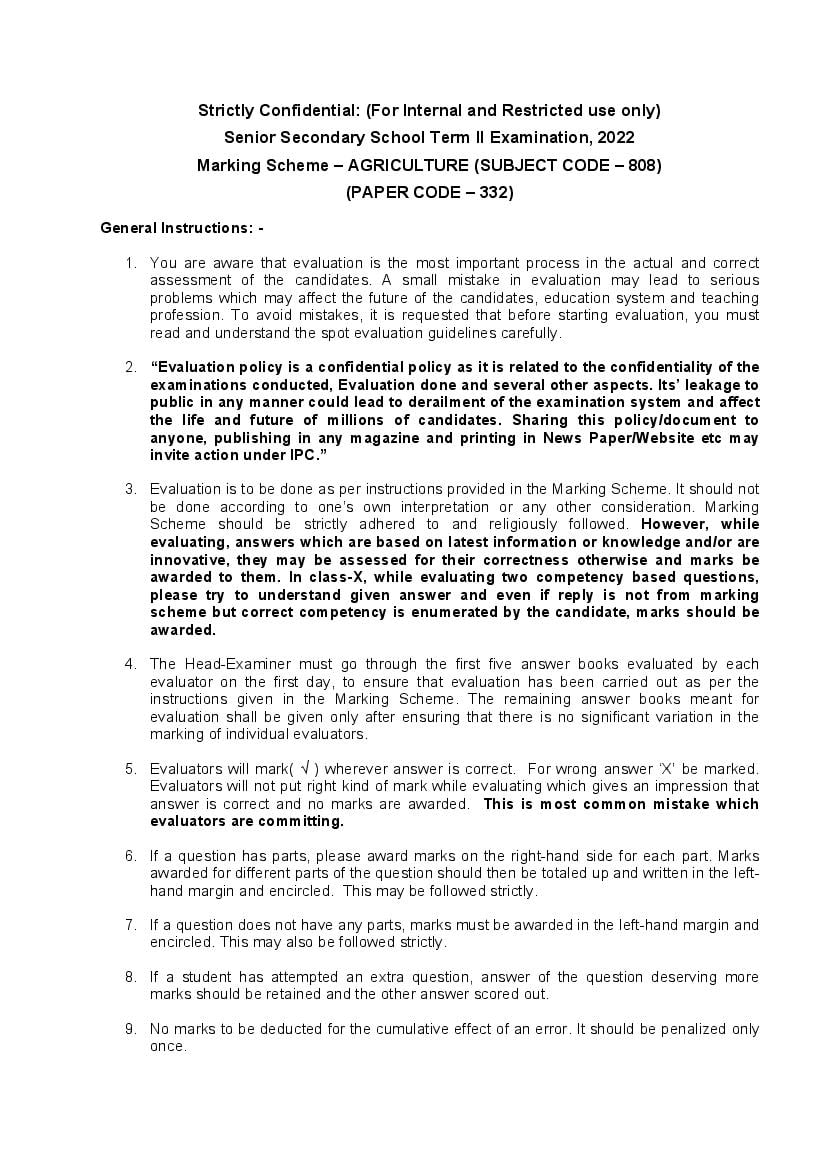
Senior Secondary School Term II Examination, 2022
Marking Scheme – AGRICULTURE (SUBJECT CODE – 808)
(PAPER CODE – 332)
General Instructions: -
1. You are aware that evaluation is the most important process in the actual and correct
assessment of the candidates. A small mistake in evaluation may lead to serious
problems which may affect the future of the candidates, education system and teaching
profession. To avoid mistakes, it is requested that before starting evaluation, you must
read and understand the spot evaluation guidelines carefully.
2. “Evaluation policy is a confidential policy as it is related to the confidentiality of the
examinations conducted, Evaluation done and several other aspects. Its’ leakage to
public in any manner could lead to derailment of the examination system and affect
the life and future of millions of candidates. Sharing this policy/document to
anyone, publishing in any magazine and printing in News Paper/Website etc may
invite action under IPC.”
3. Evaluation is to be done as per instructions provided in the Marking Scheme. It should not
be done according to one’s own interpretation or any other consideration. Marking
Scheme should be strictly adhered to and religiously followed. However, while
evaluating, answers which are based on latest information or knowledge and/or are
innovative, they may be assessed for their correctness otherwise and marks be
awarded to them. In class-X, while evaluating two competency based questions,
please try to understand given answer and even if reply is not from marking
scheme but correct competency is enumerated by the candidate, marks should be
awarded.
4. The Head-Examiner must go through the first five answer books evaluated by each
evaluator on the first day, to ensure that evaluation has been carried out as per the
instructions given in the Marking Scheme. The remaining answer books meant for
evaluation shall be given only after ensuring that there is no significant variation in the
marking of individual evaluators.
5. Evaluators will mark( √ ) wherever answer is correct. For wrong answer ‘X’ be marked.
Evaluators will not put right kind of mark while evaluating which gives an impression that
answer is correct and no marks are awarded. This is most common mistake which
evaluators are committing.
6. If a question has parts, please award marks on the right-hand side for each part. Marks
awarded for different parts of the question should then be totaled up and written in the left-
hand margin and encircled. This may be followed strictly.
7. If a question does not have any parts, marks must be awarded in the left-hand margin and
encircled. This may also be followed strictly.
8. If a student has attempted an extra question, answer of the question deserving more
marks should be retained and the other answer scored out.
9. No marks to be deducted for the cumulative effect of an error. It should be penalized only
once.
Page 2
be used. Please do not hesitate to award full marks if the answer deserves it.
11. Every examiner has to necessarily do evaluation work for full working hours i.e. 8 hours
every day and evaluate 30 answer books per day in main subjects and 35 answer books
per day in other subjects (Details are given in Spot Guidelines).This is in view of the
reduced syllabus and number of questions in question paper.
12. Ensure that you do not make the following common types of errors committed by the
Examiner in the past:-
Leaving answer or part thereof unassessed in an answer book.
Giving more marks for an answer than assigned to it.
Wrong totaling of marks awarded on a reply.
Wrong transfer of marks from the inside pages of the answer book to the title page.
Wrong question wise totaling on the title page.
Wrong totaling of marks of the two columns on the title page.
Wrong grand total.
Marks in words and figures not tallying.
Wrong transfer of marks from the answer book to online award list.
Answers marked as correct, but marks not awarded. (Ensure that the right tick mark is
correctly and clearly indicated. It should merely be a line. Same is with the X for
incorrect answer.)
Half or a part of answer marked correct and the rest as wrong, but no marks awarded.
13. While evaluating the answer books if the answer is found to be totally incorrect, it should
be marked as cross (X) and awarded zero (0)Marks.
14. Any unassessed portion, non-carrying over of marks to the title page, or totaling error
detected by the candidate shall damage the prestige of all the personnel engaged in the
evaluation work as also of the Board. Hence, in order to uphold the prestige of all
concerned, it is again reiterated that the instructions be followed meticulously and
judiciously.
15. The Examiners should acquaint themselves with the guidelines given in the Guidelines for
spot Evaluation before starting the actual evaluation.
16. Every Examiner shall also ensure that all the answers are evaluated, marks carried over
to the title page, correctly totaled and written in figures and words.
17. The Board permits candidates to obtain photocopy of the Answer Book on request in an
RTI application and also separately as a part of the re-evaluation process on payment of
the processing charges.
Page 3
Senior Secondary School Examination TERM–II, 2022
AGRICULTURE (Subject Code–808)
[ Paper Code : 332 ]
Maximum Marks : 35
SECTION A (3 + 2 = 5 marks)
Answer any 03 questions out of the given 04 questions 1x3=3
Q 1. It is working towards developing competencies of people in the domain of 1
renewable energy, sustainable development and waste management.
Q 2. A green collar worker is one who is employed in the environmental sectors of the 1
economy or deals with the environment work/profession
Q 3. A startup is a company that is in the first stage of its operations 1
Q 4. Characteristics of entrepreneurship (Any one) 1
(i) It is an economic activity done to create, develop and maintain a profit-
oriented organisation.
(ii) It begins with identifying an opportunity as a potential to sell and make
profit in the market.
(iii) It deals with optimisation in utilisation of resources.
(iv) It is the ability of an enterprise and an entrepreneur to take risks.
Answer any 01 question out of the given 02 questions 2x1=2
Q 5. Green jobs contribute in protecting the environment and reducing carbon 2
footprint by (Any two)
1. Increase the efficiency of energy and raw material.
2. Reduce greenhouse gas emissions.
3. Control waste and pollution.
4. Protect and restore ecosystems.
5. Support adaptation to the effects of climate change.
Page 1 of 6
Page 4
gain capital for their business (Any two)
1) Government Mudra Yojana — https:// mudralsans.in/
2) Credit Guarantee Scheme — https://www.cgtmse.in/
3) Stand-Up India Scheme — https://www. standupmitra.in/
SECTION B (5 + 8 + 9 = 22 marks)
Answer any 05 questions out of the given 07 questions 1x5=5
Q 7. Only fungus or Paddy straw mushroom 1
Q 8. Queen 1
Q 9. Sugar 1
Q 10. The plants that yield nectar and pollen are collectively termed as bee pasturage. 1
Q 11. 8-15% 1
Q 12. When rose outer one/two petals start unfurling 1
Q 13. Canning 1
Answer any 04 questions out of the given 06 questions 2x4=8
Q 14. Bio pesticide (Any two) 2
i. Microbial pesticides
ii. Plant-incorporated-protectants (PIPs)
iii. Biochemical pesticides
iv. Botanical pesticides (Neem, Chrysanthemum, tobacco, etc)
v. Biotic agents (parasitoids and predators)
Q 15. Main advantages of bee-keeping: 2
a) Provides honey - a valuable nutritional food
b) Provides bees wax - which has many uses in industry
Page 2 of 6
Page 5
d) Provides additional income
e) Royal jelly and bee sting are used in medicine
Q 16. Pre-cooling reduces respiration rate and decreases breakdown of nutritional and 2
other stored material in the steam, leaves and petals, delays bud opening and
flower senescence. It also delays rapid water loss and decreases flower sensitivity
to ethylene. It removes field heat from flowers
Q 17. Bee dance communicate to the other worker bees the distance and the direction 2
of the food source. It is a language of bee dance
Q 18. Four methods of drying foods through application of heat 2
i. Sun drying
ii. Mechanical drying, thermal drying or equipments
iii. Vacuum drying
iv. Freeze drying
Q 19. Fruits suitable for making preserves (murabbas) (Any four) 2
Aonla, beal, apple, pear, mango, cherry, karonda, strawberry, pineapple, papaya, etc.
Answer any 03 questions out of the given 05 questions 3x3=9
There is no standard method for making chili pickles. It varies from region to
Q 20. 3
region. Therefore, marks should be given to the students for writing down
the steps for making pickles.
Q 21. There are three methods of pasteurization 3
i. Bottle or holding pasteurization
ii. Overflow method
iii. Flash pasteurization
Q 22. Three types of nursery beds 3
1) Flat bed
2) Raised bed
3) Deep bed
1) Flat Bed: - It is prepared where, there annual rain fall is very less or water
Page 3 of 6
Page 6
2) Raised bed:- It is most popular nursery bed. It is prepared where, there
annual rainfall is very high or water drainage system is poor. It is generally
made 15cm high from ground level.
3) Deep bed:- It is prepare in temperate zone for protection of cold wind. It is
generally made 25-30cm deep from ground level.
Q 23. Three main principles: 3
a) Prevention / delay the microbial decomposition of the food
i. By keeping out the micro organisms –Asepsis
ii. By Removal of micro organisms –Filtration
iii. By Hindering the growth and activity of micro organisms -Anaerobic
condition
iv. By killing the micro organisms -Exposing at high temperature
b) Prevention / delay the shelf decomposition of the food.
i. By destruction or inactivate the enzyme – Blanching
ii. Prevention / delay the non-enzymatic chemical reactions –
Antioxidant
c) Prevention of damage by insects, animals, mechanical causes etc
Q 24 Various methods for judging the end point during fruit jam preparation 3
a) Sheet or Flake test
b) Temperature:- 1050C.
c) TSS:- 68-70%
d) Weight Test:- If total weight of jam is 1.5 time is more than sugar weight,
jam is prepared.
SECTION C
(COMPETENCY BASED QUESTIONS)
Answer any 02 questions out of the given 03 questions 2x4=8
Q 25. Packaging significantly reduces losses and maintains their freshness 4
succulence and quality for longer period. Packaging also provides protection
Page 4 of 6
Page 7
pathological deterioration during storage, transportation and marketing.
Characteristics of packaging (Description on following point)
The characteristics of packaging are to contain, to protect, to
communicate and to market the product.
a) To contain produce
b) To protect produce against
c) To communicate
d) To market the product
e) Increases shelf life
Q 26. Nursery is a place where seedling, saplings or any other planting materials are 4
raised, propagated, multiplied and sold out for planting.
Importance of Nursery: (Any three)
i. The young seedlings require special attention during the first few weeks
after germination. It is easier and economical to look after the young and
tender seedlings growing in plant nursery bed in a small area than in a
large permanent site.
ii. Majority of fruit crops are propagated by vegetative means. The
propagules require special skill and aftercare before transferring them in
the main field. In a controlled condition in plant nursery all these can be
provided successfully by skilled labour.
iii. Cuttings are best rooted and grafts are hardened in the mist house
chamber.
iv. Direct sowing method is not so successful in several crops when compared
with transplanting of seedlings raised in plant nursery.
v. Plants hardened in the plant nursery are preferred for causality
replacement in orchards
vi. Besides these, raising of seedlings or saplings in nursery provides more
time for preplanting operations/preparations.
vii. Seasoning/hardening of seedlings against natural odds is only possible in
plant nursery.
viii. Genuine variety of plants obtained
ix. Disease free plants are obtained.
Q 27. Process of obtaining the raw silk from silkworm cocoon 4
(i) The cocoons are first treated by steam or dry heat to kill the insect inside.
Page 5 of 6
Page 8
emergence of the moth.
(ii) Next, the cocoons are soaked in hot water (95° -97°C) for 10-15 minutes to soften
the gum that binds the silk threads together. This process is called cooking.
(iii) The “cooked” cocoons are kept in hot water and the loose ends of the
thread are caught by hand.
(iv) Threads from several cocoons are wound together on wheels
(“charakhas”) to for the reels of raw silk
(v) Only about one-half of the silk of each cocoon is reelable, the remainder is
used as a silk waste and formed into spun silk.
(vi) Raw silk thus obtained is processed through several treatments to give it
the final shape.
Page 6 of 6
Document Details
| Board / Org | CBSE |
| Exam | Class 12 |
| Type | Solution |
| Pages | 8 |
| Updated | 30 Apr 2026 |