CBSE Class 12 Question Paper 2022 Solution Accountancy
Finished viewing? Save it for later —
Download CBSE Class 12 Question Paper 2022 Solution Accountancy (PDF · 15 pages)About CBSE Class 12 Question Paper 2022 Solution Accountancy
CBSE Class 12 Question Paper 2022 Solution Accountancy is available here for free download. Published by CBSE for Class 12, this solution can be viewed online or downloaded as a PDF (15 pages). Candidates preparing for Class 12 can use CBSE Class 12 Question Paper 2022 Solution Accountancy to understand the exam pattern, the type of questions asked, and the overall difficulty level.
Frequently Asked Questions
How can I download CBSE Class 12 Question Paper 2022 Solution Accountancy?
Open this page and click the Download button to save CBSE Class 12 Question Paper 2022 Solution Accountancy as a PDF. It is completely free on AglaSem Docs.
Is CBSE Class 12 Question Paper 2022 Solution Accountancy free to download?
Yes. CBSE Class 12 Question Paper 2022 Solution Accountancy can be viewed online and downloaded as a PDF free of cost on AglaSem Docs.
How many pages does CBSE Class 12 Question Paper 2022 Solution Accountancy have?
CBSE Class 12 Question Paper 2022 Solution Accountancy contains 15 pages, which you can read online or download together as a single PDF.
Where can I find more Class 12 study material?
You can find more Class 12 question papers, sample papers, syllabus, and answer keys on AglaSem Docs.
CBSE Class 12 Question Paper 2022 Solution Accountancy – Text
Read the full text of this solution below — useful to quickly search, copy and reference the content online without downloading the PDF.
📄 View text version (15 pages)
Page 1
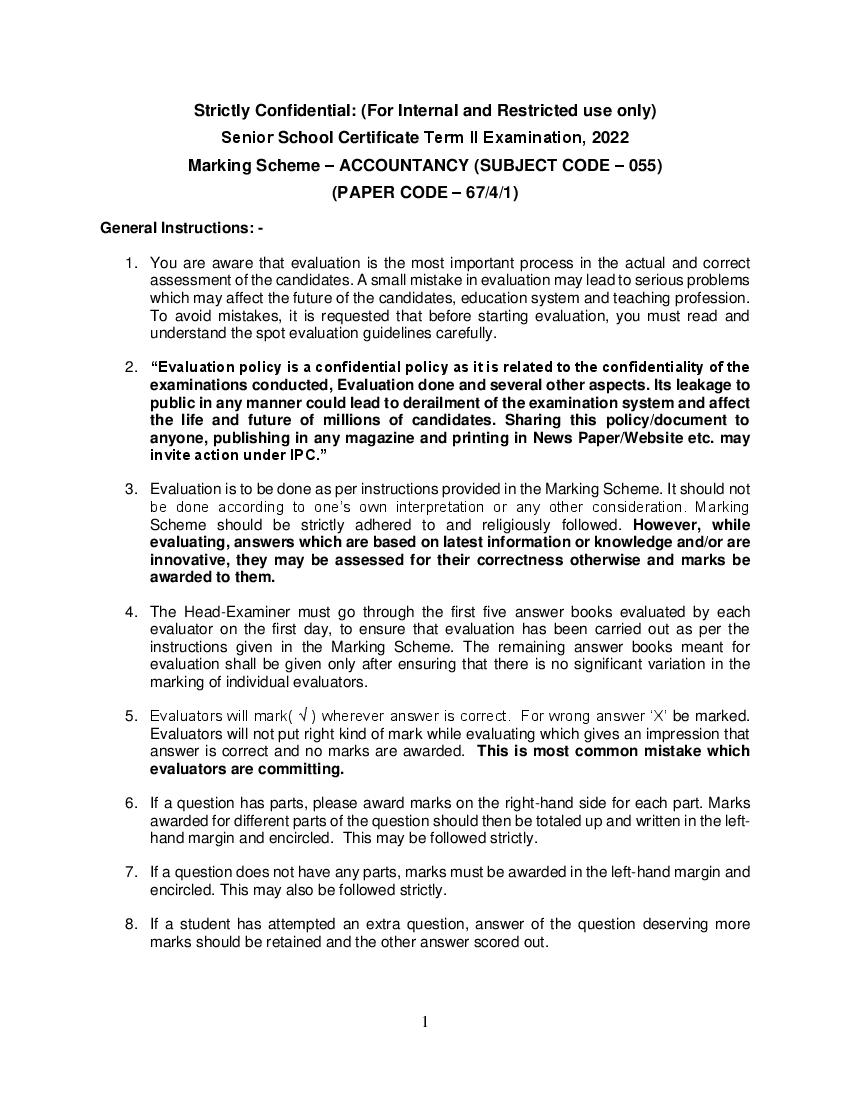
Senior School Certificate Term II Examination, 2022
Marking Scheme – ACCOUNTANCY (SUBJECT CODE – 055)
(PAPER CODE – 67/4/1)
General Instructions: -
1. You are aware that evaluation is the most important process in the actual and correct
assessment of the candidates. A small mistake in evaluation may lead to serious problems
which may affect the future of the candidates, education system and teaching profession.
To avoid mistakes, it is requested that before starting evaluation, you must read and
understand the spot evaluation guidelines carefully.
2. “Evaluation policy is a confidential policy as it is related to the confidentiality of the
examinations conducted, Evaluation done and several other aspects. Its leakage to
public in any manner could lead to derailment of the examination system and affect
the life and future of millions of candidates. Sharing this policy/document to
anyone, publishing in any magazine and printing in News Paper/Website etc. may
invite action under IPC.”
3. Evaluation is to be done as per instructions provided in the Marking Scheme. It should not
be done according to one’s own interpretation or any other consideration. Marking
Scheme should be strictly adhered to and religiously followed. However, while
evaluating, answers which are based on latest information or knowledge and/or are
innovative, they may be assessed for their correctness otherwise and marks be
awarded to them.
4. The Head-Examiner must go through the first five answer books evaluated by each
evaluator on the first day, to ensure that evaluation has been carried out as per the
instructions given in the Marking Scheme. The remaining answer books meant for
evaluation shall be given only after ensuring that there is no significant variation in the
marking of individual evaluators.
5. Evaluators will mark( √ ) wherever answer is correct. For wrong answer ‘X’ be marked.
Evaluators will not put right kind of mark while evaluating which gives an impression that
answer is correct and no marks are awarded. This is most common mistake which
evaluators are committing.
6. If a question has parts, please award marks on the right-hand side for each part. Marks
awarded for different parts of the question should then be totaled up and written in the left-
hand margin and encircled. This may be followed strictly.
7. If a question does not have any parts, marks must be awarded in the left-hand margin and
encircled. This may also be followed strictly.
8. If a student has attempted an extra question, answer of the question deserving more
marks should be retained and the other answer scored out.
1
Page 2
once.
10. A full scale of 0-40 marks as given in Question Paper has to be used. Please do not
hesitate to award full marks if the answer deserves it.
11. Every examiner has to necessarily do evaluation work for full working hours i.e. 8 hours
every day and evaluate 30 answer books per day in main subjects and 35 answer books
per day in other subjects (Details are given in Spot Guidelines).This is in view of the
reduced syllabus and number of questions in question paper.
12. Ensure that you do not make the following common types of errors committed by the
Examiner in the past:-
• Leaving answer or part thereof unassessed in an answer book.
• Giving more marks for an answer than assigned to it.
• Wrong totaling of marks awarded on a reply.
• Wrong transfer of marks from the inside pages of the answer book to the title page.
• Wrong question wise totaling on the title page.
• Wrong totaling of marks of the two columns on the title page.
• Wrong grand total.
• Marks in words and figures not tallying.
• Wrong transfer of marks from the answer book to online award list.
• Answers marked as correct, but marks not awarded. (Ensure that the right tick mark
is correctly and clearly indicated. It should not merely be a line. Same is with the X for
incorrect answer.)
• Half or a part of answer marked correct and the rest as wrong, but no marks awarded.
13. While evaluating the answer books if the answer is found to be totally incorrect, it should
be marked as cross (X) and awarded zero (0) Marks.
14. Any unassessed portion, non-carrying over of marks to the title page, or totaling error
detected by the candidate shall damage the prestige of all the personnel engaged in the
evaluation work as also of the Board. Hence, in order to uphold the prestige of all
concerned, it is again reiterated that the instructions be followed meticulously and
judiciously.
15. The Examiners should acquaint themselves with the guidelines given in the Guidelines for
spot Evaluation before starting the actual evaluation.
16. Every Examiner shall also ensure that all the answers are evaluated, marks carried over
to the title page, correctly totaled and written in figures and words.
17. The Board permits candidates to obtain photocopy of the Answer Book on request in an
RTI application and also separately as a part of the re-evaluation process on payment of
the processing charges.
2
Page 3
Senior School Certificate Examination TERM–II, 2022
ACCOUNTANCY (Subject Code–055)
[ Paper Code : 67/4/1 ]
Maximum Marks : 40
PART A
(Accounting for Not-for-Profit Organisations, Partnership Firms and Companies)
Q. No. EXPECTED ANSWERS / VALUE POINTS Marks
1. Q. Distinguish between…………………………………………….
Basis Receipts and Payments Income and
Account Expenditure Account
Depreciation Depreciation is not included in Income and expenditure
receipts and payments a/c. account does include
Depreciation.
Opening balance Balance in the beginning There is no opening
1×2
represents cash in hand/cash at balance.
bank/ bank overdraft in the =
beginning. 2marks
2. Q. P,Q and R were partners……………………
Given ratio of P Q R
3 : 4 : 1
New Share = Old Share + Gain
P’s old share = 3/8
P’s gain = 1/3 of R’s share
= 1/3 x 1/8 = 1/24 ½
P’s new share = 3/8 + 1/24 = 10/24 ½
Q’s old share = 4/8
Q’s gain = 2/3 of R’s share
½
= 2/3 x 1/8 = 2/24
½
Q’s new share = 4/8 + 2/24 = 14/24
New profit sharing ratio of P:Q =
10:14 i.e. 5:7 2 marks
3
Page 4
Ans. For correct
months
A’s share = 7/10 ; A died on 30th June, 2022 +
Previous year’s profits = ₹16,00,000 1 mark for
correct
profit of A
A’s share of profits in the year of death =16,00,000 x 3/12 x 7/10 =
2 marks
= ₹ 2,80,000
4. (a) Q. Young Cricket Club……………………………
SUBSCRIPTIONS ACCOUNT
Amount Particulars Amount
Particulars
(₹) (₹)
Balance b/d / 16,000
Balance b/d /Subscriptions 8,000
outstanding at the beg. Subscriptions in advance
at the beginning
Income & Expenditure A/c Bank A/c 48,000
(Bal. figure) 62,000
Balance c/d /Subscriptions 12,000 ½x6
Balance c/d / Subscriptions outstanding at the end =
in advance at the end 6,000 3 marks
76,000 76,000
OR
(b) Q. During the year ended……………………………
Calculation of amount of stationery to be debited to Income expenditure A/c
for the year ended 31st March, 2022
(₹)
Amount paid for stationery during the year 37,000 ½
Less: Creditors for stationery as on 1.4.21 (9,000) ½
Add: Creditors for stationery as on 31.3.22 6,000 ½
Stationery purchased during the year 34,000
Add: Stock of stationery as on 1.4.21 7,000 ½
Less: Stock of stationery on 31.3.22 (11,000) ½
Amount of stationery to be debited to Income & Expenditure A/c 30,000 ½
=
Alternate Solution : 4 (b)
3 marks
4
Page 5
Amount Particulars Amount
Particulars
(₹) (₹)
Cash A/c / Bank A/c 37,000 Balance b/d 9,000
- Payment to creditors Stock of stationery A/c – 34,000
credit purchases
Balance c/d 6,000 1½
(Balancing figure)
43,000 43,000
STOCK OF STATTIONERY A/c
Amount Particulars Amount
Particulars
(₹) (₹)
Balance b/d 7,000 Income & Expenditure 30,000
Creditors for stationery A/c – Stationery
A/c – credit purchases 34,000 consumed (Balancing
1½
figure)
Balance c/d 11,000 =
41,000 41,000 3 marks
5. Q. Mohan, Girdhari and Shyam……………………………
(i) Amount agreed to be paid to Girdhari = 5,90,000
Less : Balance of his capital A/c = 5,00,000 1½
Girdhari’s share of Goodwill (3/9) = 90,000
Goodwill of the firm = 90,000 x 9/3 = ₹ 2,70,000
(ii) Journal
L Debit Amount Credit Amount
Date Particulars
F (₹) (₹)
2022 Mohan’s Capital A/c Dr. 60,000
March Shyam’s Capital A/c Dr. 30,000
31 1½
To Girdhari’s capital A/c 90,000
(Girdhari’s share of goodwill
adjusted to remaining partners’ =3
capital accounts in gaining ratio) marks
5
Page 6
X Ltd.
Journal
Date Particulars L.F. Debit Credit
Amount Amount
(₹) (₹)
Bank A/c Dr. 6,00,000
To Debenture Application A/c 6,00,000 ½
(Application money received on
30,000 debentures @ ₹ 20 each)
Debenture Application A/c Dr. 6,00,000
To 8% Debentures account 3,00,000
To Debenture Allotment A/c 2,00,000
To Bank A/c 1,00,000 1
(Debenture Application money for
15,000 debentures transferred to
Debentures A/c, excess credited to
Debenture Allotment A/c and
money refunded on rejected
applications)
Debenture Allotment A/c Dr. 12,00,000
12,00,000 ½
To 8% Debentures A/c
(Allotment money due on 15,000
debentures @ ₹ 80 each)
Bank A/c Dr. 10,00,000
10,00,000 1
To Debenture Allotment A/c
=
(Balance of allotment money
3 marks
received on 15,000 debentures)
OR
(b) Q. Pass necessary journal……………………………
6
Page 7
Journal
Date Particulars L.F. Debit Credit
Amount Amount
(₹) (₹)
Bank A/c Dr. 5,00,000
To Debenture Application & 5,00,000
½
Allotment A/c
(Application money received on
5,000 debentures @ ₹ 100 each)
Debenture Application &
Allotment A/c Dr. 5,00,000
Loss on issue of Debentures A/c Dr. 50,000
To 9% Debentures A/c 5,00,000
To Premium on redemption of 1
Debentures A/c 50,000
(Issue of 5,000 9% debentures
redeemable at 10% premium)
(ii) Z Ltd.
Journal
Date Particulars L.F. Debit Credit
Amount Amount
(₹) (₹)
Bank A/c Dr. 4,05,000
To Debenture Application & 4,05,000
½
Allotment A/c
(Application money received on
4,500 debentures @ ₹ 90 each)
Debenture Application & 4,05,000
Allotment A/c Dr.
Loss on issue of Debentures A/c Dr. 67,500
To 9% Debentures A/c 4,50,000
To Premium on redemption of
Debentures A/c 22,500 1
(Issue of 4,500 debentures of ₹ 100 each =
at 10% discount redeemable at 5%
premium) 3 marks
7. Q. From the following………………………………………
7
Page 8
for the year ended 31st March, 2022
Dr. Cr.
Amount Amount
Expenditure Income
(₹) (₹)
Loss on sale of furniture 1,500 Subscription (1,500 x 150) 2,25,000
Salaries 49,000 Sale of old newspapers 2,500
Printing & Stationery 32,000 Hire of Ground 47,500
½ x 10 =
Secretary’s Honorarium 25,000 Locker Rent 11,500
5 marks
Excess of income over 1,83,050 Interest on Fixed Deposit 4,050
expenditure - Surplus -- Accrued
2,90,550 2,90,550
8. (a) Q. X, Y and Z were partners………………………………….
Revaluation A/c
Dr. Cr.
Particulars Amount Particulars Amount
(₹) (₹)
Provision for doubtful Land & Building a/c 15,000
debts A/c 6,000 Partners’ Capital
Stock A/c 5,000 A/cs - loss on
Furniture A/c 2,000 Revaluation :
Machinery A/c 20,000 X 5,400
½x6
Y 5,400 =
Z 7,200 18,000 3
33,000 33,000
Dr. Z’s Capital A/c Cr.
Particulars Amount Particulars Amount
(₹) (₹)
½x4
Revaluation A/c (loss) 7,200 Balance B/d 4,00,000
=2
Z’s Loan A/c 4,72,800 General Reserve A/c 80,000
(Balancing figure) 3+2
=
4,80,000 4,80,000 5 marks
OR
(a) Q. Sonu, Monu and Ashu were partners…………………………
8
Page 9
Amounts Amount
Particulars Particulars
(₹) (₹)
Sundry Assets : Sundry Liabilities :
Stock 25,000 Creditors 35,000 1mark
Debtors 20,000 Provision for D/D for
Furniture 15,000 2,000 37,000 transfer
1,40,000 Bank A/c : of assets
Land & Bldg. 80,000
+ 1 mark
Bank A/c (Creditors) 34,300 Land & Bldg.
for assets
85,000
Monu ’s Capital A/c Furniture 6,000
realized
2,000 in cash +
(Remuneration) Debtors 20,000 1,11,000
½ x 6 for
Ashu’s Capital A/c remaini
(Unrecorded Asset) 3,000 ng
entries
Sonu’s Capital i.e.
A/c - Stock 25,000
2+3
Loss Transferred to :
Sonu’s Capital A/c150
=
Monu’s Capital A/c 90 5 marks
Ashu’s Capital A/c 60 300
1,76,300 1,76,300
9
Page 10
B Ltd.
Journal
L.F. Debit Credit
Date Particulars Amount Amount
(₹) (₹)
Building A/c Dr. 3,00,000
Plant A/c Dr. 2,80,000
Furniture A/c Dr. 20,000
Goodwill A/c Dr. 30,000
1½
To C Ltd. 6,30,000
( Purchase of assets from C Ltd.)
(a) C Ltd. Dr.
To 9% Debentures A/c 6,30,000
( Issue of 6,300 debentures at par) 6,30,000 ½
(b) C Ltd. Dr.
To 9% Debentures A/c 6,30,000
To Securities Premium 5,04,000 1½
Reserve A/c
(Issue of 5,040 debentures of ₹100 1,26,000
each at premium of 25%)
(c) C Ltd. Dr.
Discount / Loss on issue of 6,30,000 1½
debentures A/c Dr. =
To 9% Debentures A/c 70,000
7,00,000 5 marks
(Issue of 7,000 debentures of ₹100
each at a discount of 10%)
PART B
OPTION 1
(Analysis of Financial Statements)
10. Q. What is meant by ‘Cash Flow Statement’?
Cash Flow Statement is a statement that provides information about historical 2
changes in Cash and Cash Equivalents of an enterprise by classifying cash
flows into Operating, Investing and Financing activities. marks
10
Page 11
Shree Ltd.
Common Size Balance Sheet as at 31st March, 2021 and 2022
% age of % age of
Particulars
31-3-2021 31-3-2022 total assets total assets
(₹) (₹) 31-3-2021 31-3-2022
(I) EQUITY and
LIABILITIES
1. Shareholder’s funds
Share Capital 30,00,000 40,00,000 60 50 ½
2.Non-Current
Liabilities
LongTerm
Borrowings 15,00,000 20,00,000 30 25 ½
3. Current Liabilities
Trade Payables 5,00,000 20,00,000 10 25
½
Total 50,00,000 80,00,000 100 100
(II) ASSETS:
1. Non-Current Assets
Fixed Assets –
(a) Tangible assets 15,00,000 20,00,000 30 25
(b) Intangible ½
Assets 10,00,000 40,00,000 20 50 ½
2. Current Assets
Inventories 25,00,000 20,00,000 50 25 ½
Total 50,00,000 80,00,000 100 100 =3
marks
OR
11
Page 12
Jeevan Ltd.
Comparative Balance Sheet as at 31st March, 2021 and 2022
31-3-2021 31-3-2022 Absolute Percentage
Particulars
(₹) (₹) Change Change
(₹) (%)
(I) Equity & Liabilities:
1. Shareholder’s funds
Share Capital 10,00,000 15,00,000 5,00,000 50 ½
2. Non-Current Liabilities
Long-Term Borrowings 5,00,000 6,00,000 1,00,000 20 ½
3. Current Liabilities
Trade Payables 10,00,000 12,00,000 2,00,000 20 ½
Total 25,00,000 33,00,000 8,00,000 32
(II) Assets :
1. Non-Current Assets
Fixed Assets –
(a) Tangible assets 12,00,000 18,00,000 6,00,000 50 ½
(b) Intangible 8,00,000 10,00,000 2,00,000 25 ½
Assets
2. Current Assets
Cash &
5,00,000 5,00,000 ---- ----
Cash Equivalents
Total 25,00,000 33,00,000 8,00,000 32 ½
=3
marks
12. Q. From the following Balance Sheet of Anuradha Ltd…………………..
12
Page 13
Calculation of ‘Cash Flows from operating activities’
for the year ended 31st March, 2022
Amount
Particulars
(₹)
Net profit before tax and extraordinary items 50,000 ½
Add : Non-cash and Non-operating expenses :
Depreciation 24,000 ½
Patents written off 2,000 ½
Interest on debentures 3,000 ½
Operating profit before working capital changes 79,000 ½
Add : Decrease in CA and increase in CL :
Inventories 24,000 ½
Less : Increase in CA and decrease in CL :
Trade Receivables (10,000) ½
Trade payables (25,000) ½
Outstanding Rent (25,000) ½
Cash generated from operations 43,000
Less : Tax paid --------
Net Cash Flow from operating activities 43,000 ½
=5
marks
PART—B
Option—II
( Computerized Accounting )
10. Q. Give the meaning of the term ‘Password Security’
Password is widely accepted Security control to access the data. Only the 2
authorized person can access the data. Any user who does not know the password marks
can not retrieve information from the system. It ensures data integrity.
13
Page 14
Components of Payroll from sub-head ‘Deduction’ are : (any three)
(i) Professional Tax – (applicable in some states ) [PT]
It is a statutory deduction according to the legislature of the State Govt.
(ii) Provident Fund –
It is a Statutory deduction, as a part of social security. It is decided by
the Govt. under the Provident Fund Act and is computed as percentage
of basic pay + dearness pay, if applicable.
(iii) Tax Deduction at Source – (TDS)
It is a statutory deduction which is deducted monthly towards income
tax liability of an employee. It is essentially an apportionment of yearly
income tax liability over 12 months. 1x3
(iv) Recovery of Loan Instalment (Loan) =
Any amount signified by the employee for deduction on account of any
loan taken up by him/her. 3 marks
(v) Any other deduction –
It may include any other deduction not included above such as Recovery
of “Advance against salary” , deduction on account of “Food Grain
advance”, “Festival advance” etc.
OR
(b) Q. Explain the three types of ‘Vouchers’
Ans. The three types of Vouchers are :
(i) Memo Voucher :
Memo Voucher is a non accounting voucher. It does not affect
accounts of the user. These entries are stated / recorded in a separate
register, but not as a part of ledger.
(ii) Post Dated Voucher :
Some accounting software allows the user to enter the voucher for
future transactions which are usually as the previous ones.
1x3
(iii) User Defined Voucher :
In accounting software, there are 23 predefined vouchers. It allows the =
user to define or create new accounting or inventory vouchers as per 3 marks
the requirement.
12. Q. Name and explain the accounts involved in Accounts Group ‘Profit and
Loss Account’
Accounts involved in Accounts Group ‘Profit and Loss Account’ are :
(i) Sales Account :
For different sales accounts, the segregation is based on tax slabs ot types of
sales. This also becomes a simple mechanism for preparation of tax returns.
14
Page 15
etc. of even sales returns account may be opened.
(ii) Purchase Account :
This is similar to sales accounts, except for the purpose of the transactions.
(iii) Direct Income : [Income Direct]:
All trade income accounts fall under sales accounts. This group may be
used for accounts like servicing contract charges that follow after the sales
of equipment.
(iv) Indirect Income ( Income Indirect) :
These are the miscellaneous non-sale income accounts, e.g. rent received
and interest received.
(v) Direct Expenses ( Expenses Direct) :
These accounts determine the Gross Profit of the company.
(vi) Indirect Expenses (Expenses Indirect) : 5 marks
These include all other administrative, selling or non- direct expenses.
***
15
Document Details
| Board / Org | CBSE |
| Exam | Class 12 |
| Type | Solution |
| Pages | 15 |
| Updated | 30 Apr 2026 |