CBSE Class 12 Question Paper 2022 Solution Biotechnology
Finished viewing? Save it for later —
Download CBSE Class 12 Question Paper 2022 Solution Biotechnology (PDF · 7 pages)About CBSE Class 12 Question Paper 2022 Solution Biotechnology
CBSE Class 12 Question Paper 2022 Solution Biotechnology is available here for free download. Published by CBSE for Class 12, this solution can be viewed online or downloaded as a PDF (7 pages). Candidates preparing for Class 12 can use CBSE Class 12 Question Paper 2022 Solution Biotechnology to understand the exam pattern, the type of questions asked, and the overall difficulty level.
Frequently Asked Questions
How can I download CBSE Class 12 Question Paper 2022 Solution Biotechnology?
Open this page and click the Download button to save CBSE Class 12 Question Paper 2022 Solution Biotechnology as a PDF. It is completely free on AglaSem Docs.
Is CBSE Class 12 Question Paper 2022 Solution Biotechnology free to download?
Yes. CBSE Class 12 Question Paper 2022 Solution Biotechnology can be viewed online and downloaded as a PDF free of cost on AglaSem Docs.
How many pages does CBSE Class 12 Question Paper 2022 Solution Biotechnology have?
CBSE Class 12 Question Paper 2022 Solution Biotechnology contains 7 pages, which you can read online or download together as a single PDF.
Where can I find more Class 12 study material?
You can find more Class 12 question papers, sample papers, syllabus, and answer keys on AglaSem Docs.
CBSE Class 12 Question Paper 2022 Solution Biotechnology – Text
Read the full text of this solution below — useful to quickly search, copy and reference the content online without downloading the PDF.
📄 View text version (7 pages)
Page 1
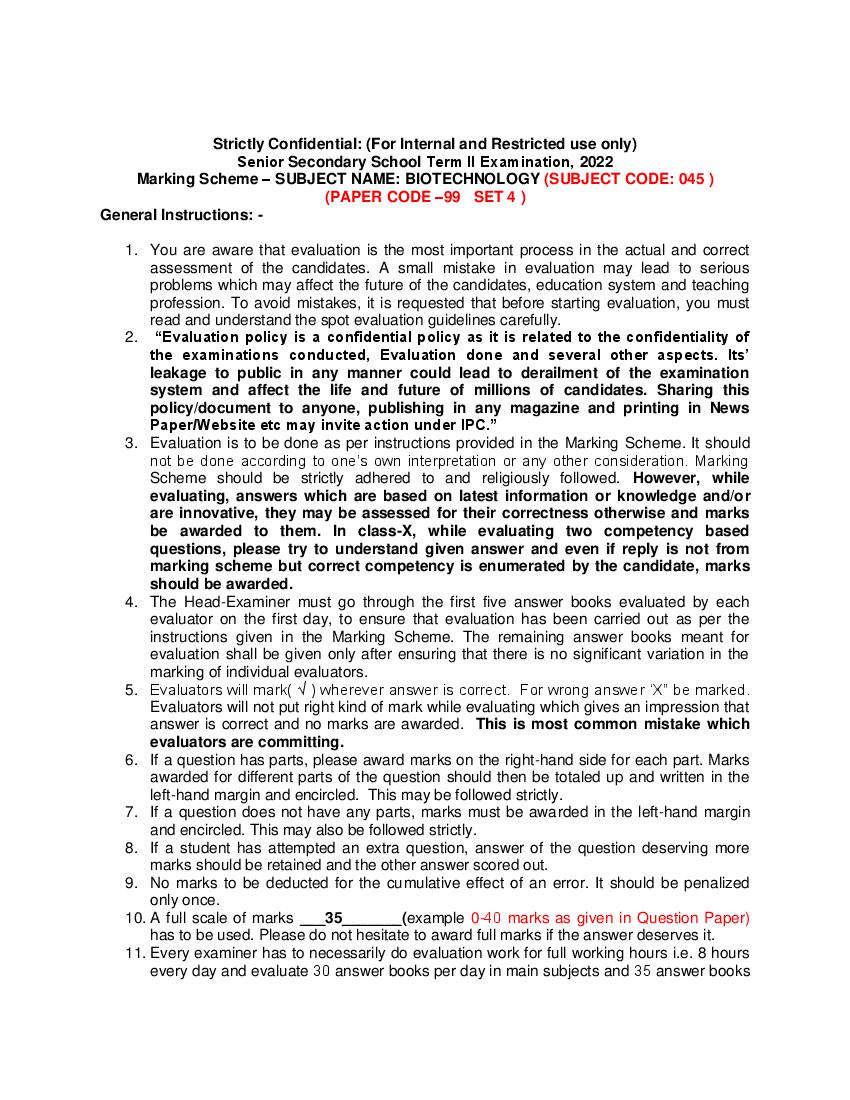
Senior Secondary School Term II Examination, 2022
Marking Scheme – SUBJECT NAME: BIOTECHNOLOGY (SUBJECT CODE: 045 )
(PAPER CODE –99 SET 4 )
General Instructions: -
1. You are aware that evaluation is the most important process in the actual and correct
assessment of the candidates. A small mistake in evaluation may lead to serious
problems which may affect the future of the candidates, education system and teaching
profession. To avoid mistakes, it is requested that before starting evaluation, you must
read and understand the spot evaluation guidelines carefully.
2. “Evaluation policy is a confidential policy as it is related to the confidentiality of
the examinations conducted, Evaluation done and several other aspects. Its’
leakage to public in any manner could lead to derailment of the examination
system and affect the life and future of millions of candidates. Sharing this
policy/document to anyone, publishing in any magazine and printing in News
Paper/Website etc may invite action under IPC.”
3. Evaluation is to be done as per instructions provided in the Marking Scheme. It should
not be done according to one’s own interpretation or any other consideration. Marking
Scheme should be strictly adhered to and religiously followed. However, while
evaluating, answers which are based on latest information or knowledge and/or
are innovative, they may be assessed for their correctness otherwise and marks
be awarded to them. In class-X, while evaluating two competency based
questions, please try to understand given answer and even if reply is not from
marking scheme but correct competency is enumerated by the candidate, marks
should be awarded.
4. The Head-Examiner must go through the first five answer books evaluated by each
evaluator on the first day, to ensure that evaluation has been carried out as per the
instructions given in the Marking Scheme. The remaining answer books meant for
evaluation shall be given only after ensuring that there is no significant variation in the
marking of individual evaluators.
5. Evaluators will mark( √ ) wherever answer is correct. For wrong answer ‘X” be marked.
Evaluators will not put right kind of mark while evaluating which gives an impression that
answer is correct and no marks are awarded. This is most common mistake which
evaluators are committing.
6. If a question has parts, please award marks on the right-hand side for each part. Marks
awarded for different parts of the question should then be totaled up and written in the
left-hand margin and encircled. This may be followed strictly.
7. If a question does not have any parts, marks must be awarded in the left-hand margin
and encircled. This may also be followed strictly.
8. If a student has attempted an extra question, answer of the question deserving more
marks should be retained and the other answer scored out.
9. No marks to be deducted for the cumulative effect of an error. It should be penalized
only once.
10. A full scale of marks ___35_______(example 0-40 marks as given in Question Paper)
has to be used. Please do not hesitate to award full marks if the answer deserves it.
11. Every examiner has to necessarily do evaluation work for full working hours i.e. 8 hours
every day and evaluate 30 answer books per day in main subjects and 35 answer books
Page 2
reduced syllabus and number of questions in question paper.
12. Ensure that you do not make the following common types of errors committed by the
Examiner in the past:-
Leaving answer or part thereof unassessed in an answer book.
Giving more marks for an answer than assigned to it.
Wrong totaling of marks awarded on a reply.
Wrong transfer of marks from the inside pages of the answer book to the title page.
Wrong question wise totaling on the title page.
Wrong totaling of marks of the two columns on the title page.
Wrong grand total.
Marks in words and figures not tallying.
Wrong transfer of marks from the answer book to online award list.
Answers marked as correct, but marks not awarded. (Ensure that the right tick mark
is correctly and clearly indicated. It should merely be a line. Same is with the X for
incorrect answer.)
Half or a part of answer marked correct and the rest as wrong, but no marks
awarded.
13. While evaluating the answer books if the answer is found to be totally incorrect, it should
be marked as cross (X) and awarded zero (0)Marks.
14. Any unassessed portion, non-carrying over of marks to the title page, or totaling error
detected by the candidate shall damage the prestige of all the personnel engaged in the
evaluation work as also of the Board. Hence, in order to uphold the prestige of all
concerned, it is again reiterated that the instructions be followed meticulously and
judiciously.
15. The Examiners should acquaint themselves with the guidelines given in the Guidelines
for spot Evaluation before starting the actual evaluation.
16. Every Examiner shall also ensure that all the answers are evaluated, marks carried over
to the title page, correctly totaled and written in figures and words.
17. The Board permits candidates to obtain photocopy of the Answer Book on request in an
RTI application and also separately as a part of the re-evaluation process on payment of
the processing charges.
Page 3
SUBJECT : BIOTECHNOLOGY THEORY (045)
TERM – II
SET 4 QP. CODE 99
SESSION: 2021-22
GENERAL INSTRUCTIONS :
a. The Marking Scheme carries suggested value points for the answers.
b. These are guidelines which constitute the complete answer.
c. The students can have their own expression and if the expression is correct
the marks be awarded accordingly.
Page 4
QP. CODE 99 TERM – II (2021-22)
SECTION – A
1 tPA degrade
Plasminogen ------- Plasmin ----- Fibrin --------------- Dissolution of blood
(Inactive precursor enzyme) clot
OR
tPA degrade 2
Plasminogen ------------- Plasmin ----- Fibrin -------- Dissolution of blood
(Inactive precursor enzyme) clot
2 Foaming denatures protein
Foaming provides hindrance to free diffusion of oxygen in the medium 1+1=2
3 (a) LOCUS LINK
Carries information on the official gene name and descriptive
information about genes.
With the help of LOCUS LINK one can access the information on
homologous genes. (Any 1)
(b) TAXONOMY BROWSER 1+1=2
Provides information on taxonomic classification of various species.
The taxonomy database has information on over 79,000 organisms.
(Any 1)
4 The gas hormone, Ethylene is involved in the regulation of fruit ripening.
Ripening of fruits can be slowed down by blocking or reducing ethylene
production. This can be achieved by introducing ethylene forming gene(s) in a 2
way that it will suppress its own expression in the crop plant.
OR
Plants have adapted to cope with abiotic stress conditions by production of stress
related osmolytes like sugars (e.g. trehalose and fructans), sugar alcohols (e.g.
mannitol) and amino acids (e.g. proline), glycine, betaine and certain proteins 2
(e.g. antifreeze proteins) (Explanation with any 2 examples )
5 Golden rice is a yellow colored genetically engineered rice which is
enriched in pro-vitamin A (beta-carotenoids).
It is developed by introducing three genes involved in the biosynthetic 1+1=2
pathway for carotenoid under the control of endosperm specific promoter,
so that the gene products (enzymes) are synthesized in the rice
endosperm.
OR
Cybrids are cytoplasmic hybrids produced through protoplast fusion in
which the genome of one partner is lost i.e., fusion of nucleated and
enucleated protoplasts of different species / Alternatively, The isolated
and purified organelles (chloroplasts or mitochondria) from one species
Page 5
(known as organelle transfer or organelle uptake). (Any 1 method)
Cytoplasmic traits :
1. Herbicide Tolerance
2. Cytoplasmic male sterility 1+½+½ = 2
(PHB, pollen formation/ suppression, leaf variegation, flower colour such as blue
rose, caffeine free coffee, blue cotton, tearless onion (Points from topic other
applications as on Pgs. 131, 132) (Any of these traits can also be considered)
6 Finite cell lines:-
Cells show limited life span, contact inhibition, density limitation, anchorage
dependence, mode of growth is monolayer, slow growth rate, doubling time is
around 24- 96 hours, normal shape of cells, number of chromosomes in cells do
not change. (Any 2) ½+½ = 1
Continuous cell lines :-
Cells show no contact inhibition, no anchorage dependence, reduced or lost
density limitation, mode of growth is either monolayer or suspension form, rapid
growth rate, doubling time is between 12 – 24 hours, more rounded shape of
cells, no of chromosomes in cells may change. (Any 2) ½+½ = 1
SECTION – B
7 (a) Regulation of pH is important for the survival of mammalian cells in culture
for :-
Maintaining appropriate ion balance
Maintaining optimal function of cellular enzymes
Optimal binding of hormones and growth factors to cell surface receptors
(Any 2) ½+½=1
(b) The interaction of CO2 derived from cells or atmosphere with water leads to a
drop in pH as described by the equation below:
H2O + CO2 ↔ H2CO3 ↔ H+ + HCO3-
The bicarbonate content of the medium neutralizes the effect of increased CO 2
according to the following equation:
NaHCO3 ----- Na+ + HCO3-
The increased HCO3 - ion drives the equation above to the left until the 2
equilibrium is reached at pH 7.4.
8 RefSeq is a curated database of mRNA and proteins of organisms like
human, mouse and rat / RefSeq is one of the several tools among the
resources for gene level sequences.
Significance: 1. Designing gene chips.
2.Describing the sequence features of human genome. 1+2=3
9 (a) The culture medium is complex because exact chemical composition is
not known.
(b) Agar is added for solidification of nutrient medium.
(c) Autoclaving at a pressure of 15 pounds psi (per square inch) for 15 – 20
minutes (at 121oC temperature). 1+1+1=3
Page 6
Sterility of the chamber
Constant temperature
Atmosphere with a fixed level of carbon dioxide (5-10% CO2)
High relative humidity
Correct osmolarity
To prevent the desiccation of culture medium (any 3) 1+1+1=3
OR
Serum is an important component of animal cell culture because it:-
Supports cell proliferation
Helps in attachment of cells to culture vessels
Is a source of peptide hormones or hormone-like growth factors that
promote healthy growth
Is a source of various amino acids, hormones, vitamins, lipids,
polyamines and salts such as calcium, chloride, ferrous, ferric, potassium 1+1=2
etc (any 2)
Antibiotics are added to culture medium to control the growth of bacterial and 1
fungal contaminants.
11 Farmers can eliminate the process of emasculation by introducing male
sterile maize plants in the field. Male sterile plants are created by
introducing a bacterial gene from Bacillus amyloliquefaciens that encodes
an enzyme barnase, which is an RNA hydrolyzing enzyme that inhibits
pollen formation. This gene is expressed specifically in the tapetal cells of
anther using tapetal-specific promoter (e g. TA29). 2
Yes / By introducing another gene from the same bacterium under the
control of TA29, whose product barstar (protein) tightly bind with RNase
so that normal pollens are formed. / By using barnase-barstar system / By 1
producing male sterile-restorer lines.
12
Diagram and correct labelings of A, B and C ½ + 1½ = 2
Artificial Seeds are produced for rapid and mass propagation of elite plant
species as well as hybrid varieties in a short time. 1
Page 7
Artificial seeds are synthetic seeds or somatic seeds. They are produced
either by encapsulating the somatic embryos in a protective covering i.e., 2
calcium alginate beads or by desiccating the somatic embryos with or
without coating.
Artificial seeds are produced for rapid and mass propagation of elite plant 1
species as well as hybrid varieties in a short time.
SECTION - C
13 (i) Extraction of metal ores / Treatment of liquid waste 1
(ii) Separation / Recovery / Isolation / Purification of metabolites from fermented
broth with or without cell disruption is known as Downstream Processing(DSP).
Less number of steps are advised:-
To achieve desired purity/ To maximize yield/ To reduce cost /To prevent ½ + ½ =1
product loss
(iii) Excipients are several ingredients which are added to pure metabolite to 1
obtain a stabilized formulation.
(iv) GRAS :- Organisms which are generally regarded as safe. These organisms
are non allergic, non toxic, non pathogenic and generally do not produce any 1
antibiotics.
(v) Biosafety issues specific in Microbial technology are:-
1. Potential of pathogenicity and infection by recombinant strains
2.Toxicity and allergy associated with the use of microbially produced
recombinant molecules.
3. Transfer of antibiotic resistant genes or to increase the environmental pool of
antibiotic resistant microorganisms
4. Problems associated with disposal of spent microbial biomass
5. Safety aspects associated with contamination, infection or mutation of process ½ + ½ =1
strains. (Any 2 or any other relevant point can be considered)
OR
(i) Turbidostat: Maintains constant cell concentration.
Chemostat: Maintains constant chemical environment 1+1=2
(ii) Fed Batch culture 1
FOR VISUALLY IMPAIRED CANDIDATES ONLY IN LIEU(ii)
Batch culture is a closed system which contains an initial limited amount of
nutrients / Batch culture shows all the usual growth phases, viz. lag, log 1
(exponential), stationary and decline.
(iii) In Continuous culture, the volume in the culture vessel
remains constant whereas in Fed-batch culture, the volume in ½+½=1
the culture vessel goes on increasing.
In Continuous culture . 1
Document Details
| Board / Org | CBSE |
| Exam | Class 12 |
| Type | Solution |
| Pages | 7 |
| Updated | 30 Apr 2026 |