CBSE Class 12 Question Paper 2024 Solution Entrepreneurship
Finished viewing? Save it for later —
Download CBSE Class 12 Question Paper 2024 Solution Entrepreneurship (PDF · 13 pages)About CBSE Class 12 Question Paper 2024 Solution Entrepreneurship
CBSE Class 12 Question Paper 2024 Solution Entrepreneurship is available here for free download. Published by CBSE for Class 12, this solution can be viewed online or downloaded as a PDF (13 pages). Candidates preparing for Class 12 can use CBSE Class 12 Question Paper 2024 Solution Entrepreneurship to understand the exam pattern, the type of questions asked, and the overall difficulty level.
Frequently Asked Questions
How can I download CBSE Class 12 Question Paper 2024 Solution Entrepreneurship?
Open this page and click the Download button to save CBSE Class 12 Question Paper 2024 Solution Entrepreneurship as a PDF. It is completely free on AglaSem Docs.
Is CBSE Class 12 Question Paper 2024 Solution Entrepreneurship free to download?
Yes. CBSE Class 12 Question Paper 2024 Solution Entrepreneurship can be viewed online and downloaded as a PDF free of cost on AglaSem Docs.
How many pages does CBSE Class 12 Question Paper 2024 Solution Entrepreneurship have?
CBSE Class 12 Question Paper 2024 Solution Entrepreneurship contains 13 pages, which you can read online or download together as a single PDF.
Where can I find more Class 12 study material?
You can find more Class 12 question papers, sample papers, syllabus, and answer keys on AglaSem Docs.
CBSE Class 12 Question Paper 2024 Solution Entrepreneurship – Text
Read the full text of this solution below — useful to quickly search, copy and reference the content online without downloading the PDF.
📄 View text version (13 pages)
Page 1
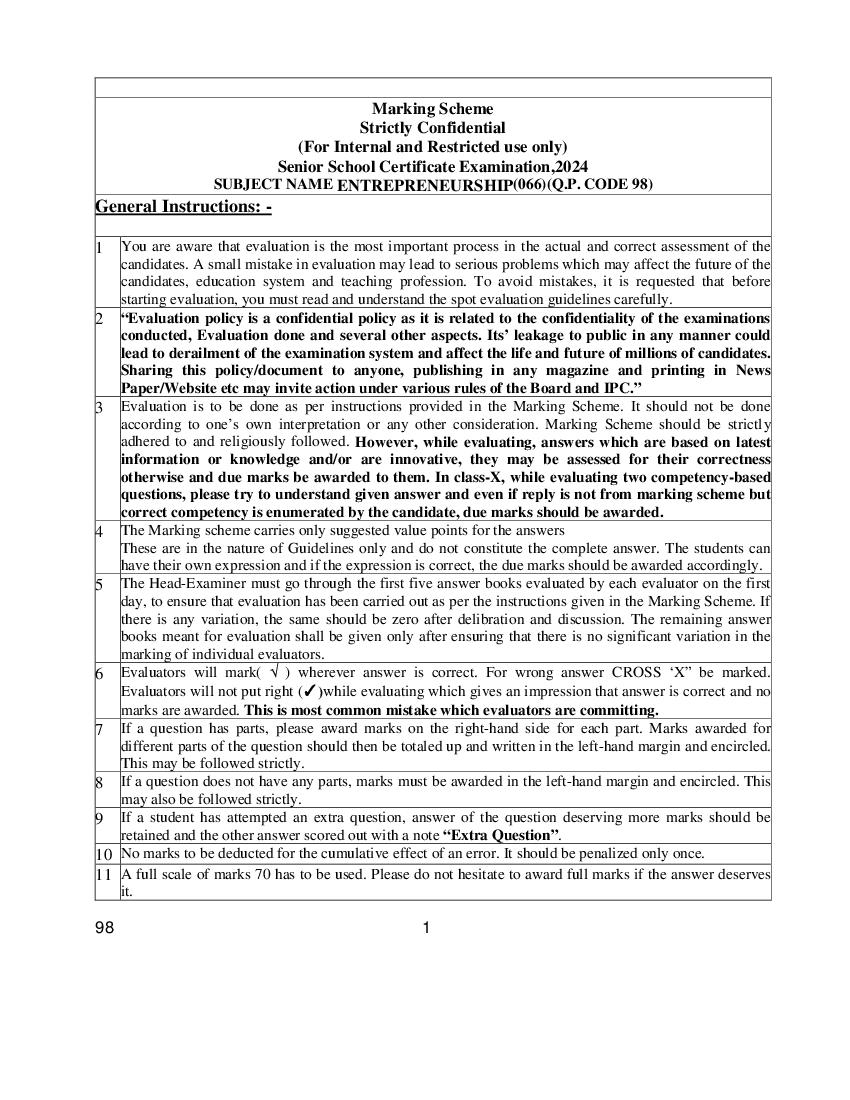
Strictly Confidential
(For Internal and Restricted use only)
Senior School Certificate Examination,2024
SUBJECT NAME ENTREPRENEURSHIP(066)(Q.P. CODE 98)
General Instructions: -
1 You are aware that evaluation is the most important process in the actual and correct assessment of the
candidates. A small mistake in evaluation may lead to serious problems which may affect the future of the
candidates, education system and teaching profession. To avoid mistakes, it is requested that before
starting evaluation, you must read and understand the spot evaluation guidelines carefully.
2 “Evaluation policy is a confidential policy as it is related to the confidentiality of the examinations
conducted, Evaluation done and several other aspects. Its’ leakage to public in any manner could
lead to derailment of the examination system and affect the life and future of millions of candidates.
Sharing this policy/document to anyone, publishing in any magazine and printing in News
Paper/Website etc may invite action under various rules of the Board and IPC.”
3 Evaluation is to be done as per instructions provided in the Marking Scheme. It should not be done
according to one’s own interpretation or any other consideration. Marking Scheme should be strictly
adhered to and religiously followed. However, while evaluating, answers which are based on latest
information or knowledge and/or are innovative, they may be assessed for their correctness
otherwise and due marks be awarded to them. In class-X, while evaluating two competency-based
questions, please try to understand given answer and even if reply is not from marking scheme but
correct competency is enumerated by the candidate, due marks should be awarded.
4 The Marking scheme carries only suggested value points for the answers
These are in the nature of Guidelines only and do not constitute the complete answer. The students can
have their own expression and if the expression is correct, the due marks should be awarded accordingly.
5 The Head-Examiner must go through the first five answer books evaluated by each evaluator on the first
day, to ensure that evaluation has been carried out as per the instructions given in the Marking Scheme. If
there is any variation, the same should be zero after delibration and discussion. The remaining answer
books meant for evaluation shall be given only after ensuring that there is no significant variation in the
marking of individual evaluators.
6 Evaluators will mark( √ ) wherever answer is correct. For wrong answer CROSS ‘X” be marked.
Evaluators will not put right (✓)while evaluating which gives an impression that answer is correct and no
marks are awarded. This is most common mistake which evaluators are committing.
7 If a question has parts, please award marks on the right-hand side for each part. Marks awarded for
different parts of the question should then be totaled up and written in the left-hand margin and encircled.
This may be followed strictly.
8 If a question does not have any parts, marks must be awarded in the left-hand margin and encircled. This
may also be followed strictly.
9 If a student has attempted an extra question, answer of the question deserving more marks should be
retained and the other answer scored out with a note “Extra Question”.
10 No marks to be deducted for the cumulative effect of an error. It should be penalized only once.
11 A full scale of marks 70 has to be used. Please do not hesitate to award full marks if the answer deserves
it.
98 1
Page 2
evaluate 20 answer books per day in main subjects and 25 answer books per day in other subjects (Details
are given in Spot Guidelines).This is in view of the reduced syllabus and number of questions in question
paper.
13 Ensure that you do not make the following common types of errors committed by the Examiner in the
past:-
● Leaving answer or part thereof unassessed in an answer book.
● Giving more marks for an answer than assigned to it.
● Wrong totaling of marks awarded on an answer.
● Wrong transfer of marks from the inside pages of the answer book to the title page.
● Wrong question wise totaling on the title page.
● Wrong totaling of marks of the two columns on the title page.
● Wrong grand total.
● Marks in words and figures not tallying/not same.
● Wrong transfer of marks from the answer book to online award list.
● Answers marked as correct, but marks not awarded. (Ensure that the right tick mark is correctly
and clearly indicated. It should merely be a line. Same is with the X for incorrect answer.)
● Half or a part of answer marked correct and the rest as wrong, but no marks awarded.
14 While evaluating the answer books if the answer is found to be totally incorrect, it should be marked as
cross (X) and awarded zero (0)Marks.
15 Any un assessed portion, non-carrying over of marks to the title page, or totaling error detected by the
candidate shall damage the prestige of all the personnel engaged in the evaluation work as also of the
Board. Hence, in order to uphold the prestige of all concerned, it is again reiterated that the instructions be
followed meticulously and judiciously.
16 The Examiners should acquaint themselves with the guidelines given in the “Guidelines for spot
Evaluation” before starting the actual evaluation.
17 Every Examiner shall also ensure that all the answers are evaluated, marks carried over to the title page,
correctly totaled and written in figures and words.
18 The candidates are entitled to obtain photocopy of the Answer Book on request on payment of the
prescribed processing fee. All Examiners/Additional Head Examiners/Head Examiners are once again
reminded that they must ensure that evaluation is carried out strictly as per value points for each answer
as given in the Marking Scheme.
98 2
Page 3
MARKING SCHEME
ENTREPRENEURSHIP
A. Answers Marks
No.
1 (B) Natural resources 1
2 (D) Tagline 1
3 (C) Private placement 1
4 (B) Hostile acquisition 1
5 (B) Size of the market being targeted 1
6 (A) Both Assertion (A) and Reason (R) are correct and Reason (R) is the correct 1
explanation of Assertion (A).
7 (A) 600 Bales 1
8 (C) Assertion (A) is correct, but Reason (R) is incorrect. 1
9 (C)Gross Working Capital = Cash + Accounts Receivable + Inventory + Other 1
Current Assets
10 (B) I and IV 1
11 (C) Both Assertion (A) and Reason (R) are correct and Reason (R) is the correct 1
explanation of Assertion (A).
12 (B) Below the line 1
13 (D) Offer to Employees 1
14 (C) Watch trends 1
15 (B) Economic 1
98 3
Page 4
17 (D) Manpower Plan 1
18 (C)Private company 1
Section B
19 a. Analytical planning: Carefully identifying the product or service, it’s ½ 2
features, design as well as the resources that will be needed. ×4
b. Resource organization: Obtaining the required resources, materials, =2
technology, human or capital resources.
c. Implementation: Applying the resources in order to accomplish the plans
and delivering results.
d. Commercial application: The provision of value to customers, reward
employees, and satisfy the stake holders.
OR
A problem is a roadblock in a situation, something that sets up a conflict and 1 2
forces an entrepreneur to find a solution. When an entrepreneur identifies such a
road block, he/she is said to have identified the problem.
Objectives of problem identification: ½
a. It should clearly state the problem +
b. Identify target group facing the problem ½
c. Find the market acceptability of the solution to the problem =1
(Any two)
20 (a) The component of product mix is ‘Branding’. ½ 2
Branding is a process, a tool, a strategy, an orientation whereby a name, a sign +
or a symbol, etc. is given to a product by the entrepreneur so as to differentiate ½
his/her product from the rival products.
(b) Trade Mark ½
Trade mark is a brand or part of a brand that is given legal protection against its +
use by other firms. ½
21 Idea germination: This is the seeding stage of a new idea. It is the stage where ½ 2
the entrepreneur recognises that an opportunity exists. The idea germination +
takes place according to interest, curiosity of the entrepreneur according to ½
which opportunity is explored and exploited to its best potential. Creative idea =1
germinates besides the interest, the need of a specific problem or area of study.
98 4
Page 5
adjudged by the entrepreneur and he starts looking for the answer to implement
the idea. If the idea is to launch a new product or service then market research is
conducted. That happens because the seed of curiosity has taken the form of an
idea, which the entrepreneurs foresee the future of the product.
The next two steps to be followed by Prabhav are:
Incubation: This is the subconscious assimilation of information. This is the
transition period. The entrepreneur starts thinking about the idea and it’s ½
implementation in his sub-conscious mind. +
½
Illumination: In this period of illumination the idea re-surfaces in a realistic =1
way and entrepreneur comes out with viable plan to give practical shape by
collecting raw-material, arranging funds, policy–making for the implementation
of idea.
22 (a) Advantages of franchisor 2
(Related to expansion risk) is Quick expansion
The most obvious advantage of franchising for an entrepreneur is that it allows 1
the venture to expand quickly using little capital. This advantage is significant
when we reflect on the problems and issues that an entrepreneur faces in trying
to manage and grow a new venture. A franchisor can expand a business
nationally and even internationally by authorizing and selling franchises in
selected locations. The capital necessary for this expansion is much less than it
would be without franchising. The value of the franchise depends on the track
record of the franchisor and on the services offered to the entrepreneur or
franchisee.
Cost advantages 1
The mere size of a franchised company offers many advantages to the
franchisees. The franchisor can purchase supplies in large quantities, thus
achieving economies of scale that would not have been possible otherwise.
Many franchise businesses produce parts, accessories, packaging and raw
materials in large quantities, then in turn sell these to the franchisees. The
franchisee are usually required to purchase these items as part of the franchise
agreement and they usually benefit from lower prices.
OR
(b) Market considerations related to channels of distribution 2
1. Number of buyers 1
If the number of buyers is large then it is better to take the services of
middlemen for the distribution of the goods. On the contrary, the distribution
98 5
Page 6
2. Types of buyers 1
Buyers can be of two types: General Buyers and Industrial Buyers. If more
buyers of the product belong to general category then there can be more
middlemen. But in case of industrial buyers there can be fewer middlemen.
23 (a) A business plan is comprehensively written down document prepared by 1 2
the entrepreneur describing formally all the relevant external and internal
elements involved in starting a new venture.
Business plans are considered as decision making tools. ½
1. Describing all necessary inputs for the enterprise. +
2. Explaining the mode of utilization of the resources. ½
3. Detailing the strategies for the execution of the project.
4. Outlining the desired goals.
5. Assessing market sensitivity and the profitability of the venture.
(Any two points)
OR
(b)
(i)Ability to harness different sources of information: Various sources like 1 2
magazines, journals, books, seminars, trade shows, family members, customers,
friends, etc. help in getting information that results in evolution of basic ideas.
Bringing together the various sources of information and knowledge and
analysing it to the best possible extent helps in identification of the right
opportunity to start a new business.
(ii)Vision and creativity: Creativity is innovating a solution and vision. The 1
entrepreneur should be able to creatively identify an idea to generate a valuable
solution to a problem.
24 Week Number of Average Amount Total billed amount (in ½ for
Customers billed per Rs.) total
customer (in Rs.) No. of
Custom
1 20 200 4,000 ers
+ ½ for
2 34 170 5,780 Total
billed
3 26 142 3,692 amount
+ ½ for
4 44 462 20,328 Formul
5 36 350 12,600 a
98 6
Page 7
final
answer
Unit Price Per Customer = Total Billed Amount/ No. of Customer =2
= 46,400/160 = Rs. 290 per customer
Section C
25 (a)Cost plus pricing method 1 3
(b)
Advantage of this method (Any one) 1
1.It is the simplest method to decide the price
2. It is easier for the company to evaluate the reasons for escalations in expenses
and take corrective action immediately.
3. The company knows the exact amount of expenditure that has been incurred
therefore they can add profit accordingly and can achieve the desired revenue.
Disadvantage of this method (Any one)
1. This method does not take into account the future demand for a product 1
which should be the base before deciding the price of a product.
2. It does not take into account the competitors actions and their effect on
pricing of the product, as in today’s competitive world, if one solely depends on
cost plus pricing, it can lead to failure of company’s product in the market.
3. It can result in the company overestimating the price of a product because this
method includes sunk cost and ignores opportunity cost.
26 (i) Scheduling – It means fixation of time, day, date when each operation is to 1 3
be commenced and completed. It is the determination of the time that should be
required to perform each operation.
(ii) Follow-up – It relates to evaluation and appraisal of work performed and is 1
helpful in detecting errors in the work.
(iii) Inspection – It is the art of comparing materials, product or performance 1
with established standards. This element helps the entrepreneur to set up
laboratories or evolve methods to ensure predetermined quality of
product/service.
OR
(i)Market-Research – Any organised effort to gather information about target 1 3
markets or customers. It is a very important component of business strategy.
98 7
Page 8
demand driven ideas in any of the following ways - 1
a. by providing important information to identify and analyse the market need,
market size and competition.
b. It is a key factor to maintain competitiveness over competitors.
c. It also includes social and opinion research which leads to systematic
gathering and interpretation of information about individuals or organisations
using statistical and analytical methods to gain insight or support decision
making.
(Any Two)
27 a. The sales strategy is – Indirect Sales 1 3
b. The other type of sales strategy is – Direct sales strategy ½
In this strategy, sales people attack the competitors head on when talking to the +
customer. They talk about each feature of the competitor’s product and compare ½
it to theirs. The term ‘negative selling’ refers to the direct sales approach.
c. Effective sales strategy requires –
(i) market knowledge ½
(ii) awareness of competitors activities +
(iii) awareness of current trends ½
(iv) detailed business analysis
(Any Two)
28 a. Political Environment – It includes government stability and trade ½ 3
regulations and overall political environment in the country +
Quote - ‘‘The Prime Minister announced relaxation in export duties on ½
electronic items. ___________.’’
b. Technological Environment – It is influenced by government spending on ½
research, new discoveries and development, government and industry focus +
of technological effort, speed of technological transfer and rate of ½
obsolescence.
Quote - ‘‘The company developed a better and cheaper video – conferencing
system ___________.’’
c. Social Environment – It includes population demographics, social ½
mobility, income distribution, lifestyle changes, attitude to work and leisure, +
levels of education and consumerism. ½
Quote - ‘‘There is an increase in the level of education and consumerism
globally.’’
98 8
Page 9
conducting research at pre-commercialization stage. During this stage the
entrepreneur has to convince the investor why his idea/product is worthwhile.
The investor will investigate into the technical and economical feasibility of the
idea.
1
(ii) Start-up finance – This is a stage when a business plan is presented by the
entrepreneur to the venture capitalist firm and a management team is formed to
run the venture.
1
(iii) Second-round financing – At this stage we presume that the idea has been
transformed into a product and is being produced and sold. This is the first
encounter with the rest of the market, the competitors and attempt is to squeeze
in the market and get some market share from the competitors
OR
Angel Investors are affluent individuals who provide capital for a business ½ 3
start-up and early stage companies having a high-risk, high-return matrix
usually in exchange for convertible debt or ownership equity.
Features
(i) Most angel investors are current or retired executives, business owners or ½
high net worth individuals having knowledge, expertise and funds that help × 5
start-ups match up to industry standards.
(ii) They expect a very high return on investment.
(iii)Apart from investing funds, most angels provide proactive advice, guidance,
industry connections and mentoring to the start-up in its early days.
(iv)Their objective is to create great companies by providing value creation, and
simultaneously helping investors realise a high return on investments.
(v)They have a sharp inclination to keep abreast of current developments in a
particular business arena, mentoring another generation of entrepreneurs by
making use of their vast experience.
Section D
30 Advertising is a paid form of communication designed to persuade potential 1 5
customers to choose the product or service over that of a competitor.
Four rules to be considered
Aim - What is the primary purpose of the advertisement? Is it to inform, sell, ½
produce listings or improve the image of the business? ×4
Target - Who is the target? From which sector of the public are we trying to =2
98 9
Page 10
mother, father etc.
Media – Bearing the aim and target in mind, which are of the media available is
the most suitable – i.e. TV, radio, press or Internet?
Competitors – What are the competitors doing? Which media channel do they
use? Are they successful? Can you improve on their approach and beat them in
competition?
Good advertising generally elicits the following four responses:
Attention – It catches the eye or ear and stands out amid the clutter of ½
competing advertisements. ×4
Interest – It arouses interest and delivers sufficient impact in the message or =2
offering.
Desire – It creates a desire to learn more or crave ownership.
Action – It spurs an action which leads to achievement of the advertisement’s
original objective – i.e. it prompts potential customers to purchase or use your
product or service.
OR
A franchise agreement is the legal document that binds the franchisor and
franchisee together. This document explains what the franchisor expects from 1 5
the franchisee in running the business. The agreement is designed to assure that
all of the franchisees within an organization are treated equitably. The
expectations must be uniform throughout the system.
The main ingredients of a franchise agreement:
1. Contract Explanation: The contract explanation is the part of the agreement 1 ×
that outlines the type of relationship a franchisee is entering into with the 4=
franchisor. 4
2. Operations Manual: The operations manual is the section of the agreement
that details the guidelines that the franchisee must legally follow in operating
the business as outlined by the franchisor. From time to time amendments may
be made and the franchisee must be prepared to adjust operations accordingly.
The franchisee needs to be aware that the contents of the document are
confidential.
3. Proprietary Statements: Proprietary statements outline how the franchise
name is to be used, as well as the marketing and advertising procedures in place
that the franchisee will be required to follow. Also, the franchisor documents
how much the franchisee will be required to contribute toward national
advertising efforts.
4. Ongoing Site Maintenance: Ongoing site maintenance is another item that is
outlined in the agreement. Included are the types and timeframes regarding
98 10
Page 11
location.
31 Primary Market- It is a market to facilitate transfer of resources from the 1 5
savers to the entrepreneurs seeking funds for:
1) Setting new enterprises
2) Expanding
3) Diversifying
Methods of flotation of new issues 1×
An entrepreneur can raise the required capital in the primary market by the 4=
following methods: 4
1. Public issue
2. Rights issue
3. Private placement
4. Offer to the employees
1. Public issue / going public
Public issue is the most popular method of raising capital these days by the
entrepreneurs. This involves raising of funds directly from the public through
the issue of prospectus. An enterprise organizing itself as a public limited
company can raise the required funds commonly by preparing a prospectus.
When an entrepreneur a offers shares to the public for subscription he/she is
required to comply with all the restrictions and formalities pertaining to the
initial issues, prospectus drafting and launch.
2. Rights issue
Rights issue is a method of raising additional finance from existing shareholders
by offering securities to them on pro-rata basis i.e. giving them a right to a
certain number of shares in proportion to the shares they are holding. Normally,
through a circular, rights issues are proposed to the existing shareholders and in
case they are not willing to subscribe, they can renounce the same in favour of
another person. This method of issuing securities is considered to be
inexpensive as it does not require any brokers, agents, underwriters, prospectus
or enlistment, etc.
3. Private placement
Private placement means the direct sale by a company of its securities to a
limited number of sophisticated investors.
4. Offer to employees
Stock options or offering shares to the employees has gained much popularity in
many countries of the world. This method enables employees to become
shareholders and share the profits of the company leading to:
a) Higher efficiency
b) Low labour turnover
98 11
Page 12
d) Low floatation cost
e) Wider/higher generation of funds.
32 A company is an association of persons who contribute money in the shape of 1 5
shares and the company gets a legal entity and enjoys permanent existence.
Features:
(i) Separate legal entity – A company has an independent status, different from 1 ×
its members. 4=
(ii) Limited liability – The liability of the shareholders of a company is 4
normally limited to the amount of shares held or guarantee given by them.
(iii)Transferability of shares – Subject to certain conditions, shares are freely
transferable. In a private company there are some restrictions.
(iv)Diffusion of ownership and management – There exists separation of
ownership from management. As the shareholders could be scattered across
country and they give the right to the directors to manage the
company’s affairs.
OR
(b)Benefits of understanding the relevant environment of business are : 5
1×
(i) Identification of opportunities to get first mover advantage - By keeping 5 =
in touch with the changes in the external environment, an enterprise can identify 5
opportunities and find strategies to capitalise on the opportunities at the earliest.
(ii) Formulation of strategies and policies -It helps in identifying threats and
opportunities in the market. These can serve as the basis of formulation of
strategies to counter threats and capitalise on opportunities in the market.
(iii) Tapping useful resources -If the company has a thorough knowledge of
the external environment, it can tap raw materials, technology and even
financial resources from the market at economical prices, at the right time.
(iv) Better performance - Proper understanding of the various elements of the
external environment is necessary to take timely action to deal with threats and
avail opportunities for the purpose of improvement in the performance of the
firm.
v) Sensitisation of entrepreneurs to cope up with rapid changes-A keen
watch on the trends in the environment would help sensitise the entrepreneur to
changing technology, competition, government policies and changing needs of
the customers. For example, trends in clothing.
vi) Image building -If a company is sensitive to the external environment, it
will come out with new products and services to meet the requirements of the
customers. This would build the image or reputation of the firm in the eyes of
98 12
Page 13
GPS systems, online booking etc.
(Any Five)
33 Full marks may be awarded to all the candidates. 5
34 (a) Component of Business Plan – Production Plan 1 5
Objective — ‘‘Picturising ahead every step in a long series of separate 1
operations, each step to be taken in the right place, of the right degree and at
the right time, and each operation to be done at maximum efficiency.’’
(b) Three options available before the venture are : 1×
i) No manufacturing involved: If the new venture does not include any 3 =
manufacturing function, say it’s a trading firm or a service provider, and then 3
this section will stand eliminated from the plan.
ii) Partial manufacturing: If some or all the manufacturing process is to be
subcontracted or outsourced, then the production plan should describe: i) Name
and location of subcontractor(s) ii) Reasons for their selection iii) Cost and time
involved iv) Any contracts that have been completed etc. In such cases, a clear
mention of what entrepreneur intends to do himself and what he plans to get it
done from outside is required.
iii) Complete Manufacturing: If the manufacturing is to be carried out in
whole by the entrepreneur, he/she will need to describe: i) the physical plant
layout, ii) the machinery and equipment required to perform the manufacturing
operations, iii) raw materials and suppliers names, addresses, terms and
conditions, iv) cost of manufacturing v) any future capital equipment required
etc.
98 13
Document Details
| Board / Org | CBSE |
| Exam | Class 12 |
| Type | Solution |
| Pages | 13 |
| Updated | 30 Apr 2026 |