MAHA SET 2018 Question Paper 3 Journalism And Mass Communication
Finished viewing? Save it for later —
Download MAHA SET 2018 Question Paper 3 Journalism And Mass Communication (PDF · 40 pages)About MAHA SET 2018 Question Paper 3 Journalism And Mass Communication
MAHA SET 2018 Question Paper 3 Journalism And Mass Communication is available here for free download. Published by Maharashtra Exams for MAHA SET, this question paper can be viewed online or downloaded as a PDF (40 pages). Candidates preparing for MAHA SET can use MAHA SET 2018 Question Paper 3 Journalism And Mass Communication to understand the exam pattern, the type of questions asked, and the overall difficulty level.
Frequently Asked Questions
How can I download MAHA SET 2018 Question Paper 3 Journalism And Mass Communication?
Open this page and click the Download button to save MAHA SET 2018 Question Paper 3 Journalism And Mass Communication as a PDF. It is completely free on AglaSem Docs.
Is MAHA SET 2018 Question Paper 3 Journalism And Mass Communication free to download?
Yes. MAHA SET 2018 Question Paper 3 Journalism And Mass Communication can be viewed online and downloaded as a PDF free of cost on AglaSem Docs.
How many pages does MAHA SET 2018 Question Paper 3 Journalism And Mass Communication have?
MAHA SET 2018 Question Paper 3 Journalism And Mass Communication contains 40 pages, which you can read online or download together as a single PDF.
Where can I find more MAHA SET study material?
You can find more MAHA SET question papers, sample papers, syllabus, and answer keys on AglaSem Docs.
MAHA SET 2018 Question Paper 3 Journalism And Mass Communication – Text
Read the full text of this question paper below — useful to quickly search, copy and reference the content online without downloading the PDF.
📄 View text version (40 pages)
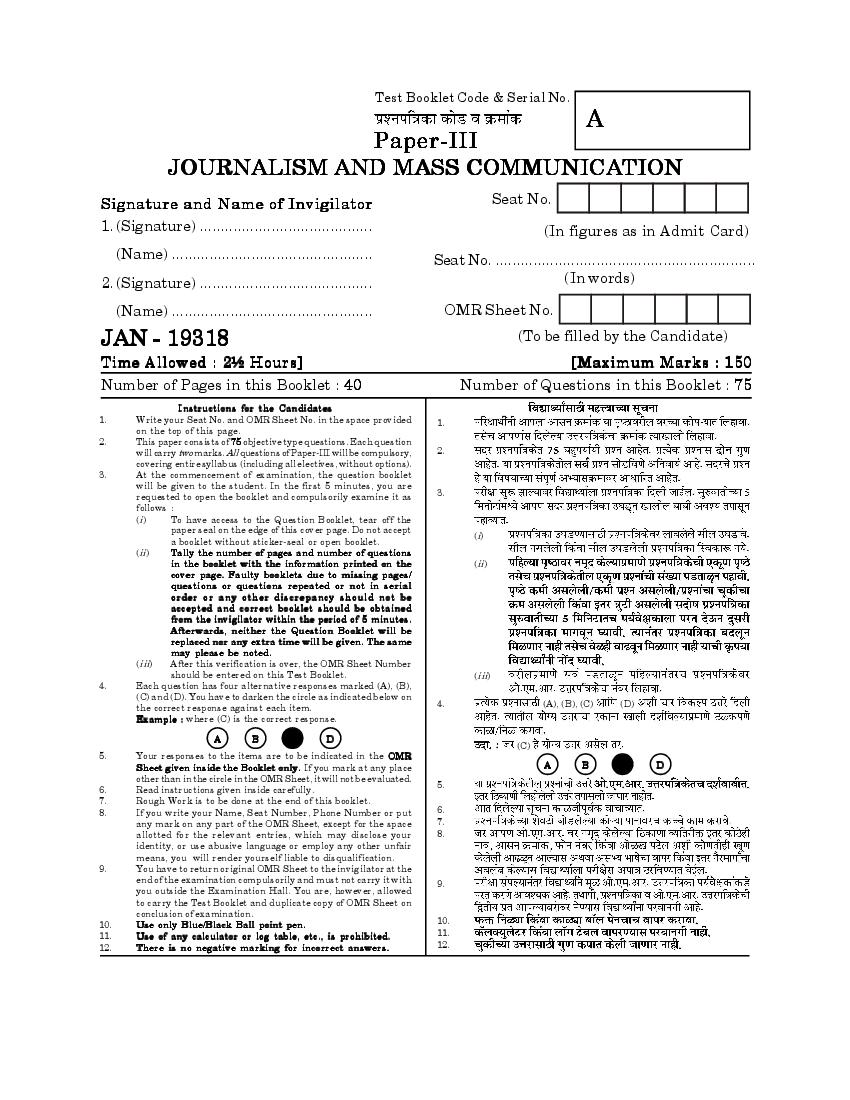
Page 1
A
JOURNALISM AND MASS COMMUNICATION
Signature and Name of Invigilator Seat No.
1. (Signature) ......................................... (In figures as in Admit Card)
(Name) ................................................ Seat No. ..............................................................
2. (Signature) ......................................... (In words)
(Name) ................................................ OMR Sheet No.
JAN - 19318 (To be filled by the Candidate)
Time Allowed : 2½ Hours] [Maximum Marks : 150
Number of Pages in this Booklet : 40 Number of Questions in this Booklet : 75
Instructions for the Candidates
1. Write your Seat No. and OMR Sheet No. in the space provided 1.
on the top of this page.
2. This paper consists of 75 objective type questions. Each question
will carry two marks. All questions of Paper-III will be compulsory, 2.
covering entire syllabus (including all electives, without options).
3. At the commencement of examination, the question booklet
will be given to the student. In the first 5 minutes, you are
requested to open the booklet and compulsorily examine it as 3.
follows :
(i) To have access to the Question Booklet, tear off the
paper seal on the edge of this cover page. Do not accept
(i)
a booklet without sticker-seal or open booklet.
(ii) Tally the number of pages and number of questions
in the booklet with the information printed on the (ii)
cover page. Faulty booklets due to missing pages/
questions or questions repeated or not in serial
o rder or any other discre pancy should not be
accepted and correct booklet should be obtained
from the invigilator within the period of 5 minutes.
Afterwards, neither the Question Booklet will be
replaced nor any extra time will be given. The same
may please be noted.
(iii) After this verification is over, the OMR Sheet Number
should be entered on this Test Booklet. (iii)
4. Each question has four alternative responses marked (A), (B),
(C) and (D). You have to darken the circle as indicated below on
the correct response against each item. 4. (A), (B), (C) (D)
Example : where (C) is the correct response.
A B D
(C)
5. Your responses to the items are to be indicated in the OMR
Sheet given inside the Booklet only. If you mark at any place A B D
other than in the circle in the OMR Sheet, it will not be evaluated.
5.
6. Read instructions given inside carefully.
7. Rough Work is to be done at the end of this booklet.
8. If you write your Name, Seat Number, Phone Number or put 6.
any mark on any part of the OMR Sheet, except for the space 7.
allotted for the relevant entries, which may disclose your 8.
identity, or use abusive language or employ any other unfair
means, you will render yourself liable to disqualification.
9. You have to return original OMR Sheet to the invigilator at the
end of the examination compulsorily and must not carry it with 9.
you outside the Examination Hall. You are, however, allowed
to carry the Test Booklet and duplicate copy of OMR Sheet on
conclusion of examination.
10. Use only Blue/Black Ball point pen. 10.
11. Use of any calculator or log table, etc., is prohibited. 11.
12. There is no negative marking for incorrect answers. 12.
Page 2
Page 3
Paper III
III
Time Allowed : 2½ Hours] [Maximum Marks : 150
Note : This paper contains Seventy Five (75) multiple choice questions. Each
question carries Two (2) marks. Attempt All questions.
(75) (2)
1. ‘‘Men look, women appear.’’ All mass 1.
media objectifies women. Which
media theorist introduced us to this
phenomenon ?
(A) Marshall McLuhan (A)
(B) Ian Van Djik (B)
(C) John Berger (C)
(D) Neil Postman (D)
2. Which of the following statements 2.
is not a correct description about the
regime of internet regulation ?
(A) Internet is a very easy medium (A)
to regulate within national
jurisdiction
(B) Much of burden of internet (B)
regulation falls on internet
service providers
(C)
(C) Multiple national and
international bodies are
incorporated in Internet
regulation (D)
(D) Much of internet developed in
a spirit of defacto freedom from
control
3 [P.T.O.
Page 4
and slander ?
(A) Libel is written and slander is
(A)
oral untrue defamatory
statement
(B) Libel is oral and slander is
(B)
written untrue defamatory
statement
(C) There is no difference between
(C)
the two
(D) Libel is defamation, slander is (D)
not
4. In semiotics, a property of signs/ 4.
texts which can have multiple
meanings :
(A)
(A) Paradigm
(B)
(B) Polysemic
(C) Populism (C)
(D) Syntagm (D)
4
Page 5
Dr. Caligari, ‘‘Metropolis’’ and
‘‘Psycho’’ are examples of films
influenced by which movement ?
(A)
(A) Social realism
(B)
(B) Neo-realism
(C) Surrealism (C)
(D) Expressionism (D)
6. Which committee recommended in 6. 1964
1964 the separation of AIR and
Doordarshan (TV) as two
independent corporations ?
(A)
(A) Joshi Committee
(B)
(B) Murdoch Committee
(C)
(C) Verghese Committee
(D) Chanda Committee (D)
5 [P.T.O.
Page 6
associated with the cultural studies
approach ?
(A)
(A) Richard Hoggart
(B)
(B) Louis Althusser
(C) Antonio Gramsci (C)
(D) David Easten (D)
8. A non-probability sampling 8.
technique that is used by
researchers to identify potential
subjects in studies where subjects (A)
are hard to locate is called :
(B)
(A) Random sampling
(B) Snowball sampling (C)
(C) Quota sampling
(D)
(D) Theoretical sampling
6
Page 7
public opinion polls by appealing
people to participate in it by sending
SMS or visiting websites. What
major objection can be raised on the
scientific validity of such research on
the basis of sampling ?
(A) Purposive sampling in such (A)
polls leads to bias
(B) Unqualified volunteer (B)
sampling in such polls leads to
bias
(C)
(C) Random sampling in such polls
introduces bias
(D)
(D) Quota sampling in such polls
produces bias
10. In the context of theory of 10.
‘Sadharanikaran’, the concept of
‘Sahahriday’ means :
(A)
(A) an ability to perceive a situation
in a unique way
(B) an innate receptivity acquired (B)
through culture and learning
(C) an ability to argue a point in
(C)
a logical way
(D) an innate compassion at heart
for other people (D)
7 [P.T.O.
Page 8
co-produced and directed by Jabbar
Patel and dealt with, among other
things, lesbianism ?
(A) Uttarayan (A)
(B) Umbartha (B)
(C) Vidushak (C)
(D) Maza Ghar (D)
12. Who received the first prestigious 12.
‘‘Dada Saheb Phalke Award’’ for
Indian Cinema ?
(A) Pankaj Mullick (A)
(B) Sulochana (B)
(C) Naushad (C)
(D) Devika Rani (D)
8
Page 9
direct and useful measure to ensure
external validity of a research ?
(A) Conducting a through
(A)
literature review
(B) Using random sampling method (B)
(C) Conducting a research over a (C)
long period of time
(D) Replicating research over (D)
heterogeneous sample
14. What condition is not important for 14.
effective communication ?
(A) Command over language (A)
(B) Clear communication objective
(B)
(C) Personality
(C)
(D) Command on content
(D)
15. In the context of concentration of
15.
ownership on internet what does the
‘Long tail’ phenomenon imply ?
(A) A large number of websites
(A)
owned by a single owner
(B) A large number of websites
(B)
attracting very high user traffic
(C) A large number of websites
(C)
owned by established mass
media owner
(D) A large number of websites (D)
attract very little user traffic
9 [P.T.O.
Page 10
in media is similar to :
(A) Subscribers
(A)
(B) ‘Inscribed Readers’
(B)
(C) Reviewers
(C)
(D) Prescribed listeners (D)
17. ‘Amar Chitra Khata’ and ‘Tinkle’ 17.
comics were founded by :
(A) R. K. Laxman (A)
(B) Anant Pai (B)
(C) Mario Miranda (C)
(D) Unni Krishnan (D)
18. When compared with production 18.
value, the selling price of
mainstream newspaper is always :
(A)
(A) Less
(B)
(B) More
(C)
(C) Equal
(D)
(D) Not fixed
10
Page 11
governs internet usage in India ?
(A) Cable Television Networks
(A)
(Regulation) Act, 1995
1995
(B) Airport Authority of India Act,
(B)
1994
1994
(C) Information Technology Act,
2000 (C) 2000
(D) Right to Information Act, 2005 (D) 2005
20. Identify the correct chronology of 20.
launch of the following Marathi
GEC’s
(A)
(A) Alpha Marathi, Zee Yuva, ETV
Marathi, Star Pravah
(B)
(B) Alpha Marathi, ETV Marathi,
Star Pravah, Zee Yuva
(C)
(C) ETV Marathi, Alpha Marathi,
Star Pravah, Zee Yuva
(D) ETV Marathi, Star Pravah, (D)
Alpha Marathi, Zee Yuva
11 [P.T.O.
Page 12
appropriate way to cope with a
negative event that may lead to
negative publicity is to :
(A) Discourage news coverage of (A)
the event
(B)
(B) Deny the event occurred
(C)
(C) Hire a new content writer
(D)
(D) Facilitate news coverage
22. What is P. Sainath mainly known 22.
for ?
(A) Writing about education
(A)
(B) Writing about agriculture
(B)
(C) Writing about science and
technology (C)
(D) Writing about cultural issues (D)
12
Page 13
‘cultural imperialism’ ?
(A) Western cultural aspects are (A)
important for popularity and
progress of media
(B)
(B) Western nations dominate the
views and social cultures in the
third world using media
(C)
(C) Ethnic cultures are superiors to
any others in the world of media
(D)
(D) Imperialism has nothing to do
with culture as media
24. A phenomenon involving the 24.
interconnection of information and
communication technologies,
computer networks and media
content is called as : (A)
(A) mass communication (B)
(B) digital diffusion (C)
(C) digital connectivity
(D) media convergence (D)
13 [P.T.O.
Page 14
main objectives of the newspaper
‘Darpan’ ?
(1)
(1) To educate people with western
knowledge (2)
(2) Create public opinion for
development of society
(3)
(3) Promote Swadeshi
(4)
(4) Promote Swaraj
(A) (1) (3)
(A) (1) and (3) are correct
(B) (2) (3)
(B) (2) and (3) are correct
(C) (1) and (2) are correct (C) (1) (2)
(D) (2) and (4) are correct (D) (2) (4)
26. Which of the following is not a film 26.
about news media ?
(A) Ace in the Hole (A)
(B) Citizen Kane (B)
(C) All the President’s Men (C)
(D) Silence (D)
14
Page 15
considered to be the significant
characteristic of popular Indian
films in the established discourse of
film theories ?
(A) Intrumption oriented narrative (A)
flow (B)
(B) Emphasis on dialogues and
verbal communication
(C)
(C) Traditional and patriarchial
underpinning to story
(D)
(D) Highly subtle and restrained
treatment of narrative
28. ‘Tone of speaking’ and ‘speed of
28.
speaking’ are the examples of :
(A) Non-verbal and verbal
communication respectively (A)
(B) Verbal and non-verbal
(B)
communication respectively
(C)
(C) Only non-verbal communication
(D) Only verbal communication (D)
15 [P.T.O.
Page 16
popular :
(A) Bharatnatyam Dancer (A)
(B) Khayal Singer (B)
(C) Dhrupad Singer (C)
(D) Kuchipudi Dancer (D)
30. What does ‘‘Androcentric View’’ 30.
mean ?
(A)
(A) Male perspective
(B)
(B) Female perspective
(C) Transgender perspective (C)
(D) Senior citizens perspective
(D)
16
Page 17
appropriate method to study the
nuances of gate-keeping process
that shapes news selection and
presentation in a typical news
room ?
(A)
(A) Survey of readers
(B) Field observation (B)
(C) Content analysis of news (C)
(D) Semiotic analysis of news (D)
32. ‘Attribution’ in journalism jargon 32.
means :
(A) Telling readers where the
(A)
information in a news story
comes from
(B)
(B) Telling readers the source who
does not want to be identified
(C)
(C) Acknowledgement of reporter
(D) When editor becomes a reporter (D)
for a news story
17 [P.T.O.
Page 18
Telecom and media expert oversaw
the launch of the following channel
in South Asia :
(A) National Geographic (A)
(B) Discovery (B)
(C) History (C)
(D) TLC (D)
34. A pejorative term that refers to 34.
supporting or promoting of a cause
exclusively through online
activism :
(A) Civil Disobedience (A)
(B) Litigation (B)
(C) Plagiarism (C)
(D) Armchair activism (D)
18
Page 19
also used in cultural studies refers
to :
(A) The question about whether
(A)
individuals act independently
or are acted upon
(B)
(B) The way in which the media set
public agendas of debate
(C)
(C) A term loosely used to describe
angst
(D)
(D) Mediation between editor of the
newspaper and reporter
36. The encoding/decoding model of 36.
communication was first developed
by which of the following
scholars ? (A)
(A) Stuart Hall
(B)
(B) John Fiske
(C)
(C) Michel Foucault
(D) George Gerbner (D)
19 [P.T.O.
Page 20
newspaper was bilingual. In which
two languages did the newspaper
publish ? (A)
(A) Marathi and Gujarati
(B)
(B) Marathi and English
(C)
(C) Marathi and Konkani
(D) Marathi and Portuguese (D)
38. In implementing public relations 38.
plan which of the following public
relations practitioners do first ?
(A)
(A) Send as many press releases as
possible to as many people
(B) Determine which media outlets (B)
best serve their purpose
(C) Art editors to promise to use
(C)
their press releases
(D) Find out which media have
(D)
been most friendly to their
client in the past
20
Page 21
involve random assignment of
subjects to experimental groups is
called :
(A)
(A) Controlled experiment
(B)
(B) Semi-random experiment
(C) Quasi-experiment (C)
(D) Neo-quasi experiment (D)
40. ‘‘Although media is an industry, it 40.
is not just any other industry or
business.’’ Which of the following
reason provides the best explanation
of the statement ?
(A)
(A) Media is a very capital intensive
industry (B)
(B) Media products have a strong
public dimension in production
and consumption
(C) Media ownership gets
(C)
concentrated in fewer hands
(D) Media products are primarily
meant for immediate (D)
entertainment
21 [P.T.O.
Page 22
journalists look for ?
(A) A variety of sources
(A)
representing different opinions
(B) Close friends and relatives (B)
(C) Officials who win expert some (C)
favour in return
(D) Officials with whom the
(D)
journalist has a close personal
relation
42. According to Manuel Castells, in a 42.
network society, communications
technologies allow for what ?
(A) Annihilation of space (A)
(B) Rapid and asychronous (B)
communication
(C)
(C) Changes the relation to time
(D) All of the above (D)
22
Page 23
term unplanned effect in the
typology of media effects ?
(A) Media campaign (A)
(B) Collective reaction (B)
(C) Development diffusion (C)
(D) Socialization (D)
44. Which of the following dimensions 44.
does not guide the dominant
paradigm of development
communication ?
(A) Capitalism (A)
(B) Counter-culture (B)
(C) Modernization (C)
(D) Surveillance (D)
45. Publication of wrong or incorrect
45.
map is a very serious offence because
it adversely affects the territorial
integrity of the country. What
should a media enterprise do in such
a case according to the Press Council
of India ?
(A) Apologise only (A)
(B) Promptly and prominently
(B)
retract with regrets
(C) It is part of freedom of speech
and expression so nothing (C)
should be done
(D) Write to the ministry of
information and broadcasting (D)
23 [P.T.O.
Page 24
as the father of public relation ?
(A) Joseph Goebbels (A)
(B) Adolf Hitler (B)
(C) Edward Bernays (C)
(D) Wilbur Schramm (D)
47. Who first translated Bhagvad Gita 47.
into English ?
(A) Charles Wilkins (A)
(B) Macaulay (B)
(C) William Jones (C)
(D) Lord Bentington (D)
48. Which one of the following is warm 48.
colour ?
(A)
(A) Blue
(B)
(B) Green
(C)
(C) Red-orange
(D)
(D) Blue-violet
24
Page 25
known as the pioneer of Hindi
journalism ?
(A)
(A) Ganga Kishore Bhattacharya
(B)
(B) Baburao Vishnu Paradkar
(C)
(C) Prem Chand
(D) Madhav Sapre (D)
50. ‘‘When you have two competing 50.
theories that make exactly the same
predictions, the simpler one is
better.’’ This approach is termed
as :
(A)
(A) Surveying
(B)
(B) Parsimony
(C) Levelling (C)
(D) Disharmony (D)
25 [P.T.O.
Page 26
51.
journalist working in commercial
media organisations. How does this
constrain their abilities ?
(A) It constrains their ability to
reach policy makers and citizen (A)
because commercial media have
their own agenda
(B) It constrains their ability
because journalists in
commercial media ask for
money (B)
(C) It contains their ability because
commercial media only look for
profit from content (C)
(D) It constrains their ability
because media advocates are
poor (D)
52. What is meant by balance in a news 52.
story ?
(A)
(A) Giving the same amount of
space to every paragraph (B)
(B) Getting a lawyer’s opinion
before writing an article
(C)
(C) Having several authors write a
story
(D) Covering all sides of an issue (D)
as fairly as possible
26
Page 27
(A) Zomato (A)
(B) Ola (B)
(C) Uber (C)
(D) Meru (D)
54. Name the media effect research 54.
which claims that people gradually
come to accept to view of world as
portrayed on television as a true
representation of reality : (A)
(A) Motivational analysis (B)
(B) Discourse analysis (C)
(C) Visual analysis (D)
(D) Cultivation analysis
55. In the year 2003-2004, the Hutton 55. 2003-2004
enquiry survey initiated a news
organisation of unethical practice.
Which of the following was the news
organisation ?
(A)
(A) CNN
(B)
(B) BBC
(C) Fox News (C)
(D) CNBC (D)
27 [P.T.O.
Page 28
at the statements given below :
(A)
(A) Visual radio is a convergent
technology that combines FM
radio with mobile phone
(B) Worldspace was the first private (B)
satellite radio platform set up
in India
(C)
(C) DAB (Digital Audio Broad-
casting) was introduced in AIR
in mid 1990’s
(D) The Chanda committee (D)
recommended a review of Vividh
Bharti to make it more
innovative and experimental
57. ‘A film studio owing a cinema hall 57.
chain’ and ‘a leading national
newspaper buying out another
national newspaper’ are examples
of :
(A) Vertical concentration of
ownership (A)
(B) Horizontal concentration of
(B)
ownership
(C) Vertical and Horizontal (C)
concentration of ownership
respectively
(D) Horizontal and vertical (D)
concentration of ownership
respectively
28
Page 29
(A) Making up quotations or
(A)
sources for a news story
(B) Taking someone else’s words or
(B)
ideas and passing them off as
one’s own
(C) Pretending to be someone other (C)
than a reporter to get an
interview
(D) Accepting gifts or bribes from
sources (D)
59. In research, a combination of 59.
concepts that is created to describe
specific situation is called :
(A) Abstract (A)
(B) Construct (B)
(C) Aim (C)
(D) Hypothesis (D)
29 [P.T.O.
Page 30
60.
rumour that a public official has
engaged in an illicit sexual
relationship ?
(A) Immediately before any other
(A)
news organization does it
(B) Only after the rumour has been
confirmed as true and its has (B)
some news value
(C) If the source of the remour is
reputable (C)
(D) Never publish such a story (D)
61. In the context of history of television
61.
in India, identify the incorrect pair
from the following :
(A) 1970
(A) 1970s—Beginning of TV
(B) 1980 —
(B) 1980s—Beginning of colour
transmission
(C) 1990
(C) 1990s—Spread of private
channels
(D) 2000s—Beginning of direct to (D) 2000
home TV transmission
30
Page 31
called ‘zoom’ is to some extent similar
to which of the following physical
camera movement ?
(A) Dolly (A)
(B) Tilt (B)
(C) Pan (C)
(D) Track (D)
63. Which of the following is not among 63.
the basic elements of investigative
reporting laid down by the Press
Council of India ? (A)
(A) The subject should be of public
importance for the reader to
know
(B)
(B) The subject should be true
(C)
(C) An attempt is being made to
hide the truth from the people
(D) It has to be the work of the
(D)
reporter, not of others he is
reporting
31 [P.T.O.
Page 32
following has an extensive local
penetration and coverage ?
(A) Magazines and community
(A)
radio
(B) TV and Newspapers (B)
(C) Newspapers and Community
(C)
Radio
(D) Social Media and Community
(D)
Radio
65. Where is a ‘Likert Scale’ used ? 65.
(A) For measuring strength of a (A)
signal
(B)
(B) In research and statistical
analysis (C)
(C) To determine length of a TV
programme
(D)
(D) In WhatsApp messaging
32
Page 33
and its regulatory body in India from
the following :
(A)
(A) Newspaper—PCI
(B)
(B) News Channels—NBSA
(C)
(C) Film—CBFI
(D) Advertising—ASCI (D)
67. In the context of research ‘‘SMOG 67.
Grading’’ refers to :
(A) A measure of readability based
(A)
on the number of syllables per
word
(B)
(B) Measuring the report/article
quantitatively for analysis
(C) It is name of codebook in (C)
content analysis
(D) Checking reliability and (D)
readability of respondent
33 [P.T.O.
Page 34
media may not be successful much
of the time in feeling people. What
to think, but it is stunningly
successful in telling audiences what
to think about. What is this theory
called ?
(A)
(A) Agenda setting
(B)
(B) Public relations
(C)
(C) Cultivation
(D) Media effects (D)
69. In research, a single question in a 69.
questionnaire that requires two
separate responses is called :
(A) Double barreled question
(A)
(B) Double blind experiment
(B)
(C) Dummy variable
(C)
(D) Deception (D)
34
Page 35
(A) An article about movies only (A)
(B) Feedback a reporter get from his (B)
editor
(C) An article that helps consumers (C)
decide whether or not they
should buy a product
(D) An article that criticises (D)
71. Which of the following is not a 71.
correct statement in the context of
CBFC as a regulatory body in
India ?
(A) (1952)
(A) It is set up under Cinemato-
(1958)
graphy Act (1952) and
Cinematograph Rules (1958)
(B)
(B) It has a revising committee
which can take a second look at
the film (C)
(C) CBFC issues four types of
certificates for film exhibition (D)
(D) Once a certificate is issued by
CBFC, the film content cannot
be challenged in the court
35 [P.T.O.
Page 36
72.
production which of the technical
person is responsible for judging the
distance between the camera and a
subject and physically manipulating
the lens on the camera to keep
subject in focus ?
(A)
(A) Technical director
(B)
(B) Cinematographer
(C)
(C) Focus puller
(D) Continuity person (D)
Instructions (Q. Nos. 73, 74 and 75) : (73, 74 75) :
Read the following passage and
answer the next three questions :
Paul Roberts thinks a society that
wants it ‘‘now’’ is untenable.
According to Roberts the dangers
36
Page 37
and upgrade, each device and click,
life moves closer to us and the world
becomes ‘our’ world. ‘‘Our society is
in the process of merging the self
with the market, he fear’s part of
this merger is involuntary. Google,
Apple, Facebook and Microsoft have
supplied consumer data to the
Government. Now the movements of
each person, all information of each
individual is available from the
beginning of life till the end. This
was possible because government
and market came together. However,
if we are being watched without our
knowledge and involuntarily then
we also have to admit that we also
37 [P.T.O.
Page 38
lives of others. We are infant eager
to watch the lives of others. We are
thus bring our privacy and we are
providing the money, resources
ourselves. We have questioned our
privacy and to be a spectator of this
auction we pay.
73. Why is the process of the merger 73.
of the self with the market
involuntary ?
(A)
(A) Because we are disinterested
(B)
(B) Because Google etc. supply data
to government without our
knowledge
(C)
(C) Because Paul Roberts says so
(D) Because it is necessary (D)
38
Page 39
about individuals ?
(A) Because Google supplied
(A)
consumer data to government
(B) Because government controls
(B)
media
(C)
(C) Because government and
market come together
(D) Because market and corporate (D)
come together
75. According to Paul Roberts what are 75.
we eager to do now and what are
we losing as a result ?
(A) We are eager to watch the lives (A)
of others and losing our privacy
as a result
(B) We are losing knowledge and (B)
involuntarily losing our privacy
(C) We are losing privacy and are
(C)
eager to gain knowledge
(D) We are eager to get information
(D)
about others and losing our
privacy
39 [P.T.O.
Page 40
40
Document Details
| Board / Org | Maharashtra Exams |
| Exam | MAHA SET |
| Type | Question Paper |
| Pages | 40 |
| Updated | 30 Apr 2026 |