MAHA SET 2015 Question Paper 2 Chemical Sciences
Finished viewing? Save it for later —
Download MAHA SET 2015 Question Paper 2 Chemical Sciences (PDF · 20 pages)About MAHA SET 2015 Question Paper 2 Chemical Sciences
MAHA SET 2015 Question Paper 2 Chemical Sciences is available here for free download. Published by Maharashtra Exams for MAHA SET, this question paper can be viewed online or downloaded as a PDF (20 pages). Candidates preparing for MAHA SET can use MAHA SET 2015 Question Paper 2 Chemical Sciences to understand the exam pattern, the type of questions asked, and the overall difficulty level.
Frequently Asked Questions
How can I download MAHA SET 2015 Question Paper 2 Chemical Sciences?
Open this page and click the Download button to save MAHA SET 2015 Question Paper 2 Chemical Sciences as a PDF. It is completely free on AglaSem Docs.
Is MAHA SET 2015 Question Paper 2 Chemical Sciences free to download?
Yes. MAHA SET 2015 Question Paper 2 Chemical Sciences can be viewed online and downloaded as a PDF free of cost on AglaSem Docs.
How many pages does MAHA SET 2015 Question Paper 2 Chemical Sciences have?
MAHA SET 2015 Question Paper 2 Chemical Sciences contains 20 pages, which you can read online or download together as a single PDF.
Where can I find more MAHA SET study material?
You can find more MAHA SET question papers, sample papers, syllabus, and answer keys on AglaSem Docs.
MAHA SET 2015 Question Paper 2 Chemical Sciences – Text
Read the full text of this question paper below — useful to quickly search, copy and reference the content online without downloading the PDF.
📄 View text version (20 pages)
Page 1
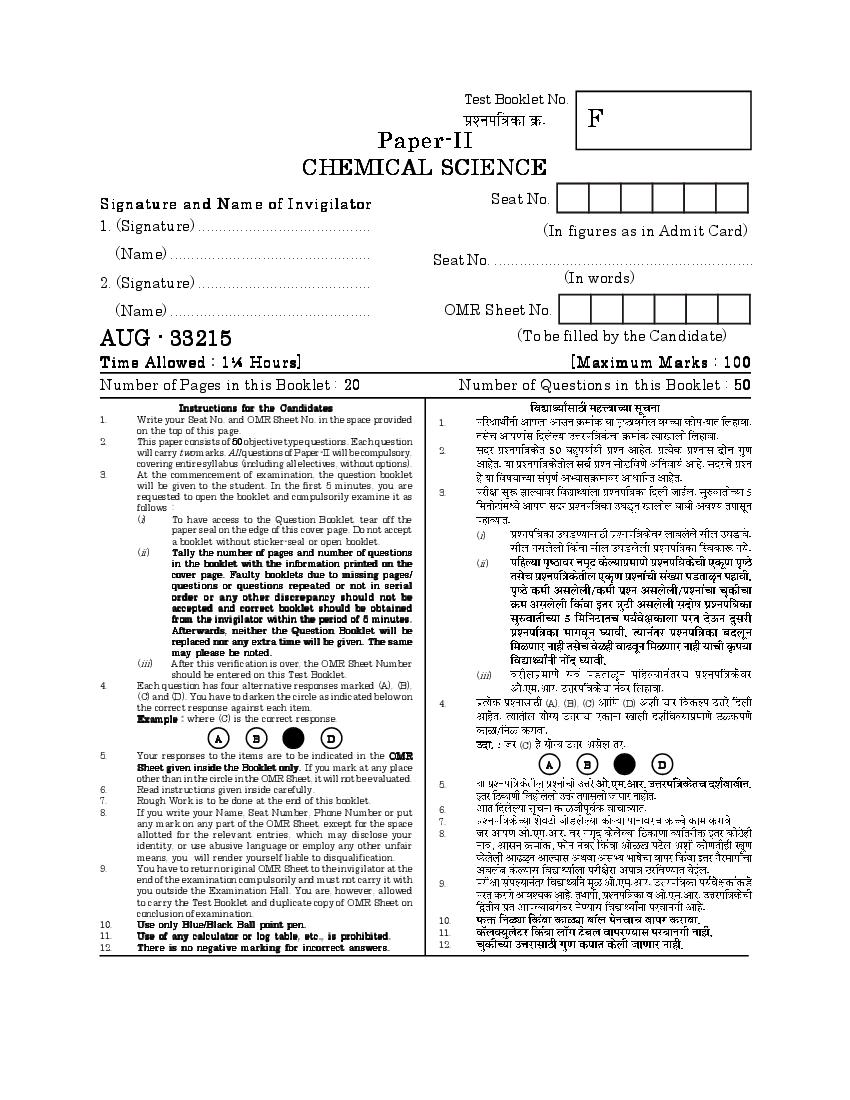
F
CHEMICAL SCIENCE
Signature and Name of Invigilator Seat No.
1. (Signature) ......................................... (In figures as in Admit Card)
(Name) ................................................ Seat No. ..............................................................
2. (Signature) ......................................... (In words)
(Name) ................................................ OMR Sheet No.
AUG - 33215 (To be filled by the Candidate)
Time Allowed : 1¼ Hours] [Maximum Marks : 100
Number of Pages in this Booklet : 20 Number of Questions in this Booklet : 50
Instructions for the Candidates
1. Write your Seat No. and OMR Sheet No. in the space provided 1.
on the top of this page.
2. This paper consists of 50 objective type questions. Each question
will carry two marks. All questions of Paper-II will be compulsory, 2.
covering entire syllabus (including all electives, without options).
3. At the commencement of examination, the question booklet
will be given to the student. In the first 5 minutes, you are
requested to open the booklet and compulsorily examine it as 3.
follows :
(i) To have access to the Question Booklet, tear off the
paper seal on the edge of this cover page. Do not accept
(i)
a booklet without sticker-seal or open booklet.
(ii) Tally the number of pages and number of questions
in the booklet with the information printed on the (ii)
cover page. Faulty booklets due to missing pages/
questions or questions repeated or not in serial
order or any other discre pancy should not be
accepted and correct booklet should be obtained
from the invigilator within the period of 5 minutes.
Afterwards, neither the Question Booklet will be
replaced nor any extra time will be given. The same
may please be noted.
(iii) After this verification is over, the OMR Sheet Number
should be entered on this Test Booklet. (iii)
4. Each question has four alternative responses marked (A), (B),
(C) and (D). You have to darken the circle as indicated below on
the correct response against each item. 4. (A), (B), (C) (D)
Example : where (C) is the correct response.
A B D
(C)
5. Your responses to the items are to be indicated in the OMR
Sheet given inside the Booklet only. If you mark at any place A B D
other than in the circle in the OMR Sheet, it will not be evaluated.
5.
6. Read instructions given inside carefully.
7. Rough Work is to be done at the end of this booklet.
8. If you write your Name, Seat Number, Phone Number or put 6.
any mark on any part of the OMR Sheet, except for the space 7.
allotted for the relevant entries, which may disclose your 8.
identity, or use abusive language or employ any other unfair
means, you will render yourself liable to disqualification.
9. You have to return original OMR Sheet to the invigilator at the
end of the examination compulsorily and must not carry it with 9.
you outside the Examination Hall. You are, however, allowed
to carry the Test Booklet and duplicate copy of OMR Sheet on
conclusion of examination.
10. Use only Blue/Black Ball point pen. 10.
11. Use of any calculator or log table, etc., is prohibited. 11.
12. There is no negative marking for incorrect answers. 12.
Page 2
2
Page 3
Paper II
Time Allowed : 75 Minutes] [Maximum Marks : 100
Note : This Paper contains Fifty (50) multiple choice questions, each question
carrying Two (2) marks. Attempt All questions.
1. The species in which the central atom uses sp2 hybrid orbitals in its bonding
is :
(A) PH3 (B) NH3
(C) BCl 3 (D) SbH3
2. Which of the following is a Lewis acid ?
(A) Br– (B) Cl –
(C) S– (D) Ag+
3. The strength of hydrogen bonds follow the order :
(A) ClH .... Cl > NH .... N > OH .... O > FH .... F
(B) ClH .... Cl < NH .... N < OH .... O < FH .... F
(C) ClH .... Cl < NH .... N > OH .... O > FH .... F
(D) ClH .... Cl < NH .... N < OH .... O > FH .... F
3 [P.T.O.
Page 4
each sample to a conical flask, diluted them with distilled water and
titrated against NaOH solution, having phenolphthalein indicator. The
following burette reading were noted :
SET Burette reading (mL)
(I) 35.22
(II) 36.14
(III) 36.13
(IV) 36.15
(V) 36.13
Which of the probable explanation for the variations in the results ?
(A) The burette was not rinsed with the NaOH solution
(B) Student misread the first set reading
(C) A different amount of water was added to the first sample
(D) The pipette was not rinsed with HCl
5. Based on the VSEPR theory, the molecule IF5 has a shape of :
(A) Trigonal bipyramid (B) Square pyramid
(C) Octahedral (D) Pentagonal bipyramid
6. A solution with pH = 2 is more acidic than one with pH = 6 by the factor
of :
(A) 4000 (B) 4
(C) 8000 (D) 10,000
7. The bond order for NO+ species is :
(A) 2 (B) 2.5
(C) 3 (D) 1.5
4
Page 5
curve ?
(A) A strong base is added to a strong acid
(B) A strong base is added to a weak acid
(C) A strong acid is added to a strong base
(D) A strong acid is added to a weak base
9. A gas ‘Z’ is bubbled through a solution containing ‘X’ and ‘Y’. If the reduction
potentials are in the order of X > Y > Z, then :
(A) Y will oxidize X and Z
(B) Y will oxidize Z but not X
(C) Y will oxidize both X and Y
(D) Y will reduce both X and Z
5 [P.T.O.
Page 6
are in the ratio :
(A) 1 : 2 : 3 (B) 3 : 2 : 2
(C) 1 : 1 : 2 (D) 1 : 1 : 3
11. Consider the following three set of experiments :
(I) (II) (III)
Colorless solution changes to blue colored solution in :
(A) II (B) III
(C) I (D) I and III
6
Page 7
reaction A B is shown :
d A
Then which of the following represents the Vs. time plot correctly ?
dt
d A d A
(A) (B)
dt dt
d A d A
(C) (D)
dt dt
7 [P.T.O.
Page 8
Mn O 4 8H + 5e Mn 2 4H 2 O; E 0 1.51 V
Mn O 2 4H + 2e Mn 2 2H 2 O; E 0 1.23 V
For the reaction
Mn O 4 4H + 3e Mn O 2 2H 2 O;
E0 is :
(A) 1.70 V (B) 5.09 V
(C) 0.27 V (D) 0.84 V
14. The point group symmetry of cis ML4X2 is :
(A) C 4v (B) D 4h
(C) C 2h (D) C 2v
15. When acidic K2Cr2O7 solution is added to Na2S solution, green Cr3+ ions
and free S are formed. When same acidic K2Cr2O7 solution is added to NaCl
solution, no change is noted. Among the substances involved in these reactions
which one is the best reducing agent ?
(A) K2Cr2O7 (B) Na2S
(C) Cr3+ (D) S
8
Page 9
to the cube of its absolute temperature. The value of for the gas is :
3 7
(A) (B)
2 2
5 9
(C) (D)
3 7
17. The correct IUPAC nomenclature for the following compound is :
(A) (E) Pent-2-en-4-yne (B) (E) Pent-1-yne-3-ene
(C) (E) Pent-4-yne-2-ene (D) (E) Pent-3-en-1-yne
18. The number of stereoisomers in (2S, 3R) tartaric acid are :
(A) Two (B) Three
(C) One (D) Four
9 [P.T.O.
Page 10
correct stereochemical structure of the product in this case is :
(A) (B)
(C) (D)
20. Consider the following compounds A, B and C.
(A) (B) (C)
The order of carbonyl stretching frequencies in the IR spectrum of the above
is :
(A) A < B < C (B) A > B > C
(C) C > B > A (D) A > C > B
10
Page 11
(I) (II)
Which one of the following represents their correct configurational notation
in terms of Cahn-Ingold-Prelog system ?
(I) (II)
(A) R S
(B) S E
(C) R Z
(D) S Z
22. 2,2'-bis (diphenylphosphino)-1,1'-binaphthalene (BINAP) contains .................
stereogenic centers and is a .................... molecule.
(A) Zero, prochiral (B) Zero, chiral
(C) Zero, achiral (D) One, chiral
11 [P.T.O.
Page 12
(A) Diastereomers of each other
(B) Identical
(C) Enantiomers of each other
(D) Regioisomers of each other
24. Diels-Alder reaction proceed via concerted cycloaddition [4 + 2] path, hence
they exhibited :
(A) Regiospecificity
(B) Stereospecificity
(C) Regioselectivity
(D) Stereoselectivity
12
Page 13
+ (X) + (Y) Sh a kin g
(A) Alkali and CCl4 (B) Alkali and CHCl3
(C) Alkali and CH2Cl2 (D) Alkali and CH3Cl
26. Chlorobenzene substrate does not undergo nucleophilic substitution reaction
under NTP with base/nucleophile, because it possess :
(A) (4n) delocalized electron cloud
(B) Strong electronegative chlorine atom
(C) (4n + 2) delocalized electron cloud
(D) Partial (C–Cl) double bond character
27. Identify the reacting compounds (X) and (Y) which on condensation forms the
following product :
St r on g Ba se
(X) + (Y) 1, 5-diphenylpentan-1,4-dien-3-one
(A) Acetone and Benzaldehyde via Aldol reaction
(B) Acetaldehyde and Benzaldehyde via Aldol reaction
(C) Acetophenone and Benzaldehyde via Aldol reaction
(D) Benzophenone and Benzaldehyde via Aldol reaction
13 [P.T.O.
Page 14
formation of the following product :
Z = Con dit ion Dibenzalacetone
(x) (y)
(A) [x = 2 and y = 1] under z = acidic conditions
(B) [x = 1 and y = 2] under z = acidic conditions
(C) [x = 2 and y = 1] under z = basic conditions
(D) [x = 1 and y = 2] under z = basic conditions
29. Identify the product of reaction between diphenyl amine, sodium nitrite and
hydrochloric acid (C6H5)2 – NH + NaNO2 + HCl (X) product :
(A) X = (C6H5)2—N—N=O
(B) X = (C6H5)2— N —C6H4N=O
|
H
(C) X = (C6H5)2—N O
(D) X = (C6H5)2—N—N—(C6H5)2
30. The spin multiplicity of singlet carbene and triplet nitrene are respectively :
(A) 0, 1 (B) 1, 0
(C) 1, 1 (D) 0, 0
14
Page 15
in the given transformations :
(A) and
(B) and
(C) and
(D) and
15 [P.T.O.
Page 16
(A) p-dichlorodiphenyl trichloroethane
(B) p-dichlorodiphenyl tetrachloroethane
(C) p-dichlorodiphenyl trichloropropane
(D) p-dichlorodiphenyl tetrachlorobutane
33. The commercially important ore of lead is :
(A) Bauxite (B) Galena
(C) Haematite (D) Cinnabar
34. Which of the following metals cannot be obtained by the electrolysis of their
aqueous solution ?
(A) Iron (B) Lead
(C) Silver (D) Sodium
35. Aluminothermic reaction is :
(A) Oxidation reaction (B) Reduction reaction
(C) Redox reaction (D) Neutralization reaction
36. The ionization potentials of the given elements/ions change in the order :
(A) Mg+ > Na > Mg2+ (B) Mg2+ > Mg+ > Na
(C) Na > Mg+ > Mg2+ (D) Mg2+ > Na > Mg+
16
Page 17
(A) triangular and trigonal pyramidal
(B) tetrahedral and trigonal pyramidal
(C) tetrahedral and triangular planar
(D) trigonal pyramidal and triangular
38. A polynuclear metal carbonyl which contains only one bridging carbonyl group
is :
(A) Fe2(CO)9 (B) Tc2(CO)10
(C) Os2(CO)9 (D) Fe3(CO)12
39. The octahedral complexes are .......... times stabilized as compared to the
tetrahedral complexes when all other parameters except the geometry are
same.
4 2
(A) (B)
9 3
9
(C) 2 (D)
4
40. The number of types of isomerism possible in [Rh(en)2 Cl(NO2)]Cl and the
number of isomers is, respectively :
(A) 3 and 6 (B) 3 and 9
(C) 4 and 9 (D) 4 and 12
41. Which one of the following compounds has the smallest (Halogen-S-Halogen)
bond angle ?
(A) SOF2 (B) SOCl2
(C) SOBr2 (D) SOI2
17 [P.T.O.
Page 18
(A) XeF2 and IF2 (B) NH3 and BF3
(C) CO 32 a nd SO 32 (D) PCl5 and ICl5
43. The acidic character of the given hydroxides increases in the order :
(A) B(OH)3 < Mg(OH)2 < Al(OH)3
(B) Mg(OH)2 < B(OH)3 < Al(OH)3
(C) B(OH)3 < Al(OH)3 < Mg(OH)2
(D) Mg(OH)2 < Al(OH)3 < B(OH)3
44. Which of the following statements is false ?
(A) The –1
C–O of free CO ligand is 2143 cm
(B) The C–O band in [Ti(CO)6]2– is higher in energy than those in free
CO
(C) The 2+ is even higher in energy than those
C–O band in [Fe(CO)6]
in free CO
k
(D) In IR spectroscopy is proportional to
45. The electron paramagnetic resonance spectroscopy is well suited for
distinguishing between :
(A) Cu(I) and Ti(IV) complexes (B) Cu(I) and Zn(II) complexes
(C) Cu(I) and Cu(II) complexes (D) Cu(I) and Sc(III) complexes
18
Page 19
(A) Absolute error (B) Determinant error
(C) Percent relative error (D) Coefficient of variation
47. An analytical method for the determination of calcium in limestone was tested
by analysis of a NIST limestone containing 30.35% CaO. The mean result
of five determinations was 30.41% with a standard deviation of 0.098%. What
is the percent relative standard deviation ?
(A) 0.06 (B) 0.32
(C) 0.12 (D) 0.24
48. The standard deviation in an analytical method for the determination of Pb
in automotive exhaust was found to be 1.0 ppm. What is 90% confidence interval
(Z = 1.64) for four replicate analysis ?
(A) ±0.041 (B) ±0.123
(C) ±0.164 (D) ±0.082
49. Which one of the following properties is shown by normal error curve ?
(A) Zero deviation from the mean occurring with minimum frequency
(B) Zero deviation from the mean occurring with maximum frequency
(C) Asymmetrical distribution of positive and negative deviations about
this maximum
(D) Exponential increase in frequency as the magnitude of deviations
increases
50. Chlorinated hydrocarbon in air sample was determined repeatedly for four
times. The standard deviation was found to be 0.04 ppm. What is the standard
error of mean ?
(A) 0.04 (B) 0.02
(C) 0.01 (D) 0.16
19 [P.T.O.
Page 20
20
Document Details
| Board / Org | Maharashtra Exams |
| Exam | MAHA SET |
| Type | Question Paper |
| Pages | 20 |
| Updated | 30 Apr 2026 |