CBSE Class 12 Question Paper 2022 Solution Economics
Finished viewing? Save it for later —
Download CBSE Class 12 Question Paper 2022 Solution Economics (PDF · 10 pages)About CBSE Class 12 Question Paper 2022 Solution Economics
CBSE Class 12 Question Paper 2022 Solution Economics is available here for free download. Published by CBSE for Class 12, this solution can be viewed online or downloaded as a PDF (10 pages). Candidates preparing for Class 12 can use CBSE Class 12 Question Paper 2022 Solution Economics to understand the exam pattern, the type of questions asked, and the overall difficulty level.
Frequently Asked Questions
How can I download CBSE Class 12 Question Paper 2022 Solution Economics?
Open this page and click the Download button to save CBSE Class 12 Question Paper 2022 Solution Economics as a PDF. It is completely free on AglaSem Docs.
Is CBSE Class 12 Question Paper 2022 Solution Economics free to download?
Yes. CBSE Class 12 Question Paper 2022 Solution Economics can be viewed online and downloaded as a PDF free of cost on AglaSem Docs.
How many pages does CBSE Class 12 Question Paper 2022 Solution Economics have?
CBSE Class 12 Question Paper 2022 Solution Economics contains 10 pages, which you can read online or download together as a single PDF.
Where can I find more Class 12 study material?
You can find more Class 12 question papers, sample papers, syllabus, and answer keys on AglaSem Docs.
CBSE Class 12 Question Paper 2022 Solution Economics – Text
Read the full text of this solution below — useful to quickly search, copy and reference the content online without downloading the PDF.
📄 View text version (10 pages)
Page 1
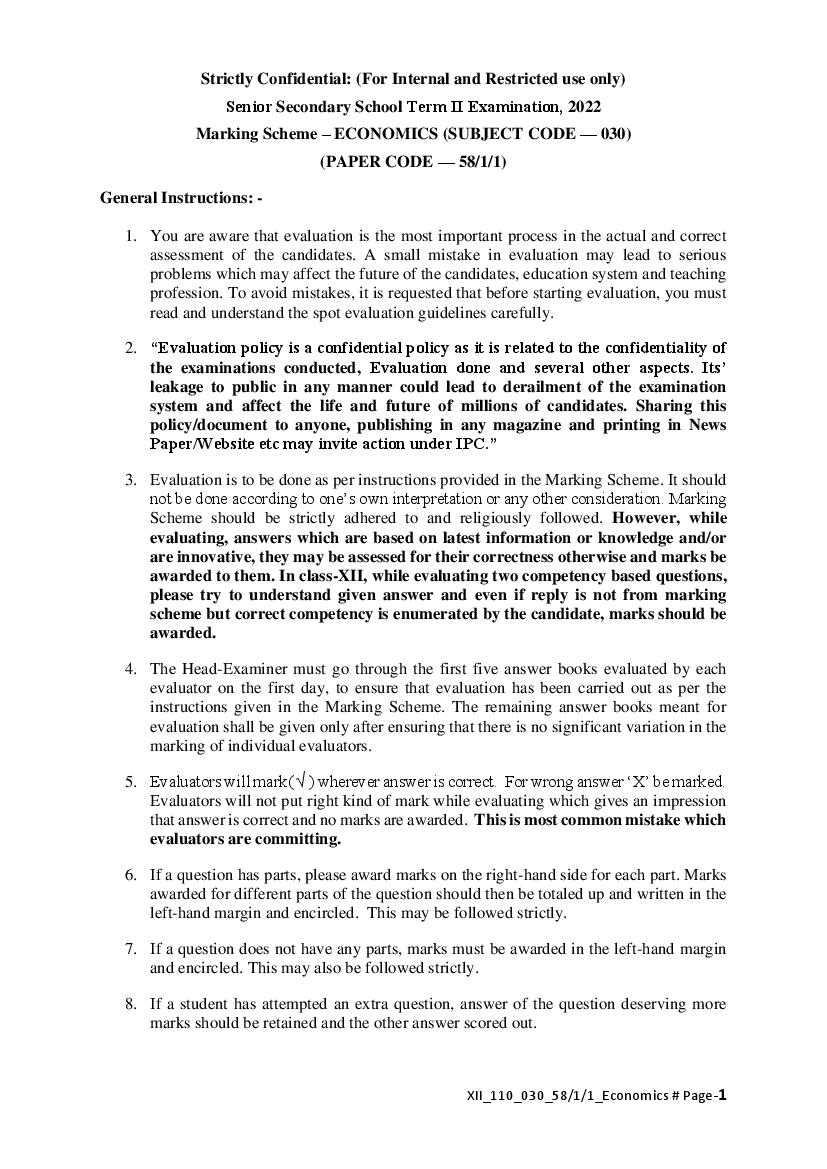
Senior Secondary School Term II Examination, 2022
Marking Scheme – ECONOMICS (SUBJECT CODE — 030)
(PAPER CODE — 58/1/1)
General Instructions: -
1. You are aware that evaluation is the most important process in the actual and correct
assessment of the candidates. A small mistake in evaluation may lead to serious
problems which may affect the future of the candidates, education system and teaching
profession. To avoid mistakes, it is requested that before starting evaluation, you must
read and understand the spot evaluation guidelines carefully.
2. “Evaluation policy is a confidential policy as it is related to the confidentiality of
the examinations conducted, Evaluation done and several other aspects. Its’
leakage to public in any manner could lead to derailment of the examination
system and affect the life and future of millions of candidates. Sharing this
policy/document to anyone, publishing in any magazine and printing in News
Paper/Website etc may invite action under IPC.”
3. Evaluation is to be done as per instructions provided in the Marking Scheme. It should
not be done according to one’s own interpretation or any other consideration. Marking
Scheme should be strictly adhered to and religiously followed. However, while
evaluating, answers which are based on latest information or knowledge and/or
are innovative, they may be assessed for their correctness otherwise and marks be
awarded to them. In class-XII, while evaluating two competency based questions,
please try to understand given answer and even if reply is not from marking
scheme but correct competency is enumerated by the candidate, marks should be
awarded.
4. The Head-Examiner must go through the first five answer books evaluated by each
evaluator on the first day, to ensure that evaluation has been carried out as per the
instructions given in the Marking Scheme. The remaining answer books meant for
evaluation shall be given only after ensuring that there is no significant variation in the
marking of individual evaluators.
5. Evaluators will mark( √ ) wherever answer is correct. For wrong answer ‘X’ be marked.
Evaluators will not put right kind of mark while evaluating which gives an impression
that answer is correct and no marks are awarded. This is most common mistake which
evaluators are committing.
6. If a question has parts, please award marks on the right-hand side for each part. Marks
awarded for different parts of the question should then be totaled up and written in the
left-hand margin and encircled. This may be followed strictly.
7. If a question does not have any parts, marks must be awarded in the left-hand margin
and encircled. This may also be followed strictly.
8. If a student has attempted an extra question, answer of the question deserving more
marks should be retained and the other answer scored out.
XII_110_030_58/1/1_Economics # Page-1
Page 2
only once.
10. A full scale of 40 marks (example 0-40 marks as given in Question Paper) has to be
used. Please do not hesitate to award full marks if the answer deserves it.
11. Every examiner has to necessarily do evaluation work for full working hours i.e. 8 hours
every day and evaluate 30 answer books per day in main subjects and 35 answer books
per day in other subjects (Details are given in Spot Guidelines).This is in view of the
reduced syllabus and number of questions in question paper.
12. Ensure that you do not make the following common types of errors committed by the
Examiner in the past:-
• Leaving answer or part thereof unassessed in an answer book.
• Giving more marks for an answer than assigned to it.
• Wrong totaling of marks awarded on a reply.
• Wrong transfer of marks from the inside pages of the answer book to the title page.
• Wrong question wise totaling on the title page.
• Wrong totaling of marks of the two columns on the title page.
• Wrong grand total.
• Marks in words and figures not tallying.
• Wrong transfer of marks from the answer book to online award list.
• Answers marked as correct, but marks not awarded. (Ensure that the right tick mark
is correctly and clearly indicated. It should merely be a line. Same is with the X for
incorrect answer.)
• Half or a part of answer marked correct and the rest as wrong, but no marks
awarded.
13. While evaluating the answer books if the answer is found to be totally incorrect, it
should be marked as cross (X) and awarded zero (0)Marks.
14. Any unassessed portion, non-carrying over of marks to the title page, or totaling error
detected by the candidate shall damage the prestige of all the personnel engaged in the
evaluation work as also of the Board. Hence, in order to uphold the prestige of all
concerned, it is again reiterated that the instructions be followed meticulously and
judiciously.
15. The Examiners should acquaint themselves with the guidelines given in the Guidelines
for spot Evaluation before starting the actual evaluation.
16. Every Examiner shall also ensure that all the answers are evaluated, marks carried over
to the title page, correctly totaled and written in figures and words.
17. The Board permits candidates to obtain photocopy of the Answer Book on request in
an RTI application and also separately as a part of the re-evaluation process on payment
of the processing charges.
XII_110_030_58/1/1_Economics # Page-2
Page 3
Senior Secondary School Examination TERM–II, 2022
ECONOMICS (Subject Code — 030)
[ Paper Code — 58/1/1 ]
Maximum Marks : 40
Q. No. EXPECTED ANSWER / VALUE POINTS Marks
1. a) Using a suitable example, distinguish between positive externalities and
negative externalities.
Positive externalities refer to benefits caused by one entity to another, without ½
being paid for it.
Whereas, negative externalities refer to the harms caused by one entity to
another, without being penalised for it. ½
For example: A new park developed by the municipal corporation raises the
welfare of the locality, is an example of positive externalities. In case the same
1
park is used by people for anti-social activities which leads to insecurity among
the residents, is an example of negative externalities.
2
(any other suitable example to be awarded marks) ________
OR
(b) Using a suitable example, distinguish between stock variables and flow
variables.
Stock variables are those variables whose quantity is measured at a particular ½
point of time.
Whereas, flow variables are those variables whose quantity is measured over a ½
period of time.
1
For example: Wealth is a stock variable and Income is a flow variable.
(any other suitable example to be awarded marks)
2
2. Justify the following statement with valid argument:
‘At higher levels of income people generally have lower Marginal
Propensity to Consume (MPC).’
At a lower level of income, a consumer generally spends a larger proportion of
his/her income on consumption expenditure (basic survival requirement). As 2
the income increases, owing to the psychological behaviour of a rational
consumer he tends to save more.
Hence, at higher levels of income people generally have lower Marginal
Propensity to Consume (MPC).
(to be marked as a whole)
3. a) State any two harmful effects of Global warming.
XII_110_030_58/1/1_Economics # Page-3
Page 4
(i) Melting of Polar ice, resulting in rise in sea level and coastal flooding. 1
(ii) Increase in incidence of tropical diseases. 1
(any other valid point/reason/argument should be awarded marks accordingly) 2
Or
(b) State any two advantages of ‘sustainable development’.
Two advantages of sustainable development are:
(i) Minimises environmental problems. 1
(ii) Provides better potential average quality of life to all future generations. 1
(any other valid point/reason/argument should be awarded marks accordingly)
2
4. Calculate equilibrium level of income for a hypothetical economy, for
which it is given that:
(i) Autonomous Investments (Io)= ₹ 2,500 crores, and
(ii) Consumption Function; C= 1000+0.8Y
where C= Consumption and Y = Income.
Given, 𝐶 = 1,000 + 0 ⋅ 8𝑌
I = ₹2,500 𝑐𝑟𝑜𝑟𝑒𝑠
At the equilibrium level, Y = C + I ½
Therefore, Y = 1,000 + 0 ⋅ 8𝑌 + 2500 ½
Y − 0 ⋅ 8𝑌 = 3,500 ½
Equilibrium level of Income(Y) = ₹ 17,500 crore ½
2
OR ________
(b) Calculate, change in Income (ΔY) for a hypothetical economy, for which
it is given that:
(i) Marginal Propensity to Consume (MPC) = 0.75, and
(ii) Change in Investments (Δl)= ₹ 20,000 crore.
Given, 𝛥𝐼 = ₹ 20,000 crore
MPC = 0 75
As we know
1 1 1
Multiplier(𝐾) = = = 0⋅25 = 4
1−𝑀𝑃𝐶 1−0⋅75
1
Y
We know, K = ½
I
Y
4=
20, 000
Change in Income (𝛥𝑌) = ₹ 80,000 crore ½
2
XII_110_030_58/1/1_Economics # Page-4
Page 5
requirements changes significantly.’
Do you agree with the given statement? Support your answer with suitable
argument.
Yes, as the income rises, the composition of infrastructure requirements
changes significantly.
● For low-income countries, basic infrastructure services like irrigation,
2
transport and power are kept on priority.
● As economies develop, most of their basic consumption demands are met,
the share of agriculture in the economy shrinks and more services related
infrastructure is required.
For example: Power, Transportation, Telecommunication and IT related
infrastructural services are needed more in high income countries.
(to be marked as a whole)
( any other valid point /reason/ argument is to be awarded marks accordingly)
6. (a) Estimate the value of Nominal Gross Domestic Product (GDP) for a
hypothetical economy. The values of Real Gross Domestic Product (GDP)
and Price Index are given as ₹ 500 crore and 125 respectively.
Given,
Real GDP = ₹ 500 crore
Price index = 125
Nominal GDP
Price index = 100 1
Real GDP
Nominal GDP 1
125 = 100
500
½
125 500
Or, Nominal GDP =
100 ½
Nominal GDP = ₹ 625 crore
OR 3
________
(b) Giving valid reasons explain, which of the following will not be
included in the estimation of National Income of India ?
(i) Purchase of shares of Sethi Ltd. by an investor in the Bombay Stock
Exchange.
(ii) Salaries paid by Indian Embassy situated at Japan, to the local workers.
(iii) Depreciation on capital assets charged by firms.
(i) Purchase of shares of Sethi Ltd. by an investor in the Bombay Stock 1
Exchange is a transaction, which is a mere paper claim and do not lead
to any value addition and thus will not be included.
(ii) Salaries paid by Indian Embassy situated at Japan, to the local workers 1
is a factor income paid to non-residents and thus will not be included.
(iii)Depreciation on capital assets is not included as it is a mere accounting 1
entry that is needed to accommodate regular wear and tear of capital.
3
XII_110_030_58/1/1_Economics # Page-5
Page 6
basis of any two indicators from the given schedule :
Indicators of Health in India in Comparison with other nations, 2015-17.
S.No. Indicators India China USA Sri
Lanka
(i) Infant Mortality 34 8 5.7 7.5
Rate/1000 live
births
(ii) Under-5, Mortality 39.4 9.3 6.6 8.8
Rate/1000 live
births
(iii) Infants Immunised 88 99 95 99
(DTP) in %
(iv) Government Health 3.9 5.7 16.8 3
spendings as a % of
GDP
Sources: HDI 2018 and WDI 2018
Comparison of India and Sri Lanka on the basis of Health Indicators:
1) India has a higher Infant Mortality Rate (34/1000 live births) as
compared to Sri Lanka (7.5/1000 live births) due to lack of health
facilities.
2) India has as a higher Under- 5 Mortality Rate (39.4/1000 live birth) as
compared to Sri Lanka (8.8/1000 Livebirths) due to malnutrition and
lack of access to healthcare facilities.
3) Infant immunisation (DTP) in % is higher in Sri Lanka (99%) as
compared to India (88%) because a very low proportion of Indian
1 ½ x2
population utilizes public health services.
4) Government health spending as a percentage of GDP is marginally
higher in India(3.9) than Sri Lanka (3). India is showing a higher
government spending as percentage of GDP, but it is much below the
needs of the economy, given the size of its population.
(any two valid points to be awarded marks)
3
XII_110_030_58/1/1_Economics # Page-6
Page 7
multiplier in an economy.
The working of multiplier is based on the fact one’s expenditure is other’s
income. Suppose the increase in investment is by ₹ 4,000 crore and marginal ½
propensity to consume is 0.5:
Round Increase in Increase in Increase in Increase in
investment income consumption savings
( I ) ( Y ) ( C ) ( S )
(₹ in (₹ in crore) (₹ in crore) (₹ in crore)
crore)
1 4000 4000 2000 2000
2 — 2000 1000 1000
3 — 1000 500 500
4 — 500 250 250 1½
—
— . . .
—
— . . .
Total 4000 8000 4000 4000
The above table shows that an increase in investment of ₹ 4,000 crore leads to 1
a total increase of ₹ 8,000 crore in income.
(any alternative presentation to be awarded marks)
Working Note:
1 1 1
𝐾 = 1−𝑀𝑃𝐶 = 1−0.5 = 0.5 = 2
𝛥𝑌
𝐾 = 𝛥𝐼
𝛥𝑌
2 = 4000
𝛥𝑌 = 8000 𝑐𝑟𝑜𝑟𝑒
(marks not to be deducted if working note is not given) 3
9. (a) (i) From the following data, calculate the value of Gross National
Product at Factor Cost (GNPFC):
S. No. Items Amount in
(₹ Crore)
(i) Compensation of Employees 12,000
(ii) Rent and Interest 1,800
(iii) Indirect taxes 1,120
(iv) Profits 1,500
(v) Depreciation 1,100
(vi) Subsidies 210
(vii) Net Factor Income from Abroad (-)120
(viii) Mixed Income of Self Employed 1,300
XII_110_030_58/1/1_Economics # Page-7
Page 8
= 12,000 + 1,800 + 1,500 + 1,100 + (−)120 + 1,300 1
= ₹ 17,580 crore ½
(ii)Distinguish between Rent and Royalty.
Rent is a factor income earned by the owners for lending their services such as 1
land, building etc.
Royalty is the income earned by a person /institution for lending Intellectual 1
Property Rights and rights of sub soil assets.
5
OR ________
(b)(i) Calculate the value of 'Net Value Added at Factor Cost' (NVAFC)
using the given data:
S. No. Items Amount
in(₹ '000)
(i) Sale of Rice in the market. 580
(ii) Purchase of Tractor and Thrasher 400
(iii) Procurement of Rice by the government 20
(iv) Self consumption of Rice during the year 15
(v) Expenditure on running and maintenance of 20
Tractor and Thrasher.
(vi) Fertilizer subsidies received from the government 3
𝑁𝑉𝐴𝐹𝐶 = (𝑖) + (𝑖𝑖𝑖) + (𝑖𝑣) -(v) +(𝑣𝑖)
1½
= 580 + 20 + 15 − 20 + 3
1
= ₹ 598 thousand ½
(ii) Distinguish between 'value of output' and 'value addition'.
Value of output is the estimated money value of final goods and services, 1
inclusive of change in stock and production for self consumption.
Whereas, Value added is the excess of value of output over the value of 1
intermediate consumption.
5
10. ‘India has been dealing with the problem of Deficient Demand, since the
imposition of Covid lockdown in March 2020’.
State and discuss any two monetary policy measures to combat the
situation of Deficient Demand in India.
Two monetary measures which may be used to solve the problem of deficient
demand are:
(i) Under Deficient Demand situation, the Central Bank may reduce the bank 2½
rate, which further decreases the lending rates of commercial banks. This
induces the public to borrow more funds and ultimately leads to an
increase in Aggregate Demand
XII_110_030_58/1/1_Economics # Page-8
Page 9
securities from open market. It will increase the money supply in the 2½
hands of the public and enhances the purchasing power and ultimately
increases level of Aggregate Demand in the economy.
(any other monetary measure to be awarded marks)
5
11. (i) 'In the recent past the Government of India has taken vital steps to
revive and popularise Indian System of Medicine (ISM)'.
Do you agree with the given statement? Justify your answer with valid
reasons.
The given statement is true. Indian Systems of Medicine (ISM) have huge
potential and can solve a large part of health care problems because they are
effective, safe and less expensive. Under AYUSH project, the government has 2
stressed upon precautionary medication.
Recently serious efforts have been undertaken by the Government to set up a
framework to promote research in the field of ISM.
(ii) 'Casualization of workforce has became a perennial problem of the
Indian economy.’ Justify the given statement with valid arguments.
Casualisation of workforce has become a perennial problem for India because
of:
o Slower growth rate of employment in the organised sector.
o Rapidly expanding construction and allied services have led to
increase in demand for casual labour. 3
o Self-employed small and marginal farmers are becoming casual
workers due to lower earnings in agricultural activities.
(to be marked as a whole)
5
Case Study:
Read the following text carefully and answer, Q. No.-12 and 13, given
below:
Chinese Economy Risks Deeper Slowdown than Markets Realise -
(Bloomberg, 24th October, 2021)
China's Economy risks slowdown faster than global investors realise. It is
pushing to cut its dependence on real-estate. It has started regulating
sectors from education to technology, as it is facing power shortage and the
pandemic.
Many economists have warned that the GDP growth rate will fall to 8.2%
this year and to below 5% in the next year.
China is now planning to stabilise debt growth, curb inequality and
channelise resources into hi-tech manufacturing. Data released in last week
already showed a sharp slow down in third quarter GDP growth to 4.9%
from 7.9% in the previous quarter. There is more pain likely to come as
electricity shortage persist, while new COVID 19 infections are expected to
rise in coming days.
Even before the pandemic hit, China was surprising economists with
slower-than-expected growth rate caused by the easing off debt risks.
XII_110_030_58/1/1_Economics # Page-9
Page 10
"above 6%" in the coming financial year.
China has signalled, in recent weeks that it could loosen some policies like
telling banks to pick up the pace of mortgage lending as a short term
stimulus. Governor of People's Bank of China Yi Gang, recently said he
sees an expansion of about 8% for this year.
China's slowdown comes as the global recovery from COVID-19 risks
looses momentum. Among those at risks from falling investments in China
are commodity exporters like Australia, South Africa, Chile, Peru and
Brazil. Slower trades could also hit countries like Malaysia, Singapore and
Thailand.
The other risk is that China's policy-makers may struggle to flick the
switch back to growth model if they feel that's needed. Economists noted
that the electricity shortages that are crimping industrial production will
make it harder to cushion growth by boosting investment in infrastructure.
That kind of policy could only work next year once the power crunch eases.
12. State and discuss any two reasons that exhibit slowdown in the Chinese
economy.
Two reasons exhibiting the slowdown in Chinese economy are
(i) Investment in China is expected to fall due to fall in demand from 1½
commodity exporters such as Australia, South Africa, Chile, Peru and
Brazil.
(ii) Electricity shortages crimped industrial production; it will make it 1½
harder to cushion growth by boosting investment in infrastructure.
(any other valid point/ reason/argument to be awarded marks) 3
13. Discuss briefly any two measures, which you may suggest as an economic
advisor to the Government of China.
Two measures to curb the situation may be quoted as:
(i) Suggesting banks to pick up the pace of mortgage lending as a short-term 1½
stimulus.
(ii) Planning to cut dependence on real estates and regulate sectors from 1½
education to technology. 3
(any other valid point/ reason/argument to be awarded marks)
***
XII_110_030_58/1/1_Economics # Page-10
Document Details
| Board / Org | CBSE |
| Exam | Class 12 |
| Type | Solution |
| Pages | 10 |
| Updated | 22 Jul 2026 |