MAHA SET 2015 Question Paper 2 Sociology
Finished viewing? Save it for later —
Download MAHA SET 2015 Question Paper 2 Sociology (PDF · 24 pages)About MAHA SET 2015 Question Paper 2 Sociology
MAHA SET 2015 Question Paper 2 Sociology is available here for free download. Published by Maharashtra Exams for MAHA SET, this question paper can be viewed online or downloaded as a PDF (24 pages). Candidates preparing for MAHA SET can use MAHA SET 2015 Question Paper 2 Sociology to understand the exam pattern, the type of questions asked, and the overall difficulty level.
Frequently Asked Questions
How can I download MAHA SET 2015 Question Paper 2 Sociology?
Open this page and click the Download button to save MAHA SET 2015 Question Paper 2 Sociology as a PDF. It is completely free on AglaSem Docs.
Is MAHA SET 2015 Question Paper 2 Sociology free to download?
Yes. MAHA SET 2015 Question Paper 2 Sociology can be viewed online and downloaded as a PDF free of cost on AglaSem Docs.
How many pages does MAHA SET 2015 Question Paper 2 Sociology have?
MAHA SET 2015 Question Paper 2 Sociology contains 24 pages, which you can read online or download together as a single PDF.
Where can I find more MAHA SET study material?
You can find more MAHA SET question papers, sample papers, syllabus, and answer keys on AglaSem Docs.
MAHA SET 2015 Question Paper 2 Sociology – Text
Read the full text of this question paper below — useful to quickly search, copy and reference the content online without downloading the PDF.
📄 View text version (24 pages)
Page 1
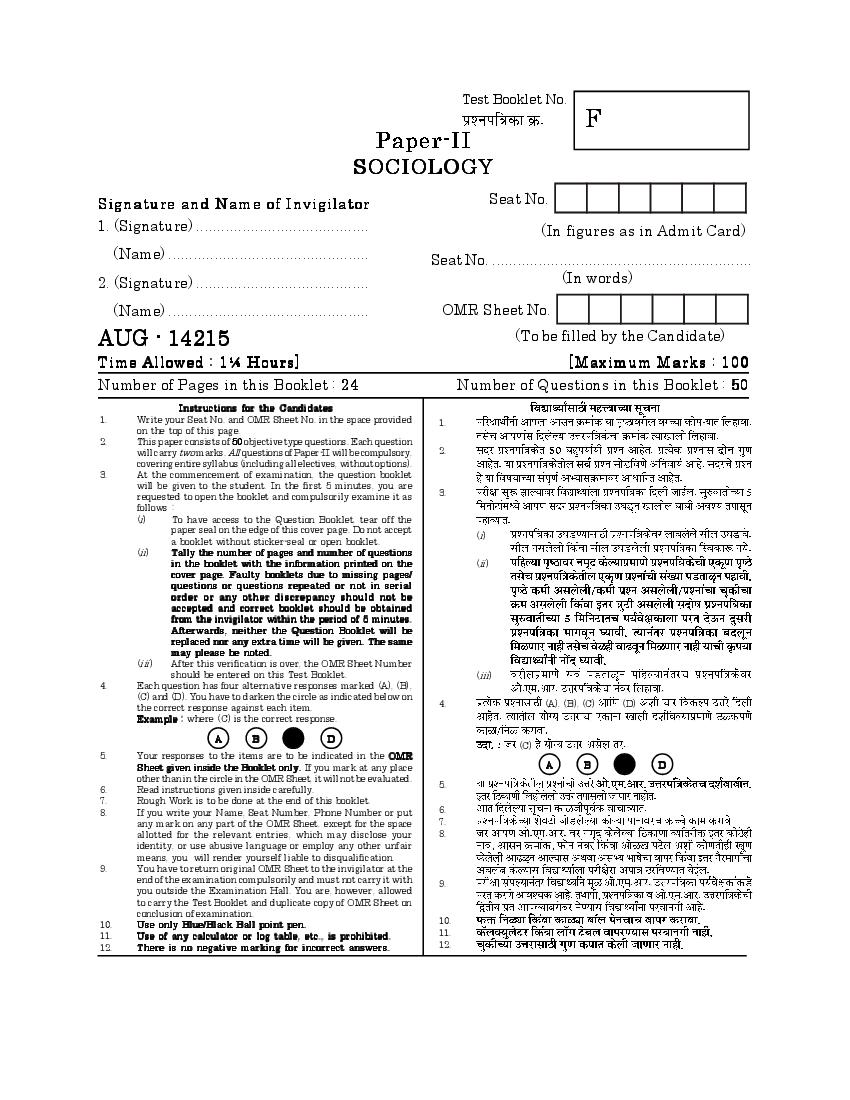
F
SOCIOLOGY
Signature and Name of Invigilator Seat No.
1. (Signature) ......................................... (In figures as in Admit Card)
(Name) ................................................ Seat No. ..............................................................
2. (Signature) ......................................... (In words)
(Name) ................................................ OMR Sheet No.
AUG - 14215 (To be filled by the Candidate)
Time Allowed : 1¼ Hours] [Maximum Marks : 100
Number of Pages in this Booklet : 24 Number of Questions in this Booklet : 50
Instructions for the Candidates
1. Write your Seat No. and OMR Sheet No. in the space provided 1.
on the top of this page.
2. This paper consists of 50 objective type questions. Each question
will carry two marks. All questions of Paper-II will be compulsory, 2.
covering entire syllabus (including all electives, without options).
3. At the commencement of examination, the question booklet
will be given to the student. In the first 5 minutes, you are
requested to open the booklet and compulsorily examine it as 3.
follows :
(i) To have access to the Question Booklet, tear off the
paper seal on the edge of this cover page. Do not accept
(i)
a booklet without sticker-seal or open booklet.
(ii) Tally the number of pages and number of questions
in the booklet with the information printed on the (ii)
cover page. Faulty booklets due to missing pages/
questions or questions repeated or not in serial
o rder or any other discre pancy should not be
accepted and correct booklet should be obtained
from the invigilator within the period of 5 minutes.
Afterwards, neither the Question Booklet will be
replaced nor any extra time will be given. The same
may please be noted.
(iii) After this verification is over, the OMR Sheet Number
should be entered on this Test Booklet. (iii)
4. Each question has four alternative responses marked (A), (B),
(C) and (D). You have to darken the circle as indicated below on
the correct response against each item. 4. (A), (B), (C) (D)
Example : where (C) is the correct response.
A B D
(C)
5. Your responses to the items are to be indicated in the OMR
Sheet given inside the Booklet only. If you mark at any place A B D
other than in the circle in the OMR Sheet, it will not be evaluated.
5.
6. Read instructions given inside carefully.
7. Rough Work is to be done at the end of this booklet.
8. If you write your Name, Seat Number, Phone Number or put 6.
any mark on any part of the OMR Sheet, except for the space 7.
allotted for the relevant entries, which may disclose your 8.
identity, or use abusive language or employ any other unfair
means, you will render yourself liable to disqualification.
9. You have to return original OMR Sheet to the invigilator at the
end of the examination compulsorily and must not carry it with 9.
you outside the Examination Hall. You are, however, allowed
to carry the Test Booklet and duplicate copy of OMR Sheet on
conclusion of examination.
10. Use only Blue/Black Ball point pen. 10.
11. Use of any calculator or log table, etc., is prohibited. 11.
12. There is no negative marking for incorrect answers. 12.
Page 2
Page 3
Paper II
II
Time Allowed : 75 Minutes] [Maximum Marks : 100
Note : This paper contains Fifty (50) multiple choice questions. Each question
carrying Two (2) marks. Attempt All questions.
(50) (2)
1. Which of the following is an example 1.
of ascribed status ?
(A) Father (A)
(B) Husband (B)
(C) Woman (C)
(D) Doctor (D)
2. Which of the following is not a type 2.
of interview ?
(A) Focused interview (A)
(B) Directive interview (B)
(C) Functional interview (C)
(D) Indepth interview (D)
3 [P.T.O.
Page 4
Merton as ................... .
(A) Manifest and Latent (A)
(B) Objective and Subjective (B)
(C) Involved and Relative (C)
(D) Dormant and Latent (D)
4. Culture pertains to ................... . 4.
(A) Social heritage (A)
(B) Social etiquette (B)
(C) Religious and moral attitudes (C)
(D) Mode of production (D)
5. Role conflict is a major phenomenon 5.
of ............................. .
(A) Primitive Society (A)
(B) Agrarian Society (B)
(C) Militant Society (C)
(D) Industrial Society (D)
4
Page 5
statement about ‘norm’ ?
(A) an abstract pattern of
(A)
interaction
(B)
(B) an abstract pattern of
behaviour
(C)
(C) an abstract pattern of culture
(D)
(D) an abstract pattern of values
7.
7. The evolutionary perspective of
stratification is stated by ......... .
(A)
(A) Gerhard Lenski
(B)
(B) Ralf Dahrendorf
(C) Davis and Moore (C)
(D) Karl Marx (D)
8. Who among the following developed 8.
socialization theory of collective
representation ?
(A)
(A) M. Weber
(B)
(B) C.H. Cooley
(C) G.H. Mead (C)
(D) E. Durkheim (D)
5 [P.T.O.
Page 6
(i) internalization of social norms
(ii) gradual changing of organism (i)
(ii)
(iii) declaring everything as
belonging to the society (iii)
(iv) training to adopt to society
(iv)
Find the correct combination
according to the code :
Codes :
(A) (ii) and (iii)
(A) (ii) (iii)
(B) (i) and (ii)
(B) (i) (ii)
(C) (i), (ii) and (iii)
(C) (i), (ii) (iii)
(D) (i) and (iv)
(D) (i) (iv)
10. Which of the following terms is
not related with sociology as a 10.
science ?
(A) Empirical science (A)
(B) Synoptic science (B)
(C) Positive science (C)
(D) Formative science (D)
11. The simplest form of measure of 11.
dispersion is :
(A) Frequency distribution (A)
(B) Range (B)
(C) Correlation (C)
(D) Association (D)
6
Page 7
(A) Value of the middle items (A)
(B) Value of the extreme items (B)
(C) Average (C)
(D) Lowest value (D)
13. Reliability means : 13.
(A) Data from known source (A)
(B) Consistency of measurement of (B)
a concept
(C) Report based on reliable data (C)
(D) Measuring correlation
14. ‘The mores can make anything (D)
Right and Prevent the 14.
condemnation of Anything.’ Who
made this statement ?
(A) Johnson (A)
(B) Summner (B)
(C) Gillin and Gillin (C)
(D) Shepard (D)
15. Qualitative research does not 15.
include :
(A) Emphasis on process (A)
(B) Subjective interpretation (B)
(C) Analysis of context (C)
(D) Objectivity of researcher (D)
7 [P.T.O.
Page 8
the correct answer from the codes
given below :
Methods
(a)
(a) Participant observation
(b)
(b) Questionnaire
(c)
(c) Case study
(d)
(d) Interview
Studies
(i)
(i) American Soldier
(ii)
(ii) Street Corner Society
(iii)
(iii) Suicide
(iv)
(iv) Five Families
(v)
(v) The Affluent Worker
Codes :
(a) (b) (c) (d)
(a) (b) (c) (d)
(A) (i) (iii) (iv) (ii)
(A) (i) (iii) (iv) (ii)
(B) (ii) (v) (iii) (i) (B) (ii) (v) (iii) (i)
(C) (ii) (v) (iv) (i) (C) (ii) (v) (iv) (i)
(D) (iv) (iii) (i) (ii) (D) (iv) (iii) (i) (ii)
17. In content analysis the unit of 17.
analysis is not :
(A) Words (A)
(B) Individual Behaviour (B)
(C) Sentences (C)
(D) Images (D)
8
Page 9
measurement is known as :
(A) Reliability
(A)
(B) Objectivity
(B)
(C) Validity
(C)
(D) Verifiability
19. Given below are two statements, one (D)
is labelled as Assertion (A) and the 19. (A)
other is labelled as Reason (R) :
(R)
Assertion (A) :
(A) :
Formulation of hypothesis helps to
delimit the field of inquiry by
singling out the pertinent facts.
Reason (R) : (R) :
It is a mistake to consider
hypotheses as facts, no matter how
systematically they have been
formulated.
Select the correct option : (A) (A) (R)
(A) Both (A) and (R) are true and (R) (A)
(R) is the correct explanation
of (A)
(B) (A) (R)
(B) Both (A) and (R) are true but
(R) (A)
(R) is not the correct explanation
of (A)
(C) (A) is true but (R) is false (C) (A) (R)
(D) (A) is false but (R) is true (D) (A) (R)
9 [P.T.O.
Page 10
of probability sampling ?
(A) Simple random (A)
(B) Snowball (B)
(C) Systematic
(C)
(D) Stratified
(D)
21. The method used to analyse
21.
relationship between variables is
known as :
(A) Dispersion
(B) Multivariate analysis (A)
(C) Correlational analysis (B)
(D) Regression (C)
22. Given below are two statements, one (D)
is labelled as Assertion (A) and the 22. (A)
other is labelled as Reason (R) : (R)
Assertion (A) :
(A) :
In participant observation, the
observer takes part in the activities
of those he observes.
Reason (R) : (R) :
A major problem for the participant
observer is that his presence to some
degree influence the action of those
he observes.
Select the correct option : (A) (A) (R)
(A) Both (A) and (R) are true and (R) (A)
(R) is the correct explanation
of (A)
(B) (A) (R)
(B) Both (A) and (R) are true but
(R) (A)
(R) is not the correct explanation
of (A)
(C) (A) is true but (R) is false (C) (A) (R)
(D) (A) is false but (R) is true (D) (A) (R)
10
Page 11
of correlation ?
(A) Positive correlation (A)
(B) Average correlation (B)
(C) Negative correlation (C)
(D) Zero correlation
(D)
24. Which of the following terms is used
24.
by Burgess for the case study
method ?
(A)
(A) Positivism
(B)
(B) Life History
(C)
(C) Cultural Microscope
(D)
(D) Social Microscope
25.
25. Which one of the following is not an
example of a quasi group ?
(A)
(A) Income group
(B)
(B) Age group
(C) Occupational group (C)
(D) Trade Union (D)
11 [P.T.O.
Page 12
correct answer from the codes :
List I I
(Thinkers)
(a) Weber (a)
(b) Pareto (b)
(c) Blumer (c)
(d) Mead (d)
List II II
(Concepts)
(i) Symbolic interactionism (i)
(ii) Generalized other (ii)
(iii) Ideal types (iii)
(iv) Circulation of Elites (iv)
(v) Social fact (v)
Codes :
(a) (b) (c) (d) (a) (b) (c) (d)
(A) (iii) (iv) (i) (ii) (A) (iii) (iv) (i) (ii)
(B) (i) (iv) (iii) (ii) (B) (i) (iv) (iii) (ii)
(C) (iii) (v) (ii) (iv) (C) (iii) (v) (ii) (iv)
(D) (ii) (v) (iv) (iii) (D) (ii) (v) (iv) (iii)
12
Page 13
Marx’s theory is mostly criticized ?
(A) Excessive emphasis on economic
factor (A)
(B) Excessive emphasis on culture (B)
(C) Excessive emphasis on ideology (C)
(D) Excessive emphasis on state (D)
28. Match the following by selecting the 28.
correct answer from the codes :
List I I
(Thinkers)
(a) Malinowski (a)
(b) Durkheim (b)
(c) Parsons (c)
(d) Collins (d)
List II II
(Concepts)
(i) Solidarity (i)
(ii) Materialism (ii)
(iii) Functional pre-requisites (iii)
(iv) Conflict theory of stratification (iv)
(v) Universal functionalism (v)
Codes :
(a) (b) (c) (d) (a) (b) (c) (d)
(A) (i) (iv) (ii) (iii) (A) (i) (iv) (ii) (iii)
(B) (ii) (v) (iv) (i) (B) (ii) (v) (iv) (i)
(C) (v) (i) (iii) (iv) (C) (v) (i) (iii) (iv)
(D) (v) (i) (iv) (ii) (D) (v) (i) (iv) (ii)
13 [P.T.O.
Page 14
interactionism differs from
functionalism and Marxism ?
Find the correct answer from the
codes :
(1) Provides an explanation for (1)
human society
(2)
(2) Focuses on small scale
interaction (3)
(3) Rejects the notion of social (4)
system
(4) It does not regard human action
as response to the system
(A) (1) (2)
Codes :
(B) (2), (3) (4)
(A) (1) and (2)
(B) (2), (3) and (4) (C) (3) (4)
(C) (3) and (4) (D) (1), (2) (4)
(D) (1), (2) and (4) 30.
30. Functionalist analysis is prominent
in the work of the following thinkers.
Arrange them chronologically.
(Identify the correct sequence from
codes) (i)
(i) Malinowski (ii)
(ii) Durkheim (iii)
(iii) Parsons (iv)
(iv) Merton
Codes :
(A) (ii) (i) (iii) (iv)
(A) (ii) (i) (iii) (iv)
(B) (i) (ii) (iii) (iv)
(B) (i) (ii) (iii) (iv)
(C) (i) (iii) (ii) (iv) (C) (i) (iii) (ii) (iv)
(D) (ii) (i) (iv) (iii) (D) (ii) (i) (iv) (iii)
14
Page 15
interactionism rests on three basic
premises. Which are they ?
(Find the correct answer according
to codes)
(i)
(i) The importance of meaning
(ii)
(ii) The source of meaning
(iii)
(iii) Responding to external stimuli
(iv) Interpretation (iv)
Codes :
(A) (i) (ii) (iii) (A) (i) (ii) (iii)
(B) (i) (iii) (iv) (B) (i) (iii) (iv)
(C) (ii) (iii) (iv) (C) (ii) (iii) (iv)
(D) (i) (ii) (iv) (D) (i) (ii) (iv)
32. The mode is : 32.
(A) Central Point (A)
(B) Arithmetic Average (B)
(C) Crude measurement (C)
(D) The size of the most frequently (D)
occurring measurement
33. Which one of the following is the
33.
significant intellectual roots of
symbolic interactionism in general
and Mead’s work in particular ?
(A) Marxism (A)
(B) Structuralism (B)
(C) Philosophy of Pragmatism (C)
(D) Linguistics (D)
15 [P.T.O.
Page 16
change that did not include concern
with conflict phenomena appeared to
be seriously deficient ?
(A) Nadel
(A)
(B) Levi-Strauss
(B)
(C) Merton
(C)
(D) Coser
35. Who among the following argued (D)
that capitalist society has a 35.
dominant ideology that serves the
interests of the ruling class ?
(A) M. Weber (A)
(B) V. Pareto (B)
(C) K. Marx
(C)
(D) R. Dahrendorf
(D)
36. Given below are two statements, one
is labelled as Assertion (A) and the 36. (A)
other is labelled as Reason (R) : (R)
Assertion (A) : (A) :
According to Marxism, social change
is not a smooth orderly progression
which gradually unfolds in
harmonius evolution.
(R) :
Reason (R) :
Marxism views that social change
proceeds from contradictions built
into society which is a source of
tension, conflict and change.
Choose the correct answer by using
the codes given below :
Codes : (A) (A) (R)
(A) Both (A) and (R) are true and (R) (A)
(R) is the correct explanation
of (A) (B) (A) (R)
(B) (A) is true but (R) is false
(C) (A) is false but (R) is true (C) (A) (R)
(D) Both (A) and (R) are true but
(R) is not the correct (D) (A) (R)
explanation of (A) (R) (A)
16
Page 17
on :
(A) Eradication of conflict (A)
(B) Increasing social integration (B)
(C) Change (C)
(D) Equilibrium
(D)
38. Match the following by selecting the
38.
correct answer from the codes :
Boo
Bo o k s
(a) Structure and Function in
(a)
Primitive Society
(b) Sexual Life of Savages
(b)
(c) The Elementary Structure of
Kinship (c)
(d) The Foundation of Social (d)
Anthropology
Authors (i)
(i) Radcliffe Brown (ii)
(ii) Levi-Strauss (iii)
(iii) Malinowski
(iv)
(iv) Parsons
(v)
(v) Nadel
Codes :
(a) (b) (c) (d)
(a) (b) (c) (d)
(A) (i) (iii) (v) (iv)
(A) (i) (iii) (v) (iv)
(B) (ii) (iv) (v) (iii) (B) (ii) (iv) (v) (iii)
(C) (i) (iii) (ii) (v) (C) (i) (iii) (ii) (v)
(D) (ii) (iv) (iii) (v) (D) (ii) (iv) (iii) (v)
17 [P.T.O.
Page 18
system theory ?
(A) Parsons (A)
(B) Merton
(B)
(C) Weber
(C)
(D) Nadel
(D)
40. Given below are two statements, one
is labelled as Assertion (A) and the 40. (A)
other is labelled as Reason (R) : (R)
Assertion (A) : (A) :
The lottery method of picking up
names is an example of random
sampling.
(R) :
Reason (R) :
In this method, every chit in the box
has an equal chance of being
picked.
In this context of the above
statement, which one of the
following is correct ?
(A) (A) (R)
Codes :
(R) (A)
(A) (A) and (R) are correct and (R)
is the correct explanation of (A) (B) (A) (R)
(R) (A)
(B) (A) and (R) are correct but (R)
is not the correct explanation (C) (A) (R)
of (A)
(C) (A) is correct but (R) is false (D) (A) (R)
(D) (A) is false but (R) is correct
18
Page 19
human actions are :
(A) Logical (A)
(B) Illogical (B)
(C) Non-logical
(C)
(D) Rational
(D)
42. Which of the following represents a
42.
form of differentiation and not
stratification ?
(A) Class (A)
(B) Gender (B)
(C) Caste (C)
(D) Sex (D)
43. Which of the following indicate 43.
quantitative aspect of change ?
(A) Development (A)
(B) Evolution
(B)
(C) Progress
(C)
(D) Growth
(D)
44. Which of the following is an
important component for 44.
differentiating between the social
group and social category ?
(A) Reciprocal communication (A)
(B) Geographical location (B)
(C) Formal rules and regulations (C)
(D) Size of the group (D)
19 [P.T.O.
Page 20
is labelled as Assertion (A) and the (R)
other is labelled as Reason (R) :
(A) :
Assertion (A) :
The magic performed by the people
living by the sea (like Trobriand
islands) before going for fishing in the
ocean is a good example of latent
function.
Reason (R) : (R) :
The magical acts tend to have a
positive consequence to the system as
the actors overcome the fear of the
unknown.
In the context of the above
statement, which one of the
following is correct ?
Codes :
(A) (A) (R)
(A) Both (A) and (R) are true and
(R) (A)
(R) is the correct explanation
of (A) (B) (A) (R)
(B) Both (A) and (R) are true but (R) (A)
(R) is not the correct
(C) (A) (R)
explanation of (A)
(C) (A) is true but (R) is false (D) (A) (R)
(D) (A) is false but (R) is true 46.
46. Training a girl child to be an
obedient woman is an example of :
(A)
(A) Adult socialisation
(B)
(B) Anticipatory socialization
(C)
(C) Anti-socialization
(D) Resocialization (D)
20
Page 21
characteristic of community ?
(A) Temporary nature (A)
(B) We-feeling (B)
(C) Common way of life (C)
(D) Self-sufficiency (D)
48. Match List I with List II and select 48. I
the correct sequence of codes given II
below :
List I I
(Classification of Groups)
(a) Primary-Secondary (a)
(b) In-group-Out-group (b)
(c) Genetic-Congregate (c)
(d) Involuntary-Voluntary (d)
List II II
(Sociologists)
(i) F.H. Giddings (i)
(ii) C.A. Ellwood (ii)
(iii) F. Tonnies (iii)
(iv) W.G. Summner (iv)
(v) C.H. Cooley (v)
Codes :
(a) (b) (c) (d) (a) (b) (c) (d)
(A) (v) (iv) (ii) (i) (A) (v) (iv) (ii) (i)
(B) (v) (iv) (i) (ii) (B) (v) (iv) (i) (ii)
(C) (v) (iii) (i) (ii) (C) (v) (iii) (i) (ii)
(D) (v) (iv) (iii) (i) (D) (v) (iv) (iii) (i)
21 [P.T.O.
Page 22
Statement (I) :
(I) :
According to Durkheim, altruistic
suicide occurs owing to the weak
attachment of an individual to the
group.
Statement (II) :
(II) :
The suicide of a soldier is an example
of altruistic suicide.
In the context of the above
statement, which one of the
following is correct ?
Codes :
(A) Statements (I) and (II) are
correct (A) (I) (II)
(B) Statements (I) and (II) are (B) (I) (II)
incorrect
(C) (I) (II)
(C) Statement (I) is correct and (II)
is incorrect
(D) (I) (II)
(D) Statement (I) is incorrect and
(II) is correct
22
Page 23
Action, Talcott Parsons puts forward
AGIL
AGIL model.’ Below are two
statements :
Assertion (A) :
(A) :
“G” in the AGIL model refers to goal
attainment. AGIL ‘G’
Reason (R) :
The political leadership must
(R) :
perform the function of goal
attainment.
In the context of the above
statements, which one of the
following is correct ?
Codes :
(A) Both (A) and (R) are correct and
(R) is the correct explanation
of (A) (A) (A) (R)
(B) Both (A) and (R) are correct but (R) (A)
(R) is not the correct
(B) (A) (R)
explanation of (A)
(C) Statement (A) is correct but (R) (R) (A)
is incorrect
(C) (A) (R)
(D) Statement (A) is incorrect but
(R) is correct (D) (A) (R)
23 [P.T.O.
Page 24
24
Document Details
| Board / Org | Maharashtra Exams |
| Exam | MAHA SET |
| Type | Question Paper |
| Pages | 24 |
| Updated | 30 Apr 2026 |