MAHA SET 2018 Question Paper 2 Law
Finished viewing? Save it for later —
Download MAHA SET 2018 Question Paper 2 Law (PDF · 16 pages)About MAHA SET 2018 Question Paper 2 Law
MAHA SET 2018 Question Paper 2 Law is available here for free download. Published by Maharashtra Exams for Maharashtra State Eligibility Test, this question paper can be viewed online or downloaded as a PDF (16 pages). Candidates preparing for Maharashtra State Eligibility Test can use MAHA SET 2018 Question Paper 2 Law to understand the exam pattern, the type of questions asked, and the overall difficulty level.
Frequently Asked Questions
How can I download MAHA SET 2018 Question Paper 2 Law?
Open this page and click the Download button to save MAHA SET 2018 Question Paper 2 Law as a PDF. It is completely free on AglaSem Docs.
Is MAHA SET 2018 Question Paper 2 Law free to download?
Yes. MAHA SET 2018 Question Paper 2 Law can be viewed online and downloaded as a PDF free of cost on AglaSem Docs.
How many pages does MAHA SET 2018 Question Paper 2 Law have?
MAHA SET 2018 Question Paper 2 Law contains 16 pages, which you can read online or download together as a single PDF.
Where can I find more Maharashtra State Eligibility Test study material?
You can find more Maharashtra State Eligibility Test question papers, sample papers, syllabus, and answer keys on AglaSem Docs.
MAHA SET 2018 Question Paper 2 Law – Text
Read the full text of this question paper below — useful to quickly search, copy and reference the content online without downloading the PDF.
📄 View text version (16 pages)
Page 1
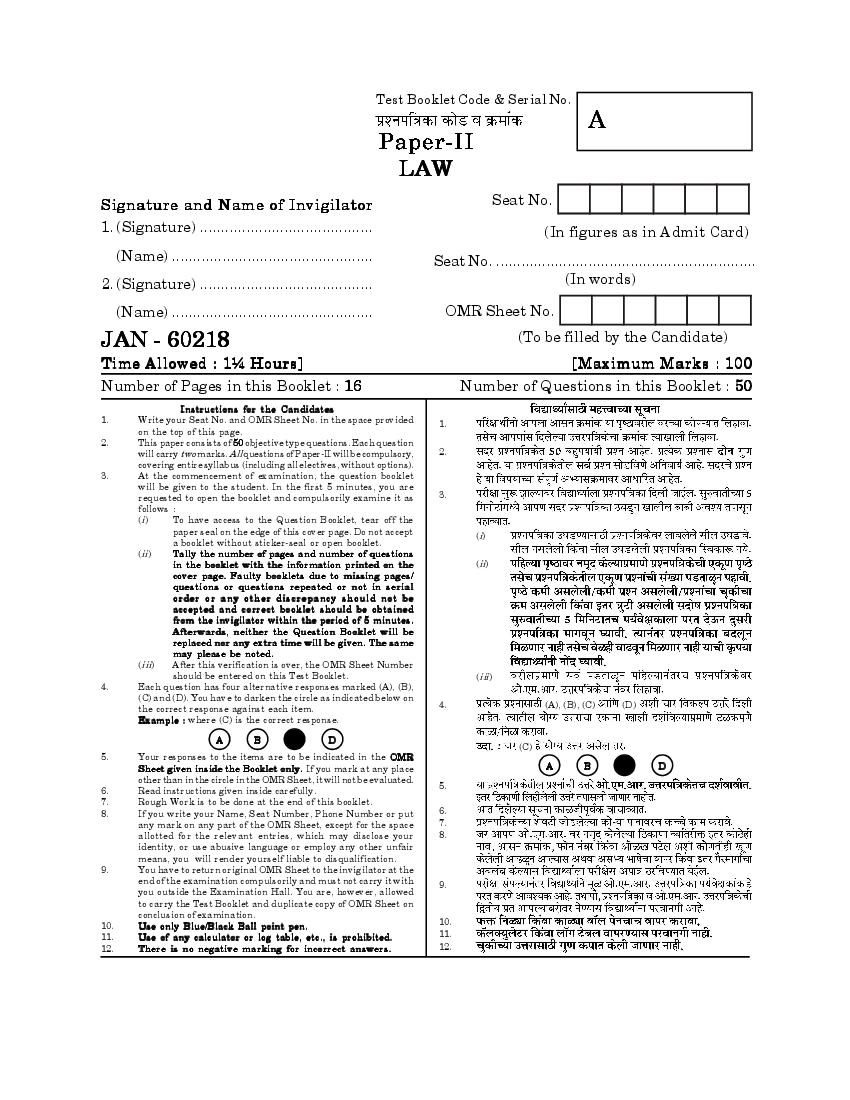
A
LAW
Signature and Name of Invigilator Seat No.
1. (Signature) ......................................... (In figures as in Admit Card)
(Name) ................................................ Seat No. ..............................................................
2. (Signature) ......................................... (In words)
(Name) ................................................ OMR Sheet No.
JAN - 60218 (To be filled by the Candidate)
Time Allowed : 1¼ Hours] [Maximum Marks : 100
Number of Pages in this Booklet : 16 Number of Questions in this Booklet : 50
Instructions for the Candidates
1. Write your Seat No. and OMR Sheet No. in the space provided 1.
on the top of this page.
2. This paper consists of 50 objective type questions. Each question
will carry two marks. All questions of Paper-II will be compulsory, 2.
covering entire syllabus (including all electives, without options).
3. At the commencement of examination, the question booklet
will be given to the student. In the first 5 minutes, you are
requested to open the booklet and compulsorily examine it as 3.
follows :
(i) To have access to the Question Booklet, tear off the
paper seal on the edge of this cover page. Do not accept (i)
a booklet without sticker-seal or open booklet.
(ii) Tally the number of pages and number of questions
in the booklet with the information printed on the (ii)
cover page. Faulty booklets due to missing pages/
questions or questions repeated or not in serial
o rder or any other discre pancy should not be
accepted and correct booklet should be obtained
from the invigilator within the period of 5 minutes.
Afterwards, neither the Question Booklet will be
replaced nor any extra time will be given. The same
may please be noted.
(iii) After this verification is over, the OMR Sheet Number
should be entered on this Test Booklet. (iii)
4. Each question has four alternative responses marked (A), (B),
(C) and (D). You have to darken the circle as indicated below on
the correct response against each item. 4. (A), (B), (C) (D)
Example : where (C) is the correct response.
A B D
(C)
5. Your responses to the items are to be indicated in the OMR
Sheet given inside the Booklet only. If you mark at any place A B D
other than in the circle in the OMR Sheet, it will not be evaluated.
5.
6. Read instructions given inside carefully.
7. Rough Work is to be done at the end of this booklet.
8. If you write your Name, Seat Number, Phone Number or put 6.
any mark on any part of the OMR Sheet, except for the space 7.
allotted for the relevant entries, which may disclose your 8.
identity, or use abusive language or employ any other unfair
means, you will render yourself liable to disqualification.
9. You have to return original OMR Sheet to the invigilator at the
end of the examination compulsorily and must not carry it with 9.
you outside the Examination Hall. You are, however, allowed
to carry the Test Booklet and duplicate copy of OMR Sheet on
conclusion of examination.
10. Use only Blue/Black Ball point pen. 10.
11. Use of any calculator or log table, etc., is prohibited. 11.
12. There is no negative marking for incorrect answers. 12.
Page 2
Page 3
Paper II
Time Allowed : 75 Minutes] [Maximum Marks : 100
Note : This paper contains Fifty (50) multiple choice questions, each question
carrying Two (2) marks. Attempt All questions.
1. Which of the following are 3. Read Assertion (A) and Reason (R)
and with the help of codes
included in the Preamble of the
given below, point out correct
Constitution ? explanation :
(A) Justice, Liberty and Equity Assertion (A) : According to Article
31-A of the Constitution, no law
(B) Justice, Liberty and giving effect to the policy of the state
Empowerment towards securing all or any of the
principle laid down in Part IV shall
(C) Justice, Liberty, Equality and
be deemed to be void on the ground
Fraternity that it is inconsistent with or takes
(D) Justice, Liberty, Equality and away or abridges any of the rights
conferred by Art. 14 or 19.
Empowerment
Reason (R) : Directive Princi-
2. To value and preserve the rich ples are superior to Fundamental
heritage of our composite culture Rights.
Codes :
is :
(A) (A) is correct, (R) is false
(A) Directive Principle of State (B) (A) is false, (R) is true
Policy (C) Both (A) and (R) are true but
(R) is not the correct explanation
(B) Fundamental Duty
of (A)
(C) Fundamental Right (D) Both (A) and (R) are true and
(R) is the correct explanation
(D) Constitutional Right
of (A)
3 [P.T.O.
Page 4
5. Which of the following statements is
the correct answer from the codes
given below it : not correct in relation to Ministers
List I
and Council of Ministers ?
(Cases)
(a) Mohd. Hanif Quareshi Vs. State
(A) Ministers shall hold office
of Bihar.
(b) Maneka Gandhi Vs. Union of during the pleasure of the
India
Parliament
(c) DAV College Jalandhar Vs .
State of Punjab (B) The Council of Ministers shall
(d) Romesh Thappar Vs. State of
Madras be collectively responsible to the
List II House of People
(Decision)
(1) Freedom of Speech and (C) Before the Minister enters upon
Expression
his office, the President shall
(2) Rights to the Minorities
(3) Right to Travel Abroad administer him the oaths of
(4) Right to carry on any
office
occupation trade or business
Codes : (D) The salaries and allowances of
(a) (b) (c) (d)
Ministers shall be such as
(A) (2) (3) (1) (4)
(B) (4) (2) (1) (3) Parliament may by law
(C) (3) (2) (1) (4)
(D) (4) (3) (2) (1) determine
4
Page 5
for compelling a public authority to
Law’ :
perform public duty ?
(A) Austin
(A) Habeas Corpus
(B) Quo warranto (B) Hart
(C) Mandamus (C) Kelsen
(D) Certiorari
(D) Pound
7. Which of the following is a
9. According to Prof. Finnis, basic
mandatory requirement for issuing
goods are :
the proclamation of emergency by
the President ? (A) Objective values
(A) Recommendation of the Prime (B) Seven
Minister
(C) Self-evident
(B) Recommendation of Union
(D) All of the above
Cabinet Communicated in oral
or written form 10. According to Prof. Hart, laws
(C) Recommendation of Home are .........
Ministry communicated (A) Commands
through the Prime Minister
(B) Rules
(D) Recommendation of Union
(C) Norms
Cabinet communicated in the
written form (D) None of the above
5 [P.T.O.
Page 6
14. In which of the following cases, the
way that the maxim of your action
ICJ stated :
could be made the maxim of a
‘‘The party which relies on custom
general action’.
of this kind (Regional or local
(A) Principle of solidarity
custom) must prove that this custom
(B) Principle of social action
is established in such a manner that
(C) Categorical imperative
it has become binding on the other
(D) Principle of common good
party ........... This follows from Article
12. In most of the Muslim countries, the
............ theory is the basis of penal 38 of the statute of the court, which
jurisprudence. refers to international custom as
(A) Deterrent evidence of general practice accepted
(B) Preventive as laws.’’
(C) Retributive (A) Temple of Preah Vihear Case,
(D) Reformative 1962
13. Will theory of rights was notably
(B) Asylum Case, 1950
propagated by .............
(C) U.N. Administrative Tribunal
(A) Bentham
Case, 1954
(B) Hart
(D) North Sea Continental Shelf
(C) Jhering
Cases, 1969
(D) Raz
6
Page 7
deemed automatically to be part of match ?
(A) Expulsion from membership of
the common law. This principle is
UN—Article 6
known as ............
(B) Admission of new members in
(A) Blackstonian doctrine
UN—Article 3
(B) Calvo Clause (C) Suspension from membership of
(C) Jus Cogens UN—Article 5
(D) Pacta sunt servanda (D) Self-defence—Article 51
18. Which of the following provisions of
16. According to which theory/doctrine,
the UN Charter provides that the
it is stated that act of recognition
parties to any dispute shall seek a
alone confers international
solution by negotiation, enquiry,
personality on an entity purporting mediation, conciliation, arbitration,
to be a state or clothes new judicial settlement, resort to regional
agencies or arrangement, or other
government with an authority to
peaceful means of their own
enter into international relations ?
choice ?
(A) Declaratory theory
(A) Article 33(1)
(B) Constitutive theory
(B) Article 2(4)
(C) Estrada doctrine
(C) Article 39
(D) Stimson doctrine (D) Article 51
7 [P.T.O.
Page 8
21. An unconsummated Muta marriage
is correct ?
would entitle the wife to :
(A) Human Rights Council replaced
UN Commission on Human
(A) full dower
Rights
(B) UN Commission on Human (B) no dower
Rights was established by
(C) half dower
General Assembly
(C) Universal Declaration of (D) one-fourth of dower
Human Rights is enforceable as
22. Divorce where a Muslim husband
conventional law
(D) The economic, social and dissolves the marriage by
cultural rights are known as
pronouncing talaq three times, is
first generation human rights
20. The consensus of opinions among called .............
Muslim jurists on any particular
(A) Talaq-e-Ahsan
rule is called ..........
(A) Qiyas (B) Talaq-e-Hasan
(B) Sharia
(C) Talaq ul Biddat
(C) Hadith
(D) Ijmaa (D) None of the above
8
Page 9
the correct answer from the codes
provisions for settlement of
given below it :
property, joint or separate of the
List I
spouses : (Sources of Hindu Laws)
(a) Yajnavalkya Smriti
(A) Parsi Marriage and Divorce Act
(b) Viramitrodaya
(B) Special Marriage Act
(c) Vivad Chintamani
(C) Hindu Marriage Act (d) Smriti Chandrika
List II
(D) None of the above
(Authors)
24. A Parsi spouse can file a petition of
(1) Vijnaneshwara
divorce in the following court :
(2) Vachaspati Misra
(A) Parsi District Matrimonial (3) Mitra Misra
(4) Deven Bhatta
Court
Codes :
(B) Civil Courts
(a) (b) (c) (d)
(C) Before a Parsi Priest (A) (1) (3) (2) (4)
(B) (3) (2) (4) (1)
(D) Court of Judicial Magistrate
(C) (2) (3) (1) (4)
First Class
(D) (1) (2) (4) (3)
9 [P.T.O.
Page 10
promises for the breach of which the
of voidable contract is subject to the
law gives a remedy or the
following limitation/s :
performance of which the law is
someway recognises as a duty.’’ This (A) Affirmation and lapse of time
statement made in :
(B) Injury to third parties
(A) Halsbury’s Laws of England
(C) Ability to restore
(B) American Restatement of the
Law of Contracts (D) All of the above
(C) Chitty on contracts
30. ‘A’, on board an English ship on the
(D) Either (A) or (B) or (C)
High Seas, causes B to enter, an
27. Tender is :
agreement by an act amounting to
(A) a promise
criminal intimidation under IPC.
(B) an offer
Afterwards sues ‘B’ for breach of
(C) a counteroffer
contract at Calcutta. The contract
(D) an invitation to offer
was under :
28. A contract entered with a conflict
person is : (A) Coercion
(A) Valid
(B) Undue influence
(B) Voidable
(C) Fraud
(C) Void
(D) None of the above
(D) Void ab initio
10
Page 11
(A) Performance of a promise the correct answer from the codes
impossible by operation of law given below it :
(B) An agreement to do an List I
impossible act (Cases)
(C) Lex non cogit ad impossibilia (a) Ashby Vs. Whyte
(D) All of the above (b) Gloucester Grammar School
32. Forfeiture of Earnest Money Deposit case
(EMD) relating to tenders under (c) Rylands Vs. Fletcher
section 5 and 74 of Contract Act
(d) Nicholas Vs. Marsland
amounts to :
List II
(A) Penalty
(Grounds)
(B) Not penalty
(1) Vij Major
(C) Compensation for incon-
(2) Injuria sine damno
venience
(3) Damnum sine Injuria
(D) Compensation for dissapoint-
ment (4) Strict liability
33. The word ‘‘Tortum’’ in its Codes :
etymological sense means : (a) (b) (c) (d)
(A) to restore (A) (3) (2) (4) (1)
(B) to infringe (B) (3) (4) (2) (1)
(C) to twist (C) (2) (3) (4) (1)
(D) to punish (D) (2) (3) (1) (4)
11 [P.T.O.
Page 12
act of his servant provided it is done has to prove that :
by the servant (Choose correct
(A) The defendant has a legal duty
option) :
to take care
(A) in the course of his employment
(B) The defendant has breached of
(B) in the interest of his master the duty
(C) both (A) and (B) (C) The damage to the plaintiff as
(D) Master can’t be held liable for a result of breach of duty
the criminal act of his servant (D) All of the above
36. The servants of the Railway 38. In a case, the plaintiff accompanied
Company, after cutting hedges and by a friend, went to a cafe for
grass negligently, left it near the refreshment. They ordered two slices
railway line. It was a dry weather. of ice cream and a bottle of ginger
Spark from the railway engine set beer. This ginger beer was served
fire to the heap of grass. Due to high in a stoppered bottle of dark. Opaque
wind the fire was carried to the glass and had been manufactured by
plantiff’s cottage which was burnt. the defendant. While pouring the
bear, the remains of a decomposed
In the light of the above fact,
snail (which had apparently found
which of the following statements is
its way into the bottle at the factory)
correct ? floated out. As a result of the
(A) The defendant company was nauseating sight of the snail and the
liable for the negligence of their impurities of the ginger beer which
servants though they could not the plaintiff had already consumed,
have foreseen the loss to the she suffered from shock and severe
cottage of plaintiff gastro-enteritis.
(B) The defendant company was not The above facts are similar with
liable for the negligence of their which of the following case ?
servants because they could not (A) Ryland Vs. Flecher (1868) LR
have foreseen the loss to the 3 HL 330
cottage of plaintiff (B) Donoghue Vs. Stevenson [1932]
(C) The plaintiff is not entitled for AC 562
damages because defendant (C) Hicks Vs. Faulkner, [1848] 8
does not owe any duty against QBD 167
him (D) Quinn Vs. Leathem, [1901] AC
(D) None of the above 495
12
Page 13
are : With the help of codes given below,
(A) motive, mens rea and actus rea point out the correct explanation :
(B) mens rea and actus rea Assertion (A) : An assembly of
(C) motive, intention and five or more persons is designated
knowledge an ‘‘unlawful assembly’’ if the
(D) knowledge, intention and action common object of the persons
40. Motive under Section 81 of IPC composing that assembly is.
should be : Reason (R) : To resist the
(A) Prevention of harm to person execution of any law, or of any legal
(B) Prevention of harm to property process, or
(C) Both (A) and (B) Codes :
(D) Either (A) or (B) (A) (A) is correct, (R) is false
41. Right to Private defence of body and (B) (A) is false, (R) is true
of property has been dealt with (C) Both (A) and (R) are true but
under : (R) is not correct explanation
(A) Section 96 of IPC of (A)
(B) Section 97 of IPC (D) Both (A) and (R) are true and
(C) Section 98 of IPC (R) is the correct explanation
(D) Section 99 of IPC of (A)
13 [P.T.O.
Page 14
term ‘Industry’ provided under
‘Z’s house, but no theft is actually
Section 2( j ) of the Industrial
committed. They are guilty of ........ Disputes Act, 1947 has been widened
by the Supreme Court in its
(A) No offence
Constitution Bench decision in
(B) Abatement by conspiracy Rajappa to subsume a number of
activities that qualify the ‘triple test’
(C) Criminal conspiracy
laid down therein.
(D) Abatement by instigation Reason (R) : The Parliament
through the Industrial Disputes
44. The following offences are added by
(Amendment) Act, 1982 has also
way of The Criminal Law (Amend- approved the Supreme Court’s move
on this point and accordingly
ment) Act, 2013 :
changed the law.
(A) Assault or criminal force to (A) Both (A) and (R) are correct
woman with intent to outrage (B) Both (A) and (R) are incorrect
(C) (A) is correct but (R) is incorrect
her modesty
(D) (A) is incorrect but (R) is correct
(B) Sexual harassment and 46. Which of the following is related to
punishment for sexual ‘Settlement’ provided under Section
2(P) of the Industrial Disputes Act,
harassment
1947 ?
(C) Assault or use of criminal force (A) Strike
(B) Labour Court
to woman with intent to disrobe
(C) Arbitration
(D) Both (B) and (C) (D) Conciliation
14
Page 15
Judges Bench of the Supreme Court
registration of a trade union are
has observed that in order to enable
provided under Section(s) .......... of the workmen to wages for the period
the Trade Unions Act, 1926. of the strike, the strike should be
legal as well as justified ?
(A) 9
(A) L. Chandra Kumar Vs. Union
(B) 10 of India
(B) Crompton Greaves Ltd. Vs .
(C) 9A
Workmen
(D) Both (A) and (C)
(C) T.K. Rangarajan Vs. Govern-
48. Immunities under Section 17 and 18 ment of Tamil Nadu and others
(D) Coir Board Ernakulam, Kerala
of the Trade Unions Act, 1926 shall
Vs. Indira Devi P.S.
be claimed by ..........
50. There can be lay off under the
(A) Registered Unions only Industrial Disputes Act, 1947
for ............
(B) Recognised Unions only
(A) Not less than one day
(C) Most Representative Unions
(B) More than one day
only (C) Not less than a week
(D) Any period including less than
(D) Both (A) and (C)
a day
15 [P.T.O.
Page 16
16
Document Details
| Board / Org | Maharashtra Exams |
| Exam | Maharashtra State Eligibility Test |
| Type | Question Paper |
| Pages | 16 |
| Updated | 30 Apr 2026 |