NCERT Solutions for Class 11 English (Woven Words) Short Stories 6 The Third and Final Continent
Finished viewing? Save it for later —
Download NCERT Solutions for Class 11 English (Woven Words) Short Stories 6 The Third and Final Continent (PDF · 6 pages)About NCERT Solutions for Class 11 English (Woven Words) Short Stories 6 The Third and Final Continent
NCERT Solutions for Class 11 English (Woven Words) Short Stories 6 The Third and Final Continent is available here for free download. Published by NCERT for Class 11, this solution can be viewed online or downloaded as a PDF (6 pages). Candidates preparing for Class 11 can use NCERT Solutions for Class 11 English (Woven Words) Short Stories 6 The Third and Final Continent to understand the exam pattern, the type of questions asked, and the overall difficulty level.
Frequently Asked Questions
How can I download NCERT Solutions for Class 11 English (Woven Words) Short Stories 6 The Third and Final Continent?
Open this page and click the Download button to save NCERT Solutions for Class 11 English (Woven Words) Short Stories 6 The Third and Final Continent as a PDF. It is completely free on AglaSem Docs.
Is NCERT Solutions for Class 11 English (Woven Words) Short Stories 6 The Third and Final Continent free to download?
Yes. NCERT Solutions for Class 11 English (Woven Words) Short Stories 6 The Third and Final Continent can be viewed online and downloaded as a PDF free of cost on AglaSem Docs.
How many pages does NCERT Solutions for Class 11 English (Woven Words) Short Stories 6 The Third and Final Continent have?
NCERT Solutions for Class 11 English (Woven Words) Short Stories 6 The Third and Final Continent contains 6 pages, which you can read online or download together as a single PDF.
Where can I find more Class 11 study material?
You can find more Class 11 question papers, sample papers, syllabus, and answer keys on AglaSem Docs.
NCERT Solutions for Class 11 English (Woven Words) Short Stories 6 The Third and Final Continent – Text
Read the full text of this solution below — useful to quickly search, copy and reference the content online without downloading the PDF.
📄 View text version (6 pages)
Page 1
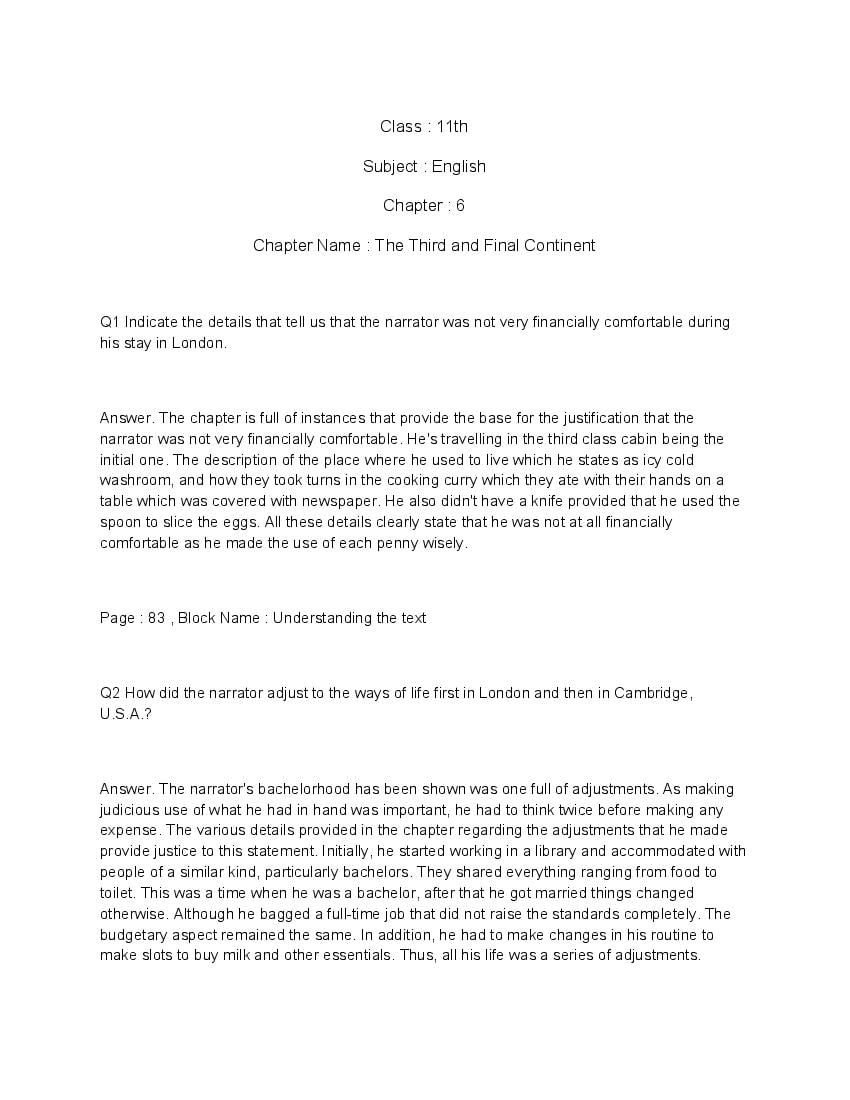
Subject : English
Chapter : 6
Chapter Name : The Third and Final Continent
Q1 Indicate the details that tell us that the narrator was not very financially comfortable during
his stay in London.
Answer. The chapter is full of instances that provide the base for the justification that the
narrator was not very financially comfortable. He's travelling in the third class cabin being the
initial one. The description of the place where he used to live which he states as icy cold
washroom, and how they took turns in the cooking curry which they ate with their hands on a
table which was covered with newspaper. He also didn't have a knife provided that he used the
spoon to slice the eggs. All these details clearly state that he was not at all financially
comfortable as he made the use of each penny wisely.
Q2 How did the narrator adjust to the ways of life first in London and then in Cambridge,
U.S.A.?
Answer. The narrator's bachelorhood has been shown was one full of adjustments. As making
judicious use of what he had in hand was important, he had to think twice before making any
expense. The various details provided in the chapter regarding the adjustments that he made
provide justice to this statement. Initially, he started working in a library and accommodated with
people of a similar kind, particularly bachelors. They shared everything ranging from food to
toilet. This was a time when he was a bachelor, after that he got married things changed
otherwise. Although he bagged a full-time job that did not raise the standards completely. The
budgetary aspect remained the same. In addition, he had to make changes in his routine to
make slots to buy milk and other essentials. Thus, all his life was a series of adjustments.
Page 2
Answer. Mrs Croft has been depicted as a very stern and authoritative figure. She wants to
question all the possibilities and was quite specific about whether the narrator was from Harvard
or Tech, to make the decision regarding the renting out of her flat. Her character is seen as that
of a lady who has an outer hard shell but is soft and tender from inside. This change is seen in
the story when the chapter unfolds. Her character could be moulded as per the situation. The
author was amazed to know that she was 103 years old.
Q4 What kind of a relationship did Mrs Croft share with her daughter Helen?
Answer. The relationship between the mother and the daughter was more practical than
emotional. The daughter was not empathy towards her mother rather she merely fulfilled the
duties towards her as an obligation and not a single task done by her was out of love and
affection. The relationship that both of them shared was not at all considerate and simply the
obligatory duties that the daughter had to fulfil. She had no regard for her mother that she was
103 years old.
Q5 How does the narrator bring out the contrast between the Indian way of life and American
society? Do you think his wife Mala adjusted comfortably to the new way of life?
Page 3
as the story is full of ample examples that proved it was adjusting in the American society is not
an easy task for the Indians.
No, Mala, the narrator's wife was not able to adjust completely in the new atmosphere. She was
not at all comfortable moving to an altogether new place where everything was completely
different.
Q6 How does the bond of affection between Mrs Croft and the narrator evolve?
Answer. The bond of affection evolve between Mrs Croft and the narrator as every evening they
started spending time together. It was when the narrator returned from the library, Mrs Croft
would call him, tap on the empty space on the bench, talk about the flag on the moon and
declare that he was splendid. That was the everyday routine that they both followed that
developed into an affectionate bond as the same attention was not given by Mrs Croft's
daughter, so where she received attention from, she was inclined towards that.
Q1 Living abroad is challenging in many ways.
Answer. The practical application of the popular saying, "Atithi Devo bhava" isn't as beautiful as
it appears to be. There are many challenges that one has to face while living abroad. The main
problems that arise are the issues of finding a place to live, the job security and most
importantly the adjustment factor. No matter how glorious position an Indian secures while living
abroad, an Asian will never be accepted fully even after gaining the residential rights of that
particular place. Thus, living abroad is that far fetched dream that appears to be every charming
but actually adjusting oneself into that atmosphere is full of compromises and sacrifices.
Page 4
Q2 The Indian family system offers more security to the aged than what is found in the West.
Answer. This statement is completely true and the story provides the main evidence in this
concern taking the example of Mrs Croft. She was 103 years of age, and yet she lacked the
proper care that was required. However, if we compare the culture of the Indian family system,
the elders are kept at the topmost priority. It is often said that the elders are treated as the
second form of God. The utmost level of respect is provided to them along with the care. They
are not considered a burden, unlike the western culture that takes up the responsibilities only to
fulfil the obligatory part. Thus, it is true that the Indian family system offers more security to the
ages as compared to the western culture.
Page : 84 , Block Name : Talking about the text
Q3 The eccentricities of the old are often endearing.
Answer. It is a general human trait that the old people develop strange habits, or we can say
they develop eccentrics. But it's also true to say that the eccentrics of the old are often
endearing because we develop the tendencies for having them. The forgetfulness of the old is
considered humorous. They demand strange things that they haven't consumed in life and thus
the childlike nature of the old is compared to being endearing.
Page : 84 , Block Name : Talking about the text
Q1 Discuss the manner in which the author interweaves details of the narrator’s family with the
flow of the main narrative.
Answer. The details of the narrator's family are an important element to understand the
narrator's perspective in dealing with the elders. It was told in the initial part of the story that the
Page 5
relationship with Mrs Croft. Thus, the details of the narrator's family were important for
understanding the main narrative as the closeness in order to Mrs Croft is an outcome of the
same. Also, the other reason that the narrator was affectionate towards the elders was that he
had an Indian background and this trait was prominent in the Asians, which was the main lack in
the Western cultures.
Page : 84 , Block Name : Appreciation
Q2 ‘Mrs Croft’s was the first death I mourned in America, for, hers was the first life I had
admired; she had left this world, at last, ancient and alone, never to return’—how do these lines
encapsulate the bond that is possible between two strangers?
Answer. The main reason behind the narrator being close to Mrs Croft was that he was highly
homesick. He found it very difficult to adjust among the western culture. Among the huge
compromises that he had to make in order to adjust himself, Mrs Croft was something that he
found peace in. Being an elderly woman, she was a mother like a figure for the narrator and he
was highly engrossed in her. Spending part with her had become an indispensable part of his
day or more importantly his life. All the little things, providing her with the rent on time, heating
her soup and the other activities that he took up was his escape from the world. Thus, all these
conditions show us the deeply encapsulated bond between the two.
Page : 84 , Block Name : Appreciation
Q3 Examine the pieces of conversation in the story. How do they reflect the worldview of each
of the speakers?
Answer. The main character of the story apart from the narrator was Mrs Croft. There are
various pieces of conversations that show us how the dealing of the lady prominently different.
In the starting when she was unsure whether to provide the narrator with the house or not, then
she was firm was questioned the narrator that whether he was from Tech Or Harvard. This was
the basis that she judged the narrator on. However, on seeing the letter of recommendation, her
viewpoint changed. Later she developed an affectionate bond with the narrator. Thus, the
Page 6
trust.
Page : 84 , Block Name : Appreciation
Q4 There are many instances of gentle humour in the story. Point out some of these and state
how this contributes to the interest of the narration.
Answer. There are many instances of gentle humour in the story. Some of them include:
How the old lady had the habit of remarking the flag on the moon and saying that it was
splendid. And apart from herself making this remark, the more important element of humour was
that the narrator has to compulsorily reply saying splendid.
Another example was how Mrs Croft on meeting the narrator's wife, Mala, said with disbelief
that she was a perfect lady.
Page : 84 , Block Name : Appreciation
Document Details
| Board / Org | NCERT |
| Exam | Class 11 |
| Type | Solution |
| Pages | 6 |
| Updated | 01 May 2026 |