NCERT Solutions for Class 11 English (Woven Words) Poetry 3 Coming
Finished viewing? Save it for later —
Download NCERT Solutions for Class 11 English (Woven Words) Poetry 3 Coming (PDF · 4 pages)About NCERT Solutions for Class 11 English (Woven Words) Poetry 3 Coming
NCERT Solutions for Class 11 English (Woven Words) Poetry 3 Coming is available here for free download. Published by NCERT for Class 11, this solution can be viewed online or downloaded as a PDF (4 pages). Candidates preparing for Class 11 can use NCERT Solutions for Class 11 English (Woven Words) Poetry 3 Coming to understand the exam pattern, the type of questions asked, and the overall difficulty level.
Frequently Asked Questions
How can I download NCERT Solutions for Class 11 English (Woven Words) Poetry 3 Coming?
Open this page and click the Download button to save NCERT Solutions for Class 11 English (Woven Words) Poetry 3 Coming as a PDF. It is completely free on AglaSem Docs.
Is NCERT Solutions for Class 11 English (Woven Words) Poetry 3 Coming free to download?
Yes. NCERT Solutions for Class 11 English (Woven Words) Poetry 3 Coming can be viewed online and downloaded as a PDF free of cost on AglaSem Docs.
How many pages does NCERT Solutions for Class 11 English (Woven Words) Poetry 3 Coming have?
NCERT Solutions for Class 11 English (Woven Words) Poetry 3 Coming contains 4 pages, which you can read online or download together as a single PDF.
Where can I find more Class 11 study material?
You can find more Class 11 question papers, sample papers, syllabus, and answer keys on AglaSem Docs.
NCERT Solutions for Class 11 English (Woven Words) Poetry 3 Coming – Text
Read the full text of this solution below — useful to quickly search, copy and reference the content online without downloading the PDF.
📄 View text version (3 pages)
Page 1
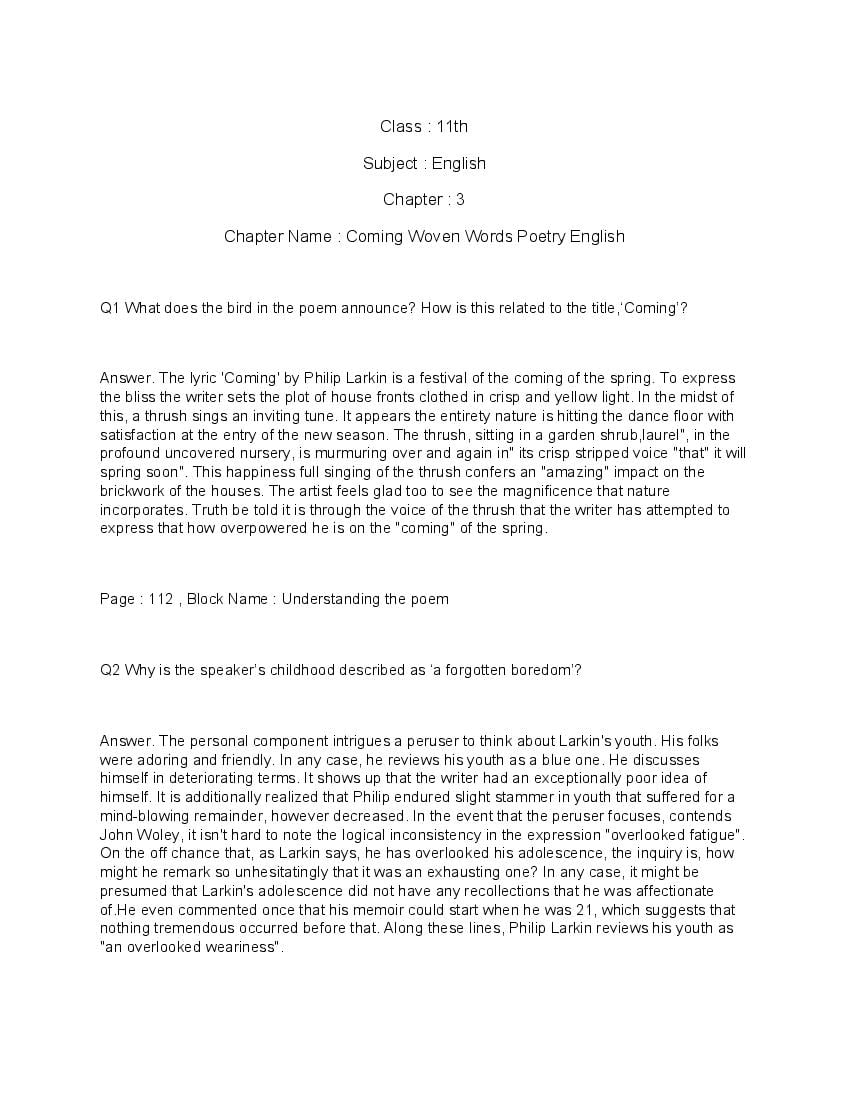
Subject : English
Chapter : 3
Chapter Name : Coming Woven Words Poetry English
Q1 What does the bird in the poem announce? How is this related to the title,‘Coming’?
Answer. The lyric 'Coming' by Philip Larkin is a festival of the coming of the spring. To express
the bliss the writer sets the plot of house fronts clothed in crisp and yellow light. In the midst of
this, a thrush sings an inviting tune. It appears the entirety nature is hitting the dance floor with
satisfaction at the entry of the new season. The thrush, sitting in a garden shrub,laurel", in the
profound uncovered nursery, is murmuring over and again in" its crisp stripped voice "that" it will
spring soon". This happiness full singing of the thrush confers an "amazing" impact on the
brickwork of the houses. The artist feels glad too to see the magnificence that nature
incorporates. Truth be told it is through the voice of the thrush that the writer has attempted to
express that how overpowered he is on the "coming" of the spring.
Q2 Why is the speaker’s childhood described as ‘a forgotten boredom’?
Answer. The personal component intrigues a peruser to think about Larkin's youth. His folks
were adoring and friendly. In any case, he reviews his youth as a blue one. He discusses
himself in deteriorating terms. It shows up that the writer had an exceptionally poor idea of
himself. It is additionally realized that Philip endured slight stammer in youth that suffered for a
mind-blowing remainder, however decreased. In the event that the peruser focuses, contends
John Woley, it isn't hard to note the logical inconsistency in the expression "overlooked fatigue".
On the off chance that, as Larkin says, he has overlooked his adolescence, the inquiry is, how
might he remark so unhesitatingly that it was an exhausting one? In any case, it might be
presumed that Larkin's adolescence did not have any recollections that he was affectionate
of.He even commented once that his memoir could start when he was 21, which suggests that
nothing tremendous occurred before that. Along these lines, Philip Larkin reviews his youth as
"an overlooked weariness".
Page 2
reconciling'?
Answer. As Larkin is caught up in the thunderous murmuring of the thrush, he rises above
present to his exhausting youth, which he feels is best overlooked. The writer is changed into a
tyke. He feels upbeat like a tyke who feels glad just by watching older folks accommodating with
one another. The tyke fathoms nothing yet grins in light of the fact that the grown-ups are
upbeat. This may seem astounding notwithstanding, if one may look all the more carefully, the
scene mirrors the honesty of a youngster. Most likely the writer has attempted to make a point
that our joy lies in other's satisfaction. The entire idea makes Larkin glad and he ponders about
the personas of universe and human life.
Q4 What two things are compared in the poem?
Answer. It is hard to pass judgment on whether the artist is attempting to think about or is
drawing a connection. Philip Larkin, in his lyric Coming, praises the appearance of the new
season, spring, with the "new stripped voice" of the thrush. He makes the symbolism of the
spring stripped out of the winter. The old season bringing forth the new season. The nature had
been dozing wide open to the harshe elements and miserable winter and presently the
freshness of the new season started another life in it. The flying creatures, houses, gardens, the
entire nature hosts consolidated the get to respect the spring. Seeing this change the writer is
glad to the point that he himself rises above into adolescence.Here Larkin features the
distinction among guiltlessness and experience. He presents a blameless viewing the
grown-ups, giggling and accommodating, most likely after a battle or accommodating with the
life. How he starts to feel upbeat however he sees nothing. This is the blamelessness of the kid
that his satisfaction lies in others joy, which is compared with the accomplished grown-ups, who
lock in themselves in trifling issues making inconveniences for themselves as well as other
people. The writer has attempted to draw out the contrast between two seasons and phases of
human life. This persona is outside Larkin's ability to understand and he is just left pondering
about everything.
Page 3
Light, chill and yellow
Bathes the serene
Foreheads of houses
Answer. The sonnet Coming by Philip Larkin is devoted to the magnificence the spring brings
alongside it. It is a festival of humankind. Before all else, the writer makes a beautiful in the
brain of a peruser. Larkin makes a delightful night landscape. The more drawn out nighttimes of
the spring are jeweled by the temple of quiet houses' rooftop tops, washed somewhere near the
crisp and yellow light of the setting sun. The peruser is granted with delightful symbolism of the
entire condition sitting gently and getting a charge out of the sun going down as the spring calls.
They all move to the murmuring of the thrush in the profound nursery. It feels like the entire
nature has woken up in the beautiful night and join the gathering to respect the happening to the
spring.
Q6 Comment on the use of the phrase ‘fresh-peeled voice
Answer. Larkin makes use of the “clean-peeled voice” of the thrush as an adjective to decorate
the nighttime putting of the new season, the spring. The word describes the freshness and
sharpness of the thrush's humming. This freshness is symbolic of the freshness that has
dissolved in the air with the advent of the new season that the poet celebrates. The thrush
sings, sitting in a “laurel-surrounded inside the deep barelawn”. It hums time and again that “it
will be spring soon”. Its singing marks an“outstanding” impact on the brickwork of the houses.
The tune of the thrush additionally acts as a catalyst inside the transcending of Philip to his
youth flashing the“forgotten-boredom” right in front of his eyes. He is converted right into a
toddler. The Poet in all likelihood tries to draw a parallelism between the freshness of the
chicken's song and the innocence of the kid. The “fresh-peeled voice” is symbolic of the spring
succeeding the wintry weather. The transformation of the season. It appears because the
iciness gave birth to the spring and now that it's far coming, the whole universe and humanity
dance to the song of thrush to join in the birthday party.
Document Details
| Board / Org | NCERT |
| Exam | Class 11 |
| Type | Solution |
| Pages | 4 |
| Updated | 22 Jul 2026 |