NCERT Solutions for Class 11 English (Woven Words) Poetry 4 Telephone Conversation
Finished viewing? Save it for later —
Download NCERT Solutions for Class 11 English (Woven Words) Poetry 4 Telephone Conversation (PDF · 3 pages)About NCERT Solutions for Class 11 English (Woven Words) Poetry 4 Telephone Conversation
NCERT Solutions for Class 11 English (Woven Words) Poetry 4 Telephone Conversation is available here for free download. Published by NCERT for Class 11, this solution can be viewed online or downloaded as a PDF (3 pages). Candidates preparing for Class 11 can use NCERT Solutions for Class 11 English (Woven Words) Poetry 4 Telephone Conversation to understand the exam pattern, the type of questions asked, and the overall difficulty level.
Frequently Asked Questions
How can I download NCERT Solutions for Class 11 English (Woven Words) Poetry 4 Telephone Conversation?
Open this page and click the Download button to save NCERT Solutions for Class 11 English (Woven Words) Poetry 4 Telephone Conversation as a PDF. It is completely free on AglaSem Docs.
Is NCERT Solutions for Class 11 English (Woven Words) Poetry 4 Telephone Conversation free to download?
Yes. NCERT Solutions for Class 11 English (Woven Words) Poetry 4 Telephone Conversation can be viewed online and downloaded as a PDF free of cost on AglaSem Docs.
How many pages does NCERT Solutions for Class 11 English (Woven Words) Poetry 4 Telephone Conversation have?
NCERT Solutions for Class 11 English (Woven Words) Poetry 4 Telephone Conversation contains 3 pages, which you can read online or download together as a single PDF.
Where can I find more Class 11 study material?
You can find more Class 11 question papers, sample papers, syllabus, and answer keys on AglaSem Docs.
NCERT Solutions for Class 11 English (Woven Words) Poetry 4 Telephone Conversation – Text
Read the full text of this solution below — useful to quickly search, copy and reference the content online without downloading the PDF.
📄 View text version (3 pages)
Page 1
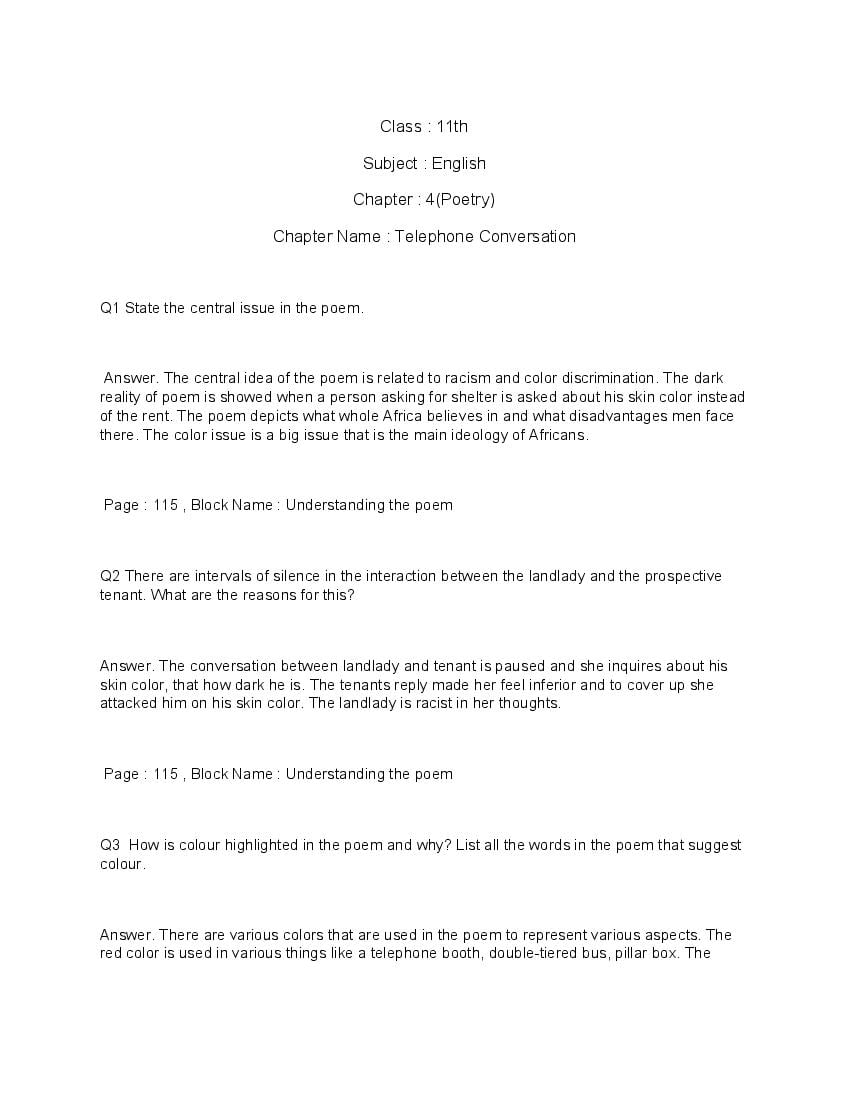
Subject : English
Chapter : 4(Poetry)
Chapter Name : Telephone Conversation
Q1 State the central issue in the poem.
Answer. The central idea of the poem is related to racism and color discrimination. The dark
reality of poem is showed when a person asking for shelter is asked about his skin color instead
of the rent. The poem depicts what whole Africa believes in and what disadvantages men face
there. The color issue is a big issue that is the main ideology of Africans.
Q2 There are intervals of silence in the interaction between the landlady and the prospective
tenant. What are the reasons for this?
Answer. The conversation between landlady and tenant is paused and she inquires about his
skin color, that how dark he is. The tenants reply made her feel inferior and to cover up she
attacked him on his skin color. The landlady is racist in her thoughts.
Q3 How is colour highlighted in the poem and why? List all the words in the poem that suggest
colour.
Answer. There are various colors that are used in the poem to represent various aspects. The
red color is used in various things like a telephone booth, double-tiered bus, pillar box. The
Page 2
Various colors like red, black, white, gold-toned are used in the poem to represent .
Q4 Which are the lines in the poem that impressed you the most and why?
Answer. ‘West African Sepia’ is the phrase which impressed the most. This phrase is the reply
by tenant to landlady. When landlady says about his skin tone he gives a befitting reply that this
shows the tiny mindset of fair skin toned people. With this poet raises problem of color
discrimination. In this poem, Soyinka says a person should be judged on his values and ethics
and not the skin tone.
Q5 You know what ‘hide-and-seek’ is. What would ‘hide-and-speak’ mean?
Answer. The term hide and seek is connected to black people, because of their complexion
makes them feel inferior and low, while white skin people raise themselves above while dark
skin tone. In childhood hide and seek was a game played by kids they would hide and would
find them.
Q6 Certain words in the poem are in capital letters—why?
Answer. Words in the poem which are in capital letters are as follows:
HOW DARK? , ARE YOU LIGHT? , OR VERY DARK? , OR VERY LIGHT?
This poems tells about the color discrimination that is commonly practised in Africa. The
treatment of lady to tenant is highly racist. The poem shows mindset of white skin people who
Page 3
the tenant was and tenant gives a befitting reply to the people.
Q7 Why do you think that the poet has chosen the title ‘Telephone Conversation’? If you were
to suggest another title for the poem, what would it be?
Answer. The poet had chosen a title ‘Telephone Conversation’ because he wants to tell how the
plot moves ahead and the whole conversation takes place on the telephone call. As soon as
landlady came to knew that the tenant was dark-skinned she started inquiring about his
appearance. I would give a title “Racist mindset.” I have given this title to show that because
racism exists in the mind not the skin of other human beings.
Q8 The power of poetry lies in suggestion and understatement. Discuss this with reference to
the poem.
Answer. Understatement is a literary device that presents statement less important than actually
it is. The poem is trying to tell that color is not the ultimate guide to judge a person. The
conversation between lady and tenant states that still people judge a book by its cover rather
than the content inside.
Document Details
| Board / Org | NCERT |
| Exam | Class 11 |
| Type | Solution |
| Pages | 3 |
| Updated | 30 Apr 2026 |