CBSE Class 12 Question Paper 2022 Solution Geography
Finished viewing? Save it for later —
Download CBSE Class 12 Question Paper 2022 Solution Geography (PDF · 10 pages)About CBSE Class 12 Question Paper 2022 Solution Geography
CBSE Class 12 Question Paper 2022 Solution Geography is available here for free download. Published by CBSE for Class 12, this solution can be viewed online or downloaded as a PDF (10 pages). Candidates preparing for Class 12 can use CBSE Class 12 Question Paper 2022 Solution Geography to understand the exam pattern, the type of questions asked, and the overall difficulty level.
Frequently Asked Questions
How can I download CBSE Class 12 Question Paper 2022 Solution Geography?
Open this page and click the Download button to save CBSE Class 12 Question Paper 2022 Solution Geography as a PDF. It is completely free on AglaSem Docs.
Is CBSE Class 12 Question Paper 2022 Solution Geography free to download?
Yes. CBSE Class 12 Question Paper 2022 Solution Geography can be viewed online and downloaded as a PDF free of cost on AglaSem Docs.
How many pages does CBSE Class 12 Question Paper 2022 Solution Geography have?
CBSE Class 12 Question Paper 2022 Solution Geography contains 10 pages, which you can read online or download together as a single PDF.
Where can I find more Class 12 study material?
You can find more Class 12 question papers, sample papers, syllabus, and answer keys on AglaSem Docs.
CBSE Class 12 Question Paper 2022 Solution Geography – Text
Read the full text of this solution below — useful to quickly search, copy and reference the content online without downloading the PDF.
📄 View text version (10 pages)
Page 1
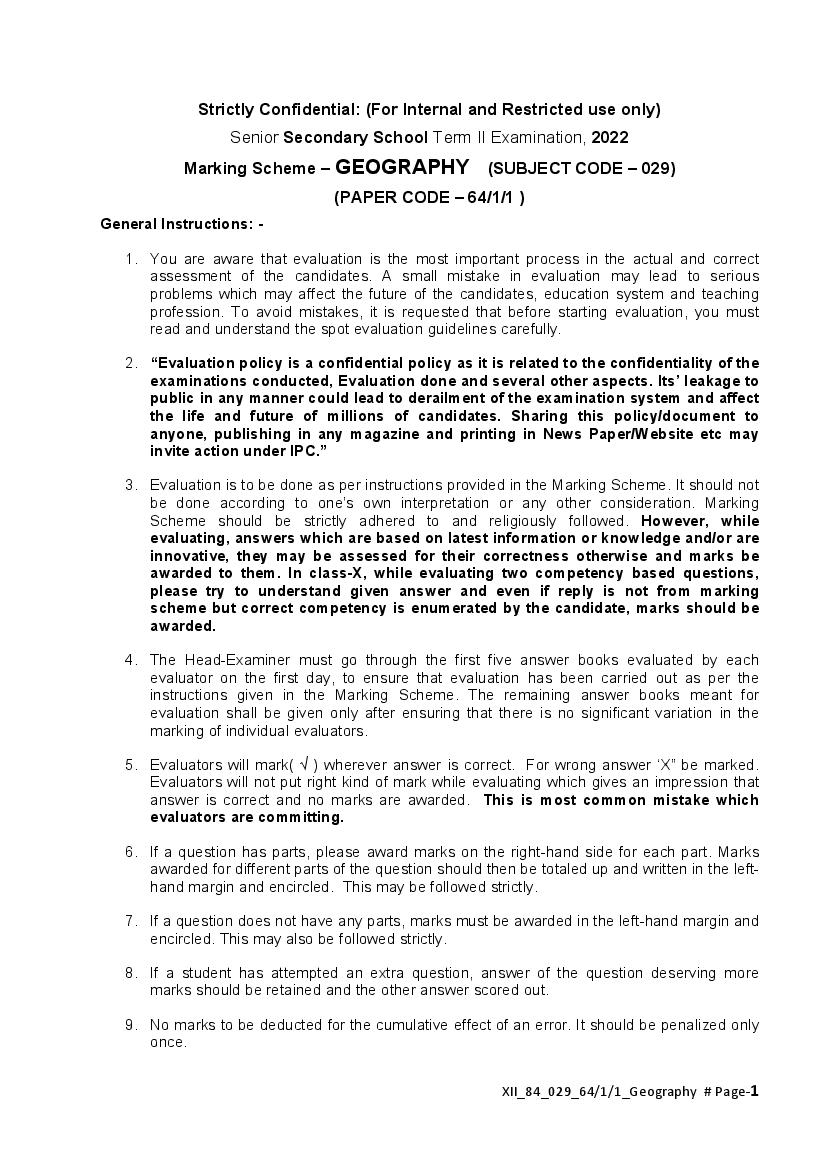
Senior Secondary School Term II Examination, 2022
Marking Scheme – GEOGRAPHY (SUBJECT CODE – 029)
(PAPER CODE – 64/1/1 )
General Instructions: -
1. You are aware that evaluation is the most important process in the actual and correct
assessment of the candidates. A small mistake in evaluation may lead to serious
problems which may affect the future of the candidates, education system and teaching
profession. To avoid mistakes, it is requested that before starting evaluation, you must
read and understand the spot evaluation guidelines carefully.
2. “Evaluation policy is a confidential policy as it is related to the confidentiality of the
examinations conducted, Evaluation done and several other aspects. Its’ leakage to
public in any manner could lead to derailment of the examination system and affect
the life and future of millions of candidates. Sharing this policy/document to
anyone, publishing in any magazine and printing in News Paper/Website etc may
invite action under IPC.”
3. Evaluation is to be done as per instructions provided in the Marking Scheme. It should not
be done according to one’s own interpretation or any other consideration. Marking
Scheme should be strictly adhered to and religiously followed. However, while
evaluating, answers which are based on latest information or knowledge and/or are
innovative, they may be assessed for their correctness otherwise and marks be
awarded to them. In class-X, while evaluating two competency based questions,
please try to understand given answer and even if reply is not from marking
scheme but correct competency is enumerated by the candidate, marks should be
awarded.
4. The Head-Examiner must go through the first five answer books evaluated by each
evaluator on the first day, to ensure that evaluation has been carried out as per the
instructions given in the Marking Scheme. The remaining answer books meant for
evaluation shall be given only after ensuring that there is no significant variation in the
marking of individual evaluators.
5. Evaluators will mark( √ ) wherever answer is correct. For wrong answer ‘X” be marked.
Evaluators will not put right kind of mark while evaluating which gives an impression that
answer is correct and no marks are awarded. This is most common mistake which
evaluators are committing.
6. If a question has parts, please award marks on the right-hand side for each part. Marks
awarded for different parts of the question should then be totaled up and written in the left-
hand margin and encircled. This may be followed strictly.
7. If a question does not have any parts, marks must be awarded in the left-hand margin and
encircled. This may also be followed strictly.
8. If a student has attempted an extra question, answer of the question deserving more
marks should be retained and the other answer scored out.
9. No marks to be deducted for the cumulative effect of an error. It should be penalized only
once.
XII_84_029_64/1/1_Geography # Page-1
Page 2
be used. Please do not hesitate to award full marks if the answer deserves it.
11. Every examiner has to necessarily do evaluation work for full working hours i.e. 8 hours
every day and evaluate 30 answer books per day in main subjects and 35 answer books
per day in other subjects (Details are given in Spot Guidelines).This is in view of the
reduced syllabus and number of questions in question paper.
12. Ensure that you do not make the following common types of errors committed by the
Examiner in the past:-
Leaving answer or part thereof unassessed in an answer book.
Giving more marks for an answer than assigned to it.
Wrong totaling of marks awarded on a reply.
Wrong transfer of marks from the inside pages of the answer book to the title page.
Wrong question wise totaling on the title page.
Wrong totaling of marks of the two columns on the title page.
Wrong grand total.
Marks in words and figures not tallying.
Wrong transfer of marks from the answer book to online award list.
Answers marked as correct, but marks not awarded. (Ensure that the right tick mark is
correctly and clearly indicated. It should merely be a line. Same is with the X for
incorrect answer.)
Half or a part of answer marked correct and the rest as wrong, but no marks awarded.
13. While evaluating the answer books if the answer is found to be totally incorrect, it should
be marked as cross (X) and awarded zero (0)Marks.
14. Any unassessed portion, non-carrying over of marks to the title page, or totaling error
detected by the candidate shall damage the prestige of all the personnel engaged in the
evaluation work as also of the Board. Hence, in order to uphold the prestige of all
concerned, it is again reiterated that the instructions be followed meticulously and
judiciously.
15. The Examiners should acquaint themselves with the guidelines given in the Guidelines for
spot Evaluation before starting the actual evaluation.
16. Every Examiner shall also ensure that all the answers are evaluated, marks carried over
to the title page, correctly totaled and written in figures and words.
17. The Board permits candidates to obtain photocopy of the Answer Book on request in an
RTI application and also separately as a part of the re-evaluation process on payment of
the processing charges.
XII_84_029_64/1/1_Geography # Page-2
Page 3
Senior Secondary School Examination TERM–II, 2022
GEOGRAPHY (Subject Code–029)
[ Paper Code : 64/1/1 ]
Maximum Marks : 35
Q. Marks
No.
EXPECTED ANSWER / VALUE POINTS
SECTION—A
( Very Short Answer Questions)
1. Why is ‘access to market’ essential for setting up industries in the world?
Explain.
Access to market is essential for setting up industry :
(i) The existence of a market for manufactured goods is the most important
factor in the location of industries.
(ii) Market means people who have a demand for these goods and also have
the purchasing power to be able to purchase from the sellers at place.
(iii) Remote areas inhabited by a few people offer small markets.
(iv) Efficient transport system offers connectivity with the market.
(v) Any other relevant point
Any two points to be explained (TB-1 page 46)
1×2
2
2. “Tertiary activities include both production and exchange”. Support the
statement.
Tertiary activities include :
i. The production involves the provision of services that are consumed.
2
ii. The output is indirectly measured in terms of wages and salaries.
iii. Exchange involves trade transport and communication facilities that are
XII_84_029_64/1/1_Geography # Page-3
Page 4
iv. Tertiary activities, therefore involve the commercial output of services
rather than the production of tangible goods.
v. They do not include processing of physical raw material/product directly.
Give examples of tertiary activities.
vi. Any other relevant point.
To be assessed as a whole. (TB-1 page 55)
3. 3.a. Mention any four features of the ‘ North-Eastern Plateau Region’ mineral
belt of India.
Features of the North-Eastern plateau region :
(i) This belt covers Chhotanagpur (Jharkhand), Odisha plateau, West Bengal
and parts of Chhattisgarh.
(ii) It has variety of minerals.
(iii) Main minerals found are iron ore, coal, manganese, bauxite, mica.
(iv) It has huge deposits of energy resource e.g. coal.
(v) Any other relevant point.
Any four points to be mentioned (TB-2 page 73)
2
XII_84_029_64/1/1_Geography # Page-4
Page 5
3.b. Mention any four features of the ‘South-Western Plateau Region’ mineral
belt of India.
Main features of the South-Western plateau region :
(i) This belt extends over Karnataka, Goa and contiguous TamilNadu uplands
and Kerala.
(ii) This belt is rich in ferrous metals and bauxite.
(iii) It also contains high grade iron ore, manganese and limestone.
(iv) It also has deposits of monazite and thorium in Kerala.
(v) Any other relevant point.
Any four points to be mentioned. (TB-2 page 73)
1×2
2
SECTION—B
(Source based)
4. Read the following source and answer the questions that follow:
The concept of development is dynamic and has evolved during the
second half of the 20th century. In the post-World War II era, the
concept of development was synonymous with economic growth which
is measured in terms of a temporal increase in Gross National Product
(GNP) and per capita income/ per capita consumption. But, even the
countries having high economic growth, experienced a speedy rise in
poverty because of its unequal distribution. So, in the 1970s, the
phrases such as redistribution with growth and growth and equity
were Incorporated in the definition of development. While dealing
with the questions related to redistribution and equity, it was realised
that the concept of development cannot be restricted to the
economic sphere alone. It also includes the issues such as improving
the well-being and living standard of people, availing of health,
education, and equality of opportunity, and ensuring political and
civil rights. By the 1980s, development emerged as a concept
encapsulating widespread improvement in the social as well as the
material well-being of all in society.
4.1. Explain the meaning of ‘Multidimensional concept of development’.
Multidimensional concept of development :
1
Encapsulating wide-spread improvement in social as well as material well
XII_84_029_64/1/1_Geography # Page-5
Page 6
health, education and equality of opportunity and ensuring political and
civil rights.
4.2. Explain the difference between ‘growth’ and ‘development’. 1
Growth is quantitative and value neutral while development means a
qualitative change which is always value positive.
4.3. Define the term ‘ sustainable development’. 1
Sustainable development takes care of ecological, social and economic
aspects of development during the present times and pleads for
conservation of resources to enable the future generations to use the
resources.
(explanation given by the students should be considered, if it conveys the
same meaning.) Tb-II, Page - 108
3
SECTION—C
(Short answer-type questions)
5. How has tourism become the world’s single largest tertiary activity in terms of
total revenues? Explain with examples.
Tourism has become the world’s single largest tertiary activity in terms of total
revenues as :
(i) 40% of total GDP comes through tourism.
(ii) Near about 250 million people are involved.
(iii) Many local persons are employed to provide facilities like accommodation,
meals & transport etc.
(iv) It also provide entertainment and special shops serving the tourists.
(v) Tourism fosters the growth of infrastructure, industries, retail trading and
craft industries.
(vi) Tourism includes- adventure, medical, historical,religious, cultural,&
weather based tourism etc.
(vii) Any other relevant point.
Any three points to be explained (TB-1 page 60)
3×1
3
XII_84_029_64/1/1_Geography # Page-6
Page 7
with examples.
Iron and steel industry is called basic industry :
(i) It provides raw material for other industries such as in making
machines/capital goods used for further production.
(ii) It provides tools for other industries.
(iii) Example : It provides raw material for railway and other means of
transport.
(iv) It may also be called a heavy industry because it uses large quantities of
bulky raw materials and its products are also heavy.
(v) Any other relevant point.
Any three points to be explained. (TB-1 page 52)
3×1
3
Or
6.b. “ ‘High technology’ is known as the latest generation of manufacturing
activities in the world”.Support the statement with examples.
High technology known as the latest generation of manufacturing :
(i) It is best understood as the application of intensive research and
development efforts leading to the manufacture of products of an advanced
scientific and engineering character.
(ii) Professional (white collar) workers make up large share of the total
workforce.
(iii) These highly skilled specialists greatly outnumber the actual production
(blue collar) workers.
(iv) Robotics on assembly line, computer-aided design and manufacturing,
electronic controls of smelting and refining processes and the constant
development of new chemical and pharmaceutical products are important
examples.
(v) Any other relevant point.
Any three points to be explained. (TB-1 page 52)
3×1
3
XII_84_029_64/1/1_Geography # Page-7
Page 8
7. How are pollutants from human activities responsible for water pollution?
Explain with examples.
Pollutants from human activities :
(i) Human beings pollute the water through industrial, agricultural and cultural
activities.
(ii) Industries produce several undesirable products including industrial wastes,
polluted waste water, poisonous gases,chemical residuals,heavy
metals,dust and smoke etc.
(iii) Most of the industrial wastes are disposed off in running water or lakes.
(iv) Various types of chemicals used in modern agriculture are also pollution
generating components.
(v) Cultural activities such as pilgrimage pollute the water sources.
(vi) Religious fairs, tourism also pollute water sources.
(vi) Any other relevant point.
Any five points to be explained. (TB-II page133)
5×1
5
8. “India has one of the largest road networks in the world”. Examine the
statement.
India has one of the largest road networks in the world :
(i) India has the second largest road network in the world with total length of
54·8 lakh kms.
(ii) About 85% of passenger and 70% of freight traffic are carried by roads
every year.
(iii) For the purpose of construction and maintenance roads are classified as
NH, SH, major district roads and rural roads.
(iv) The NH constitute only about 2% of total road length but carry 40% of
road traffic.
(v) The SH constitute 4% of total road length in the country.
(vi) District roads accounts for 14% of the total road length of the country. 5×1
XII_84_029_64/1/1_Geography # Page-8
Page 9
(viii) Other roads include border roads and international highways.
(ix) Any other relevant point.
Any five points to be explained. (TB-II page 114, 115)
5
9. 9.a. What is ‘Transport network’? Describe the main features of road transport
in the World.
Transport network :
Several places (nodes) joined together by a series of routes (links) to form a
pattern are called transport network. It includes all the means of transportation.
Main features of road transport :
(i) Road transport is most economical for short distance.
(ii) Freight transport by road is gaining importance because it offers door to
door service.
(iii) The quality of roads varies greatly between developed and developing
countries/ regions.
(iv) Road construction and maintenance require heavy expenditure.
(v) They can negotiate different gradients of slopes/ terrain.
(vi) Any other relevant point.
Any four points to be described. (TB-1 page 66, 67) 1+4
5
Or
9.b. Define the term ‘trans-continental railways’. Describe the main
characteristics of trans-Siberian railway.
Trans continental railways :
Trans-continental railways run across the continent and link its two ends. They
were constructed for economic and political reasons.
Main characteristics of trans-Siberian railway :
(i) Major rail route of Russia runs from St. Petersburg in the West to
Vladivostok on the Pacific coast.
(ii) It is the most important route in Asia.
(iii) It is the longest rail route (9332 km) in the world.
(iv) Double-tracked and electrified trans-continental railway in the world. 1+4
XII_84_029_64/1/1_Geography # Page-9
Page 10
Any four points to be described. ( TB-1 page 69-70)
5
10.
For Visually impaired candidates (any five) :
10.1 Koraput
10.2 Gujarat
10.3 Hazaribagh
10.4 Silchar
10.5 Chennai
10.6 Maharashtra 5
***
XII_84_029_64/1/1_Geography # Page-10
Document Details
| Board / Org | CBSE |
| Exam | Class 12 |
| Type | Solution |
| Pages | 10 |
| Updated | 22 Jul 2026 |