Finished viewing? Save it for later —
Download CBSE Class 12 Question Paper 2024 Solution History (PDF · 39 pages)About CBSE Class 12 Question Paper 2024 Solution History
CBSE Class 12 Question Paper 2024 Solution History is available here for free download. Published by CBSE for Class 12, this solution can be viewed online or downloaded as a PDF (39 pages). Candidates preparing for Class 12 can use CBSE Class 12 Question Paper 2024 Solution History to understand the exam pattern, the type of questions asked, and the overall difficulty level.
Frequently Asked Questions
How can I download CBSE Class 12 Question Paper 2024 Solution History?
Open this page and click the Download button to save CBSE Class 12 Question Paper 2024 Solution History as a PDF. It is completely free on AglaSem Docs.
Is CBSE Class 12 Question Paper 2024 Solution History free to download?
Yes. CBSE Class 12 Question Paper 2024 Solution History can be viewed online and downloaded as a PDF free of cost on AglaSem Docs.
How many pages does CBSE Class 12 Question Paper 2024 Solution History have?
CBSE Class 12 Question Paper 2024 Solution History contains 39 pages, which you can read online or download together as a single PDF.
Where can I find more Class 12 study material?
You can find more Class 12 question papers, sample papers, syllabus, and answer keys on AglaSem Docs.
CBSE Class 12 Question Paper 2024 Solution History – Text
Read the full text of this solution below — useful to quickly search, copy and reference the content online without downloading the PDF.
📄 View text version (39 pages)
Page 1
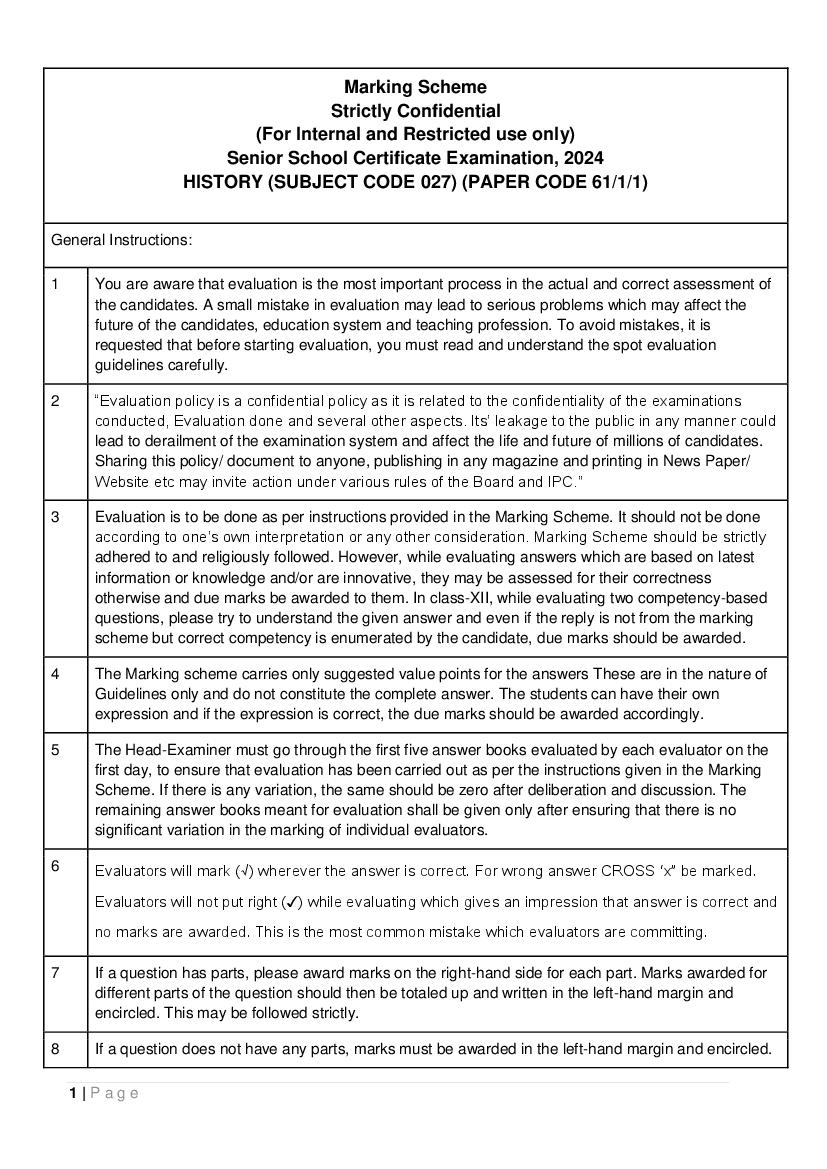
Strictly Confidential
(For Internal and Restricted use only)
Senior School Certificate Examination, 2024
HISTORY (SUBJECT CODE 027) (PAPER CODE 61/1/1)
General Instructions:
1 You are aware that evaluation is the most important process in the actual and correct assessment of
the candidates. A small mistake in evaluation may lead to serious problems which may affect the
future of the candidates, education system and teaching profession. To avoid mistakes, it is
requested that before starting evaluation, you must read and understand the spot evaluation
guidelines carefully.
2 “Evaluation policy is a confidential policy as it is related to the confidentiality of the examinations
conducted, Evaluation done and several other aspects. Its‟ leakage to the public in any manner could
lead to derailment of the examination system and affect the life and future of millions of candidates.
Sharing this policy/ document to anyone, publishing in any magazine and printing in News Paper/
Website etc may invite action under various rules of the Board and IPC.”
3 Evaluation is to be done as per instructions provided in the Marking Scheme. It should not be done
according to one‟s own interpretation or any other consideration. Marking Scheme should be strictly
adhered to and religiously followed. However, while evaluating answers which are based on latest
information or knowledge and/or are innovative, they may be assessed for their correctness
otherwise and due marks be awarded to them. In class-XII, while evaluating two competency-based
questions, please try to understand the given answer and even if the reply is not from the marking
scheme but correct competency is enumerated by the candidate, due marks should be awarded.
4 The Marking scheme carries only suggested value points for the answers These are in the nature of
Guidelines only and do not constitute the complete answer. The students can have their own
expression and if the expression is correct, the due marks should be awarded accordingly.
5 The Head-Examiner must go through the first five answer books evaluated by each evaluator on the
first day, to ensure that evaluation has been carried out as per the instructions given in the Marking
Scheme. If there is any variation, the same should be zero after deliberation and discussion. The
remaining answer books meant for evaluation shall be given only after ensuring that there is no
significant variation in the marking of individual evaluators.
6 Evaluators will mark (√) wherever the answer is correct. For wrong answer CROSS ‘x” be marked.
Evaluators will not put right (✓) while evaluating which gives an impression that answer is correct and
no marks are awarded. This is the most common mistake which evaluators are committing.
7 If a question has parts, please award marks on the right-hand side for each part. Marks awarded for
different parts of the question should then be totaled up and written in the left-hand margin and
encircled. This may be followed strictly.
8 If a question does not have any parts, marks must be awarded in the left-hand margin and encircled.
1|Page
Page 2
9 If a student has attempted an extra question, the answer of the question deserving more marks
should be retained and the other answer scored out with a note “Extra Question”.
10 No marks to be deducted for the cumulative effect of an error. It should be penalised only once.
11 A full scale of marks 80 (example 0 to 80/70/60/50/40/30 marks as given in Question Paper) has to
be used. Please do not hesitate to award full marks if the answer deserves it.
12 Every examiner has to necessarily do evaluation work for full working hours i.e., 8 hours every day
and evaluate 20 answer books per day in main subjects and 25 answer books per day in other
subjects (Details are given in Spot Guidelines).
13 Ensure that you do not make the following common types of errors committed by the Examiner in the
past:-
● Leaving the answer or part thereof unassessed in an answer book.
● Giving more marks for an answer than assigned to it.
● Wrong totaling of marks awarded on an answer.
● Wrong transfer of marks from the inside pages of the answer book to the title page.
● Wrong question wise totaling on the title page.
● Wrong totaling of marks of the two columns on the title page.
● Wrong grand total.
● Marks in words and figures not tallying/not same.
● Wrong transfer of marks from the answer book to online award list.
● Answers marked as correct, but marks not awarded. (Ensure that the right tick mark is correctly and
clearly indicated. It should merely be a line. Same is with the x for incorrect answers.)
● Half or a part of the answer marked correct and the rest as wrong, but no marks awarded.
14 While evaluating the answer books, if the answer is found to be totally incorrect, it should be marked
as cross (x) and awarded zero (0)Marks.
15 Any un-assessed portion, non-carrying over of marks to the title page, or totaling error detected by
the candidate shall damage the prestige of all the personnel engaged in the evaluation work as also
of the Board. Hence, in order to uphold the prestige of all concerned, it is again reiterated that the
instructions be followed meticulously and judiciously
16 The Examiners should acquaint themselves with the guidelines given in the “Guidelines for spot
Evaluation” before starting the actual evaluation.
17 Every Examiner shall also ensure that all the answers are evaluated, marks carried over to the title
page, correctly totaled and written in figures and words.
18 The candidates are entitled to obtain a photocopy of the Answer Book on request on payment of the
prescribed processing fee. All Examiners/Additional Head Examiners/Head Examiners are once
again reminded that they must ensure that evaluation is carried out strictly as per value points for
each answer as given in the Marking Scheme.
2|Page
Page 3
MARKING SCHEME 2024
HISTORY (027) MM: 80
_________________________________________________
S.NO Value Points Pg No. Marks
SECTION A
(Multiple Choice Type Questions) 21x1=21
1 (D) Shortughai Pg 12 1
2 (B) (ii), (iii) and (iv) Pg 68-90 1
3 (D) Asoka Pg 47 1
4 (B) Medicine Pg 79 1
5 (C) 1-(iv), 2-(iii), 3-(ii), 4-(i) Pg 100 1
6 (B) Mathura School of Art, (Visually Impaired) (A) Sakya Pg 103, 1
Pg 90
7 (D) Polyandry-Woman having several husbands. Pg 57 1
8 (B) Arabic Pg 117 1
9 (D) Sheikh Nizammudin Auliya Pg 160 1
10 (B)1-(ii), 2-(i), 3(iv), 4(iii) Pg 172 1
11 (D) Mulk-abadi deals with the fiscal side of the Mughal Empire. Pg 218 1
12 (B) Francois Bernier Pg 132 1
13 (A)Internal conflicts and alliance with the Sultanates against Pg 173 1
Vijayanagara.
14 (D) Muzarain-Peasants Pg 210 1
15 (A) (ii), (iii), (i), (iv) Pg 260-270 1
16 (C)1-(ii), 2(i), 3(iv), 4-(iii) Pg 296 1
17 (A)Both Assertion (A) and Reason(R) are true and Reason(R) is Pg 349 1
the correct explanation of Assertion(A).
18 (A)R.V. Dhulekar Pg 426 1
3|Page
Page 4
20 (A)Shah Mal Pg 263 1
21 (C)Colonial Rule Pg 327 1
Section B
(Short-Answer Type Questions) 6x3=18
22 (a)“Mahabharata is a dynamic text.” Justify the statement. Pg 77 3
Mahabharata, dynamic text.
(i) Performing Arts.
(ii) Written in a variety of languages.
(iii) Several stories.
(iv) Sculptural form.
(v) Painting
(vi) Bhagavad Gita.
(vii) Righteous path of action.
(viii) Reference of Kunti O Nishadi.
(ix) Any other relevant point
Any three to be assessed
OR
(b) Analyse the role of scholars in the task of preparing the critical Pg 54 3
edition of the Mahabharata.
Critical edition of Mahabharata:
(i) V.S. Sukthankar and scholars initiated the task.
(ii) Collected scripts from various regions.
(iii) Selected the common and differential aspects.
(iv) 13,000 pages were published.
(v) Regional variations were found.
(vi) Variations were reflective.
(vii) Any other relevant point
Any three to be assessed
23 Explain any three sources to know about the Mauryan Empire. Pg 32 3
Sources to know about Mauryan Empire
(i) Kautilya‟s Arthashastra.
(ii) Megasthene‟s Indica.
(iii) Buddhist and Jain literature.
(iv) Inscriptions of Ashoka.
(v) Punch marked coins of the Mauryas.
(vi) Asoka‟s dhamma and his dhamma mahamattas.
(vii) Any other relevant point
Any three to be assessed
4|Page
Page 5
with examples.
Water resource management was carried through:
(i) Tungabhadra river, which flows in a north-easterly direction.
(ii) Kamalapuram tank was the most important tank.
(iii) Water from this tank irrigated the fields and was conducted
through a channel to the royal centre.
(iv) Hiriya canal was one of the most prominent water networks.
(v) Water embankments were built to create reservoirs of different
sizes.
(vi) Any other relevant point)
Any three to be assessed
25 „„Revenue from the land was the economic mainstay of the Pg 213 3
Mughal empire.‟‟ Support the statement with examples.
Land revenue of Mughals:
(i) It was vital for the state to create an administrative apparatus
to control agricultural production and to fix and collect
revenue.
(ii) Apparatus for revenue collector – record keeping and revenue
collector.
(iii) Classification of land – Polaj, Parauti, Chachar and Banjar.
Both cultivated and cultivable lands were measured in each
province.
(iv) Revenue collected in kind and cash.
(v) Jama and Hasil
(vi) The Ain happens to be a valid souce to know the
aggregates of such lands.
(vii) The amir gulzar was supposed to be the revenue collector.
(viii) Any other relevant point
Any three to be assessed
26 (a)Why was the Revolt of 1857 specially widespread in Pg 266 3
Awadh? Explain.
Awadh and 1857 Revolt.
(i) Implementation of subsidiary alliance system.
(ii) Annexation policy of the British. (Doctrine of Lapse)
(iii) Need of Awadh – due to the productive region and market.
(iv) Dethroning of Wajid Ali Shah on the pretext of misrule.
(v) Life was gone out of the body.
(vi) This emotional disturbance was aggravated by the people‟s
material losses.
(vii) The removal of the nawab led to the dissolution of the court
culture.
5|Page
Page 6
Any three to be assessed
OR
(b) Why did the rebel proclamations in 1857 appeal for unity to all Pg 271 3
sections of the population? Explain.
Rebel Vision of Unity
(i) The rebel proclamation repeatedly appealed to all the
sections of the population irrespective of their caste and
creed.
(ii) Proclamations issued under the name of Bahadur shah
appealed to the people to join the standards of Mahavir and
Muhhammad.
(iii) In Barailley the British incited the Hindus and Muslim, the
attempt failed.
(iv) According to the Azamgarh Proclamation, 25th August, 1857
both Hindus and Muslims were being ruined under tyranny
and oppression.
(v) Many social groups joined the revolt and appealed for the
unity of the country.
(vi) Any other relevant point
Any three to be assessed
27 Explain the causes that led to the conflict between the Paharias of Pg 241 3
Rajmahal Hills and the Santhals.
(i) Paharias and Santhals.
(ii) Land dispute, encroachments.
(iii) Damin-i-koh, the land issued to the santhals in 1832.
(iv) Conflict over resources.
(v) Disparities created by the Britishers between the paharias and
the santhals.
(vi) When the santhals settled on the outskirts (outside) the
Rajmahal hills, the paharais opposed.
(vii) Any other relevant point
Any three to be assessed
Section C
(Long-Answer Type Questions) 3x8=24
28 (a) “The most unique feature of the Harappan civilization was the Pgs 4-7 8
development of urban centres.” Explain.
Harappa urban planning
6|Page
Page 7
(ii) Lower-town
(iii) Drainage
(iv) Domestic architecture which involves 700 wells, courtyard,
kitchen staircase, etc.
(v) Great Bath
(vi) Warehouse
(vii) Roads and their planning, the grid pattern.
(viii) Dockyard at Lothal.
(ix) Mackay‟s quote and his admiration of the efficient
construction of drains.
(x) The various materials used for construction like gypsum,
limestone, mortar.
(xi) Any other relevant point
Any eight to be assessed
OR
(b) Explain the role of various archaeologists in the discovery of Pgs 19- 8
Harappa. 20
(i) Role of Archaeologists in the discovery of Harappa:
(ii) Cunningham‟s confusion to be discussed.
(iii) Daya Ram Sahni discovered seals at Harappa in 1921.
(iv) Rakhal Das Banerjee discovered seals at Mohenjodaro in
1922.
(v) John Marshall announced the discovery of a new civilization.
(vi) S. N. Roy noted it in his book-the story of Indian archaeology.
(vii) R.E.M. Wheeler suggested the following of stratigraphy for the
survey.
(Role of any four archaeologists to be assessed)
29 Describe the contribution of Kabir to the Bhakti Movement and his Pg 161 8
impact on religious and social harmony.
Kabir:
(i) Kabir was one of the most outstanding examples of poet saint
of the fourteenth-fifteenth centuries.
(ii) His early childhood.
(iii) Verses ascribed to Kabir have been compiled in three
distinct but overlapping traditions.
(iv) The kabirBijak, Kabir Granthavali, Adi Granth serve as a
major source to know Kabir and his philosophies.
(v) His poems have survived in several languages.
(vi) Also striking is the range of traditions Kabir drew on to
describe the Ultimate Reality.
(vii) He drew terms from vedantic traditions-Alakh, Nirankar,
7|Page
Page 8
(viii) Other terms having mystical connotations were also being
used. (shabada or shunya)
(ix) His ideas were crystallized through debates and poems.
(x) Hagiographies also play an important role.
(xi) He was against idolatry and polytheism.
(xii) Reference of ulatbansi and sant bhasha.
(xiii) Any other relevant point
Any eight to be assessed
OR
(b) Describe the teachings of Guru Nanak Dev ji emphasizing Pg 163-
his philosophy of oneness. 164
(i) Guru Nanak Devji
(ii) Advocated Nirguna Bhakti.
(iii) Rejected sacrifices and rituals.
(iv) Discussed about Absolute Rab.
(v) Connect to Divine.
(vi) Expressed ideas through hymns – Shabad.
(vii) Composed ragas.
(viii) Set up rules for congregational worship. (Sangat)
(ix) Successor was Guru Angad Devji .
(x) Adi Granth Sahib and Gurbani.
(xi) Later founded the Khalsa Panth.
(xii) Any other relevant point
Any eight to be assessed
30 (a) “There are many different kinds of sources from which we Pgs 8
can reconstruct the political career of Gandhi and the history 307-313
of the Indian nationalist movement.” Examine the statement.
(i) Source to know about Gandhi
(ii) Letters
(iii) Writings
(iv) Speeches
(v) Journals
(vi) Public statements
(vii) Autobiography
(viii) Government records
(ix) Police records
(x) Newspaper
(xi) Any other relevant point
Any eight to be assessed
8|Page
Page 9
(b) Examine the contribution of Mahatma Gandhi towards nation Pgs 8
building after the independence of India. 295,305-
307
Gandhiji towards nation building:
(i) Appealed Hindu – Muslim – Sikh for Peace.
(ii) Discussed rights of minorities (harijans).
(iii) Discussed democratic secular state.
(iv) Full rights should be given to citizens.
(v) Finest hour of Mahatma Gandhi.
(vi) Visited riot-turned areas – Bengal and Punjab.
(vii) Promoted equally of all classes .
(viii) Wanted to see United India.
(ix) Gandhi‟s social ideologies like:
Hindu-Muslim Unity.
promotion of charkha(khadi)
Removal of Untouchability.
Satyagraha and abolition of child marriages.
(x) Any other relevant point.
Any eight to be assessed
SECTION D
(Source-Based Questions) 3x4=12
31 Buddhism in practice Pg 91 1+1+2=
4
This is an excerpt from the Sutta Pitaka, and contains the advice
given by the Buddha to a wealthy householder named Sigala :In five
ways should a master look after his servants and employees …by
assigning them work according to their strength, by supplying them
with food and wages, by tending them in sickness; by sharing
delicacies with them and by granting leave at times…In five ways
should the clansmen look after the needs of samanas (those who
have renounced the world) and Brahmanas : by affection in act and
speech and mind, by keeping open house to them and supplying
their worldly needs. There are similar instructions to Sigala about
how to behave with his parents, teacher and wife.
(31.1) How did Buddha highlight the significance of compassion in
the social hierarchy? (1)
Ans. (i) Equality of all beings.
(ii) Non-discrimination policy.
(iii) Ethical conduct.
9|Page
Page 10
(v) Any other relevant point.
Any one point to be explained.
(31.2) Why did Buddha emphasise righteous action? (1)
Ans. (i)Kindness.
(ii)Generosity.
(iii)Inner virtues.
(iv) Purification of mind for the attainment of nibbana.
(v) Any other relevant point.
Any one point to be explained.
(31.3) Explain any two tenets of Karma according to Buddha.(2)
Ans. (i) Generate positive karmas.
(ii) Foster harmony.
(iii) Believe in peace and cohesiveness.
(iv)Any other relevant point.
Any two points to be explained.
32 A strange nation? Pg 129 1+1+2=
The travelogue of Abdur Razzaq written in the 1440s is an interesting 4
mixture of emotions and perceptions. On the one hand, he did not
appreciate what he saw in the port of Calicut (present-day
Kozhikode) in Kerala, which was populated by “a people the likes of
whom I had never imagined”, describing them as “a strange nation”.
Later in his visit to India, he arrived in Mangalore, and crossed the
Western Chats. Here he saw a temple that filled him with admiration :
Within three leagues (about nine miles) of Mangalore, I saw an
Idol-house the likes of which is not to be found in all the world.
It was a square, approximately ten yards a side, five yards in
height, all covered with cast bronze, with four porticos. In the
entrance portico was a statue in the likeness of a human being,
full stature, made of gold. It had two red rubies for eyes, so
cunningly made that you would say it could see. What craft and
artisanship!
(32.1) Why did Abdur Razzaq call India a „strange nation‟? (1)
Ans. (i) Sense of unfamiliarity.
(ii) Cultural differences as he was accustomed to his own.
(iii) Any other relevant point.
10 | P a g e
Page 11
(32.2) How do emotions and perceptions reflect in this source? (1)
Ans. (i)Emotions such as admiration, surprise and confusion.
(ii) Any other relevant point.
Any one point to be explained.
(32.3) How did Abdur Razzaq describe the temples of the western
Ghats in Mangalore? (2)
Ans. (i) Bronze corned entrance.
(ii) Gold statue.
(iii) Any other relevant point.
Any two points to be explained.
33 “There cannot be any divided loyalty” Pg 330 1+1+2=
Govind Ballabh Pant emphasised to become loyal citizens. 4
For the success of democracy one must train himself in the art of
self-discipline. In democracies one should care less for himself and
more for others. All loyalties must exclusively be centred round the
State. If in a democracy, you create rival loyalties, or you create a
system in which any individual or group, instead of suppressing his
extravagance, cares not for larger or other interests, then democracy
is doomed.
(33.1) How has Pant described the key to the success of
Democracy? (1)
Ans. (i) Self-discipline.
(ii) Care less for yourself and more for others.
(iii) Any other relevant point.
Any one point to be explained.
(33.2) How has Pant defined the art of self-discipline
in democracy? (1)
Ans. (i) Most suitable for plural country.
(ii) Ensured decision making for all.
(iii) Democracy should address socio–economic equality.
(iv) Any other relevant point.
Any one point to be considered.
(33.3) Explain Pant‟s views on the relationship between
democracy and equality. (2)
Ans. (i) No divided loyalty but all loyalties should be centred round
the State.
(ii) Care for a larger section of the population.
(iii) Any other relevant point.
11 | P a g e
Page 12
SECTION E
(Map-Based Questions) 5
34 (34.1) On the given political outline map of India (on page 23), locate 3x1=3
and label the following with appropriate symbols :
(i) Banawali, a Harappan site 1 Pg.2
(ii) Amravati stupa 1 Pg.94
(iii) (a) Agra (Territory under the Mughals) Pg. 214
OR 1
(iii) (b) Ajmer (Territory under the Mughals)
(34.2) On the same outline map, two centres related to the Indian Pg. 286-
National Movement are marked as A and B. Identify them and 313
write their correct names on the lines drawn near them. 2
Note : The following questions are for the Visually Impaired
Candidates only, in lieu of Q. No. 34 :
(34.1) Mention any two Buddhist sites in India. Pg 95
Nagarjunakonda, Sanchi, Amravati, Lumbini, Barhut, Bodh 2
Gaya, Ajanta, Kusinagara, Nasik (Any two sites)
(34.2) (a) Mention the capital city of Vijayanagara empire. Pg 170
Hampi/Vijaynagara
OR 1
(34.2) (b) Mention any one territory under the Mughal empire.
Delhi, Agra, Panipat, Amber, Ajmer, Lahore, Goa. Pg 214 1
(Any one territory)
(34.3) Mention any two centres of the Indian National Movement. Pg286-
Champaran, Kheda, Ahemdabad, Benaras, Amritsar, Chauri 313 2
Chaura, Lahore, Bardoli, Dandi, Bombay, Karachi.
(Any two centres)
SEE ATTACHED MAP
12 | P a g e
Page 13
Page 14
Strictly Confidential
(For Internal and Restricted use only)
Senior School Certificate Examination, 2024
HISTORY (SUBJECT CODE 027) (PAPER CODE 61/1/2)
General Instructions:
1 You are aware that evaluation is the most important process in the actual and correct assessment of
the candidates. A small mistake in evaluation may lead to serious problems which may affect the
future of the candidates, education system and teaching profession. To avoid mistakes, it is
requested that before starting evaluation, you must read and understand the spot evaluation
guidelines carefully.
2 “Evaluation policy is a confidential policy as it is related to the confidentiality of the examinations
conducted, Evaluation done and several other aspects. Its‟ leakage to the public in any manner
could lead to derailment of the examination system and affect the life and future of millions of
candidates. Sharing this policy/ document to anyone, publishing in any magazine and printing in
News Paper/ Website etc may invite action under various rules of the Board and IPC.”
3 Evaluation is to be done as per instructions provided in the Marking Scheme. It should not be done
according to one‟s own interpretation or any other consideration. Marking Scheme should be strictly
adhered to and religiously followed. However, while evaluating answers which are based on latest
information or knowledge and/or are innovative, they may be assessed for their correctness
otherwise and due marks be awarded to them. In class-XII, while evaluating two competency-based
questions, please try to understand the given answer and even if the reply is not from the marking
scheme but correct competency is enumerated by the candidate, due marks should be awarded.
4 The Marking scheme carries only suggested value points for the answers These are in the nature of
Guidelines only and do not constitute the complete answer. The students can have their own
expression and if the expression is correct, the due marks should be awarded accordingly.
5 The Head-Examiner must go through the first five answer books evaluated by each evaluator on the
first day, to ensure that evaluation has been carried out as per the instructions given in the Marking
Scheme. If there is any variation, the same should be zero after deliberation and discussion. The
remaining answer books meant for evaluation shall be given only after ensuring that there is no
significant variation in the marking of individual evaluators.
6 Evaluators will mark (√) wherever the answer is correct. For wrong answer CROSS ‘x” be marked.
Evaluators will not put right (✓) while evaluating which gives an impression that answer is correct
and no marks are awarded. This is the most common mistake which evaluators are committing.
7 If a question has parts, please award marks on the right-hand side for each part. Marks awarded for
different parts of the question should then be totaled up and written in the left-hand margin and
encircled. This may be followed strictly.
8 If a question does not have any parts, marks must be awarded in the left-hand margin and encircled.
1|Page
Page 15
9 If a student has attempted an extra question, the answer of the question deserving more marks
should be retained and the other answer scored out with a note “Extra Question”.
10 No marks to be deducted for the cumulative effect of an error. It should be penalised only once.
11 A full scale of marks 80 (example 0 to 80/70/60/50/40/30 marks as given in Question Paper) has to
be used. Please do not hesitate to award full marks if the answer deserves it.
12 Every examiner has to necessarily do evaluation work for full working hours i.e., 8 hours every day
and evaluate 20 answer books per day in main subjects and 25 answer books per day in other
subjects (Details are given in Spot Guidelines).
13 Ensure that you do not make the following common types of errors committed by the Examiner in
the past:-
● Leaving the answer or part thereof unassessed in an answer book.
● Giving more marks for an answer than assigned to it.
● Wrong totaling of marks awarded on an answer.
● Wrong transfer of marks from the inside pages of the answer book to the title page.
● Wrong question wise totaling on the title page.
● Wrong totaling of marks of the two columns on the title page.
● Wrong grand total.
● Marks in words and figures not tallying/not same.
● Wrong transfer of marks from the answer book to online award list.
● Answers marked as correct, but marks not awarded. (Ensure that the right tick mark is correctly
and clearly indicated. It should merely be a line. Same is with the X for incorrect answers.)
● Half or a part of the answer marked correct and the rest as wrong, but no marks awarded.
14 While evaluating the answer books, if the answer is found to be totally incorrect, it should be marked
as cross (x) and awarded zero (0)Marks.
15 Any un-assessed portion, non-carrying over of marks to the title page, or totaling error detected by
the candidate shall damage the prestige of all the personnel engaged in the evaluation work as also
of the Board. Hence, in order to uphold the prestige of all concerned, it is again reiterated that the
instructions be followed meticulously and judiciously
16 The Examiners should acquaint themselves with the guidelines given in the “Guidelines for spot
Evaluation” before starting the actual evaluation.
17 Every Examiner shall also ensure that all the answers are evaluated, marks carried over to the title
page, correctly totaled and written in figures and words.
18 The candidates are entitled to obtain a photocopy of the Answer Book on request on payment of the
prescribed processing fee. All Examiners/Additional Head Examiners/Head Examiners are once
again reminded that they must ensure that evaluation is carried out strictly as per value points for
each answer as given in the Marking Scheme.
2|Page
Page 16
MARKING SCHEME 2024
HISTORY (027) MM: 80
_________________________________________________
S.NO Value Points Pg No. Marks
SECTION A
(Multiple Choice Type Questions) 21x1=21
1 (C) Colonial Rule Pg 327 1
2 (A) Shah Mal Pg 263 1
3 (A) The zamindars got the permanent rights on the land Pg 228 1
4 (A) R.V. Dhulekar Pg 426 1
5 (A) Both Assertion(A) and Reason(R) are true and Reason(R) is Pg 349 1
the correct explanation of assertion(A)
6 (C) 1-(ii), 2(i), 3(iv), 4-(iii) Pg 296 1
7 (A) (ii), (iii), (i), (iv) Pg 260-270 1
8 (D) Muzarain-Peasants Pg 210 1
9 (A) Internal conflicts and alliance with the Sultanates against Pg 173 1
Vijayanagara
10 (B) Francois Bernier Pg 132 1
11 (D) Mulk-abadi deals with the fiscal side of the Mughal Empire. Pg 218 1
12 (B) 1-(ii), 2-(i), 3(iv),4(iii) Pg 172 1
13 (D) Sheikh Nizamuddin Auliya Pg 160 1
14 (B) Arabic Pg 117 1
15 (D) Polyandry Pg 57 1
16 (B) Mathura School of Art , visually impaired(A) Sakya Pg 103, 1
Pg 90
17 (C) 1-(iv), 2-(iii), 3(ii), 4(i) Pg 100 1
18 (B)Medicine Pg 79 1
19 (D)Asoka Pg 47 1
3|Page
Page 17
21 (D)Shortughai Pg 12 1
Section B
(Short-Answer Type Questions) 6x3=18
22 (a) “Mahabharata is a dynamic text.” Justify the statement. Pg 77 3
Mahabharata, dynamic text:
(i) Performing Arts.
(ii) Written in a variety of languages.
(iii) Several stories.
(iv) Sculptural form.
(v) Painting
(vi) Bhagavad Gita
(vii) Righteous path of action
(viii) Reference of Kunati O Nishadi.
(ix) Any other relevant point
Any three to be assessed
OR
(b) Analyse the role of scholars in the task of preparing the critical Pg 54 3
edition of the Mahabharata.
Critical edition of Mahabharata :
(i) V.S. Sukthankar and scholars initiated the task.
(ii) Collected scripts from various regions.
(iii) Selected the common and differential aspects.
(iv) 13,000 pages were published.
(v) Regional variations were found.
(vi) Variations were reflective.
(vii) Any other relevant point
Any three to be assessed
23 “The emergence of the Mauryan empire was regarded as a major Pg 34 3
landmark in Indian history.” Explain the statement.
Mauryan Empire – a landmark in history (reasons/justifications)
(i) Spectacular art provided by the scholars/artists.
(ii) Ashokan inscriptions and their diversity.
(iii) Role of Ashoka as inspiration for his people/subjects.
(iv) Propagation of Asoka‟s dhamma.
(v) Coinage.
(vi) Trade beyond the subcontinent.
(vii) Any other relevant point
Any three to be assessed
4|Page
Page 18
of Vijayanagara empire? Explain with examples.
Fortifications of Vijayanagara :
(i) Seven lines of fortification.
(ii) Encircled city, hinterland and forests.
(iii) Outermost wall linked hills surrounded the city.
(iv) Massive masonry construction.
(v) Use of no mortar or cementing materials.
(vi) Use of stone blocks with earth, packed with rubble.
(vii) Enclosed agricultural tracts between sacred centre and urban
centre.
(viii) Any other relevant point
Any three to be assessed
25 “The villages in the Mughal empire were seen as Little Republics.” Pg 205 3
Support the statement with examples.
Villages as little Republics:
(i) Made up of fraternal partners sharing resources and labour.
(ii) Individual ownership of resources and assets.
(iii) Powerful individuals decided the affairs of the village.
(iv) They had authority to dispense justice.
(v) Cash nexus through trade.
(vi) Any other relevant point
Any three to be assessed
26 (a) Why was the Revolt of 1857 specially widespread in Awadh? Pg 266 3
Explain.
Awadh and 1857 Revolt:
(i) Implementation of subsidiary alliance system.
(ii) Annexation policy of the British (Doctrine of Lapse).
(iii) Geography and soil – due to productive region and market
(iv) Dethroning of Wajid Ali Shah on the pretext of misrule.
(v) Life was gone out of the body.
(vi) This emotional disturbance was aggravated by the people‟s
material losses.
(vii) The removal of the nawab led to the dissolution of the court
culture.
(viii) Any other relevant point
Any three to be assessed
OR
(b)Why did the rebel proclamations in 1857 appeal for unity to all Pg 271 3
sections of the population ? Explain.
5|Page
Page 19
(i) The rebel proclamation repeatedly appealed to all the
sections of the population irrespective of their caste and
creed.
(ii) Proclamations issued under the name of Bahadur Shah
appealed to the people to join the standards of Mahavir and
Muhhammad.
(iii) In Bareilly the British incited the Hindus and Muslim, the
attempt failed.
(iv) According to the Azamgarh Proclamation, 25th August, 1857
both the Hindus and Muslims were being ruined under tyranny
and oppression.
(v) Many social groups joined the revolt and appealed for the
unity of the country.
(vi) Any other relevant point)
Any three to be assessed
27 Critically examine the Fifth Report of 1813. Pg 264 3
Fifth Report of 1813.
(i) It was the fifth in a series of reports on EIC administration in
India.
(ii) It ran into 1002 pages with 800 pages of appendix.
(iii) Petitions of Zamindars, Ryots, Collectors.
(iv) Notes of revenue and judicial administration of Bengal
and Madras.
(v) Many wanted a revocation (Cancellation) of the Royal
Charter given to the EIC.
(vi) It carried information of Company‟s misrule and
Maladministration in India.
(vii) Any other relevant point
Any three to be assessed
Section C
(Long-Answer Type Questions) 3x8=24
28 (a) “The most unique feature of the Harappan civilization was the Pgs 4-7 8
development of urban centres.” Explain.
Harappa town planning:
(i) Citadel
(ii) Lower-town
(iii) Drainage
(iv) Domestic architecture included 700 wells, courtyard, kitchen
staircase, etc.
(v) Great Bath
6|Page
Page 20
(vii) Roads
(viii) Dockyard
(ix) Mackay‟s quote and his admiration of the efficient
construction of drains.
(x) The various materials used for construction like gypsum,
limestone, mortar.
(xi) Any other relevant point
Any eight to be assessed
OR
(b) Explain the role of various archaeologists in the discovery of Pgs 19- 8
Harappa. 21
Role of Archaeologists in the discovery of Harappa:
(i) Cunningham‟s confusion.
(ii) Daya Ram Sahni discovered seals at Harappa.
(iii) Rakhal Das Banerjee discovered seals at Mohenjodaro.
(iv) John Marshall announced the discovery of a new civilization.
(v) S. N. Roy noted it in his book Story of Indian archaeology.
(vi) R.E.M. Wheeler suggested the following of stratigraphy for the
survey.
(Role of any four archaeologists to be assessed)
29 (a) Explain the main characteristics of the Lingayat tradition Pg. 147 8
during Medieval India.
The Lingayats:
(i) The movement emerged in Karnataka, led by Basavanna.
(ii) His followers were known as Virashaivas.
(iii) They were the wearers of linga.
(iv) They worshipped Shiva in his manifestation as a linga.
(v) Men wore small linga in a silver case.
(vi) They were wandering monks.
(vii) They believed that death will unite us with Lord Shiva.
(viii) They did not practice funerary rites, but buried the dead.
(ix) They challenged the idea of caste system.
(x) They questioned the theory of Rebirth.
(xi) They encouraged widow remarriage.
(xii) Any other relevant point
Any eight to be assessed
7|Page
Page 21
(b) Explain Kabir‟s teachings on love, devotion and inner Pgs 8
realization. 161-162
Kabir:
(i) Kabir was one of the most outstanding examples of poet saint
of the fourteenth-fifteenth centuries.
(ii) His early childhood.
(iii) Verses ascribed to Kabir have been compiled in three
distinct but overlapping traditions.
(iv) The kabirBijak, Kabir Granthavali, Adi Granth serve as a
major source to know Kabir and his philosophies.
(v) His poems have survived in several languages.
(vi) Also striking is the range of traditions Kabir drew on to
describe the Ultimate Reality.
(vii) He drew terms from vedantic tradition-Brahman, Atman,
Nirankar etc.
(viii) Other terms having mystical connotations were also being
used. (shunya or shabda)
(ix) His ideas were crystallized through debates and poems.
(x) Hagiographies also play an important role.
(xi) He did not believe in polytheism and idolatry.
(xii) Reference to ulatbansi and sant bhasha.
(xiii) Any other relevant point
Any eight to be assessed
30 (a) Examine the causes and events of the „Quit India Movement‟. Pg 303 8
Causes
(i) Demand for self- rule.
(ii) Dissatisfaction from British policies.
(iii) Government of India Act 1935.
(iv) Failure of Cripps mission.
(v) Influence of WWII.
Events
(i) Launched by Gandhiji and INC against the British.
(ii) Gandhi gave the slogan „Do or Die‟.
(iii) Bombay resolution of 1942 was passed.
(iv) Mass protest.
(v) Civilians disobeyed Government orders.
(vi) Demonstrations, strikes and processions.
(vii) A parallel government was set up in Satara.
(viii) The satara prati sarkar functioned till the elections of 1946.
(ix) British declared INC as an illegal organisation.
(x) Thousands of Indians were imprisoned.
(xi) Parallel governments were formed.
8|Page
Page 22
Any eight to be assessed
OR
(b) Examine Gandhi's political role as a leader and social reformer. Pgs 287- 8
297
As a leader:
(i) His B.H.U. speech was inspiring and the very beginning
of making Indian nationalism a mass phenomenon.
(ii) His localised struggles-At Champaran, Kheda and
Ahemdabad.
(iii) Rowlatt Satyagraha of 1919.
(iv) Role in non-cooperation movement.
(v) Role in Civil Disobedience.
(vi) Role in Quit India Movement.
(vii) Last days of Gandhiji (finest hours).
(viii) Gandhiji as a reformer:
(ix) Principle of Ahimsa.
(x) Satyagraha as a weapon of the strong.
(xi) Advocated Swadeshi. (charkha)
(xii) Advocated communal harmony.
(xiii) Caste equality. (Harijans)
(xiv) Abolition of child marriages.
(xv) Any other relevant point
Any eight to be assessed
SECTION D
(Source-Based Questions) 3x4=12
31 A strange nation? Pg 129 1+1+2=
The travelogue of Abdur Razzaq written in the 1440s is an interesting 4
mixture of emotions and perceptions. On the one hand, he did not
appreciate what he saw in the port of Calicut (present-day
Kozhikode) in Kerala, which was populated by “a people the likes of
whom I had never imagined”, describing them as “a strange nation”.
Later in his visit to India, he arrived in Mangalore, and crossed the
Western Chats. Here he saw a temple that filled him with admiration :
Within three leagues (about nine miles) of Mangalore, I saw an
idol-house the likes of which is not to be found in all the world. It was
a square, approximately ten yards a side, five yards in height, all
covered with cast bronze, with four porticos. In the entrance portico
was a statue in the likeness of a human being, full stature, made of
gold. It had two red rubies for eyes, so cunningly made that you
would say it could see. What craft and artisanship!
(31.1) Why did Abdur Razzaq call India a „strange nation‟? (1)
9|Page
Page 23
(ii) Cultural differences as he was accustomed to his own.
(iii) Any other relevant point.
Any one point to be explained.
(31.2) How do emotions and perceptions reflect in this source? (1)
Ans. (i) Emotions such as admiration, surprise and confusion.
(ii) Any other relevant point.
Any one point to be explained.
(31.3) How did Abdur Razzaq describe the temples of the Western
Ghats in Mangalore? (2)
Ans.(i) Bronze corned entrance
(ii) Gold statue
(iii) Any other relevant point.
Any two points to be explained.
32 “There cannot be any divided loyalty” Pg 330 1+1+2=
Govind Ballabh Pant emphasised to become loyal citizens. 4
For the success of democracy one must train himself in the art of
self-discipline. In democracies one should care less for himself and
more for others. All loyalties must exclusively be centred round the
State. If in a democracy, you create rival loyalties, or you create a
system in which any individual or group, instead of suppressing his
extravagance, cares not for larger or other interests, then democracy
is doomed.
(32.1) How has Pant described the key to the success of
Democracy? (1)
Ans. (i) Self -discipline.
(ii) Care less for yourself and more for others.
(iii) Any other relevant point.
Any one point to be explained.
(32.2) How has Pant defined the art of self-discipline in
Democracy? (1)
Ans. (i) Most suitable for plural country.
(ii)Ensured decision making for all.
(iii)Democracy should address socio–economic equality.
(iv) Any other relevant point.
Any one point to be explained.
(32.3) Explain Pant‟s views on the relationship between Democracy
and equality. (2)
Ans. (i) No divided loyalty but all loyalties should be centred round
the State.
(ii) Care for a larger section of the population.
10 | P a g e
Page 24
Any two points to be explained.
33 Buddhism in practice Pg 91 1+1+2=
This is an excerpt from the Sutta Pitaka, and contains the advice 4
given by the Buddha to a wealthy householder named Sigala :In five
ways should a master look after his servants and employees …by
assigning them work according to their strength, by supplying them
with food and wages, by tending them in sickness; by sharing
delicacies with them and by granting leave at times…In five ways
should the clansmen look after the needs of samanas (those who
have renounced the world) and Brahmanas : by affection in act and
speech and mind, by keeping open house to them and supplying
their worldly needs. There are similar instructions to Sigala about
how to behave with his parents, teacher and wife.
(33.1) How did Buddha highlight the significance of compassion in
Social hierarchy? (1)
Ans. (i) Equality of all beings.
(ii) Non-discrimination.
(iii)Ethical
(iv) Service to others.
(v)Any other relevant point.
Any one point to be explained.
(33.2) Why did Buddha emphasise righteous action? (1)
Ans. (i)Kindness.
(ii)Generosity.
(iii)Inner virtues.
(iv)Purification of mind to attain nibbana.
(v)Any other relevant point.
Any one point to be explained.
(33.3) Explain any two tenets of Karma according to Buddha.(2)
Ans. (i) Generate positive karmas.
(ii) Foster harmony.
(iii) Believe in peace and cohesiveness.
(iv) Any other relevant point.
Any two points to be explained.
SECTION E
(Map-Based Questions) 5
34 (34.1) On the given political outline map of India (on page 23), locate 3x1=3
and label the following with appropriate symbols :
(i) Banawali, a Harappan site 1 Pg.2
(ii) Amravati stupa 1 Pg.94
11 | P a g e
Page 25
OR 1
(iii) (b) Ajmer (Territory under the Mughals)
(34.2) On the same outline map, two centres related to the Indian Pg. 286-
National Movement are marked as A and B. Identify them and write 313
their correct names on the lines drawn near them. 2
Note : The following questions are for the Visually Impaired
Candidates
only, in lieu of Q. No. 34 :
(34.1) Mention any two Buddhist sites in India. Pg 95 2
Nagarjunakonda, Sanchi, Amravati, Lumbini, Barhut, Bodh
Gaya, Ajanta, Kusinagara, Nasik (Any two sites)
Pg 170
(34.2) (a) Mention the capital city of Vijayanagara empire.
Hampi/Vijayanagara 1
OR
(34.2) (b) Mention any one territory under the Mughal empire. Pg 214
Delhi, Agra, Panipat, Amber, Ajmer, Lahore, Goa. 1
(Any one territory)
(34.3) Mention any two centres of the Indian National Movement. Pg286-
Champaran, Kheda, Ahemdabad, Benaras, Amritsar, Chauri 313
Chaura, Lahore, Bardoli, Dandi, Bombay, Karachi.
(Any two centres) 2
SEE ATTATCHED MAP
12 | P a g e
Page 26
Page 27
Strictly Confidential
(For Internal and Restricted use only)
Senior School Certificate Examination, 2024
HISTORY (SUBJECT CODE 027) (PAPER CODE 61/1/3)
General Instructions:
1 You are aware that evaluation is the most important process in the actual and correct assessment
of the candidates. A small mistake in evaluation may lead to serious problems which may affect the
future of the candidates, education system and teaching profession. To avoid mistakes, it is
requested that before starting evaluation, you must read and understand the spot evaluation
guidelines carefully.
2 “Evaluation policy is a confidential policy as it is related to the confidentiality of the examinations
conducted, Evaluation done and several other aspects. Its‟ leakage to the public in any manner
could lead to derailment of the examination system and affect the life and future of millions of
candidates. Sharing this policy/ document to anyone, publishing in any magazine and printing in
News Paper/ Website etc may invite action under various rules of the Board and IPC.”
3 Evaluation is to be done as per instructions provided in the Marking Scheme. It should not be done
according to one‟s own interpretation or any other consideration. Marking Scheme should be strictly
adhered to and religiously followed. However, while evaluating answers which are based on latest
information or knowledge and/or are innovative, they may be assessed for their correctness
otherwise and due marks be awarded to them. In class-XII, while evaluating two competency-based
questions, please try to understand the given answer and even if the reply is not from the marking
scheme but correct competency is enumerated by the candidate, due marks should be awarded.
4 The Marking scheme carries only suggested value points for the answers These are in the nature of
Guidelines only and do not constitute the complete answer. The students can have their own
expression and if the expression is correct, the due marks should be awarded accordingly.
5 The Head-Examiner must go through the first five answer books evaluated by each evaluator on
the first day, to ensure that evaluation has been carried out as per the instructions given in the
Marking Scheme. If there is any variation, the same should be zero after deliberation and
discussion. The remaining answer books meant for evaluation shall be given only after ensuring
that there is no significant variation in the marking of individual evaluators.
6 Evaluators will mark (√) wherever the answer is correct. For wrong answer CROSS ‘x” be marked.
Evaluators will not put right (✓) while evaluating which gives an impression that answer is correct
and no marks are awarded. This is the most common mistake which evaluators are committing.
7 If a question has parts, please award marks on the right-hand side for each part. Marks awarded for
different parts of the question should then be totaled up and written in the left-hand margin and
encircled. This may be followed strictly.
8 If a question does not have any parts, marks must be awarded in the left-hand margin and
encircled. This may also be followed strictly.
1|Page
Page 28
should be retained and the other answer scored out with a note “Extra Question”.
10 No marks to be deducted for the cumulative effect of an error. It should be penalised only once.
11 A full scale of marks 80 (example 0 to 80/70/60/50/40/30 marks as given in Question Paper) has to
be used. Please do not hesitate to award full marks if the answer deserves it.
12 Every examiner has to necessarily do evaluation work for full working hours i.e., 8 hours every day
and evaluate 20 answer books per day in main subjects and 25 answer books per day in other
subjects (Details are given in Spot Guidelines).
13 Ensure that you do not make the following common types of errors committed by the Examiner in
the past:-
● Leaving the answer or part thereof unassessed in an answer book.
● Giving more marks for an answer than assigned to it.
● Wrong totaling of marks awarded on an answer.
● Wrong transfer of marks from the inside pages of the answer book to the title page.
● Wrong question wise totaling on the title page.
● Wrong totaling of marks of the two columns on the title page.
● Wrong grand total.
● Marks in words and figures not tallying/not same.
● Wrong transfer of marks from the answer book to online award list.
● Answers marked as correct, but marks not awarded. (Ensure that the right tick mark is correctly
and clearly indicated. It should merely be a line. Same is with the X for incorrect answers.)
● Half or a part of the answer marked correct and the rest as wrong, but no marks awarded.
14 While evaluating the answer books, if the answer is found to be totally incorrect, it should be
marked as cross (x) and awarded zero (0)Marks.
15 Any un-assessed portion, non-carrying over of marks to the title page, or totaling error detected by
the candidate shall damage the prestige of all the personnel engaged in the evaluation work as also
of the Board. Hence, in order to uphold the prestige of all concerned, it is again reiterated that the
instructions be followed meticulously and judiciously
16 The Examiners should acquaint themselves with the guidelines given in the “Guidelines for spot
Evaluation” before starting the actual evaluation.
17 Every Examiner shall also ensure that all the answers are evaluated, marks carried over to the title
page, correctly totaled and written in figures and words.
18 The candidates are entitled to obtain a photocopy of the Answer Book on request on payment of
the prescribed processing fee. All Examiners/Additional Head Examiners/Head Examiners are once
again reminded that they must ensure that evaluation is carried out strictly as per value points for
each answer as given in the Marking Scheme.
2|Page
Page 29
MARKING SCHEME 2024
HISTORY (027) MM:80
_________________________________________________
S.NO Value Points Pg Marks
No.
SECTION A
(Multiple Choice Type Questions) 21x1=21
1 (B) 1-(ii), 2-(i), 3(iv), 4(iii) Pg 172 1
2 (D) Sheikh Nizammudin Auliya Pg 160 1
3 (B) Arabic Pg 117 1
4 (D) Polyandry-Woman having several husbands Pg 57 1
5 (B) Mathura School of Art , (Visually impaired) (A) Sakya Pg 103 1
Pg 90
6 (C)1-(iv), 2-(iii), 3-(ii), 4-(i) Pg 100 1
7 (B) Medicine (Ayurveda) Pg 79 1
8 (D) Asoka Pg 47 1
9 (B) (ii), (iii) and (iv) Pg 68-90 1
10 (D)Shortughai Pg 12 1
11 (C)Colonial Rule Pg 327 1
12 (A)Shah Mal Pg 263 1
13 (A)The zamindars got the permanent rights on the lands. Pg 228 1
14 (A)R.V. Dhulekar Pg 426 1
15 (A) Both Assertion (A) and Reason(R) are true and Reason(R) is Pg 349 1
the correct explanation of Assertion(A)
16 (C)1-(ii), 2(i), 3(iv), 4-(iii) Pg 296 1
17 (A)(ii), (iii), (i), (iv) Pg 260-270 1
18 (D) Muzarain-Peasant Pg 210 1
3|Page
Page 30
Vijayanagara.
20 (B)Francois Bernier Pg 132 1
21 (D)Mulk- abadi deals with the fiscal side of the Mughal Empire. Pg 218 1
Section B
(Short-Answer Type Questions) 6x3=18
22 (a)“Mahabharata is a dynamic text.” Justify the statement. Pg 77 3
Mahabharata, dynamic text.
(i) Performing Arts.
(ii) Written in a variety of languages.
(iii) Several stories narrate the social values of the time.
(iv) Sculptural forms.
(v) Paintings.
(vi) Bhagavad Gita.
(vii) Righteous path of action.
(viii) Reference of Kunti O Nishadi.
(ix) Any other relevant point
Any three to be assessed
OR
(b)Analyse the role of scholars in the task of preparing the critical Pg 54 3
edition of the Mahabharata.
Critical edition of Mahabharata.
(i) V.S. Sukthankar and scholars initiated the task.
(ii) Collected scripts from various regions.
(iii) Selected the common and differential aspects of the text.
(iv) 13,000 pages were published.
(v) Regional variations were found.
(vi) Variations were reflective.
(vii) Any other relevant point
Any three to be assessed
23 How did coinage in ancient India contribute to trade and development? Pgs 3
Explain with examples. 44-45
(i) To some extent exchanges were facilitated by the Introduction of
coinage.
4|Page
Page 31
Exchange.
(iii) The widespread use of gold coins indicates the enormous value of
transactions.
(iv) Archaeologists have excavated several thousand copper coins
issued by the Yaudheyas pointing to their interest in economic
exchanges.
(v) Any other relevant point
Any three to be assessed
24 Explain the distinctive features of the Royal Centre of the Vijayanagara Pgs 3
Empire. 179-
180
(i) The royal centre was located in the south-western part of the
Settlement.
(ii) It included over 60 temples. The patronage and cult of temples
were important for the rulers.
(iii) About 30 buildings have been identified as palaces. They are
large structures associated with ritual functions.
(iv) The Mahanavami Dibba with the details of its structure.
(v) The Lotus Mahal/Audience Hall and its architecture.
(vi) Hazara Ram Temple and its magnificence.
(vii) Any other relevant point
Any three to be assessed
25 How did the women lead their lives in the Mughal rural society? Explain Pg 3
with examples. 206
(i) They worked with men in the agricultural fields.
(ii) They performed artisanal tasks such as spinning yarn, sifting,
embroidery, kneading clay etc.
(iii) Many of them worked in their employer‟s harem.
(iv) The women experienced High mortality rate.
(v) Cases of malnutrition due to frequent pregnancies were reported.
(vi) Bride price marriages/widow remarriages.
(vii) Menstruating women were not allowed on pottery, plough etc.
(viii) Any other relevant point
Any three to be assessed
26 (a)Why was the Revolt of 1857 specially widespread in Awadh? Pgs 3
266-
Explain.
267
Awadh and 1857 Revolt.
(i) Implementation of subsidiary alliance system.
(ii) Annexation policy of the British (Doctrine of Lapse).
(iii) Need of Awadh – due to its soil fertility and lucrative market.
5|Page
Page 32
(v) Life was gone out of the body.
(vi) This emotional disturbance was aggravated by the people‟s
material losses.
(vii) The removal of the nawab led to the dissolution of the court
culture.
(viii)Any other relevant point
Any three to be assessed
OR
(b) Why did the rebel proclamations in 1857 appeal for unity Pg271 3
to all sections of the population ? Explain.
Rebel Vision of Unity
(i) The rebel proclamation repeatedly appealed to all the sections of
the population irrespective of their caste and creed.
(ii) Proclamations issued under the name of Bahadur shah appealed to
the people to join the standards of Mahavir and Muhhammad.
(iii) In Bareilly the British incited the Hindus and Muslim, the attempt
failed.
(iv) According to the Azamgarh Proclamation, 25th August, 1857 both
Hindus and Muslims were being ruined under tyranny and
oppression.
(v) Many social groups joined the revolt and appealed for the unity of the
country.
(vi) Any other relevant point
Any three to be assessed
27 Analyse the causes of Bombay-Deccan Riots. Pgs 3
252-
54
(i) Peasants were given land by the British.
(ii) Conditions of peasants deteriorated due to oppression.
(iii) Money lending was widespread and credits were high.
(iv) Peasants feared injustice at the hands of moneylenders.
(v) Limitation law was exploited to the full.
(vi) Deeds and bonds appeared as new symbols of oppression.
(vii) Peasants came to associate the misery of their lives with the new
regime of bonds and deeds.
(viii)Any other relevant point
Any three to be assessed
6|Page
Page 33
(Long-Answer Type Questions) 3x8=24
28 (a)“The most unique feature of the Harappan civilization was the Pgs 8
development of urban centres.” Explain. 4-7
Harappa urban planning
(i) Citadel
(ii) Lower-town
(iii) Drainage
(iv) Domestic architecture, well, courtyard, kitchen staircase, etc.
(v) Great Bath
(vi) Warehouse
(vii) Roads
(viii) Dockyard
(ix) Mackay‟s quote and his admiration of the efficient construction
of drains.
(x) The various materials used for construction like gypsum,
limestone, mortar.
(xi)Any other relevant point
Any eight to be assessed
OR
(b) Explain the role of various archaeologists in the discovery of Harappa. Pgs 8
19-20
Role of Archaeologists in the discovery of Harappa
(i) Cunningham‟s confusion in detail.
(ii) Daya Ram Sahni discovered seals at Harappa.
(iii) Rakhal Das Banerjee discovered seals at Mohenjodaro.
(iv) John Marshall announced the discovery of a new civilization.
(v) S. N. Roy‟s contribution in his story of Indian archaeology.
(vi) R.E.M. Wheeler suggested to follow the stratigraphy for his surveys.
(Role of any four archaeologists to be assessed)
29 How did Mirabai‟s life and works influence the culture and Society? Pgs 8
Explain. 164-
(i) Woman poet of the medieval period. 165
(ii) Devotee of Krishna.
(iii) Bhajans attributed to her were made popular.
(iv) She was a Marwar princess married to the Mewar family.
(v) She did not submit to the traditional rules.
(vi) Wandering singer composed songs in praise of Lord Krishna.
(vii) Her Preceptor was Raidas.
(viii) She strongly defied the caste system.
(ix) She donned white robes.
(x) She is a source of inspiration for future generations.
7|Page
Page 34
Any eight to be assessed
OR
(b) How did the Alvar and Nayanar traditions shape religious and cultural Pgs 8
life during the Medieval period? Explain. 145-
146
Alvars and Nayanars :
(i) They sang hymns in Tamil in praise of God.
(ii) They strongly protested against the caste system.
(iii) Nalayira Divya Prabandham and Tevaram, were their compositions
which provides an in depth study into their role.
(iv) Perhaps one of the most striking features of these traditions was the
presence of women.
(iv) Karaikkal Ammaiyar and Andal were revered as women devotees.
(vi) Temples of Lord Vishnu and Shiva patronised by the Chola rulers
were constructed.
(vii) The various temples built were those at Chidambaram, Thanjavur,
Gangaikonda and Cholapuram.
(viii) Patronage was provided by the state to these saints.
(ix) Spectacular Bronze structures of Shiva were constructed.
(ix) They sang hymns in temples and wandered from place to place.
(x) They initiated a protest against the caste system.
(xi)Any other relevant point
Any eight to be assessed
30 (a) Examine the causes and events of the Non-Cooperation Pgs 8
Movement. 305-
Causes: 307
(i) Rowlatt Act of 1919.
(ii) Jallianwala Bagh Massacre.
(iii) Khilafat Movement clubbed with NCM.
(iv) Sessions of INC (Calcutta and Nagpur)
(v) Encouraged by the success of the Rowlatt satyagraha, Gandhiji
called for a campaign of non-cooperation.
Events:
(i) Swadeshi and boycott.
(ii) Indians left government schools college and schools, lawyers
boycotted courts.
(iii) The working class went on a strike.
(iv) Farmers in Awadh did not pay taxes.
(v) Hill tribes in Andhra violated the forest laws.
(vi) Mass protests were undertaken by various sections of the
society.
(vii) Use of khadi as a symbol of self-reliance.
8|Page
Page 35
(ix) Promotion of Indian culture, language
(x) Withdrawl of NCM due to the chauri chaura incident.
(xi)Any other relevant point
Any eight to be assessed (four from causes, four from events)
OR
(b) Examine the causes and events of the Civil Disobedience Pgs 8
Movement. 295-
302
Causes:
(i) Salt law, the most hated law by the Indians.
(ii) The state had a monopoly in the sale and manufacture of salt.
(iii) Issue of dominion status.
(iv) Inspiration from Bardoli Satyagraha.
(iv) Lahore Session of 1929.
(v) Demand for Poorna Swaraj.
Events :
(i) Dandi March which led to the violation of the salt law, where
Gandhiji made a fistful of salt destroying the salt monopoly of the
British.
(ii) The Civilians disobeyed the order of the British.
(iii) Across large parts of India peasants disobeyed the colonial laws.
(iv) Boycott of British goods.
(v) Protest by the masses on a large scale.
(vi) Participation of women on a large scale like kamaladevi
chattopadhyay.
(vii) Swadeshi Movement.
(viii) Gandhi–Irwin Pact of 1931.
(ix) Any other relevant point
To be assessed as a whole
SECTION D
(Source-Based Questions) 3x4=12
31 A strange nation? Pg129 1+1+2
The travelogue of Abdur Razzaq written in the 1440s is an interesting =4
mixture of emotions and perceptions. On the one hand, he did not
appreciate what he saw in the port of Calicut (present-day Kozhikode) in
Kerala, which was populated by “a people the likes of whom I had never
imagined”, describing them as “a strange nation”.
Later in his visit to India, he arrived in Mangalore, and crossed the
Western Chats. Here he saw a temple that filled him with admiration:
Within three leagues (about nine miles) of Mangalore, I saw an idol-
9|Page
Page 36
square, approximately ten yards a side, five yards in height, all covered
with cast bronze, with four porticos. In the entrance portico was a statue
in the likeness of a human being, full stature, made of gold. It had two
red rubies for eyes, so cunningly made that you would say it could see.
What craft and artisanship!
(31.1) Why did Abdur Razzaq call India a „strange nation‟? (1)
Ans. (i) Sense of unfamiliarity.
(ii) Cultural differences as he was accustomed to his own.
(iii) Any other relevant point.
Any one point to be explained.
(31.2) How do emotions and perceptions reflect in this source? (1)
Ans. (i) Emotions such as admiration, surprise and confusion.
(ii) Any other relevant point.
Any one point to be explained.
(31.3) How did Abdur Razzaq describe the temples of the
Western Ghats in Mangalore? (2)
Ans. (i) Bronze corned entrance
(ii) Gold statue
(iii) Any other relevant point.
Any two points to be explained.
32 Pg330 1+1+2
“There cannot be any divided loyalty”
=4
Govind Ballabh Pant emphasised to become loyal citizens.
For the success of democracy one must train himself in the art of self-
discipline. In democracies one should care less for himself and more for
others. All loyalties must exclusively be centred round the State. If in a
democracy, you create rival loyalties, or you create a system in which
any individual or group, instead of suppressing his extravagance, cares
not for larger or other interests, then democracy is doomed.
(32.1) How has Pant described the key to the success of democracy? (1)
Ans.(i) Self -discipline.
(ii) Care less for yourself and more for others.
(iii) Any other relevant point.
Any one point to be explained.
(32.2) How has Pant defined the art of self-discipline in democracy? (1)
Ans. (i) Most suitable for plural country.
(ii)Ensured decision making for all.
(iii)Democracy should address socio–economic equality.
(iv) Any other relevant point.
10 | P a g e
Page 37
(32.3) Explain Pant‟s views on the relationship between democracy and
Equality. (2)
Ans. (i) No divided loyalty but centred round the State.
(ii) Care for a larger section of the country.
(iii)Any other relevant point
Any two points to be explained.
33 Buddhism in practice Pg 91 1+1+2
This is an excerpt from the Sutta Pitaka, and contains the advice given =4
by the Buddha to a wealthy householder named Sigala :
In five ways should a master look after his servants and employees …
by assigning them work according to their strength, by supplying them
with food and wages, by tending them to sickness; by sharing delicacies
with them and by granting leave at times…
In five ways should the clansmen look after the needs of samanas (those
who have renounced the world) and Brahmanas: by affection in act and
speech and mind, by keeping open house to them and supplying their
worldly needs? There are similar instructions to Sigala about how to
behave with his parents, teacher and wife.
33 (33.1) How did Buddha highlight the significance of compassion in
social hierarchy? (1)
Ans. (i) Equality of all beings.
(ii) Non-discrimination.
(iii)Ethical
(iv) Service to others.
(v)Any other relevant point.
Any one point to be explained.
(33.2) Why did Buddha emphasise righteous action? (1)
Ans. (i)Kindness.
(ii)Generosity.
(iii)Inner virtues.
(iv)Purification of mind to attain nibbana.
(v)Any other relevant point.
Any one point to be explained.
(33.3) Explain any two tenets of Karma according to Buddha. (2)
Ans. (i) Generate positive karmas.
(ii) Foster harmony.
(iii) Believe in peace and cohesiveness.
(iv) Any other relevant point.
Any two points to be explained.
11 | P a g e
Page 38
(Map-Based Questions) 5
34 (34.1) On the given political outline map of India (on page 23), locate 3x1=3
and label the following with appropriate symbols :
(i) Banawali, a Harappan site 1 Pg.2
(ii) Amravati stupa 1 Pg.94
(iii) (a) Agra (Territory under the Mughals) Pg.
OR 1 214
(iii) (b) Ajmer (Territory under the Mughals)
(34.2) On the same outline map, two centres related to the Indian Pg.
National Movement are marked as A and B. Identify them and write their 286-
correct names on the lines drawn near them. 2 313
Note : The following questions are for the Visually Impaired Candidates
only, in lieu of Q. No. 34 :
(34.1) Mention any two Buddhist sites in India. Pg 95 2
Nagarjunakonda, Sanchi, Amravati, Lumbini, Barhut, Bodh
Gaya, Ajanta, Kusinagara, Nasik (Any two sites)
Pg
(34.2) (a) Mention the capital city of Vijayanagara empire. 170
Hampi/Vijayanagara 1
OR
(34.2) (b) Mention any one territory under the Mughal empire.
Delhi, Agra, Panipat, Amber, Ajmer, Lahore, Goa. Pg 1
(Any one territory) 214
(34.3) Mention any two centres of the Indian National Movement.
Champaran, Kheda, Ahemdabad, Benaras, Amritsar, Chauri 2
Chaura, Lahore, Bardoli, Dandi, Bombay, Karachi. Pg286
(Any two centres) -313
SEE ATTACHED MAP
12 | P a g e
Page 39
Document Details
| Board / Org | CBSE |
| Exam | Class 12 |
| Type | Solution |
| Pages | 39 |
| Updated | 30 Apr 2026 |