CBSE Class 12 Question Paper 2022 Solution Entrepreneurship
Finished viewing? Save it for later —
Download CBSE Class 12 Question Paper 2022 Solution Entrepreneurship (PDF · 10 pages)About CBSE Class 12 Question Paper 2022 Solution Entrepreneurship
CBSE Class 12 Question Paper 2022 Solution Entrepreneurship is available here for free download. Published by CBSE for Class 12, this solution can be viewed online or downloaded as a PDF (10 pages). Candidates preparing for Class 12 can use CBSE Class 12 Question Paper 2022 Solution Entrepreneurship to understand the exam pattern, the type of questions asked, and the overall difficulty level.
Frequently Asked Questions
How can I download CBSE Class 12 Question Paper 2022 Solution Entrepreneurship?
Open this page and click the Download button to save CBSE Class 12 Question Paper 2022 Solution Entrepreneurship as a PDF. It is completely free on AglaSem Docs.
Is CBSE Class 12 Question Paper 2022 Solution Entrepreneurship free to download?
Yes. CBSE Class 12 Question Paper 2022 Solution Entrepreneurship can be viewed online and downloaded as a PDF free of cost on AglaSem Docs.
How many pages does CBSE Class 12 Question Paper 2022 Solution Entrepreneurship have?
CBSE Class 12 Question Paper 2022 Solution Entrepreneurship contains 10 pages, which you can read online or download together as a single PDF.
Where can I find more Class 12 study material?
You can find more Class 12 question papers, sample papers, syllabus, and answer keys on AglaSem Docs.
CBSE Class 12 Question Paper 2022 Solution Entrepreneurship – Text
Read the full text of this solution below — useful to quickly search, copy and reference the content online without downloading the PDF.
📄 View text version (10 pages)
Page 1
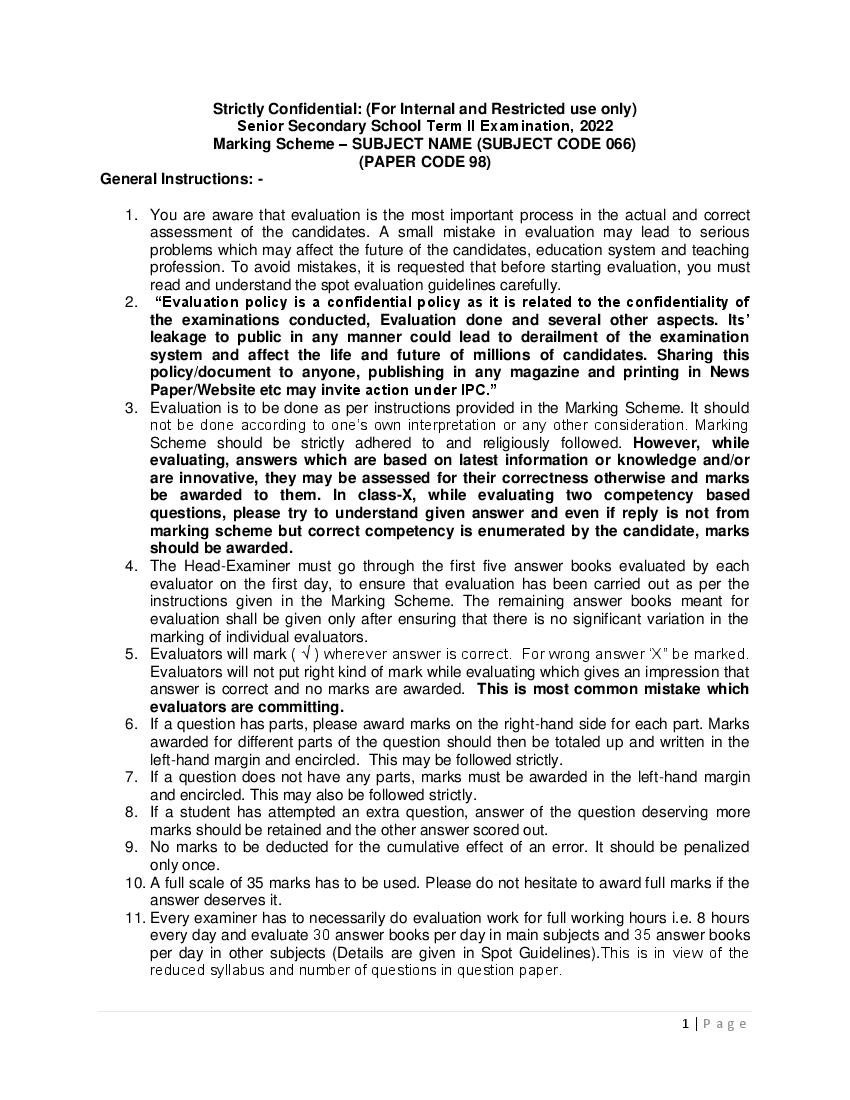
Senior Secondary School Term II Examination, 2022
Marking Scheme – SUBJECT NAME (SUBJECT CODE 066)
(PAPER CODE 98)
General Instructions: -
1. You are aware that evaluation is the most important process in the actual and correct
assessment of the candidates. A small mistake in evaluation may lead to serious
problems which may affect the future of the candidates, education system and teaching
profession. To avoid mistakes, it is requested that before starting evaluation, you must
read and understand the spot evaluation guidelines carefully.
2. “Evaluation policy is a confidential policy as it is related to the confidentiality of
the examinations conducted, Evaluation done and several other aspects. Its’
leakage to public in any manner could lead to derailment of the examination
system and affect the life and future of millions of candidates. Sharing this
policy/document to anyone, publishing in any magazine and printing in News
Paper/Website etc may invite action under IPC.”
3. Evaluation is to be done as per instructions provided in the Marking Scheme. It should
not be done according to one’s own interpretation or any other consideration. Marking
Scheme should be strictly adhered to and religiously followed. However, while
evaluating, answers which are based on latest information or knowledge and/or
are innovative, they may be assessed for their correctness otherwise and marks
be awarded to them. In class-X, while evaluating two competency based
questions, please try to understand given answer and even if reply is not from
marking scheme but correct competency is enumerated by the candidate, marks
should be awarded.
4. The Head-Examiner must go through the first five answer books evaluated by each
evaluator on the first day, to ensure that evaluation has been carried out as per the
instructions given in the Marking Scheme. The remaining answer books meant for
evaluation shall be given only after ensuring that there is no significant variation in the
marking of individual evaluators.
5. Evaluators will mark ( √ ) wherever answer is correct. For wrong answer ‘X” be marked.
Evaluators will not put right kind of mark while evaluating which gives an impression that
answer is correct and no marks are awarded. This is most common mistake which
evaluators are committing.
6. If a question has parts, please award marks on the right-hand side for each part. Marks
awarded for different parts of the question should then be totaled up and written in the
left-hand margin and encircled. This may be followed strictly.
7. If a question does not have any parts, marks must be awarded in the left-hand margin
and encircled. This may also be followed strictly.
8. If a student has attempted an extra question, answer of the question deserving more
marks should be retained and the other answer scored out.
9. No marks to be deducted for the cumulative effect of an error. It should be penalized
only once.
10. A full scale of 35 marks has to be used. Please do not hesitate to award full marks if the
answer deserves it.
11. Every examiner has to necessarily do evaluation work for full working hours i.e. 8 hours
every day and evaluate 30 answer books per day in main subjects and 35 answer books
per day in other subjects (Details are given in Spot Guidelines).This is in view of the
reduced syllabus and number of questions in question paper.
1|P a ge
Page 2
Examiner in the past:-
Leaving answer or part thereof unassessed in an answer book.
Giving more marks for an answer than assigned to it.
Wrong totaling of marks awarded on a reply.
Wrong transfer of marks from the inside pages of the answer book to the title page.
Wrong question wise totaling on the title page.
Wrong totaling of marks of the two columns on the title page.
Wrong grand total.
Marks in words and figures not tallying.
Wrong transfer of marks from the answer book to online award list.
Answers marked as correct, but marks not awarded. (Ensure that the right tick mark
is correctly and clearly indicated. It should merely be a line. Same is with the X for
incorrect answer.)
Half or a part of answer marked correct and the rest as wrong, but no marks
awarded.
13. While evaluating the answer books if the answer is found to be totally incorrect, it should
be marked as cross (X) and awarded zero (0)Marks.
14. Any unassessed portion, non-carrying over of marks to the title page, or totaling error
detected by the candidate shall damage the prestige of all the personnel engaged in the
evaluation work as also of the Board. Hence, in order to uphold the prestige of all
concerned, it is again reiterated that the instructions be followed meticulously and
judiciously.
15. The Examiners should acquaint themselves with the guidelines given in the Guidelines
for spot Evaluation before starting the actual evaluation.
16. Every Examiner shall also ensure that all the answers are evaluated, marks carried over
to the title page, correctly totaled and written in figures and words.
17. The Board permits candidates to obtain photocopy of the Answer Book on request in an
RTI application and also separately as a part of the re-evaluation process on payment of
the processing charges.
2|P a ge
Page 3
Time allowed: 2 hours Maximum Marks : 35
General Instructions:
Please read the following instructions carefully and strictly follow them.
(i) This question paper contains 15 questions. Marks have been indicated against each
question.
(ii) All questions are compulsory.
(iii) This question paper is divided into three sections – Section A, B and C
(iv) Section – wise overall choice is given to the students.
(v) Section A: Questions number 1 to 6 (6 questions) carry 2 marks each. Attempt any 4
questions out of 6 questions.
(vi) Section B: Questions number 7 to 11 (5 questions carry 3 marks each. Attempt any 4
questions out of 5 questions.
(vii) Section C: Questions number 12 to 15 (4 questions carry 5 marks each. Attempt any
3 questions out of 4 questions.
SECTION A
Attempt any 4 questions out of 6 questions from this section.
1. Kwality Stores is famous for its woolen garments sourced from Ludhiana. Its most 2
popular selling item is its sweat – shirt which is sold at ₹ 1,000 per piece. The cost of
placing an order and receiving goods is ₹ 500 per order. Its holding cost is ₹ 300 p.a.
Economic order quantity for Kwality Stores is 200 sweat – shirts.
Calculate the annual demand of the sweat – shirts.
Ans. EOQ = √2𝑃𝐷 ÷ 𝐶 ½ (formula)
EOQ – 200 Units/Sweatshirts
P – ₹ 500 - Cost of placing an order
D–x
C – ₹ 300 - Holding cost
200 = √2 × 500 × 𝑥 ÷ 300
(squaring both sides) ½ (inserting
the values)
(200)2 = (2 ×500 × x) ÷ 300
40000 × 3 ÷ 10 = x ½
(calculation)
x = 12000 units ½ (final
answer)
3|P a ge
Page 4
Ans. Angel investors fill the gap in start-ups or early stage financing between ‘friends and 1
families’ by providing seed funding and formal venture capital.
Features of angel investors (any one):
(a) Most angel investors are current or retired executives, business owners or high net
worth individuals who have their knowledge, expertise and funds that help start-ups 1
match up to industry standards.
(b) An angel investor bears extremely high risk and are usually subject to dilution from
future investment rounds. They expect a very high return on investment.
(c) Most angels provide pro-active advice, guidance, industry connections and
mentoring start-ups in its early days.
(d) Their objective is to create great companies by providing value creation, and
simultaneously helping investors realise a high return on investments.
(e) They have a sharp inclination to keep abreast current developments in a particular
business area, mentoring another generation of entrepreneurs by making use of their
vast experience.
3. What is meant by ‘Personal Selling’? State any two roles of a salesperson. 2
Ans. Personal selling is selling products personally. It involves oral presentation of message 1
in the form of conversation with one or more prospective customers for the purpose of
making sales.
A sales person plays three different roles (any two): ½+½
(i) Be persuasive
(ii) A service provider
(iii) Be informative
4. Give the meaning of a ‘Franchise Agreement’. 2
Ans. A franchise agreement is a legal document that binds the franchisor and franchisee 2
together. This document explains what the franchisor expects from the franchisee in
running the business.
5. Give the meaning of ‘Variable Price Method’ of pricing. 2
Ans. Variable price method of pricing is a marketing approach that permits different rates to 2
be extended to different customers for the same goods or services.
6. Oorja and KTC Wifi are two broadband provider companies operating in South – East 2
Delhi. Both are close competitors and have developed their strong customer base over
the years. The COVID – 19 pandemic made the offices and schools switch their
customer base online. Just then a multinational service provider company, Storex BB,
entered the market and launched its service at a much cheaper price with better
connectivity. To counter the threat posed by the company Storex BB, both companies
Oorja and KTC Wifi decided to consolidate their business.
(a) Identify the enterprise growth strategy adopted by Oorja and KTC Wifi.
(b) Sate the type of growth strategy identified in part (a) above.
(c) Give the goal of the type of growth strategy as stated in part (b) above
Ans. (a) Enterprise Growth Strategy - Merger ½
(identification)
(b) Type—Horizontal merger, i.e., the merger occurring between companies in the ½ (type)
4|P a ge
Page 5
(c) The goal of a horizontal merger is to create a new larger organisation with more 1
market share.
SECTION - B
Attempt any 4 questions out of 5 questions from this section.
7. (a) Give the meaning of Cash Conversion Cycle (CCC). 3
(b) State the relationship between the Cash Conversion Cycle (CCC) and the
quantum of working capital required by a business.
(c)Calculate the Gross working capital for Ojas Ltd. from the details given below:
i. Stock 1,00,000
ii. Debtors 2,50,000
iii. Creditors 82,600
iv. Cash 38,000
v. Short – term Investments 2,00,000
vi. Short- term Loan 1,42,000
vii. Long – term Investments 3,00,000
viii. Outstanding expenses 50,000
Ans. (a) Cash conversion cycle is the length of time between a firm’s purchase of 1 (meaning)
inventory and receipt of cash from accounts receivables.
OR
The duration between buying the raw material and receiving the cash from the
customer is known as Cash conversion cycle.
OR
It is the time required for a business to turn purchases into cash receipts from
customers.
(Any one of the above-mentioned meanings)
½
(b) Longer the CCC, working capital required is more; shorter the cycle, less working (relationship)
capital is needed.
(c) Gross working capital = Sum total of all current assets ½ (formula)
Calculation:
Items Amount (in Rs.)
Stock 1,00,000
Debtors 2,50,000
Cash 38,000
Short-term investment 2,00,000 1(calculation
Gross working capital 5,88,000 and final
answer)
8. Calculate the Return of Equity (ROE) for Neerja International, for the year 2020 – 3
2021 from the details given below:
Details Amount (₹)
5|P a ge
Page 6
ii. 12% loan from State Bank of India 2,00,000
iii. 8% Debentures 2,00,000
iv. Fixed expenses per month
- Salary 1,50,000
- Rent 50,000
- Electricity & Utilities 10,000
v. Depreciation 35,000
vi. Tax Rate 30%
Monthly Sales revenue was ₹10,00,000 and Cost of goods sold was ₹4,00,000.
Ans. Item Sub total (Rs) Total (Rs)
Investment 10,00,000
Owned 6,00,000
Borrowed 12 % loan 2,00,000
Borrowed 8 % debenture 2,00,000
Interest: 12/100 × 24,000
2,00,000 ½
Interest: 8/100 × 2,00,000 16,000 (Calculation
40,000 of Interest)
Sales (10,00,000 × 12) 1,20,00,000
Less: COGS (4,00,000 × 48,00,000
12)
EBIT 72,00,000
Fixed Expenses:
Salary(1,50,000 × 12) (18,00,000)
Rent (50,000 × 12) (6,00,000)
Electricity (10,000 × 12) (1,20,000)
Depreciation (35,000)
Interest (40,000) ½ (EBIT
Earning after interest 46,05,000 calculation)
before tax
Tax @ 30% (30/100 × (13,81,500) ½ (Net
46,05,000) Income
Net Income 32,23,500 Calculation)
ROE = Net Income/Equity 32,23,500/6,00,000 × 100 537.25% ½+½+½
× 100 (formula +
Application +
Final answer)
9. Explain the three components of a Brand. 3
Ans. (a) Brand name—that part of a brand which can be vocalised, i.e., can be spoken. ( ½ mark for
identification
(b) Brand mark—that part of a brand which can be recognised but cannot be and ½ for
vocalized, i.e., is not utterable. explanation
for each
(c) Trade mark—that part of a brand which gives legal protection against its uses by point)
other firms.
6|P a ge
Page 7
Ans. Synergy: 1+1+1
It is the most essential component of mergers.
Synergy between the participating firms determines the increase in the value
of combined entity.
It refers to the difference between the value of the combined firm and the
value of the sum of the participants.
It occurs in the form of revenue enhancement and cost savings.
(Any three)
11. Rupali intends to start an enterprise that will produce healthy alternatives for 3
chocolates and sugar carvings. In order to assess the taste preferences of people
and possible options for flavours she conducted an online survey. Based on the
information collected she analysed the market and decided to launch coconut,
jaggery and sesame based chocolates under the brand name ‘Coco Demerara’. She
decided to fix the price of chocolates at a relatively lower level in the beginning and
later on as the demand picks up she may revise the price.
(a) Identify the pricing strategy used by Rupali for her chocolates.
(b) State the marketing objective of the pricing strategy opted by Rupali.
(c) Mention any two advantages of the pricing strategy the firm, identified in part
(a) above.
Ans. (a) Penetration pricing 1
(identification)
(b) Objective—increasing market share or sales volume, rather than to make
profits in short-term 1 (objective)
(c) The advantages of penetration pricing to the firm are (any two):
It can result in fast diffusion and adoption. This can achieve high market ½ + ½
rates quickly.
It can create goodwill among the early adopters segment. This can create
more trade by word of mouth.
It creates cost control and cost reduction pressures from the start, leading to
greater efficiency.
It discourages the entry of competitors, how prices act as a barrier to entry.
It can create high stock turnover throughout the distribution channel.
This can create critically important enthusiasm and support in the channel.
SECTION - C
Attempt any 3 questions out of 4 questions from this section
12. What is meant by ‘Venture Capital’? State any four features of venture capital 5
finance.
Ans. Venture capital is a type of private equity provided as seed funding at early stage, 1 (meaning)
high potential, high risk, growth up companies.
Features of Venture Capital Finance (any four): 1×4
It is basically equity finance in relatively new companies.
It is long-term investment in growth-oriented small or medium firms.
7|P a ge
Page 8
firms.
It involves high-risk-return-spectrum.
It is a subset of private equity.
The venture capital institutions have a continuous involvement in the
business after making the investment.
Such institutions disinvest the holding either to the promoters or in the
market.
13. Give the meaning of ‘channel of distribution’. Explain any four factors affecting 5
channels of distribution with relation to the nature and quality of the product being
distributed.
Ans. A channel of distribution is defined as the path or route along which goods move from 1 (meaning)
producers or manufactures to ultimate consumers or industrial users.
Considerations related to quality and nature of the product are: 1 × 4 ( ½ for
Unit value of product - When the product is very costly it is best to use a small heading and
distribution channel. ½ for
explanation
Standardised and customised product - Standardised products are those for which for each
cost is pre-determined and there is no scope for alteration. point)
Customised products are those which are made according to the discretion of the
consumer and also there is a scope for alteration.
Perishability - A manufacturer should choose minimum or no middlemen as channel
of distribution for such an item or product which is of highly perishable nature. On the
contrary, a long distribution channel can be selected for durable goods.
Technical nature - If a product is of technical nature, then it is better to supply it
directly to the consumer. This will help the user to know the necessary technicalities
of the product.
(Only the above-mentioned points to be considered as per the given case study; no
other points from the book to be considered)
14. ‘Kapoor Merrytime Ltd.’ Is a renowned name in naturally flavoured ice-creams made 5
from fresh fruits and edible vegetables. The company has its presence in
Maharashtra and Goa. Its ice – creams sell under the brand name ‘Satvika’. The
company has a strong foothold in Maharashtra but is struggling for success in the
Goa market. The reason is the presence of a successful local brand by ‘Pastle Ice-
creams Ltd. In the market. ‘Pastle Ice-creams Ltd.’ Is selling natural ice-creams with
locally preferred flavours.
‘Kapoor Merrytime Ltd.’ tired to negotitate its way but because of the goodwill of
‘Pastle Ice-creams Ltd.’, it could not succeed in its efforts. Frustrated, ‘kapoor
Meerytime Ltd.’ started buying the shares of ‘Pastle Ice – creams Ltd.’ to gain control
over the management of ‘Pastle Ice – creams Ltd.
(a) Identify and explain the type of business combination adopted by ‘Kapoor
Merrytime Ltd.’ as its growth strategy in the Goa market.
(b) Explain any two advantages which ‘Kapoor Merrytime Ltd.’ would have by
adopting its designed strategy.
Ans. (a) Acquisition: A corporate action in which a company buys most, if not all, of the ½
8|P a ge
Page 9
firm. 1 ½ (for
explanation)
(b) Advantages (any two):
(i) Synergy - synergy between the participating firms determines the
increase in value of the combined entity. It accrues in the form of
revenue enhancement and cost savings. 1½×2(½
(ii) Improved Profitability - Companies explore the possibilities of a for heading
merger when they anticipate that it will improve their profitability. and ½ for
(iii) Entry into new market - A company can enter a new market, but may explanation
have to face stiff competition from the existing companies and may for each
have to battle out for a share in the existing market. However, if the point)
merger route is adopted, one can enter the market with greater case
and avoid too much competition.
(any two with proper explanation)
(If the examinee has not identified ‘Acquisition’ but has identified it as one of
the types of acquisition no marks to be awarded.
1 ½ marks for explaining the term ‘Acquisition’. Due credit should be given
even if the explanation mentions ‘Hostile acquisition’).
(Only the above-mentioned points to be considered as per the given case study; no
other points from the book to be considered)
15. ‘Pratap Furnitures Ltd.’ is the market leader in moulded furniture. Now it is planning to 5
enter into a new product line, that is, furniture made of wood and bamboo.
To start production it needs new machine and skilled labour along with good quality
wood. For all this it needs ₹2crore. ‘Pratap Furniture Ltd.’ is planning to raise funds
by issue of prospectus. But its Board of Directors decided to honour the existing
shareholders by offering them the shares on pro-rata basis, before going for issue
through prospectus.
(a) Identify and explain the type of capital market from which ‘Pratap Furnitures Ltd.’
is going to raise funds.
(b) Explain the two methods of raising funds discussed in the above case.
(c) What reward do the investors get when shares are issued through prospectus?
Ans. (a) Primary market: Primary market is also called as new issue market and is 1 + 1
basically to facilitate transfer of resources from the savers to the entrepreneurs
seeking funds for:
a) Setting new enterprises
b) Expanding
c) Diversifying.
(b) (i) Public issue: Public issue is the most popular method of raising capital these
days by the entrepreneurs. This involves raising of funds directly from the public ½+½
through the issue of prospectus. An enterprise organizing itself as a public limited
company can raise the required funds commonly by preparing a prospectus. When
an entrepreneur a offers shares to the public for subscription he/she is required to
comply with all the restrictions and formalities pertaining to the initial issues,
prospectus drafting and launch.
9|P a ge
Page 10
shareholders by offering securities to them on pro-rata basis i.e. giving them a right to
a certain number of shares in proportion to the shares they are holding. Normally, ½ + ½
through a circular, rights issues are proposed to the existing shareholders and in
case they are not willing to subscribe, they can renounce the same in favour of
another person. This method of issuing securities is considered to be inexpensive as
it does not require any brokers, agents, underwriters, prospectus or enlistment, etc.
(c) Appreciation of their investment. 1
10 | P a g e
Document Details
| Board / Org | CBSE |
| Exam | Class 12 |
| Type | Solution |
| Pages | 10 |
| Updated | 30 Apr 2026 |