MAHA SET 2019 Question Paper 2 Chemical Science
Finished viewing? Save it for later —
Download MAHA SET 2019 Question Paper 2 Chemical Science (PDF · 36 pages)About MAHA SET 2019 Question Paper 2 Chemical Science
MAHA SET 2019 Question Paper 2 Chemical Science is available here for free download. Published by Maharashtra Exams for Maharashtra State Eligibility Test, this question paper can be viewed online or downloaded as a PDF (36 pages). Candidates preparing for Maharashtra State Eligibility Test can use MAHA SET 2019 Question Paper 2 Chemical Science to understand the exam pattern, the type of questions asked, and the overall difficulty level.
Frequently Asked Questions
How can I download MAHA SET 2019 Question Paper 2 Chemical Science?
Open this page and click the Download button to save MAHA SET 2019 Question Paper 2 Chemical Science as a PDF. It is completely free on AglaSem Docs.
Is MAHA SET 2019 Question Paper 2 Chemical Science free to download?
Yes. MAHA SET 2019 Question Paper 2 Chemical Science can be viewed online and downloaded as a PDF free of cost on AglaSem Docs.
How many pages does MAHA SET 2019 Question Paper 2 Chemical Science have?
MAHA SET 2019 Question Paper 2 Chemical Science contains 36 pages, which you can read online or download together as a single PDF.
Where can I find more Maharashtra State Eligibility Test study material?
You can find more Maharashtra State Eligibility Test question papers, sample papers, syllabus, and answer keys on AglaSem Docs.
MAHA SET 2019 Question Paper 2 Chemical Science – Text
Read the full text of this question paper below — useful to quickly search, copy and reference the content online without downloading the PDF.
📄 View text version (36 pages)
Page 1
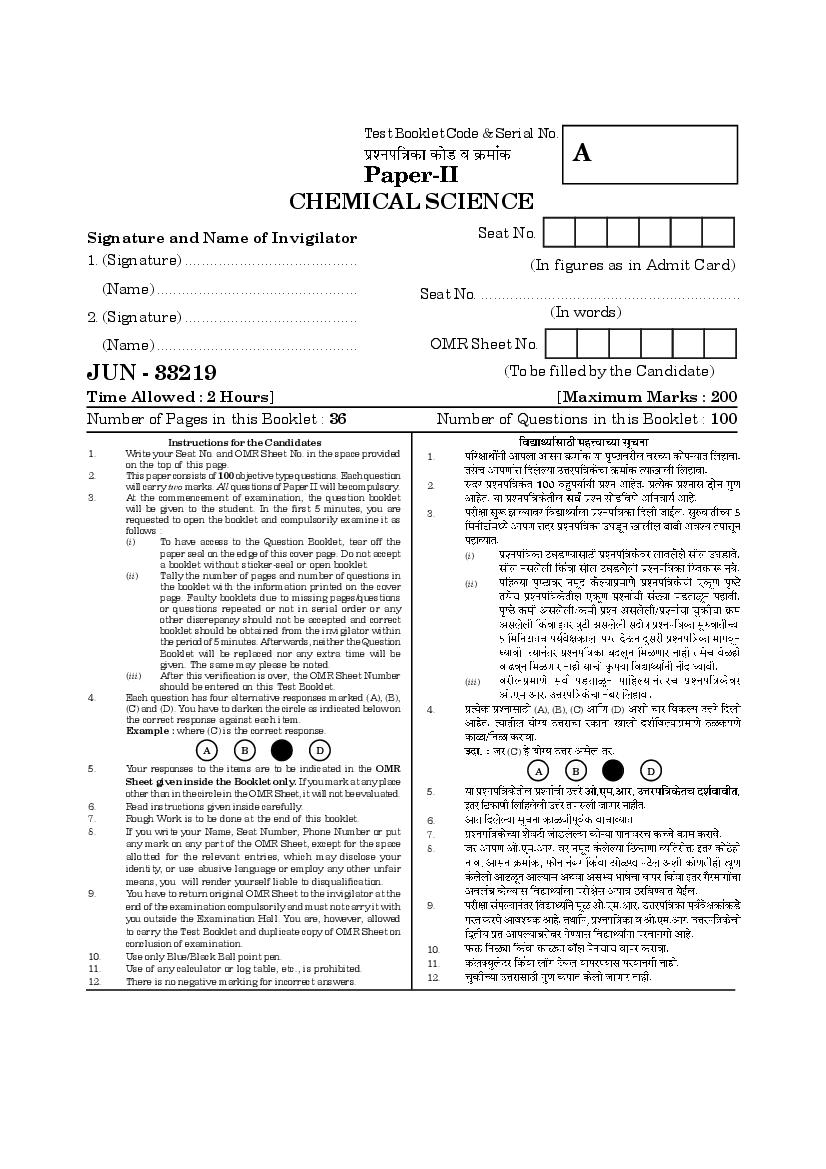
A
CHEMICAL SCIENCE
Signature and Name of Invigilator Seat No.
1. (Signature) ......................................... (In figures as in Admit Card)
(Name) ................................................ Seat No. ..............................................................
2. (Signature) ......................................... (In words)
(Name) ................................................ OMR Sheet No.
JUN - 33219 (To be filled by the Candidate)
Time Allowed : 2 Hours] [Maximum Marks : 200
Number of Pages in this Booklet : 36 Number of Questions in this Booklet : 100
Instructions for the Candidates
1. Write your Seat No. and OMR Sheet No. in the space provided 1.
on the top of this page.
2. This paper consists of 100 objective type questions. Each question
will carry two marks. All questions of Paper II will be compulsory. 2.
3. At the commencement of examination, the question booklet
will be given to the student. In the first 5 minutes, you are 3.
requested to open the booklet and compulsorily examine it as
follows :
(i) To have access to the Question Booklet, tear off the
paper seal on the edge of this cover page. Do not accept (i)
a booklet without sticker-seal or open booklet.
(ii) Tally the number of pages and number of questions in
the booklet with the information printed on the cover (ii)
page. Faulty booklets due to missing pages/questions
or questions repeated or not in serial order or any
other discrepancy should not be accepted and correct
booklet should be obtained from the invigilator within
the period of 5 minutes. Afterwards, neither the Question
Booklet will be replaced nor any extra time will be
given. The same may please be noted.
(iii) After this verification is over, the OMR Sheet Number
(iii)
should be entered on this Test Booklet.
4. Each question has four alternative responses marked (A), (B),
(C) and (D). You have to darken the circle as indicated below on 4. (A), (B), (C) (D)
the correct response against each item.
Example : where (C) is the correct response.
A B D (C)
5. Your responses to the items are to be indicated in the OMR A B D
Sheet given inside the Booklet only. If you mark at any place
other than in the circle in the OMR Sheet, it will not be evaluated. 5.
6. Read instructions given inside carefully.
7. Rough Work is to be done at the end of this booklet. 6.
8. If you write your Name, Seat Number, Phone Number or put 7.
any mark on any part of the OMR Sheet, except for the space
8.
allotted for the relevant entries, which may disclose your
identity, or use abusive language or employ any other unfair
means, you will render yourself liable to disqualification.
9. You have to return original OMR Sheet to the invigilator at the
end of the examination compulsorily and must not carry it with 9.
you outside the Examination Hall. You are, however, allowed
to carry the Test Booklet and duplicate copy of OMR Sheet on
conclusion of examination.
10.
10. Use only Blue/Black Ball point pen.
11.
11. Use of any calculator or log table, etc., is prohibited.
12. There is no negative marking for incorrect answers. 12.
Page 2
Page 3
Paper II
Time Allowed : 120 Minutes] [Maximum Marks : 200
Note : This Paper contains Hundred (100) multiple choice questions. Each question
carrying Two (2) marks. Attempt All questions.
1. The total number of lone pairs for the ion I3 is :
(A) 0 (B) 3
(C) 6 (D) 9
2. The hybridization for the complex ion [FeF6]3– and [Fe(CN)6]3– is :
(A) d2sp3 and sp3d2 (B) d2sp3 and d2sp3
(C) sp3d2 and sp3d2 (D) sp3d2 and d2sp3
3. Which of the following diatomic molecules is paramagnetic ?
(A) B 2 (B) C 2
(C) N 2 (D) F 2
4. Size of the d orbitals for Si, P, S and Cl follow the order :
(A) Si > P > S > Cl (B) Cl > P > S > Si
(C) Cl > S > P > Si (D) P > S > Si > Cl
5. The molecules P4 and CH4 exhibit the same :
(A) Color (B) Geometry
(C) Boiling point (D) Physical state at 300 K
6. The bond order for O2 and the hypothetical molecules N2 and O2 will follow
the trend :
(A) O2 N2 O2 (B) N2 O2 O2
(C) N2 O2 O2 (D) N2 O2 O2
7. According to CFT, Ni2+ can have two unpaired electrons in :
(A) Octahedral geometry
(B) Tetrahedral geometry
(C) Both octahedral and tetrahedral geometry
(D) Square planar geometry
3 [P.T.O.
Page 4
(A) [Ti(H2O)6]3+ (B) [Ni(H2O)6]2+
(C) [Mn(H2O)6]2+ (D) [Cr(H2O)6]3+
9. The carbonyl stretching frequency ( CO) for the complexes (i) [Co(CO)4]–
(ii) [Ni(CO)4] and (iii) [Fe(CO)4]2– will follow the trend :
(A) (ii) > (iii) > (i) (B) (i) > (iii) > (ii)
(C) (iii) > (ii) > (i) (D) (ii) > (i) > (iii)
10. The spin only magnetic moment for the complex Hg[Co(SCN)4] is :
(A) 3 (B) 15
(C) 8 (D)24
11. The molecular formula for sodium bis (thiosulphato) argentate (I) is :
(A) Na2[Ag(S2O3)2] (B) Na3[Ag(S2O3)2]
(C) Na[Ag(S2O3)2] (D) Na3[Ag(S2O3)]
12. The number of terminal carbonyl ligands in the complex [ 5 CP Rh(CO)]3 (where
CP is cyclopentadienide anion) such that each Rhodium centre satisfies the 18
electron rule is :
(A) 1 (B) 2
(C) 3 (D) 0
13. The 31P {H} NMR spectrum of complex (Rh(PPh3)3Cl] will exhibit :
(A) Two triplets
(B) Two doublets
(C) Doublet of doublet and doublet of triplet
(D) Triplet of doublet and triplet of triplet
14. Which of the following molecules will NOT exhibit a temperature dependent
19F NMR spectrum ?
(A) PF 5 (B) ClF 3
(C) PCl2F 3 (D) SF6
4
Page 5
(A) The energy required for LMCT is higher for ReO4 than MnO4
(B) MnO4 is colored due to MLCT
(C) d – d transition are forbidden in ReO4
(D) The energy of d – d transition in ReO4 is much higher than MnO4
16. The number of EPR lines observed in AlH3 radical (27Al, nuclear spin = 5/2)
will be :
(A) 6 (B) 4
(C) 24 (D) 18
17. The EPR spectrum of p-benzosemiquinone radical anion consists of :
(A) a quintet with intensity 1 : 2 : 3 : 2 : 1
(B) a quartet with intensity 1 : 3 : 3 : 1
(C) a quintet with intensity 1 : 1 : 1 : 1 : 1
(D) a quintet with intensity 1 : 4 : 6 : 4 : 1
18. The Mössbauer spectra of K3[Fe(CN)6] and K4[Fe(CN)6] respectively will
exhibit :
(A) 1 line each (B) 2 lines each
(C) 2 and 1 lines (D) 1 and 2 lines
19. The ion [Ni(Pyridine)4(H2O)2]2+ has d – d absorption bands at 27000, 16500
and 10150 cm–1. The 10 Dq value of Ni2+ ion is :
(A) 10150 cm–1 (B) 10500 cm–1
(C) 16500 cm–1 (D) 6350 cm–1
20. The electric dipole allowed transition in a d3 atomic system is :
(A) 4F 2D (B) 3F 3P
(C) 4F 4P (D) 4F 2G
5 [P.T.O.
Page 6
(A) 0.0007 (B) 0.0700
(C) 70.000 (D) 0.0070
22. The ground term symbol of Pr3+ ion is (At. No. Pr = 59)
(A) 3H6 (B) 3H4
(C) 6H15/2 (D) 6H5/2
23. The -diketonato complexes of which metal ion is used as shift reagent in NMR
spectroscopy :
(A) Ce3+ (B) La3+
(C) Eu3+ (D) Ho3+
24. The symmetry and number of carbonyl stretching bands in the complex are :
(A) C2V, four (B) C2V, three
(C) C3V, two (D) C3V, three
25. The overall charge ‘x’ on the stable complex [ 5 CP Fe(CO)3 ]x should be
(CP = cyclopentadienide anion) :
(A) 0 (B) +2
(C) +1 (D) –1
26. The total number of M – M bonds in the stable complex [(µ – Cl) (µ – CH2)
Os3(CO)10]– are :
(A) 2 (B) 1
(C) 0 (D) 3
6
Page 7
[Cr(H2O)5Cl]2+ + 5NH 4 is an example of :
(A) Ligand transfer process only
(B) Ligand exchange process only
(C) Outer sphere electron transfer process
(D) Inner sphere electron transfer process
28. Which of the following complexes will have the highest spin only magnetic
moment ?
(A) [VCl6]4– (B) [Ni(CN)4]2–
(C) [Co(NH3)6]3+ (D) [( 5 – C5H5)2Cr]
29. The respective enzymes involved in CO and CN– poisoning are :
(A) deoxyhemoglobin and oxidized cytochrome C oxidase
(B) deoxyhemoglobin and reduced cyctochrome C oxidase
(C) oxyhemoglobin and oxidized cytochrome C oxidase
(D) oxyhemoglobin and reduced cytochrome C oxidase
30. The reaction CO2 H2O H2CO3 catalysed by the zinc containing enzyme
cationic anhydrase at physiological pH is facile due to :
(A) decrease in nucleophilicity of H2O on coordination to Zn
(B) decrease in nucleophilicity of CO2 on coordination to Zn
(C) increase in nucleophilicity of H2O on coordination to Zn
(D) increase in nucleophilicity of CO2 on coordination to Zn
31. Oxyhemoglobin is diamagnetic due to electron spin coupling between :
(A) Low spin Fe2+ and oxygen molecule
(B) High spin Fe3+ and superoxide radical
(C) High spin Fe2+ and oxygen molecule
(D) Low spin Fe3+ and superoxide radical
7 [P.T.O.
Page 8
molecules from the first coordination sphere at 25°C will be :
(A) Be2+ > Mg2+ > Ca2+ (B) Mg2+ > Be2+ > Ca2+
(C) Ca2+ > Mg2+ > Be2+ (D) Mg2+ > Ca2+ Be2+
33. Which pair of catalyst and its application is incorrect ?
(A) Cis—[Rh(CO)2I2]–; acetic acid synthesis
(B) [Rh(PPh3)3Cl]; alkene hydrogenation
(C) [H Rh(PPh3)3]; asymmetric hydrogenation
(D) [HCo(CO)4]; hydroformylation of alkenes
34. The most abundant transition metal ion in sea water and earth’s crust is :
(A) Molybdenum (B) Copper
(C) Iron (D) Zinc
35. The oxidation state of molybdenum in [( 7-tropylium) Mo(CO)3]+ is :
(A) +2 (B) +1
(C) 0 (D) –1
36. The product of the reaction between 2 Cl– and cis-(Pt(NH3)2(Py)2]2+ will
be :
(A) cis-[PtCl2(NH3)(PY)] (B) cis-[Pt(NH3)2Cl2]
(C) trans-[PtCl2(Py)(NH3)] (D) cis-[PtCl2(Py)2]
37. The correct order of acidity of the following molecules is :
(I) (II) (III) (IV)
(A) (IV) < (III) < (II) < (I) (B) (III) < (IV) < (II) < (I)
(C) (IV) < (II) < (I) < (III) (D) (IV) < (I) < (III) < (II)
8
Page 9
(A) 3-ethyl-5-hydroxy-1-methyl cyclohexane
(B) 5-ethyl-3-methyl cyclohexanol
(C) 1-ethyl-3-methyl-5-hydroxy-cyclohexane
(D) 3-ethyl-5-methyl cyclohexanol
39. The correct order of dipole moment for the following compounds is :
(I) (II) (III) (IV)
(A) (III) < (I) < (IV) < (II) (B) (III) < (II) < (I) < (IV)
(C) (I) < (IV) < (III) < (II) (D) (I) < (II) < (III) < (IV)
40. The configurations of the double bonds in the following molecule are :
(A) 2E, 4E (B) 2E, 4Z
(C) 2Z, 4E (D) 2Z, 4Z
9 [P.T.O.
Page 10
stereochemical descriptor for P and Q :
(A) P is ‘R’ and Q is ‘S’
(B) P is ‘R’ and Q is Racemic
(C) P is ‘S’ and Q is ‘R’
(D) P is ‘S’ and Q is Racemic
42. The correct Newmann projection of (2S, 3R)-D-threose is :
(A) (B)
(C) (D)
10
Page 11
(A) (B)
(C) (D)
44. The major product of the following reaction is :
(A) (B)
(C) (D)
45. Predict the major product of the following reaction :
(A) (B)
(C) (D)
11 [P.T.O.
Page 12
are :
(A)
(B)
(C)
(D)
12
Page 13
(A)
(B)
(C)
(D)
13 [P.T.O.
Page 14
(A)
(B)
(C)
(D)
14
Page 15
of 2-pinene is :
(A) 7 (B) 10
(C) 9 (D) 6
50. Which among the following substractes (R-I) is not suitable for the desired
reaction below :
(A)
(B) Ph—I
(C)
(D)
15 [P.T.O.
Page 16
(A) (B)
(C) (D)
16
Page 17
spect r al dat a i n 1H-NMR is : 0.9(t, J = 6 Hz, 3H) 1.1 (d, J = 6.5 Hz, 3H),
1.5 – 1.6(m, 2H), 3.6 (broad singlet, 1H, Ex. D2O), 3.9 (Sextet, J = 6.5 Hz, 1H).
The correct structure of the compound is :
(A)
(B) CH3—CH2—CH2—CH2—OH
(C)
(D)
53. T h e correct absolute configuration for the following compound is :
(A) 1R, 4R (B) 1R, 4S
(C) 1S, 4R (D) 1S, 4S
17 [P.T.O.
Page 18
substituents are axial ?
(A) 3 (B) 2
(C) 1 (D) 0
55. The major product of the following reaction is :
(A) (B)
(C) (D)
18
Page 19
(A)
(B)
(C)
(D)
19 [P.T.O.
Page 20
(A) (B)
(C) (D)
58. The major product of the following reaction is :
(A) (B)
(C) (D)
20
Page 21
(A)
(B)
(C)
(D)
21 [P.T.O.
Page 22
(A) (B)
(C) (D)
61. Major product in the following reaction sequence is :
(A) (B)
(C) (D)
22
Page 23
(A) (B)
(C) (D)
63. The major product of the following reaction is :
(A) (B)
(C) (D)
23 [P.T.O.
Page 24
(A)
(B)
(C)
(D)
24
Page 25
(A) (B)
(C) (D)
25 [P.T.O.
Page 26
(A) (B)
(C) (D)
67. The major product of the following reaction is :
(A) (B)
(C) (D)
26
Page 27
(A) (B)
(C) (D)
69. For the adsorption of N2 on activated carbon at 77 K :
(A) H = 0; S < 0 (B) H < 0; S < 0
(C) H > 0; S < 0 (D) S = 0; S = 0
70. The bond energies of O2(g) and N2(g) are 941 and 499 kJ/mol respectively.
If Hformation of NO is 90 kJ/mol, the bond dissociation energy of NO is :
(A) 810 kJ (B) 630 kJ
(C) 1130 kJ (D) 565 kJ
71. W h en U r an i u m –235 ( 235U) is bombarded with neutron, fission occurs and the
fragments formed are :
(A) 94Kr + 140Ba + 2n (B) 94Kr + 139Ba + 2n
(C) 94Kr + 139Xe + 2n (D) 94Kr + 140Ba + 1n
27 [P.T.O.
Page 28
mixture of two isotopes.
(A) Difference between the activities of the two isotopes
(B) Sum of the activity of each isotope
(C) Product of activities contributed by each isotope
(D) Ratio of activities of one isotope to the other
73. The isotope of carbon used for radiating is :
(A) 11 C (B) 12 C
(C) 13 C (D) 14 C
74. In a grand canonical ensemble, a system X of fixed volume is in contact with
a large reservoir Y, then :
(A) X can exchange only energy with Y
(B) X can exchange only particles with Y
(C) X can exchange neither energy nor particles with Y
(D) X can exchange both energy and particles with Y
75. A scientist attempts to replace a few carbon atoms in 1.0 g of diamond with
boron atoms or nitrogen atoms in separate experiments. Which of the following
is correct ?
(A) The resulting material with B doping will be an n-type semiconductor
(B) The resulting material with B doping will be a p-type semiconductor
(C) B doping is not possible as B cannot form multiple bonds
(D) The resulting material with N doping will be a p-type semiconductor
76. The DP of a polymer with average molecular weight of 25000 g/mol and monomer
weight of 254 g/mol will be :
(A) 68 (B) 88
(C) 98 (D) 78
28
Page 29
(A) Racemization
(B) Optical isomerism
(C) Geometrical isomerism
(D) Both optical and geometrical isomerism
78. Burgers vector is a measure of the lattice distortion due to the presence
of :
(A) point defect (B) line defect
(C) surface defect (D) volume defect
79. If is the fraction of the surface covered at PA (pressure of the adsorbate A),
then :
(A) rate of adsorption is proportional to × PA
(B) rate of desorption is proportional to (1 – ) × PA
Vads at PA
(C)
Vmax
Vmax
(D)
Vads at PA
80. Which of the following are state functions ?
(I) q + w (II) q
(III) w (IV) H – TS
(A) (I) and (IV) (B) (I), (II) and (III)
(C) (II), (III) and (IV) (D) (II) and (III)
29 [P.T.O.
Page 30
be close to :
(A) 75 pm (B) 38 pm
(C) 106 pm (D) 27 pm
82. Enthalpy changes in chemical reactions from the data given below :
1 1
H I HI(g) ; H = 26.0 kJ
2 2(g) 2 2(s)
1 1
H2(g) I 2(g) HI(g) ; H = 5.0 kJ
2 2
H sublimation of I2 can be obtained as :
(A) 31 kJ (B) –62 kJ
(C) 62 kJ (D) 21 kJ
83. Work function of Al is 4.2 eV. When light with E = 6.2 eV is incident on an
Al surface, maximum kinetic energy of the emitted photo-electrons will be
(1 eV = 1.6 × 10⁻¹⁹ J) :
(A) 2.0 × 10⁻¹⁹ J (B) 9.9 × 10⁻¹⁹ J
(C) 3.2 × 10⁻¹⁹ J (D) 6.7 × 10⁻¹⁹ J
84. Which of the following equations corresponds to photoelectric effect ?
(A) h = W0 + K.E (B) h = W0 – K.E
(C) h = W0 + K.E (D) h = W0 – K.E
85. The molecule that has the same symmetry as that of NH3 is :
(A) BH3 (B) CHCl3
(C) CH4 (D) BF 3
30
Page 31
(A) (B) i
x t t
(C) i (D) i
x x
87. In which of the following pairs both the molecules will give pure rotational
spectra ?
(A) CH4 and CHCl3 (B) CH2Cl2 and CCl4
(C) CH2Cl2 and CHCl3 (D) CH4 and CCl4
88. Which point in the phase diagram best represents supercritical condition ?
(A) A (B) B
(C) C (D) D
31 [P.T.O.
Page 32
equilibrium according to the following reaction :
3H2(g ) N 2(g) 2NH 3 ( H r n 92 kJ)
Which of the following is/are true for the system between t1t2 ?
(I) The temperature of the system will decrease.
(II) The rates of the forward and reverse reactions were equal.
(III) The rate of formation of NH3 is equal to the rate of disappearance of H.
(IV) If more NH3(g) is added to the system at time t2 while the temperature
is held constant, total pressure in the container will decrease.
(A) (I) and (II) (B) (II) and (IV)
(C) (III) only (D) (II) only
90. Which of the following are correct ?
(I) Henry’s law is applicable for the dissolution of O2 in water.
(II) Henry’s law is applicable for the dissolution of HCl in water.
(III) Dissolution of gases in liquids increases with pressure.
(IV) Unit of Henry’s law constant is atm–1.
(A) (I), (II), (III) (B) (I), (III)
(C) (II), (III), (IV) (D) (I), (III), (IV)
32
Page 33
Which of the following account for this incident ?
(I) Over the years CO2 has saturated in the upper layers of lake water.
(II) Over the years large quantities CO2 has dissolved in the bottom layers
of water.
(III) Heavy winds could have overturned the lake water.
(IV) This event is a natural phenomenon explained by Raoult’s law.
(A) (II), (III) and (IV) (B) (I), (III)
(C) (I), (II) and (IV) (D) (II), (III)
92. During the electrolysis of an aqueous solution of KCl which susbtance is formed
at the ................. cathode.
(A) Chlorine (B) Hydrogen
(C) Oxygen (D) Potassium
93. When a drop of liquid at the tip of a capillary is balanced by surface tensional
forces, its weight is equal to :
(A) r2 (B) 2 r
4 3
(C) /2 r (D) r
3
94. The pressure difference across a curved interface can be written as :
1 1 1 1
(A) P=r (B) P=r
R1 R2 R1 R2
1 1 1 1 1 1
(C) P= (D) P=
r R1 R2 r R1 R2
33 [P.T.O.
Page 34
NaCl(s) Na (g) Cl(g) ; H10 786 kJ/mole
H2O(l) Na (g) Cl(g) Na (aq) Cl(aq) ;
H hyd H2 H3 783 kJ/mole
It can be inferred that :
(A) Enthalpy of hydration of NaCl is –3 kJ/mol
(B) Enthalpy of hydration of NaCl is –1569 kJ/mol
(C) Entropy change for dissolution of NaCl must be positive
(D) Enthalpy of hydration of NaCl is 1.5 kJ/mol
96. At high temperatures NO reacts with H2 to produce nitrous oxide N2O, a green-
house gas. According to the following stoichiometric equation :
2NO(g) + H2(g) N2O(g) + H2O(g)
The following experimental data was obtained at 820°C :
Which of the following is correct ?
2d[NO] d[H2O]
(A) k[NO][H2 ] (B) k[NO]2[H2 ]
dt dt
d[H2O] d[H2O]
(C) 1 10 7[NO]2[H2 ] (D) 1 107[NO]2[H2 ]
dt dt
34
Page 35
is proposed to proceed through the following mechanism :
(CH3 )3CBr(aq) (CH3 )3C(aq) Br(aq)
(CH3 )3C(aq) + N3 (CH3 )3CH3(aq)
Assuming (CH3)3 C+ to be under steady state, which of the following is
correct ?
(I) Rate = k1 k2[(CH3 )3CBr][N3 ]/K 1[Br ]
(II) Rate = k1 k2[(CH3 )3CBr][N3 ]/k 1[Br ] k2[N3 ]
(III) If k2 >>> k–1 plot of [(CH3)3Br] Vs. ‘t’ will be straight line
(IV) If k2 >>> k–1 unit of experimental rate constant will be time–1
(A) (I) and (II) (B) (II) only
(C) (II) and (IV) (D) (II) and (III)
98. Point group of cyclohexane in :
(A) Chair form is D3d
(B) Boat form is C3V
(C) Both chair and boat form is C2V
(D) Boat form is D3d
99. The kinetic chain length of a polymer is defined as the :
(A) Number of monomer units consumed per active center
(B) Number of monomer units consumed per unit time
(C) Number of monomer units consumed per unit concentration
(D) Number of monomer units consumed per active center per unit
concentration
100. The number average molecular weight of a polymer can be determined by :
(A) Vapour pressure osmometry
(B) Sedimentation equilibrium method
(C) Light scattering method
(D) Viscosity method
35 [P.T.O.
Page 36
36
Document Details
| Board / Org | Maharashtra Exams |
| Exam | Maharashtra State Eligibility Test |
| Type | Question Paper |
| Pages | 36 |
| Updated | 30 Apr 2026 |