CBSE Class 12 Question Paper 2024 Solution Home Science
Finished viewing? Save it for later —
Download CBSE Class 12 Question Paper 2024 Solution Home Science (PDF · 14 pages)About CBSE Class 12 Question Paper 2024 Solution Home Science
CBSE Class 12 Question Paper 2024 Solution Home Science is available here for free download. Published by CBSE for Class 12, this solution can be viewed online or downloaded as a PDF (14 pages). Candidates preparing for Class 12 can use CBSE Class 12 Question Paper 2024 Solution Home Science to understand the exam pattern, the type of questions asked, and the overall difficulty level.
Frequently Asked Questions
How can I download CBSE Class 12 Question Paper 2024 Solution Home Science?
Open this page and click the Download button to save CBSE Class 12 Question Paper 2024 Solution Home Science as a PDF. It is completely free on AglaSem Docs.
Is CBSE Class 12 Question Paper 2024 Solution Home Science free to download?
Yes. CBSE Class 12 Question Paper 2024 Solution Home Science can be viewed online and downloaded as a PDF free of cost on AglaSem Docs.
How many pages does CBSE Class 12 Question Paper 2024 Solution Home Science have?
CBSE Class 12 Question Paper 2024 Solution Home Science contains 14 pages, which you can read online or download together as a single PDF.
Where can I find more Class 12 study material?
You can find more Class 12 question papers, sample papers, syllabus, and answer keys on AglaSem Docs.
CBSE Class 12 Question Paper 2024 Solution Home Science – Text
Read the full text of this solution below — useful to quickly search, copy and reference the content online without downloading the PDF.
📄 View text version (14 pages)
Page 1
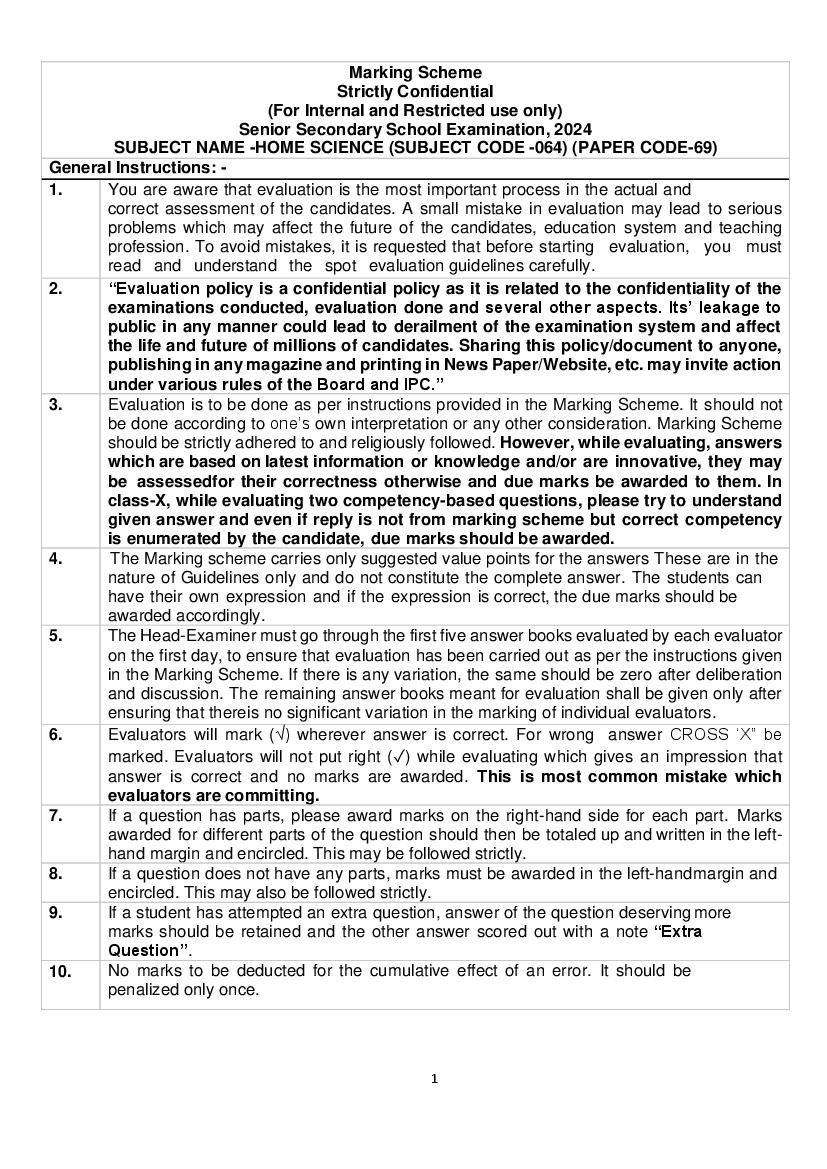
Strictly Confidential
(For Internal and Restricted use only)
Senior Secondary School Examination, 2024
SUBJECT NAME -HOME SCIENCE (SUBJECT CODE -064) (PAPER CODE-69)
General Instructions: -
1. You are aware that evaluation is the most important process in the actual and
correct assessment of the candidates. A small mistake in evaluation may lead to serious
problems which may affect the future of the candidates, education system and teaching
profession. To avoid mistakes, it is requested that before starting evaluation, you must
read and understand the spot evaluation guidelines carefully.
2. “Evaluation policy is a confidential policy as it is related to the confidentiality of the
examinations conducted, evaluation done and several other aspects. Its’ leakage to
public in any manner could lead to derailment of the examination system and affect
the life and future of millions of candidates. Sharing this policy/document to anyone,
publishing in any magazine and printing in News Paper/Website, etc. may invite action
under various rules of the Board and IPC.”
3. Evaluation is to be done as per instructions provided in the Marking Scheme. It should not
be done according to one’s own interpretation or any other consideration. Marking Scheme
should be strictly adhered to and religiously followed. However, while evaluating, answers
which are based on latest information or knowledge and/or are innovative, they may
be assessedfor their correctness otherwise and due marks be awarded to them. In
class-X, while evaluating two competency-based questions, please try to understand
given answer and even if reply is not from marking scheme but correct competency
is enumerated by the candidate, due marks should be awarded.
4. The Marking scheme carries only suggested value points for the answers These are in the
nature of Guidelines only and do not constitute the complete answer. The students can
have their own expression and if the expression is correct, the due marks should be
awarded accordingly.
5. The Head-Examiner must go through the first five answer books evaluated by each evaluator
on the first day, to ensure that evaluation has been carried out as per the instructions given
in the Marking Scheme. If there is any variation, the same should be zero after deliberation
and discussion. The remaining answer books meant for evaluation shall be given only after
ensuring that thereis no significant variation in the marking of individual evaluators.
6. Evaluators will mark (√) wherever answer is correct. For wrong answer CROSS ‘X” be
marked. Evaluators will not put right (✓) while evaluating which gives an impression that
answer is correct and no marks are awarded. This is most common mistake which
evaluators are committing.
7. If a question has parts, please award marks on the right-hand side for each part. Marks
awarded for different parts of the question should then be totaled up and written in the left-
hand margin and encircled. This may be followed strictly.
8. If a question does not have any parts, marks must be awarded in the left-hand margin and
encircled. This may also be followed strictly.
9. If a student has attempted an extra question, answer of the question deserving more
marks should be retained and the other answer scored out with a note “Extra
Question”.
10. No marks to be deducted for the cumulative effect of an error. It should be
penalized only once.
1
Page 2
Paper) has to be used. Please do not hesitate to award full marks if the answer deserves
it.
12. Every examiner has to necessarily do evaluation work for full working hours i.e., 8 hours
every day and evaluate 20 answer books per day in main subjects and 25 answer books per
day in other subjects (Details are given in Spot Guidelines). This is in view of the reduced
syllabus and number of questions in question paper.
13. Ensure that you do not make the following common types of errors committed by the
Examiner in the past: -
● Leaving answer or part there of unassessed in an answer book.
● Giving more marks for an answer than assigned to it.
● Wrong totaling of marks awarded on an answer.
● Wrong transfer of marks from the inside pages of the answer book to the title page.
● Wrong question wise totaling on the title page.
● Wrong totaling of marks of the two columns on the title page.
● Wrong grand total.
● Marks in words and figures not tallying/not same.
● Wrong transfer of marks from the answer book to online award list.
● Answers marked as correct, but marks not awarded. (Ensure that the right tick mark is
correctly and clearly indicated. It should merely be a line.Same is with the X for
incorrect answer.)
● Half or a part of answer marked correct and the rest as wrong, but no marks awarded.
14. While evaluating the answer books if the answer is found to be totally incorrect,
it should be marked as cross (X) and awarded zero (0) Marks.
15. Any un assessed portion, non-carrying over of marks to the title page, or totaling error
detected by the candidate shall damage the prestige of all the personnel engaged in the
evaluation work as also of the Board. Hence, in orderto uphold the prestige of all concerned,
it is again reiterated that the instructions be followed meticulously and judiciously.
16. The Examiners should acquaint themselves with the guidelines given in the
“Guidelines for spot Evaluation” before starting the actual evaluation.
17. Every Examiner shall also ensure that all the answers are evaluated, marks
carried over to the title page, correctly totaled and written in figures and words.
18. The candidates are entitled to obtain photocopy of the Answer Book on request on payment
of the prescribed processing fee. All Examiners/Additional Head Examiners/Head Examiners
are once again reminded that they must ensure that evaluation is carried out strictly as per
value points for each answer as given in the Marking Scheme.
2
Page 3
MARKING SCHEME
Q. No. EXPECTED ANSWERS / VALUE POINTS Marks
SECTION A
1. (C) To ensure survival, protection and education of the girl child 1
2. (C) Room attendant 1
3. (D) Iron 1
4. (B) Ergonomics 1
5. (A) 100 kg 1
6. (D) Mid-day Meal Programme 1
OR OR
(B) Jhunjhunu, Rajasthan 1
7. (C) National AIDS Control Organisation 1
8. (D) Anganwadis 1
9. (B) Food fortification is removing of nutrients from the foodstuffs. 1
10. (A) Warli - Maharashtra 1
11. (C) i - 4, ii - 3, iii - 2, iv -1 1
12. (D) i - 3, ii - 4, iii - 1, iv - 2 1
13. (B) (i) and (iii) 1
OR OR
(C) (ii) and (iii) 1
14. (A) (iii) and (iv) 1
SECTION B (CASE STUDY-BASED QUESTIONS)
15. (B) Liquid diet: Fluids high in fibre and fats 1
16. (B) It is the specialised area of nutrition which deals with nutrition 1
during illness.
17. (C) (A) is true, but (R) is false. 1
18. (A) Both (A) and (R) are true and (R) is the correct explanation of (A). 1
SECTION C
19. Name any four self-employment avenues in the field of food processing
that can be taken up as a household or cottage scale activity.
Self-employment avenues in the field of food processing that can be taken ½X4=2
up as a household or cottage scale activity-
❖ Dehydrated products / Papad / Wadi
❖ Murrabba / Candy
❖ Pickles / Jam / Jelly / Squash
❖ Roasted and Puffed snacks / Salted peanuts / Khakhra
❖ Fried snacks / Mathri / Namkeen / Namakpara / Thepla / Chips / Murukku
❖ Bakery products
❖ Sweets / Jaggery making
❖ Drinking water pouches
Any other, Any four
3
Page 4
vulnerable children.
CARA is a central agency which helps in legal adoption of children / Its full form 1
is Central Adoption Resource Authority.
Any one
Its function is to - 1
1. set up guidelines for adoption to safeguard the welfare and rights of
children.
2. strengthen adoption rules.
3. facilitate the process of adoption.
Any other, Any one
OR OR
(b) What is meant by NSS? Write its one aim in the development of
youth in India.
NSS is a scheme which involves school and college level students in 1
programmes of social service and national development / Its full form is National
Service Scheme.
Any one
Its aim is to involve students in following activities / programmes- 1
1. construction and repair of roads,school buildings, village ponds, tanks etc.
2. environmental and ecological improvement like tree plantation, removal of
weeds, digging pits etc.
3. hygiene and sanitation, family welfare, childcare, mass immunization
4. vocational training in crafts, tailoring, knitting etc.
5. organising co-operatives
6. implementing various relief and rehabilitation programmes to meet the
needs of economically and socially weaker sections of the community
Any other, Any one
21. How do Indian consumers tend to get swayed by enticing sales promotion
gimmicks and fall prey to them?
Enticing sales promotion gimmicks- 1X2=2
1. Exchange offers
2. Bonus
3. Lucky draw
4. Misleading / Exaggerated advertisement
5. Sale and Discount
6. Free gifts
7. Misleading / Attractive packaging
8. Duplicate products / Imitations are sold as original products
Any other, Any two
4
Page 5
successful in professional life. Which four core life skills would he now
suggest to his team members at his work place?
Core life skills – ½X4=2
1. Self-awareness
2. Empathy
3. Communication
4. Interpersonal relationships
5. Decision making
6. Problem solving
7. Creative thinking
8. Critical thinking
9. Coping with emotions
10. Coping with stress
Any four
23. As per the National Curriculum Framework (NCF)-2005 Position Paper
on Early Childhood Education, mention any two basic objectives of Early
Childhood Care and Education (ECCE).
Basic objectives of Early Childhood Care and Education (ECCE)- 1x2=2
1. Holistic development of the child to enable him/her to realise the potential.
2. Preparation for school.
3. Providing support services for women and children.
Any two
24.(a) Classify colours on the basis of Munsell’s colour wheel. Provide an
example of any one type of colour.
Classification of colours on the basis of Munsell’s Colour wheel- ½X3=1½
1. Primary colours
Example- Red / Yellow / Blue
2. Secondary colours
Example-Orange / Green / Purple (Voilet)
3. Tertiary or Intermediate colours
Example-Red-Orange / Yellow-Orange / Yellow-Green / Blue-Green /
Blue-Purple / Red-Purple
Any one example of any one type of colour ½
OR OR
5
Page 6
S.No. Structural Design Applied Design 1X2=2
1. Refers to the basic cut or Refers to the ornamentation of
silhouette of the garments / the garments /apparel.
apparel.
2. Depends on the form, not It is superimposed on the basic
superimposed ornamentation. structure.
3. It takes into account the basic It includes fabric finishes, dyeing
processing of fibre, types of and printing, patch work, mirror
fibres and yarns, variation of work, embroidery, fancy needle
weaving, knitting etc. work, lace work etc.
Any other, Any two differences
25. Various job options are available in food industry with respect to food
safety and quality control. Get information on any four career avenues
available in this field from your brother who has completed his Masters
in Food Microbiology.
Career avenues available in food industry with respect to food safety and ½X4=2
quality control-
1. Food Analysts
2. Food Quality Control managers in food industry laboratories
3. Food inspectors / Food Testing Professionals at various positions in food
testing laboratories in public / private sector / voluntary organisations
4. Food Auditors
5. Food Microbiologists / Specialist in HACCP / BIS / Agmark etc.
6. Quality Certification Professionals in ISO / BIS / FSSAI etc.
7. Teaching and Academics
8. Research and Development Professionals
9. Scientific Writers
10. Content Creators / Bloggers
11. Entrepreneurs
Any other, Any four
26. 'Consumers must purchase products with standardization marks.’ Justify
this statement by giving two reasons. ISI Mark is the certification mark
of which organisation?
Standardization marks ensure- 1X2=2
1. quality of the product
2. purity of the product / product is not duplicate
3. value for money
4. safety / consumer protection
5. that product is manufactured as per the guidelines given by certification
bodies
Any other, Any two
ISI Mark is the certification mark of -
BIS (Bureau of Indian Standards) 1
6
Page 7
suggest any three knowledge and skills required to be successful in this
field.
Knowledge and skills required to be successful in the field of Development 1X3=3
Communication-
1. Cognitive skills / Ability to comprehend an issue
2. Creative / Presentation skills / Ability to project the concepts in a creative
manner
3. Technical skills / Camera techniques / Video production / Content
development / Editing skills
4. Questioning ability / Ability to look into the finer details of any issue /
gather unique and interesting stories
5. Ability to work with diverse groups / Understand others’ viewpoint
6. Language skills (Speaking, Writing, Reading) / Ability to write reports and
documents
7. Computer skills
8. Knowledge of related laws and regulations
Any other, Any three
OR OR
(b) Compare print media with television as a method of Development
Communication.
S.No. Print Media Television 1X3=3
1. Visual mode of Audio-visual mode of
communication communication
2. Limited for literate people Suitable for both literate and
illiterate people
3. Printed mode Electronic mode
4. Inexpensive Expensive
5. Mobile medium Fixed medium
Any other, Any three differences
28. Commercial laundries are organised in different sections which deal with
specific jobs.
(a) Make a list of any four jobs done in various sections for an
entrepreneur who wants to set up his own commercial laundry.
Jobs done in various sections of a commercial laundry- ½X4=2
1. Collection, Inspection and Sorting of articles
2. Pretreatments like mending, repairing and stain removal
3. Washing
4. Water extraction
5. Drying
6. Drycleaning
7. Pressing and Ironing
8. Dyeing
9. Special finishes like zari polishing, calendering etc.
10. Packing
11. Distribution
Any other, Any four
7
Page 8
laundry?
In commercial laundry, system of code tags helps to – 1
1. keep a record / invoice.
2. identify / match the articles of each customer with the invoice.
Any other, Any one
29.(a) Food has been preserved using various methods since prehistoric times.
(i) Make a list of four old methods of food preservation, which are still
being used today.
Old methods of food preservation- ½X4=2
1. Sun drying
2. Controlled fermentation
3. Salting
4. Pickling
5. Candying
6. Roasting
7. Smoking
8. Baking
9. Using spices, oil, sugar etc. as preservatives
Any other, Any four
(ii) Name any one institute in India offering specialised courses in Food
Processing and Technology.
1. Central Food Technological Research Institute (CFTRI), Mysore 1
2. National Institute of Food Technology and Entrepreneurship Management
(NIFTEM), Sonepat
Any other, Any one
OR OR
(b) (i) Discuss briefly the significance of food processing and technology as a
discipline.
Significance of food processing and technology- 1X2=2
1. Helps in storage and processing of agricultural and horticultural surplus.
2. Increased demand of processed products due to changing life styles,
increasing mobility and globalization.
3. Consumers demand foods free from chemicals, pesticides, preservatives
etc.
4. Helps to increase shelf life of food products.
5. Used to convert bulky, perishable foods into more useful, concentrated,
palatable foods and potable beverages.
6. Reduces preparation time for the cooking.
8
Page 9
8. Fortification of staple food can be done to increase its nutrient content.
9. Increased prevalence of lifestyle diseases demands altering the nutrient
content of foods.
10. Adds to the economic growth of the country.
11. Generates employment opportunities.
Any other, Any two
(ii) By whom are standards for fortification of staple foods like salt, milk,
oils laid down in India?
FSSAI (Food Safety and Standards Authority of India) 1
SECTION D
30. HACCP involves identification of food hazards during each stage in the
food chain.
(a) Give full form of HACCP.
Hazard Analysis Critical Control Point (HACCP) 1
(b) Mention three reasons why implementing HACCP in food industry
is important.
Implementation of HACCP in food industry is important as it- 1X3=3
1. is a cost-effective and preventive approach to ensure food safety.
2. enables us to detect hazards at any stage of processing or
manufacturing.
3. ensures a good quality end product, by taking appropriate action at the
stage where the problem occurs.
4. enables producers, processors, distributors and exporters to utilise
resources efficiently.
5. is important for consumer protection and international food trade.
6. assures consistently good quality products.
7. holds responsibility for safe food with producers and suppliers as per
FSSA, 2006.
Any other, Any three
31.(a) Shaurya has checked into a hotel. Which department’s staff will first greet
and welcome him? List any other three services provided by this
department.
Department responsible for greeting and welcoming guests -
1
Front Office
9
Page 10
1. Organising reservation status of room availability
2. Registering guests and allocation of rooms
3. Maintaining records of check-in and check-out details
4. Porter services
5. Issuing room keys to guests
6. Passing messages to guests
7. Coordinating with other guest services / departments such as transport,
room service, housekeeping, restaurant, accounts etc.
8. Providing in-house and external information to the guests
9. Preparing and settling their bills
10. Taking feedback from the guests
11. Keeping record of personal information of the guests
Any other, Any three
OR
OR
(b) The phrase ‘A home away from home’ is often used in hospitality industry,
to denote that guests are provided with comforts and facilities similar to
their homes. In this context, mention any four types of establishments who
offer hospitality services.
Types of establishments who offer hospitality services- 1X4=4
1. Hotel / A commercial establishment offering lodging, meals and other
services to its guests.
2. Motel / Provides services like a hotel and provides parking facility near the
room or a room door that opens onto the parking lot.
3. Lodge / Offers rented accommodation especially for sleeping and may or
may not offer food and other services.
4. Resort / Offers a broad range of amenities, sports facilities and leisure
activities for ensuring a total vacation experience.
5. Furnished apartments / Provides all essential amenities needed by the
guests.
6. Furnished camps / Provides hospitality to people who go for hiking,
undertake adventure sports etc.
7. Cruise lines / Operates cruise ships on oceans or rivers and provides all
comforts and amenities.
8. Guest houses / Smaller establishments that offer private rooms for rent in
someone’s home or apartment.
Any other, Any four
32. Anil is designing a bridal lehenga:
(a) How can he create rhythm in it? Suggest two ways, with examples.
Ways to create rhythm- 1X2=2
1. Repetition - of embroidery, lace, piping, colour etc. in the lehenga.
2. Gradation / Cordation - by gradual increase or decrease in size of motifs,
lines, colours and textures.
3. Radiation - where eyes move in an organised way from a central point
such as gathers in waist of lehenga.
4. Parallelism - where elements lie parallel to each other such as tucks or
pleats in lehenga. Bands of colour also create rhythm in a lehenga.
Any other, Any two
10
Page 11
design the lehenga in a single hue?
Monochromatic harmony / scheme 1
(c) Name any one technique that can enhance the texture of the lehenga
through surface ornamentation.
Surface ornamentation technique-
Tufting / Flock printing / Embroidery / Mirror work / Bead work / Lace work / 1
Stone work / Applique work / Stitched effects
Any other, Any one
33. It is important to recognise the elderly as a human resource and their
rich experience should be used for national development.
(a) To ensure a healthy and secure life for the elderly, which initiative
was taken by the Government of India in the year 1999?
National Policy for Older Persons 1
(b) State three reasons why the elderly are considered to be a vulnerable
group.
Reasons why the elderly are considered to be a vulnerable group- ½X3=1½
1. Deteriorating health / Illness / Decreased physiological reserves.
2. Ageing and weaker defence mechanisms leads to disabilities such as low
vision, deafness, loss of mobility etc.
3. Loneliness, isolation and a sense of being a burden on others leads to
depression and anxiety.
4. Financially dependent on others.
5. Lack of family support from own children / Misbehaviour by family
members.
6. Fragmentation of the traditional family system and change in traditional
value system.
7. Inability to care for oneself.
Any other, Any three
(c) List any three facilities provided in multi-service centres for older
persons.
Facilities provided in multi-service centres for older persons- ½X3=1½
1. Day care (Basic facilities such as nutritious food, safe drinking water etc.)
2. Educational opportunities
3. Entertainment opportunities
4. Healthcare / Medical support
5. Companionship
6. Counselling services
Any other, Any three
11
Page 12
store which deals with only ready-to-wear clothing lines.
(i) List three job responsibilities which are expected of her to attract more
customers.
Job responsibilities of visual merchandise designer- 1X3=3
1. Designing window displays
2. Arranging store merchandise
3. Creating attractive props
4. Organising clothing placement
5. Styling mannequins
6. Spearheading marketing campaigns
Any other, Any three
(ii) Which terms are used in France for the following?
(1) Ready-to-wear clothing
1
Prêt-à-porter
(2) Art of dress making
1
Couture
OR OR
(b) Reema is a fashion designer and runs a fashion designing institute.
(i) How will she explain the five stages of ‘Fashion Cycle’ to the new students
pursuing this course?
Five stages of Fashion Cycle- ½X5=2½
1. Introduction of a Style
Designers interpret their research and creative ideas into apparel and then
offer the new styles to the public.
2. Increase in Popularity
As the new fashion is purchased, worn and seen by many people, it may
begin to rise in popularity.
3. Peak of Popularity
At the height of popularity, manufacturers copy fashion or produce
adaptations due to increased demand.
4. Decline in Popularity
Eventually so many copies of that style are mass produced that fashion-
conscious people get tired of it and begin to look for something new.
5. Rejection of a Style or Obsolescence
In this last phase, some consumers have already turned to new looks, thus
beginning a new cycle.
12
Page 13
institute.
Fashion Cycle graph/ diagram
2½
For Visually Impaired Candidates
No need to draw Graph/Diagram in part (ii)
Note-
Marks to be awarded out of 5 for part (i)
35. (a) ‘India is facing the double burden of malnutrition.’ Justify this
statement by giving two reasons.
1. Coexistence of both undernutrition and overnutrition. 1X2=2
2. Undernutrition / Inadequate or faulty diet / Disease or infections / Poverty /
Insufficient access to food / Poor maternal and child care practices /
Unsafe water / Poor hygiene / Inadequate health services / Inadequate
knowledge / Discrimination against women, elderly and girls
3. Overnutrition / Sedentary lifestyle / Dependence on faster means of
transportation / Decreased outdoor activities/ Less physical work /
Changes in dietary patterns due to dependence on fast food, processed
food
Any other, Any two
13
Page 14
restore health of people. Discuss how these health services are
provided to people at three different levels.
Health care in India is provided at three levels- 1X3=3
1. Primary Health Care
❖ It is the first level of contact of the individual, family or community
with the health system.
❖ These services are provided through a network of primary health
centres (PHCs) / dispensaries.
2. Secondary Health Care
❖ More complex health problems are resolved at the second level
through district hospitals and community health centres.
❖ Community health centres function as the first referral level.
3. Tertiary Health Care
❖ It is the third / highest and specialised level of health care.
❖ It deals with the more complex health problems that cannot be
dealt with at the first two levels.
❖ Institutions at tertiary level are medical college hospitals,
regional hospitals, specialised hospitals and All-India Institutes
of Medical Sciences.
Three levels of Health Care with one point each
14
Document Details
| Board / Org | CBSE |
| Exam | Class 12 |
| Type | Solution |
| Pages | 14 |
| Updated | 30 Apr 2026 |