CBSE Class 12 Question Paper 2022 Solution History
Finished viewing? Save it for later —
Download CBSE Class 12 Question Paper 2022 Solution History (PDF · 13 pages)About CBSE Class 12 Question Paper 2022 Solution History
CBSE Class 12 Question Paper 2022 Solution History is available here for free download. Published by CBSE for Class 12, this solution can be viewed online or downloaded as a PDF (13 pages). Candidates preparing for Class 12 can use CBSE Class 12 Question Paper 2022 Solution History to understand the exam pattern, the type of questions asked, and the overall difficulty level.
Frequently Asked Questions
How can I download CBSE Class 12 Question Paper 2022 Solution History?
Open this page and click the Download button to save CBSE Class 12 Question Paper 2022 Solution History as a PDF. It is completely free on AglaSem Docs.
Is CBSE Class 12 Question Paper 2022 Solution History free to download?
Yes. CBSE Class 12 Question Paper 2022 Solution History can be viewed online and downloaded as a PDF free of cost on AglaSem Docs.
How many pages does CBSE Class 12 Question Paper 2022 Solution History have?
CBSE Class 12 Question Paper 2022 Solution History contains 13 pages, which you can read online or download together as a single PDF.
Where can I find more Class 12 study material?
You can find more Class 12 question papers, sample papers, syllabus, and answer keys on AglaSem Docs.
CBSE Class 12 Question Paper 2022 Solution History – Text
Read the full text of this solution below — useful to quickly search, copy and reference the content online without downloading the PDF.
📄 View text version (13 pages)
Page 1
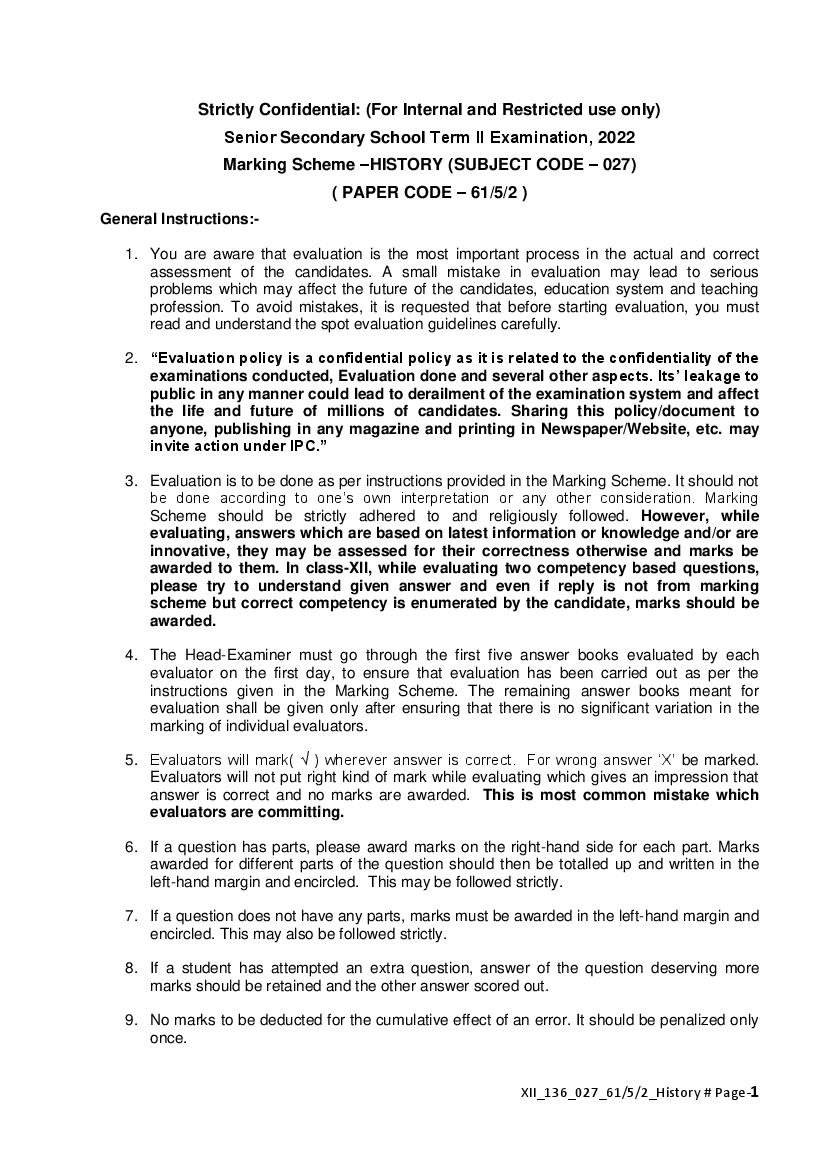
Senior Secondary School Term II Examination, 2022
Marking Scheme –HISTORY (SUBJECT CODE – 027)
( PAPER CODE – 61/5/2 )
General Instructions:-
1. You are aware that evaluation is the most important process in the actual and correct
assessment of the candidates. A small mistake in evaluation may lead to serious
problems which may affect the future of the candidates, education system and teaching
profession. To avoid mistakes, it is requested that before starting evaluation, you must
read and understand the spot evaluation guidelines carefully.
2. “Evaluation policy is a confidential policy as it is related to the confidentiality of the
examinations conducted, Evaluation done and several other aspects. Its’ leakage to
public in any manner could lead to derailment of the examination system and affect
the life and future of millions of candidates. Sharing this policy/document to
anyone, publishing in any magazine and printing in Newspaper/Website, etc. may
invite action under IPC.”
3. Evaluation is to be done as per instructions provided in the Marking Scheme. It should not
be done according to one’s own interpretation or any other consideration. Marking
Scheme should be strictly adhered to and religiously followed. However, while
evaluating, answers which are based on latest information or knowledge and/or are
innovative, they may be assessed for their correctness otherwise and marks be
awarded to them. In class-XII, while evaluating two competency based questions,
please try to understand given answer and even if reply is not from marking
scheme but correct competency is enumerated by the candidate, marks should be
awarded.
4. The Head-Examiner must go through the first five answer books evaluated by each
evaluator on the first day, to ensure that evaluation has been carried out as per the
instructions given in the Marking Scheme. The remaining answer books meant for
evaluation shall be given only after ensuring that there is no significant variation in the
marking of individual evaluators.
5. Evaluators will mark( √ ) wherever answer is correct. For wrong answer ‘X’ be marked.
Evaluators will not put right kind of mark while evaluating which gives an impression that
answer is correct and no marks are awarded. This is most common mistake which
evaluators are committing.
6. If a question has parts, please award marks on the right-hand side for each part. Marks
awarded for different parts of the question should then be totalled up and written in the
left-hand margin and encircled. This may be followed strictly.
7. If a question does not have any parts, marks must be awarded in the left-hand margin and
encircled. This may also be followed strictly.
8. If a student has attempted an extra question, answer of the question deserving more
marks should be retained and the other answer scored out.
9. No marks to be deducted for the cumulative effect of an error. It should be penalized only
once.
XII_136_027_61/5/2_History # Page-1
Page 2
be used. Please do not hesitate to award full marks if the answer deserves it.
11. Every examiner has to necessarily do evaluation work for full working hours i.e. 8 hours
every day and evaluate 30 answer books per day in main subjects and 35 answer books
per day in other subjects (Details are given in Spot Guidelines). This is in view of the
reduced syllabus and number of questions in question paper.
12. Ensure that you do not make the following common types of errors committed by the
Examiner in the past:-
Leaving answer or part thereof unassessed in an answer book.
Giving more marks for an answer than assigned to it.
Wrong totalling of marks awarded on a reply.
Wrong transfer of marks from the inside pages of the answer book to the title page.
Wrong question wise totalling on the title page.
Wrong totalling of marks of the two columns on the title page.
Wrong grand total.
Marks in words and figures not tallying.
Wrong transfer of marks from the answer book to online award list.
Answers marked as correct, but marks not awarded. (Ensure that the right tick mark is
correctly and clearly indicated. It should merely be a line. Same is with the X for
incorrect answer.)
Half or a part of answer marked correct and the rest as wrong, but no marks awarded.
13. While evaluating the answer books if the answer is found to be totally incorrect, it should
be marked as cross (X) and awarded zero (0) Marks.
14. Any unassessed portion, non-carrying over of marks to the title page, or totaling error
detected by the candidate shall damage the prestige of all the personnel engaged in the
evaluation work as also of the Board. Hence, in order to uphold the prestige of all
concerned, it is again reiterated that the instructions be followed meticulously and
judiciously.
15. The Examiners should acquaint themselves with the guidelines given in the Guidelines for
spot Evaluation before starting the actual evaluation.
16. Every Examiner shall also ensure that all the answers are evaluated, marks carried over
to the title page, correctly totalled and written in figures and words.
17. The Board permits candidates to obtain photocopy of the Answer Book on request in an
RTI application and also separately as a part of the re-evaluation process on payment of
the processing charges.
XII_136_027_61/5/2_History # Page-2
Page 3
Senior Secondary School Examination TERM–II, 2022
HISTORY (Subject Code – 027)
[ Paper Code – 61/5/2 ]
Maximum Marks : 40
Q. Marks
EXPECTED ANSWER / VALUE POINTS
No.
SECTION A 3x4=
(SHORT ANSWER TYPE QUESTIONS) 12
1. (a) “The Jotedars were more effective than that of zamindars in the villages”.
Examine the statement in the context of Permanent Settlement.
The Jotedars
(i) The Jotedars were located in the villages.
(ii) They exercised direct control over the villagers.
(iii) Jotedars also lent money to the villagers in their times of need.
(iv) They resisted the efforts of zamindars to increase the jama of their villages
3
(v) They deliberately delayed payments to zamindars.
(vi) They controlled local trade as well as money lending
(vii) They had immense power on poor cultivators.
(viii) Prevented zamindar‘s officials from executing their duties
(ix) Any other relevant point
Any three points to be examined. [ Pg 261]
Or
(b) Examine how the lives of Paharias in the hills of Raj Mahal, were 3
intimately connected to the forests.
Lives of Paharias
(i) Paharias used to subsist on forest produce
(ii) They collected Mahua for food from forests
(iii) They collected silk cocoons and resin for sale
(iv) They collected wood for charcoal production
(v) They were hunters, food gatherers, silk worm rearers & were intimately
connected to the forest.
(vi) The undergrowth, i.e., grass became fodder for their cattle
(vii) Practised shifting cultivation
(viii) They lived in hutments within tamarind groves.
(ix) They considered the entire region as their land and the basis of their
identity.
(x) They resisted the intrusion of outsiders.
(xi) They regularly raided the plains where settled agriculturists lived.
XII_136_027_61/5/2_History # Page-3
Page 4
(xiii) They negotiated political relations with outsiders.
(xiv) Zamindars on the plains purchased peace by paying a regular tribute to the
Paharias.
(xv) Any other relevant point
(Any three points to be examined) [ Pg 266–67]
3
2. Describe the three lists of the Federalism provided by the Drafting
Committee in the Constituent Assembly.
Three lists of Federalism :
(i) Three lists were—Union, State and the Concurrent
(ii) First list subjects were to be preserved for the Centre
(iii) Second list subjects vested with the States
(iv) Third list subjects were to be shared between Centre and State
(v) Many subjects were placed under Union control exclusively
(vi) The Union had control of minerals and key industries
(vii) Article 356 gave the Centre the powers to take over a state administration
on the recommendation of the Governor.
(viii) Any other relevant point
(Any three points to be described) [ Pg 423] 3
3
3. Explain why the Revolt of 1857 became an expression of popular resistance
in Awadh than anywhere else to the British rule.
Revolt of 1857 became an expression of popular resistance
(i) Dalhousie‘s Annexation created dissatisfaction in the areas of Annexation.
(ii) Wazid Ali Shah was dethroned and exiled.
(iii) Wazid Ali Shah was widely loved by the people.
(iv) There was wide spread sense of grief among the people.
(v) People cried in agony on the loss of Wazid Ali Shah.
(vi) People thought life has gone out of the body.
(vii) In streets and markets people lamented the loss of Wazid Ali Shah.
(viii) There was emotional upheaval.
(ix) Removal of Nawab led to the dissolution of Court and its culture.
(x) Large numbers of people like poets, dancers, musicians, artisans, cooks,
etc. lost their jobs.
(xi) People identified the firangi raj with the end of their world.
(xii) They lamented the breakdown of things they valued, respected and held
dear to them. 3
XII_136_027_61/5/2_History # Page-4
Page 5
(xiv) Any other relevant point.
(Any three points to be explained) [Pg 296–297]
3
4. How did Gandhiji try to bring peace in various areas after the independence
of India? Explain.
Last days of Gandhiji :
i. Gandhiji did not attend any function to celebrate the independence of
India.
ii. He marked the day with a 24 hour fast.
iii. He visited hospitals and refugee camps to give consolation to distressed
people.
iv. He moved from the villages of Noakhali in east Bengal to the
villages of Bihar for communal peace
v. He visited the riots ton areas Calcutta and Delhi for the safeguards of
minority community
vi. He persuaded the local people to guarantee the safety of Hindus.
vii. He visited riot torn districts of Punjab.
viii. He showed his concern with the sufferings of the minority community.
ix. He spread the message of ‗help and respect each other‘.
x. He tried to build and spirit of mutual trust.
xi. He tried to build confidence between the communities.
Any other relevant points
(Any three points to be explained) [Pg 366] 3
3
SECTION B 6x3 =
Long Answer Type Questions 18
5. “The link between sepoys and the rural peasant folk had important
implications in the course of the Revolt of 1857.” Elucidate the statement
with suitable examples.
Link between sepoys and the rural peasant in the Revolt of 1857.
(i) The dispossession of Taluqdars meant the breakdown of an entire order.
(ii) Ties of loyalty and patronage between peasant and taluqdar broke down
(iii) Peasants were exposed to over assessments and inflexible method of
collection by the British agents.
(iv) During the 1857 revolt, taluqdars and peasants fought against the British in
places like Awadh.
(v) The grievances of the peasants were carried over to the Sepoy lines.
(vi) Vast majority of Sepoys were recruited from villages. 6
XII_136_027_61/5/2_History # Page-5
Page 6
(viii) British officers developed a sense of superiority.
(ix) They started treating Sepoys as their racial inferiors.
(x) Abuse and physical violence became common.
(xi) Trust was replaced by suspicion.
(xii) Thus Sepoys and peasants developed a common link against the British
during the period of revolt.
(xiii) Any other relevant point
(Any six points to be explained)
[Pg 299]
6
6. (a) “The paintings in the Mughal Chronicles possess special powers to
communicate ideas about the power of kings and kingdom.” Give arguments
to support the statement.
Paintings in the Mughal Chronicles
(i) The paintings described the events in visual form.
(ii) The paintings by the side of a page gave visual expression to the theme.
(iii) The paintings were largely miniatures.
(iv) The paintings not only enhance the beauty of a book but possess special
powers of communicating ideas.
(v) Abul Fazal described paintings as a magical art.
(vi) Artists have a unique way of recognising God.
(vii) The Emperor, the Court and the people were the main subject-matter of the
paintings.
(viii) Mughal paintings transmitted the idea of divine status of the Emperor.
(ix) Paintings were seen as a subject of amusement and study.
(x) Sometimes the paintings were a constant source of tension between the
Emperor and the Ulamas.
(xi) Islamic prohibition of the portrayal of human beings enshrined in the
Quran as well as the Hadiths created tension between the Ulamas and the
painters.
(xii) Painters were rewarded and encouraged by the Emperor.
(xiii) Imperial workshops were organized by the Kingdom.
(xiv) Any other relevant point
(Any six points to be explained) [Pg 228]
XII_136_027_61/5/2_History # Page-6
Page 7
Or
(b) “Few women of the imperial household played a significant role in the
Mughal empire.” Justify the statement.
The Imperial Household
(i) The Mughal household consisted of the Emperor‘s wives, concubines,
mothers, sisters, relatives, female servants and slaves.
(ii) Mughal household maintained a distinction between the wives who came
from royal families and aristocratic families (begums) and other
wives(aghas & agachas)
(iii) The aghas and the agachas could rise to the position of the Begum
depending on the husband‘s will.
(iv) The tasks performed by the slaves in the imperial household ranged from
the mundane to those requiring skill, tact and intelligence.
(v) Women of the Mughal household played a significant role in the Mughal
Empire.
(vi) Nurjahan and Mughal Princesses controlled significant financial
resources.
(vii) Shah Jahan‘s daughters, Jahanara & Roshanara, also enjoyed annual
income equal to high imperial Mansabdar.
(viii) Control over resources helped Mughal women to commission some
gardens and buildings.
(ix) In Delhi a throbbing Centre of Chandni Chowk was designed by
Jahanara Begum.
(x) Humayunnma was written by Gulbadan Beghum.
(xi) Jahanara participated in many architectural projects of Shah Jahan.
(xii) Any other relevant point
(Any six points to be explained) [Pg 242–243] 6
6
7. (a) Describe the circumstances that led to the initiation of Non-Cooperation 3+3=
Movement by Gandhiji. Explain the significance of this movement. 6
Circumstances that led to the initiation of Non-Cooperation Movement
(i) During First World War the British had instituted Press Censorship.
(ii) Rowlatt Act was promulgated in 1919.The Act permitted detention without
trial.
(iii) Gandhiji called for countrywide Bandh against the Rowlatt Act.
(iv) Martial law was imposed in Punjab.
XII_136_027_61/5/2_History # Page-7
Page 8
(vi) Gandhiji and many congressmen were arrested.
(vii) Gandhiji supported Khilafat movement.
(viii) Feeling of nationalism & demand for Swaraj
(ix) Calcutta & Nagpur sessions of Congress
(x) Dissatisfaction with the Government of India Act 1919
(xi) Under these circumstances Gandhiji called for Non-Cooperation.
(xii) Any other relevant point
(Any three points) (3)
Significance :
(i) British rule was shaken to its foundation for the first time.
(ii) Indians from every walk joined the movement.
(iii) It got the Cooperation of Khilafat.
(iv) It was training for self-rule.
(v) It became an epoch in the life of Indians.
(vi) Deep economic impact on the British
(vii) British manufactured goods were boycotted
(viii) Swadeshi goods adopted.
(ix) Students left schools and colleges in large numbers.
(x) Indians returned their titles awarded by the British
(xi) Lawyers and court officials boycotted the British courts
(xii) Khadi was used instead of mill made cloth.
(xiii) People from all strata joined the movement.
(xiv) Non Cooperation Movement led to Hindu-Muslim unity
(xv) Any other relevant point
(Any three points) (3)
Any three points from each section to be explained [Pg 349–350–351]
OR
(b) Describe the role of Gandhiji as a social reformer and as a political
leader.
Gandhiji as a social reformer :
(i) He spoke against the social evils in society.
(ii) He spoke against child marriage.
(iii) He spoke against untouchability and wanted it abolished
3+3=
(iv) He worked for Hindu-Muslim harmony & unity. 6
XII_136_027_61/5/2_History # Page-8
Page 9
(vi) He promoted the spinning of the Charkha.
(vii) He called the lower sections of society as ―Harijan‖
(viii) He believed in equlity of castes.
(ix) He tried to redress the grievances of workers and peasants.
(x) He appeared as a ‗Saviour‘ who would rescue Indians from high taxes
and oppressive officials.
(xi) He tried to restore dignity and autonomy to Indians.
(xii) Gandhiji encouraged the communication of Nationalism in the mother
tongue
(xiii) He tried to break the boundaries between mental labour and manual
labour.
(xiv) Any other relevant point
(Any three points) (3)
Gandhiji as a political leader :
(i) Gandhiji successfully carried out several movements and achieved
success.
(ii) Gandhiji organised Satyagraha movement at Champaran, Kheda and
Ahemdabad to support peasants and mill workers.
(iii) He led Non-Cooperation Movement against the Rowlatt Act, Jallianwalla
Bagh and in support of Khilafat Movement etc.
(iv) He initiated Civil Dispobedience Movement against the Salt Law &
Simon Commission.
(v) Salt Satyagrah proved him to be a leader of the masses.
(vi) He gave a call for Quit India Movements against inclusion of India in the
Second World War, against Government of India Act (1935) & Cripps Mission
(vii) He broadened the base of nationalism.
(viii) People from all strata (peasants, workers, industrialists, women, students,
tribals etc) of society supported Gandhiji and joined the national movement.
(ix) His era of politics is known as Gandhian nationalism.
(x) Any other relevant point
(Any three points) (3)
Any three points from each section to be explained. [Pg 355]
6
SECTION C 4x2 =
(Case Based Questions) 8
XII_136_027_61/5/2_History # Page-9
Page 10
“We are not going to just copy” 1+1+2
This is what Jawahar Lal Nehru said in his famous speech of 13 December, 1946: =4
We say that it is our firm and solemn resolve to have an independent sovereign
republic. India is bound to be sovereign, it is bound to be independent and it is
bound to be a republic… Now, some friends have raised the question: ―Why have
you not put in the word ‗democratic‘ here? ― Well, I told them that it is
conceivable, of course that a republic may not be democratic but the whole of our
past is witness to this fact that we stand for democratic institutions. Obviously we
are aiming at democracy and nothing less than a democracy. What form of
democracy, that shape it might take is another matter. The democracies of the
present day, many of them in Europe and elsewhere, have played a great part in
the world‘s progress. Yet it may be doubtful if those democracies may not have to
change their shape somewhat before long if they have to remain completely
democratic. We are not going just to copy, I hope, a certain democratic procedure
or an institution of a so-called democratic country. We may improve upon it. In
any event whatever system of government we may establish here must fit in with
the temper of our people and be acceptable to them. We stand for democracy. It
will be for this House to determine what shape to give to that democracy, the
fullest democracy.
(i) Define the term sovereignty.
a) Sovereignty—Means the independent authority of the State, not being
subject and in the control of any other State or extended power. (1)
(ii) Which constitutions of the countries were referred by the Constitution
Assembly?
Referred Constitutions were :
(i) French Constitution
(ii) American Constitution
(iii)British Constitution
(d) Any other relevant point
(Any two of the above) (1)
(ii) How is democracy explained in this source?
Democracy:
(i) India needed democracy.
(ii) India stood for democratic institutions
(iii)Democracies of Europe and elsewhere had played a great part in the
world‘s progress.
(iv) According to Nehru, India will not just copy a certain democratic
procedure or an institution of so called democratic country, it will improve
upon it.
(v) Democracy had to be according to the temper of Indian people and had to
be acceptable to them.
(vi) Any other relevant point(Any two points to be explained) (2) [Page 412]
XII_136_027_61/5/2_History # Page-10
Page 11
9. Read the source given below and answer the question that follow:
Darbar-I Akbari
Abu‘I Fazl gives a vivid account of Akbar‘s darbar: 1+1+2
=4
Whenever His Majesty (Akbar) holds court (darbar) a large is beaten, the sounds
of which are accompanied by Divine praise. In this manner, people of all classes
receive notice. His Majesty‘s son and grandchildren, the grandees of the Court,
and all other men who have admittance, attends to make the kornish, and remain
standing in their proper places. Learned men of renowned and skilful mechanics
pay their respects; and the officers of justice presents their reports. His Majesty,
with his usual insights, gives orders, and settles everything in a satisfactory
manner. During the whole time, skilful gladiators and wrestlers from all countries
hold themselves in readiness, and singers, male and female, are in waiting. Clever
juggles and funny tumblers also are anxious to exhibit their dexterity and agility.
(i) How were the people informed about the conduct of the court?
a) People were informed about the conduct of the Court by the beating of a
large drum and the sound of which was accompanied by the divine praise. In this
way people of all classes received the notice. (1)
(ii) How was the social control exercised in the court?
a) In the King‘s Court, King‘s sons and grandchildren and all other men, who
had the admittance, attended to make kornish and had to remain standing on
their proper places.
b) All other men had to pay their respects and officers of justice presented
their reports.
c) The place allotted to the courtiers and others was a sign of importance.
d) Social control in court society was exercised through carefully defining in
full detail the forms of address, courtesies and speech which were acceptable in
court.
e) The slightest infringement of etiquette was noticed and punished.
f) Any other relevant point
(Any one point) (1)
(iii) How did Akbar dispose of the appeals or cases in the court?
a) The Emperor heard all the reports of the officers of justice.
b) Akbar, with his usual insight, gave orders.
c) Everything was settled in a satisfactory manner by the Emperor.
d) Any other relevant point
(Any two points) (2)
(Page 237)
XII_136_027_61/5/2_History # Page-11
Page 12
(MAP BASED QUESTION) 2
10.
(a) On the given political outline map of India mark and label any one of the
following with appropriate symbols:
SEE ATTACHED MAP
(i) Jallianwala Bagh Massacre– Amritsar 1
Or
The place where Salt Law was broken by Gandhiji - Dandi
(ii) A capital of the Mughal Empire marked as A —Delhi/Shah Jahanabad 1
For Visually Impaired Candidates :
Jallianwala Bagh Massacre– Amritsar
Or
The place where Salt Law was broken by Gandhiji – Dandi
(b) Any one capital of Mughal Empire – Agra/Delhi/Fatehpur Sikri/Lahore
XII_136_027_61/5/2_History # Page-12
Page 13
**
XII_136_027_61/5/2_History # Page-13
Document Details
| Board / Org | CBSE |
| Exam | Class 12 |
| Type | Solution |
| Pages | 13 |
| Updated | 22 Jul 2026 |