CBSE Class 12 Question Paper 2022 Solution Informatic Practice
Finished viewing? Save it for later —
Download CBSE Class 12 Question Paper 2022 Solution Informatic Practice (PDF · 12 pages)About CBSE Class 12 Question Paper 2022 Solution Informatic Practice
CBSE Class 12 Question Paper 2022 Solution Informatic Practice is available here for free download. Published by CBSE for Class 12, this solution can be viewed online or downloaded as a PDF (12 pages). Candidates preparing for Class 12 can use CBSE Class 12 Question Paper 2022 Solution Informatic Practice to understand the exam pattern, the type of questions asked, and the overall difficulty level.
Frequently Asked Questions
How can I download CBSE Class 12 Question Paper 2022 Solution Informatic Practice?
Open this page and click the Download button to save CBSE Class 12 Question Paper 2022 Solution Informatic Practice as a PDF. It is completely free on AglaSem Docs.
Is CBSE Class 12 Question Paper 2022 Solution Informatic Practice free to download?
Yes. CBSE Class 12 Question Paper 2022 Solution Informatic Practice can be viewed online and downloaded as a PDF free of cost on AglaSem Docs.
How many pages does CBSE Class 12 Question Paper 2022 Solution Informatic Practice have?
CBSE Class 12 Question Paper 2022 Solution Informatic Practice contains 12 pages, which you can read online or download together as a single PDF.
Where can I find more Class 12 study material?
You can find more Class 12 question papers, sample papers, syllabus, and answer keys on AglaSem Docs.
CBSE Class 12 Question Paper 2022 Solution Informatic Practice – Text
Read the full text of this solution below — useful to quickly search, copy and reference the content online without downloading the PDF.
📄 View text version (12 pages)
Page 1
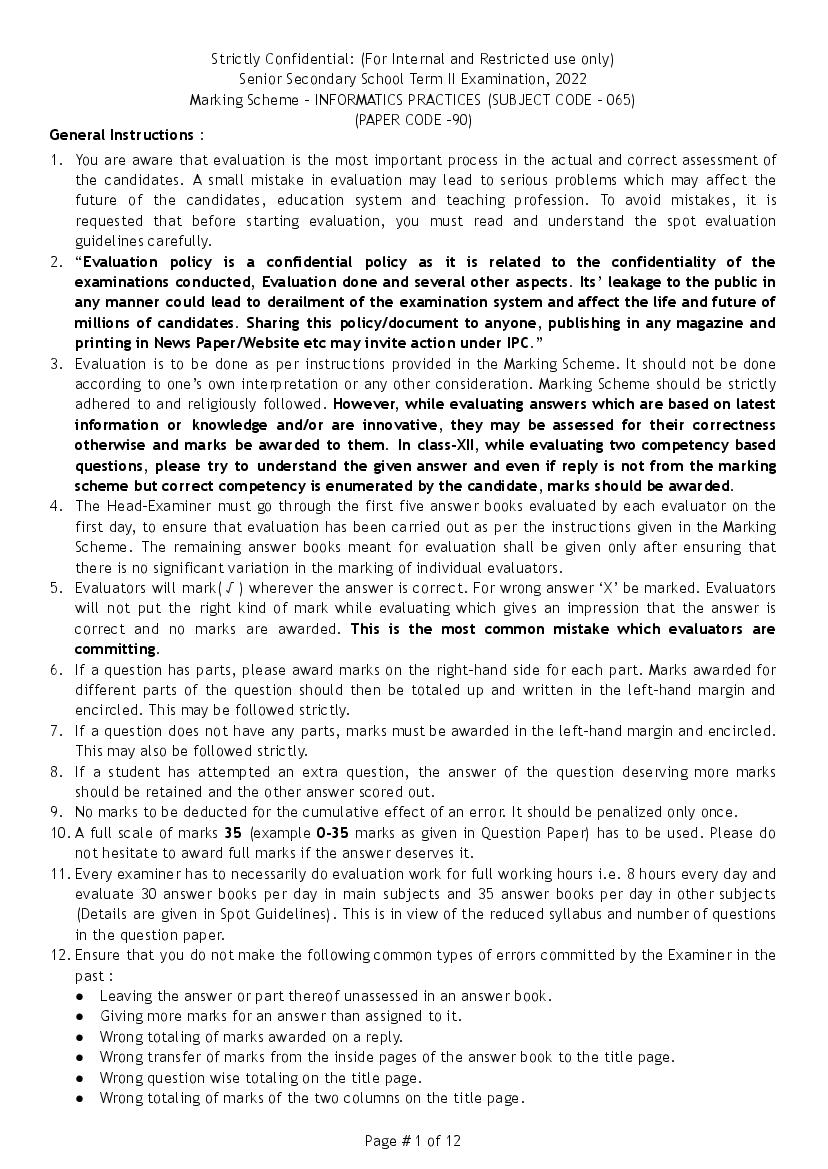
Senior Secondary School Term II Examination, 2022
Marking Scheme – INFORMATICS PRACTICES (SUBJECT CODE – 065)
(PAPER CODE –90)
General Instructions :
1. You are aware that evaluation is the most important process in the actual and correct assessment of
the candidates. A small mistake in evaluation may lead to serious problems which may affect the
future of the candidates, education system and teaching profession. To avoid mistakes, it is
requested that before starting evaluation, you must read and understand the spot evaluation
guidelines carefully.
2. “Evaluation policy is a confidential policy as it is related to the confidentiality of the
examinations conducted, Evaluation done and several other aspects. Its’ leakage to the public in
any manner could lead to derailment of the examination system and affect the life and future of
millions of candidates. Sharing this policy/document to anyone, publishing in any magazine and
printing in News Paper/Website etc may invite action under IPC.”
3. Evaluation is to be done as per instructions provided in the Marking Scheme. It should not be done
according to one’s own interpretation or any other consideration. Marking Scheme should be strictly
adhered to and religiously followed. However, while evaluating answers which are based on latest
information or knowledge and/or are innovative, they may be assessed for their correctness
otherwise and marks be awarded to them. In class-XII, while evaluating two competency based
questions, please try to understand the given answer and even if reply is not from the marking
scheme but correct competency is enumerated by the candidate, marks should be awarded.
4. The Head-Examiner must go through the first five answer books evaluated by each evaluator on the
first day, to ensure that evaluation has been carried out as per the instructions given in the Marking
Scheme. The remaining answer books meant for evaluation shall be given only after ensuring that
there is no significant variation in the marking of individual evaluators.
5. Evaluators will mark( √ ) wherever the answer is correct. For wrong answer ‘X’ be marked. Evaluators
will not put the right kind of mark while evaluating which gives an impression that the answer is
correct and no marks are awarded. This is the most common mistake which evaluators are
committing.
6. If a question has parts, please award marks on the right-hand side for each part. Marks awarded for
different parts of the question should then be totaled up and written in the left-hand margin and
encircled. This may be followed strictly.
7. If a question does not have any parts, marks must be awarded in the left-hand margin and encircled.
This may also be followed strictly.
8. If a student has attempted an extra question, the answer of the question deserving more marks
should be retained and the other answer scored out.
9. No marks to be deducted for the cumulative effect of an error. It should be penalized only once.
10. A full scale of marks 35 (example 0-35 marks as given in Question Paper) has to be used. Please do
not hesitate to award full marks if the answer deserves it.
11. Every examiner has to necessarily do evaluation work for full working hours i.e. 8 hours every day and
evaluate 30 answer books per day in main subjects and 35 answer books per day in other subjects
(Details are given in Spot Guidelines). This is in view of the reduced syllabus and number of questions
in the question paper.
12. Ensure that you do not make the following common types of errors committed by the Examiner in the
past :
● Leaving the answer or part thereof unassessed in an answer book.
● Giving more marks for an answer than assigned to it.
● Wrong totaling of marks awarded on a reply.
● Wrong transfer of marks from the inside pages of the answer book to the title page.
● Wrong question wise totaling on the title page.
● Wrong totaling of marks of the two columns on the title page.
Page # 1 of 12
Page 2
● Marks in words and figures not tallying.
● Wrong transfer of marks from the answer book to online award list.
● Answers marked as correct, but marks not awarded. (Ensure that the right tick mark is correctly
and clearly indicated. It should merely be a line. Same is with the X for incorrect answers.)
● Half or a part of the answer was marked correct and the rest as wrong, but no marks awarded.
13. While evaluating the answer books if the answer is found to be totally incorrect, it should be marked
as cross (X) and awarded zero (0) Marks.
14. Any unassessed portion, non-carrying over of marks to the title page, or totaling error detected by
the candidate shall damage the prestige of all the personnel engaged in the evaluation work as also
of the Board. Hence, in order to uphold the prestige of all concerned, it is again reiterated that the
instructions be followed meticulously and judiciously.
15. The Examiners should acquaint themselves with the guidelines given in the Guidelines for spot
Evaluation before starting the actual evaluation.
16. Every Examiner shall also ensure that all the answers are evaluated, marks carried over to the title
page, correctly totaled and written in figures and words.
17. The Board permits candidates to obtain a photocopy of the Answer Book on request in an RTI
application and also separately as a part of the re-evaluation process on payment of the processing
charges.
Specific Instructions:
● In SQL related questions – both ways of text/character entries should be acceptable. For
example: “AMAR” and ‘amar’ both are acceptable.
● In SQL related questions – all date entries should be acceptable. For example. ‘YYYY-MM-DD’,
‘YY-MM-DD’, ‘DD-Mon-YY’, “DD/MM/YY”, ‘DD/MM/YY’, “MM/DD/YY”, ‘MM/DD/YY’ and
{MM/DD/YY} are correct.
● In SQL related questions – semicolon should be ignored for terminating the SQL statements
● In SQL related questions, ignore case sensitivity.
● In SQL related output questions, ignore Column Headings.
Q. Mar
No. ks
SECTION—A
(Each question carries 2 marks)
1. Rushil thought “WWW” and “Internet” are synonyms i.e., they meant same 2
and can be used interchangeably. But the teacher said that they are not
same. Help him to understand the meaning of both the terms with the help
of a suitable example of each.
Ans The Internet is a system of linked networks that are worldwide in scope and
facilitate data communication services such as remote login, file transfer,
electronic mail, the World Wide Web and newsgroups.
OR
It is a network of networks spread across the globe, all of which are
connected to each other.
OR
The Internet is a public network of devices like desktop computers, laptops,
servers, tablets, mobile phones, other handheld devices, printers, scanners
Page # 2 of 12
Page 3
Example: Network of computers to perform E-commerce, E-Governance etc.
WWW can be defined as a hypertext information retrieval system on the
Internet.
OR
WWW is the universe of the information available on the internet.
OR
WWW consists of web pages, which use HTML to interchange information on
the internet.
OR
The World Wide Web (WWW) or web in short is a collection of information
stored in the form of hyperlinked web pages and web resources.
Example, www.google.com
(½ mark for writing each correct explanation of Internet and WWW)
(½ mark each for writing any correct example of Internet and WWW)
OR
What are Cookies? How can we disable Cookies?
Ans This is a small text file which contains the name of the website that it has
come from and a unique ID tag.
OR
A cookie is a text file created by the web server while browsing websites
and gets stored on the user's computer.
We can disable cookies by changing the Privacy and Security settings of the
browser.
OR
We can disable cookies by selecting the Do Not Allow option when prompted
whether to allow cookies for a website.
(1 mark for writing correct definition of cookie)
(1 mark for writing correct way to disable cookies)
2 (i) What is the function of a Gateway? 1
Ans A gateway is a network device that establishes an intelligent connection
between a local network and external networks with completely different
structures
OR
It is a network device that connects two dissimilar networks.
(1 mark for writing any correct functionality of a Gateway)
Page # 3 of 12
Page 4
Ans Java, Flash, Adobe Acrobat, Quicktime
NOTE:
Any other valid name for plug-ins to be accepted.
(½ mark each for writing each correct example)
OR
(½ mark each for writing correct explanation of plug-in without
example)
3 Find the output of the following SQL Queries : 2
(i) SELECT ROUND (7658.345,2);
(ii) SELECT MOD (ROUND (13·9, 0), 3);
Ans (i) 7658·35
(ii) 2
(1 mark for writing each correct output)
OR
Give any two differences between the POWER( ) and SUM( ) SQL functions.
Ans POWER() returns the value of a number raised to the power of another
number, while SUM() returns the sum of the values stored in a specific
column.
POWER() is a single row function while SUM() is a group/aggregate
function.
POWER() accepts two parameters while SUM() accepts one parameter.
(1 mark each for writing each of the two correct differences)
OR
(1 mark for explaining any of the power() OR sum() )
NOTE:
(Full 2 marks to be given if difference is explained with the help of
examples of each function)
4 Give one advantage and disadvantage each of Bus and Star Topology. 2
Ans Advantage of BUS Topology :
Minimum cable length required
Disadvantage of BUS Topology :
If there is any problem in the main cable the entire network fails.
Advantage of STAR Topology :
Considered faster than other topologies, as each device is directly
connected with the central hub/device.
Page # 4 of 12
Page 5
More cable length is required compared to Bus topology.
NOTE:
Any valid advantage, disadvantage of Star and Bus topology to be accepted.
(½ mark for writing any one correct advantage of Bus Topology)
(½ mark for writing any one correct disadvantage of Bus Topology)
(½ mark for writing any one correct advantage of Star Topology)
(½ mark for writing any one correct disadvantage of Star Topology)
OR
(1 mark for drawing only the topology layouts without explaining the
advantages and disadvantages)
5 Find the output of the following SQL queries: 2
(i) SELECT SUBSTR ("FIT INDIA MOVEMENT", 5);
(ii) SELECT INSTR ("ARTIFICIAL INTELLIGENCE", "IA");
Ans (i) INDIA MOVEMENT
(ii) 8
(1 mark for writing each correct output)
6 Srikanth created the following table STUDENT in his database.
Table : STUDENT
RollNo Name Class Marks
1 Ritika 12 40
2 Angad 12 35
3 Kaveri 11 42
4 Lalitha 12 21
5 Daniel 11 44
6 Rabindra 11 39
7 Rabia 11 28
He now wants to count number of students in each class where the number
of students is more than 3. He has executed the following query :
SELECT MAX (Marks) FROM STUDENT WHERE COUNT (*) > 3 GROUP
BY Class;
But, he got an error. Identify the error(s) and rewrite the query. Also
underline the correction(s) done.
Ans SELECT CLASS, COUNT(*) FROM STUDENT
GROUP BY CLASS HAVING COUNT (*) > 3;
OR
SELECT COUNT(*) FROM STUDENT
GROUP BY CLASS HAVING COUNT (*) > 3;
NOTE:
COUNT() to be accepted with any column name in place of *
Page # 5 of 12
Page 6
(½ mark for writing GROUP BY CLASS)
(½ mark for writing HAVING COUNT (*) > 3 )
7 Ms Mohini is working in a school and stores the details of all students in a 2
table SCHOOLDATA.
TABLE : SCHOOLDATA
Admno Name Class House Percent Gender Dob
20150001 Aditya Das 10 Green 86 Male 2006-02-20
20140212 Harsh Sharma 11 Red 75 Male 2004-10-05
20090234 Swapnil Pant 10 Yellow 84 Female 2005-11-21
20130216 Soumen Rao 9 Red 91 Male 2006-04-10
20190227 Rahil Arora 10 Blue 70 Male 2005-05-14
20120200 Akasha Singh 11 Red 64 Female 2004-12-16
Write SQL statements from the above given table to:
(i) To remove leading spaces from the column name;
(ii) Display the names of students who were born on Sunday.
Ans (i) SELECT LTRIM (Name) FROM SCHOOLDATA;
(½ mark for writing SELECT LTRIM (Name) )
(½ mark for writing FROM SCHOOLDATA )
(ii) SELECT NAME FROM SCHOOLDATA WHERE DAYNAME (DoB) =
"Sunday";
(½ mark for writing SELECT NAME FROM SCHOOLDATA )
(½ mark for writing WHERE DAYNAME (DoB) = "Sunday" )
OR
Predict the output of the following SQL queries from the above table :
SCHOOLDATA
(i) SELECT MAX (Percent) FROM SCHOOLDATA;
(ii) SELECT LEFT (Gender, 1), Name FROM SCHOOLDATA WHERE
YEAR (Dob) = 2005;
Ans (i) 91
(ii) F Swapnil Pant
M Rahil Arora
(1 mark for writing correct output for (i) )
(½ mark for each correct line of output for (ii) )
SECTION—B
(Each question carries 3 marks)
8 Predict the output of the following SQL queries : 3
Page # 6 of 12
Page 7
(ii) SELECT POWER(5,2);
(iii) SELECT UPPER (MID ("start up india", 10));
Ans (i) ALL THE BEST
(ii) 25
(iii) INDIA
(1 mark for writing each correct output)
OR
Consider a table “MYPET” with the following data :
Table : MYPET
Pet_id Pet_Name Breed LifeSpan Price Discount
101 Rocky Labrador 12 16000 5
Retriever
202 Duke German Shepherd 13 22000 10
303 Oliver Bulldog 10 18000 7
404 Cooper Yorkshire 16 20000 12
Terrier
505 Oscar Shih Tzu NULL 25000 8
Write SQL queries for the following :
(i) Display the Breed of all the pets in uppercase.
(ii) Display the total price of all the pets.
(iii) Display the average life span of all the pets.
Ans (i) SELECT UPPER (Breed) FROM MYPET;
OR
SELECT UCASE (Breed) FROM MYPET;
(½ mark for writing SELECT UPPER (Breed)
OR SELECT UCASE (Breed) )
(½ mark for writing FROM MYPET )
(ii) SELECT SUM (Price) FROM MYPET;
(½ mark for writing SELECT SUM (Price) )
(½ mark for writing FROM MYPET )
(iii) SELECT AVG (LifeSpan) FROM MYPET;
(½ mark for writing SELECT AVG (LifeSpan) )
(½ mark for writing FROM MYPET )
9 Write the names of SQL functions to perform the following operations : 3
(i) Display name of the Month from your date of birth.
(ii) Convert email-id to lowercase.
(iii) Count the number of characters in your name.
Ans (i) MONTHNAME( )
(ii) LCASE( )/LOWER( )
(iii) LENGTH( )
Page # 7 of 12
Page 8
Only Function names, without () to be accepted
(1 mark for writing each correct SQL function)
10 Consider the following table: PRODUCT 3
Table : PRODUCT
PID PNAME PRICE QUANTITY
P1001 Eraser 10.50 5
P1002 Ball Pen 15.00 2
P1003 Gel Pen 25.10 3
P1004 Ruler 5.00 1
Find the output of the following SQL queries :
(i) SELECT 10+MOD(QUANTITY,3) FROM PRODUCT
WHERE PNAME = "Eraser";
(ii) SELECT ROUND(PRICE, 2) *QUANTITY
FROM PRODUCT WHERE QUANTITY > 2;
(iii) SELECT UCASE(RIGHT(PNAME, 2))
FROM PRODUCT;
Ans (i) 12
(ii) 52·50
75·30
(iii) ER
EN
EN
ER
(1 mark for writing each correct output)
Note:
(Only ½ mark to be awarded for (iii) if UCASE() is not considered for the
output)
SECTION—C
(Each question carries 4 marks)
11 Consider the table: ITEM 4
Table : ITEM
SNo Itemname Type Price Stockdate
1 Chaises Living 11500·58 2020-02-19
2 Accent Chairs Living 31000.67 2021-02-15
3 Baker Racks Kitchen 25000·623 2019-01-01
4 Sofa Living 7000·3 2020-10-18
5 Nightstand Bedroom NULL 2021-07-23
Write SQL queries for the following :
(i) Display all the records in descending order of Stockdate.
(ii) Display the type and total number of items of each Type.
(iii) Display the least Price.
(iv) Display the Itemname with their price rounded to 1 decimal place.
Ans (i) SELECT * FROM ITEM ORDER BY Stockdate DESC;
Page # 8 of 12
Page 9
(½ Mark for writing ORDER BY Stockdate DESC )
(ii) SELECT Type, COUNT(*)FROM ITEM GROUP BY Type;
NOTE:
COUNT() to be accepted with any column name (except Price), in
place of *
(½ Mark for writing SELECT Type, COUNT(*)FROM ITEM )
(½ Mark for writing GROUP BY Type )
(iii) SELECT MIN(PRICE) FROM ITEM;
(½ Mark for writing SELECT MIN(PRICE) )
(½ Mark for writing FROM ITEM )
(iv) SELECT Itemname, ROUND(Price, 1) FROM ITEM;
(½ Mark for writing SELECT Itemname, ROUND(Price, 1) )
(½ Mark for writing FROM ITEM )
12 Consider the following table : 4
Table : SALESMAN
Scode Sname Area Qtysold Dateofjoin
S001 Ravi North 120 2015-10-01
S002 Sandeep South 105 2012-08-01
S003 Sunil NULL 68 2018-02-01
S004 Subh West 280 2010-04-01
S005 Ankit East 90 2018-10-01
S006 Raman North NULL 2019-12-01
Predict the output for the following SQL queries :
(i) SELECT MAX(Qtysold), MIN(Qtysold) FROM SALESMAN;
(ii) SELECT COUNT(Area) FROM SALESMAN;
(iii) SELECT LENGTH (Sname) FROM SALESMAN
WHERE MONTH (Dateofjoin)=10;
(iv) SELECT Sname FROM SALESMAN WHERE RIGHT(Scode,1)=5;
Ans (i) 280 68 (½ Mark for each correct value of the output)
(ii) 5 (1 Mark for the correct value of the output)
(iii) 4 (½ Mark for each value of the output)
5
(iv) Ankit (1 Mark for the correct value of the output)
OR
Based on the given table SALESMAN, write SQL queries to perform the
following operations :
(i) Count the total number of salesman.
Ans (i) SELECT COUNT(*)FROM SALESMAN;
Page # 9 of 12
Page 10
COUNT() to be accepted with any column name (except Qtysold), in
place of *
(½ mark for writing SELECT COUNT(*))
(½ mark for writing FROM SALESMAN)
(ii) Display the maximum qtysold from each area.
Ans SELECT MAX (Qtysold), Area
FROM SALESMAN GROUP BY Area;
OR
SELECT Area, MAX (Qtysold)
FROM SALESMAN GROUP BY Area;
(½ mark for writing SELECT MAX (Qtysold),Area FROM SALESMAN )
(½ mark for writing GROUP BY Area)
(iii) Display the average qtysold from each area where number of salesman is
more than 1.
Ans SELECT AVG (Qtysold), Area
FROM SALESMAN
GROUP BY Area HAVING COUNT(*)>1;
OR
SELECT Area, AVG (Qtysold)
FROM SALESMAN
GROUP BY Area HAVING COUNT(*)>1;
NOTE:
COUNT() to be accepted with any column name (except Qtysold), in
place of *
(½ mark for writing SELECT AVG(Qtysold),Area FROM SALESMAN )
(½ mark for writing GROUP BY Area HAVING COUNT(*)>1 )
(iv) Display all the records in ascending order of area.
Ans SELECT * FROM SALESMAN ORDER BY Area;
(½ mark for writing SELECT * FROM SALESMAN )
(½ mark for writing ORDER BY Area )
13 ABC International School, Delhi has different wings Administrative Wing 4
(W1), Primary Wing (W2), Middle Wing (W3) and Secondary Wing (W4) as
shown in the diagram :
Page # 10 of 12
Page 11
connect all the wings as well as all the computers of each wing (W1, W2,
W3, W4).
Distance between the wings are as follows :
W3 to W1 85 m
W1 to W2 40 m
W2 to W4 25 m
W4 to W3 120 m
W3 to W2 150 m
W1 to W4 170 m
Number of computers in each of the wing:
W1 125
W2 40
W3 42
W4 60
Based on the above specifications, answer the following questions :
(i) Suggest the topology and draw the most suitable cable layout for connecting
all the wings of Delhi branch.
Ans
Star Topology Bus Topology
Layout Option 1 Layout Option 2
(Connecting from the place of SERVER)
Bus Topology Bus Topology
Layout Option 3 Layout Option 4
Page # 11 of 12
Page 12
Layout Option 5 Layout Option 6
(½ mark for writing the correct topology)
(½ mark for drawing the correct layout)
(ii) Suggest the kind of network required (out of LAN, MAN, WAN) for connecting
(a) Administrative Wing (W1) with Middle Wing (W3)
(b) Administrative Wing (W1) with the Mumbai branch
Ans (a) LAN
(b) WAN
(½ mark for writing LAN for part (a))
(½ mark for writing WAN for part (b))
(iii) Suggest the placement of the following devices with justification:
(a) Repeater
(b) Switch/Hub
Ans (a) Repeater to be placed based on layout drawn in part(i), between two
physically connected buildings wherever the distance between the two
buildings is more.
(b) Switch/Hub to be placed in all wings W1, W2, W3 and W4 as each of the
buildings has more than one computer.
(½ mark for writing each correct placement)
(iv) Due to pandemic school had to adopt Online classes. Suggest the protocol
that is used for sending the voice signals over internet. Also, give an
example of an application of WWW that helped the teachers to send
messages instantly to the students.
Ans Protocol name : VoIP OR Voice Over Internet Protocol
WhatsApp, Slack, Skype, Yahoo Messenger, Google Talk, Facebook Messenger,
Google Hangout, Instant Messenger
Any of the above or any other correct example of an application of WWW for
instant messaging.
(½ mark for VoIP)
(½ mark for any one correct example)
Page # 12 of 12
Document Details
| Board / Org | CBSE |
| Exam | Class 12 |
| Type | Solution |
| Pages | 12 |
| Updated | 30 Apr 2026 |