MAHA SET 2015 Question Paper 2 Philosophy
Finished viewing? Save it for later —
Download MAHA SET 2015 Question Paper 2 Philosophy (PDF · 24 pages)About MAHA SET 2015 Question Paper 2 Philosophy
MAHA SET 2015 Question Paper 2 Philosophy is available here for free download. Published by Maharashtra Exams for MAHA SET, this question paper can be viewed online or downloaded as a PDF (24 pages). Candidates preparing for MAHA SET can use MAHA SET 2015 Question Paper 2 Philosophy to understand the exam pattern, the type of questions asked, and the overall difficulty level.
Frequently Asked Questions
How can I download MAHA SET 2015 Question Paper 2 Philosophy?
Open this page and click the Download button to save MAHA SET 2015 Question Paper 2 Philosophy as a PDF. It is completely free on AglaSem Docs.
Is MAHA SET 2015 Question Paper 2 Philosophy free to download?
Yes. MAHA SET 2015 Question Paper 2 Philosophy can be viewed online and downloaded as a PDF free of cost on AglaSem Docs.
How many pages does MAHA SET 2015 Question Paper 2 Philosophy have?
MAHA SET 2015 Question Paper 2 Philosophy contains 24 pages, which you can read online or download together as a single PDF.
Where can I find more MAHA SET study material?
You can find more MAHA SET question papers, sample papers, syllabus, and answer keys on AglaSem Docs.
MAHA SET 2015 Question Paper 2 Philosophy – Text
Read the full text of this question paper below — useful to quickly search, copy and reference the content online without downloading the PDF.
📄 View text version (24 pages)
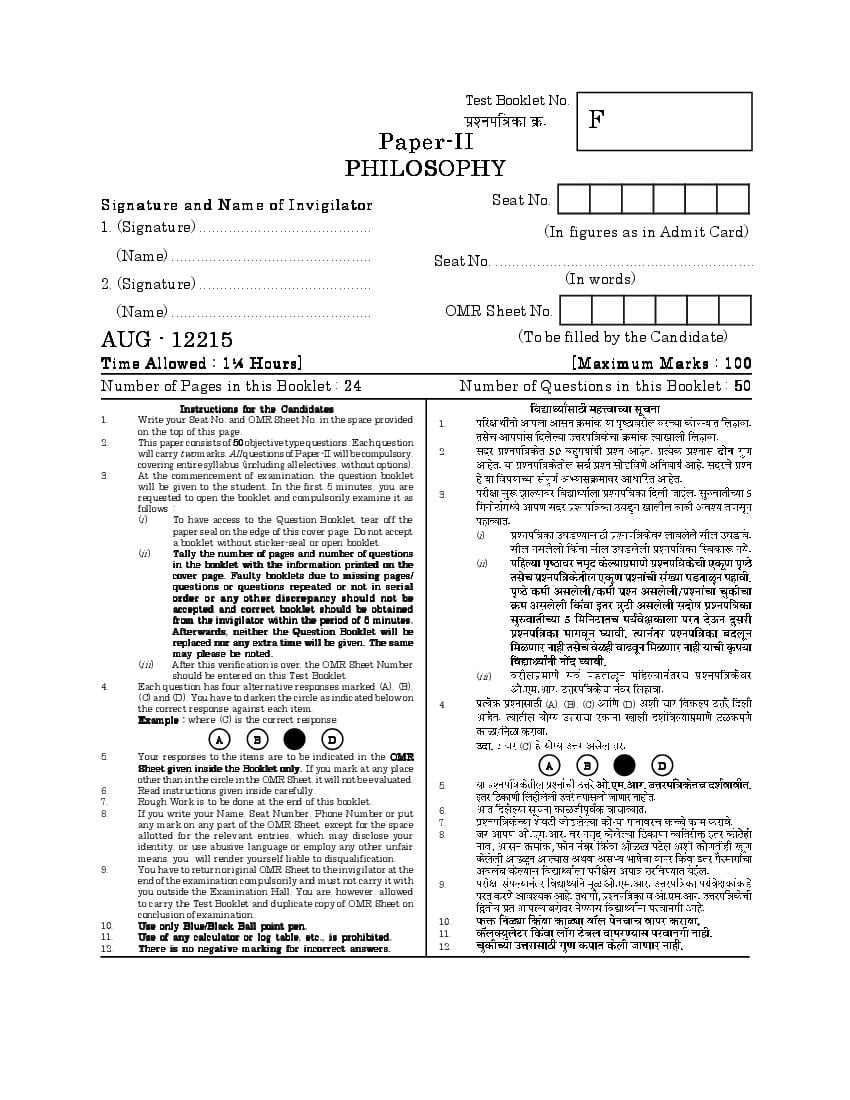
Page 1
F
PHILOSOPHY
Signature and Name of Invigilator Seat No.
1. (Signature) ......................................... (In figures as in Admit Card)
(Name) ................................................ Seat No. ..............................................................
2. (Signature) ......................................... (In words)
(Name) ................................................ OMR Sheet No.
AUG - 12215 (To be filled by the Candidate)
Time Allowed : 1¼ Hours] [Maximum Marks : 100
Number of Pages in this Booklet : 24 Number of Questions in this Booklet : 50
Instructions for the Candidates
1. Write your Seat No. and OMR Sheet No. in the space provided 1.
on the top of this page.
2. This paper consists of 50 objective type questions. Each question
will carry two marks. All questions of Paper-II will be compulsory, 2.
covering entire syllabus (including all electives, without options).
3. At the commencement of examination, the question booklet
will be given to the student. In the first 5 minutes, you are
requested to open the booklet and compulsorily examine it as 3.
follows :
(i) To have access to the Question Booklet, tear off the
paper seal on the edge of this cover page. Do not accept (i)
a booklet without sticker-seal or open booklet.
(ii) Tally the number of pages and number of questions
in the booklet with the information printed on the (ii)
cover page. Faulty booklets due to missing pages/
questions or questions repeated or not in serial
o rder or any other discre pancy should not be
accepted and correct booklet should be obtained
from the invigilator within the period of 5 minutes.
Afterwards, neither the Question Booklet will be
replaced nor any extra time will be given. The same
may please be noted.
(iii) After this verification is over, the OMR Sheet Number
should be entered on this Test Booklet. (iii)
4. Each question has four alternative responses marked (A), (B),
(C) and (D). You have to darken the circle as indicated below on
the correct response against each item. 4. (A), (B), (C) (D)
Example : where (C) is the correct response.
A B D
(C)
5. Your responses to the items are to be indicated in the OMR
Sheet given inside the Booklet only. If you mark at any place A B D
other than in the circle in the OMR Sheet, it will not be evaluated.
5.
6. Read instructions given inside carefully.
7. Rough Work is to be done at the end of this booklet.
8. If you write your Name, Seat Number, Phone Number or put 6.
any mark on any part of the OMR Sheet, except for the space 7.
allotted for the relevant entries, which may disclose your 8.
identity, or use abusive language or employ any other unfair
means, you will render yourself liable to disqualification.
9. You have to return original OMR Sheet to the invigilator at the
end of the examination compulsorily and must not carry it with 9.
you outside the Examination Hall. You are, however, allowed
to carry the Test Booklet and duplicate copy of OMR Sheet on
conclusion of examination.
10. Use only Blue/Black Ball point pen. 10.
11. Use of any calculator or log table, etc., is prohibited. 11.
12. There is no negative marking for incorrect answers. 12.
Page 2
Page 3
Paper II
II
Time Allowed : 75 Minutes] [Maximum Marks : 100
Note : This paper contains 50 multiple choice questions, each carrying
Two (2) marks. Attempt All questions.
50 (2)
1. The dialectical method of Hegel 1.
consists of :
(A) thesis and hypothesis (A)
(B) thesis, synthesis and hypothesis (B)
(C) antithesis and hypothesis (C)
(D) thesis, antithesis and synthesis (D)
2. According to Vaisesika consciousness 2.
is :
(A)
(A) Permanent property of soul
(B)
(B) Accidental property of soul
(C)
(C) Nature of soul
(D) Pure consciousness (D)
3 [P.T.O.
Page 4
(A) Monad of all monads (A)
(B) Eternal perceiver (B)
(C) The Highest Reality (C)
(D)
(D) All-embracing Truth
4. “The movement from certainty to 4.
uncertainty is what I call fear” is
said by :
(A)
(A) K. C. Bhattacharya
(B)
(B) Iqbal
(C)
(C) J. Krishnamurti
(D)
(D) S. Radhakrishnan
5. “A clear idea is one which is so 5.
apprehended that it will be
recognized wherever it is met with,
so that no other will be mistaken
for it.” This is held by :
(A)
(A) William James
(B)
(B) C. S. Pierce
(C) John Dewey (C)
(D) Wittgenstein (D)
4
Page 5
introduced into philosophy by :
(A) Aristotle (A)
(B) Aquinas (B)
(C) Berkeley (C)
(D)
(D) Plato
7. “Jñana, Karma, Bhakti and Yoga 7.
are the means to Liberation” is
maintained by :
(A)
(A) K. C. Bhattacharya
(B)
(B) J. Krishnamurti
(C)
(C) Swami Vivekananda
(D)
(D) B. R. Ambedkar
8.
8. The prominent sophists were :
(A) Socrates and Plato (A)
(B) Protagoras and Gorgias (B)
(C) Anaxagoras and Democritus (C)
(D) Democritus and Protagoras (D)
5 [P.T.O.
Page 6
correctly matched ?
(A)
(A) Tripitaka — A Buddhist text
(B) Tattvacintamani — Nyaya text (B)
(C) Tattvarthadhigamasutra —
(C)
A Mimamsa text
(D)
(D) Kiranavali — A Vaisesika text
10. The ultimate human destiny, 10.
according to Radhakrishnan, is not
individual but universal redemption
called :
(A)
(A) Sarvodaya
(B)
(B) Sarvamukti
(C)
(C) Bodhisattva
(D)
(D) Mahaparinirvana
11. Hume’s account of causation is : 11.
(A) Epistemological (A)
(B) Psychological (B)
(C) Logical (C)
(D) Historical (D)
6
Page 7
‘sense’ and ‘non-sense’ by :
(A) analyzing the value-judgments
(A)
which represent the world of
facts
(B) refuting philosophy of language
(C) drawing a limit to the (B)
expression of thoughts but not
(C)
to thinking
(D) describing the contents of
(D)
judgements
13. According to Tagore the finite form 13.
of Human tells about the
characteristics of man such as :
(A)
(A) Universality and Ego
(B)
(B) Individuality and Ego
(C) Creativity and Ego (C)
(D) Creativity and Individuality (D)
7 [P.T.O.
Page 8
that is concerned with pure abstract
knowledge is :
(A)
(A) Logic
(B)
(B) Practical science
(C)
(C) Theoretical science
(D)
(D) The productive science
15. ‘All knowable objects are nameable 15.
the pot is knowable object, therefore
the pot is nameable’. It is an
example of the inference called :
(A)
(A) Kevalanvayi
(B)
(B) Kevala Vyatireki
(C)
(C) Seshavat
(D) Anvaya-Vyatireki (D)
8
Page 9
about :
(A)
(A) Interpretation of Being
(B)
(B) Philosophy of Language
(C)
(C) Interpretation of Religion
(D) Interpretation of Dasein (D)
17. Which of the following is not 17.
mentioned in the concept of
‘Tri-rna’ ?
(A)
(A) Rsi-rna
(B)
(B) Deva-rna
(C)
(C) Nisarga-rna
(D)
(D) Pitru-rna
18. St. Anselm’s ontological argument 18.
for the existence of God is criticized
by :
(A) Leibnitz (A)
(B) Descartes (B)
(C) Bradley (C)
(D) Kant (D)
9 [P.T.O.
Page 10
development of Absolute is :
(A) Redemption (A)
(B) Self-consciousness (B)
(C) Cipher (C)
(D) God (D)
20. Match the pair and choose the 20.
correct alternative from the codes
given below :
List I List II I II
(a ) Ramanuja (i ) Dvaita (a) (i )
(b ) Vallabha (ii ) Visistadvaita (b) (ii)
(c) Nimbarka (iii) Suddhadvaita (c) (iii)
(d) Madhva (iv) Dvaitadvaita (d ) (iv)
Codes :
(a) (b) (c) (d) (a) (b) (c) (d)
(A) (ii ) (iv) (iii) (i) (A) (ii ) (iv) (iii) (i )
(B) (ii ) (iii) (iv) (i) (B) (ii ) (iii) (iv) (i )
(C) (i ) (iii) (iv) (ii)
(C) (i ) (iii) (iv) (ii )
(D) (i ) (iv) (iii) (ii) (D) (i ) (iv) (iii) (ii )
10
Page 11
with stoicism is :
(A)
(A) Thales
(B)
(B) Plato
(C)
(C) Heraclitus
(D)
(D) Zeno
22. In their unity of science project, the 22.
logical positivists gave the highest
position to :
(A) History and Physics
(A)
(B) Sociology and Physics (B)
(C) Economics and Physics (C)
(D) Physics (D)
11 [P.T.O.
Page 12
23.
correctly matched ?
List I List II I II
(A) Svatantra- — Dinnaga
(A)
Vijnanavada
(B)
(B) Shunyavada — Dharmakirti
(C) Vijnanavada — Nagarjuna (C)
(D) Pratityasamutpada
(D)
— Vatsyayana
24. The study of mathematics is the key 24.
to understand the structure and
order of universe is the opinion of :
(A) Aristotle (A)
(B) Pythagoras (B)
(C) Empedocles (C)
(D) Democritus (D)
12
Page 13
(A) B. R. Ambedkar (A)
(B) B. G. Tilak (B)
(C) Sri Aurobindo (C)
(D)
(D) M. N. Roy
26. In the philosophy of Plato’s ‘Ideas’ 26.
are : (A)
(A) real but non-existent (B)
(B) existent but unreal (C)
(C) neither real nor non-existent
(D) both real and existent (D)
27. According to Ramanuja, the relation 27.
between matter, spirit and God is
called :
(A)
(A) Samavaya
(B)
(B) Samyoga
(C) Ayutasiddhi (C)
(D) Aprthaksiddhi (D)
13 [P.T.O.
Page 14
and select the code correctly
matched :
List I List II I II
(a ) Thales (i ) Ideas (a) (i )
(b ) Plato (ii ) Change (b) (ii)
(c) Pythagoras (iii) Numbers (c) (iii)
(d) Heraclitus (iv) Water (d ) (iv)
Codes :
(a) (b) (c) (d) (a) (b) (c) (d)
(A) (i ) (iii) (iv) (ii) (A) (i ) (iii) (iv) (ii )
(B) (iv) (i ) (iii) (ii) (B) (iv) (i ) (iii) (ii )
(C) (iii) (ii ) (iv) (i) (C) (iii) (ii ) (iv) (i )
(D) (ii ) (iv) (i) (iii) (D) (ii ) (iv) (i ) (iii)
29. Kumbhaka is a step in : 29.
(A) Niyama (A)
(B) Asana (B)
(C) Yama (C)
(D) Pranayama (D)
14
Page 15
30. In his refutation of idealism, Moore
criticizes :
(A)
(A) Spinoza’s Natura Naturans (B)
(B) Locke’s Tabula Rasa (C)
(C) Descartes’ Cogito ergo sum
(D)
(D) Berkeley’s Esse Est Percipi
31. Surrendering oneself to God is 31.
called, in Yoga :
(A)
(A) Bhakti
(B)
(B) Prapatti
(C)
(C) Kriyayoga
(D) Isvarapranidhana (D)
32. Which of the philosophers noted 32.
below belong to Milesian school ?
The correct code is :
(1)
(1) Thales
(2)
(2) Anaximander
(3)
(3) Parmenides
(4)
(4) Anaximanes
Codes :
(A) (2) (3)
(A) (2) and (3)
(B) (1), (2) and (4) (B) (1), (2) (4)
(C) (2) and (4) (C) (2) (4)
(D) (1), (2), (3) and (4) (D) (1), (2), (3) (4)
15 [P.T.O.
Page 16
33.
means :
(A)
(A) not only non-violence but love
(B) not only non-violence but also (B)
love, service and sacrifice
(C) not only non-violence but also
love and service (C)
(D) not only non-violence but also
(D)
service
34. ‘Even if there be anything, we 34.
cannot know it’ is the view of :
(A) Parmenides
(A)
(B) Democritus
(B)
(C) Protagoras
(C)
(D) Gorgias (D)
16
Page 17
Wittgenstein regards traditional
philosophical problems as :
(A)
(A) Complex
(B)
(B) Pseudo
(C)
(C) Genuine
(D)
(D) Simple
36. Which one of the following pairs is 36.
correctly matched ?
I II
List I List II
(A) Iqbal — Self is immortal (A)
(B) Vivekananda — integral yoga
(B)
(C) Radhakrishnan — Rejection of
Nirguna brahman (C)
(D) K. C. Bhattacharya
(D)
— Critique of modern
civilization
17 [P.T.O.
Page 18
match ?
(A)
(A) Ryle — Category mistake
(B)
(B) Heidegger — Meta-ethics
(C)
(C) Husserl — Phenomenology
(D)
(D) Nietzsche — Existentialism
38. Tagore’s philosophy is based on : 38.
(A) Contemplation (A)
(B) Personal Realization (B)
(C) Argumentation (C)
(D) Discussion (D)
39. The concept of Apurva is propounded 39.
by :
(A)
(A) Vedanta
(B)
(B) Samkhya
(C)
(C) Mimansa
(D) Nyaya (D)
18
Page 19
will chooses evil, the cause of the
choice is :
(A) God (A)
(B) Satan (B)
(C) Lack of Knowledge (C)
(D) Nature (D)
41. ‘Substance cannot be separated from 41.
essence’ is the point :
(A) made by Plato criticizing
(A)
Socrates
(B) made by Aristotle criticizing
(B)
Plato
(C) made by Locke criticizing
(C)
Descartes
(D) made by Berkeley criticizing
Locke (D)
19 [P.T.O.
Page 20
presumption :
(A)
(A) How can I become a Christian ?
(B)
(B) Know yourself
(C)
(C) God is dead.
(D)
(D) Man is the measure of all things
43. Which of the following is not
43.
characteristic of Modern Indian
Philosophy ?
(A) Belief in liberation
(A)
(B) Belief in reality of world
(B)
(C) No belief in superstition and
dogmatism
(C)
(D) No belief in human existence
and freedom of man (D)
20
Page 21
reject the metaphysical propositions.
Reason (R) : Truth of the
(R)
proposition depends upon the
method of its verification.
(A) (A) (R)
(A) Both (A) and (R) are
individually true
(B) (A) (R)
(B) (A) is true but (R) is false
(C) (A) (R)
(C) (A) is false but (R) is true
(D) Both (A) and (R) are (D) (A) (R)
individually false
45. Point out from the following reason 45.
why Dr. B. R. Ambedkar opposes the
caste system prevalent in India ?
(A)
(A) as it is suggested by smritis
(B) as it is Vedic heritage (B)
(C) as it creates discrimination, (C)
social injustice and inequality
within the Indian Nation
(D)
(D) as it is suggested by karma
21 [P.T.O.
Page 22
upheld by :
(A) Schlick (A)
(B) Moore (B)
(C) Carnap (C)
(D) Ayer (D)
47. Plato’s hierarchy is topped by : 47.
(A) Idea of God (A)
(B) Idea of Good (B)
(C) God (C)
(D) Goodness (D)
48. According to Vivekananda, Absolute 48.
has become the universe by passing
through :
(A)
(A) Matter, Life, Mind
(B)
(B) Space, Time, Causation
(C)
(C) Jiva, Mind, Soul
(D) Matter, Spirit, God (D)
22
Page 23
has a/an :
(A)
(A) representative function
(B)
(B) empirical function
(C)
(C) pragmatic function
(D)
(D) expressive function
50. Yoga is defined by Patañjali 50.
as :
(A) Yogah Karmasu Kausalam (A)
(B) Yogah Cittavrttinirodhah (B)
(C) Samatvam Yogah Ucyate (C)
(D) Dhyanayoga (D)
23 [P.T.O.
Page 24
24
Document Details
| Board / Org | Maharashtra Exams |
| Exam | MAHA SET |
| Type | Question Paper |
| Pages | 24 |
| Updated | 30 Apr 2026 |