CBSE Class 12 History Question Paper 2020 Set 61-5-1 Solutions
Finished viewing? Save it for later —
Download CBSE Class 12 History Question Paper 2020 Set 61-5-1 Solutions (PDF · 10 pages)About CBSE Class 12 History Question Paper 2020 Set 61-5-1 Solutions
CBSE Class 12 History Question Paper 2020 Set 61-5-1 Solutions is available here for free download. Published by CBSE for Class 12, this solution can be viewed online or downloaded as a PDF (10 pages). Candidates preparing for Class 12 can use CBSE Class 12 History Question Paper 2020 Set 61-5-1 Solutions to understand the exam pattern, the type of questions asked, and the overall difficulty level.
Frequently Asked Questions
How can I download CBSE Class 12 History Question Paper 2020 Set 61-5-1 Solutions?
Open this page and click the Download button to save CBSE Class 12 History Question Paper 2020 Set 61-5-1 Solutions as a PDF. It is completely free on AglaSem Docs.
Is CBSE Class 12 History Question Paper 2020 Set 61-5-1 Solutions free to download?
Yes. CBSE Class 12 History Question Paper 2020 Set 61-5-1 Solutions can be viewed online and downloaded as a PDF free of cost on AglaSem Docs.
How many pages does CBSE Class 12 History Question Paper 2020 Set 61-5-1 Solutions have?
CBSE Class 12 History Question Paper 2020 Set 61-5-1 Solutions contains 10 pages, which you can read online or download together as a single PDF.
Where can I find more Class 12 study material?
You can find more Class 12 question papers, sample papers, syllabus, and answer keys on AglaSem Docs.
CBSE Class 12 History Question Paper 2020 Set 61-5-1 Solutions – Text
Read the full text of this solution below — useful to quickly search, copy and reference the content online without downloading the PDF.
📄 View text version (10 pages)
Page 1
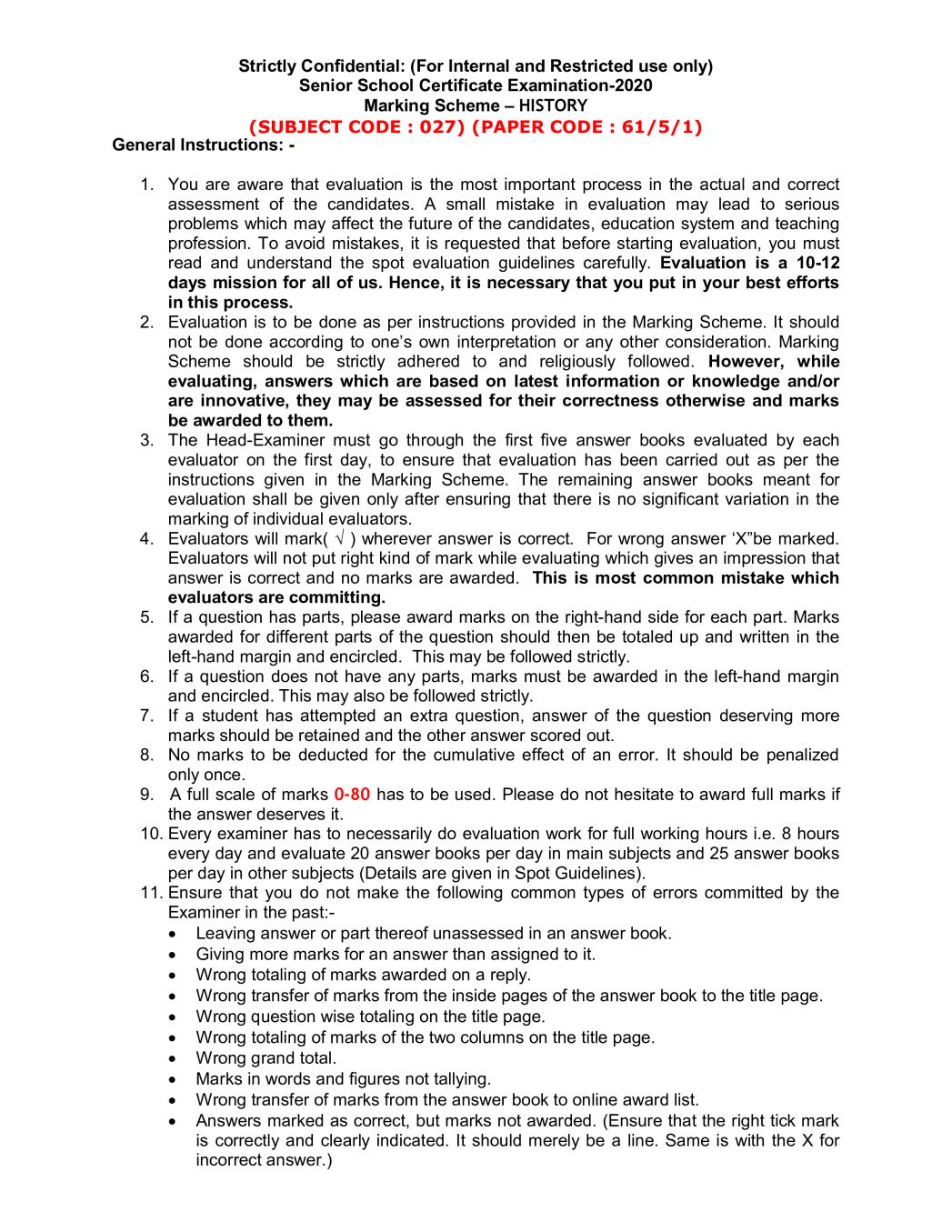
Senior School Certificate Examination-2020
Marking Scheme – HISTORY
(SUBJECT CODE : 027) (PAPER CODE : 61/5/1)
General Instructions: -
1. You are aware that evaluation is the most important process in the actual and correct
assessment of the candidates. A small mistake in evaluation may lead to serious
problems which may affect the future of the candidates, education system and teaching
profession. To avoid mistakes, it is requested that before starting evaluation, you must
read and understand the spot evaluation guidelines carefully. Evaluation is a 10-12
days mission for all of us. Hence, it is necessary that you put in your best efforts
in this process.
2. Evaluation is to be done as per instructions provided in the Marking Scheme. It should
not be done according to one’s own interpretation or any other consideration. Marking
Scheme should be strictly adhered to and religiously followed. However, while
evaluating, answers which are based on latest information or knowledge and/or
are innovative, they may be assessed for their correctness otherwise and marks
be awarded to them.
3. The Head-Examiner must go through the first five answer books evaluated by each
evaluator on the first day, to ensure that evaluation has been carried out as per the
instructions given in the Marking Scheme. The remaining answer books meant for
evaluation shall be given only after ensuring that there is no significant variation in the
marking of individual evaluators.
4. Evaluators will mark( √ ) wherever answer is correct. For wrong answer ‘X”be marked.
Evaluators will not put right kind of mark while evaluating which gives an impression that
answer is correct and no marks are awarded. This is most common mistake which
evaluators are committing.
5. If a question has parts, please award marks on the right-hand side for each part. Marks
awarded for different parts of the question should then be totaled up and written in the
left-hand margin and encircled. This may be followed strictly.
6. If a question does not have any parts, marks must be awarded in the left-hand margin
and encircled. This may also be followed strictly.
7. If a student has attempted an extra question, answer of the question deserving more
marks should be retained and the other answer scored out.
8. No marks to be deducted for the cumulative effect of an error. It should be penalized
only once.
9. A full scale of marks 0-80 has to be used. Please do not hesitate to award full marks if
the answer deserves it.
10. Every examiner has to necessarily do evaluation work for full working hours i.e. 8 hours
every day and evaluate 20 answer books per day in main subjects and 25 answer books
per day in other subjects (Details are given in Spot Guidelines).
11. Ensure that you do not make the following common types of errors committed by the
Examiner in the past:-
Leaving answer or part thereof unassessed in an answer book.
Giving more marks for an answer than assigned to it.
Wrong totaling of marks awarded on a reply.
Wrong transfer of marks from the inside pages of the answer book to the title page.
Wrong question wise totaling on the title page.
Wrong totaling of marks of the two columns on the title page.
Wrong grand total.
Marks in words and figures not tallying.
Wrong transfer of marks from the answer book to online award list.
Answers marked as correct, but marks not awarded. (Ensure that the right tick mark
is correctly and clearly indicated. It should merely be a line. Same is with the X for
incorrect answer.)
Page 2
awarded.
12. While evaluating the answer books if the answer is found to be totally incorrect, it should
be marked as cross (X) and awarded zero (0)Marks.
13. Any unassessed portion, non-carrying over of marks to the title page, or totaling error
detected by the candidate shall damage the prestige of all the personnel engaged in the
evaluation work as also of the Board. Hence, in order to uphold the prestige of all
concerned, it is again reiterated that the instructions be followed meticulously and
judiciously.
14. The Examiners should acquaint themselves with the guidelines given in the Guidelines
for spot Evaluation before starting the actual evaluation.
15. Every Examiner shall also ensure that all the answers are evaluated, marks carried over
to the title page, correctly totaled and written in figures and words.
16. The Board permits candidates to obtain photocopy of the Answer Book on request in an
RTI application and also separately as a part of the re-evaluation process on payment of
the processing charges.
Page 3
CLASS XII
AISSCE MARCH 2020
CODE NO. Set-61/5/1
Q.NO EXPECTED ANSWERS/ VALUE POINTS PAGE MARKS
Part -A NO.
1 S.N. Roy (Sourindranath Roy) Pg-20 1
2 Inscriptions :- The written records engraved on the stone Pg-37 1
tablets, pillars and walls on the other hand
Prashasti –Contains information about the rulers.
3 A-1 and 2 only Pg-1 1
4 Mother Goddess ( Harappa) Pg-23 1
For visually impaired :-Unicorn.
5 C-scholars are not able to read the script. Pg-15 1
6 Patliputra Pg-31 1
OR
Magadha
7 Dhamma Pg-32 1
8 Al-Bruni was from Khwarizm/Uzbekistan and had written Pg-116 1
the Kitab-ul-Hind in Arabic Language.
OR
Muhammad Bin Tughlaq was impressed by the
scholarship of Ibn Battuta. Pg-118
9 A-(i-b,ii-c,iii-d, iv-a) Pg- 1
121,122,1
37
10 A-Large population , Bazaars and efficient Pg-126` 1
communication.
11 A-Karl Marx Pg-132 1
12 Nalayira Divya Prabhandham Pg-144 1
13 Malik Muhammad Jayasi Pg-158 1
14 Adi Granth Sahib Pg-161 1
15 Raidas/ Ravidas Pg-165 1
16 Permanent Settlement Pg- 1
260/262
17 A David Recardo Pg-277 1
18 C-1,2 and 3 Pg-319 1
19 A- Both ( A ) and (R) are correct and (R) is the correct Pg-328 1
explanation of ( A)
20 A-Lord Wellesley Pg-336 1
21 Part -B
Limits of Epigraphy
Technical limitations –
i. Letters are faintly engraved and reconstruction are
uncertain.
ii. Inscription may be damaged or letters are missing.
iii. It is not always easy to be sure about the exact
meaning of the words used in inscription .
iv. Not all inscriptions have been deciphered.
v. Many inscriptions have not survived the ravages
of time.
vi. The content of the inscriptions projects the
perspective of the person who commissioned
1
Page 4
vii. Any other relevant point. Pg-48 3
Any three points to be justified.
OR
Land and Riverine routes
i. Routes were extended in various directions: -
Central Asia, North Africa, West Asia, Southeast
Asia and China.
ii. Rulers tried to control these routes.
iii. Peddlers and merchants travelled on these
routes.
iv. Wide range of goods was carried through these
routes. Pg-44
v. Any other relevant point. 3
Any three points to be justified.
22 Ceremonial features of Mahanavami Dibba
i. The Vijayanagara kings displayed their
prestige power and suzerneity on various
occasion.
ii. Worship of images and state horses.
iii. The sacrifice of buffaloes and other animals.
iv. Dances, wrestling matches were performed
there.
v. Processions of horses, elephants, chariots,
soldiers etc.
vi. Inspection of armies of nayakas in open field.
vii. Tributes by nayakas to kings were given.
viii. Any other relevant point Pg-181
Any three points to be described. 3
23 Gandhiji efforts for restoring communal harmony
i. He tried to stop communal violence through
his principles.
ii. He visited riot torn areas of various regions.
iii. He showed his concern towards the sufferings
of the minorities.
iv. He worked for the equality of all classes.
v. He tried to build a spirit of mutual trust and
confidence between the two communities.
Pg-365-
vi. Any other relevant point.
395 3
Any three points to be explained.
24 Reasons for the annexation of Awadh by British
i. Suitable soil for cotton and indigo cultivation.
ii. Awadh could be developed as Principle Market
of upper India.
iii. Takeover of Awadh was expected to complete
the process of territorial annexation.
Pretext of Awadh’s annexation
i. Region was being misgoverned and mal
administered.
ii. Wrongly assumed that Wajid Ali Shah was an
unpopular ruler.
iii. Subsidiary alliance.
Any one point of reason and two point of pretext to be Pg-296
explained. 1+2=3
25 Part- C
Conservation of Sanchi Stupa
i. The rulers of Bhopal(Shahjahan Begum and
her successor Sultan Jahan Begum)provided
2
Page 5
ii. She funded the museum.
iii. She funded the guesthouse where John
Marshall lived and wrote the volumes.
iv. She funded the publication of the volumes.
v. ASI also helped to restore and preserve it.
Fate of Amravati
i. Local Raja wanted to build a temple on the
ruins of stupa.
ii. Colin Meckanize prepared report on Amravati
but was never published.
iii. Walter Elliot , the commissioner of Guntur
took away Sculpture panels of Amravati to
Madras.
iv. Slabs of Amravati were sent to Asiatic Society
of Bengal.
v. Indefensible policy led to decline of original
work of Amravati.
vi. Any other relevant point. Pg-83,98 4+4=8
Four points each from both to be explained.
OR
Hindu and Buddhist Art and Sculpture
Hindu Sculpture and Art
i. Vaishnavism – Sculpture of ten Avatars. Eg. the
Varaha rescuing the earth goddess(Aihole), Vishnu
with Sheshnag.
ii. Shaivaism- Sculptures of Shiva in Linga
iii. Sculptures of Shiva in human form too.
iv. The image of Durga at Mahabalipuram.
v. Sculpture of Vasudeva –Krishna in Mathura.
vi. Ellora Sculptures.
vii. Kailash Nath temple.
viii. Any other relevant point
Buddhist Sculptures
i. Empty seat of Buddha indicated meditation.
ii. Wheel stand for first Serman of Buddha.
iii. Shailabhanjika , an auspicious symbol of
prosperity.
iv. Gajalakshmi –Goddess of good fortune.
v. Tree symbolizes an event in the life of the
Buddha.
vi. Images of Buddha and Bodhisattas.
vii. Serpants and animal motifs.
viii. Scenes from Jataka stories and Buddha’s
hagiography.
ix. Any other relevant point
Any four example of each to support the statement 4+4=8
Pg-99-106
26 Akbar-Nama
i. Written by Abu’l Fazl.
ii. This chronicle is based on range of sources,
records of events , official documents and oral
testimonies.
iii. It is divided into three books and third book is
Ain-i-Akbari – composed of Manzil Abadi,
Sipah Abadi and Mulk Abadi.
3
Page 6
reign covering geographic, social, political,
administrative and cultural.
v. Written in Indo –Persian style with rhythm and
diction.
vi. He articulated the ideas associated with Akbar.
vii. This chronicle was written in thirteen years.
viii. It shows the diverse population of the empire
like Hindus, Jainas, Buddhist and Muslims. Pg-218, 8
ix. It showed the composite culture.
230
x. Any other relevant point.
Any eight points to be described.
OR
Physical arrangement of Mughal Court
i. Its centerpiece was the throne based on
sovereign as axis mundi.
ii. The canopy was symbol of Kingship.
iii. Status was determined by spatial proximity to
king.
iv. No one was allowed to move without King’s
permission.
v. Court courtesies were followed.
vi. Salutation and prostration represented status.
vii. Protocols governed diplomatic envoys.
viii. Jharokha Darshan by the King was a ritual.
ix. Primary business was conducted in Diwan-i-
aam and private discussions took place at
Diwan-i-Khaas.
x. Court was full of life during occasions such as
Id,Shab-i-barat, holi , etc. Pg-239- 8
xi. On birthdays, the King was weighted against 241
commodities for charity.
xii. Any other relevant point
Any eight points to be described.
27 Role of Congress party in the making of Constituent
Assembly
i. The Constituent Assembly was dominated by
Congress.
ii. 82% of the members belonged to Congress.
iii. Members of the Congress differed in their
opinion on critical issues.
iv. Jawahar Lal Nehru , Vallabh Bhai Patel and
Rajendra Prasad were the members of
Congress who played important role in the
Constituent Assembly.
v. Nehru moved ‘Objective Resolution’ and ‘Tri
colour National Flag’.
vi. Patel played key role in drafting reports and
reconciling views.
vii. Dr. Prasad was the President of the Assembly.
viii. Dr. B.R. Ambedkar served as Chairman of the
Drafting Committee. KM Munshi and Alladi
Krishnaswamy Aiyar gave crucial inputs.
ix. The discussions within the Constituent
Assembly were also influenced by the opinions
expressed by the public.
x. Any other relevant point. Pg-409- 8
Any four points to be examined. 425
4
Page 7
Issue of Separate Electorate in the Constituent
Assembly
i. Demand of separate electorate was based on
defining rights of minorities.
ii. Assembly interpreted minority in terms of
economically weaker groups, tribal
community, religious community and groups
with backward caste.
iii. Leaders of the groups anticipated demands in
the form of separate electorates.
iv. There were huge debates on this question in
Assembly.
v. B.P. Bahadur wanted separate electorate for
minorities
vi. N.G.Ranga urged for rights for poor and
downtrodden.
vii. Jaipal Singh wanted rights for Tribals.
viii. Ambedkar demanded separate electorates for
depressed caste.
ix. J. Nagappa discussed about systematic
marginalization.
x. Many members like Sardar Patel, R.V.
Dhulekar , G.B. Pant considered separate
electorate as a cause of division and against the
unity of India.
xi. Sardar Patel considered separate electorate as
poison
xii. According to the members, it would lead to
divided loyalties and isolate the minorities
from majority.
xiii. Any other relevant point.
Pg-416- 8
To be assessed as a whole.
419
28 Part D: Source Based Question
The wealthy Shudra
28.1 Why did the Brahmana consider themselves
superior to other caste?
Ans. Brahmana considered himself superior to other caste
a)on the basis of their wisdom
b) On the basis of fair colour.
c) On the basis of Purity
d) Considered as sons of Brahma
e)Any other relevant point.
Any two points. (2)
28.2 How did a Shudra improve his status according to
Kachchana?
Ans. According to Kachchana, a Shudra could improve his
status
a) On the basis of wealth.
b) On the basis of economic status and dignity. (2)
28.3 What does this story reveal about Buddhist
attitude towards Varna?
Ans. Buddhist attitude about Varna
a) Rejection of Caste based ideas.
b) Rejected the ideas of superiority on the basis of birth.
5
Page 8
d) Any other relevant point. (2)
29 Source Based Questions
How Silver came to India
29.1 How could the Mughal empire accumulate
enormous wealth? Explain.
Ans. Accumulation of enormous wealth by Mughals.
a) Through the vibrant network of overland trade.
b) Due to the expansion in the commodity composition
and of trade. (2)
29.2 How did silver travel to across the globe to reach
India? Explain.
Ans. Silver travelled across the globe to reach India.
a) Availability of metal currency.
b) Expansion of minting technique.
c) Circulation of money in the economy.
d) Extraction of taxes and revenue in cash.
Any two points. (2)
29.3 How were the transactions made in the 17th
century India? Explain.
Ans. Ways of transaction in 17th century Pg-217 2+2+2=6
a) Through Cash Transactions.
b) Through Commodity transactions. (2)
30
Tomorrow we shall break the Salt Law
30.1 Examine the reactions of Indians towards the Salt
Law.
Ans. Reactions of Indians towards the Salt Tax Law.
a. There was wider discontentment against Salt Law.
b. The state monopoly over Salt was deeply unpopular.
(2)
30.2 Why was Gandhiji confident that the government
would not arrest the Satyagrahis? Explain.
Ans. Gandhiji was confident on the non-arrest of
Satyagrahis
a. He considered his protestors as the army of peace.
b. Fear of world opinion on British. (2)
30.3 Examine the base of Dandi March.
Ans. Base of Dandi March
a. To break the most widely disliked law of British.
b. To mobilize discontent against British Rule.
c. To launch nationalist campaign against British.
d. To unite all classes communities, castes towards 2+2+2=6
Pg-358
Swaraj. (2)
(Any two points)
31 On Map attached
For visually impaired candidates
31.1 Matured Harappan Sites
Kalibangan, Lothal , Nageshwar, Dholavira ,
Rakhigarhi,Banawali-(India) Pg-2 3
Harappa , Channudaro, Balakot, Mohanjadaro
Any three
Buddhist Sites
Sanchi , Barhut, Ajanta, Nasik, Karla, Nagarjunakonda,
Amravati, Bodh Gaya, Lumbini 3
Any three Pg-95
31.2
Centre of the Revolt 1857
6
Page 9
Azamgarh, Banaras, Calcutta Pg-305
Any three 3
See attached filled map
7
Page 10
Document Details
| Board / Org | CBSE |
| Exam | Class 12 |
| Type | Solution |
| Pages | 10 |
| Updated | 22 Jul 2026 |