CBSE Class 12 Question Paper 2022 Solution Legal Studies
Finished viewing? Save it for later —
Download CBSE Class 12 Question Paper 2022 Solution Legal Studies (PDF · 15 pages)About CBSE Class 12 Question Paper 2022 Solution Legal Studies
CBSE Class 12 Question Paper 2022 Solution Legal Studies is available here for free download. Published by CBSE for Class 12, this solution can be viewed online or downloaded as a PDF (15 pages). Candidates preparing for Class 12 can use CBSE Class 12 Question Paper 2022 Solution Legal Studies to understand the exam pattern, the type of questions asked, and the overall difficulty level.
Frequently Asked Questions
How can I download CBSE Class 12 Question Paper 2022 Solution Legal Studies?
Open this page and click the Download button to save CBSE Class 12 Question Paper 2022 Solution Legal Studies as a PDF. It is completely free on AglaSem Docs.
Is CBSE Class 12 Question Paper 2022 Solution Legal Studies free to download?
Yes. CBSE Class 12 Question Paper 2022 Solution Legal Studies can be viewed online and downloaded as a PDF free of cost on AglaSem Docs.
How many pages does CBSE Class 12 Question Paper 2022 Solution Legal Studies have?
CBSE Class 12 Question Paper 2022 Solution Legal Studies contains 15 pages, which you can read online or download together as a single PDF.
Where can I find more Class 12 study material?
You can find more Class 12 question papers, sample papers, syllabus, and answer keys on AglaSem Docs.
CBSE Class 12 Question Paper 2022 Solution Legal Studies – Text
Read the full text of this solution below — useful to quickly search, copy and reference the content online without downloading the PDF.
📄 View text version (15 pages)
Page 1
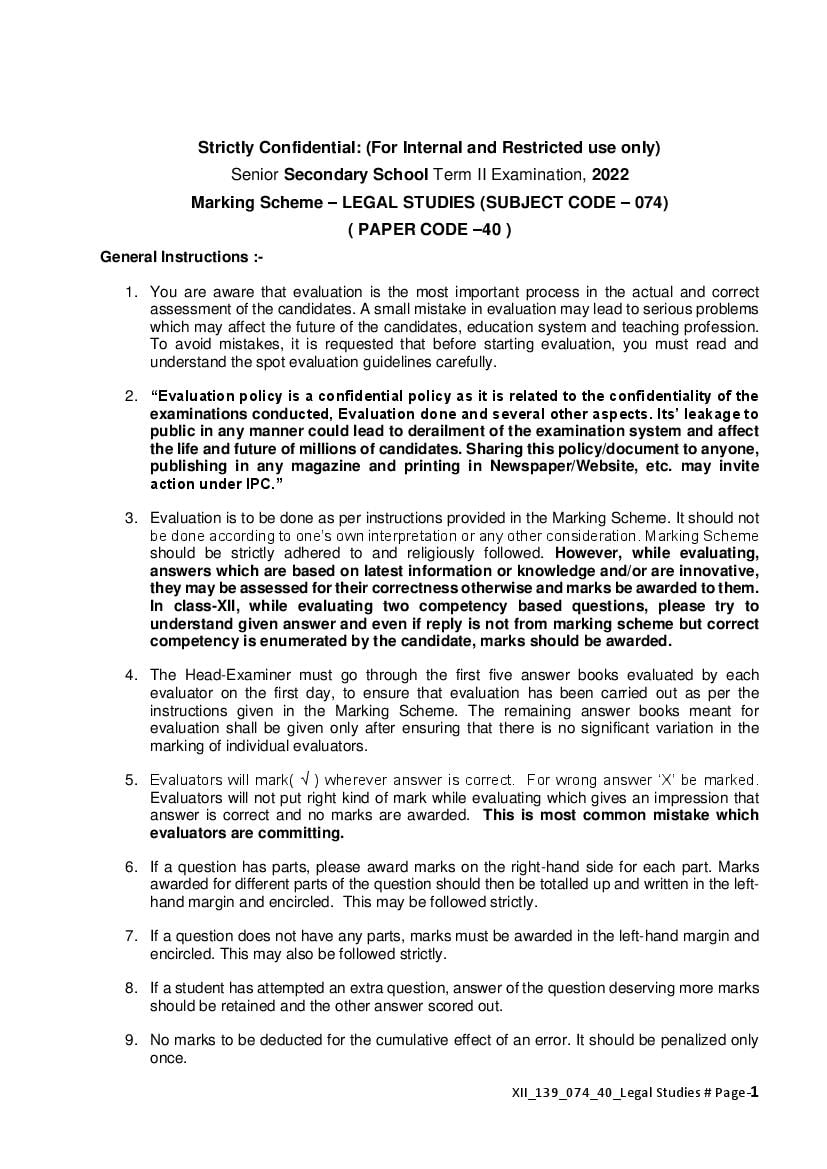
Senior Secondary School Term II Examination, 2022
Marking Scheme – LEGAL STUDIES (SUBJECT CODE – 074)
( PAPER CODE –40 )
General Instructions :-
1. You are aware that evaluation is the most important process in the actual and correct
assessment of the candidates. A small mistake in evaluation may lead to serious problems
which may affect the future of the candidates, education system and teaching profession.
To avoid mistakes, it is requested that before starting evaluation, you must read and
understand the spot evaluation guidelines carefully.
2. “Evaluation policy is a confidential policy as it is related to the confidentiality of the
examinations conducted, Evaluation done and several other aspects. Its’ leakage to
public in any manner could lead to derailment of the examination system and affect
the life and future of millions of candidates. Sharing this policy/document to anyone,
publishing in any magazine and printing in Newspaper/Website, etc. may invite
action under IPC.”
3. Evaluation is to be done as per instructions provided in the Marking Scheme. It should not
be done according to one’s own interpretation or any other consideration. Marking Scheme
should be strictly adhered to and religiously followed. However, while evaluating,
answers which are based on latest information or knowledge and/or are innovative,
they may be assessed for their correctness otherwise and marks be awarded to them.
In class-XII, while evaluating two competency based questions, please try to
understand given answer and even if reply is not from marking scheme but correct
competency is enumerated by the candidate, marks should be awarded.
4. The Head-Examiner must go through the first five answer books evaluated by each
evaluator on the first day, to ensure that evaluation has been carried out as per the
instructions given in the Marking Scheme. The remaining answer books meant for
evaluation shall be given only after ensuring that there is no significant variation in the
marking of individual evaluators.
5. Evaluators will mark( √ ) wherever answer is correct. For wrong answer ‘X’ be marked.
Evaluators will not put right kind of mark while evaluating which gives an impression that
answer is correct and no marks are awarded. This is most common mistake which
evaluators are committing.
6. If a question has parts, please award marks on the right-hand side for each part. Marks
awarded for different parts of the question should then be totalled up and written in the left-
hand margin and encircled. This may be followed strictly.
7. If a question does not have any parts, marks must be awarded in the left-hand margin and
encircled. This may also be followed strictly.
8. If a student has attempted an extra question, answer of the question deserving more marks
should be retained and the other answer scored out.
9. No marks to be deducted for the cumulative effect of an error. It should be penalized only
once.
XII_139_074_40_Legal Studies # Page-1
Page 2
be used. Please do not hesitate to award full marks if the answer deserves it.
11. Every examiner has to necessarily do evaluation work for full working hours i.e. 8 hours
everyday and evaluate 30 answer books per day in main subjects and 35 answer books per
day in other subjects (Details are given in Spot Guidelines). This is in view of the reduced
syllabus and number of questions in question paper.
12. Ensure that you do not make the following common types of errors committed by the
Examiner in the past :-
• Leaving answer or part thereof unassessed in an answer book.
• Giving more marks for an answer than assigned to it.
• Wrong totaling of marks awarded on a reply.
• Wrong transfer of marks from the inside pages of the answer book to the title page.
• Wrong question wise totaling on the title page.
• Wrong totaling of marks of the two columns on the title page.
• Wrong grand total.
• Marks in words and figures not tallying.
• Wrong transfer of marks from the answer book to online award list.
• Answers marked as correct, but marks not awarded. (Ensure that the right tick mark is
correctly and clearly indicated. It should merely be a line. Same is with the X for incorrect
answer.)
• Half or a part of answer marked correct and the rest as wrong, but no marks awarded.
13. While evaluating the answer books if the answer is found to be totally incorrect, it should be
marked as cross (X) and awarded zero (0) Marks.
14. Any unassessed portion, non-carrying over of marks to the title page, or totaling error
detected by the candidate shall damage the prestige of all the personnel engaged in the
evaluation work as also of the Board. Hence, in order to uphold the prestige of all
concerned, it is again reiterated that the instructions be followed meticulously and
judiciously.
15. The Examiners should acquaint themselves with the guidelines given in the Guidelines for
spot Evaluation before starting the actual evaluation.
16. Every Examiner shall also ensure that all the answers are evaluated, marks carried over to
the title page, correctly totaled and written in figures and words.
17. The Board permits candidates to obtain photocopy of the Answer Book on request in an
RTI application and also separately as a part of the re-evaluation process on payment of
the processing charges.
18. The Marking Scheme carries only suggested value points for an answer.
19. These are only the guidelines and do not constitute the complete answer.
XII_139_074_40_Legal Studies # Page-2
Page 3
should be awarded accordingly.
21. The Board permits candidates to obtain photocopy of the Answer Book on request on
payment of the prescribed processing fee. All evaluators/Additional Head Examiners/Head
Examiners are once again reminded that they must ensure that evaluation is carried out as
per value points for each answer as given in the marking scheme.
22. Please read the following guidelines carefully and seek clarifications from the Head
Examiner in case of any doubt to reduce subjectivity and bias.
23. Credit should be given to student writing the concept in his own language. Marks should
not be deducted for non-use of bookish language.
24. Every care has been taken to prepare the Marking Scheme. However, it is important to
keep in mind that, it is neither exhaustive nor exclusive.
25. The examiners are requested to use their own knowledge and experience wherever
necessary.
26. Marks should be awarded for any CREATIVE answer given by the student which is logically
correct and is related to the concepts taught.
27. Marking should be neither over-strict nor over-liberal. Marks should not be deducted for
spelling errors, wrong proper names, minor inaccuracies, or omission of detail.
28. No marks should be deducted for overshooting word limit.
29. Though break-up of value points is given in a few answers, the examiner may be flexible
in marking the different parts, if the answers reflect understanding of the scope of the
question.
XII_139_074_40_Legal Studies # Page-3
Page 4
Senior Secondary School Examination TERM–II, 2022
LEGAL STUDIES (Subject Code – 074)
[ Paper Code – 40 ]
Maximum Marks : 40
SECTION A
(Attempt any 5 questions out of 7)
Q. No. EXPECTED ANSWER / VALUE POINTS Marks
Q.1. Rachita is a student leader. She makes a hate speech targeting 2
members of a certain community in the college premises. The college
authorities stop her speech mid-way and Rachita accuses them of
violating her fundamental rights. Identify which fundamental right
applies in this situation. State whether the restriction is justified.
1. (a) Article 19 prescribes and protects freedom of speech and 1m (for
expression. (Mentioning only article number or the title of the identification)+
article to be awarded ) 1m (for
(b) State can reasonably limit this freedom in the event of threat to justification)
sovereignty and integrity of India, security of the State.
(pg 116-118)
2
Q.2 State any two outcomes of the enactment of Advocates Act, 1961. 2
2. (a) All old categories of legal practitioners abolished and 1m
consolidated into one—advocates. +
(b) Established All India Bar Council
(c) Established State Bar Council 1m
(d) Advocates were allowed to practise in all Courts throughout the (for any two
Country. mentioned
(Pg 148-149) points)
2
Q.3 Aman is a law graduate who is keen on working for an organization 2
with a social justice orientation. Explain the option available to Aman
as a law graduate in this context.
XII_139_074_40_Legal Studies # Page-4
Page 5
organisations have positions for law graduates.
1m (for
(b) They may be general in nature providing free legal aid, etc. to
identification)+
more specialist organizations involved in women and child
rights, etc. (Pg 154) 1m (for
explanation)
2
Q.4 In what circumstances do Legal services institutions avail the services 2
of Senior Advocates?
4. (a) Services of senior advocates may be availed if the Chairman of
the Legal Services Institution feels it is a matter of great public
importance. 1m
(b) It may also be done where serious threats to the life and liberty +
of the applicant exists.
(Pg 176) 1m
2
Q.5 Kenwe Shurochi, ex-President of Lukaya, is convicted of grave acts of 2
brutality against his own citizens during a civil war. Identify the
international institution that was set up to prosecute the accused in this
instance. List the major crimes that come under its jurisdiction.
5. (a) International Criminal Court or ICC 1m (for
(b) Crimes against humanity, genocide, war crimes, crimes of identification)+
aggression. (any two can be mentioned)
(Pg 201-202) 1m (for
mentioning
any two
crimes)
2
Q.6 In 1960, the legal aid scheme died a natural death due to paucity of 2
funds. In 1973, the movement was revived by the Union Government
with formation of a Committee to develop legal aid scheme for states.
(a) Who was the Chairman of this Committee?
(b) How did this Committee develop a strong foundation
for initiating legal aid scheme in India?
6. (a) Justice Krishna Iyer.
(b) It devised a strategy in a decentralized mode with legal aid 1m (for Part
committees in every district, State and Centre. a)+
XII_139_074_40_Legal Studies # Page-5
Page 6
Or
relevant point
A committee on judicature was set up under the chairmanship of for part b)
Justice P N Bhagwati to implement the legal aid scheme.
Or
This Committee suggested legal aid camps and nyayalayas in rural
areas and recommended the inclusion of free legal aid provision in the
Constitution
(Pg 174)
2
Q.7 In a regional summit in South Asia, there is widespread acceptance of
the need to strengthen the bonds between nations by promoting cultural
heritage and the equal dignity of all cultures. Identify the international
organization that works towards this objective. Why was the need for
creation of this organization felt? 2
7. (a) UNESCO Or United Nations Educational, Scientific and
Cultural Organisation
(b) Members felt that mere economic and political arrangements are
not enough to ensure growth and stability in Member-States. By
promoting culture, preserving the heritage, sharing knowledge and 1m (For
understanding that are beneficial for the whole of mankind, UNESCO identification)+
aims to aid sustainable development and foster greater cooperation
between nations.
(Pg 195) 1m (for reason)
2
SECTION B
(Attempt any 5 questions out of 7 questions)
Garvit is arrested on the apprehension that he will indulge in acts
Q.8
of rioting, leading to public disorder near a community centre
during the festival season.
(a) Identify and explain the legal provision under which Garvit
is arrested.
(b) Are the safeguards provided under Article 22 of the Indian
Constitution available to Garvit?
3
8. (a) Preventive detention laws 1m (for
identification)
XII_139_074_40_Legal Studies # Page-6
Page 7
any crime, but their release may be detrimental to society. 1m (For
(b) No, Safeguard under Article 22 are not available to persons explanation)
detained under preventive detention laws(Reason is not
mandatory. Only no can be awarded full marks) +
(Pg 121) 1m (for part b)
3
Prem is a bonded labourer working for a construction baron. He
Q.9
is paying off a debt his father had incurred and had not been able
to pay off before his death. His two sons, Bhim (aged 10) and
Arjun (aged 11) have to drop out of school and work in a glass
factory to make their ends meet. A journalist highlights Prem's
plight in a newspaper article as it was common for most of the
families in village Bhandha from where he was reporting. He
also wrote a letter to the Hon'ble Supreme Court requesting its
intervention in this situation.
(a) Identify and explain the fundamental rights of Prem
and his sons, that have been violated.
(b) How would the newspaper article and the letter
written to the Supreme Court help the villagers? 3
9.
(a) 1. Prohibition of traffic in human beings and forced labor -Article
23 prohibits human trafficking, beggar and forced labor.
2. Prohibition of employment of children in factories, etc. -
Article 24 prohibits employment of children below the age of
fourteen years in factories, mining, and other hazardous
employment.
3. Right to education -Article 21A states that the State shall
provide free and compulsory education to all children of the age 1m for each for
of six to fourteen years any 2
fundamental
(any two articles to be identified and explained) right (0.5 m for
identification
(b) Public Interest Litigation/Social action litigation/PIL/SAL of the right +
It is a process by which letters written to Supreme Court or High 0.5m for
Courts by public-spirited persons or organizations alleging explanation) =
fundamental rights violations are converted into petitions. The 2 (for part a)
author of the letter alleges violations of fundamental rights of the
weaker sections of Indian society who are unable to approach the
court +
(Pg 120-121; 124)
1m (For part b)
XII_139_074_40_Legal Studies # Page-7
Page 8
Pramod, an advocate in the Patna High Court specializes in
Q.10
commercial transactions. He is very hardworking and can go to any
extent to bring justice to his clients. In one case, he is defending Mr.
Raghav for breach of contract. Mr. Raghav offers him a contingency
fee as an incentive to win. He also urges Pramod to meet the judge in
person for managing a favourable decision. Pramod refuses to carry on
with the case. Mr. Raghav moves a complaint against Pramod.
(a) Is Pramod justified in refusing to carry on as a
defense lawyer for Mr. Raghav ? If yes why, if no
why not?
(b) Who has the authority to take an action against
Pramod?
(c) State the consequences faced by an advocate for
breach of professional duties 3
10. (a) Yes, An Advocate has a duty to refuse to represent clients 0.5m (for yes)
who insist on adopting unfair means.
+
(b) State Bar Council Or Bar Council (Bar council of India/BCI is not 0.5m(for
to be considered correct) justification of
(c) Breach of rules leads to disciplinary action leading to suspension yes)
Or debarment
(Pg 150-151) +
1m(for part b)
+
1m(for part c)
3
Q.11 Teresa Williams is a lawyer based in Malaysia and she is keen on 3
expanding her clientele in the country. Assess the regulations that will
apply when she advertises her services.
11. (a) Legal profession (Publicity Rules), 2001—simple, 1m(For
comprehensive code that regulates all legal and non-legal identification
directories, etc. of professional
(b) Controls publication of journals, magazines and interviews in the code)
media.
Bars publicity through clients and even regulates greeting cards. +
(Pg 152)
XII_139_074_40_Legal Studies # Page-8
Page 9
explanation of
the code)
3
Why was The Legal Services Authorities Act of 1987 amended in year
Q.12
2002? Describe the changes that were introduced in the Principal Act. 3
12. (a) To encouraging pre-litigation legal services specially in public 1m(For part a)
utility service, the Parliament has made certain amendments in Legal +
Services Authorities Act by passing an Act known as the Legal
Services Authorities (Amendments) Act, 2002. 2m (For part b)
(b) The purpose of this amendment is to bring out certain changes in
the Legal Services Act, 1987 (hereinafter referred to as the principal
Act) especially for the establishment of permanent Lok Adalats to
settle disputes concerning public utility services at pre-litigation
state.
Or
It established permanent lok adalats for public utility services.
(Pg 184)
3
When can a case be referred to Lok Adalat ? State the powers of Lok
Q.13
Adalats while trying a suit. 3
13. a) A case may be referred to Lok Adalat when the parties thereof
agree or one of the parties thereof makes an application to the court
for referring the case to the Lok Adalat for settlement.
b)Powers of Lok Adalat:
a) The summoning and enforcing the attendance of any witness and
examining him on oath.
b) The discovery and production of any document.
c) The reception of evidence on affidavits
d) The requisitioning of any public record or document or copy of
such record or document from any court or office;
e) Such other matters as may be prescribed 1m (for part a)
f) are equivalent to that of a Civil court
+
(Any 4 points)
0.5mX 4(For
(Pg 183) part b)=2m
3
XII_139_074_40_Legal Studies # Page-9
Page 10
concept of Legal Aid. 3
14. (a) The 1976 Amendment inserted 39 A in the Constitution which
reiterate equality that promotes justice for all.
(b) Provisions of Article 21 clarifies that right to life and personal
liberty can be violated only by reasonable procedure.
(c) Creation of equal opportunity for accessing courts is a dimension
of equality clause in Article 14.
(d) Article 15 of the Constitution of India, the State shall not
discriminate against any citizen on grounds of religion, race, caste,
sex, place of birth or any of them. Based on this cardinal principle,
no citizen shall on the grounds only of religion, race, caste, sex,
place of birth or any of them, be subject to any disability.
(Any 3 points)
OR
(a) The 1976 amendment of the Constitution inserted Article 39-A
in the Constitution which is as follows: Equal justice and free legal
aid- The State shall secure that the operation of the legal system
promotes justice, on a basis of equal opportunity, and shall, in
particular, provide free legal aid, by suitable legislation or schemes
or in any way, to ensure that opportunities for securing justice are
not denied to any citizen by reason of economic or other
disabilities.
(b)Maneka Gandhi v. Union of India (AIR 1978 SC 597) provided
clarity on what procedure means under Article 21. The right to life
or liberty could be violated only by a fair, just and reasonable
procedure. In the adversarial system, the fairness requires legal
representation.
(c)Creation of equal opportunity for accessing the courts is a
dimension of the equality clause in Article 14. Denial of
1m
opportunities in public employment or education to different
classes is not the only occasion when considerations about
retaining equality go missing; the inadequacy of the legal system +
to provide an effective forum to the indigent in another.
(d) In the MH Hoskot case, the court observed: Judicial justice,
with procedural intricacies, legal submissions and critical 1m
examination of evidence, leans upon professional expertise; a
failure of equal justice under the law is on the cards where such
+
supportive skills is absent for one side.
(Any 3)
(Pg174-175) 1m
XII_139_074_40_Legal Studies # Page-10
Page 11
SECTION C
(Attempt any 3 questions out of 5 questions)
Ashok files a complaint with the National Commission for Minorities
Q.15
(NCM) alleging discrimination against people speaking a certain
language in the recruitment for state government jobs. The NCM
however declines his complaint.
(a) State the ground/grounds on which the NCM may refuse to
entertain Ashok's case.
(b) Who are regarded as 'Minorities' for being safeguarded by
National Commission for Minorities?
(c) State any three functions performed by National
Commission for Minorities.
5
15. (a) NCM can refuse to entertain a case if matter does not relate to
religious minorities.
(b) The minorities here are referred to religious minorities of
Muslims, Christians, Sikhs, Buddhists, Jains, and zoroastrians
(Parsis).
(Atleast 2 minorities should be mentioned if ‘religious minorities’ is
not mentioned)
(c) The functions of the Commission include the following
1. evaluating the progress of the development of Minorities;
2. monitoring the working of the safeguards provided in the
Constitution and in other laws enacted by Parliament and the
State Legislatures;
3. making recommendations for the effective implementation of
safeguards for the protection of the interests of Minorities by the
Central Government or the State Governments;
4. looking into specific complaints regarding deprivation of rights and
safeguards of the Minorities and taking up such matters with the
appropriate authorities;
5. initiating studies on problems arising out of any discrimination
against Minorities and recommending measures for their
removal;
6. conducting studies, research, and analysis on the issues relating to
socio-economic and educational development of Minorities; 1m(for part a)
7. suggesting appropriate measures in respect of any Minority to be +
undertaken by the Central Government or the State Governments;
8. and making periodical or special reports to the Central Government 1m(for Part b)
on any matter pertaining to Minorities and in particular the +
difficulties confronted by them
3m(For part c)
(Any 3)
XII_139_074_40_Legal Studies # Page-11
Page 12
5
Q.16 Susanna is U.K. based lawyer, who is considering law practice in
India. Outline the eligibility for enrolment as an advocate in India
and the rules that govern enrolment of foreign nationals.
5
16. (a) To be eligible for enrolment in India—
1. An Advocate must be an Indian Citizen,
2. At least 21 years of age
3. Have an LLB degree
4. Advocates must clear the All India Bar Examination to start
practice.
(Any 3)
(b)Foreign nationals may be enrolled on a reciprocal
basis with the country of her citizenship and foreign
degrees may be recognized for the purpose. In the
absence of this reciprocity—foreign nationals cannot 3m(for part a)
practice law in India.
(Pg 149) +
2m(For part b)
5
Q.17 Republic of Ralonia and India sign an agreement to stop the
harvesting of the eggs of a rare bird. There is already a domestic
law in force in India banning the sale and purchase of these eggs.
How does the interplay of domestic and international law work
out in similar instances in India?
Explain with the help of Constitutional Provisions and decided
case laws. 5
17. (a) In the case of Magan Bhai Patel vs. Union of India—the court held
that if a treaty restricts rights of citizens or modifies the laws of the
State—there would have to be a legislative measure.If no right is
restricted, then it does not need to have a legislative measure to
enact it.
(b)
1. Article 51 of the Indian Constitution specifically states that the State
shall endeavor to 'foster respect for international law and treaty 1m(for part a)
obligations in the dealings of organized peoples with one another'.
+
2. Under Article 253 of the Constitution of India, the Parliament and
4m(for part b)
the Union of India have the power to implement treaties and can even
XII_139_074_40_Legal Studies # Page-12
Page 13
to provisions of an international treaty.
3. In the land mark case of Kesavananda Bharti v. State of Kerala, it
was observed that the court must interpret the provisions of the
constitution in light of Charter of the United Nations.
4. However, in the case of Sheela Barse v Secretary Children's Aid
Society, the Supreme Court held that India had ratified conventions
regarding the protection of children and this placed an obligation on
the State Government to implement these principles. This was a case
in which there were no contradictory laws and as they were
supplementing the law already in force the court held that the treaty
could be applied directly to Indian law.
5. The most revolutionary of these cases was the case of Vishaka v
State of Rajasthan, in which the Indian courts used the provisions of
the Convention on Elimination of all forms of Discrimination against
Women, (CEDAW), to create legally binding obligations regarding
sexual harassment.
(any 4 points)
(Pg199-200)
5
Why is Private International Law referred to as "Conflict of
Q.18
Laws"? Explain the provisions of the following conventions that
make them important in the sphere of Private International Law.
(i) Vienna Convention on Sale of Goods
(ii) United Nations Commission for International Trade Law
(UNCITRAL) Model Law. 5
18. a. Private international law is called law of conflict because it deals
with Jurisdiction issues or which law to apply or deals with
uniformity issues.
2m(For part a)
b. (i) UN Convention on Contracts for Sale of International Goods +
(CSIG) also known as Vienna Convention is an example of private
1.5m(For part
international law that has gained more traction in recent times. It
b (i))
is a multilateral treaty—provides options for avoiding choice of
law issues. Provides a framework of accepted substantive rules +
w.r.t. contract disputes. One of the most influential documents in 1.5m
private international law. Deemed to be incorporated into any
otherwise applicable domestic laws—unless expressly excluded. (for part b (ii))
XII_139_074_40_Legal Studies # Page-13
Page 14
laws and guides, related to international trade and commercial
laws, including the UNCITRAL Arbitration Rules.
(Pg 190-191)
5
XII_139_074_40_Legal Studies # Page-14
Page 15
XII_139_074_40_Legal Studies # Page-15
Document Details
| Board / Org | CBSE |
| Exam | Class 12 |
| Type | Solution |
| Pages | 15 |
| Updated | 30 Apr 2026 |