MAHA SET 2018 Question Paper 2 Home Science
Finished viewing? Save it for later —
Download MAHA SET 2018 Question Paper 2 Home Science (PDF · 20 pages)About MAHA SET 2018 Question Paper 2 Home Science
MAHA SET 2018 Question Paper 2 Home Science is available here for free download. Published by Maharashtra Exams for Maharashtra State Eligibility Test, this question paper can be viewed online or downloaded as a PDF (20 pages). Candidates preparing for Maharashtra State Eligibility Test can use MAHA SET 2018 Question Paper 2 Home Science to understand the exam pattern, the type of questions asked, and the overall difficulty level.
Frequently Asked Questions
How can I download MAHA SET 2018 Question Paper 2 Home Science?
Open this page and click the Download button to save MAHA SET 2018 Question Paper 2 Home Science as a PDF. It is completely free on AglaSem Docs.
Is MAHA SET 2018 Question Paper 2 Home Science free to download?
Yes. MAHA SET 2018 Question Paper 2 Home Science can be viewed online and downloaded as a PDF free of cost on AglaSem Docs.
How many pages does MAHA SET 2018 Question Paper 2 Home Science have?
MAHA SET 2018 Question Paper 2 Home Science contains 20 pages, which you can read online or download together as a single PDF.
Where can I find more Maharashtra State Eligibility Test study material?
You can find more Maharashtra State Eligibility Test question papers, sample papers, syllabus, and answer keys on AglaSem Docs.
MAHA SET 2018 Question Paper 2 Home Science – Text
Read the full text of this question paper below — useful to quickly search, copy and reference the content online without downloading the PDF.
📄 View text version (20 pages)
Page 1
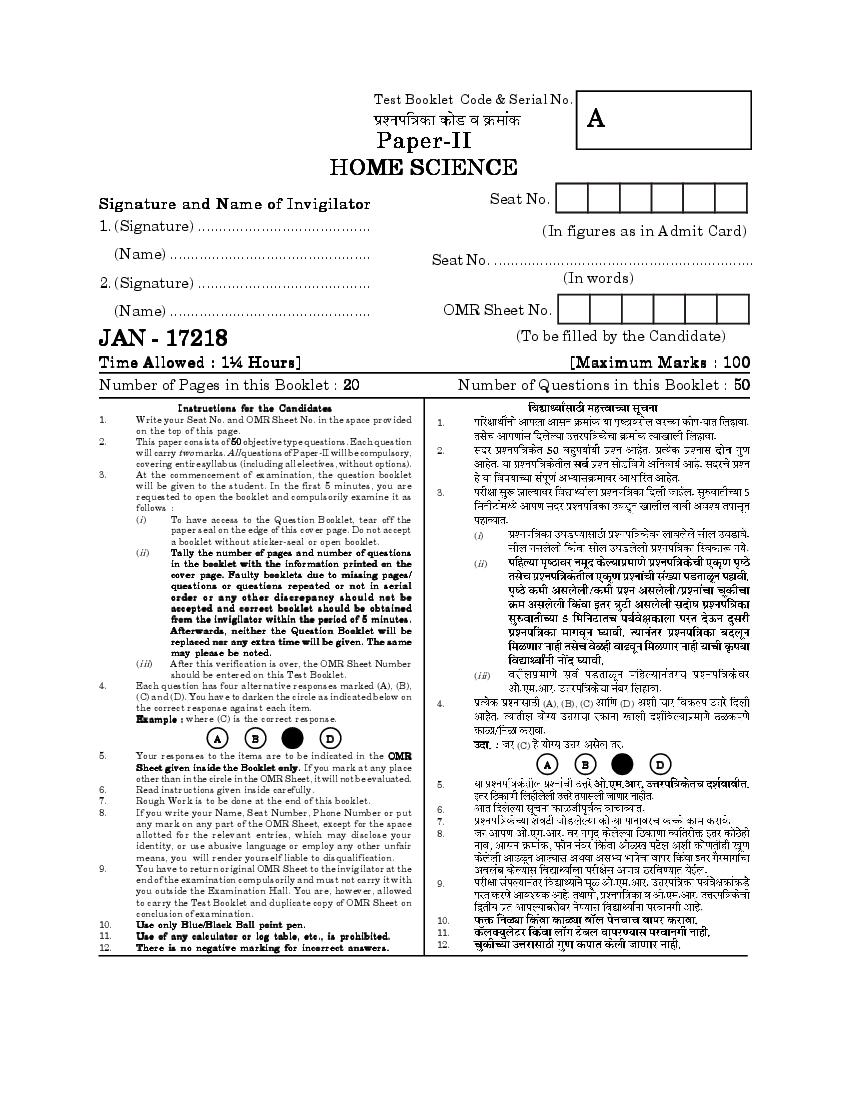
A
HOME SCIENCE
Signature and Name of Invigilator Seat No.
1. (Signature) ......................................... (In figures as in Admit Card)
(Name) ................................................ Seat No. ..............................................................
2. (Signature) ......................................... (In words)
(Name) ................................................ OMR Sheet No.
JAN - 17218 (To be filled by the Candidate)
Time Allowed : 1¼ Hours] [Maximum Marks : 100
Number of Pages in this Booklet : 20 Number of Questions in this Booklet : 50
Instructions for the Candidates
1. Write your Seat No. and OMR Sheet No. in the space provided 1.
on the top of this page.
2. This paper consists of 50 objective type questions. Each question
will carry two marks. All questions of Paper-II will be compulsory, 2.
covering entire syllabus (including all electives, without options).
3. At the commencement of examination, the question booklet
will be given to the student. In the first 5 minutes, you are
requested to open the booklet and compulsorily examine it as 3.
follows :
(i) To have access to the Question Booklet, tear off the
paper seal on the edge of this cover page. Do not accept
(i)
a booklet without sticker-seal or open booklet.
(ii) Tally the number of pages and number of questions
in the booklet with the information printed on the (ii)
cover page. Faulty booklets due to missing pages/
questions or questions repeated or not in serial
o rder or any other discre pancy should not be
accepted and correct booklet should be obtained
from the invigilator within the period of 5 minutes.
Afterwards, neither the Question Booklet will be
replaced nor any extra time will be given. The same
may please be noted.
(iii) After this verification is over, the OMR Sheet Number
should be entered on this Test Booklet. (iii)
4. Each question has four alternative responses marked (A), (B),
(C) and (D). You have to darken the circle as indicated below on
the correct response against each item. 4. (A), (B), (C) (D)
Example : where (C) is the correct response.
A B D
(C)
5. Your responses to the items are to be indicated in the OMR
Sheet given inside the Booklet only. If you mark at any place A B D
other than in the circle in the OMR Sheet, it will not be evaluated.
5.
6. Read instructions given inside carefully.
7. Rough Work is to be done at the end of this booklet.
8. If you write your Name, Seat Number, Phone Number or put 6.
any mark on any part of the OMR Sheet, except for the space 7.
allotted for the relevant entries, which may disclose your 8.
identity, or use abusive language or employ any other unfair
means, you will render yourself liable to disqualification.
9. You have to return original OMR Sheet to the invigilator at the
end of the examination compulsorily and must not carry it with 9.
you outside the Examination Hall. You are, however, allowed
to carry the Test Booklet and duplicate copy of OMR Sheet on
conclusion of examination.
10. Use only Blue/Black Ball point pen. 10.
11. Use of any calculator or log table, etc., is prohibited. 11.
12. There is no negative marking for incorrect answers. 12.
Page 2
Page 3
Paper II
II
Time Allowed : 75 Minutes] [Maximum Marks : 100
Note : This paper contains Fifty (50) multiple choice questions. Each question
carries Two (2) marks. Attempt All questions.
(50) (2)
1. Phrynoderma is caused by the 1.
deficiency of :
(A)
(A) Essential fatty acids
(B)
(B) Thiamin
(C)
(C) Vitamin C
(D)
(D) Vitamin D
2. MPN stands for : 2.
(A) Most Probable Number (A)
(B) Minimum Probable Number (B)
(C) Maximum Probable Number (C)
(D) Multiple Probable Number (D)
3. Which of the following process 3.
involves dextrinisation ?
(A) Boiling milk and flour to make (A)
custard
(B) Steaming Idli (B)
(C) Toasting bread (C)
(D) Fermentation (D)
3 [P.T.O.
Page 4
radiation is also known as :
(A) Cold sterilisation (A)
(B) Dry sterilisation (B)
(C) Heat sterilisation
(C)
(D) Pasteurisation
(D)
5. Which acid is formed during Rigor
5.
Mortis ?
(A)
(A) Citric acid
(B) Lactic acid (B)
(C) Oxalic acid (C)
(D) Gluconic acid (D)
6. Carnitine shuttle operates in the : 6.
(A) Glycolysis (A)
(B) TCA cycle (B)
(C) Urea cycle (C)
(D) -oxidation of fats (D)
7. What is the dose of iron in the
7.
weekly iron folate supplementation
(WIFS) program ?
(A)
(A) 60 mg
(B)
(B) 80 mg
(C) 100 mg (C)
(D) 120 mg (D)
4
Page 5
(A) Adapted starvation (A)
(B) Non-adapted starvation (B)
(C) Mixed malnutrition (C)
(D) Severe undernutrition (D)
9. The fasting blood glucose level is : 9.
(A) 50 to 80 mg/dl
(B) 70 to 110 mg/dl (A)
(C) 80 to 120 mg/dl (B)
(D) 130 to 140 mg/dl (C)
10. Characteristics of Personnel (D)
Management are : 10.
(A) Maximum work capacity and
job satisfaction (A)
(B) Development of workers’ (B)
quality, training
(C) Co-operation and union (C)
(D) Freedom and time (D)
5 [P.T.O.
Page 6
selection of an Anganwadi worker ?
(A) Her personality and
(A)
commitment towards children
(B) To ensure that she knows some (B)
English and is educated
(C) Her understanding of the
(C)
community culture
(D)
(D) Her training for early childhood
care education
12. Which aspect is not important in 12.
management of an institution
serving children with special needs ?
(A) Following prescribed legal
norms
(A)
(B) Seeking parent/family
involvement
(B)
(C) A program that promotes child’s
self-esteem (C)
(D) A compulsory program of
(D)
vocational training
6
Page 7
garments to give comfort to the
wearer is known as :
(A) Gathers (A)
(B) Tucks (B)
(C) Pleats (C)
(D) Ease (D)
14. Vertical lines in a garment should 14.
be preferred by :
(A) Short and obese person (A)
(B) Thin person (B)
(C) Tall person (C)
(D) Tall and obese person (D)
15. An effective ecofriendly bleach for 15.
textile fibers is :
(A) Sodium perborate (A)
(B) Sodium hypochlorite (B)
(C) Hydrogen peroxide (C)
(D) Chlorine bleach (D)
16. Kneading and squeezing method is 16.
used for washing Rayon fabrics
because they :
(A)
(A) have smooth surface
(B)
(B) have low wet strength
(C) are expensive (C)
(D) have poor absorption (D)
7 [P.T.O.
Page 8
primary property of textile fibres ?
(A) High length to width ratio (A)
(B) Strength (B)
(C) Lustre (C)
(D) Cohesiveness (D)
18. Knitted fabrics are described in 18.
terms of :
(A) Courses and Wales (A)
(B) Warp and Weft (B)
(C) Lap and Sliver (C)
(D) Roving and Lap (D)
19. A weave characterized by diagonal 19.
lines on its surface is :
(A) Honeycomb (A)
(B) Plain (B)
(C) Twill (C)
(D) Satin (D)
8
Page 9
single yarns is called :
(A) Cord Yarn
(A)
(B) Filament Yarn
(B)
(C) Ply Yarn (C)
(D) Novelty Yarn (D)
21. Plain weave fabric constructed with 21.
coloured woven check pattern is :
(A) Gingham (A)
(B) Corduroy (B)
(C) Denim (C)
(D) Chintz (D)
22. The characteristics of main social 22.
function of the family as :
(A)
(A) Socialization, Political,
Psychological, Guidance (B)
(B) Reproduction, Maintenance,
Placement, Socialization
(C)
(C) Economic, Maintenance,
Reproduction, Guidance
(D) Evaluating, Reproduction, (D)
Political, Placement
9 [P.T.O.
Page 10
resources are :
(A)
(A) Family life cycle, managerial
efficiency, attitude
(B) Socio-economic status, desire,
(B)
interest and wants
(C) Property, community resources,
money, environment (C)
(D) Friends, banks, shops and
(D)
hospitals
24. The correct sequence of steps in 24.
decision-making are :
(A)
(A) Problem identification, goals,
mental ability, analysis
frequency
(B)
(B) Intelligence, group decision,
selection, time
(C)
(C) Time management, action,
individual, process
(D) Problem identification, searching
(D)
alternatives, taking decision,
implementation of decision and
feedback
10
Page 11
simplification is to :
(i)
(i) Reduce time on a given
operation (ii)
(ii) Reduce boredom (iii)
(iii) Reduce effectiveness (iv)
(iv) Reduce number of motions (A) (i), (ii), (iii)
(A) (i), (ii), (iii)
(B) (ii), (iii), (iv)
(B) (ii), (iii), (iv)
(C) (i), (ii), (iv)
(C) (i), (ii), (iv)
(D) (iii), (iv), (i)
(D) (iii), (iv), (i)
26. The factors affecting housing plan 26.
are :
(A)
(A) Roominess, Grouping, Garage
(B)
(B) Garden Facilities, Income and
Values of Family
(C) Rocky soil, ownership, health spa (C)
(D) Flexibility, sanitation, privacy (D)
27. The different types of decorative
27.
designs are :
(A) Modern design and structural (A)
design
(B)
(B) Geometric design and structural
design
(C) Naturalistic design and stylized (C)
design
(D) Structural design and stylized
design (D)
11 [P.T.O.
Page 12
while selecting the household
equipments are :
(A)
(A) Guarantee, Design, Expenditure
(B)
(B) Utility, Quality, Disposal
(C) Services, Operations, Disposal (C)
(D) Quality, Standards, Weight (D)
29. “Home Management is planning, 29.
controlling and evaluating the use
of resources in a family to attain its
goals” has been defined by :
(A) R. P. Devdas (A)
(B) Gross and Crandall (B)
(C) Prof. R. C. Davis (C)
(D) Nickell and Dorsey (D)
30. Which statement about Human 30.
Development is false ?
(A) Development includes sequential
(A)
pattern of growth
(B) Human development starts at (B)
birth
(C)
(C) The different domains of
development are interdependent
(D) Development is continuous (D)
12
Page 13
about urine and feces and
experiments on such aspects. He/she
as per Freud’s theory is in ................
stage.
(A)
(A) Oral
(B) Anal (B)
(C) Phallic (C)
(D) Genital (D)
32. Sunil, a 7-year old shows actions that 32.
benefit other people such as sharing
and care when his friend is injured.
This is an example of :
(A)
(A) Anti-social behavior
(B)
(B) Altruism
(C) Pro-social behavior (C)
(D) Cooperative participatory action (D)
33. Which is the most important 33.
component of a good preschool
curriculum ?
(A)
(A) Warmth, safety and security for
children
(B) An international curriculum (B)
(C) Expensive play equipments (C)
(D) Ensuring parent involvement (D)
13 [P.T.O.
Page 14
and limits are important and helpful
to a child :
(A)
(A) To provide security and clarity
about boundaries
(B)
(B) To reflect care and parental
authority
(C) To bring about unquestioned (C)
compliance (D)
(D) To make him/her good boy/girl
35. The cross-sectional method used to
35.
study play patterns of children :
(A) is always more appropriate
than the longitudinal method (A)
for understanding play
(B)
(B) is good to understand how
children play at different ages
with one another
(C)
(C) studies the same group of
children at different times
(D)
(D) gives a favorable a picture of
the effects of play on children
14
Page 15
36.
masculine or feminine is known
as : (A)
(A) Gender consistency (B)
(B) Gender roles
(C)
(C) Gender identity
(D)
(D) Gender intensification
37. Learning in a non-formal education 37.
programme takes place through :
(A) Democratic discussion and
(A)
dialogue
(B)
(B) Telephone
(C)
(C) Classroom
(D) Internet (D)
38. An out-of-school system of education 38.
for rural women :
(A) Management (A)
(B) Participation (B)
(C) Extension education (C)
(D) Communication (D)
15 [P.T.O.
Page 16
knowledge to wives, in urban and
rural areas on food, child care and
home decoration.
(A)
(A) Industry
(B)
(B) Organization
(C)
(C) Home science extension
(D)
(D) Management
40. .................. education has no 40.
examination.
(A)
(A) Extension education
(B)
(B) Non-formal education
(C)
(C) Formal education
(D) College education (D)
41. ................... is a method of indirect 41.
control and provide development of
personnel.
(A)
(A) Supervision
(B)
(B) Extension
(C) Planning (C)
(D) Evaluation (D)
16
Page 17
information and understanding are
referred as :
(A)
(A) Relation
(B)
(B) Co-ordination
(C) Learning (C)
(D) Communication (D)
43. .................. is a traditional method of
43.
communication.
(A) Internet (A)
(B) Cell phone (B)
(C) Telephone (C)
(D)
(D) Bhajan
44. Which one is ingredient of 44.
communication ?
(A)
(A) Message and channel
(B)
(B) Audio aids
(C)
(C) Organiser
(D) Visual aids (D)
17 [P.T.O.
Page 18
does not include :
(A)
(A) Rapport building
(B)
(B) Need assessment
(C)
(C) Interview of all members
(D) Securing people’s participation (D)
46. Teaching in higher education 46.
implies :
(A)
(A) Presenting the information
given in the text-book (B)
(B) Asking questions in the class
(C)
and conducting examination
(C) Helping students prepare for
and pass the examination
(D)
(D) Helping students learn how to
learn
47. Which among the following is a 47.
quantitative method ?
(A)
(A) Focus group discussion
(B)
(B) Structured observation
(C)
(C) 24 hour diet recall
(D) Case study (D)
18
Page 19
school, the list of children is taken
from the attendance register. This
is referred to as :
(A)
(A) Sampling
(B)
(B) Random sampling
(C)
(C) Lottery method
(D) Sampling frame (D)
49. A statistical hypothesis test that 49.
derives inference based on small
samples :
(A)
(A) Chi-square
(B)
(B) ANOVA
(C)
(C) T-test
(D) Mean (D)
50. The qualitative information is one 50.
which concerns the :
(A) Value of some variable
(A)
(B) Rate of change
(B)
(C) Condition or status of a system
(C)
(D) Presence or absence of some
specific object (D)
19 [P.T.O.
Page 20
20
Document Details
| Board / Org | Maharashtra Exams |
| Exam | Maharashtra State Eligibility Test |
| Type | Question Paper |
| Pages | 20 |
| Updated | 30 Apr 2026 |