MBSE Class 9 Syllabus 2022 Bengali
Finished viewing? Save it for later —
Download MBSE Class 9 Syllabus 2022 Bengali (PDF · 6 pages)About MBSE Class 9 Syllabus 2022 Bengali
MBSE Class 9 Syllabus 2022 Bengali is available here for free download. Published by Mizoram Board for Class 9, this syllabus can be viewed online or downloaded as a PDF (6 pages). Candidates preparing for Class 9 can use MBSE Class 9 Syllabus 2022 Bengali to understand the exam pattern, the type of questions asked, and the overall difficulty level.
Frequently Asked Questions
How can I download MBSE Class 9 Syllabus 2022 Bengali?
Open this page and click the Download button to save MBSE Class 9 Syllabus 2022 Bengali as a PDF. It is completely free on AglaSem Docs.
Is MBSE Class 9 Syllabus 2022 Bengali free to download?
Yes. MBSE Class 9 Syllabus 2022 Bengali can be viewed online and downloaded as a PDF free of cost on AglaSem Docs.
How many pages does MBSE Class 9 Syllabus 2022 Bengali have?
MBSE Class 9 Syllabus 2022 Bengali contains 6 pages, which you can read online or download together as a single PDF.
Where can I find more Class 9 study material?
You can find more Class 9 question papers, sample papers, syllabus, and answer keys on AglaSem Docs.
MBSE Class 9 Syllabus 2022 Bengali – Text
Read the full text of this syllabus below — useful to quickly search, copy and reference the content online without downloading the PDF.
📄 View text version (6 pages)
Page 1
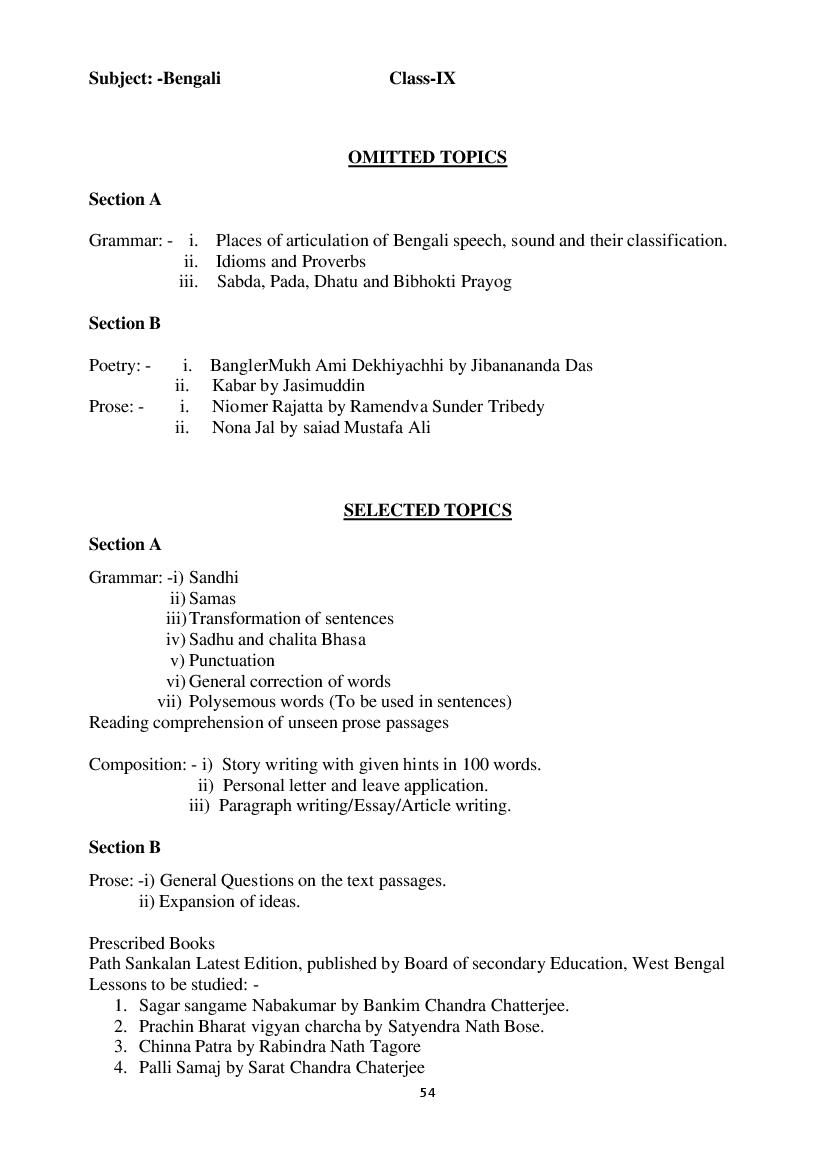
OMITTED TOPICS
Section A
Grammar: - i. Places of articulation of Bengali speech, sound and their classification.
ii. Idioms and Proverbs
iii. Sabda, Pada, Dhatu and Bibhokti Prayog
Section B
Poetry: - i. BanglerMukh Ami Dekhiyachhi by Jibanananda Das
ii. Kabar by Jasimuddin
Prose: - i. Niomer Rajatta by Ramendva Sunder Tribedy
ii. Nona Jal by saiad Mustafa Ali
SELECTED TOPICS
Section A
Grammar: -i) Sandhi
ii) Samas
iii) Transformation of sentences
iv) Sadhu and chalita Bhasa
v) Punctuation
vi) General correction of words
vii) Polysemous words (To be used in sentences)
Reading comprehension of unseen prose passages
Composition: - i) Story writing with given hints in 100 words.
ii) Personal letter and leave application.
iii) Paragraph writing/Essay/Article writing.
Section B
Prose: -i) General Questions on the text passages.
ii) Expansion of ideas.
Prescribed Books
Path Sankalan Latest Edition, published by Board of secondary Education, West Bengal
Lessons to be studied: -
1. Sagar sangame Nabakumar by Bankim Chandra Chatterjee.
2. Prachin Bharat vigyan charcha by Satyendra Nath Bose.
3. Chinna Patra by Rabindra Nath Tagore
4. Palli Samaj by Sarat Chandra Chaterjee
54
Page 2
Lessons to be studied
1. Kalketur Nikat Bharudatta by KabikakanMukunda Chakraborty
2. Agamony by Ramprasad Sen
3. Issawar Chandra Bidhasagar by Madhusudan Datta
4. Bharat Tirtha by Rabindra Nath Tagore
Short Stories
Name of Book: -Am AntirBhampu(1970) by BibhutiBhushun Banerji
Questions should be of general nature i.e. dealing with themes, characters, etc
The whole book is prescribed.
55
Page 3
Subject : Bengali Max. Marks : 80
Class : IX Time : 3 hours
No. of Paper : 1(One)
1. Weightage to Objectives of Learning :
Sl/no. Learning Objectives Marks Percentage
Knowledge :
Questions testing the students’ ability to recall data,
1.1 facts, information, key words may be who, what, 24 30%
when, which, how, name, relate, define, term, tell,
select.
Comprehension :
Understanding the meaning, translation, ability to
1.2 bring out information, contemplate, interpret, 24 30%
summarize and describe the concept and meaning
within the context.
Expression :
Questions testing the students’ ability to depict
1.3 innovative, thinking using the language creatively, 15 19%
explain, describe, discuss, report, comment,
compare, summarise
Higher Order Thinking Skills (HOTS) :
Ability to combine facts, ideas or information to
1.4 make a new whole, key words may be analyze, 08 10%
compare, classify, elaborate, explain, summarize,
differentiate.
Evaluation :
Question to test the ability to form opinions, make
1.5 judgements, assessments, justifying the value or 09 11%
worth of decision or outcome based on the text or
given passages.
TOTAL 80 100%
2. Weightage to Form of Questions :
Sl/no. Form of Questions No. of Questions Marks for each question Total Marks
2.1 Objective Type 26 1 26
2.2 Short Answer 13 2 26
2.3 Long Answer I 06 3 18
2.4 Long Answer II 02 5 10
TOTAL 47 80
56
Page 4
Reading : 08 Marks
Composition : 15 Marks
Grammar : 18 Marks
Prose : 15 marks
Poetry : 13 Marks
Short Stories : 11 Marks
Total : 80 Marks
SECTION – A 41 marks
1. Reading Comprehension of unseen prose passages
(it should be 150 – 250 words) 8 marks
2. Composition 15 marks
(i) Story writing (with given hints in 100 words)
title – 1 mark, moral – 1 mark, story – 3 marks (5marks)
(ii) Personal letter and leave application (5marks)
(iii) Paragraph writing/ Essay/ Article writing (5marks)
3. Grammar 18 marks
(i) Sandhis (any 2/3 out of five) (2 marks)
(ii) Samas (any 2/3 out of five) (2 marks)
(iii) Transformation of sentences (simple, compound, complex) (3 marks)
(iv) Sadhu and Chalita Bhasa (2 marks)
(v) Punctuation (Sentences only from prose) (2 marks)
(vi) Polysemous words (To be used in sentences)
(Ekisabda Bibhinya Artha Prayog) (3 marks)
(vii) General Correction of words (Any 2/3 out of five) (3 marks)
SECTION – B 39 marks
1. Prose : 15 marks
(i) Three extracts from different prose lessons followed
by 3 questions. (3x3 = 9)
(ii) Two out of three questions (each having subparts)
from different prose lessons. (2x3 = 6)
2. Poetry : 13 marks
(i) Three extracts based on poetry lesson s followed
by sub question in each. (3x3 = 9)
(ii) Two out of three question from poems. (2x2 = 4)
3. Short Stories : 11 marks
(i) Two out of three questions each having sub – parts. (2x3 = 6)
(ii) One question out of two from stories given in
the Rapid reader book having sub parts with
different objective of learning. (5 marks)
57
Page 5
There shall not be any overall choice in the question paper. However internal choice on a very
selective basis shall be given based on same objective. It shall also have same mark allotment
and same difficulty level.
5. Scheme of Section :
There shall be two (2) sections viz., A and B.
58