MBSE Class 9 Syllabus 2022 Maths
Finished viewing? Save it for later —
Download MBSE Class 9 Syllabus 2022 Maths (PDF · 6 pages)About MBSE Class 9 Syllabus 2022 Maths
MBSE Class 9 Syllabus 2022 Maths is available here for free download. Published by Mizoram Board for Class 9, this syllabus can be viewed online or downloaded as a PDF (6 pages). Candidates preparing for Class 9 can use MBSE Class 9 Syllabus 2022 Maths to understand the exam pattern, the type of questions asked, and the overall difficulty level.
Frequently Asked Questions
How can I download MBSE Class 9 Syllabus 2022 Maths?
Open this page and click the Download button to save MBSE Class 9 Syllabus 2022 Maths as a PDF. It is completely free on AglaSem Docs.
Is MBSE Class 9 Syllabus 2022 Maths free to download?
Yes. MBSE Class 9 Syllabus 2022 Maths can be viewed online and downloaded as a PDF free of cost on AglaSem Docs.
How many pages does MBSE Class 9 Syllabus 2022 Maths have?
MBSE Class 9 Syllabus 2022 Maths contains 6 pages, which you can read online or download together as a single PDF.
Where can I find more Class 9 study material?
You can find more Class 9 question papers, sample papers, syllabus, and answer keys on AglaSem Docs.
MBSE Class 9 Syllabus 2022 Maths – Text
Read the full text of this syllabus below — useful to quickly search, copy and reference the content online without downloading the PDF.
📄 View text version (6 pages)
Page 1
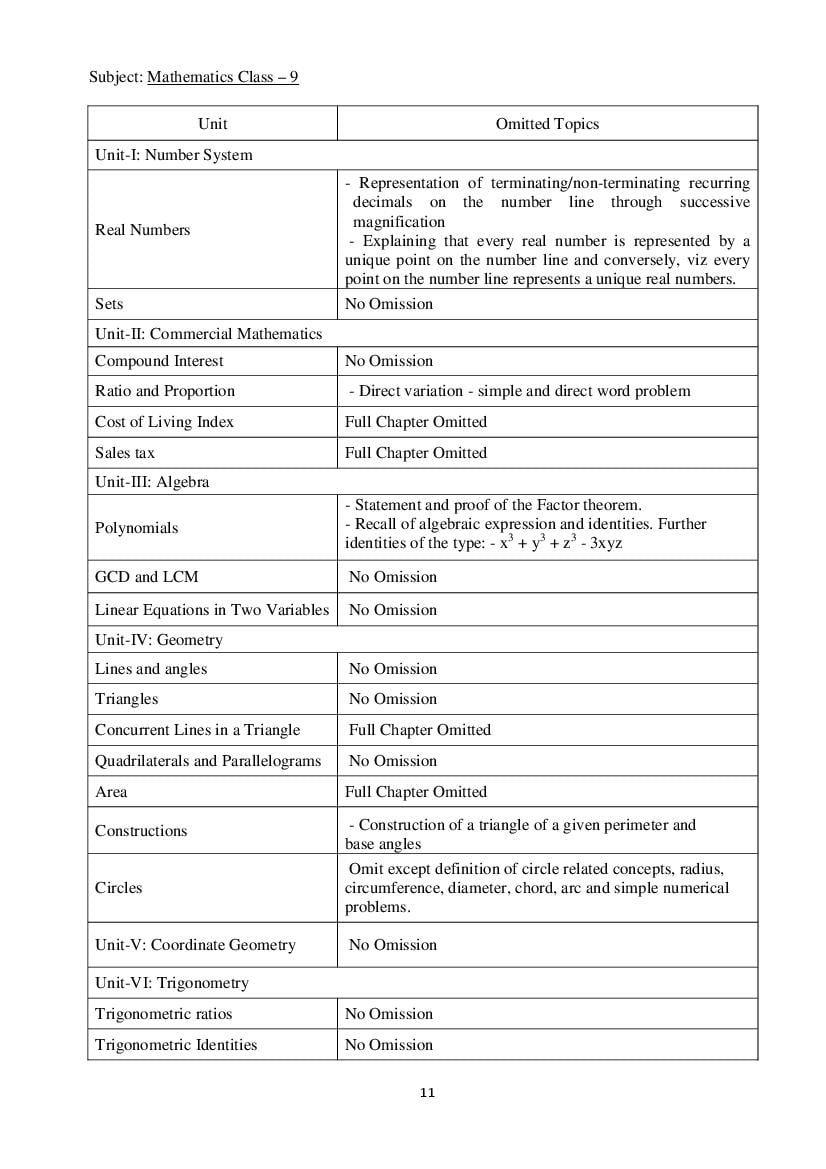
Unit Omitted Topics
Unit-I: Number System
- Representation of terminating/non-terminating recurring
decimals on the number line through successive
Real Numbers magnification
- Explaining that every real number is represented by a
unique point on the number line and conversely, viz every
point on the number line represents a unique real numbers.
Sets No Omission
Unit-II: Commercial Mathematics
Compound Interest No Omission
Ratio and Proportion - Direct variation - simple and direct word problem
Cost of Living Index Full Chapter Omitted
Sales tax Full Chapter Omitted
Unit-III: Algebra
- Statement and proof of the Factor theorem.
Polynomials - Recall of algebraic expression and identities. Further
identities of the type: - x3 + y3 + z3 - 3xyz
GCD and LCM No Omission
Linear Equations in Two Variables No Omission
Unit-IV: Geometry
Lines and angles No Omission
Triangles No Omission
Concurrent Lines in a Triangle Full Chapter Omitted
Quadrilaterals and Parallelograms No Omission
Area Full Chapter Omitted
Constructions - Construction of a triangle of a given perimeter and
base angles
Omit except definition of circle related concepts, radius,
Circles circumference, diameter, chord, arc and simple numerical
problems.
Unit-V: Coordinate Geometry No Omission
Unit-VI: Trigonometry
Trigonometric ratios No Omission
Trigonometric Identities No Omission
11
Page 2
Application of Hero's formula in finding the area of a
Areas
quadrilateral
Surface Areas and volumes No Omission
Unit-VIII: Statistics and Probability
- Histogram(with varying base lengths)
Statistics - Frequency polygons
- Mean, median and mode of ungrouped data
Probability No Omission
MATHEMATICS (Selected)
CLASS – 9
UNIT-I: NUMBER SYSTEM
Real numbers:
- Irrational number as non-terminating and non-repeating decimals
- Real numbers and the real number line. Surds and Rationalization of surds. Problems of
proving a number to be irrational number should be avoided. Representing an irrational
number on the number line should be avoided for numbers other than 2, 3 and 5
Sets:
- Revision
- Representation of sets, equal sets, subsets, power set, universal set.
UNIT-II: COMMERCIAL MATHEMATICS
Compound Interest:
- Compound interest when the interest is compounded yearly and half-yearly.
- Rate of growth and depreciation. Conversion period not more than four (Rate should be 4%,
5% or 10%).
Ratio and Proportion:
- Ratio and proportion.
UNIT-I I I : ALGEBRA
Polynomials:
- Definition of a polynomial in one variable, its coefficients, with examples and counter
examples, its terms, zero polynomial.
- Degree of a polynomial. Constant, linear, quadratic, cubic polynomials; monomials, binomials,
trinomials.
- Factors and multiples.
- Zeros / roots of a polynomial / equation. State and motivate the Remainder Theorem with
examples and analogy to integers.
- Factorisation of ax2 + bx + c, a≠ 0 where a, b, c are real numbers, and of cubic polynomials
using the Factor Theorem.
- Recall of algebraic expressions and identities. Further identities of the type:
(x + y+ z)2 = x2 + y2 +z2 +2xy+2yz +2zx ; (x ± y)3 =x3 ± y3 ± 3xy (x ± y);
x3 ± y3= (x ± y) (x2 m xy+ y2);
and their use in factorization of polynomials.
12
Page 3
- G.C.D. and L.C.M. of polynomials by factorisation.
Linear Equations in Two Variables:
― Recall of linear equations in one variable.
― Introduction to the equation in two variables.
― Prove that a linear equation in two variables has infinitely many solutions, and justify their
being written as ordered pairs of real numbers, plotting them and showing that they seem
to lie on a line.
― System of linear equation in two variables.
― Solution of the system of linear equations by substitution method.
― Simple word problems.
UNIT-IV: GEOMETRY
Lines and Angles:
1. If two parallel lines are intersected by a transversal, then the pair of corresponding angles are
equal.
2. If two parallel lines are intersected by a transversal, then the pair of alternate angles are equal.
3. Vertically opposite angles are equal.
4. If a transversal intersects two lines in such a way that a pair of alternate angles is equal, then the
two lines are parallel.
5. If a transversal intersects two parallel lines, then the interior angles on the same side of the
transversal are supplementary.
6. If a transversal intersects two lines in such a way that a pair of interior angles on the same side of
the transversal are supplementary, then the two lines are parallel.
7. Lines which are parallel to a given line are parallel to each other.
8. If a side of a triangle is produced, the exterior angle so formed is equal to the sum of the two
interior opposite angles.
Triangles:
1. Two triangles are congruent if any two sides and the included angle of one triangle are equal to
any two sides and the included angle of the other triangle.
2. Two triangles are congruent if any two angles and the included side of one triangle are equal to
any two angles and the included side of the other triangle.
3. Two triangles are congruent if the three sides of one triangle are equal to the three sides of the
other triangle.
4. Two right triangles are congruent if the hypotenuse and a side of one triangle are respectively
equal to the hypotenuse and a side of the other triangle.
5. The angles opposite to equal sides of a triangle are equal.
6. The sides opposite to equal angles of a triangle are equal.
Quadrilaterals and Parallelograms:
1. A quadrilateral is a parallelogram if a pair of its opposite sides is parallel and of equal length.
2. Diagonals of a rectangle are equal and bisect each other.
3. Diagonals of a rhombus bisect each other at right angles.
4. Diagonals of a square are equal and bisect each other at right angles.
5. In a triangle, the line segment joining the mid points of any two sides is parallel to the third side
and is half of it.
6. The line drawn through the mid point of one side of a triangle parallel to another side bisects the
third side.
7. Triangle inequalities and relation between ‘angle and facing side’; inequalities in a triangle.
13
Page 4
1. Construction of a triangle given its base, sum of the other two sides and one base angle.
2. Construction of a triangle given its base, difference of the other two sides and one base angle.
3. Construction of a triangle given its two sides and a median corresponding to one of these sides.
4. Construction of a triangle equal in area to a given quadrilateral.
(i) Proofs of constructions not required.
(ii) Constructions using ruler and compasses only.
Circles:
Definitions of circle related concepts, radius, circumference, diameter, chord, arc, subtended angle and simple
numericals.
UNIT-V: COORDINATE GEOMETRY
- The Cartesian plane.
- Co-ordinates of a point, names and terms associated with the coordinate plane, notations,
plotting points in the plane, graph of linear equations as examples.
- Focus on linear equations of the type ax+by+c=0 by writing it as y=mx+c and linking with
the chapter on linear equations in two variables.
UNIT-VI: TRIGONOMETRY
Trigonometric ratios:
- Formation of angles through rotation of a ray.
- Idea of positive and negative angles.
- Trigonometric ratios of an acute angle of a right angled triangle. Trigonometric ratio of 0,30,45,60,90.
- Given a trigonometric ratio, to find all other trigonometric ratios.
- Given a side and an angle of a right triangle, to find other sides and angles.
Trigonometric Identities:
- Very simple identity proof of trigonometric ratios.
UNIT-VII: MENSURATION
Areas:
- Area of a triangle using Hero’s formula (without proof)
Surface Areas and Volumes:
- Concept of surface area.
- Surface areas and volumes of cubes, cuboids, spheres (including hemispheres) and right
circular cylinders/cones.
UNIT-VIII: STATISTICS AND PROBABILITY
Statistics:
- Introduction to statistics.
- Collection of data, presentation of data – tabular form, ungrouped/ grouped, bar graphs.
Probability:
- History, repeated experiments and observed frequency approach to probability. Focus is on
empirical probability. (A large amount of time to be devoted to group and to individual
activities to motivate the concept; the experiments to be drawn from real-life situations, and
from example used in the chapter on statistics).
14
Page 5
Sl/no. Form of Questions No. of Questions Marks for each question Total Marks
2.1 Objective type 24 1 24
2.2 Short Answer I 10 2 20
2.3 Short Answer II 07 3 21
2.4 Long Answer 03 5 15
TOTAL 44 80
Weightage to Content Area :
Sl/no. Topic Marks
3.1 Number System and Sets 08
3.2 Commercial Mathematics 10
3.3 Algebra 16
3.4 Geometry 14
3.5 Coordinate Geometry 04
3.6 Trigonometry 10
3.7 Mensuration 10
3.8 Statistics and Probability 08
TOTAL 80
Scheme of Options :
All questions shall be compulsory i.e. there shall not be any overall choice in the questions
paper. However, internal choices have been provided in 2 questions of 3 marks each and 1
question of 5 marks. These choices may be given from within the same topic.
15