MBSE Class 9 Syllabus 2022 Science
Finished viewing? Save it for later —
Download MBSE Class 9 Syllabus 2022 Science (PDF · 5 pages)About MBSE Class 9 Syllabus 2022 Science
MBSE Class 9 Syllabus 2022 Science is available here for free download. Published by Mizoram Board for Class 9, this syllabus can be viewed online or downloaded as a PDF (5 pages). Candidates preparing for Class 9 can use MBSE Class 9 Syllabus 2022 Science to understand the exam pattern, the type of questions asked, and the overall difficulty level.
Frequently Asked Questions
How can I download MBSE Class 9 Syllabus 2022 Science?
Open this page and click the Download button to save MBSE Class 9 Syllabus 2022 Science as a PDF. It is completely free on AglaSem Docs.
Is MBSE Class 9 Syllabus 2022 Science free to download?
Yes. MBSE Class 9 Syllabus 2022 Science can be viewed online and downloaded as a PDF free of cost on AglaSem Docs.
How many pages does MBSE Class 9 Syllabus 2022 Science have?
MBSE Class 9 Syllabus 2022 Science contains 5 pages, which you can read online or download together as a single PDF.
Where can I find more Class 9 study material?
You can find more Class 9 question papers, sample papers, syllabus, and answer keys on AglaSem Docs.
MBSE Class 9 Syllabus 2022 Science – Text
Read the full text of this syllabus below — useful to quickly search, copy and reference the content online without downloading the PDF.
📄 View text version (5 pages)
Page 1
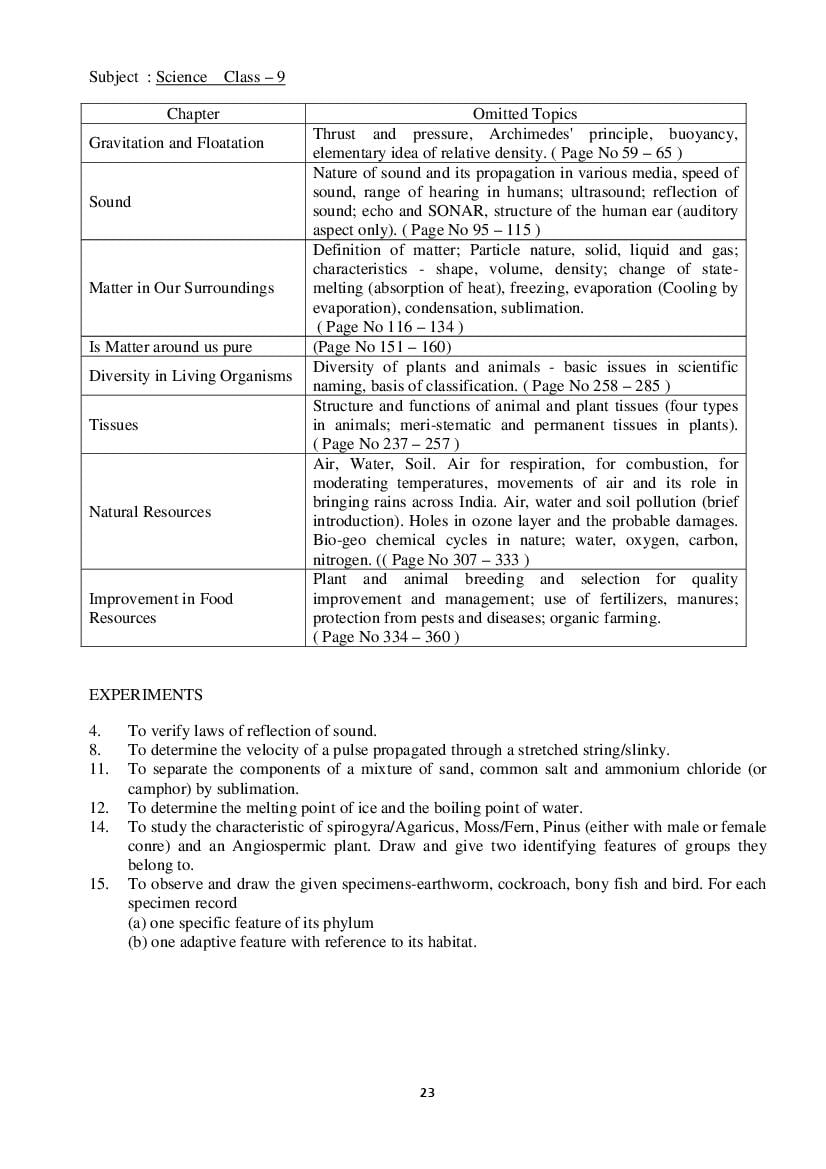
Chapter Omitted Topics
Thrust and pressure, Archimedes' principle, buoyancy,
Gravitation and Floatation
elementary idea of relative density. ( Page No 59 – 65 )
Nature of sound and its propagation in various media, speed of
sound, range of hearing in humans; ultrasound; reflection of
Sound
sound; echo and SONAR, structure of the human ear (auditory
aspect only). ( Page No 95 – 115 )
Definition of matter; Particle nature, solid, liquid and gas;
characteristics - shape, volume, density; change of state-
Matter in Our Surroundings melting (absorption of heat), freezing, evaporation (Cooling by
evaporation), condensation, sublimation.
( Page No 116 – 134 )
Is Matter around us pure (Page No 151 – 160)
Diversity of plants and animals - basic issues in scientific
Diversity in Living Organisms
naming, basis of classification. ( Page No 258 – 285 )
Structure and functions of animal and plant tissues (four types
Tissues in animals; meri-stematic and permanent tissues in plants).
( Page No 237 – 257 )
Air, Water, Soil. Air for respiration, for combustion, for
moderating temperatures, movements of air and its role in
bringing rains across India. Air, water and soil pollution (brief
Natural Resources
introduction). Holes in ozone layer and the probable damages.
Bio-geo chemical cycles in nature; water, oxygen, carbon,
nitrogen. (( Page No 307 – 333 )
Plant and animal breeding and selection for quality
Improvement in Food improvement and management; use of fertilizers, manures;
Resources protection from pests and diseases; organic farming.
( Page No 334 – 360 )
EXPERIMENTS
4. To verify laws of reflection of sound.
8. To determine the velocity of a pulse propagated through a stretched string/slinky.
11. To separate the components of a mixture of sand, common salt and ammonium chloride (or
camphor) by sublimation.
12. To determine the melting point of ice and the boiling point of water.
14. To study the characteristic of spirogyra/Agaricus, Moss/Fern, Pinus (either with male or female
conre) and an Angiospermic plant. Draw and give two identifying features of groups they
belong to.
15. To observe and draw the given specimens-earthworm, cockroach, bony fish and bird. For each
specimen record
(a) one specific feature of its phylum
(b) one adaptive feature with reference to its habitat.
23
Page 2
Class - 9
Motion
Distance and displacement, velocity; uniform and non-uniform motion along a straight line;
acceleration, distance-time and velocity-time graphs for uniform and uniformly accelerated motion,
equations of motion by graphical method; elementary idea of uniform circular motion
Force and Newton's laws
Force and motion, Newton's laws of motion, inertia of a body, inertia and mass, momentum, force
and acceleration, elementary idea of conservation of momentum, action and reaction forces
Gravitation and Floatation
Gravitation; universal law of gravitation, force of gravitation of the earth (gravity), acceleration due
to gravity; mass and weight; free fall. Work, Energy and Power Work done by a force, energy,
power; kinetic and potential energy; law of conservation of energy
Is Matter Around Us Pure
Elements, compounds and mixtures. Heterogenous and homogenous mixtures, colloids and
suspensions.
Atoms and Molecules
Atoms and molecules. Law of constant proportions. Atomic and molecular masses. Mole Concept,
Relationship of mole to mass of the particles and numbers. Valency. Chemical formula of common
compounds.
Structure of the Atom
Electrons, protons and neutrons; Isotopes and isobars.
Cell - Basic Unit of life : Cell as a basic unit of life; prokaryotic and eukaryotic cells, mul-ticellular
organisms; cell membrane and cell wall, cell organelles; chloroplast, mitochondria, vacuoles, ER,
golgi apparatus; nucleus, chromosomes - basic structure, number.
Diversity in Living Organisms
Hierarchy of categories / groups, Major groups of plants (salient features) (Bacteria, Thalophyta,
Bryophyta, Pteridophyta, gymnosperms and Angiosperms). Major groups of animals (salient
features) (Non-chordates upto phyla and chordates upto classes).
Why Do We Fall Ill
Health and its failure. Infectious and Non-infectious diseases, their causes and manifestation.
Diseases caused by microbes (Virus, Bacteria and protozoans) and their prevention, Principles of
treatment and prevention. Pulse polio programme.
24
Page 3
Unit Topic Marks
1 Motion
10
2 Force and Laws of Motion
3 Gravitation & Floatation 07
4 Work and Energy 07
5 Is matter around us pure? 08
6 Atoms and Molecules 08
7 Structure of the Atom 07
8 The fundamental unit of life 07
10 Diversity in living Organisms 08
11 Why do we fall ill 08
Total 70
Weightage to Form of Questions :
Sl/no. Form of Questions No. of Questions Marks for each question Total Marks
2.1 Objective Type 14 1 14
2.2 Very Short Answer 07 1 07
2.2 Short Answer I 08 2 16
2.3 Short Answer II 07 3 21
2.4 Long Answer 03 4 12
TOTAL 39 70
Scheme of Option :
There shall not be any overall choice in the question paper. However, internal choice on a
very selective basis shall be given based on same objective. It shall also have same mark allotment
and same difficulty level.
Scheme of Section :
There shall be three sections namely Section A (Physics), Section B (Chemistry) and Section
C (Biology).
25
Page 4
Page 5
Class - 9
List of experiments
1. To prepare
a) a true solution of common salt, sugar and alum
b) a suspension of soil, chalk powder and fine sand in water
c) a colloidal of starch in water and egg albumin in water and distinguish between these on the
basis of
i) transparency
ii) filtration criterion
iii) stability
2. To prepare
a) a mixture
b) a compound
using iron filings and sulphur powder and distinguish between these on the basis of:
i) appearance i.e., homogeneity and heterogeneity
ii) behaviour towards a magnet
iii) behaviour towards carbon disulphide a solvant.
iv) effect of heat.
3. To study the extent of cooling caused by evaporation on the following liquids, using a
thermometer. Also to arrange these liquids in the increasing order of the extent of
cooling produced
i) Water
ii) Alcohol
iii) Ether
4. To determine the density of solid (denser than water) by using a spring balance and a
measuring cylinder.
5. To establish the relation between the loss in weight of a solid when fully immersed in
i) tap water
ii) strongly salty water, with the weight of water displaced by it by taking at least two
different solids.
6. To measure the temperature of hot water as it cools and plot a temperature-time graph.
7. To prepare stained temporary mounts of (a) onion peel and (b) human cheek cells and to record
observations and draw their labelled diagrams.
8. To identify parenchyma and sclerenchyma tissues in plants, striped muscle fibers and nerve
cells in animals, from prepared slides and to draw their labelled diagrams.
9. To observe the onion peel cells placed in hypertonic solution under the microscope and draw
labelled diagram of the same.
27