MBSE Class 9 Syllabus 2022 Manipuri
Finished viewing? Save it for later —
Download MBSE Class 9 Syllabus 2022 Manipuri (PDF · 5 pages)About MBSE Class 9 Syllabus 2022 Manipuri
MBSE Class 9 Syllabus 2022 Manipuri is available here for free download. Published by Mizoram Board for Class 9, this syllabus can be viewed online or downloaded as a PDF (5 pages). Candidates preparing for Class 9 can use MBSE Class 9 Syllabus 2022 Manipuri to understand the exam pattern, the type of questions asked, and the overall difficulty level.
Frequently Asked Questions
How can I download MBSE Class 9 Syllabus 2022 Manipuri?
Open this page and click the Download button to save MBSE Class 9 Syllabus 2022 Manipuri as a PDF. It is completely free on AglaSem Docs.
Is MBSE Class 9 Syllabus 2022 Manipuri free to download?
Yes. MBSE Class 9 Syllabus 2022 Manipuri can be viewed online and downloaded as a PDF free of cost on AglaSem Docs.
How many pages does MBSE Class 9 Syllabus 2022 Manipuri have?
MBSE Class 9 Syllabus 2022 Manipuri contains 5 pages, which you can read online or download together as a single PDF.
Where can I find more Class 9 study material?
You can find more Class 9 question papers, sample papers, syllabus, and answer keys on AglaSem Docs.
MBSE Class 9 Syllabus 2022 Manipuri – Text
Read the full text of this syllabus below — useful to quickly search, copy and reference the content online without downloading the PDF.
📄 View text version (5 pages)
Page 1
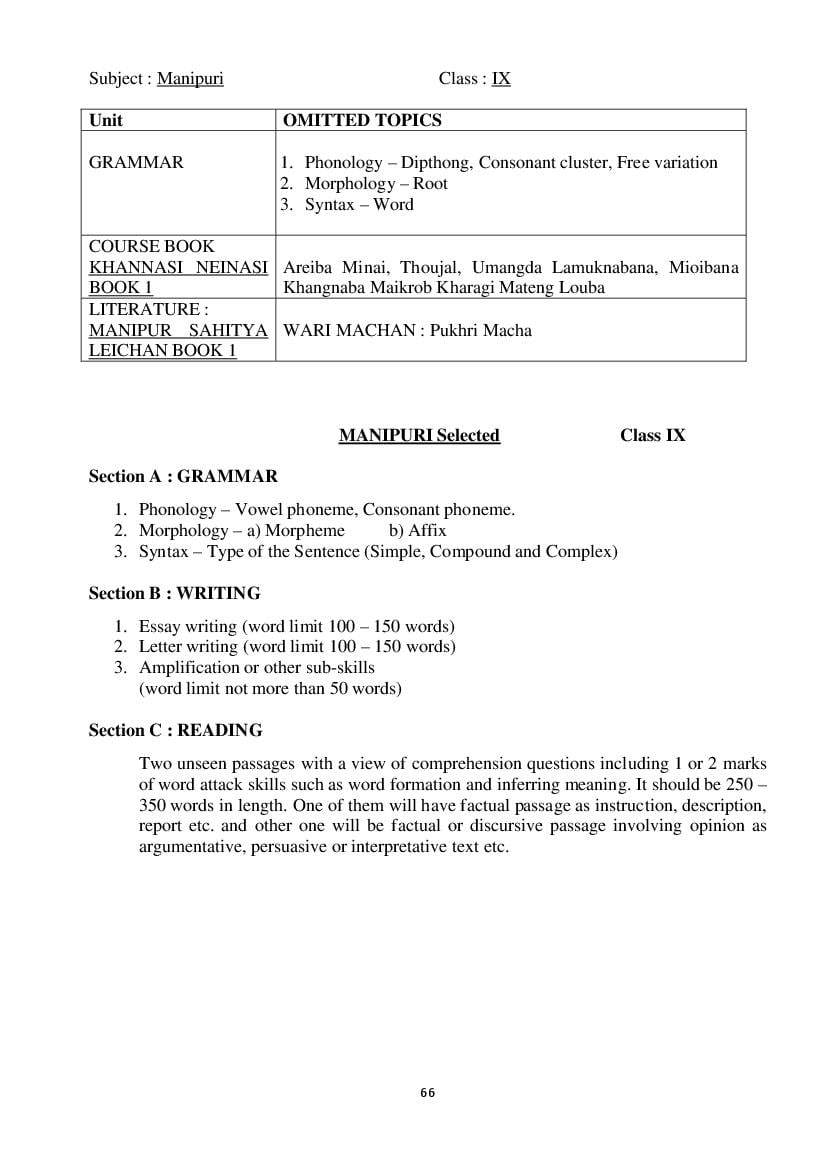
Unit OMITTED TOPICS
GRAMMAR 1. Phonology – Dipthong, Consonant cluster, Free variation
2. Morphology – Root
3. Syntax – Word
COURSE BOOK
KHANNASI NEINASI Areiba Minai, Thoujal, Umangda Lamuknabana, Mioibana
BOOK 1 Khangnaba Maikrob Kharagi Mateng Louba
LITERATURE :
MANIPUR SAHITYA WARI MACHAN : Pukhri Macha
LEICHAN BOOK 1
MANIPURI Selected Class IX
Section A : GRAMMAR
1. Phonology – Vowel phoneme, Consonant phoneme.
2. Morphology – a) Morpheme b) Affix
3. Syntax – Type of the Sentence (Simple, Compound and Complex)
Section B : WRITING
1. Essay writing (word limit 100 – 150 words)
2. Letter writing (word limit 100 – 150 words)
3. Amplification or other sub-skills
(word limit not more than 50 words)
Section C : READING
Two unseen passages with a view of comprehension questions including 1 or 2 marks
of word attack skills such as word formation and inferring meaning. It should be 250 –
350 words in length. One of them will have factual passage as instruction, description,
report etc. and other one will be factual or discursive passage involving opinion as
argumentative, persuasive or interpretative text etc.
66
Page 2
COURSE BOOK : KHANNASI NEINASI BOOK – 1
There will be 9 question in which 5 questions will carry 2 marks each and 4 question
will carry 1 mark each.
LITERATURE : MANIPURI SAHITYA LEICHAL BOOK – 1
a. WARI MACHA – Inthokpa
b. SHEIRENG
c. WARENG : Tougadaba Thabakta Mai Onsinba
d. LAMKOI WARI : Ningsinglak I Ngasidi
i. One out of two explanation from different prose lessons. (4 marks)
ii. One out of two explanation from different poems. (4 marks)
iii. Two out of four question from different prose lesson. (3+3 = 6)
iv. Two out of four question from different poem. (3+3 = 6)
v. One question from any prose lesson. (4 marks)
vi. One question from any poem. (2 marks)
67
Page 3
Subject : Manipuri Max. Marks : 80
Class : IX Time : 3 hours
No. of Paper : 1(One)
1. Weightage to Objectives of Learning :
Sl/no. Learning Objectives Marks Percentage
Knowledge :
Questions testing the students’ ability to recall,
1.1 define, identify facts, terminology/glossaries e.g. 24 30%
W.H. questions based on the text (seen and unseen)
and to apply grammatical rules.
Comprehension :
Question testing the students ability to bring out
1.2 information, understand, contemplate, interpret, 24 30%
summarise and describe the concept and meaning
within the context.
Expression :
Questions testing the students’ ability to depict
1.3 innovative, thinking using the language creatively, 15 19%
explain, describe, discuss, report, comment,
compare, contrast, summarise, etc.
Higher Order Thinking Skills (HOTS) :
Question testing the students’ ability to appreciate,
1.4 reason , analyse, synthesize, interpret, compare, 08 10%
contrast, compiling the pieces of information
beyond textbooks, extrapolation etc.
Inferential & Evaluative :
Question testing the students’ ability to form
1.5 opinions, make judgements, assessments, justifying 09 11%
the value or worth of decision or outcome based on
the text or given passages.
TOTAL 80 100%
2. Weightage to Form of Questions :
Sl/no. Form of Questions No. of Questions Marks for each question Total Marks
2.1 Objective Type 09 1 09
2.2 Very Short Answer 15 1 15
2.3 Short Answer I 13 2/3 32
2.4 Short Answer II 03 4/5 12
2.5 Long Answer 02 6 12
TOTAL 42 80
68
Page 4
Reading : 10 Marks
Writing : 15 Marks
Grammar : 15 Marks
Course book : 14 marks
Literature : 26 Marks
Total : 80 Marks
4. Scheme of Option :
There shall not be any overall choice in the question paper. However internal choice on a very
selective basis shall be given based on same objective. It shall also have same mark allotment
and same difficulty level.
5. Scheme of Section :
There shall be 4 (four) sections namely – Section A, B, C and D.
69