CBSE Class 12 Question Paper 2024 Solution Legal Studies
Finished viewing? Save it for later —
Download CBSE Class 12 Question Paper 2024 Solution Legal Studies (PDF · 28 pages)About CBSE Class 12 Question Paper 2024 Solution Legal Studies
CBSE Class 12 Question Paper 2024 Solution Legal Studies is available here for free download. Published by CBSE for Class 12, this solution can be viewed online or downloaded as a PDF (28 pages). Candidates preparing for Class 12 can use CBSE Class 12 Question Paper 2024 Solution Legal Studies to understand the exam pattern, the type of questions asked, and the overall difficulty level.
Frequently Asked Questions
How can I download CBSE Class 12 Question Paper 2024 Solution Legal Studies?
Open this page and click the Download button to save CBSE Class 12 Question Paper 2024 Solution Legal Studies as a PDF. It is completely free on AglaSem Docs.
Is CBSE Class 12 Question Paper 2024 Solution Legal Studies free to download?
Yes. CBSE Class 12 Question Paper 2024 Solution Legal Studies can be viewed online and downloaded as a PDF free of cost on AglaSem Docs.
How many pages does CBSE Class 12 Question Paper 2024 Solution Legal Studies have?
CBSE Class 12 Question Paper 2024 Solution Legal Studies contains 28 pages, which you can read online or download together as a single PDF.
Where can I find more Class 12 study material?
You can find more Class 12 question papers, sample papers, syllabus, and answer keys on AglaSem Docs.
CBSE Class 12 Question Paper 2024 Solution Legal Studies – Text
Read the full text of this solution below — useful to quickly search, copy and reference the content online without downloading the PDF.
📄 View text version (28 pages)
Page 1
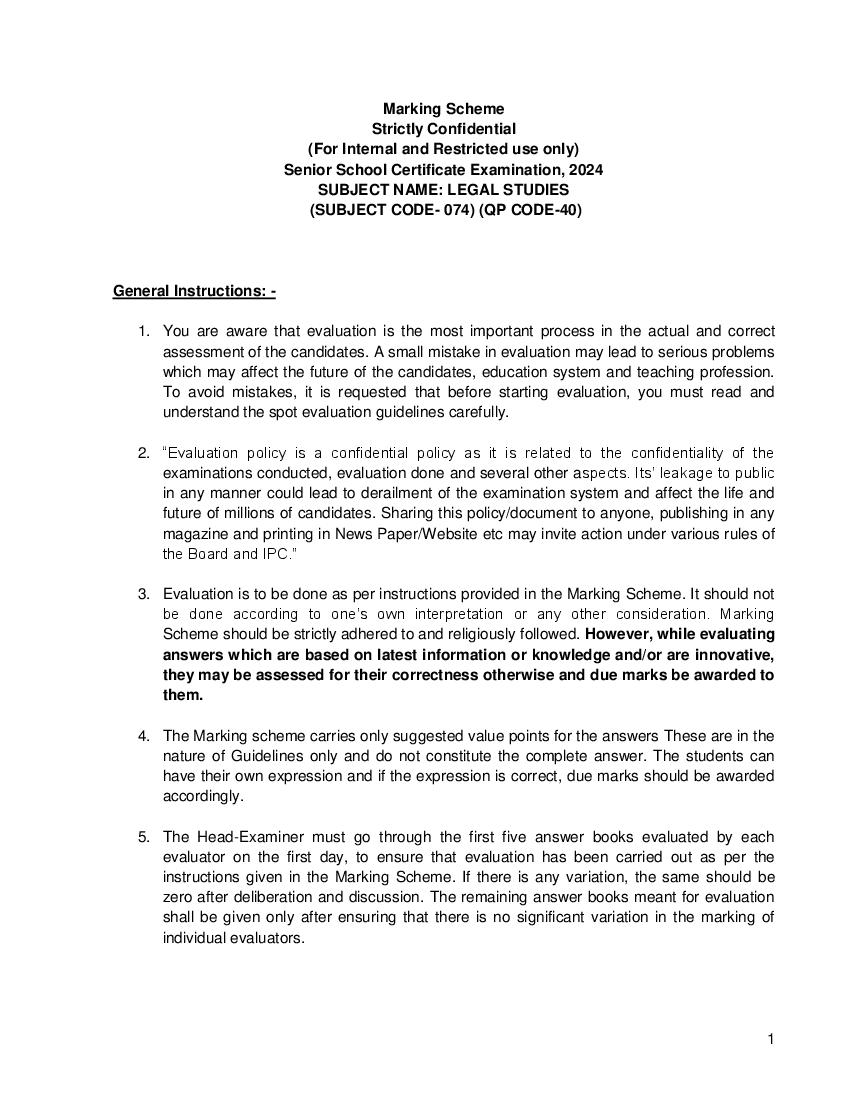
Strictly Confidential
(For Internal and Restricted use only)
Senior School Certificate Examination, 2024
SUBJECT NAME: LEGAL STUDIES
(SUBJECT CODE- 074) (QP CODE-40)
General Instructions: -
1. You are aware that evaluation is the most important process in the actual and correct
assessment of the candidates. A small mistake in evaluation may lead to serious problems
which may affect the future of the candidates, education system and teaching profession.
To avoid mistakes, it is requested that before starting evaluation, you must read and
understand the spot evaluation guidelines carefully.
2. ―Evaluation policy is a confidential policy as it is related to the confidentiality of the
examinations conducted, evaluation done and several other aspects. Its‘ leakage to public
in any manner could lead to derailment of the examination system and affect the life and
future of millions of candidates. Sharing this policy/document to anyone, publishing in any
magazine and printing in News Paper/Website etc may invite action under various rules of
the Board and IPC.‖
3. Evaluation is to be done as per instructions provided in the Marking Scheme. It should not
be done according to one‘s own interpretation or any other consideration. Marking
Scheme should be strictly adhered to and religiously followed. However, while evaluating
answers which are based on latest information or knowledge and/or are innovative,
they may be assessed for their correctness otherwise and due marks be awarded to
them.
4. The Marking scheme carries only suggested value points for the answers These are in the
nature of Guidelines only and do not constitute the complete answer. The students can
have their own expression and if the expression is correct, due marks should be awarded
accordingly.
5. The Head-Examiner must go through the first five answer books evaluated by each
evaluator on the first day, to ensure that evaluation has been carried out as per the
instructions given in the Marking Scheme. If there is any variation, the same should be
zero after deliberation and discussion. The remaining answer books meant for evaluation
shall be given only after ensuring that there is no significant variation in the marking of
individual evaluators.
1
Page 2
marked. Evaluators will not put right (✓) while evaluating which gives an impression that
answer is correct and no marks are awarded. This is the most common mistake which
evaluators are committing.
7. If a question has parts, please award marks on the right-hand side for each part. Marks
awarded for different parts of the question should then be totalled up and written in the left-
hand margin and encircled. This may be followed strictly.
8. If a question does not have any parts, marks must be awarded in the left-hand margin and
encircled. This may also be followed strictly.
9. If a student has attempted an extra question, the answer of the question deserving more
marks should be retained and the other answer scored out with a note ―Extra Question‖.
10. No marks to be deducted for the cumulative effect of an error. It should be penalized only
once.
11. A full scale of marks 0 to 80 has to be used. Please do not hesitate to award full marks if
the answer deserves it.
12. Every examiner has to necessarily do evaluation work for full working hours i.e., 8 hours
every day and evaluate 20 answer books per day in main subjects and 25 answer books
per day in other subjects (Details are given in Spot Guidelines). This is in view of the
reduced syllabus and number of questions in the question paper.
13. Ensure that you do not make the following common types of errors committed by the
Examiner in the past: -
● Leaving the answer or part thereof unassessed in an answer book.
● Giving more marks for an answer than assigned to it.
● Wrong totalling of marks awarded on an answer.
● Wrong transfer of marks from the inside pages of the answer book to the title page.
● Wrong question wise totalling on the title page.
● Wrong totalling of marks of the two columns on the title page.
● Wrong grand total.
● Marks in words and figures not tallying/not same.
● Wrong transfer of marks from the answer book to online award list.
● Answers marked as correct, but marks not awarded. (Ensure that the right tick
mark is correctly and clearly indicated. It should merely be a line. Same is with the
X for incorrect answers.)
● Half or a part of the answer marked correct and the rest as wrong, but no marks
awarded.
2
Page 3
be marked as cross (X) and awarded zero (0) Marks.
15. Any unassessed portion, non-carrying over of marks to the title page, or totalling error
detected by the candidate shall damage the prestige of all the personnel engaged in the
evaluation work as also of the Board. Hence, in order to uphold the prestige of all
concerned, it is again reiterated that the instructions be followed meticulously and
judiciously.
16. The Examiners should acquaint themselves with the guidelines given in the ―Guidelines
for Spot Evaluation‖ before starting the actual evaluation.
17. Every Examiner shall also ensure that all the answers are evaluated, marks carried over to
the title page, correctly totalled and written in figures and words.
18. The candidates are entitled to obtain a photocopy of the Answer Book on request on
payment of the prescribed processing fee. All Examiners/Additional Head Examiners/Head
Examiners are once again reminded that they must ensure that evaluation is carried out
strictly as per value points for each answer as given in the Marking Scheme.
19. Please read the guidelines carefully and seek clarifications from the Head Examiner in
case of any doubt to reduce subjectivity and bias.
20. Every care has been taken to prepare the Marking Scheme. However, it is important to
keep in mind that it is neither exhaustive nor exclusive.
21. The examiners are requested to use their own knowledge and experience wherever
necessary.
22. Marking should be neither over-strict nor over-liberal. Marks should not be deducted for
spelling errors, wrong proper names, minor inaccuracies, or omission of detail.
23. Though break-up of value points is given in a few answers, the examiner may be flexible in
marking the different parts, if the answers reflect understanding of the scope of the
question.
3
Page 4
SECTION- A
1 The National and State Human Rights Commissions are governed by 1
______
(A) Protection of Civil Rights Act, 1955
(B) Universal Declaration of Human Rights (UDHR)
(C) Article 338 of the Constitution of India
(D) Protection of Human Rights Act, 1993
Ans. (D) Protection of Human Rights Act, 1993 (Page no 148) 1
2 Jerry, a US national, has a 4 year undergraduate degree in Political 1
Science and is considering applying to law schools in the U.S.A.
The prerequisite for this is_______ .
(A) CLE (B) MPT
(C) LSAT (D) MEE
Ans (C) LSAT ( Page no 189) 1
3 For the process of removal of judges in India – 1
Identify the correct sequence in the ascending order :
(i) Constitution of an inquiry committee
(ii) Order by the President
(iii) Notice for motion for removal of a judge
(iv) Submission of the inquiry report
(A) (iii), (iv), (i), (ii) (B) (iii), (i), (iv), (ii)
(C) (iv), (iii), (i), (ii) (D) (iii), (ii), (i), (iv)
Ans (B) (iii), (i), (iv), (ii) ( Page no 18 - 19 ) 1
4 Assertion (A): PILs are based on the tenets of citizen standing and 1
representative standing.
Reason (R) : PILs have strengthened the role of judiciary as a monitor
and watchdog agency.
(A) Both (A) and (R) are true and (R) is the correct explanation of (A).
(B) Both (A) and (R) are true and (R) is not the correct explanation of (A).
(C) (A) is true, but (R) is false.
(D) (A) is false, but (R) is true.
4
Page 5
of (A). ( Page no 10 )
5 Match the ‗Country‘ in Column – A with ‗Provision of Advertising by the 1
lawyers‘ in Column – B :
Column – A Column – B
a. India i.Model Rules of Professional conduct
b. Malaysia ii. Lawyers are permitted to advertise in print media
c. Hong Kong iii. Lawyers are allowed to put only
five pieces of information on the internet.
d. U.S.A. iv. Legal Profession (Publicity Rules) 2001
regulates advertising by lawyers
a b c d
(A) i ii iv iii
(B) ii iii i iv
(C) iii iv ii i
(D) iv i iii ii
Ans a b c d 1
( C ) iii iv ii i ( Page no 187)
6 The aim of the Lokpal and Lokayukta Act, 2013 is___________ . 1
(A) to prevent instances of corruption through stringent measures.
(B) to eradicate corruption for betterment of society.
(C) to foster a culture of accountability within the public sector.
(D) to combat acts of bribery and corruption of public servants.
Ans (D) to combat acts of bribery and corruption of public servants 1
( Page no 47)
7 Which of the following scenarios best exemplifies the concept ‗deterrence 1
is an objective of criminal law‘?
(A) After consuming alcohol at a party, Suresh chooses to hire a taxi
and arrive home safely.
(B) Manya, a habitual shoplifter, receives a warning from a store owner
to stop her from stealing again.
(C) Alex caught driving under the influence of alcohol, faces a hefty fine,
license suspension and mandatory education programme.
(D) Sana refrains from cheating in an exam-being aware of the punitive
consequences.
5
Page 6
license suspension and mandatory education programme.
(Page no 113)
8 Emma, a talented photographer, discovers that her original photograph 1
has been reproduced without her permission and is being sold at an art
gallery. The gallery has been profitting from the unauthorized use of
Emma‘s work, causing her financial loss and diminishing the value of her
artistic creation. Which of the following intellectual property right of
Emma is being violated by the art gallery?
(A) Patent
(B) Trademark
(C) Copyright
(D) Trade Secret
Ans 1
(C) Copyright ( Page no 83)
9 Adheer is indebted to Bhanu and Bhanu is indebted to Chitranjan. By 1
mutual agreement among the three, Bhanu is absolved of the liability to
pay Chitranjan and Chitranjan accepts Adheer as his debtor. This
understanding is converted into a contract. Which of the following options
correctly describes the effect of this new arrangement on the already
existing contract between the parties?
(A) The existing contract is discharged by rescission as all terms of the
contract are cancelled.
(B) The existing contract is discharged by novation as the new contract
will substitute the old one.
(C) The existing contract is automatically discharged by performance.
(D) The existing contract is discharged by operation of law as the parties
have merged terms of contract.
Ans (B) The existing contract is discharged by novation as the new contract 1
will substitute the old one. ( Page no 59)
10 Assertion (A) : Tribunals have contributed in supplementing the role of 1
courts in adjudicating service disputes.
Reason (R) : Appeals against the orders of the Division Bench of any
High Court lie before the Central Administrative Tribunal.
(A) Both (A) and (R) are true and (R) is the correct explanation of (A).
(B) Both (A) and (R) are true but (R) is not the correct explanation
of (A).
(C) (A) is true, but (R) is false.
(D) (A) is false, but (R) is true.
6
Page 7
Ans 1
11 Which of the following statements correctly describe features of Tort law? 1
1. Tort is a civil law subject.
2. Damages under tort law are always unliquidated.
3. Tort is an instrument for making people adhere to standards of
reasonable behaviour.
4. Tort is an intentional criminal activity.
5. Tort is a civil wrong.
(A) 1, 3, 4 (B) 2, 3, 5
(C) 2, 4, 5 (D) 1, 3, 5
Ans (B) 2, 3, 5 ( Page no 62-63) 1
12 Why is sole proprietorship the easiest type of business to establish ? 1
(A) Because there is no separate entity of the owner and business in
eyes of law.
(B) Because there is lack of government regulations.
(C) Because the sole proprietor enjoys all profits and bears all losses.
(D) Because the liability of the sole proprietor is unlimited.
Ans (B) Because there is lack of government regulations. ( Page no 101) 1
13 Which of the following statements is true for ‗Consideration‘ as an 1
important element in contract?
(A) A contract without consideration is voidable.
(B) Consideration must be adequate and real.
(C) Consideration can be in the nature of an act or forbearance.
(D) Consensus ad idem is the pre-requisite for consideration.
Ans (C) Consideration can be in the nature of an act or forbearance. 1
(Page no 55)
14 Assertion (A) : Article 18 of Indian Constitution abolished all titles except 1
for military and academic titles.
Reason (R) : Titles violate the essence of Article 14 of the Indian
Constitution.
(A) Both (A) and (R) are true and (R) is the correct explanation of (A).
(B) Both (A) and (R) are true and (R) is not the correct explanation of (A).
(C) (A) is true, but (R) is false.
(D) (A) is false, but (R) is true.
7
Page 8
of (A). ( Page no 131-133)
15 Which of the following conditions needs to be fulfilled by Sakshi‘s 1
invention to be eligible for protection under intellectual property?
(A) Invention should fall within the category of ‗work‘.
(B) Invention has a special scheme of shape, colour, line, pattern etc.
(C) Invention must be a notable change in the field and has
commercial viability.
(D) Invention must be indicative of its geographic origin.
Ans (C) Invention must be a notable change in the field and has commercial 1
viability. (Page no 86)
16 Jagdish and Susheela, neighbours in the same residential complex, are 1
experiencing a disagreement regarding the boundary wall between their
houses. They would like to resolve this dispute through a method that
encourages open communication and mutual agreement. Which of the
following options is best suited to their situation?
(A) Litigation (B) Negotiation
(C) Lok Adalat (D) Mediation
Ans (D) Mediation (Page no 43) 1
17 Assertion (A) : Fundamental duties are enforceable in the court of law 1
and one can be punished for its violation.
Reason (R ) : Fundamental duties contain standards to be followed by
the citizens.
(A) Both (A) and (R) are true and (R) is the correct explanation of (A)
(B) Both (A) and (R) are true and (R) is not the correct explanation
of (A).
(C) (A) is true, but (R) is false.
(D) (A) is false, but (R) is true.
Ans (D) (A) is false, but (R) is true. (Page no 143) 1
18 Which among the given requirement is not essential to be fulfilled by an 1
Advocate for obtaining licence to practise law in India?
(A) Minimum 21 years of age.
(B) An LLB degree from a college/university recognised by the Bar
Council of India.
(C) Enrolment with the Bar Council of India.
(D) Must clear the All India Bar Examination.
Ans (C) Enrolment with the Bar Council of India. (Page no 183) 1
19 Two companies ABC and XYZ, have a contractual dispute regarding non- 1
8
Page 9
pursue ad hoc arbitration to resolve their dispute. Which of the following
is a key feature of ad hoc arbitration?
(A) The process is conducted by an arbitral institution.
(B) The process follows a pre-determined set of rules established by a
recognized arbitration organization.
(C) The parties have the flexibility to tailor the arbitration process to their
specific needs and preferences.
(D) The process is conducted by a sole arbitrator appointed under the
statutory provisions.
Ans (C) The parties have the flexibility to tailor the arbitration process to their 1
specific needs and preferences. (Page no 39)
20 Jai is accused of stealing a valuable item from a store. During the trial, 1
the prosecution argues that he acted with a particular mental state
regarding the alleged theft. Which of the following legal concepts relates
to the mental state of Jai and plays a role in determining his culpability ?
(A) actus reus (B) mens rea
(C) motive (D) ignorance of law
Ans (B) mens rea ( Page no 114) 1
SECTION- B
21 Ananya is a conflict-resolution specialist, who is called into facilitate a 2 marks
workplace dispute between two long-standing employees. Both are
valuable team members, but their conflict is affecting their productivity
and team dynamics. Examine the features of transformative mediation
that Ananya can employ in this situation.
Ans Ananya as a conflict resolution specialist can employ any feature of 2 marks
transformative mediation in this prevailing situation to solve the dispute at
the workplace. It is focussed on empowerment of parties ,encourages
deliberation, decision-making, and perspective-taking. She can practice
with a micro-focus on communication, identifying opportunities for
empowerment and recognition as those opportunities appear in the parties
‗own conversations, and responding in ways that provide an opening for
parties to choose what, if anything, to do with them.
A transformative mediator focuses on communication between the parties
and encourages them to reach a mutually amicable decision
(Any one relevant explanation) (Page no. 43)
9
Page 10
has recently gained a reputation for aggressively soliciting clients who
have been involved in accidents or ‗personal injury‘ incidents. Identify this
category of lawyers and the country where they exist. What will be the
status of this category of lawyers in India ?
Ans The category of lawyers Sally belongs to is called the ‘ambulance (½ +½ =1mark)
chasers’ or the ‗personal injury lawyers’. Such types of lawyers exist in + 1 mark for its
the USA. status in India
Ambulance chasing is not representative of professional practice in India
since these classes of lawyers are the sort who solicit business by lurking
around hospitals or by ads in newspapers and in Yellow Pages with toll
free numbers and ―free‖ consultations.
(Page no. 187)
23 (a) How are judges of the Supreme Court of India appointed under the 2
collegium model for judicial appointments?
OR
(b) Explain the role of High Courts in the Indian Judicial System.
Ans (a) The collegium model for appointments of judges of the Supreme 2 marks
Court of India includes the following steps-
(i) The Chief Justice of India consults four senior most judges of the
Supreme Court;
(ii) The Chief Justice of India sends his recommendations to the Union
Minister of Law and Justice;
(iii) The Union Minister of Law sends his recommendations to the Prime
Minister;
(iv) The Prime Minister will then advise the President and President to
declare the appointments of Supreme court judges.
(Full marks to be awarded even if the answer has been explained as a
flowchart)
(Page no. 16)
OR
(b) The role of High Courts in the Indian Judicial System is as under-
1 mark each for
(i) Can hear appeals from lower courts;
any two roles of
(ii) Can issue writs for restoring Fundamental Rights;
the HC = 2
(iii) Can deal with cases within the jurisdiction of the State; and
marks
(iv) Exercises superintendence and control over courts below it.
(v) It is a Court of record and can punish for contempt of the court.
(Page no. 13 & 14)
10
Page 11
recognised by the State and wholly funded by it.
To promote the spirit of unity and oneness, all the students in these
schools have to attend a special religious prayer every morning
irrespective of their religious beliefs.
A group of students refused to participate in the prayer. The school
authorities, after giving warning for being indisciplined, suspended the
students for a week. Parents of these students alleged violation of
fundamental rights of their children.
Is the action of school authorities justified? Stating the relevant
Constitutional provision, give reason for your answer.
Ans The action of school authorities to suspend the students for a week on 1+1=2 marks
indiscipline grounds because they had refused to participate in the prayer
is not justified.
(The relevant Constitutional provision in this regard is Article 28). It states
that no religious instruction shall be provided in any educational institution
wholly maintained out of State funds.The State recognized or State aided
educational institutions cannot force any student to take part in any
religious instruction or to attend any religious worship conducted in such
institutions unless he/she has given consent for the same. In the case of
minors, the guardians should have given consent for the same.
(Page no. 140)
25 Arjun threatened to kill Bhim if he does not sell his house worth Rs. 1 2
crore to Arjun for Rs. 50 lakhs. Bhim, out of fear, signs the contract for
selling his house to Arjun.
(a) Identify the essential of valid contract missing in the above situation.
(b) What remedy, if any, is available to Bhim in the given case?
Ans (a) Free Consent; one of the essential elements of a valid contract is 1+1=2 marks
missing as Bhim, out of fear, signs the contract for selling his house to
Arjun. Consent should be free and not caused by coercion, undue
influence, misrepresentation, fraud or mistake. If consent is obtained by the
influence of any one of the above said, then the consent so obtained is not
free.
(b) The contract becomes voidable (avoid enforcement of contact) for Bhim
whose consent is not free. The remedy available in the given case is that
the contract can be rejected/invalidated/declared void at the option of
Bhim, the aggrieved party on grounds of coercion, undue influence,fraud or
misrepresentation.
(Page no. 56)
11
Page 12
that has gained immense popularity in the market. To protect their unique
brand identity and product, they are considering whether to register a
trademark or maintain it as a trade secret. Explain the fundamental
difference between trademark and trade secret to Tech Genius, that
would help them in decision making.
Ans A ―Trademark‖ is a distinguishing symbol which any person can use to 1+1=2 marks
exert public attention or to create some kind of impression in the minds of
the people. It is a brand entity which has a capability to distinguish one‘s
goods and services from another person‘s goods and services./ It
guarantees its unchanged quality /It advertises the goods or services. /It
creates an image for the goods or services. It includes word, design, logo,
shape of goods, their packaging and combination of colours.
A ―Trade secret‖ is defined as any information with commercial value,
which is not available in the public domain and the disclosure of which
would cause significant harm to the owner. Trade secrets can include a
wide range of confidential information that is important for the success and
survival of a business. This information can be in the form of strategies,
designs, client databases, formulas, programs, or any other confidential
information that must be kept secret to maintain the competitive advantage
of the business. (Page no. 87 & 88)
27 During a nationwide emergency, the government implements strict 2
measures to maintain law and order, suspending certain constitutional
rights. As part of these measures, a particular group of individuals is
detained by the authorities for questioning, due to suspected involvement
in unlawful activities. The group refused to cooperate on the grounds that
they were entitled to safeguards under Article 22 of the Constitution
which the authorities denied. In this context, explain why Article 22
safeguards may not apply.
Ans Article 22- ‗Protection against arrest and detention‘ safeguards do not 2
apply to:
(i) a person from an enemy country, and
(ii) to persons arrested or detained under preventive detention laws.
Hence Article 22 safeguards will not apply in this case as the preventive
detention laws allow for detaining persons on suspicion; who otherwise
have not been found guilty of any crime but their release may be
detrimental to society like, they may commit more crimes if released or
affect adversely investigations by the State./ Fundamental rights can also
be suspended while a national emergency has been proclaimed in the
Country.
(Page no. 137)
12
Page 13
starting a small bakery together. They have limited funds but plenty of
enthusiasm. Considering their situation, why might they find partnership a
viable option to start a bakery?
Ans In the given situation Neha and Nisha should start the bakery in the 2 marks for
partnership firm. It helps to solve the needs of greater capital investment, any 2 points
varied skills and sharing of risks. A successful partnership can help a
business thrive by allowing the partners to pool their labor and resources.
Other factors are easy to establish (with the exception of developing a
partnership agreement), partners may have complementary skills, start up
cost is low,more capital is available for business.
(Page no. 103 & 104)
SECTION- C
29 Saurabh took a comprehensive fire insurance for protecting his shop and 3
godown against fire. AIG Insurance Company insured his shop and
godown. The term of insurance stated that the claim amount will paid only
when the insured properties are destroyed by fire within the period of
insurance cover. Identify the type of contract entered between Saurabh
and AIG Insurance Company. State any two characteristics of this type of
contract.
Ans. The contract entered between Saurabh and AIG Insurance Company is a 1 mark for
Contingent Contract. identification
Features / characteristics: +
1. A contingent contract is a contract to do or not to do something
depending upon the happening or non-happening of a future uncertain
event. 2 marks for two
2. A contingent contract is enforceable under the law Features
3. The uncertain future event does not determine the outcome of the
contract. It is only collateral to the contract.
4. There may or may not be reciprocal promises.
(Any two features) (Page no. 58)
30 (a) State the circumstances in which legal aid can be denied or 3
withdrawn.
OR
(b) ―A right to access to justice is sine-qua-non for social justice.‖
13
Page 14
1. Legal aid can be denied if a person is found ineligible under Section 12 three points
of the Legal Services Authorities Act, 1987;
2. Legal aid can be withdrawn if the aided person who applied under the
income category is found to possess sufficient means;
3. Legal aid can be withdrawn where the aided person obtained legal
services by misrepresentation or fraud;
4. Legal aid can be withdrawn where the aided person does not cooperate
with the Legal Services Authority/Committee or with the legal services
advocate;
5. Legal aid can be withdrawn where the person engages a legal
practitioner other than the one assigned by the Legal Services
Authority/Committee;
6. Legal aid can be withdrawn in the event of death of the aided person
except in the case of civil proceedings where the right or liability survives;
7. Legal aid can be withdrawn where the application for legal service or the
matter in question is found to be an abuse of the process of law or of legal
services.
(Any three points) (Page no. 204)
OR
(b) 1. There are millions of people who are denied human rights only
3 marks
because they cannot afford the cost required for the enforcement of their
rights. In order to do social justice for them and to make human rights
meaningful, legal aid becomes essential.
2. Human Rights which cannot be enforced due to poverty are
meaningless and worthless. Access to justice itself is one of the most basic
human rights, and without it, the realization of many other human rights
may become difficult.
3. Indeed, the right to access justice or Legal Aid is evolved by judicial
creativity for the benevolence of poor persons. Now, neither is it possible
nor is it proper to isolate the right to legal aid from a range of human rights.
4.Mere declaration and passing of resolutions about human rights are not
enough, the guarantee for the enforcement of these rights is equally
essential. The right to legal aid stands first in the specie of human rights.
5. The right to legal aid enables the accomplishment of human rights and
makes them worthwhile for the poor masses in the world The consumers of
justice have to pay the remuneration of counsel, and bear expenditures for
court fees, and also other contingent charges.Thus poverty is an obstacle
in the way of getting justice and due to this reason, the poor become a
sufferer of social injustice.
6. Legal aid is only a way for providing social justice to all.
7. The Constitution (Forty-second amendment) Amendment Act, 1976
inserted Article 39-A in the Constitution which is as follows: Equal Justice
and free legal aid.
8. Denying access to the courts, forces dispute resolution into other arenas
14
Page 15
(To be assessed as a whole)
(Page no. 197, 198, 204, 205)
31 ―International law is a weak law as compared to municipal law.‖ Justify 3
the statement giving any three reasons to substantiate the answer.
Ans. International law is a weak law as compared to municipal law because of 3 marks for any
the following reasons: 3 points
1. The United Nations (UN) General Assembly consists of representatives
of around 190 countries. Although it has an outward appearance of a
legislature, it has no power to issue binding laws.
2. The resolutions passed by UN General Assembly serve merely as
recommendations except in certain cases, such as to determine the UN
budget, while admitting new members of the UN, and electing new judges
to the International Court of Justice (ICJ) along with the Security
Council.
3. The international court system does not have absolute jurisdiction in
international law. In contentious cases, the ICJ‘s jurisdiction requires the
consent of the particular states that are involved.
4. There is no international police force or system of law enforcement, and
there is no supreme executive authority.
5. The UN Security Council may authorize the use of force in specific
cases to compel states to comply with its decisions only where there is a
prior act or threat of aggression. Any such enforcement action can be
vetoed by any of the Security Council‘s five permanent members..The
forces involved must be assembled from member states on an ad hoc
basis as there is no standing UN military.
6. According to Austin‘s View, International law is not a true law as any rule
which is not enacted by any superior or legislative authority, cannot be
regarded as a law
7. In case of a conflict between municipal law and international law,
Countries give preference to municipal laws over international laws.
(Any three points) (Page no.164)
32 State the recommendations that can be made by the National Human 3
Rights Commission, when a public servant is identified as the perpetrator
of a human rights violation.
Ans. Once the inquiry and investigation is completed by the NHRC, it can make 3 marks for any
recommendations to government authority in cases where any public 3 points
servant is the perpetrator of human rights violation.
● The recommendation may include payment of compensation to the
victims or suggest initiation of proceedings for prosecution of
the public servant.
15
Page 16
or the High Court for directions and orders.
● The Commission may also ask the State authority to provide
immediate interim relief to the victim.
● Intervening in court proceedings- The Commission may with the
permission of the court intervene in court proceedings concerning
human rights violations by public servants..
● Inspection of jails - The Commission may also visit any jail
or other governmental institutions, where prisoners are lodged or
detained, to study the living conditions of the inmates and make
recommendations to the government.
(Any three points) (Page no.148 and 149)
33 Differentiate between senior advocates and advocates-on-record. 3
Ans. 1.5 marks for
Senior Advocate : Senior
Advocate +
1. Senior Advocates are designated as such by the Supreme Court of 1.5 marks for
India or by any High Court. The Court can designate any advocate, AOR
with his consent, as Senior Advocate, if in its opinion by virtue of his
ability and standing at the Bar or special knowledge or experience
in law, the said advocate is deserving of such distinction.
2. A Senior Advocate is not entitled to appear without an advocate-on-
record in the Supreme Court or without a junior in any other court or
tribunal in India.
3. He is not entitled to file a vakalatnama in any court or tribunal, or
accept instructions to draft pleading or affidavits, advice on
evidence or to do any drafting work of an analogous kind in any
Court or Tribunal.
4. A designated senior advocate wears a gown with a ―flap‖ at the
back.
Advocates-on-Records :
1. Only these advocates are entitled to file any matter or document
before the Supreme Court. They can also file an appearance or act
for a party in the Supreme Court. If one wants to practice as an
Advocate-on-Record (AOR) in the Supreme Court he or she needs
to practice for 4 years as an advocate and thereafter must intimate
to the Supreme Court that he has started taking training with a
Senior Advocate on record because he intends to become an
Advocate-on-record.
2. After completion of one year‘s training, he has to appear for an
examination conducted by the Supreme Court itself.
3. After an advocate passes this examination he must have a
registered office within a radius of 10 miles from the Supreme Court
16
Page 17
4. Only an AOR can file a vakalatnama in the Supreme Court on
behalf of a client. Any correspondence by the Supreme Court is
sent to the AOR.
(Due consideration to be given to the examinees who may have
presented the differences as a table)
(To be assessed as a whole)
(Page no.184)
34 (a)In a criminal trial, the judge takes an active role in investigating the 3
case, gathering evidence and questioning witnesses, while the accused
has a limited say in the proceedings. Identify the system and state the
main advantages of this system.
OR
(b) A commercial dispute has arisen between two companies over a
breach of contract. They have to pursue arbitration as a means of resolving
the conflict. Outline the process of arbitration.
Ans. (a) This type of legal system is called an Inquisitorial System. 1 mark for
Advantages of Inquisitorial System: identification
1. The system offers procedural efficiency as the active role of judges +
prevents delays and prolonged trials.
2. The system preserves equality between the parties as even the
stronger party with more resources and expert lawyers may not be 2 marks for any
able to influence the judges. two advantages
3. The role of lawyers is limited and the procedural formalities,e.g.
Cross-examination that may prolong the trial and lead to delays in
several matters is not there.
(Any two points) (Page no. 33,34,35)
OR
3 marks
(b) Following is the process of arbitration-
STEP 1 : NOTICE - the party aggrieved will send a notice to the defaulting
party initiating arbitration.
STEP 2: Choose an Arbitrator - The parties in an arbitration have the
freedom to select a qualified expert known as an arbitrator either by an
agreement or by court referral.
STEP 3: Statement of CLAIM - The initial documents filed by the claimants
enlisting the issues raised to be resolved in an arbitration.
STEP 4: Statement of COUNTERCLAIM -Respondent‘s reply to the claim
presented by the claimant.
STEP 5: Proceedings start (decide the place and time to meet)
The process of dispute resolution through arbitration is confidential, unlike
17
Page 18
STEP 6: AWARD
The decision rendered by an arbitrator is known as an arbitral award. In
addition to an arbitral award, the arbitrator also holds power and authority
to grant interim measures. The arbitral award is binding on the parties to
dispute. (Page no. 38-39)
35 Explain the role of the Supreme Court of India as a ‗sentinel qui vie‘. 3
Ans. The Supreme Court of India is considered the sentinel qui vie and protects 3
the fundamental and constitutional rights of the people.
Public Interest Litigation:
The Supreme Court has relaxed its locus standi (meaning the right of a
party to appear and be heard by a Court) and has permitted public spirited
citizens and civil society organisations to approach the Court on behalf of
the victims for better administration of justice.
The Court has on its own initiative started cases of public importance
called suo moto actions.
This extra-ordinary jurisdiction has been invoked either through writs or
even by writing letters to Judges, whose modalities are maintained under
the guidelines for PIL enacted by the Court.
It is empowered to issue directions, orders or writs, including writs in the
nature of habeas corpus, mandamus, prohibition, quo warranto and
certiorari to enforce them.
(Examinee to be marked on PIL, but if he/she has written about ‘writ
jurisdiction’ or ‘suo moto action’ due consideration to be given)
Writ Jurisdiction:
Article 32 of the Constitution gives an extensive original jurisdiction to the
Supreme Court for the enforcement of fundamental rights of the citizens,
through issuing directions, orders and writs.
Suo moto action:
‗Suo moto‘ power allows the Court to initiate legal action on their
cognizance of a matter without any petition being filed, or interest being
brought before them. Courts have initiated legal proceedings on their own
based on media reports, telegrams and letters received by aggrieved
people, taking a suo Moto cognizance of the issue. (Page no. 9,10,12)
36. Jyoti is selling her residential property to Jagat. Describe in brief, the 3
process of how the ownership of the property will be transferred.
Ans. The process of transferring the ownership of the property is; 3 marks for any
three relevant
1. Mode of transfer: points
18
Page 19
property. If the value of the property is more than Rs. 100/-, then transfer
has to be made only by a registered instrument.
2. Attestation:
A registered instrument must be attested at least by two witnesses to the
transfer. Attestation means affixing the signature to the instrument for the
transfer of property. The witnesses should mark their signature too on the
instrument with the intention to attest. The intention behind including this
provision was to ensure that transfer was done with the free will of the
executant.
3. Registration:
Registration of the instrument is an essential legal formality. During
registration, the parties to the transfer must be present to affix their
signatures to the document and complete the transaction with regard to
immovable property. While doing so, the document for transfer must
mention clearly the rights, obligations and liabilities of the parties to the
transfer.Registration shall take place by finally affixing a seal of the
Registrar‘s office which shall be subsequently included in the official
records.
4. Mutation:
Once a property has been transferred by way of relinquishment, sale or gift
deed in the ―name‖ of the recipient. It is also important to have the transfer
recorded in the municipal records by way of mutation.
5. Payment of fee:
Stamp duty on transfer is payable as per applicable state laws.
(Any three points) (Page no. 75)
SECTION-D
37 (a) (i) Analyse the purpose of the Environment Protection Act, 1986. 5
(ii) State three provisions of the Indian Constitution that demonstrates a
commitment to sustainability and Environmental stewardship.
OR
(b) In the context of criminal law, explain the term ‗preparation‘. Under what
circumstances is preparation punishable under the IPC?
Ans. (a) (i)The purpose of the Act is to implement the decisions of the United
Nations Conference on the Human Environment, relating to the protection
and improvement of the human environment and the prevention of
19
Page 20
other living creatures, plants and property.
The Act is an ―umbrella‖ legislation designed to provide a framework for the
central government to coordinate the activities of various central and state
authorities established under previous laws, such as the Water Act and the
Air Act.
It is with the enactment of Environment Protection Act, 1986 that a
concrete step has been taken for combating modern day challenges in
environment protection and improvement.
(Any one point) (Page No 97-98) 2+3= 5marks
(a)(ii) Three provisions of the Indian Constitution that demonstrate a
commitment to sustainability and Environmental stewardship are:
-The Constitution of India under Article 21 enshrines the ‗Right to Life‘. This
article in its wider interpretation encompasses ‗Right to clean environment‘
as an important facet of ‗life‘.
-Article 38 shoulders the State with the responsibility of maintaining social
order for ensuring a welfare state. This is only possible with the people
living in a pollution free environment.
-Article-48A, inserted by the 42nd amendment to the Constitution of India,
states ―Protection and improvement of environment and safeguarding of
forests and wild life- The State shall endeavor to protect and improve the
environment and to safeguard the forests and wildlife of the country‘.
-A duty has also been imposed on all citizens to protect our environment.
Article-51A(g) of the Indian Constitution says: ―It shall be the duty of every
citizen of India to protect and improve the natural environment including
forests, lakes, rivers and wildlife, and to have compassion for living
creatures.‖
(Any three points) (Page No. 97)
OR
(b) The second stage of crime refers to arranging all the essential steps to
carry out the intended criminal act. Preparation is not unlawful in itself 2+3=5 marks
since it is difficult to prove that the essential preparations were made for
the commission of the crime.
However, in some exceptional circumstances, mere preparation is also
punished. When the offence is regarded as a serious offence, preparation
to commit offences is penalised under the Indian Penal Code. A few of
them are mentioned below: -
(i) Collecting arms etc., with intention of waging war against the
20
Page 21
(ii) Preparing Indian coins or Government stamps for counterfeiting ,
(iii) Possession of counterfeit coin,
(iv) Possession of Counterfeit Government stamp,
(v) Possession of false weight or measure,
(vi) Making preparations to commit dacoity
(Any three points) (Pg 116-117)
38. (a) (a) Environment degradation is a global concern. Depleting ozone layer 5
and shrinking water bodies raised an alarm. Ten developing countries of
Asia decided to come together as EC10 and lay down mutually agreeable
norms and practises that would be followed by each of them to curb this
degradation. All the ten delegates, representing their countries, signed
the document. Narnia, a small island country, is one of the signatories.
Since it is in its development phase, a lot of industrial and toxic waste is
generated and dumped in the water bodies surrounding it. Its
neighbouring country ‗Zout‘ raised its concern in EC10, and reprimanded
Narnia for its action violative of the norms laid.
(i) What is the document, signed by EC10 called? When will this document
become binding on the signatories, EC10?
(ii) How will the international relations of Narnia be regulated since it is one
of the signatories?
OR
(b) (i) What is International Law? Differentiate between the two categories
of International Law.
(ii) Ferdinando, a Sri Lankan citizen married Sritama, an Indian. After
marriage, Ferdinando and Sritama went to Sri Lanka.They had a son from
this wedlock. A matrimonial dispute ensued between the two and Sritama
came back to India. They want to part ways and Sritama wants custody of
her son.
Identify the category of international law that would be applied to the given
situation. Give reason for your answer.
Ans. (a)(i)The document signed by EC10 is called a - A Treaty/International 2 + 3=5 marks
Convention/Charter/ Agreement/Covenant
A state is bound to this document after establishing consent /
ratification/signature/exchange of instrument
21
Page 22
(a)(ii) The international relations of Narnia will be regulated keeping in view
following points - States normally conform to relevant rules and principles
of international laws while responding to any international situation, as they
are conscious not to be negatively viewed by the international community.
The rules of international law are based on reciprocity or self-interest.
Breach in international rules by a State may result in loss of its credibility
and that may affect it in future relations with other states.
When international rules and principles are followed by States it creates
value of certainty, predictability, and sense of common purpose in
international affairs.
In the area of environment, bilateral negotiations have been replaced by
multilateral ones, transforming the process of individual state consent into
community acceptance.
(Any one explained point) (Pg 164)
OR
(b)(i)International Law is a framework of rules and principles binding the
relations between states, governing their conduct amongst themselves and 1+2=3 marks
other international entities that are legally recognized and between citizens for part (i)
of other nations. It is a system of treaties and agreements between nations
that governs how nations interact with other nations, citizens of other
nations, and businesses of other nations.
The two categories of International law are:
(a) Public international law
(b)Private International law +
Public International Law is the law that regulates relations between
states. Public International law is different from other types of laws
because it is concerned with interstate regulation, i.e., it deals in regulating
the conduct of one state with another and is not concerned with the
relations between private entities (legal and natural persons) and even the
domestic laws of any country.
The primary objective of Public International Law is to provide for a
framework of rules and regulations which help in fostering stable and
organized international relations.
It is a set of rules which governs the intercourse between nations through
determining the rights and obligations of the governments of the nations.
22
Page 23
security, Human rights, Finance, Airspace, Trade, etc
Private International Law is a set of rules and principles that govern
interstate interactions and transactions of private parties. It comprises of
certain rules and regulations which are established or agreed upon by
private citizens from different nations who enter into transactions and that
would govern them if a dispute were to arise.
For example, in marriage laws, there is conflict of laws with respect to
marriage related issues between couples belonging to different
jurisdictions. The questions about which legal system and norms should
apply forms part of private international law.
(Any 2 points)(Pg 165-167)
1+1=2 marks
(b)(ii) The category of International law that would be applied in the given for part (ii)
situation will be private international law
Reason- In marriage laws, there is conflict of laws with respect to marriage
related issues between couples belonging to different jurisdictions. The
questions about which legal system and norms should apply forms part of
private international law.It deals with a private dispute of citizens
(Any 1 relevant point)(Pg 166)
39 NALSA Regulations, 2010 aim to provide free and competent legal 5
services under the provisions of Legal Services Authorities Act, 1987.
(a) Enumerate any four categories of person who are entitled for legal aid
under Section 12 of the Act.
(b) Explain the three broad features of NALSA Regulations 2010.
Ans.39 (a) Section 12 -Criteria for giving legal services: 0.5 mark each
Every person who has to file or defend a case shall be entitled to legal for any 4 points
services under the Legal Services Authorities Act if that person is— for part (a)=2
(a) a member of a Scheduled Caste or Scheduled Tribe; marks
(b) a victim of trafficking in human beings or begar as referred to in article
23 of the Constitution; +
(c) a woman or a child;
(d) a person with disability 3 marks for 3
(e) a person under circumstances of underserved want such as being a features for
victim of a mass disaster, ethnic, violence, caste atrocity, flood, drought, part (b)
earthquake or industrial disaster; or
(f) an industrial workman; or
(g) in custody, including custody in a protective home or in a juvenile
home , or in a psychiatric hospital or psychiatric nursing home ; or
(h) in receipt of annual income less than rupees nine thousand or such
other higher amount as may be prescribed by the State Government, if
23
Page 24
rupees twelve thousand or such other higher amount as may be
prescribed by the Central Government, if the case is before the
Supreme Court.
(i) Senior citizens‘ eligibility for free legal aid depends on the Rules framed
by the respective State Governments in this regard.
(Any four points) (Page no . 201)
(b) The three broad features of NALSA Regulations 2010 are as
follows:
1. Selection of Panel Lawyers
The legal services institution is vested with the authority to invite
applications from legal practitioners with requisite professional experience
to indicate the types of cases as they may be entrusted with. The panel
shall be prepared by the Executive Chairman of the legal service institution
in consultation with the Attorney-General (for Supreme Court), Advocate-
General (for High Courts), Government Pleader (for districts/Taluks), and
the Bar Association President.The legal practitioner shall have three years
or more of experience at the bar for being considered for empanelment.
Personal traits like competence, integrity, suitability, and experience shall
be considered. Separate panels shall be maintained for different types of
cases. The Regulations also provide for retainer lawyers. The Panel has to
be reconstituted every three years without disturbing the work of panel
lawyers already representing ongoing cases. In such cases where the
panel lawyer wishes to withdraw from a case entrusted to him shall
communicate this to the Member Secretary and the latter may permit him
to do so. The panel lawyer is barred from taking any fee, remuneration, or
other valuable consideration from any person for whom legal services are
rendered under the Regulation or Act. The panel lawyer may be withdrawn
from a case or his name removed from the panel on account of non-
performance of duties satisfactorily or for actions against the object and
purpose of the Act or Regulations.
2. Payment of Fee
The Regulations specify the rules regarding the payment of fees for panel
lawyers which shall be in accordance with the State regulations without
any delay on receipt of completion of proceedings for them. It suggests a
periodic revision of honorarium for the different types of services provided
by panel lawyers in legal aid cases.
24
Page 25
The services of senior advocates may be available, if the Chairman of the
legal services institution forms an opinion to that effect in cases of great
public importance and where serious threat to the life and liberty of the
applicant exists.
(Page no. 200- 202)
40 (a) Heena, a hair dresser treated Selena‘s hair with hair colour and as a 5
result Selena contracted dermatitis. The manufacturers of the hair colour
Beauty Blossom Company had delivered the product to Heena in
properly labelled bottles together with a small brochure of instructions.
Both the label and the brochure contained a warning that the hair colour
might be reactive on certain skin types and a patch test on skin was
recommended before it was used.
Selena sues the manufacturer Beauty Blossom Company for negligence.
Would the manufacturers of the hair colour be held liable to Selena ?
Discuss with the help of decided case. Also discuss the liability of Heena
towards Selena.
OR
40(b) Sindhal Iron and Steel Company, an iron foundry unit, imported metal 5
scrap from certain war-ravaged country. One day while the scrap was
being unloaded from the trucks in the premises of the unit, an explosion
occurred resulting in the death of an employee and two children living in
the adjoining house. Later on, it was found that the scrap consisted of
some bomb shell scraps which were not completely defused.
On an action filed against Sindhal Iron and Steel Company, it pleaded that
all safety measures were taken care of by them and There was no
negligence on their part.
Discuss the liability, if any, of Sindhal Iron and Steel Company for the
damages towards employee and children with the help of decided case.
Also mention the basic principles that would have to be established to hold
Sindhal Iron and Steel Company liable.
Ans. (a)Liability of Beauty Blossom Company: The manufacturers of the hair 1 mark for
colour will not be held liable to Selena. stating the
liability of the
Heena, Hair dresser of Salon: She will be liable to Selena under tort for company
negligence
+
25
Page 26
in damages. Generally, in order to argue successfully that the defendant stating the
has been negligent, the victim or the claimant must establish three liability of
Heena
elements against the defendant in a tort of negligence case – 1) the
defendant owes a duty of care to the victim; 2) there has been a breach of +
duty of care on part of the defendant; and 3) the breach of the duty to care
resulted in the harm suffered by the claimant. 3 marks for any
one of the two
(ANY ONE OF THE FOLLOWING TWO CASES CAN BE GIVEN BY THE cases=5 marks
STUDENTS)
Case 1: In MacPherson v. Buick Motor Co., a famous American case,
the Plaintiff bought a car from a retail dealer, and was injured when a
defective wheel collapsed. The Plaintiff sued the Defendant, Buick Motor
Co. (Defendant), the original manufacturer of the car, for negligence. The
wheel was not made by the defendant; it was bought from another
manufacturer. The Defendant, however, failed to inspect the wheel. It was
observed by the court that the defendant was responsible for the finished
product. It was not at liberty to put the finished product on the market
without subjecting the components to tests.
In order to establish duty of care in relation to ultimate purchasers, it must
be proved that
a. nature of the product must be such that it is likely to place life and limb in
danger if negligently made. This knowledge of danger must be probable,
not merely possible.
b. There must be knowledge that in the usual course of events, the danger
will be shared by people other than the buyer. This may be inferred from
the nature of the transaction and the proximity or remoteness of the
relation.
The court held that the manufacturer of the product placed this product on
the market to be used without inspection by its customers. If the
manufacturer was negligent and danger could be forseen, a liability will
follow.
Case 2: DONGHUE V STEVENSON
i. Duty of Care:
The duty of care principle can be explained by citing an actual case.
In Donoghue v Stevenson, a case decided in England, the plaintiff
26
Page 27
Stevenson. The drink had a decomposed snail in the bottle that made the
claimant ill. The court held that the manufacturer owed duty of care to
those who are ‗reasonably foreseeable‘ to be affected by the product.
Thus, the duty of care is owed to those whom one can reasonably foresee
as being potentially harmed. This principle is applicable to numerous fact
situations.
ii. Breach of Duty of Care:
Once the duty of care is proven the claimant then must establish that the
duty of care was broken; i.e., the defendant was unsuccessful in fulfilling
the duty of care in accordance with the standard of ‗reasonableness‘. The
standard is that of ‗reasonable conduct‘ or ‗reasonable foresight‘; however,
the act need not be flawless. In the case of Donoghue v Stevenson
discussed above, the court held that the manufacturers of products owe a
duty of reasonable care to the consumers who use the products. Similarly,
the standard of duty of reasonable care will vary based on the peculiar fact
situation of every case.
iii. Harm to the Claimant:
In the case of Donoghue v Stevenson, the negligence on part of the
manufacturer of the soft drink resulted in the illness or injury to the
claimant.
(Page no. 66,67)
OR
(b)Sindhal Iron and Steel Company is liable because it has Absolute
liability, since it is an industrial unit.
In India, the principle of Absolute Liability was introduced by the Supreme
Court in the aftermath of the two instances of gas leaks from factories
1 mark for
killing thousands and injuring lakhs. identification of
liability + 4
The first case was the infamous Bhopal gas leak disaster of 1984 marks for
where a factory of the Union Carbide Corporation located in Bhopal had a explaining the
major leakage of the gas methyl isocyanate that killed 2260 and injured case law along
around 600,000 people. with the
principles=5
In the second incident of 1985 in Delhi, a factory of the Shri Ram Foods marks
and Fertilizer Industries leaked oleum gas that killed one person that had
few others hospitalized and created huge panic among the residents. The
27
Page 28
Mehta v. Shri Ram Foods and Fertilizer Industries, held that;
If an industry/enterprise is engaged in some inherently dangerous activity
from which it is deriving commercial gain and that activity is capable of
causing catastrophic damage then the industry officials are absolutely
liable to pay compensation to the aggrieved parties. The industry cannot
plead that all safety measures were taken care of by them and that there
was no negligence on their part. They will not be allowed any exceptions
neither can they take up any defence like that of ‗Act of God‘ or ‗Act of
Stranger‘.
The deep pocket principle was also laid down in the instant case.
The basic principles of absolute liability as emerged above are:
1. Enterprise (commercial objective)
2. Hazardous or inherently dangerous activity
3. Escape is not necessary
(Page no. 69)
28
Document Details
| Board / Org | CBSE |
| Exam | Class 12 |
| Type | Solution |
| Pages | 28 |
| Updated | 30 Apr 2026 |