MAHA SET 2015 Question Paper 2 Physical Education
Finished viewing? Save it for later —
Download MAHA SET 2015 Question Paper 2 Physical Education (PDF · 24 pages)About MAHA SET 2015 Question Paper 2 Physical Education
MAHA SET 2015 Question Paper 2 Physical Education is available here for free download. Published by Maharashtra Exams for MAHA SET, this question paper can be viewed online or downloaded as a PDF (24 pages). Candidates preparing for MAHA SET can use MAHA SET 2015 Question Paper 2 Physical Education to understand the exam pattern, the type of questions asked, and the overall difficulty level.
Frequently Asked Questions
How can I download MAHA SET 2015 Question Paper 2 Physical Education?
Open this page and click the Download button to save MAHA SET 2015 Question Paper 2 Physical Education as a PDF. It is completely free on AglaSem Docs.
Is MAHA SET 2015 Question Paper 2 Physical Education free to download?
Yes. MAHA SET 2015 Question Paper 2 Physical Education can be viewed online and downloaded as a PDF free of cost on AglaSem Docs.
How many pages does MAHA SET 2015 Question Paper 2 Physical Education have?
MAHA SET 2015 Question Paper 2 Physical Education contains 24 pages, which you can read online or download together as a single PDF.
Where can I find more MAHA SET study material?
You can find more MAHA SET question papers, sample papers, syllabus, and answer keys on AglaSem Docs.
MAHA SET 2015 Question Paper 2 Physical Education – Text
Read the full text of this question paper below — useful to quickly search, copy and reference the content online without downloading the PDF.
📄 View text version (24 pages)
Page 1
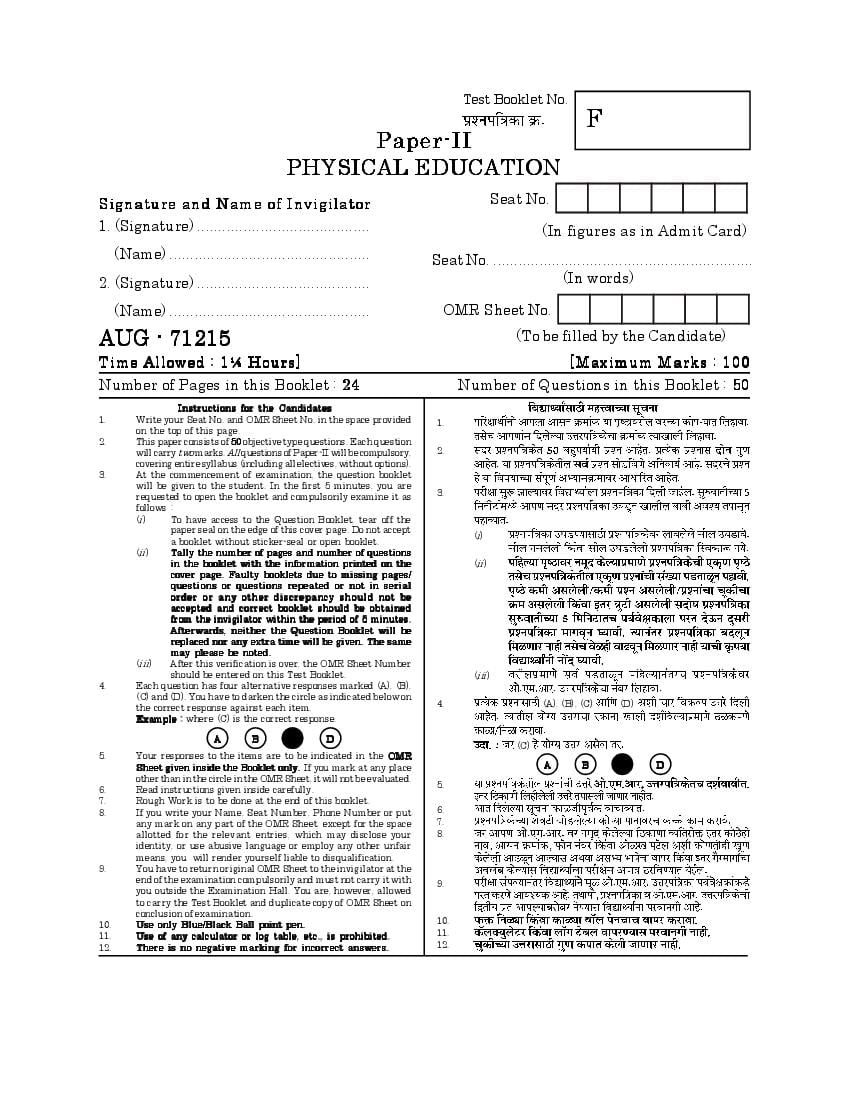
F
PHYSICAL EDUCATION
Signature and Name of Invigilator Seat No.
1. (Signature) ......................................... (In figures as in Admit Card)
(Name) ................................................ Seat No. ..............................................................
2. (Signature) ......................................... (In words)
(Name) ................................................ OMR Sheet No.
AUG - 71215 (To be filled by the Candidate)
Time Allowed : 1¼ Hours] [Maximum Marks : 100
Number of Pages in this Booklet : 24 Number of Questions in this Booklet : 50
Instructions for the Candidates
1. Write your Seat No. and OMR Sheet No. in the space provided 1.
on the top of this page.
2. This paper consists of 50 objective type questions. Each question
will carry two marks. All questions of Paper-II will be compulsory, 2.
covering entire syllabus (including all electives, without options).
3. At the commencement of examination, the question booklet
will be given to the student. In the first 5 minutes, you are
requested to open the booklet and compulsorily examine it as 3.
follows :
(i) To have access to the Question Booklet, tear off the
paper seal on the edge of this cover page. Do not accept
(i)
a booklet without sticker-seal or open booklet.
(ii) Tally the number of pages and number of questions
in the booklet with the information printed on the (ii)
cover page. Faulty booklets due to missing pages/
questions or questions repeated or not in serial
o rder or any other discre pancy should not be
accepted and correct booklet should be obtained
from the invigilator within the period of 5 minutes.
Afterwards, neither the Question Booklet will be
replaced nor any extra time will be given. The same
may please be noted.
(iii) After this verification is over, the OMR Sheet Number
should be entered on this Test Booklet. (iii)
4. Each question has four alternative responses marked (A), (B),
(C) and (D). You have to darken the circle as indicated below on
the correct response against each item. 4. (A), (B), (C) (D)
Example : where (C) is the correct response.
A B D
(C)
5. Your responses to the items are to be indicated in the OMR
Sheet given inside the Booklet only. If you mark at any place A B D
other than in the circle in the OMR Sheet, it will not be evaluated.
5.
6. Read instructions given inside carefully.
7. Rough Work is to be done at the end of this booklet.
8. If you write your Name, Seat Number, Phone Number or put 6.
any mark on any part of the OMR Sheet, except for the space 7.
allotted for the relevant entries, which may disclose your 8.
identity, or use abusive language or employ any other unfair
means, you will render yourself liable to disqualification.
9. You have to return original OMR Sheet to the invigilator at the
end of the examination compulsorily and must not carry it with 9.
you outside the Examination Hall. You are, however, allowed
to carry the Test Booklet and duplicate copy of OMR Sheet on
conclusion of examination.
10. Use only Blue/Black Ball point pen. 10.
11. Use of any calculator or log table, etc., is prohibited. 11.
12. There is no negative marking for incorrect answers. 12.
Page 2
Page 3
Paper II
II
Time Allowed : 75 Minutes] [Maximum Marks : 100
Note : This Paper contains Fifty (50) multiple choice questions. Each question
carries Two (2) marks. Attempt All questions.
(50) (2)
1. The mind interprets events and 1.
creates reality, where truth and
values are absolute and universally
shared is known as :
(A)
(A) Naturalism
(B)
(B) Idealism
(C)
(C) Pragmatism
(D)
(D) Realism
2.
2. Sport Sociology deals with :
(1) Transforming sport (1)
(2) Behaviour of man in society (2)
(3) Activities of the mind (3)
(4) Gender issues in sport (4)
Select the correct codes :
(A) (1), (2) and (4) (A) (1), (2) (4)
(B) (2), (3) and (4)
(B) (2), (3) (4)
(C) (1), (2) and (3)
(C) (1), (2) (3)
(D) (1), (3) and (4)
(D) (1), (3) (4)
3 [P.T.O.
Page 4
3. Turnvereine Association where
Gymnastic was designed to build
strong and fit youth in Germany was
founded by :
(A)
(A) Adolph Speiess
(B)
(B) Friedrich Ludwig John
(C)
(C) J.F. Guts Muths
(D)
(D) Johann B. Basedow
4.
4. During intense exercises the supply
of blood increases towards :
(A) Brain (A)
(B) Skin (B)
(C) Kidney (C)
(D) Skeletal muscles
(D)
4
Page 5
describes the bodies ability to
maintain its normal state ?
(A)
(A) Anabolism
(B)
(B) Catabolism
(C)
(C) Homeostasis
(D)
(D) Metabolism
6.
6. The importance of Krebs cycle is in
the production of :
(A) ATP (A)
(B) Water (B)
(C) ADP (C)
(D) Acetyl CoA (D) CoA
7. The following belong together except
7.
which one ?
(A)
(A) Trachea
(B)
(B) Bronchi
(C)
(C) Larynx
(D) Esophagus (D)
5 [P.T.O.
Page 6
circulated each minute is known as :
(A) Aerobic output (A)
(B) Cardiac output (B)
(C) Lung volume (C)
(D) Tidal volume (D)
9. The leader who allows complete 9.
freedom in decision making and does
not participate in the group activities
is : (A)
(A) Autocratic
(B)
(B) Democratic
(C)
(C) Laissez-faire
(D) Easy going (D)
10. Which is the most effective method 10.
for encouraging self-learning ?
(A) Demonstration method (A)
(B) Lecture method (B)
(C) Observation method (C)
(D) Task method (D)
6
Page 7
things most often repeated are the
best retained ?
(A) Law of readiness (A)
(B) Law of exercise (B)
(C) Law of effect (C)
(D) Law of recency (D)
12. Both positive and negative transfers 12.
are largely the results of :
(A) Similarity of responses in the (A)
first and the second task
(B) Dissimilarity of responses in the
(B)
first and the second task
(C) Both similarity and
(C)
dissimilarity of responses in the
first and the second task
(D) Co-ordination of responses in (D)
the first and the second task
7 [P.T.O.
Page 8
propounded by :
(A) Behaviourists (A)
(B) Gestalists (B)
(C) Structuralist
(C)
(D) Functionalist
(D)
14. The meaning of motor skill is :
14.
(A) Manipulation (A)
(B) Learning of operating machines
(B)
(C) Learning to drive motor cars
(C)
(D) Learning which involves mainly
(D)
the use of muscles
15. Vertebra, Sacrum and Coccyx are
15.
the examples of :
(A) Long bones (A)
(B) Flat bones (B)
(C) Irregular bones (C)
(D)
(D) Short bones
8
Page 9
16. Movements that occur primarily in
the sagittal plane are :
(A)
(A) Adduction, lateral flexion,
flexion, dorsiflexion
(B) Flexion, extension, dorsiflexion, (B)
plantar flexion
(C) Flexion, extension, dorsiflexion, (C)
internal-external rotation
(D) Supination and pronation
(D)
17. Lifting the lateral border of the foot
17.
is an example of :
(A) Elevation
(A)
(B) Pronation (B)
(C) Inversion (C)
(D) Eversion (D)
9 [P.T.O.
Page 10
acceleration :
(A)
(A) Its speed always increases
(B)
(B) Its velocity always increases
(C)
(C) It always falls towards the earth
(D) A force always acts on it (D)
19. In a second class lever what lies at 19.
both the ends ?
(A)
(A) Fulcrum and force
(B)
(B) Force and resistance
(C)
(C) Fulcrum and resistance
(D)
(D) Fulcrum, force resistance
20.
20. Arrange the following phases of shot-
put according to sequence from the
beginning : (1)
(1) Release action
(2)
(2) Glide
(3)
(3) Putting stance
(4)
(4) Standing stance
Select the correct option :
(A) (3), (2), (1) and (4) (A) (3), (2), (1) (4)
(B) (2), (3), (1) and (4) (B) (2), (3), (1) (4)
(C) (4), (3), (1) and (2) (C) (4), (3), (1) (2)
(D) (4), (2), (3) and (1) (D) (4), (2), (3) (1)
10
Page 11
is :
(A)
(A) Holding advance credentials
(B) Decision-making (B)
(C) Practicing from an evidence-
based perspective (C)
(D) Being a member of a
(D)
professional organization
22. Arrange the correct steps in 22.
curriculum planning :
(1) Providing curriculum aids and (1)
guides
(2) Determining the purpose of (2)
education
(3)
(3) Translating the purpose in a
programme
(4)
(4) Translating into specific subject
matter
Select the correct option :
(A) (1), (2), (3) and (4) (A) (1), (2), (3) (4)
(B) (4), (3), (2) and 1 (B) (4), (3), (2) (1)
(C) (2), (3), (4) and (1) (C) (2), (3), (4) (1)
(D) (2), (1), (3) and (4) (D) (2), (1), (3) (4)
11 [P.T.O.
Page 12
the ‘National Curriculum Frame-
work’ in India ?
(A)
(A) UGC
(B)
(B) NCERT
(C)
(C) NCTE
(D) CBSE (D)
24. Which disease is also called 24.
“Lockjaw” ? (A)
(A) Tetanus
(B)
(B) Rabies
(C)
(C) Leprosy
(D)
(D) Measles
25. Which of the following nutrients 25.
contains the element of nitrogen ?
(A) Water (A)
(B) Protein (B)
(C) Carbohydrates (C)
(D) Fat (D)
12
Page 13
obesity ?
(A) 18.5—24.9
(A) 18.5 to 24.9
(B) 40
(B) 40 or higher
(C) 30—39.9
(C) 30 to 39.9
(D) 25 to 29.9 (D) 25—29.9
27. Which of the following is not an 27.
aspect of health related fitness ?
(A) Flexibility
(A)
(B) Aerobic capacity
(B)
(C) Muscular strength and
endurance (C)
(D) Balance (D)
28. Equated group design is also called : 28.
(A) Random group design (A)
(B) Repeated measures design (B)
(C)
(C) Reverse group design
(D)
(D) Parallel group design
13 [P.T.O.
Page 14
29.
generally applied for the
determination of sampling error
is :
(A)
(A) Mean
(B)
(B) Correlation
(C) Chi-square test (C)
(D) Standard deviation (D)
30. Many types of sum of square are
30.
used in calculation of an ANOVA.
They are :
(1)
(1) Mean square
(2)
(2) Total sum of square
(3)
(3) Within group’s sum of square
(4) Between groups sum of square (4)
Select the correct sequence from the
codes given below :
(A) (1), (2), (3) and (4) (A) (1), (2), (3) (4)
(B) (3), (4), (1) and (2)
(B) (3), (4), (1) (2)
(C) (2), (3), 4) and (1)
(C) (2), (3), 4) (1)
(D) (4), (1), (2) and (3)
(D) (4), (1), (2) (3)
14
Page 15
experimental design the subject acts
as their own control ?
(A) Random group design (A)
(B) Single group design (B)
(C) Repeated measures design (C)
(D) Factorial design (D)
32. Official records, personal records 32.
pictoral records are :
(A) primary sources
(A)
(B) secondary sources
(B)
(C) both primary and secondary
(C)
sources
(D)
(D) critical sources
33.
33. The process of assembling and using
resources in an organization is
known as :
(A)
(A) organizing
(B)
(B) controlling
(C)
(C) staffing
(D) directing (D)
15 [P.T.O.
Page 16
tool used quantity and allocate
resources to specific activities ?
(A) Budget
(A)
(B) Contingency plan
(B)
(C) Accounting
(C)
(D) Benchmarking
(D)
35. In accordance with which principle
35.
of training does the coach load his
athletes in a group ?
(A) Principles of uniformity and
(A)
differentiation
(B)
(B) Continuity of load
(C)
(C) Progression of loading
(D)
(D) Regulation of training
16
Page 17
strength training in which all
repetitions and sets of an exercise
are completed before starting new
exercise is termed as :
(A)
(A) Set training
(B)
(B) Station training
(C) Circuit training (C)
(D) Auxotonic training (D)
37. Which of the following sports has
37.
incorporated the instant review
system ?
(A)
(A) Kho-Kho
(B) Kabaddi (B)
(C) Football (C)
(D) Badminton
(D)
17 [P.T.O.
Page 18
38. Which official is the administrative
head of a Sports Federation ?
(A)
(A) The Patron
(B) The Chairman (B)
(C) Chief Executive Officer (C)
(D) The President (D)
39. An important advantage of 39.
planning in an organization is to
examine :
(A)
(A) The employees
(B)
(B) Ongoing plan
(C)
(C) The facilities and resources
(D)
(D) Critical issues facing the
organization
18
Page 19
step in a sports programme ?
(A) Directing (A)
(B) Staffing (B)
(C) Planning (C)
(D) Controlling (D)
41. A teacher who believes that all 41.
students can learn and tries to build
on their motor abilities, with develop
meaningful learning experiences
when students are engaged in :
(A) Diversity in teaching and
(A)
learning
(B)
(B) Culturally relevant training
(C) Social justice learning (C)
(D) Movement related teaching and
(D)
learning
19 [P.T.O.
Page 20
in AAHPERD health related
Physical Fitness Test ?
(A) 3
(A) 3
(B) 4
(B) 4
(C) 5
(C) 5
(D) 6 (D) 6
43.
43. When the reliability and validity of
a test have already been established,
it is called :
(A) Objective test (A)
(B) Subjective test (B)
(C) Teacher made test (C)
(D) Standardized test
(D)
20
Page 21
measure :
(A) Brain activity (A)
(B) Muscle potentiality (B)
(C) Lung capacity (C)
(D) Cardiac output (D)
45. Tennis skill is measured by : 45.
(A) Miller Wall-Volley test
(A)
(B) McDonald test
(B)
(C) Dyer test (C)
(D) Brady Volley test (D)
46. The formula used for calculating 46.
number of matches in a league
competition is :
n (n 1)
(A)
n (n 1) 2
(A)
2
n (n – 1)
n (n – 1) (B)
(B) 2
2
n (n 1) n (n 1)
(C) (C)
2 2
n (n – 1) n (n – 1)
(D) (D)
2 2
21 [P.T.O.
Page 22
(A) LSD may be used for unequal (A)
sample size
(B) Scheffe test may be used for (B)
unequal sample size
(C) Scheffe test may be used for (C)
equal sample size
(D) LSD and Scheffe test may be (D)
used for equal sample size
48. 2018 Commonwealth Games will be
48. 2018
held at :
(A)
(A) Gold Coast, Australia
(B)
(B) Rio de Janeiro, Brazil
(C)
(C) Seoul, South Korea
(D)
(D) Kuala Lumpur, Malaysia
22
Page 23
right of every citizen included in :
(A) WHO Charter
(A)
(B) UNESCO Charter
(B)
(C) SNIPES Charter
(C)
(D) HRD Minister Charter
(D)
50. Indian Molkhamb Team gave 50.
demonstration in which Olympic
Games ?
(A) 1932
(A) 1932
(B) 1936
(B) 1936
(C) 1940
(C) 1940
(D) 1944
(D) 1944
23 [P.T.O.
Page 24
24
Document Details
| Board / Org | Maharashtra Exams |
| Exam | MAHA SET |
| Type | Question Paper |
| Pages | 24 |
| Updated | 30 Apr 2026 |