CBSE Class 12 Question Paper 2022 Solution Physical Education
Finished viewing? Save it for later —
Download CBSE Class 12 Question Paper 2022 Solution Physical Education (PDF · 17 pages)About CBSE Class 12 Question Paper 2022 Solution Physical Education
CBSE Class 12 Question Paper 2022 Solution Physical Education is available here for free download. Published by CBSE for Class 12, this solution can be viewed online or downloaded as a PDF (17 pages). Candidates preparing for Class 12 can use CBSE Class 12 Question Paper 2022 Solution Physical Education to understand the exam pattern, the type of questions asked, and the overall difficulty level.
Frequently Asked Questions
How can I download CBSE Class 12 Question Paper 2022 Solution Physical Education?
Open this page and click the Download button to save CBSE Class 12 Question Paper 2022 Solution Physical Education as a PDF. It is completely free on AglaSem Docs.
Is CBSE Class 12 Question Paper 2022 Solution Physical Education free to download?
Yes. CBSE Class 12 Question Paper 2022 Solution Physical Education can be viewed online and downloaded as a PDF free of cost on AglaSem Docs.
How many pages does CBSE Class 12 Question Paper 2022 Solution Physical Education have?
CBSE Class 12 Question Paper 2022 Solution Physical Education contains 17 pages, which you can read online or download together as a single PDF.
Where can I find more Class 12 study material?
You can find more Class 12 question papers, sample papers, syllabus, and answer keys on AglaSem Docs.
CBSE Class 12 Question Paper 2022 Solution Physical Education – Text
Read the full text of this solution below — useful to quickly search, copy and reference the content online without downloading the PDF.
📄 View text version (17 pages)
Page 1
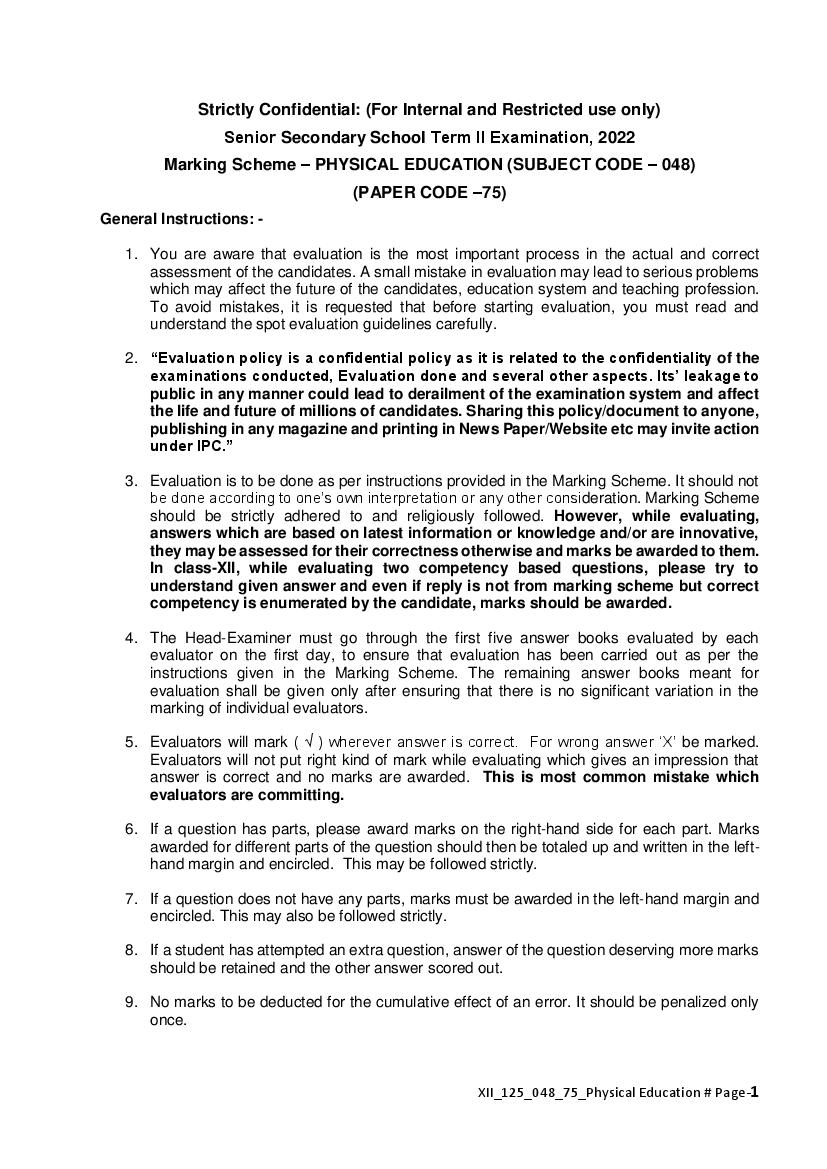
Senior Secondary School Term II Examination, 2022
Marking Scheme – PHYSICAL EDUCATION (SUBJECT CODE – 048)
(PAPER CODE –75)
General Instructions: -
1. You are aware that evaluation is the most important process in the actual and correct
assessment of the candidates. A small mistake in evaluation may lead to serious problems
which may affect the future of the candidates, education system and teaching profession.
To avoid mistakes, it is requested that before starting evaluation, you must read and
understand the spot evaluation guidelines carefully.
2. “Evaluation policy is a confidential policy as it is related to the confidentiality of the
examinations conducted, Evaluation done and several other aspects. Its’ leakage to
public in any manner could lead to derailment of the examination system and affect
the life and future of millions of candidates. Sharing this policy/document to anyone,
publishing in any magazine and printing in News Paper/Website etc may invite action
under IPC.”
3. Evaluation is to be done as per instructions provided in the Marking Scheme. It should not
be done according to one’s own interpretation or any other consideration. Marking Scheme
should be strictly adhered to and religiously followed. However, while evaluating,
answers which are based on latest information or knowledge and/or are innovative,
they may be assessed for their correctness otherwise and marks be awarded to them.
In class-XII, while evaluating two competency based questions, please try to
understand given answer and even if reply is not from marking scheme but correct
competency is enumerated by the candidate, marks should be awarded.
4. The Head-Examiner must go through the first five answer books evaluated by each
evaluator on the first day, to ensure that evaluation has been carried out as per the
instructions given in the Marking Scheme. The remaining answer books meant for
evaluation shall be given only after ensuring that there is no significant variation in the
marking of individual evaluators.
5. Evaluators will mark ( √ ) wherever answer is correct. For wrong answer ‘X’ be marked.
Evaluators will not put right kind of mark while evaluating which gives an impression that
answer is correct and no marks are awarded. This is most common mistake which
evaluators are committing.
6. If a question has parts, please award marks on the right-hand side for each part. Marks
awarded for different parts of the question should then be totaled up and written in the left-
hand margin and encircled. This may be followed strictly.
7. If a question does not have any parts, marks must be awarded in the left-hand margin and
encircled. This may also be followed strictly.
8. If a student has attempted an extra question, answer of the question deserving more marks
should be retained and the other answer scored out.
9. No marks to be deducted for the cumulative effect of an error. It should be penalized only
once.
XII_125_048_75_Physical Education # Page-1
Page 2
be used. Please do not hesitate to award full marks if the answer deserves it.
11. Every examiner has to necessarily do evaluation work for full working hours i.e. 8 hours
every day and evaluate 30 answer books per day in main subjects and 35 answer books
per day in other subjects (Details are given in Spot Guidelines). This is in view of the
reduced syllabus and number of questions in question paper.
12. Ensure that you do not make the following common types of errors committed by the
Examiner in the past :-
Leaving answer or part thereof unassessed in an answer book.
Giving more marks for an answer than assigned to it.
Wrong totaling of marks awarded on a reply.
Wrong transfer of marks from the inside pages of the answer book to the title page.
Wrong question wise totaling on the title page.
Wrong totaling of marks of the two columns on the title page.
Wrong grand total.
Marks in words and figures not tallying.
Wrong transfer of marks from the answer book to online award list.
Answers marked as correct, but marks not awarded. (Ensure that the right tick mark is
correctly and clearly indicated. It should merely be a line. Same is with the X for incorrect
answer.)
Half or a part of answer marked correct and the rest as wrong, but no marks awarded.
13. While evaluating the answer books if the answer is found to be totally incorrect, it should be
marked as cross (X) and awarded zero (0) Marks.
14. Any unassessed portion, non-carrying over of marks to the title page, or totaling error
detected by the candidate shall damage the prestige of all the personnel engaged in the
evaluation work as also of the Board. Hence, in order to uphold the prestige of all
concerned, it is again reiterated that the instructions be followed meticulously and
judiciously.
15. The Examiners should acquaint themselves with the guidelines given in the Guidelines for
spot Evaluation before starting the actual evaluation.
16. Every Examiner shall also ensure that all the answers are evaluated, marks carried over to
the title page, correctly totaled and written in figures and words.
17. The Board permits candidates to obtain photocopy of the Answer Book on request in an
RTI application and also separately as a part of the re-evaluation process on payment of
the processing charges.
XII_125_048_75_Physical Education # Page-2
Page 3
a. The making scheme carries only suggested value points for the answers.
b. These are only Guideline and do not constitute the complete answer.
c. The students can have their own expression and if the expression is correct, the marks be
awarded accordingly.
d. The candidates would be permitted to obtain a photocopy of the Answer book on request
on payment of the prescribed processing fee. All Examiners/Additional Head Examiners
are once again reminded that they must ensure that evaluation that is carried out strictly
as per value points for each answer as given in the marking Scheme.
e. All the Head Examiners/Additional Head Examiners/Examiners are instructed that while
evaluating the answer scripts, if the answer is found to be totally incorrect, (X) should be
marking on the incorrect answer and awarded ‘0’ marks.
XII_125_048_75_Physical Education # Page-3
Page 4
Senior Secondary School Examination TERM–II, 2022
PHYSICAL EDUCATION (Subject Code – 048)
[ Paper Code – 75]
Maximum Marks: 35
Section - A
Q. No. EXPECTED ANSWER / VALUE POINTS Marks
1. “Asanas can be used as a preventive measure.” Comment. 2
Asanas strengthen the Immune System
Improve blood circulation
Efficient working of Respiratory System
Improves Digestive System
Efficiency of the Nervous System increases.
Excretory System becomes efficient
Stimulate and regulate the functions of endocrine glands
Improve concentration ability
Improve body flexibility
(Any 4 or any other relevant points) 2
2. What is Active and Passive flexibility?
1. Active Flexibility: It is the ability of joints to do movements without any
external help. The stretching is done to its full range without the help of a
partner. It is further divided into two categories- Static and Dynamic
flexibility.
2. Passive Flexibility: It is the ability of joints to do movements with external 1+1
help. E.g. performing stretching exercise with the help of partner.
2
3. “Extrinsic motivation sometimes may kill intrinsic motivation.” Justify.
Extrinsic motivation refers to behavior that’s driven by external rewards like
cash, fame, grades, and praise.
Extrinsic motivation sometimes may kill intrinsic motivation. As a consequence
of extrinsic motivation an athlete initiates and assists an activity for attraction,
incentive, rewards etc.
Earlier or later the athlete loses interest and quits the sport once the rewards etc.
aren’t any longer forthcoming.
For example, children may start playing cricket for fun and excitement, and may
be motivated to practice and compete regularly at sports training centres but may 2
XII_125_048_75_Physical Education # Page-4
Page 5
succeed, This conflict between the motives to exercise or participate in sports
usually leads to burnout and later to dropping out from sports altogether.
(Any other similar points) 2
Define disability and list down any two types of disability.
4.
A physical or mental condition that limits a person's movements, senses, or
activities.
Or
Disability is the state of an individual, when he/she cannot work efficiently.
Disability
Cognitive Intellectual Physical Disability
Memory disorder, Reasoning Mobility
Hyperactive Learning Dexterity,
Dyslexia Problem solving Respiratory disorder,
Communication Vision
Judgment Epilepsy
Sleep disorder
Motor deficiency
Sensory impairment
1+½+½
(Any one relevant definition and any 2 types of relevant disabilities) 2
5. Describe any 2 objectives of first aid.
1 Preserves Life
2 Promotes recovery
3 Protects from unconsciousness
4 Prevents the escalation of the illness or Injury
5 Pain relief
6 To make the victim comfortable till he is transported to a
medical facility as per necessity. 1+1
2
(explain any 2 points)
XII_125_048_75_Physical Education # Page-5
Page 6
1 Reaction Ability: It is ability to react against the signal. It is of 2
types—simple reaction ability and complex reaction
ability.
E.g. 100 Mts. start
2 Balance Ability It is the ability to maintain the balance during static
and moving condition.
E.g. Water-skiing or performing on balancing beam.
3 Rhythm Ability: It is the ability to understand the rhythm and to do the
movement accordingly.
E.g. This kind of ability is vital in gymnastics, synchronized
swimming acts diving and figure skating.
4 Adaptation Ability to change the complete movement on the basis
Ability : of changes or anticipated changes in the situation.
E.g. This ability is needed in combat sports like judo,
wresting, etc.
5 Differentiation It is ability to achieve high level of fine tuning
Ability: between the individual movement phases and body
part movements
E.g. basketball dribbling by a fresher and movement
efficiency through regular practice.
6 Coupling Ability: It is the ability to couple two or more movements of
different body parts for performing perfect sports
movements.
E.g. Coordination between hands, feet and eyes
like marching, smashing etc.
7 Orientation Ability to change position and movement of the body
Ability: in time and space in relation to a definite field of 1+1
action.
E.g. Starting from the blocks in sprints.
(Any 2 types with any relevant example)
2
7. What are the symptoms of Autism Spectrum Disorder?
1 Difficulty in communication.
2 Repetitive behaviour.
3 Does not express emotions.
4 Avoids eye contact
5 Touching object repeatedly
6 Don’t make friends.
7 Sensitive to taste, smell and sound. 1+1
8 Difficulty in speech.
9 Failure to show interest, not responding to name
10 Avoid social interactions.
(Any 2 relevant points)
2
XII_125_048_75_Physical Education # Page-6
Page 7
1. Aerobic capacity
2. Oxygen Intake
3. Oxygen uptake
4. Energy reserve
5. Lactic acid tolerance
6. Anaerobic capacity
7. Movement Economy
8. Vo2 max
9. Muscle composition 1+1
(Explain any 2 points) 2
9. Enlist any 4 causes of Oppositional Defiant Disorder.
1 Biological or Genetic factors
2 Physical Factors
3 Psychological Factors
4 Social Factors
5 Environmental Factor
(list any 4 relevant characteristics from the above factors) 2
2
Section- B
10. Define aggression. Discuss any 2 types of Aggression.
Aggression: The kind of behaviour that causes harm or damage to people or 1+2
property.
Or (any other relevant definition)
Types:
Hostile aggression refers to actions motivated by anger and that are intended
solely to harm someone. Their primary aim is to cause injury to the other human
being. Unplanned, reactionary, impulsive, fuelled by intense emotions,
aggressors have a loss of control during outbursts and experience physiological
hyper arousal.
Instrumental aggression is necessary to achieve performance goals. Athletes
attempt to injure an opponent because they believe that doing so will increase
their chances of victory. Instrumental aggression is used to gain advantage or win
not because of enmity or anger.
Assertive Behaviour: The aim of assertive behaviour is to communicate
productively with another person, achieving what is often described as a win/win
outcome. This involves standing up for your own rights without violating those
of the other person. To do this, you need to express your needs, wants, opinions,
beliefs and feelings in a direct, honest and adult way.
Or
XII_125_048_75_Physical Education # Page-7
Page 8
(Similar Explanation for any two)
What do you mean by disability etiquettes? List down any 4 disability
11.
etiquettes while communicating with a person with special needs.
Disability etiquettes are a set of guidelines dealing specifically with how to
approach a person with disability.
OR
Disability etiquettes refer to communicating and interacting respectfully and
courteously with people who have disabilities.
Disability etiquettes
Communication should be two ways
- speaking to the person directly, and not to the person accompanying her/him
- Establish a rapport with her/him
If necessary, use a communication aid such as a communication book or
communication device.
Keep your tone low.
Communicate with the individual slowly and clearly.
Give them time to respond.
Language to be used must be very nice and humble.
Always look at and speak directly to the person.
Never be rude. Always be polite.
Speak clearly and slowly, but without exaggerating your lip movements
or shouting.
Use sign language if you and the person are both familiar with it.
When an interpreter accompanies a person, direct your remarks to the
person rather than to the interpreter.
While talking to that person keep your body low and be in front of his eye
level.
Without any hurry, hear out the person patiently.
Try to read body language and lip sync. Don’t make awkward faces.
If there is any trouble in understanding, then provide enough time for the
person to explain.
Use short questions and answers while communication.
While coming in contact with a person with visual impairment always
introduce yourself. 1+2
(Any four relevant points) 3
XII_125_048_75_Physical Education # Page-8
Page 9
Stress Greenstick Comminuted Impacted
Management of Bone Injuries
a. Stress Fracture
1. Rest while the bone heals itself.
2. Apply ice for 24 to 48 hours. (Every 2 hrs. for 15-20 mins.)
3. Give painkillers with the consent of medical expert.
4. Use a splint if there is a need for immobilization
5. Start putting lightweight on the affected area after the swelling is reduced.
6. Avoid doing the activity that caused fracture for at least 6 weeks.
7. Take physiotherapy after the restoration of the bone to normal condition.
b. Greenstick Fracture
1. Immobilization with the help of a removable splint
2. swelling can be reduced with medicine
3. Use painkillers with the consent of medical expert.
4. Take physiotherapy after the restoration of the bone to normal condition.
c. Comminuted Fracture
1. Use plasters and splint above and below the fractured area as there
are many fragment pieces of bone.
2. Use painkillers with the consent of medical expert.
3. Take physiotherapy after the restoration of the bone to normal condition.
d. Transverse Fracture
1. Hospitalization is not necessary if the injury is limited to the minor break.
2. Serious Case in which the spinal cord can damage requires an operation.
3. Use Painkiller and avoid any activity.
4. Take physiotherapy after the restoration of the bone to normal condition.
e. Oblique Bone Fracture
1. Most Oblique bone fracture requires surgery for treatment.
2. If the damage is extensive, metal rods and screws are used to hold the bone in
place.
3. Take physiotherapy after the restoration of the bone to normal condition.
f. Impacted Fractures
1. Use a Sling or splint for immobilization. 1½+1½
XII_125_048_75_Physical Education # Page-9
Page 10
3. Take physiotherapy after the restoration of the bone to normal condition.
(Any two types with diagram and management technique)
Note for visually impaired candidates pick any two types of bone injury with their
management from the above.
3
13. Write the benefits and contraindications of Matsyasana.
Benefits :
1. Matsyasana opens and stretches the neck muscles and shoulders.
2. Helps in opening the chest and corrects round shoulders too.
3. This posture provides relief from respiratory disorders by encouraging deep
breathing. Hence, Matsyasana increases lung capacity to a great extend.
4. This posture (with the spine curved and bent backwards) provides a great way
of strengthening the back muscles with the formation of the arch.
5. There is an increased supply of blood to the cervical and thoracic regions of
the back that helps tone the parathyroid, pituitary and pineal glands.
6. The practice of Matsyasana brings down the tensions and the stiffness at the
neck and the shoulders. It also helps in curing the initial stages of spondylitis
with the guidance of an experienced yoga teacher.
7. The repeated practice of Matsyasana improves the flexibility of the neck. This
flexibility in the neck helps in the practice of various other yoga poses of
advance level.
8. This posture helps to regulate emotions and stress.
Contraindications :
1. People who are suffering from heart diseases, high blood pressure or low
blood pressure should not perform Matsyasana.
2. Patients of migraine and insomnia should also abstain from practicing the fish
posture.
3. Individuals having serious neck or lower-back injuries are recommended
strongly not to perform this pose.
4. Men and women who just had an abdominal surgery should not perform
Matsyasana. This also applies to people with hernia.
5. If a person has issues like dizziness or cervical spine problems, then he or she
should not perform this asana.
6. People having peptic ulcers should also refrain from including Matsyasana in
their yoga routine.
7. The pose should be performed only under the close observation of an 1½+
experienced yoga teacher. 1½
( Any 3 benefits and any 3 contraindication) 3
XII_125_048_75_Physical Education # Page-10
Page 11
Isometric Isotonic
1 Isometric exercise involves static Isotonic exercise involves dynamic
muscle contraction against a movement but doesn’t require a
stationary resistance. constant movement speed.
2 It is used in only few games like It is the most popular and effective type
Gymnastics, weightlifting, of strength training used in almost all
wrestling etc. games and sports.
3 It develops maximum strength. It develops explosive strength.
4 Iso-same, metric-length this is a Iso-same, tonic- tension, a type in which
type of muscle contraction in the muscle changes in length either
which muscle remains at same shortening or lengthening.
length.
5 It can rehabilitate immobilised Does not contribute to rehabilitation.
joints
6 Strength developed do not last Strength developed remains for a
long longer period.
7 Poor development of coordination Develops excellent coordination.
and skill.
8 Does not contribute to develop Contributes to develop endurance and
endurance and speed. speed
9 Movements of exercising body Movements of exercising body parts are
parts are not visible. visible.
10 Recovery from muscular fatigue is Recovery from muscular fatigue is fast.
slow.
11 e.g. Pushing against wall, Flexed e.g. Push-ups, Pull-ups, Rope climbing,
arm hang etc. bench press etc.
(Any 3 relevant points) 1×3
3
Section - C
What are the personality traits according to the Big Five Theory?
15.
Personality Traits:- Big five Theory
Openness –
- More willing to embrace new things
- Being imaginative
- Insightful and having variety of interest
- Open minded
- Curious
Extraversion –
- Talkative, vocal and energetic
- Socialize easily and make friends easily.
- Positive emotions
- Enthusiastic
- Action oriented
1×4
Conscientiousness –
XII_125_048_75_Physical Education # Page-11
Page 12
- Trustworthy, dutiful,
- Self-disciplined and responsible.
- Detail oriented
- Punctual
- Strong work ethics
Agreeableness –
- Kind loving and compassionate
- Agree with others and compatible
- Co- operative and polite.
- Empathetic and affectionate
- Trustworthy and honest
Neuroticism –
- Emotionally unstable
- Unsuccessful in maintaining inter personal relationships.
- Sad and moody
- Feeling of self-doubt
- Anxiety and irritability
- Unable to handle stress
- Self-conscious and shy
(explain any 4 traits)
4
XII_125_048_75_Physical Education # Page-12
Page 13
16.
respiratory system.
Short-term effects of exercise on cardiorespiratory :
1. Increased heart rate
2. Increased blood circulation
3. Increased blood pressure
4. Increased stroke volume
5. Increased cardiac output
6. Increased breath rate
7. Increased tidal volume
8. Oxygen up-take increase
Long-term effects of exercise on cardiovascular system :
1. Increased size and strength of heart
2. Low level of accumulation of lactic acid
3. Decrease in resting heart rate
4. Normal blood pressure.
5. Increase in stroke volume and cardiac output
6. Increase strength of intercostal muscles
7. Diaphragm muscles strengthen
8. Lungs volume increases
9. Vital capacity increases
10. No of RBC & WBC increases
11. Diffusion of gases increases
12. Unused Alveoli become active
13. Delay in Second wind. 2+2
14. Increase in Residual volume
(Explain any 2 points from each category) 4
XII_125_048_75_Physical Education # Page-13
Page 14
17.
Endurance – Ability to Sustain an Activity.
Or
Physiologic capacity of an individual to sustain movement over a period of time.
Or
Ability to resist fatigue
Methods of Endurance development
1.Continuous training method.
2. Interval training method
3. Fartlek training method
1. Continuous Method: Best method. Exercise is performed without break.
Intensity remains low but exercise is done for a longer period.
Best example: Cross country race.
Rate of heart beat remains btw 140 - 160 beats per minute
Total duration of exercise is not less than 30 minute
Duration can be increased according to ability of athlete.
It can be either slow or fast continuous.
2. Interval Method: Based on effect and recovery principle.
Recovery period is given to athlete after each speedy workout.
Recovery period can be adjusted according to efficiency of athlete.
Load can be increased by reducing the recovery period or by increasing the
workout
eg: 1. 400 mts race with 80% speed
2. Working or jogging till heart rate comes down to 120-140 beats/min
3. 400 mts race with 80% speed
Repetitions depend on experience or capacity of athlete
3. Fartlek method: It means speed play
Blending of continuous and interval training
Lays emphasise on both aerobic & anaerobic systems
Pace or speed is not pre planned and is left on discretion of individual. Speed can
be changed as per surroundings.
(Hills, Rivers, Forest, Muddy roads etc.)
Heart rate ranges between 140-180 beats/min and the duration of training
depends upon the experience of athlete.
1+3
(Any one relevant definition and explain 3 methods) 4
What is obesity? Draw stick diagram of any two asanas recommended to 1+(1½
18.
control obesity and explain their procedure. ×2 )
Obesity is a condition in which excess body fat accumulates to such an extent that
health may be affected. It is commonly defined as a Body Mass Index (BMI) of
30kg/m2 or higher.
Or
Obesity, in absolute terms, is an increase of body adipose tissue (fat tissue) mass.
Or
XII_125_048_75_Physical Education # Page-14
Page 15
Any two out of the following Asanas
Vajarasana
Procedure:
1. Kneel on the ground on floor with your knees, ankles and toes touching the
ground.
2. Toes should be stretched backwards.
3. Place palms of both the hands on your knees.
4. Upper body must be straight.
5. Keep control on breath, take a long breath, hold and exhale.
6. For mental peace, keep your eyes closed and focus on breath.
7. Be in that position for 5-10 minutes.
Hastasana
Procedure:
1. Stand erect with both feet together.
2. Stretch palms facing in an upward direction.
3. Keep hands straight and near to ears. Do not strain.
4. Keep knees straight.
5. Exhale while bending to one side.
6. Hold in this position for 10-15 seconds.
7. Inhale and come back to centre.
8. Repeat it from other side as well.
XII_125_048_75_Physical Education # Page-15
Page 16
Procedure:
1. Stand erect on both legs.
2. Keep your legs 1-2 feet apart so that the body weight is balanced properly.
3. Stretch the arms sideways and raise them to shoulder level.
4. Your arms should be parallel to the floor in a straight line.
5. Bend to the left side from waist towards the floor.
6. Place left hand on the left foot.
7. Stretch the right arm upwards.
8.Maintain this position for 5-10 seconds
9. Breathe normally.
10. Repeat the same procedure on the other side.
Ardhmatsyendrasana
1. Sit on the mat and extend legs in front.
2. Bend knee of left leg and place the left foot close to your right buttock.
3. Bend the right knee and place right foot on the ground.
4. Keep the left foot on right knee and keep the right hand on the backside.
5. Bend the right arm elbow and encircle the waist as much as possible as if trying
to touch the naval.
6. Turn the head towards right side and try to look behind over the shoulder.
7. Repeat the same procedure on the other side.
For visually impaired Candidates
Briefly explain the procedure of any 1 yoga asana for managing Obesity along
with its benefits and contraindications.
1.Vajarasana
Benefits:
1. Vajrasana increases flexibility in the ankles.
2. Folding of knees and thighs stretches the quadriceps muscles and improves
blood circulation.
XII_125_048_75_Physical Education # Page-16
Page 17
region and pelvic muscles are strengthened.
4. Vajrasana can be practised even after a meal. In fact, it increases the
efficiency of the digestive system and aids digestion.
5. It increases the blood circulation in the abdominal area.
6. This asana helps with people suffering from sciatica and sacral infections.
7. It is beneficial for those suffering from stomach ailments such as peptic
ulcer or hyper acidity.
8. It strengthens the pelvic muscles which helps prevent hernia and aids
women in childbirth.
Contraindications:
10. Person suffering from piles should not practice it.
11. This asana should not be practised if one is suffering from injured
ligaments at the ankles or at the knees.
12. Those suffering from hernia or intestinal ulcers should take
medical advice and guidance before practicing this asana and
should perform it under supervision of a trained yoga teacher.
13. Runners should avoid this if they have injury in their hamstrings or
the calves.
14. This asana is not to be practised by people who have severe arthritis
and pain in the knees.
2. Hastasana (Hastottanasana)
Benefits:
1. This asana improves curvature of the spine.
2. It exercises back, neck and spinal joints.
3. This asana relieves constipation.
4. It makes the waist slim, the chest board and removes fatty deposits on hips.
It also increase height of growing children.
Contraindications:
1. Avoid this asana if you are suffering from severe back, neck and shoulder
pain.
2. Patients suffering from pain in the sciatic nerve should also avoid practicing
this asana.
3. Trikonasana
4. Ardhmatsyasana
(Any 2 benefits and 2 contraindication of any 2 asana listed above) 2+2
4
***
XII_125_048_75_Physical Education # Page-17
Document Details
| Board / Org | CBSE |
| Exam | Class 12 |
| Type | Solution |
| Pages | 17 |
| Updated | 30 Apr 2026 |