HP Board 12th Class Model Test Paper 2023 Physics
Finished viewing? Save it for later —
Download HP Board 12th Class Model Test Paper 2023 Physics (PDF · 6 pages)About HP Board 12th Class Model Test Paper 2023 Physics
HP Board 12th Class Model Test Paper 2023 Physics is available here for free download. Published by Himachal Pradesh Board for Class 12, this sample paper can be viewed online or downloaded as a PDF (6 pages). Candidates preparing for Class 12 can use HP Board 12th Class Model Test Paper 2023 Physics to understand the exam pattern, the type of questions asked, and the overall difficulty level.
Frequently Asked Questions
How can I download HP Board 12th Class Model Test Paper 2023 Physics?
Open this page and click the Download button to save HP Board 12th Class Model Test Paper 2023 Physics as a PDF. It is completely free on AglaSem Docs.
Is HP Board 12th Class Model Test Paper 2023 Physics free to download?
Yes. HP Board 12th Class Model Test Paper 2023 Physics can be viewed online and downloaded as a PDF free of cost on AglaSem Docs.
How many pages does HP Board 12th Class Model Test Paper 2023 Physics have?
HP Board 12th Class Model Test Paper 2023 Physics contains 6 pages, which you can read online or download together as a single PDF.
Where can I find more Class 12 study material?
You can find more Class 12 question papers, sample papers, syllabus, and answer keys on AglaSem Docs.
HP Board 12th Class Model Test Paper 2023 Physics – Text
Read the full text of this sample paper below — useful to quickly search, copy and reference the content online without downloading the PDF.
📄 View text version (6 pages)
Page 1
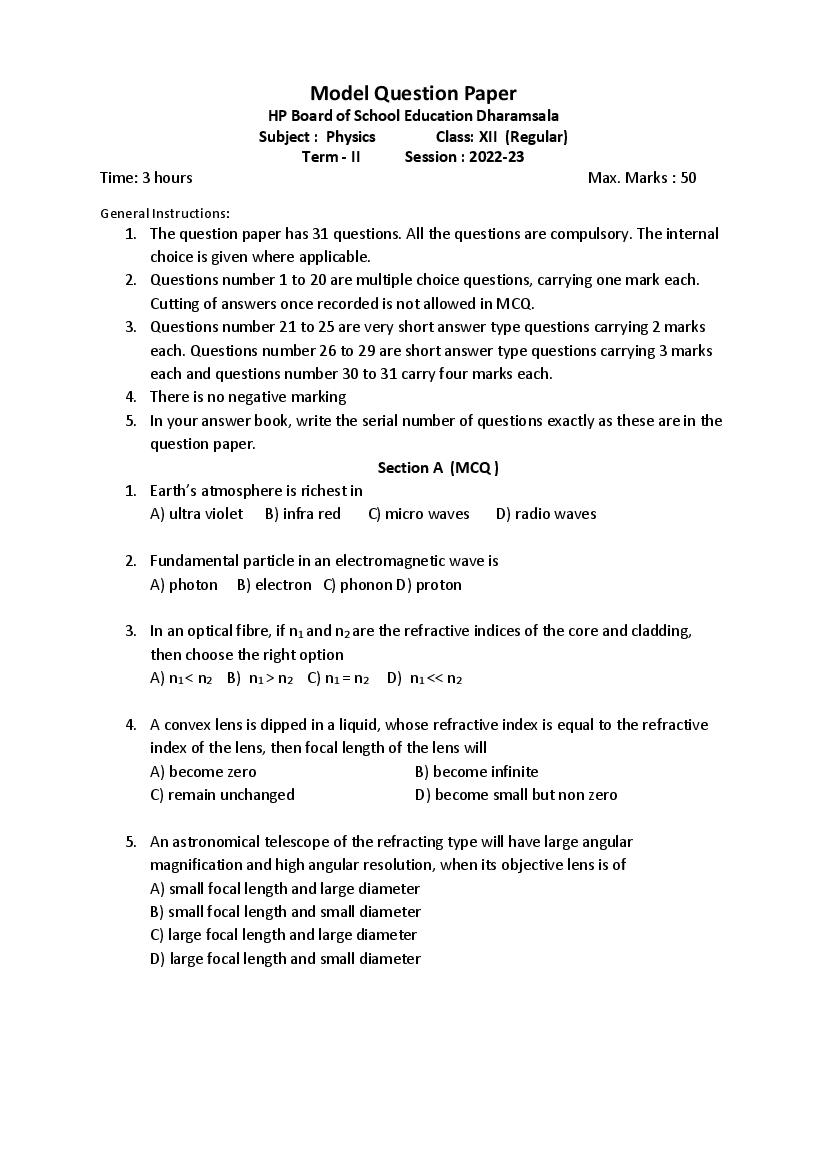
HP Board of School Education Dharamsala
Subject : Physics Class: XII (Regular)
Term - II Session : 2022-23
Time: 3 hours Max. Marks : 50
General Instructions:
1. The question paper has 31 questions. All the questions are compulsory. The internal
choice is given where applicable.
2. Questions number 1 to 20 are multiple choice questions, carrying one mark each.
Cutting of answers once recorded is not allowed in MCQ.
3. Questions number 21 to 25 are very short answer type questions carrying 2 marks
each. Questions number 26 to 29 are short answer type questions carrying 3 marks
each and questions number 30 to 31 carry four marks each.
4. There is no negative marking
5. In your answer book, write the serial number of questions exactly as these are in the
question paper.
Section A (MCQ )
1. Earth’s atmosphere is richest in
A) ultra violet B) infra red C) micro waves D) radio waves
2. Fundamental particle in an electromagnetic wave is
A) photon B) electron C) phonon D) proton
3. In an optical fibre, if n1 and n2 are the refractive indices of the core and cladding,
then choose the right option
A) n1 < n2 B) n1 > n2 C) n1 = n2 D) n1 << n2
4. A convex lens is dipped in a liquid, whose refractive index is equal to the refractive
index of the lens, then focal length of the lens will
A) become zero B) become infinite
C) remain unchanged D) become small but non zero
5. An astronomical telescope of the refracting type will have large angular
magnification and high angular resolution, when its objective lens is of
A) small focal length and large diameter
B) small focal length and small diameter
C) large focal length and large diameter
D) large focal length and small diameter
Page 2
microscopes is limited due to the phenomenon of
A) interference
B) diffraction
C) dispersion
D) total internal reflection
7. In Young’s double slit experiment, the intensity at the centre of screen is I. When one
of the slits is covered, the intensity at centre will now be
A) I/2 B) I C) I/4 D) I/3
Study the following paragraph and answer questions no. 8 and 9 based on it.
It is observed that the mass of a stable nucleus is always less than the sum of the
masses of its constituent protons and neutrons. The difference in the mass of a
nucleus and its constituents is called mass defect. Using Einstein’s mass energy
equivalence, we express the mass difference in terms of terms of energy known as the
binding energy of the nucleus. The value of B. E. Per nucleon gives a measure of the
stability of that nucleus. Greater the B. E. Per nucleon of the nucleus, more stable is
the nucleus.
8. If number of nucleons increase, then B. E. Per nucleon of the nucleus
A) first increases then decreases with mass number
B) continuously increases
C) continuously decreases
D) remains constant
9. Average B. E. Per nucleon is maximum for the nucleus
A) 2He4
B) 8O16
C) 26Fe56
D) 92U238
10. A transistor can be used as
A) oscillator and switch
B) oscillator and amplifier
C) switch and amplifier
D) All of the above
11. For a light of wavelength λ in nano meter, the photon energy hν in eV is
1240 1200 1360 λ
A) B) C) D) 1240
λ λ λ
Page 3
1. n-type semiconductor a) ne = nh
2. p-type semiconductor b) ne >> nh
3. intrinsic semiconductor c) ne << nh
4. extrinsic semiconductor d) ne ≠ nh
A) 1- c, 2- a, 3 – b, 4 – d
B) 1- b, 2- c, 3 – d, 4 – a
C) 1- b, 2- c, 3 – a, 4 – d
D) 1- b, 2- d, 3 – a, 4 – c
13. The graph of kinetic energy of emitted electron with frequency of incident radiation
is as shown
The slope of the curve is
KE
ν
A) h/ν B) h C) hc D) h/e
14. First experiment to verify wave nature of electron experimentally was
A) Young’s double slit experiment
B) Davisson and Germer experiment
C) Diffraction at single slit
D) Rutherford’s alpha scattering experiment
15. A TV transmission tower has a height of 140 m and the height of the receiving
antenna is 40 m. What is the maximum distance upto which signal can be
broadcasted from this tower using LoS mode?
A) 65 km
B) 80 km
C) 40 km
D) 48 km
16. Frequency band used for F M broadcast is of
A) 88 – 108 k Hz B) 88 – 108 M Hz C) 88 – 108 G Hz D) 88 – 108 Hz
Page 4
A) raises the potential barrier
B) reduces the majority carrier current to zero
C) lowers the potential barrier
D) none of the above
18. Match the following
1. Myopia a) convergent lens
2. Hypermetropia b) cylindrical lens
3. Astigmatism c) divergent lens
A) 1- c, 2- a, 3 – b
B) 1- b, 2- c, 3 – a
C) 1- b, 2- a, 3 – c
D) 1- a, 2- c, 3 – b
In question number 19 and 20, a statement of assertion (A) is followed by a statement
of reason (R). Mark the correct option out of the options given below
A) If both assertion and reason are correct and R is true explanation of A.
B) If both assertion and reason are correct and R is not the correct explanation of A.
C) If assertion is true but reason is false.
D) If both assertion and reason are false.
19. Assertion: Zener diode works on the principle of breakdown voltage.
Reason: Current suddenly increases after breakdown voltage
20. Assertion: When the reflected wave is perpendicular to the refracted wave, the
reflected wave is totally polarised wave.
Reason: Refractive index of a medium is numerically equal to tangent of the
polarising angle.
Section B
21. Does the apparent depth of a tank of water change if viewed obliquely? If so, does
the apparent depth increase or decrease?
OR
When a tiny circular obstacle is placed in the path of light from a distant source, a
bright spot is seen at the centre of the shadow of the obstacle. Explain why?
Page 5
distance of distinct vision is 50 cm? It is given that the distance of normal vision is 50
cm?
23. Calculate momentum of the electrons accelerated through a potential difference of
56 V.
OR
The work function for a certain metal is 4.2 eV. Will this metal give photoelectric
emission for incident radiation of wavelength 330 nm?
24. Draw a labelled energy level diagram of hydrogen atom and its various spectral
series.
25. How will you obtain an OR gate using NAND gates only.
26. Discuss the inconsistency in Ampere’s circuital law. What modification was given by
Maxwell in this law. (1.5 + 1.5 = 3)
OR
Show that the average energy density of the electric field equals the average energy
density of the magnetic field.
27. Draw the diagrams for
i) refraction of a plane wave by a thin prism
ii) refraction of a plane wave by a convex lens
iii) reflection of a plane wave by a concave mirror
28. Obtain the law of radioactive decay. Hence define disintegration constant.
OR
With the help of a labelled diagram describe in brief moderator, control rods and
coolant in a nuclear reactor.
29. a) Define sky wave propagation
b) Why space wave propagation is called LoS propagation? (1+2 = 3)
30. What is dispersion of light? Derive an expression for the angle of deviation for a ray of
light passing through an equilateral prism of refracting angle A.
OR
b) Define interference of light. Derive conditions for constructive and destructive
interference using the superposition principle.
31. a) Draw a circuit diagram for an npn transistor in common emitter configuration to
study its
Page 6
ii) output characteristics
iii) transfer characteristics
Use the relevant plots where applicable and give their important features.
OR
What is an oscillator? Give its working principle with the help of a labelled circuit
diagram, explain how a transistor can be used to produce self sustained oscillations?
Document Details
| Board / Org | Himachal Pradesh Board |
| Exam | Class 12 |
| Type | Sample Paper |
| Pages | 6 |
| Updated | 22 Jul 2026 |