PU CET PG 2018 Question Paper MSc_2Yr__Human Genomics_
Finished viewing? Save it for later —
Download PU CET PG 2018 Question Paper MSc_2Yr__Human Genomics_ (PDF · 7 pages)About PU CET PG 2018 Question Paper MSc_2Yr__Human Genomics_
PU CET PG 2018 Question Paper MSc_2Yr__Human Genomics_ is available here for free download. Published by Panjab University for PU CET PG, this question paper can be viewed online or downloaded as a PDF (7 pages). Candidates preparing for PU CET PG can use PU CET PG 2018 Question Paper MSc_2Yr__Human Genomics_ to understand the exam pattern, the type of questions asked, and the overall difficulty level.
Frequently Asked Questions
How can I download PU CET PG 2018 Question Paper MSc_2Yr__Human Genomics_?
Open this page and click the Download button to save PU CET PG 2018 Question Paper MSc_2Yr__Human Genomics_ as a PDF. It is completely free on AglaSem Docs.
Is PU CET PG 2018 Question Paper MSc_2Yr__Human Genomics_ free to download?
Yes. PU CET PG 2018 Question Paper MSc_2Yr__Human Genomics_ can be viewed online and downloaded as a PDF free of cost on AglaSem Docs.
How many pages does PU CET PG 2018 Question Paper MSc_2Yr__Human Genomics_ have?
PU CET PG 2018 Question Paper MSc_2Yr__Human Genomics_ contains 7 pages, which you can read online or download together as a single PDF.
Where can I find more PU CET PG study material?
You can find more PU CET PG question papers, sample papers, syllabus, and answer keys on AglaSem Docs.
PU CET PG 2018 Question Paper MSc_2Yr__Human Genomics_ – Text
Read the full text of this question paper below — useful to quickly search, copy and reference the content online without downloading the PDF.
📄 View text version (7 pages)
Page 1
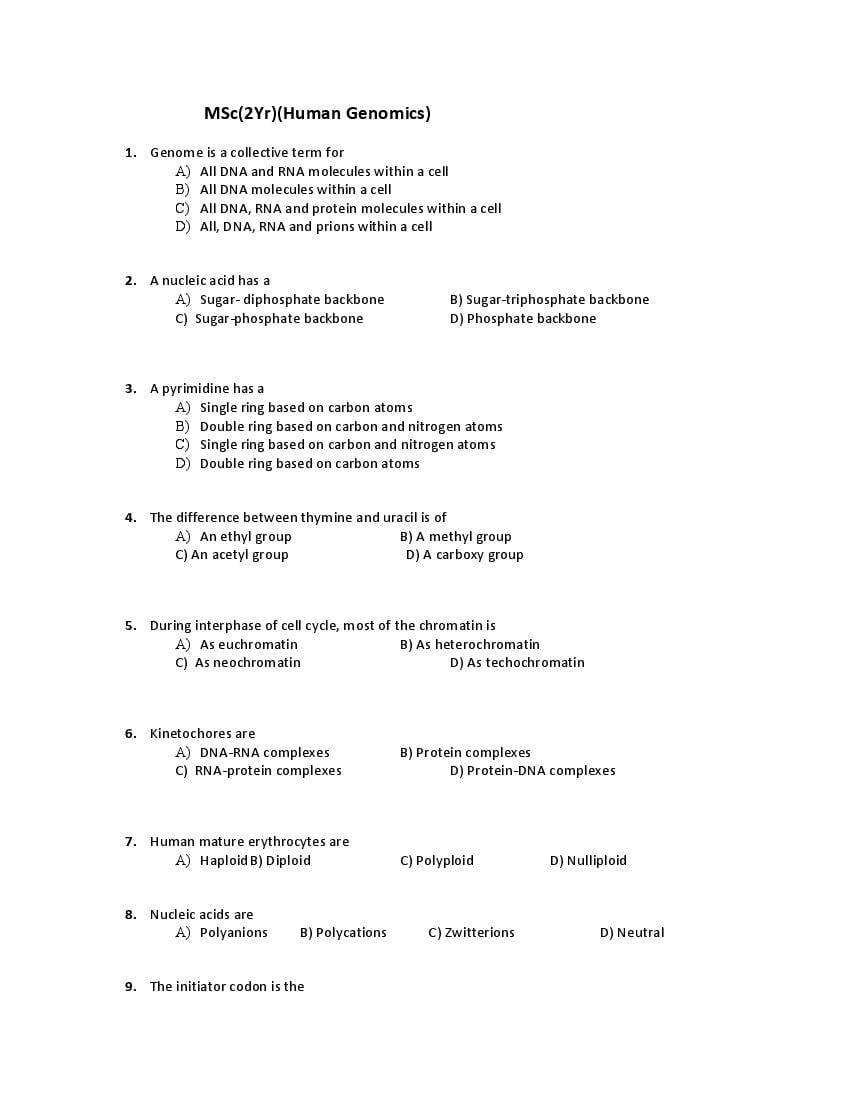
1. Genome is a collective term for
A) All DNA and RNA molecules within a cell
B) All DNA molecules within a cell
C) All DNA, RNA and protein molecules within a cell
D) All, DNA, RNA and prions within a cell
2. A nucleic acid has a
A) Sugar- diphosphate backbone B) Sugar-triphosphate backbone
C) Sugar-phosphate backbone D) Phosphate backbone
3. A pyrimidine has a
A) Single ring based on carbon atoms
B) Double ring based on carbon and nitrogen atoms
C) Single ring based on carbon and nitrogen atoms
D) Double ring based on carbon atoms
4. The difference between thymine and uracil is of
A) An ethyl group B) A methyl group
C) An acetyl group D) A carboxy group
5. During interphase of cell cycle, most of the chromatin is
A) As euchromatin B) As heterochromatin
C) As neochromatin D) As techochromatin
6. Kinetochores are
A) DNA-RNA complexes B) Protein complexes
C) RNA-protein complexes D) Protein-DNA complexes
7. Human mature erythrocytes are
A) Haploid B) Diploid C) Polyploid D) Nulliploid
8. Nucleic acids are
A) Polyanions B) Polycations C) Zwitterions D) Neutral
9. The initiator codon is the
Page 2
C) Start of splicing D) Start of supercoiling
10. tRNAs have a classic cloverleaf structure because of
A) Intermolecular hydrogen bonding B) Intermolecular phosphodiester bonds
C) Intramolecular hydrogen bonding D) Intramolecular covalent bonds
11. 3’ Untranslated region
A) Is at the end of a DNA molecule B) Is at the end of a mRNA
C) Is at the end of a rRNA D) Is at the end of a protein
12. Cyanobacteria are
A) Lithotrophs B) Organotrophs C) Autotrophs D) Chemotrophs
13. Carbon atom can form
A) Covalent single, double and triple bonds
B) Noncovalent single, double, triple bonds
C) Covalent single, and double bonds
D) Noncovalnet single and double bonds
14. Cellular dimensions are limited by
A) Rate of diffusion of solute molecules across cell membrane
B) Rate of synthesis of moleculescollision
C) Rate of enzyme catalysis
D) Rate of ATP synthesis
15. Archea is a
A) Kingdom of life B) Phylum
C) Phylogenetic group D) Type of bacteria
16. Which of the following does not protect body surfaces
A) Skin B) Gut microflora
C) Salivary amylase D) Mucus
17. Clonal selection occurs when antigen is encountered with
A) Neutrophils B) Mast cells C) T cells D) Basophils
18. Immunological unresponsiveness to self antigens is called
A) Tolerance B) Adaptive immunity
C) Memory D) Self defense
19. Which of the following microscopy techniques relies on the specimen interfering with the
wavelength of light to produce a high contrast image without the need for dyes or any damage
to the sample?.
A) Phase contrast microscopy B) Electron microscopy
C) Confocal microscopy D) Transmission electron microscopy
20. Which of the following applies to membrane lipids?
A) Scramblases and flipases catalyze flipping of lipid molecules between outer and inner
leaflets
B) Lipids can move spontaneously from one leaflet to another
C) There is no movement of lipids between outer and inner leaflets
Page 3
21. With respect to their surrounding membrane system, which is the odd one out?
A) Nucleus B) Mitochondria
C) Endoplasmic reticulum D) Chloroplast
22. Which of the following is a secondary lymphatic organ?
A) Bone marrow B) Spleen C) Thymus D) Hypothalamus
23. Which antibody is primarily found in mucosal secretions?
A) IgG B) sIgG C) sIgA D) IgA
24. Which type of cell specifically destroys virally infected body cells?
A) Cytotoxic T lymphocytes B) Activated B lymphocytes
C) Phagocytic macrophages D) Plasma cells
25. Which of the following would NOT be true of a transition state analogue for an enzyme
catalysed reaction?
A) It is broken down rapidly by the enzyme
B) It binds to the enzyme's active site
C) It makes more interactions with the enzyme than the substrate
D) It is a powerful inhibitor of the enzyme
26. DNA polymerase contains a lysine residue that is important in binding to DNA. Mutations were
constructed in which this lysine residue was converted to either glutamate, glycine, valine OR
arginine. Which mutation would be predicted to be the most and which the least deleterious to
the ability of the polymerase to bind DNA?
A) Most: valine. Least: glutamate B) Most: arginine. Least: glutamate
C) Most: glutamate. Least: arginine D) Most: arginine. Least: glycine
27. A ribosome is involved in all of the following EXCEPT
A) Formation of a peptide bond
B) Checking fidelity of translation
C) Aminoacylation of tRNA
D) Binding of aminoacyl tRNA to mRNA
28. The specialised structures found at the ends of eukaryotic chromosomes are known as
A) Terminators B) Telomeres C) Centromeres D) Long terminal repeats
29. Hsp70 is a
A) Part of core histones B) Molecular chaperone
C) Part of nucleosome D) Part of replicon
Page 4
A) CpG B) GpC C) ApC D) CpC
31. An RNA molecule can be radioactively labelled during its synthesis using
A) γ-32P ATP B) α-32P ATP
C) 32P- dideoxy -ATP D) 3H-thymidine
32. In a bacterial cloning plasmid, one function of a selectable marker could be
A) to code for an enzyme that destroys an antibiotic
B) to code for synthesis of an antibiotic
C) to kill the cell containing plasmid
D) to provide site for replication of plasmid
33. Ion exchange chromatography separates proteins on the basis of
A) Hydrophobicity B) Charge, density and shape
C) Charge and density D) Charge
34. HIV is
A) A virus which causes influenza B) A retrovirus which causes SAIDS
C) A retrovirus which causes AIDS D) A retracted virus which causes AIDS
35. According to Beer-Lamberts law, absorbance of a solute is not dependent upon
A) Concentration B) Density of the medium
C) Length of the light path D) Extinction coefficient
36. Evolution is:
A) Directed to a goal B) An intelligent design
C) A random ongoing process D) Over now
37. The bulk of stored energy in the human body is in the chemical form of
A) ATP B) Glucose C) Glycogen D) Triglycerides
38. In living systems, true criteria for spontaneity of a reaction is
A) Gibbs free energy B) Enthalpy
C) Change in entropy D) Change in Gibbs free energy
39. In living systems usually:
A) Pressure, volume and pH is variable
B) Amount of matter is variable
C) Pressure, temp, pH is constant
D) Pressure, temp, pH is variable
40. Methylation of DNA takes place in
A) Replication process B) Combination process
C) Gene imprinting D) DNA supercoiling
41. During starvation, the blood concentration of which hormone will show major increase
A) Insulin B) Glucagon C) FSH D) Leptin
42. Which of the following structures represents an interface between the nervous and endocrine
systems?
Page 5
43. One among following is not an allosteric protein
A) GPCRs B) Aspartate transcabamylase
C) Immunoglobins D) Hemoglobin
44. Which one of the following groups of compounds are hormones not formed from?
A) Proteins B) Steroids C) Peptides D) Carbohydrates
B)
45. Which of the following is not the site of action of insulin?
A) Skeletal muscle B) Smooth muscle
C) Liver D) Adipose tissue
46. If the partial pressure of carbon dioxide increases, what happens to the blood pH?
A) It will increase B) It will decrease
C) It will not change D) It will fluctuate constantly
47. mRNA with caps are found in
A) Prokaryotic systems
B) Eukaryotic systems
C) Both in prokaryotic and eukaryotic systems
D) None of the above
48. One of them is involved in translation in prokaryotes
A) RF-5 B) EF-K C) RF-3 D) EF-U
49. In transcription of a gene, the slowest step is
A) Elongation B) Termination C) Release D) Initiation
50. Which of the following process is governed by molecular recognition?
A) Brownian motion B) Passive diffusion
C) Translation by the ribosome D) Osmosis
51. Which one of the following factors would reduce the affinity of oxygen for haemoglobin?
A) Decreased pH B) Increased pH
C) Increased plasma conc. of calcium D) Decreased 2, 3, BPG
52. If the contents of the intestinal lumen are more concentrated than the blood, water will be:
A) Absorbed into the body B) Secreted into the lumen
C) No movement of water will occur D) Active transport of water into the body
53. Histones are
A) RNA binding proteins B) Regulatory proteins
C) DNA binding proteins D) Not proteins
54. The majority of carbon dioxide is transported from tissue to lungs
A) Dissolved in plasma B) Attached to plasma proteins
C) Attached to hemoglobin D) As bicarbonate ions
55. Drosha is a
A) Lipid B) Ligase C) Endoribonuclease D) Exoribonuclease
56. Biological membranes are associated with all of the following except
A) Free movement of proteins and nucleic acids across the membrane
Page 6
C) Release of protons when damaged
D) Prevention of free diffusion of ionic solutes
57. In humans, uric acid is an (excreted) end product in the catabolism of
A) Urea B) Amino acids C) Urines D) Lpyrimidines
58. RNA can make
A) Secondary structures only
B) No structures at all
C) Secondary as well as tertiary structures
D) Only primary structures
59. Proteins three dimensional structure can be determined by
A) Immunoelectron microscopy B) X-ray crystallography
C) MRI D) FTIR
60. Megaloblastic anemia is due to lack of
A) Vitamin B3 B) Vitmain K C) Vitamin B9 D) Vitamin B12
61. Which of the following is not a tandemly repeated DNA sequence?
A) LINES B) Histone genes
C) Ribosomal RNA genes D) Telomeres
62. Which enzyme catalyzes unwinding of DNA?
A) Unwindase B) Topoisomerase C) Helicase D) Flipase
63. In protein synthesis, tRNA acts as a
A) Connector molecule B) Linker molecule
C) Adaptor molecule D) Ligator molecule
64. How many different tRNA molecules are present in a human cell
A) More than twenty B) Just twenty
C) Less than twenty D) Sixty four
65. How many amino acids are encoded by the following mRNA sequence? CUUGAAGCGAUAUGA
A) 6 B) 5 C) 4 D) 3
66. Which among the following amino acid is coded by just one codon?
A) Glycine B) Alanine C) Methionine D) Proline
67. What is the energy source during elongation phase of protein synthesis?
A) CTP B) ATP C) UTP D) GTP
68. Aquaporins are
A) Proteins which mediate water transport
B) Proteins that makes holes in membranes
C) Pores for exocytosis
D) Pores for endocytosis
Page 7
A) Methionine B) Adenosylmethionine
C) Formylmethionine D) Methylatedmethionine
70. Diacylglycerol and calcium
A) Can act as second messengers B) Cannot act as second messengers
C) Have no role in signal transduction D) Are not of any use
71. What is a YAC
A) A vector B) A probe C) A microarray D) A DNA library
72. Among following which one is a G protein?
A) IF-5 B) IF-6 C) IF-5 D) EF-Tu
73. Which test is used to test the mutagenicity of a compound?
A) PCR B) ELISA C) RT-PCR D) Ames test
74. Living systems are
A) Isolated systems B) Closed systems
C) Open systems D) Not at all true systems
75. Which one is not required during PCR
A) ddNTPs B) dNTPs C) Taq polymerase D) Template
x-x-x
Document Details
| Board / Org | Panjab University |
| Exam | PU CET PG |
| Type | Question Paper |
| Pages | 7 |
| Updated | 22 Jul 2026 |